Last updated: June 6, 2026 — every date, visa rule and price in this guide to ziyarat in Iraq was re-checked against official announcements and recent traveler reports this week. Religious dates follow the moon and can shift by a day.
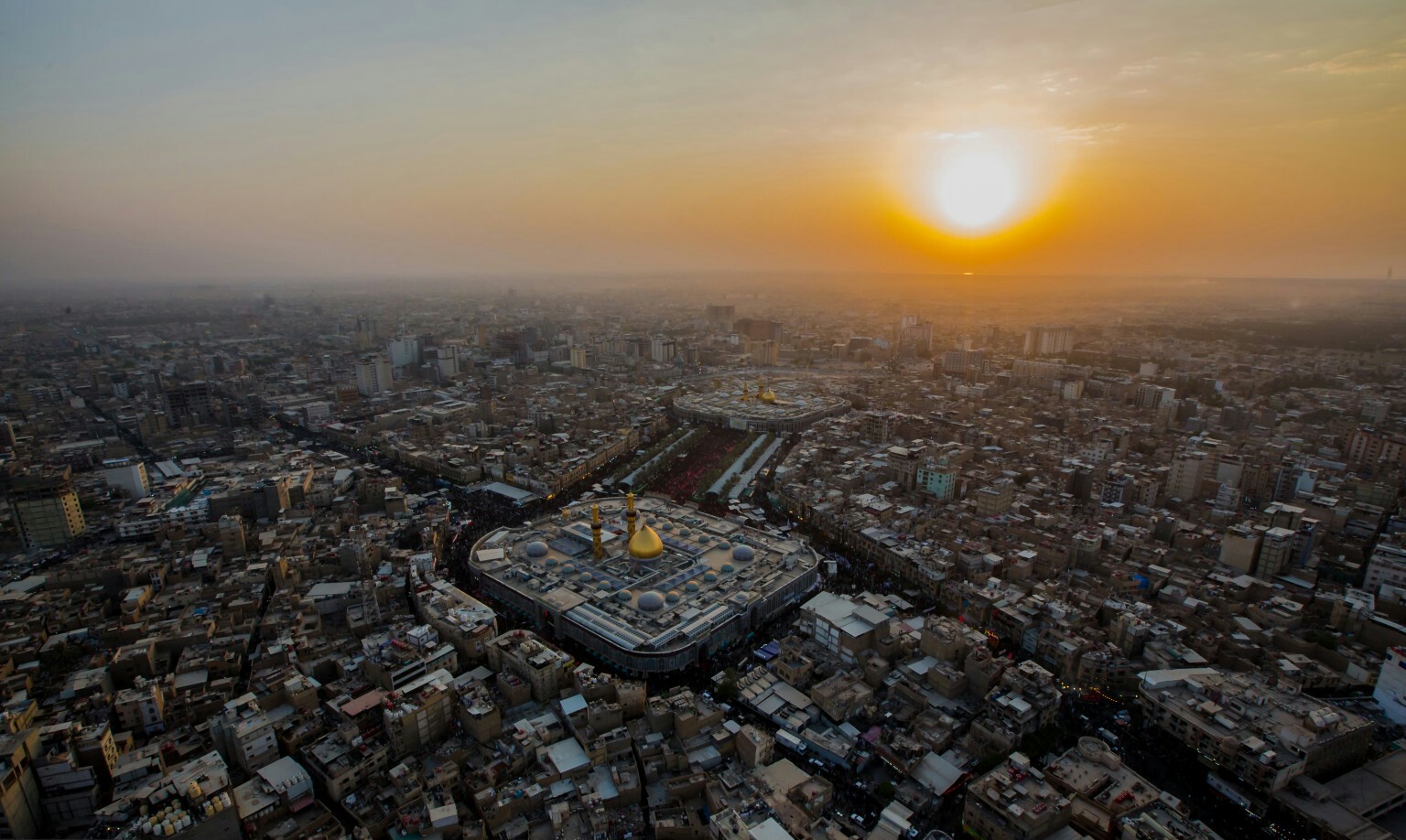
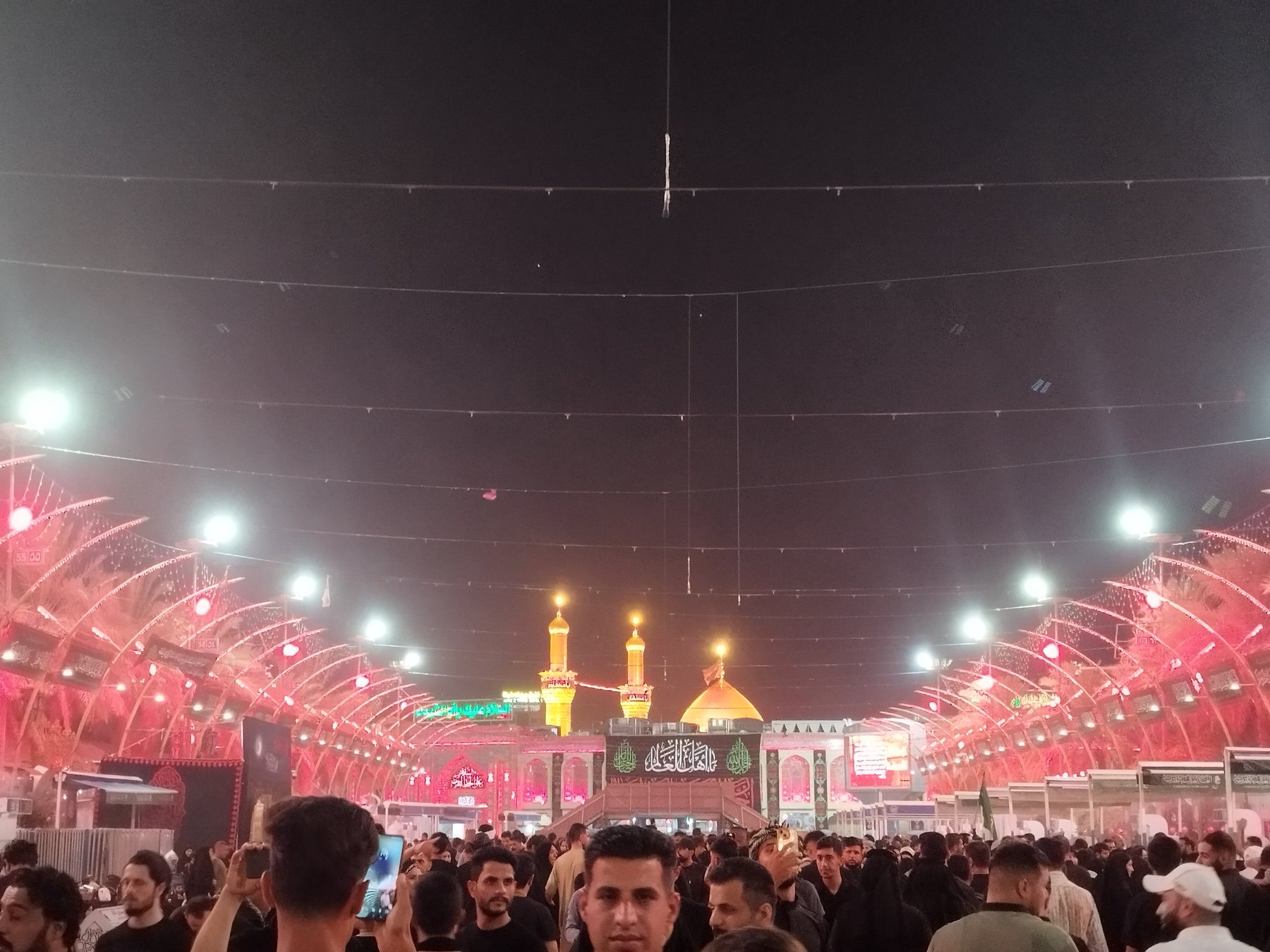
The first time I walked out of Bayn al-Haramayn at night — the 378 metres of open marble between the shrines of Imam Hussain and his brother Abbas in Karbala — an Iraqi man pressed tea into my hand, asked where I was from, and said simply: “You are Hussain’s guest now.” I have been to a lot of famous places. I have never been anywhere that feels like the holy cities of Iraq.
Ziyarat in Iraq means pilgrimage to the shrines of the Imams: Imam Ali in Najaf, Imam Hussain and Abbas in Karbala, the Kadhimiya shrine in Baghdad, and the Al-Askari shrine in Samarra. Visitors come year-round on e-visas or pilgrim group visas, with the Arbaeen walk in Safar drawing over 20 million people — the largest annual gathering on earth.
This guide is written for two readers at once: the pilgrim planning a first ziyarat — wondering about visas, dress, hotels, and how the Najaf–Karbala logistics actually work — and the traveler drawn to one of the most extraordinary expressions of faith anywhere on the planet. I’ve tried to answer the practical questions tour operators gloss over and the religious context most travel blogs skip entirely.
In this guide: At a glance · What ziyarat is · The holy cities · Najaf · Karbala · Kadhimiya · Samarra · The Arbaeen walk · Ziyarat calendar 2026–27 · Visas · Getting there & around · Where to stay · Dress code & etiquette · Itineraries · Costs · Safety · Beyond the big four · FAQ
Ziyarat in Iraq at a glance
| Essential | The short version (June 2026) |
|---|---|
| The four shrine cities | Najaf (Imam Ali), Karbala (Imam Hussain & Abbas), Kadhimiya in Baghdad (Imams al-Kadhim & al-Jawad), Samarra (Imams al-Hadi & al-Askari) |
| Visa | E-visa via evisa.iq (~$160) for ~37 nationalities; pilgrim group visas via licensed operators for others; reduced flat-fee visas during the Arbaeen season — full visa guide here |
| Best airports | Najaf (NJF) for Najaf–Karbala; Baghdad (BGW) if starting with Kadhimiya. Karbala’s own airport is still unfinished |
| Days needed | 4–5 days for Najaf + Karbala; 7–10 days to add Kadhimiya, Samarra and Kufa properly |
| Arbaeen 2026 | Expected August 3–4, 2026 (20 Safar 1448, confirmed by moon sighting). The walk from Najaf takes 2–3 days — start by August 1 |
| Ashura 2026 | Expected June 25–26, 2026, with the most intense commemorations in Karbala |
| Dress | Modest everywhere; abaya plus hijab (or chador) for women inside shrine precincts, no exceptions |
| Money | Cash country — crisp US dollars exchanged to Iraqi dinar; cards rarely work (more in the main Iraq guide) |
| Daily budget | $40–70/day independent; $90–160/day on organized ziyarat packages |
What ziyarat actually is — and why Iraq matters so much
Ziyarat (زيارة) literally means “visit.” In Shia Islam it refers to the devotional visit to the graves of the Prophet’s family — the Ahl al-Bayt — and above all to the Imams, the twelve divinely-guided successors Shia Muslims recognize after the Prophet Muhammad. Unlike the Hajj, ziyarat is not one of the obligatory pillars of Islam. It is mustahab — recommended, beloved, deeply encouraged by the Imams themselves in hadith — which is why scholars describe it as a duty of love rather than law. Nobody is “required” to go. Tens of millions go anyway.
And Iraq is the heart of it. Of the twelve Imams, six are buried on Iraqi soil, in four cities that have grown around their shrines like pearl around grit:
| Imam | Position | Died | Buried in |
|---|---|---|---|
| Ali ibn Abi Talib | 1st Imam | 661 CE | Najaf |
| Hussain ibn Ali | 3rd Imam | 680 CE, Battle of Karbala | Karbala |
| Musa al-Kadhim | 7th Imam | 799 CE | Kadhimiya, Baghdad |
| Muhammad al-Jawad | 9th Imam | 835 CE | Kadhimiya, Baghdad |
| Ali al-Hadi | 10th Imam | 868 CE | Samarra |
| Hasan al-Askari | 11th Imam | 874 CE | Samarra |
Samarra carries one more layer of meaning: Shia Muslims believe the twelfth Imam, Muhammad al-Mahdi, went into occultation there — hidden by God, to return at the end of time. The cellar associated with that event, the Sardab, sits within the Al-Askari shrine complex. So a full Iraq ziyarat circuit touches the resting places of six Imams and the site connected to the awaited seventh.
Two practical notes on language before we go further. First, transliterations vary wildly — Hussain, Husayn, Hussein; Kadhimiya, Kadhimayn, Kazimiyya — and I’ve used the spellings you’ll most often see on signs in Iraq. Second, pilgrims traditionally add honorifics (“peace be upon him”) after the Imams’ names; I’ve kept the text editorial for readability, with no disrespect intended whatsoever.
One thing that surprises many first-time visitors: ziyarat culture is profoundly hospitable to outsiders. Sunni Muslims visit these shrines. So do Christians and the simply curious. The shrine authorities run guest departments precisely because religious tourism in Iraq long predates leisure tourism — and, as I’ll explain in the etiquette section, respectful non-Muslim visitors are welcomed into the shrines themselves, not just the courtyards.
The holy cities of Iraq, compared
Most first ziyarat trips center on Najaf and Karbala — 80 km apart in Iraq’s south — with Kadhimiya and Samarra added by travelers with more time. Here’s how the four shrine cities stack up:
| City | Who is buried here | Time needed | Getting there | What stays with you |
|---|---|---|---|---|
| Najaf | Imam Ali; Prophets Adam and Nuh by tradition | 1–2 days + half-day for Kufa | Fly into NJF airport directly | The golden dome at dusk; Wadi al-Salam stretching to the horizon |
| Karbala | Imam Hussain and his brother Abbas | 2 days minimum | 80 km / 1–1.5 hr from Najaf by road | Standing in Bayn al-Haramayn between the two shrines at night |
| Kadhimiya | Imams Musa al-Kadhim and Muhammad al-Jawad | Half to full day | Northern Baghdad, 20 min from the center in light traffic | Twin golden domes rising out of Baghdad’s densest bazaar streets |
| Samarra | Imams Ali al-Hadi and Hasan al-Askari; site of the 12th Imam’s occultation | Day trip from Baghdad | 125 km north of Baghdad, ~2 hr with checkpoints | The rebuilt golden dome — and the 9th-century spiral minaret next door |
Najaf: the city of Imam Ali
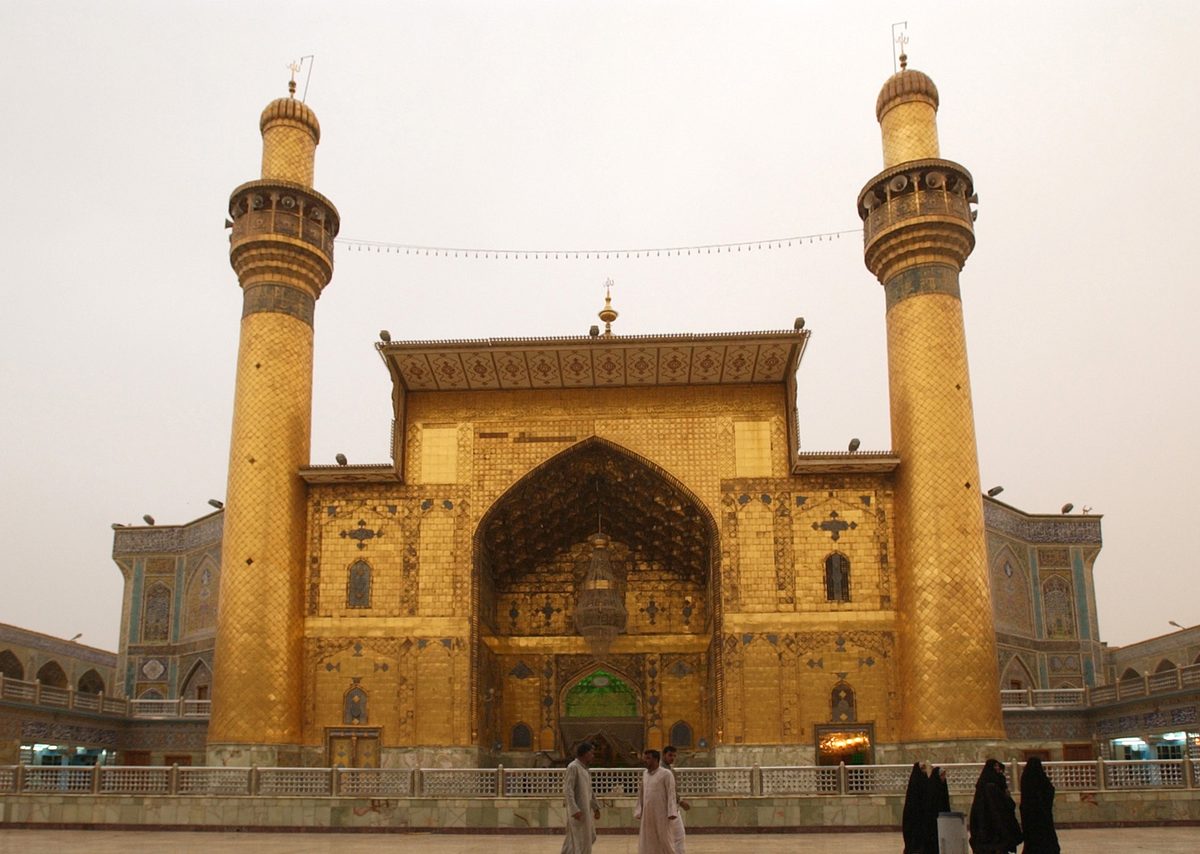
Najaf is where most ziyarat journeys begin, for the simple reason that its airport sits twenty minutes from the shrine and the city is built entirely around the man buried at its center. Imam Ali — cousin and son-in-law of the Prophet, first Imam to Shia Muslims, fourth caliph to Sunnis — was struck down while leading dawn prayers in nearby Kufa in 661 CE and, per Shia tradition, buried secretly at Najaf so his enemies could not desecrate the grave. The location stayed hidden for over a century. Today it is one of the most venerated places in the Islamic world.
The Imam Ali Shrine
The shrine anchors the old city the way a stone anchors ripples. Everything — the bazaar, the seminaries, the hotels — radiates outward from the gold-plated dome and twin minarets. Inside, under chandeliers and a mosaic of mirrored tiles that splinters light into thousands of pieces, the silver zarih (the latticed cage enclosing the grave) is pressed day and night by pilgrims reciting the ziyarat texts, weeping, photographing nothing — cameras stay outside, though phones are tolerated in most areas.
By tradition the Prophets Adam and Nuh (Noah) are buried alongside Imam Ali, which pilgrims will tell you within your first hour in the city. Treat it as the tradition it is; it changes the texture of the place either way. Najaf is also the intellectual capital of Shia Islam — its hawza (seminary) has taught for nearly a thousand years, and the offices of Grand Ayatollah Ali al-Sistani, arguably the most influential living Shia authority, sit in an alley a few minutes’ walk from the shrine. You’ll see clerics everywhere, robes flapping, books under arms. The city reads, debates and prays for a living.
Visit the shrine at least twice: once in daylight to take in the architecture and once after the evening prayer, when the courtyard fills with families, the marble still radiates the day’s heat, and the dome glows like something lit from within.
Wadi al-Salam: the valley of peace
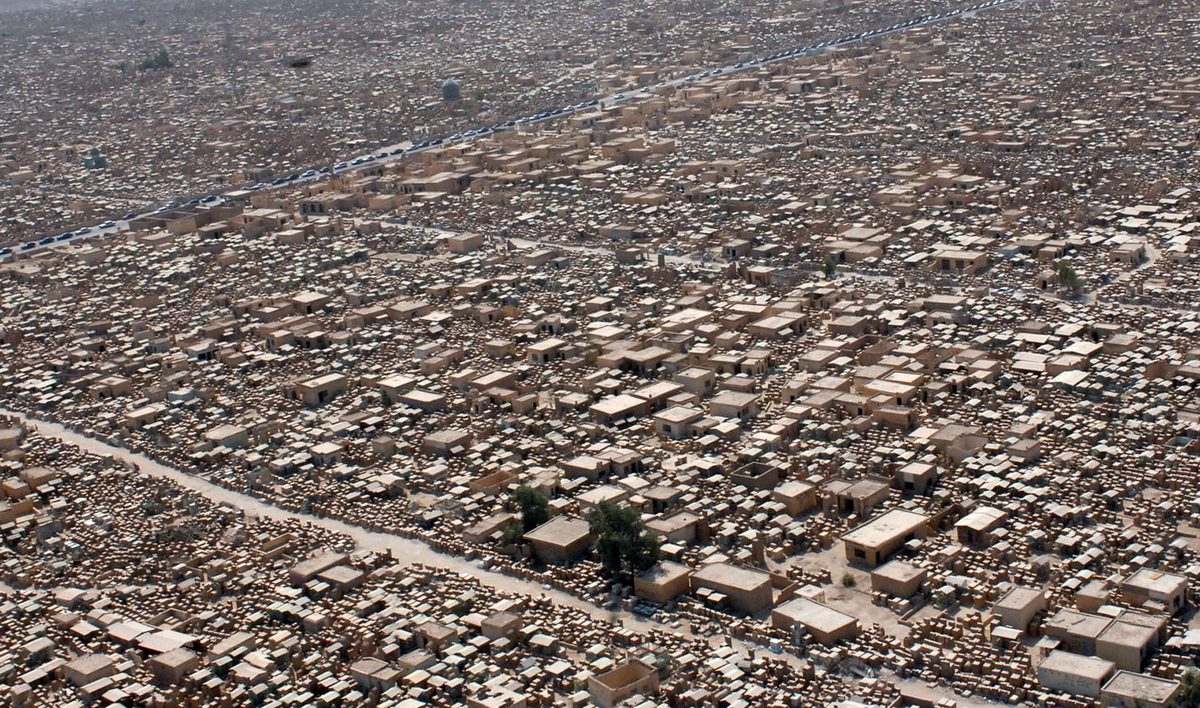
On Najaf’s edge begins the largest cemetery on earth. Wadi al-Salam — the Valley of Peace — covers roughly six square kilometres and holds, by most estimates, more than six million graves, with burials continuing daily as they have for some 1,400 years. Shia families from across the world send their dead here to rest near Imam Ali; the cemetery is on UNESCO’s tentative World Heritage list, and around 50,000 new burials still arrive each year.
Walking its lanes is unlike any cemetery visit you’ve ever made: brick tombs the color of the desert, domed family crypts, ladders descending into underground vaults, professional grave-readers reciting Quran for hire. It is not morbid. It is overwhelming in the way standing before an ocean is overwhelming — a horizon made entirely of human stories. Go in early morning light, dress as you would for the shrine, and hire one of the local guides at the entrance if you want the history; a respectful tip of a few dollars is expected.
Kufa: the half-day you must not skip
Twenty minutes northeast of Najaf lies Kufa, and I’d argue no ziyarat itinerary is complete without it. The Great Mosque of Kufa is one of the earliest mosques in existence — founded with the city itself around 638–639 CE — and it is where Imam Ali was struck by Ibn Muljam’s poisoned sword while at prayer in 661. The spot is marked inside the mosque; pilgrims pause there with an intensity that needs no translation.
Within the same complex are the tombs of Muslim ibn Aqil — Imam Hussain’s cousin and envoy, killed in Kufa shortly before Karbala — and his protector Hani ibn Urwa. Their stories form the prologue to the Karbala tragedy, which makes visiting here before Karbala the right narrative order. Nearby stands the Sahla Mosque, associated in tradition with the Prophet Idris and with the awaited Mahdi, where evening prayers draw large local crowds on Tuesday nights. House of Imam Ali, the modest restored residence where he lived as caliph, sits a few hundred metres from the Kufa mosque and rounds out the circuit.
Karbala: where it all happened
Karbala is not a city with a shrine. It is a wound that grew a city around it. On the 10th of Muharram, 61 AH — October 680 CE — Imam Hussain, grandson of the Prophet, was killed here with his small band of family and companions, surrounded by an army after refusing allegiance to the Umayyad caliph Yazid. The women and children of his camp were taken captive. For Shia Muslims, Karbala is the moral hinge of history: the proof that standing for justice can mean losing everything, and that losing everything can still mean winning forever. “Every day is Ashura,” the saying goes, “and every land is Karbala.”
You feel it the moment you arrive. Karbala has no archaeological grandeur — the city is dense, modern, functional. What it has is gravity. Twenty-plus million people a year do not come here for the architecture.
The Imam Hussain Shrine
The shrine stands over the spot where Hussain fell, his grave beneath a golden dome flanked by gilded minarets, the zarih above it crafted from silver and constantly polished by passing hands. The qatlgah — the place of martyrdom itself — is marked within the complex. Even at 2 a.m. the haram is never empty; there is always someone pressed to the lattice, always a recitation in the air. The shrine’s guest department offers free tours in English most days; ask at the information office near Bab al-Qibla, the main gate.
Below the main hall, often missed by first-timers, lie the graves of all 72 of Hussain’s companions killed in the battle, buried together in a single tomb near the foot of his grave. Habib ibn Mazahir, his elderly friend and companion, has his own zarih in the corner of the sanctuary.

The Al-Abbas Shrine and Bayn al-Haramayn
Four hundred metres away — 378, to be precise, across the open esplanade called Bayn al-Haramayn, “between the two sanctuaries” — stands the shrine of Abbas ibn Ali, Hussain’s half-brother and standard-bearer. Abbas died trying to bring water back from the Euphrates for the camp’s children, his arms cut from him as he fought; he is, for pilgrims, the embodiment of loyalty, and many Iraqis will tell you — quietly, since rankings feel impolite — that they fear Abbas’s intercession most of all. Water dispensers throughout both shrines exist partly in his memory; watch how many pilgrims murmur his name before they drink.
Bayn al-Haramayn itself is where the Battle of Karbala is believed to have largely taken place. Today it’s white marble underfoot, mist fans in summer, and at night one of the most affecting public spaces I know — families picnicking, processions chanting latmiyat (mourning hymns), volunteers pushing carts of free tea. Sit on the marble for an hour after evening prayers and you will understand ziyarat better than any book can teach you.
Day trips: Babylon and the old Euphrates towns
Ancient Babylon — yes, that Babylon — lies just 40 minutes northeast of Karbala near Hillah, which makes a half-day archaeology break entirely doable between shrine visits. The Lion of Babylon, the Ishtar Gate reconstruction and Saddam’s gaudy palace overlooking the ruins are all covered in my guide to the best places to visit in Iraq. En route between Najaf and Karbala you can also stop at Al-Kifl, the shrine of the Prophet Dhul-Kifl (identified with Ezekiel), a remarkable site shared by Jewish and Islamic history with its Hebrew inscriptions intact.
Kadhimiya: Baghdad’s golden shrine quarter
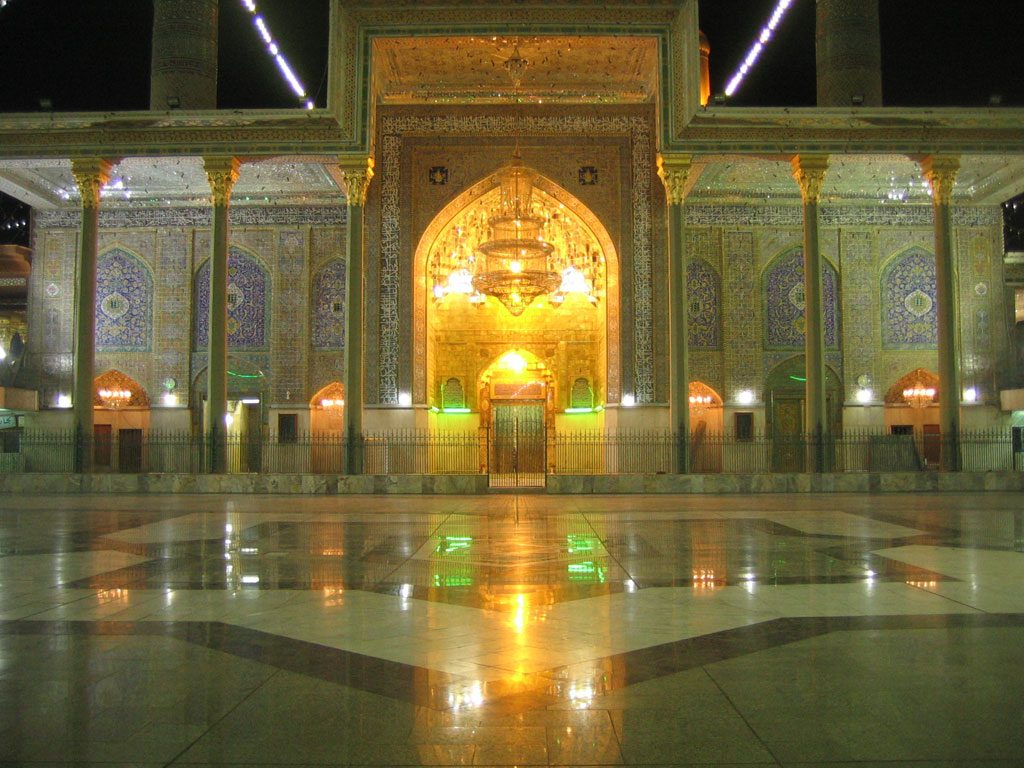
Kadhimiya is technically a Baghdad neighborhood, but spiritually it’s the third holy city — grown around the tombs of Musa al-Kadhim, the seventh Imam, who died in 799 in the prisons of Harun al-Rashid, and his grandson Muhammad al-Jawad, the ninth Imam, who died in 835. The shrine that covers them both is, for my money, the most beautiful in Iraq: two golden domes instead of one, four gilded minarets, and a tilework facade of blues and golds that catches fire in late-afternoon light. The current structure owes its splendor to Safavid restoration in the early 1500s, and two towering figures of Shia scholarship — Shaykh al-Mufid and Nasir al-Din al-Tusi — are buried within the complex.
The neighborhood around it is one of Baghdad’s oldest and liveliest: gold souks (Kadhimiya is where Baghdadis buy wedding jewelry), date sellers, perfume stalls trading in oud and rosewater. Security is tighter here than in Najaf or Karbala — expect vehicle barriers well before the shrine, a walk through pedestrian-only streets, body searches at the gates, and phone-camera sensitivity that varies with the guard. Build in time, carry your passport, and treat the checks with patience; this shrine was a repeated bombing target during the 2000s, and the procedures are why it no longer is.
Across the Tigris, fifteen minutes away in Adhamiyah, stands the Abu Hanifa Mosque, the resting place of the founder of the Hanafi school of Sunni law. Pilgrims with broad shoulders about the sectarian past visit both in an afternoon — and the symbolism of doing so is not lost on Baghdadis on either bank of the river.
Samarra: the golden dome and the spiral minaret
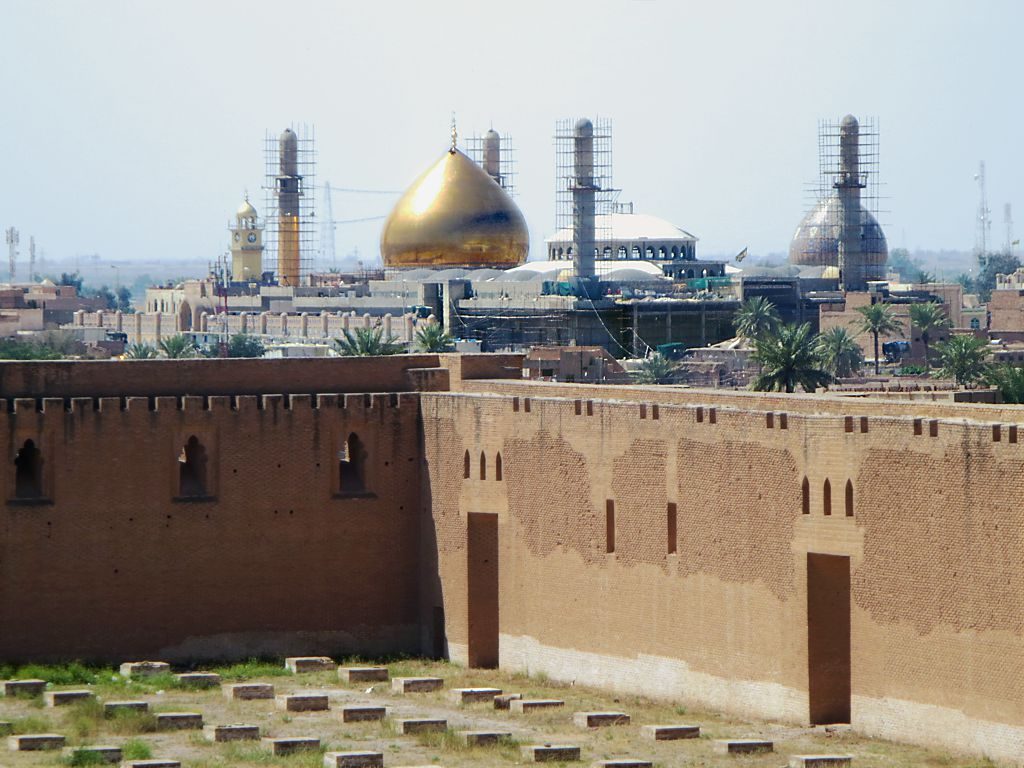
Samarra, 125 km north of Baghdad, asks more effort than the other shrine cities and repays every kilometre. The Al-Askari Shrine holds the tombs of the tenth and eleventh Imams — Ali al-Hadi (d. 868) and his son Hasan al-Askari (d. 874) — and adjoins the Sardab, the cellar associated with the occultation of the twelfth Imam, the Mahdi, whom Shia Muslims await as the restorer of justice. For pilgrims this gives Samarra a unique emotional register: grief downstairs, expectation upstairs.
The shrine’s recent history is brutal and important to know. In February 2006, al-Qaeda bombers destroyed its golden dome; in June 2007 they returned and toppled the two minarets. The attacks tipped Iraq into its darkest years of sectarian war. The dome and minarets were rebuilt and re-gilded by 2009, and their restored shine is itself a kind of statement — Samarra’s Sunni townspeople guard a Shia shrine that the whole country paid in blood to rebuild. Security remains the strictest of any Iraqi shrine: expect to deposit bags and sometimes phones, pass multiple checks, and see a heavy escort presence between the highway and the shrine.
Five minutes away spirals the Malwiya — the 52-metre corkscrew minaret of the 9th-century Great Mosque of Samarra, once the largest mosque on earth, built when Samarra was the Abbasid capital. It’s a UNESCO World Heritage site and the most photographed silhouette in Iraq. Climbing the outer ramp is sometimes permitted, sometimes not, depending on the security mood; even from the ground, the pairing of Abbasid brick and golden dome makes Samarra the most visually arresting day trip in the country. Go with a driver who knows the checkpoints, carry your passport, and start early — the route from Baghdad runs through agricultural towns where traffic and checks can stretch the 2-hour drive toward three.
The Arbaeen walk: the largest gathering on earth
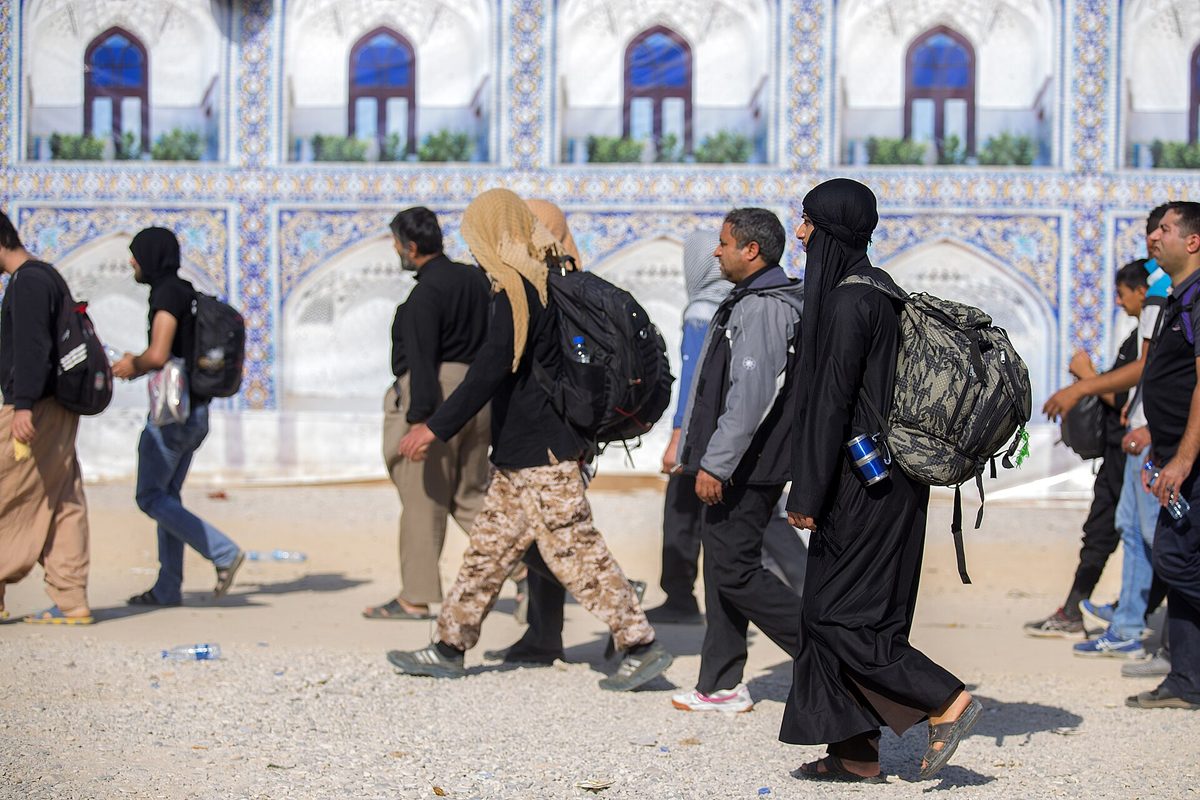
Forty days after Ashura, on the 20th of Safar, Shia Muslims mark Arbaeen — the end of the traditional mourning period for Imam Hussain. And in the most extraordinary logistical-spiritual event I have ever witnessed, twenty-plus million people converge on Karbala for it, most of them walking the 80 kilometres from Najaf over two to three days. The 2025 walk drew between 21.1 and 22.4 million pilgrims depending on which shrine authority’s electronic count you cite. For scale: that is several times the size of Hajj, repeated every single year, organized substantially by volunteers.
Arbaeen 2026 is expected to fall on August 3–4 (confirmed by moon sighting closer to the date). Walkers should plan to leave Najaf around July 31–August 1 to arrive by the eve of Arbaeen.
How the walk actually works
The classic route follows the Najaf–Karbala highway, and the entire way is marked by numbered poles — 1,452 of them, spaced 50 metres apart — so pilgrims can pace themselves and arrange meeting points (“see you at pole 900”). Most walkers exit the Imam Ali Shrine after dawn prayers, cover 25–30 km a day, and reach the Al-Abbas Shrine — pole 1452 — on the second or third evening.
What makes the walk possible — what makes it the event it is — are the mawakib (singular: mawkib), the volunteer service tents that line every metre of the route. Iraqi families save all year to feed strangers for these two weeks. Walk ten minutes and you’ll be offered rice and qeema stew, tea, fresh bread, foot massages, phone charging, a mattress for the night, all free, all pressed on you with an insistence that brings many first-timers to tears. Money is nearly useless on the route; the only real currency is “thank you,” and even that is waved away — pilgrims are considered guests of Hussain.
A few practical realities, learned the sweaty way:
- Heat. Arbaeen 2026 lands in early August, when southern Iraq runs 43–48°C by afternoon. Walk dawn-to-midmorning and late afternoon-to-night; rest through the middle of the day in a mawkib (everyone does). Salt tablets or electrolyte sachets are not optional.
- Feet. Broken-in walking shoes plus sandals, moleskin blister patches, and change your socks twice a day. The medical mawakib treat thousands of blistered feet daily and will look after you free of charge.
- Navigation and losing people. Mobile networks choke under 20 million users — SMS often gets through when calls and WhatsApp fail. Agree on pole-number meeting points in advance. Lost-person reporting centers operate roughly every 3 km along the route.
- Women on the walk. Vast numbers of women walk, including alone and with children; the route has women-only rest areas and the crowd watches out for its own. Standard shrine dress applies the entire way.
- It is not only for Shia Muslims. Sunni pilgrims, Christians, Yazidis and curious foreigners walk every year and are received with genuine warmth. If you come as a non-Muslim, come as you would to any sacred thing: openly, respectfully, and prepared to be fed against your will.
Muharram, Ashura and the ziyarat calendar
Ziyarat happens year-round, but the religious calendar changes the experience completely — and since Islamic months track the moon, the Gregorian dates shift about 11 days earlier each year. The dates that matter most:
| Occasion | Islamic date | Expected in 2026 | What it means on the ground |
|---|---|---|---|
| Start of Muharram | 1 Muharram 1448 | ~June 16–17, 2026 | Mourning season begins; black banners go up nationwide; Karbala fills |
| Ashura | 10 Muharram 1448 | ~June 25–26, 2026 | Commemoration of Imam Hussain’s martyrdom; Karbala at maximum intensity; processions everywhere in Iraq |
| Arbaeen | 20 Safar 1448 | ~August 3–4, 2026 | The great walk; 20M+ pilgrims; transport and hotels in the holy cities effectively saturated |
| Arbaeen 2027 (for planners) | 20 Safar 1449 | ~July 24, 2027 | Shifts ~11 days earlier; same saturation rules apply |
If you want ziyarat at its most overwhelming, come for Ashura or Arbaeen and accept the crowds as part of the devotion. If you want contemplative time at the zarih, unhurried shrine photography from the courtyards, and hotel rooms at half price, come in the quieter months — October through April is the sweet spot for weather, and the shrines between religious occasions are spacious, calm and just as moving. My honest advice for a first ziyarat: do the quiet version first, then return for Arbaeen knowing what you’re walking toward.
Visas for ziyarat: the three lanes
I keep this section deliberately current — it was re-checked June 6, 2026 — but visa rules in Iraq move fast; treat this as the map, and confirm the territory with the full Iraq visa guide, which I update first whenever rules shift.
There are effectively three lanes into Federal Iraq for ziyarat:
Lane 1: the e-visa (most Western, Gulf and East Asian passports). Iraq abolished its $77 visa-on-arrival on March 1, 2025. Citizens of roughly 37 countries — the US, UK, EU states, Canada, Australia, Japan, most of the Gulf among them — now apply at evisa.iq before flying: passport scan, photo, first hotel’s name, around $160 by card, officially 6–72 hours’ processing but realistically allow two weeks in mid-2026. The visa is single entry and works at Baghdad, Basra and Najaf airports and major land borders. Print the approval on paper; airlines and immigration both ask.
Lane 2: the pilgrim group visa (Indian, Pakistani, Bangladeshi and most African passports). Nationalities outside the e-visa list travel for ziyarat through licensed pilgrimage operators, who arrange group visas tied to a registered itinerary — the system that moves hundreds of thousands of South Asian pilgrims annually, especially around Arbaeen. Costs and processing vary by country and season (typically a few hundred dollars and several weeks; operators commonly advise applying 20+ working days out). The group’s agency representative — the mandoob — handles arrival formalities. If an agent promises you a no-group “ziyarat visa” outside this system, walk away.
Lane 3: the Arbaeen-season facilitation. For the Arbaeen seasons of recent years, Iraq’s Interior Ministry has announced reduced flat-fee visit visas (in 2025: the legal fee reduced to $55 plus a $5 electronic service fee, valid from 1 Muharram through Arbaeen) and outright visa-free entry for Iranian pilgrims, who form the largest foreign contingent. Each year’s measures are announced weeks before Muharram — watch for the 2026 announcement around mid-June 2026, and assume airports and land borders will be saturated either way.
| Question | Answer (June 2026) |
|---|---|
| Visa on arrival in Baghdad or Najaf? | No — abolished March 1, 2025. E-visa or group visa only (see entry requirements) |
| E-visa cost and time | ~$160; officially 6–72 hr, allow 2 weeks |
| Indian/Pakistani pilgrims | Licensed group operators only; no independent e-visa lane at present |
| Arbaeen season | Reduced flat-fee visas announced annually; Iranians visa-free (2025 precedent) |
| Kurdistan visa for the holy cities? | No — it’s a separate system and does not permit travel to Federal Iraq |
Getting there and around
Which airport: Najaf or Baghdad?
For a shrine-focused trip, fly into Najaf (NJF) if you possibly can. The airport is 20–30 minutes from the Imam Ali Shrine, an hour and a bit from Karbala, and is served by around ten airlines from the pilgrimage-traffic hubs: flydubai from Dubai, Jazeera from Kuwait, Gulf Air from Bahrain, Qatar Airways from Doha, Royal Jordanian from Amman, Turkish from Istanbul, plus heavy Iranian traffic from Tehran, Mashhad and Isfahan. Fares run higher than to Baghdad for the convenience; around Arbaeen they spike outrageously and sell out months ahead.
Baghdad (BGW) makes sense if your itinerary starts with Kadhimiya and Samarra before heading south, or if the fare difference is large. The drive Baghdad–Karbala runs about two to two and a half hours with checkpoints. My main Iraq travel guide covers the Baghdad arrival process — the e-visa desk choreography, taxi negotiation, SIM cards — in detail.
Karbala’s own airport is not open. The under-construction Imam Hussein International Airport northeast of the city has been “opening next year” since 2024; as of June 2026 it handles no scheduled flights. Any booking site or operator claiming to fly you “to Karbala” means Najaf or Baghdad plus a road transfer.
Between the holy cities
| Route | Distance / time | How | Cost (early-2026 reports) |
|---|---|---|---|
| Najaf airport → Najaf shrine | ~10 km / 20–30 min | Airport taxi (fixed-ish rates; agree first) | ~15,000–25,000 IQD |
| Najaf ↔ Karbala | 80 km / 1–1.5 hr | Shared “coaster” minibus from the garage (bus station), or private taxi | ~2,500–3,000 IQD shared; ~25,000–35,000 IQD private |
| Baghdad (Alawi garage) ↔ Karbala | 110 km / ~2.5 hr | Shared coaster or taxi | ~3,500–5,000 IQD shared |
| Baghdad ↔ Samarra | 125 km / 2–3 hr | Private driver strongly recommended (checkpoints) | ~$60–90 for the round-trip day |
| Najaf ↔ Kufa | 10 km / 15–20 min | Taxi or local minibus | ~5,000 IQD taxi |
Two ground-transport notes. First, around Ashura and Arbaeen the Najaf–Karbala road closes to normal traffic in stages as millions walk it — buses reroute, journey times triple, and during the final days you may simply have to walk like everyone else (this is, frankly, the point). Second, women traveling without male companions are routinely waved to the front seats of shared taxis and treated protectively; solo female pilgrims I’ve met report the holy-cities corridor as the easiest part of Iraq to travel.
Where to stay in Karbala and Najaf
Both cities are hotel cities the way Mecca is a hotel city: hundreds of properties, almost all within walking distance of the shrines, almost none on international booking platforms. Booking.com lists a thin slice; the rest work by phone, WhatsApp, or simply walking in — which, outside the religious peaks, works fine and gets you better rates than any website.
- Karbala: the closer to Bayn al-Haramayn, the higher the price and the older the building. Recent traveler reports put clean mid-range doubles near the shrines around 50,000–80,000 IQD (~$38–60); simpler pilgrim hotels run 25,000–40,000 IQD. The Baron and a clutch of newer hotels on the ring road offer business-level comfort for $80–120.
- Najaf: similar structure around the Imam Ali Shrine; reported mid-range doubles ~$50–70 (Nobles Palace types), budget pilgrim houses from ~20,000 IQD per person. Najaf’s hotel stock skews newer thanks to the airport.
- Arbaeen exception: in the two weeks around Arbaeen, prices triple-to-quintuple, minimum stays appear, and most rooms are block-booked by operators a season ahead. Either book through a package, accept a mawkib floor mattress like millions do (free, and unforgettable), or visit another time.
Hotels in both cities will store luggage, arrange shrine-area taxis at honest rates, and wake you for dawn prayers without being asked. Pay cash in dinars; for how to handle money in a country where cards barely work, see the money section of the Iraq travel guide.
Dress code and shrine etiquette
The shrines are working sanctuaries, not museums, and the rules are enforced with courtesy but zero flexibility:
| Rule | The reality at the gate |
|---|---|
| Women’s dress | Abaya (full-length loose black overgarment) plus hijab covering all hair — or a chador — required inside shrine precincts in Najaf, Karbala, Kadhimiya and Samarra. Attendants at the women’s security tents will check; an under-cap keeps stray hair honest. Abayas are sold everywhere near the shrines for $10–20 if you arrive without |
| Men’s dress | Long trousers and sleeves; no shorts, no logos likely to offend. Locals wear dishdasha or shirt-and-trousers |
| Shoes | Off before carpeted areas; free supervised shoe storage at every gate — keep your token, note your gate name |
| Cameras | Dedicated cameras banned inside; phones generally tolerated in courtyards, discouraged-to-banned at the zarih, fully deposited at Samarra. When a green-feather attendant signals, comply immediately |
| Entrances | Separate gates for men and women, with airport-style searches at each. Carry your passport always |
| At the zarih | Move with the flow, don’t plant yourself; the crowd has its own current. Fridays and evenings are the crush; early mornings are calm |
| General conduct | No loud talk, no eating in prayer halls, ask before photographing people — and around mourning processions, photograph the scene, not grieving faces in close-up |
For women, specifically
Iraq imposes no mahram (male guardian) requirement on visiting women — solo female pilgrims and travelers enter on the same visas as anyone else, and inside the shrines the women’s sections are run entirely by women. The abaya rule applies only within shrine precincts and the immediate old-city zones around them; elsewhere in these cities, loose clothing and a headscarf are the workable standard. Several solo women I’ve compared notes with describe Najaf and Karbala as the places they felt most looked-after in the Middle East — invited to family iftars, guarded in queues, handed children to hold. Some national pilgrim-quota systems (notably group arrangements from South Asia) impose their own composition rules on tour groups; that’s the operator’s constraint, not Iraqi law.
For non-Muslim visitors
Yes, you can enter — courtyards and, in Najaf, Karbala and Kadhimiya, the shrine halls themselves — provided you dress and behave like everyone else. Nobody will ask your religion at the gate. Say you’re a visitor honoring Imam Hussain if asked warmly, which you will be, usually alongside an invitation to tea. The guest departments of both Karbala shrines actively welcome non-Muslim visitors with English-speaking guides. The one hard line: during Ashura’s peak rituals, be a quiet guest at the edge of the grief, not a lens in the middle of it.
How many days do you need? Two itineraries that work
The essential ziyarat — 5 days:
| Day | Plan |
|---|---|
| 1 | Arrive Najaf (NJF), evening ziyarat at the Imam Ali Shrine when the courtyard cools and glows |
| 2 | Dawn at Wadi al-Salam, then Kufa: the Great Mosque, Muslim ibn Aqil, Sahla Mosque by evening |
| 3 | Morning ziyarat Najaf, coaster to Karbala, first night ziyarat in Bayn al-Haramayn |
| 4 | Imam Hussain Shrine in depth (guest-department tour), Al-Abbas in the evening |
| 5 | Sunrise in Bayn al-Haramayn, depart via Najaf or onward to Baghdad |
The full circuit — 9 days: days 1–5 as above, then day 6 Karbala → Baghdad with a Babylon stop en route, day 7 Kadhimiya shrine and the gold souk plus Abu Hanifa across the river, day 8 Samarra day trip (Al-Askari, the Sardab, the Malwiya), day 9 depart Baghdad. Add a tenth day if you want Karbala a second time on the way out — most people do.
What ziyarat in Iraq actually costs
| Item | Independent (per person) | Organized package |
|---|---|---|
| Visa | ~$160 e-visa (or ~$60 Arbaeen-season rate) | Usually bundled |
| Hotels | $15–30/night pilgrim class; $40–70 mid-range | Included, twin-share |
| Food | $8–15/day eating brilliantly (kebab, qeema, masgouf splurge) | Included |
| Intercity transport | $2–4 per shared leg; Samarra day ~$70 | Included |
| 5-day total (ex-flights) | ~$300–450 | ~$600–900 |
| 9-day total (ex-flights) | ~$550–800 | ~$1,100–1,800 |
Packages from South Asia (where the group-visa system makes them near-mandatory) run roughly $1,400–1,800 for 14 days including flights. Within Iraq, the main thing money buys is proximity to the shrines and a guide who knows the gate procedures; the spiritual product, as one hotelier in Karbala put it to me, is free.
Is ziyarat in Iraq safe right now?
The honest, two-sided answer — current as of June 6, 2026. Western government advisories remain maximally cautious: the US State Department holds Iraq at Level 4 “Do Not Travel” and in March 2026 ordered non-emergency embassy staff to leave; the UK FCDO currently advises against all travel to Iraq amid regional tensions. Insurance and consular support are genuinely limited, and you should read those advisories yourself before booking anything.
On the ground, the picture pilgrims actually experience is different: the Najaf–Karbala corridor is the most policed, most practiced piece of tourism infrastructure in Iraq, moving twenty million visitors a year through layered checkpoints, and the shrine cities have been stable for years. Religious tourism in Iraq never stopped, even in the worst years — the systems protecting it are correspondingly serious. My detailed, regularly-updated breakdown of incidents, regions and real-world risk is in Is Iraq safe to visit? — read it alongside this guide rather than taking either headline or hype at face value.
The risks that statistically matter for pilgrims are unglamorous: August heat (treat 45°C as the hazard it is), road traffic (use reputable drivers; the intercity highways are the most dangerous part of any Iraq trip), and crowd crush at peak rituals. That last one deserves dates and respect: the 2019 Ashura stampede in Karbala killed 31 people during the Tweireej run. In serious crowds, stay to the edges, agree on meeting points, keep children on shoulders, and skip the densest surges — the Imams, locals will tell you, do not require you to be trampled.
Beyond the big four: other ziyarat sites worth knowing
Iraq’s sacred geography goes far deeper than the four shrine cities, and a few additions repay the detour. Al-Kifl, between Najaf and Hillah, holds the tomb of the Prophet Dhul-Kifl — identified with the biblical Ezekiel — where Hebrew inscriptions and Islamic tilework share one sanctuary, a remnant of Iraq’s ancient Jewish communities. Balad, north of Baghdad, has the shrine of Sayyid Muhammad, son of the tenth Imam, beloved for vow-making. Al-Mada’in, southeast of Baghdad beside the great Arch of Ctesiphon, holds Salman al-Farsi, the Persian companion of the Prophet. In Kufa, the tombs of Maytham al-Tammar and al-Mukhtar reward anyone gripped by the post-Karbala story, and Basra’s old Zubair district holds sites tied to the earliest decades of Islam. For the non-ziyarat wonders — Babylon, Ur, the marshes — start with my guide to the best places to visit in Iraq.
Ziyarat in Iraq: your questions, answered
What is ziyarat in Islam?
Ziyarat is the devotional visit to the graves of the Prophet’s family and the Imams — in Iraq, above all the shrines of Imam Ali in Najaf and Imam Hussain in Karbala. It is an act of love, remembrance and renewal of allegiance to the Imams’ principles, accompanied by recited visitation texts.
Is ziyarat obligatory (farz) or recommended?
Recommended — mustahab — not obligatory like Hajj. Hadith from the Imams strongly encourage it, and many devout families try to go regularly, but there is no fixed religious requirement of frequency. The walk at Arbaeen is likewise devotional, not compulsory.
Can tourists and non-Muslims visit Karbala and Najaf?
Yes. Non-Muslims may enter the shrine complexes in Najaf, Karbala and Kadhimiya — dress code observed, conduct respectful — and the shrines’ guest departments offer free English tours. Samarra admits visitors under tighter security. During Ashura and Arbaeen, come as a quiet guest, not a spectacle-hunter.
How many days do you need for ziyarat in Iraq?
Five days covers Najaf, Kufa and Karbala without rushing. Nine to ten days adds Kadhimiya, Samarra and a Babylon stop. Pilgrims on classic South Asian packages typically spend 10–14 days covering the same circuit at gentler pace.
How do I get an Iraq visa for ziyarat?
Roughly 37 nationalities apply online at evisa.iq (~$160, single entry). Indian, Pakistani, Bangladeshi and most African passports go through licensed pilgrim-group operators instead. Around Arbaeen, Iraq announces reduced flat-fee visas. Full current detail: the Iraq visa guide.
When is Arbaeen in 2026?
Expected August 3–4, 2026 (20 Safar 1448), finalized by moon sighting. Walkers should be in Najaf by August 1. Expect peak crowds, peak heat — and, if recent years hold, more than 20 million fellow pilgrims.
How far is the walk from Najaf to Karbala?
About 80 km along the marked pilgrim route, lined with 1,452 numbered poles 50 metres apart. Most walkers take two to three days, sleeping and eating free in the volunteer mawakib that line the entire road.
Which airport is best for Karbala?
Najaf (NJF) — just over an hour from Karbala by road, with direct flights from Dubai, Doha, Kuwait, Bahrain, Amman, Istanbul and Iranian cities. Karbala’s own airport remains unopened as of June 2026; Baghdad works if you’re starting north.
What should women wear in the holy cities?
Inside shrine precincts: abaya plus hijab with no hair showing (a chador also works), checked at women’s security gates. Around town, loose clothing and a headscarf suffice. Abayas cost $10–20 in the shrine-side markets if you need one on arrival.
Do women need a mahram for ziyarat in Iraq?
No — Iraqi visa rules impose no mahram requirement, and women travel and enter the shrines independently. Some countries’ group-package systems impose their own rules on group composition, which is an operator matter rather than Iraqi law.
Is it safe to go right now?
Western advisories say avoid Iraq (US Level 4; FCDO against all travel, June 2026), and you should weigh that seriously. On the ground, the shrine-city corridor is Iraq’s most secured space and hosts tens of millions of visitors annually without incident. Read the full, dated analysis in Is Iraq safe?
What does a ziyarat trip cost?
Independent travelers manage the five-day Najaf–Karbala core on $300–450 plus flights, staying in pilgrim hotels and eating local. Organized packages run $600–900 for five days within Iraq, or $1,400–1,800 for the classic 14-day package with flights from South Asia.
Final thoughts: why this pilgrimage stays with people
I have watched sunrise from the courtyard of Imam Ali and midnight in Bayn al-Haramayn, eaten rice pressed on me by a family who saved all year to give it away, and stood in the largest crowd on earth and felt safer than on my own high street. Whatever you carry into Iraq’s holy cities — faith, curiosity, grief, doubt — the cities take it seriously. That is their genius. Hussain’s question, locals will tell you, is addressed to everyone: what do you stand for, and what would you give up for it?
Come with patience for checkpoints, shoes you can surrender at gates, and a heart you don’t mind having rearranged. Start with the visa, check the honest safety picture, build the rest of your trip with the complete Iraq travel guide — and if the Arbaeen walk calls you, answer it once in your life.
Photo credits
- Pilgrims at the golden-domed Imam Ali Shrine in Najaf, the starting point of ziyarat in Iraq — U.S. Navy / Arlo K. Abrahamson (Public domain) via Wikimedia Commons
- Aerial view of Wadi al-Salam in Najaf, the largest cemetery in the world — Sgt. Johnnie French / U.S. Army (Public domain) via Wikimedia Commons
- Pilgrims inside the courtyard of the Imam Hussain Shrine in Karbala, Iraq — Md iet / CC BY-SA 4.0 via Wikimedia Commons
- Arbaeen pilgrims with backpacks walking past shrine tilework on the route to Karbala — Mostafa Meraji / CC BY-SA 4.0 via Wikimedia Commons
- The tiled courtyard and golden portal of the Kadhimiya shrine in Baghdad at night — Jafaralshamma / CC BY-SA 3.0 via Wikimedia Commons
- The rebuilt golden dome of the Al-Askari Shrine rising over Samarra — David Stanley / CC BY 2.0 via Wikimedia Commons
All images are used under their respective free licenses; click through for full source details. None of the photographers endorse this site.