Iraqi food is one of the world’s oldest and most underrated cuisines: slow-cooked, deeply aromatic, and built around lamb, rice, fresh-baked bread and dates. Picture smoky grilled masgouf fish split open over a wood fire, vine leaves and vegetables stuffed and stewed in pomegranate, and trays of syrup-soaked sweets. It’s rich and comforting rather than fiery — and it carries 5,000 years of Mesopotamian, Persian and Ottoman history on the plate.
I’ll be honest: of everywhere I’ve eaten across the Middle East, Iraq is the country whose food surprised me most, because almost nobody talks about it. You arrive braced for kebabs and leave dreaming about a fish you watched cook for two hours on the bank of the Tigris, a clotted cream so rich it shouldn’t be legal, and tea so constant it functions less like a drink than a national handshake.
This is the food hub of our complete Iraq travel guide, and I’ve written it the way you’ll actually eat your way through the country: the 25 dishes worth crossing a checkpoint for, what each one really is, and — the part every other list skips — exactly where to find it, from Baghdad’s riverbanks to a Najaf alley to a Kurdish breakfast table. Prices are in Iraqi dinars with rough dollar equivalents at the mid-2026 street rate of about 1,500 IQD to the dollar; treat them as “about right,” not gospel.
Iraqi food at a glance: 25 dishes to try
Here’s the fast version — the 25 dishes and drinks I’d put on any first-timer’s list, what they are, and where each one is at its best. The deep dives, with where-to-eat detail, follow below.
| # | Dish | What it is | Where it shines |
|---|---|---|---|
| 1 | Masgouf | Butterflied river carp grilled upright by a wood fire — the national dish | Baghdad (Abu Nuwas St), the southern marshes |
| 2 | Quzi | Slow-roasted lamb over spiced rice with nuts and raisins | Everywhere; the feast/wedding centerpiece |
| 3 | Dolma | Vine leaves and vegetables stuffed with rice and meat, cooked in pomegranate | Home tables; Kurdistan does a famous version |
| 4 | Kubba Mosul | A giant disc of bulgur shell stuffed with spiced meat, fried and sliced | Mosul and the north |
| 5 | Kubba Hamuth | Tangy soup with rice-shell dumplings | Baghdad home cooking |
| 6 | Tepsi Baytinijan | Baked tray of eggplant, meatballs, tomato and potato | Baghdad and central Iraq |
| 7 | Maqluba | “Upside-down” pot of rice, meat and fried vegetables, flipped to serve | Family lunches countrywide |
| 8 | Biryani (Iraqi) | Amber rice with peas, nuts, raisins and fried vermicelli | Celebrations; restaurants everywhere |
| 9 | Margat Bamia | Okra and lamb stew in tangy tomato, eaten over rice | Everyday lunch across Iraq |
| 10 | Qeema | Minced-meat and chickpea stew, famous as Ashura charity food | Karbala and Najaf, especially Muharram |
| 11 | Fasolia | White bean and lamb stew over rice | Comfort food countrywide; “fasûlî” in Kurdistan |
| 12 | Tashreeb | Torn bread soaked in rich meat or bean broth | South and center; a laborer’s classic |
| 13 | Timman & hikakeh | Iraqi amber rice — and the prized crispy crust from the bottom of the pot | Every meal; the crust is fought over |
| 14 | Mujaddara | Lentils, rice and caramelized onions — the great vegetarian staple | Countrywide; cheap and everywhere |
| 15 | Kebab & tikka | Grilled minced-meat skewers (kebab) and marinated chunks (tikka) | Every city; Erbil’s grill street is a rite |
| 16 | Falafel with amba | Chickpea fritters in samoon bread, dressed with tangy mango sauce | Street corners everywhere, especially Baghdad |
| 17 | Sabich (sabach) | Sandwich of fried eggplant, egg, salad and amba — Iraqi-Jewish roots | Baghdad street stalls |
| 18 | Kahi & geymar | Flaky breakfast pastry with buffalo clotted cream and date syrup | Baghdad and the south, at dawn |
| 19 | Makhlama | Skillet of eggs, minced lamb and tomato — a power breakfast | Breakfast joints countrywide |
| 20 | Pacha | Slow-boiled sheep’s head, trotters and stomach — the brave breakfast | Mosul above all; winter mornings |
| 21 | Samoon | Diamond-shaped clay-oven bread that comes with everything | Every bakery in the country |
| 22 | Kleicha | Date- or walnut-filled cookie — Iraq’s national sweet, made for Eid | Homes nationwide; bakeries year-round |
| 23 | Daheen | Dense date-syrup and butter fudge, a Najaf specialty | Najaf’s sweet shops |
| 24 | Iraqi dates | Barhi, Khastawi, Zahidi and Sayer — the south’s liquid-gold fruit | Basra and the southern groves |
| 25 | Chai | Sweet black tea in a tulip glass — the drink that runs the country | Every chai khana, all day, every day |
That’s the shortlist. Now the part that makes this guide different from the listicles: what each dish actually is, how to eat it well, and where to go for the real thing.
What Iraqi food is actually like (and is it spicy?)
Before the dishes, a few things that reframe the whole cuisine. First, the question I get most: is Iraqi food spicy? No — not in the chili-heat sense. Iraqi cooking is aromatic, not hot. The flavor comes from baharat (a warm blend leaning on cinnamon, cumin, cardamom, cloves and black pepper), from dried lime (noomi basra), turmeric, tomato and a love of sweet-and-sour notes — pomegranate molasses, tamarind, the tang of citric acid in a stew. If you can’t handle heat, you’ll be completely fine here; if you live for chili burn, you’ll be reaching for the pickles and the bottle of amba to add a kick.
Second, this is genuinely ancient food. The world’s oldest written recipes — cuneiform tablets from around 1750 BC — were found in Mesopotamia, modern Iraq, and you can still taste the lineage: stews thickened with grain, an obsession with lamb, sweets built on dates and sesame. Eating here is the closest thing there is to eating in the cradle of civilization, and Iraqis know it — there’s real pride in a dish like kleicha that traces back to Sumerian moon-shaped cakes.
Third, the building blocks. Lamb is king (chicken, beef and river fish round it out; there’s no pork, as Iraq is overwhelmingly Muslim). Rice is the canvas — long-grain amber timman anbar from the Middle Euphrates, prized for its scent. Bread is at every meal, usually pillowy samoon or flatbread torn from a clay oven. And dates are everywhere, sweet and savory — Iraq has grown them since antiquity and the date palm is practically a national symbol. Get those four — lamb, rice, bread, dates — and you understand 80% of the menu.
One last note on geography, because it matters more here than in most countries: Iraq’s food changes as you travel. The north (Mosul and Kurdistan) leans on bulgur, sumac and heavier spicing; the center (Baghdad) is the land of rice dishes, grills and sweets; the south (Basra and the marshes) is about fish, dates and a famous lemon tea. I’ll flag the regional differences as we go, and pull them together in a where-to-eat-what section near the end.
The signature dishes: mains every visitor should eat
If you only have a handful of meals in Iraq, spend them here. These are the dishes Iraqis themselves serve to honor a guest.
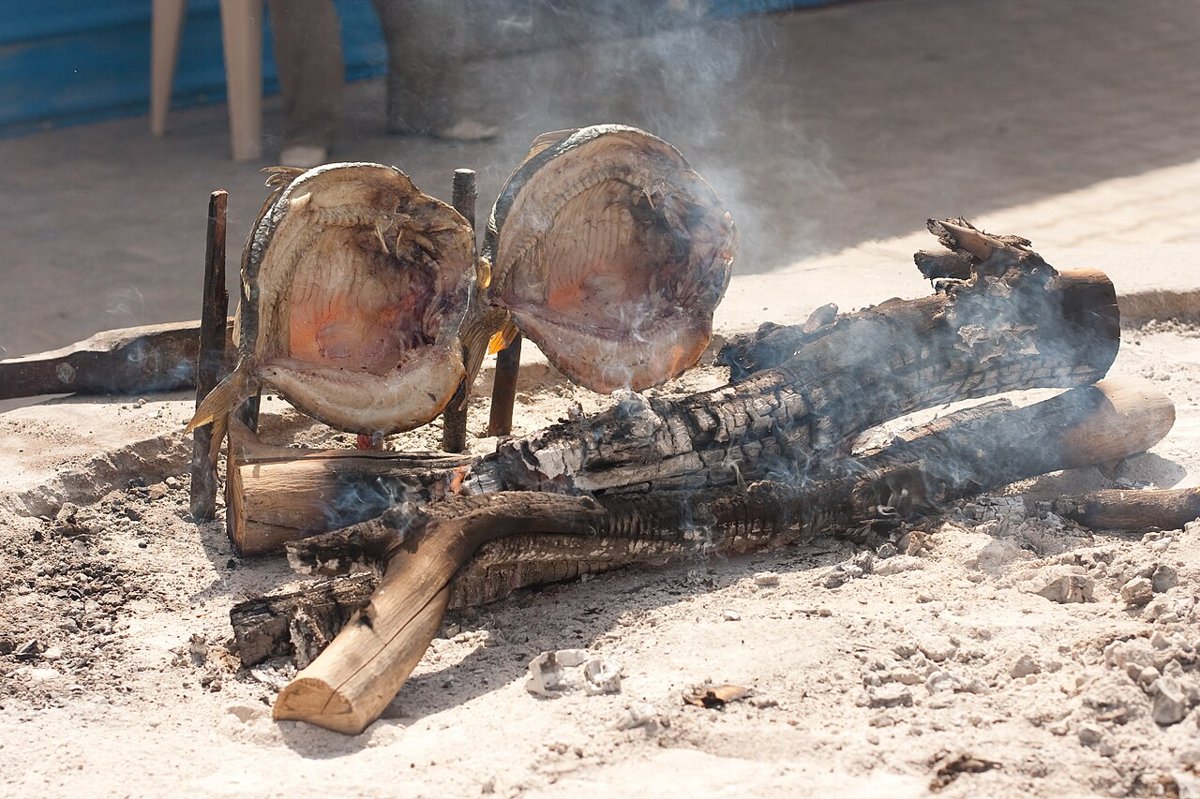
1. Masgouf — Iraq’s 5,000-year-old national dish
If Iraq has one dish to its name, it’s masgouf, and it’s worth planning a meal around. A whole freshwater carp — traditionally from the Tigris or Euphrates — is split open from the back, butterflied flat, and marinated in olive oil, salt, turmeric and tangy tamarind. Then comes the theater: the fish is propped vertically on stakes in a ring around an open wood fire and slow-roasted by the radiant heat for anywhere from 45 minutes to a couple of hours, before being laid skin-down on the embers to finish. The result is smoky, flaky, almost buttery, eaten with your hands off flatbread with raw onion, lime, amba and pickles.
Two things make masgouf special beyond the taste. One, it’s ancient — grilling river fish this way is depicted in Mesopotamian art, so you are eating something genuinely Sumerian. Two, it’s a ritual, not fast food: you choose your fish from a tank or ice bed, it’s priced by weight, and then you wait, drink tea, and let the evening unspool. Don’t go starving and in a hurry.
Where to eat it: Baghdad’s Abu Nuwas Street, the riverside strip along the Tigris, is the spiritual home of masgouf — a row of restaurants where the fish cook in the open air at dusk. There’s a wonderful version in the southern marshes too, cooked plainer (often just salt), and Mosul and Kurdistan spice theirs more heavily with sumac. Expect to pay around $10–20+ per person depending on the fish’s weight — a splurge by Iraqi standards, and entirely worth doing once. More on the capital’s food scene in our Baghdad travel guide.
2. Quzi — the feast on a tray
If masgouf is Iraq’s signature, quzi (also spelled qoozi or ghozi) is its celebration. A whole lamb or large cuts are slow-cooked until the meat collapses off the bone, then laid over a mountain of spiced rice studded with fried nuts, raisins and sometimes chickpeas, with the fat and juices soaking down into the grains. It’s the dish that comes out for weddings, Eid and any time a family wants to honor a guest — you’ll often see it presented on a huge communal platter that everyone eats from together.
It tastes like the best version of comfort food: fragrant with cardamom, cinnamon and cloves, the lamb falling apart, the rice rich and golden. Some Iraqis will tell you quzi, not masgouf, is the true national dish — it’s a fair argument. You’ll find it in any sit-down restaurant, and it’s the one I’d order to share if you’re a group.
3. Dolma — stuffed, stewed and served upside-down

Iraqi dolma is a labor of love and, in my opinion, some of the best in the Middle East. Vine leaves, plus onions, eggplant, peppers, courgettes and tomatoes, are stuffed with a fragrant mix of rice and minced meat, packed tightly into a pot, and stewed low and slow — the Iraqi signature being a generous hit of pomegranate molasses that makes the whole thing sweet-sour and glossy. When it’s done, the cook inverts the entire pot onto a platter so it arrives in a dramatic dome, the leaves and vegetables glistening.
It’s a home dish above all — if an Iraqi family invites you to eat, there’s a good chance dolma appears — but plenty of restaurants do it well. The Kurdish version (often called yaprakh) is justly famous, and northern cooks sometimes add a sourer pomegranate edge. Vegetarian versions exist, stuffed with just rice, herbs and spices, and they’re excellent.
4 & 5. Kubba — the dumpling that has a hundred forms
Kubba (kibbeh elsewhere) is a whole food group in Iraq: a shell of bulgur or rice, sometimes ground meat, wrapped around a spiced filling of minced lamb, onions and nuts, then fried, boiled or baked. Every region has its own, and arguing about whose is best is a national sport. The two you should seek out:
- Kubba Mosul — the showstopper from Mosul: a large flat disc, almost the size of a plate, with a thin cracked-wheat shell, cooked and then cut into wedges like a savory pie. Distinctive and delicious.
- Kubba Hamuth — a tangy Baghdad soup-stew where rice-shell dumplings swim in a sour broth with chard, turnip and beetroot, the kind of thing Iraqi grandmothers are revered for.
You’ll also meet kubba Halab (a torpedo of rice shell, deep-fried) and the bulgur kubba burghul. If you see kubba on a menu or in a market case, just try whichever the local version is — it’s never a wrong move.
6 & 7. Tepsi Baytinijan and Maqluba — the great baked and flipped rice dishes
Tepsi baytinijan is Baghdad home cooking at its most beloved: a baking tray (tepsi) layered with fried eggplant, meatballs, potato, tomato and garlic, baked until everything melds into a rich, jammy casserole eaten with rice and bread. It’s humble and completely addictive.
Maqluba — literally “upside-down” — is the theatrical cousin: meat, fried vegetables (eggplant, cauliflower, potato) and rice are layered in a pot, cooked, then flipped onto a platter so it stands like a savory cake. The Iraqi version often has a yellower rice and sometimes thin vermicelli noodles, leaning a touch Persian. Both are family-lunch staples you’re more likely to meet in a home or a traditional restaurant than a kebab joint — worth seeking out.
Stews and home cooking: the marag and the rice
This is the food Iraqis actually eat most days — a pot of stew (marag) ladled over rice, with bread and pickles on the side. It rarely makes the glossy listicles, but it’s the heart of the cuisine, and the local “people’s restaurants” (mat’am sha’bi) that serve it are where you’ll eat best and cheapest, usually for 5,000–12,000 IQD ($3.50–8) a plate.
8. Biryani, the Iraqi way
Iraqi biryani isn’t the soupy, fiery South Asian kind — it’s a fragrant celebration rice, amber grains tossed with peas, raisins, fried almonds or cashews, crispy fried vermicelli and pieces of chicken or lamb, gently spiced. It shows up at parties and Friday lunches and is one of the easier “wow” dishes to find in restaurants.
9. Margat Bamia and the world of stews
Margat bamia — okra stewed with lamb in a tangy tomato sauce, sharpened with a hit of citric acid or dried lime — is the everyman lunch, eaten over rice with the obligatory bread. It’s the gateway to a whole family of marag: margat baytinijan (eggplant), fasolia (white beans, below), and dozens of seasonal variations. If you want to eat like an Iraqi for a week, you’ll rotate through these.
10. Qeema — the stew with a sacred role
Qeema (gheimeh) is a thick stew of finely minced meat and chickpeas or split peas, scented with dried lime — the name comes from an Akkadian word for “finely chopped,” which tells you how old it is. Beyond being delicious over rice, qeema has a special place during Muharram and Ashura, when enormous communal pots are cooked and given away as charity (nazri) to mourners and pilgrims in the holy cities. If you visit Karbala or Najaf around then, you may well be handed a plate — accept it; it’s a gesture of hospitality and faith. More on that in our Iraq pilgrimage guide.
11. Fasolia — Iraqi comfort in a bowl
Fasolia is a white bean and lamb stew, slow-simmered with tomato until thick, served over rice — pure comfort, and a dish nearly every Iraqi has strong feelings about. In Kurdistan you’ll see it as fasûlî. It’s cheap, filling, and a safe, satisfying order anywhere.
12. Tashreeb — bread soup for the soul
Tashreeb (or tharid) is one of the oldest tricks in the book: torn flatbread layered in a bowl and drowned in a rich broth — lamb, chickpea or bean — until the bread goes silky and soaks up everything. It’s a laborer’s breakfast-lunch, hearty and humble, and it has religious resonance too (tharid is famously mentioned as a favored food in Islamic tradition). Look for it at no-frills places in the south and center.
13. Timman and the prized crust
You can’t talk Iraqi food without talking timman (rice). The good stuff is timman anbar, an aromatic amber long-grain grown in the Middle Euphrates that perfumes the whole kitchen. But the real prize is hikakeh — the golden, crunchy crust that forms at the bottom of the rice pot. Families genuinely compete for it. If you’re offered the crust, you’re being treated well.
The grill: kebab, tikka and the art of charcoal

Grilled meat is the backbone of eating out in Iraq, and the vocabulary is worth knowing so you order what you want.
14. Kebab, tikka and kofta
Kebab in Iraq usually means minced lamb or beef, mixed with onion and parsley, pressed onto flat skewers and grilled over charcoal until the edges char — juicy, smoky, served on bread with grilled tomatoes, onion and sumac. Tikka is the other pillar: marinated chunks of lamb or chicken on a skewer, charred at the edges and pink within. Kofta is the spiced-mince version shaped into fingers or balls. A mixed grill (mashawi) gets you a bit of everything, and it’s how I’d start any meal in a grill house.
The grilling itself is a craft — the best places fan the coals by hand and time the skewers to the second. Erbil’s grill scene in Iraqi Kurdistan is a particular pleasure, with whole streets of charcoal smoke at night, and the braver eater can find offal kebabs (heart, liver, kidney) that locals swear by. Our Iraqi Kurdistan guide has more on the north’s food.
Street food and sandwiches: eating on the move
Iraq’s street food is cheap, fast and genuinely great — and it’s where solo travelers and budget eaters will spend a lot of happy meals, usually for under $2.
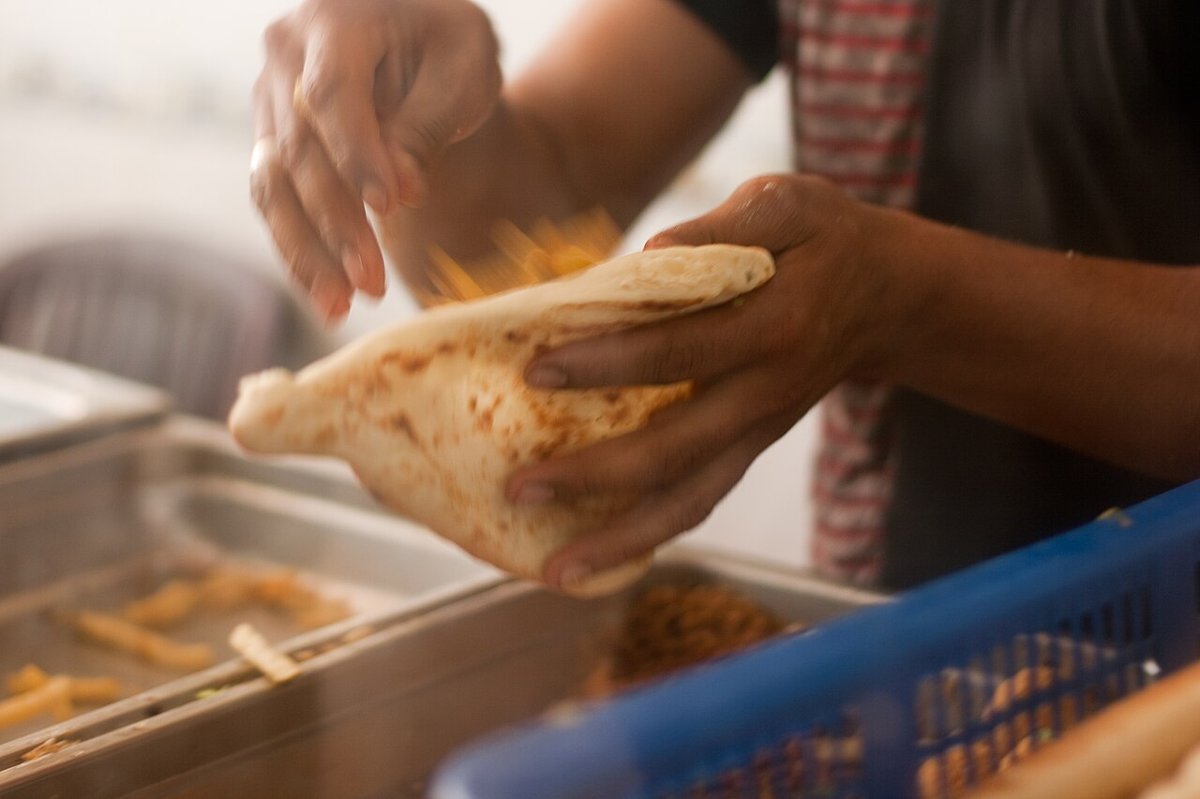
15 & 16. Falafel with amba — and the magic of fermented mango
Iraqi falafel is its own thing: chickpea fritters fried crisp and stuffed into a samoon roll with salad, pickles and — crucially — amba, a tangy, funky, turmeric-yellow sauce made from fermented mango that is the secret handshake of Iraqi street food. Amba’s origin is a great story: according to legend it was created in the late 1800s by the Sassoons, a wealthy Baghdadi-Jewish family trading in Bombay, who shipped pickled mango back to Basra and on to Baghdad’s markets. Today it’s drizzled over falafel, grilled meat, eggs and fish across the country (and, via the Iraqi-Jewish diaspora, all over Israel too). A falafel sandwich runs about 1,000–2,000 IQD — under a dollar — and it’s one of the great cheap eats anywhere.
17. Sabich — the eggplant sandwich with a backstory
The sabich (sabach) is a glorious mess of a sandwich: fried eggplant, hard-boiled or fried egg, salad, fries, pickles and amba, all packed into bread. Like amba, it carries Baghdadi-Jewish roots and went on to become a street-food icon in Israel — a small, edible piece of Iraq’s complex history. Cheap, filling, and a favorite of mine for a fast lunch.
A few more to grab on the street
Keep an eye out for: lablabi (warm boiled chickpeas in a lemony broth, a winter pick-me-up), grilled corn on the cob and corn-and-cheese cups sold from carts for a few hundred dinars, Karrada chips (a Baghdad institution of oily, seasoned potato chips named for the neighborhood), and sfiha / lahm bi ajeen (open-faced minced-meat flatbreads). None will cost you more than pocket change.
21. Samoon — the bread that’s always there
I’m slotting samoon in here because you’ll meet it within an hour of landing. These diamond-shaped, slightly chewy white-bread rolls are baked in clay ovens and arrive with practically everything — torn to scoop stew, wrap kebab or build a sandwich. Fresh and warm from a bakery, with nothing on it, it’s a snack in its own right. Flatbread (khubz) baked on the walls of a tannour oven is the other constant. Bread is sacred here in a quiet way; you’ll notice Iraqis never waste it.
The Iraqi breakfast: the meal worth setting an alarm for
If you take one piece of advice from this guide, make it this: get up for breakfast in Iraq. It’s the meal that converted me. There are two directions you can go — indulgent-sweet or hearty-savory — and ideally you do both on different mornings.

18. Kahi and geymar — the breakfast of the gods
This is the one. Kahi is a flaky, buttery layered pastry, shatteringly crisp, a bit like a cross between filo and a paratha, baked fresh and brushed with syrup. It’s served with geymar (also written qaymar) — a thick, rich clotted cream traditionally made from the milk of the water buffaloes that graze the southern marshes, so fatty and luscious it’s closer to the Turkish kaymak than to anything you’d call “cream.” You spread the geymar on the warm kahi, drizzle over date syrup (dibis) or honey, and eat it with hot sweet tea. It is outrageously good and outrageously rich, and it’s most associated with Baghdad and the south. Find a dedicated morning kahi shop, go early before they sell out, and don’t plan on doing much for an hour afterward.
19. Makhlama and bagila bil dihin — the savory side
For a savory start, makhlama is the move: eggs scrambled with minced lamb, tomato and spices in a hot skillet, scooped up with bread — Iraq’s answer to a power breakfast. Bagila bil dihin is the other classic, especially in Baghdad: cooked broad (fava) beans served with fried eggs, clarified butter and bread, sold from breakfast carts and hole-in-the-wall spots at dawn. Both are cheap, filling and exactly what you want before a long day of sightseeing.
20. Pacha — the breakfast for the brave
And then there’s pacha, the dish that separates the curious from the committed. It’s a slow-boiled assembly of sheep’s head, trotters and stomach — yes, all of it, tongue and cheeks included — served with bread soaked in the fatty broth. It’s a winter dish, eaten early for energy, and Mosul is its heartland (you’ll also hear it called kalle-pache, or serûpê in Kurdish). I won’t pretend it’s for everyone — the texture and richness are a lot — but it’s a beloved delicacy and a genuine cultural experience. If you’re game, go with a local who knows a good pacha house, and go hungry.
The Kurdish breakfast spread
Up north, breakfast becomes a spread: a table covered in small plates — thick yogurt (mast), local honey eaten with more of that buffalo cream, white cheeses, olives, tomato and cucumber, eggs, fresh bread, sometimes a tahini-and-date-syrup dip (dibis w rashi) — all grazed slowly over endless glasses of tea. In the mountains around Duhok and Sulaymaniyah it’s a leisurely weekend institution. It’s vegetarian-friendly, beautiful, and a lovely way to start a day in Kurdistan.
Chai culture: the drink that runs Iraq

You cannot understand Iraq without understanding its tea. Chai — strong, dark, sweet black tea — is the social currency of the entire country, and it’s drunk all day, every day. It’s served in a small tulip-shaped glass called an istikan, set on a little saucer, with sugar already in or a couple of cubes on the side (the traditional move is to hold a sugar cube between your teeth and sip the tea through it). Iraqis are among the heaviest tea drinkers on earth — easily a handful of glasses a day, often many more — and the household tea tin empties fast.
The method matters: proper Iraqi chai is double-brewed, with a concentrated essence kept hot in a small pot stacked on top of a larger pot of boiling water, so each glass is mixed to strength. It’s often scented with cardamom, sometimes with a dried lime or a hint of cinnamon. Down in Basra, look for limon chai basrawi, a fragrant lemon tea the south is proud of.
But the real point of chai isn’t the tea — it’s the chai khana, the teahouse, which is the living room of Iraqi public life. Men (and, increasingly, mixed groups in the cities) sit for hours over tea, a water pipe (shisha/hookah) and a board of dominoes or backgammon, putting the world to rights. Baghdad’s most famous is the Shabandar Café on Mutanabbi Street, open since 1917, its walls covered in old photographs — a cultural landmark as much as a teahouse, and a wonderful place to sit with a glass and watch the city’s book market swirl. After a restaurant meal, a glass of chai usually arrives unbidden and free; accept it, slow down, and you’re doing Iraq right. Arabic coffee (qahwa), cardamom-spiced and served in tiny cups, plays a similar role, especially as a gesture of welcome.
Sweets and desserts worth the sugar crash
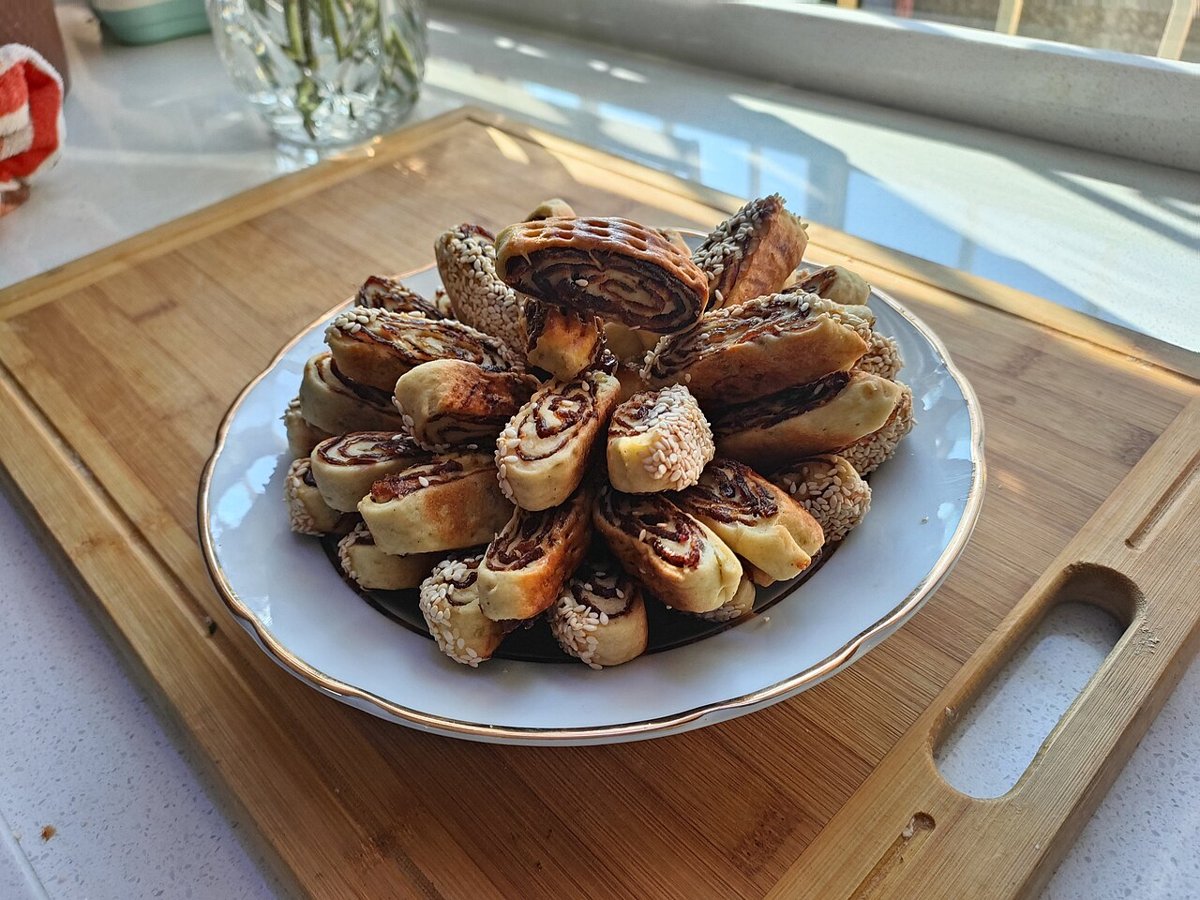
Iraqis have a serious sweet tooth, and the country’s desserts lean on dates, sesame, rosewater, cardamom and syrup. A few to hunt down:
22. Kleicha — the national cookie
Kleicha is the one to know — widely called Iraq’s national cookie, and a sweet with genuinely ancient roots. Food historians trace it back to the Sumerian qullupu, moon-shaped cakes baked to mark the spring new year and the goddess Ishtar; a recognizable recipe even appears in a 13th-century Arabic cookbook. Today kleicha is a soft, spiced pastry rolled around fillings — most famously dates (kleichat tamur), but also walnuts, coconut or sesame — and scented with cardamom and rosewater. It’s made in vast quantities for Eid al-Fitr and Eid al-Adha, when every household bakes its own; if you’re in Iraq around either holiday, you’ll be offered plates of it everywhere. Bakeries sell it year-round, and a box makes the perfect edible souvenir.
23 & more. Daheen, baklava and the syrup-soaked rest
Beyond kleicha, save room for: daheen (a dense Najaf specialty of date syrup, butter and sometimes coconut cooked into a rich fudge — buy it in Najaf’s sweet shops); baklava and its layered-pastry cousins; halawet el-jibn (a sweet-cheese roll filled with cream); mehalabiya (a delicate milk-and-rosewater pudding, sometimes written muhallebi); zalabia (crisp fried dough soaked in syrup, big during Ramadan alongside qatayef stuffed pancakes); and znud el-sit and tulumba for the deep-fried-and-syruped crowd. Wash any of them down with — what else — a glass of chai.
24. Iraqi dates — the original sweet
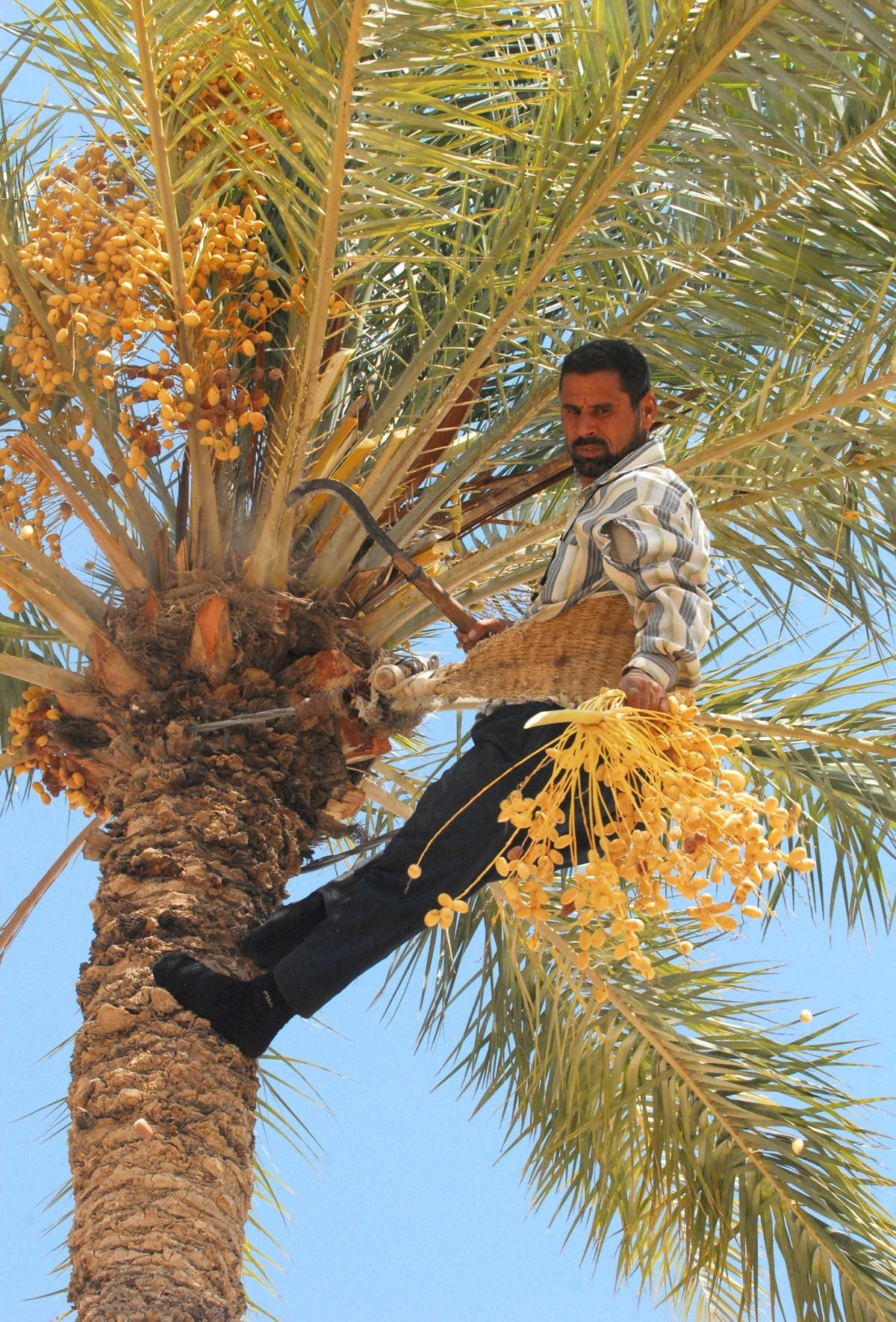
And then there are the dates, which deserve their own mention. Iraq has been one of the world’s great date lands since antiquity, and the southern groves around Basra produce dozens of varieties — soft, honeyed Barhi (incredible eaten fresh and yellow), prized Khastawi, firm Zahidi, glossy Sayer. They turn up everywhere: eaten with cream or cheese, boiled down into the dibis syrup that sweetens breakfast, stuffed with nuts as a sweet, or simply pressed on you by a host. Bring a kilo home. There’s more on the deep south’s date country in our southern Iraq guide (publishing soon).
Can you drink alcohol in Iraq?
A practical question with a complicated, changing answer, so let me be precise and date it. Federally, alcohol is heavily restricted. A 2023 law (Article 14 of the Municipal Revenues Law) criminalized the import, sale and production of alcohol nationwide, and in November 2024 parliament moved to ban its sale in hotels and social clubs too, with fines reported at roughly $7,700–$19,000 for violators. Enforcement has tightened through 2025, with customs ordered to stop alcohol imports.
In practice, as of mid-2026, the picture on the ground is uneven. The Kurdistan Region does not enforce the ban — alcohol is openly and legally sold in Erbil, Sulaymaniyah and Duhok in shops, hotels and restaurants, and the north runs its own customs. In Baghdad, liquor shops (historically run by Christian families) have faced pressure and closures but alcohol still circulates, and Baghdad airport’s duty-free has continued to sell. In the holy cities of Najaf and Karbala, alcohol is effectively absent, and you should not expect or seek it there. The traditional Iraqi spirit, for the record, is arak — an anise spirit that turns cloudy with water, sipped with mezze.
The traveler’s takeaway: don’t plan a trip around drinking. If you want a beer or a glass of wine, Kurdistan is where it’s easy and unremarkable; elsewhere, be discreet, never drink in or near religious sites, and read the room. For the broader legal-and-cultural context, see our honest safety guide and our full Iraqi culture and etiquette guide.
Iraqi food by region: where to eat what
This is the section the listicles never write, and it’s the one that’ll actually shape your trip. Iraq’s regions each have a signature, and timing your eating to where you are pays off — it lines up neatly with our roundup of the best places to visit in Iraq.
Baghdad and the center
The capital is the all-rounder and the masgouf capital. Come here for masgouf on Abu Nuwas Street by the Tigris, the city’s legendary kebab and tikka houses, tepsi baytinijan and rice dishes, Karrada’s street snacks, and tea at the historic Shabandar Café on Mutanabbi Street. Baghdad also has the country’s most cosmopolitan modern dining — good cafés, Lebanese and Turkish places, even a few international names — if you need a break from lamb and rice. Our Baghdad guide goes deep on neighborhoods and where to base yourself.
Mosul and the north
Mosul is the home of kubba Mosul, that great wheel of stuffed bulgur, and the spiritual capital of pacha. Northern cooking is more heavily spiced and fond of sumac (you’ll taste it on the masgouf and grills), and the city’s food culture is part of its remarkable recovery story — covered in our Mosul travel guide (publishing soon).
Iraqi Kurdistan
The north’s autonomous region eats a little differently and a little more freely: the famous Kurdish breakfast spread, mountain honey and dairy, fasûlî, dolma, charcoal grills (Erbil’s grill streets are a highlight), and — uniquely in Iraq — easy access to a glass of wine or beer with dinner. Erbil and Sulaymaniyah have the country’s most developed restaurant scenes and the best odds of a card machine and an English menu. See our Iraqi Kurdistan guide for the full picture, and getting there is covered in our transport guide.
Najaf, Karbala and the shrine cities
Pilgrim country has its own food rhythm. This is the land of daheen (Najaf’s date fudge), of qeema cooked in enormous charity pots during Muharram, and of simple, generous restaurant meals geared to feeding huge numbers of visitors. During Arbaeen and Ashura the hospitality is overwhelming — free food and tea (nazri) is pressed on every traveler. No alcohol, modest dress, and an experience of communal eating you won’t find anywhere else. Our pilgrimage guide explains the seasons and etiquette.
Basra and the deep south
The south is about dates, fish and lemon tea. Basra’s date groves are legendary, the masgouf here is cooked plainer and superb, and limon chai basrawi is the local pride. The marshes add buffalo-milk geymar and a fish-and-rice river culture that feels timeless. It’s all in our southern Iraq guide (publishing soon).
Vegetarian and vegan in Iraq
Let’s be honest: Iraq is a meat-loving country, and a strict vegetarian (let alone vegan) will have to work a little. But you won’t go hungry, and the building blocks are genuinely good. Reliable meat-free options:
- Mujaddara — lentils, rice and caramelized onions, naturally vegan and found everywhere.
- Timman bagilla — fava-bean and dill rice, fragrant and filling (sometimes cooked with meat, so ask).
- Fasolia and bean stews — request them without meat; the base is beans and tomato.
- Falafel sandwiches with amba and salad — a vegan street-food staple.
- Dolma — vegetarian versions stuffed with just rice and herbs are common, especially in Ramadan.
- Mezze and breakfast — hummus, baba ghanoush, fattoush, tabbouleh, fresh bread, olives, cheeses and the Kurdish breakfast spread are a vegetarian’s best friends.
- Lablabi — warm spiced chickpeas, vegan and cheap.
The practical tips: learn the words for “without meat” (bidoon laham), watch for meat stock in rice and stews, and lean on Kurdistan and bigger cities where there’s more variety and more English. Vegans should note that geymar, yogurt and ghee are everywhere in breakfast and sweets. It’s doable — just be clear and flexible.
What it costs to eat in Iraq (and the cash rule)
Good news: eating is one of the cheapest things you’ll do here. A street falafel or sandwich is well under a dollar; a hearty plate of stew, rice and bread at a local restaurant is around 5,000–12,000 IQD ($3.50–8); a fuller sit-down meal runs 12,000–25,000 IQD ($8–17); and even a masgouf splurge tops out around $20 a head. Tea is a few hundred dinars almost everywhere. You’d have to try hard to spend a lot.
The one rule that matters: Iraq is a cash economy for foreigners. Restaurants, cafés, street carts and markets take cash, full stop — your card will not work in the vast majority of places, and ATMs largely serve local accounts. Carry dinars in small notes for street food and tea, change US dollars at exchange shops (not banks) for the better street rate, and never assume you can tap or split a bill on an app. The full money playbook — exchange rates, how much cash to bring, tipping — is in our Iraq travel cost guide.
On tipping at the table: it’s appreciated but light. Round up or leave 5–10% at a nicer restaurant; at a cheap local place, just round up. Keep a pocket of small notes for it.
Eating in Iraq: hospitality, etiquette and staying healthy
Iraqi hospitality is not a cliché — it’s a force of nature. You will be invited to eat, offered tea you didn’t order, and pressed to take seconds (and thirds). A few things that help you navigate it gracefully: eat and pass food with your right hand; expect to be fed generously and to have your protests overruled; a token refusal before accepting is normal on both sides; and if you’re hosted in a home, bring a small gift (sweets or fruit) and praise the cook sincerely. Removing your shoes indoors is common. During Ramadan, daytime eating in public is limited and many places only open after sunset for iftar — plan around it (our best time to visit guide has the dates).
On staying healthy: don’t drink the tap water — stick to bottled or filtered, which is cheap and everywhere, and skip ice if you’re unsure. Iraqi food is generally fresh and safe, but as anywhere, the busiest places with high turnover are the safest bets, and you might give your stomach a day or two to adjust to the richness (all that geymar and lamb fat is no joke). Bring any medications you rely on. Our safety guide covers health and water in more detail.
Where to find Iraqi food outside Iraq
Can’t get to Baghdad yet? Iraq’s large diaspora means you can get a real taste closer to home. The Iraqi-Jewish community made amba and sabich fixtures of Israel; Dearborn, Michigan and the wider Detroit area have a deep Iraqi and Chaldean community with excellent bakeries and restaurants; London, Sweden, Amman and the Gulf all have Iraqi kitchens worth seeking out. Look for kleicha and samoon at Middle Eastern bakeries, and ask for masgouf or quzi at Iraqi restaurants — many will do a Friday version. It’s a good way to pick your must-eats before a trip, and to keep the craving alive after.
Iraqi food FAQ
What is the national dish of Iraq?
Masgouf — butterflied freshwater carp marinated in tamarind and turmeric and slow-grilled upright beside an open wood fire — is widely considered Iraq’s national dish. Quzi, a slow-roasted lamb served over spiced rice, is the other strong contender and the classic feast dish. Both are must-eats.
Is Iraqi food spicy?
No, not in the chili-heat sense. Iraqi food is aromatic and warmly spiced — cardamom, cumin, cinnamon, dried lime, turmeric and baharat — rather than hot. Sourness from tamarind and pomegranate is more characteristic than burn. If you want heat, add pickles or amba; it’s never built into the dishes.
What do Iraqis eat for breakfast?
The famous one is kahi and geymar — flaky pastry with rich buffalo clotted cream and date syrup. Savory mornings bring makhlama (eggs with minced lamb and tomato) and bagila bil dihin (broad beans with egg). In winter the brave eat pacha, and Kurdistan does a leisurely spread of cheese, yogurt, honey and eggs.
What is masgouf?
Masgouf is Iraq’s iconic grilled fish: a whole carp split open, marinated in olive oil, salt, turmeric and tamarind, then stood upright around a wood fire and slow-roasted for up to a couple of hours before finishing on the coals. It’s smoky, flaky and eaten with bread, onion, amba and lime. Find it on Baghdad’s Abu Nuwas Street.
What is the most popular food in Iraq?
There’s no single winner, but the dishes you’ll see most are kebab and tikka (grilled meats), margat bamia (okra stew over rice), dolma, kubba, quzi and masgouf. Day to day, most Iraqis eat a stew (marag) over rice with bread — that’s the true everyday staple, even if masgouf gets the fame.
What is kubba (kibbeh) in Iraq?
Kubba is a shell of bulgur or rice wrapped around spiced minced meat, then fried, boiled or baked. Iraq has many forms: kubba Mosul is a large fried disc cut into wedges; kubba hamuth is a tangy dumpling soup; kubba Halab is a deep-fried rice torpedo. Each region champions its own.
What is amba?
Amba is a tangy, funky, turmeric-yellow sauce made from fermented mango — a defining flavor of Iraqi street food, drizzled over falafel, sabich, eggs and grilled meat. By legend it was created in the 1800s by a Baghdadi-Jewish trading family in India and shipped back to Basra, and it later became popular in Israel too.
Can you drink alcohol in Iraq?
It’s restricted. A 2023 federal law banned the import, sale and production of alcohol, tightened further in 2024, but enforcement is uneven. Kurdistan (Erbil, Sulaymaniyah, Duhok) sells alcohol openly and legally; in Baghdad it’s discreet and shrinking; in the holy cities it’s effectively absent. Don’t plan a trip around drinking, and never near religious sites.
What desserts are popular in Iraq?
Kleicha, the date- or walnut-filled national cookie made for Eid, leads the list. Also seek out daheen (Najaf date fudge), baklava, halawet el-jibn (sweet-cheese roll), mehalabiya (rosewater milk pudding), zalabia and qatayef (especially in Ramadan), and of course fresh and syrup-dried Iraqi dates.
What is the most common drink in Iraq?
Chai — strong, sweet black tea served in a small tulip glass called an istikan — is drunk all day, every day, and is central to social life. It’s often scented with cardamom; Basra has a beloved lemon version. Cardamom Arabic coffee plays a similar role as a welcome drink.
Is Iraqi food halal, and what meat do Iraqis eat?
Yes — Iraq is overwhelmingly Muslim, so the food is halal and there’s no pork. Lamb is the favorite meat, followed by chicken, beef, goat and freshwater fish like the carp used for masgouf. Offal is eaten too, most famously in pacha.
Is Iraqi food good for vegetarians?
It’s meat-heavy, but vegetarians manage well with mujaddara (lentils and rice), bean stews like fasolia, falafel, vegetarian dolma, and a wealth of mezze and breakfast spreads. Learn “bidoon laham” (without meat), watch for meat stock, and lean on Kurdistan and bigger cities for the most variety.
Final thoughts: come hungry, leave changed
Iraqi food is the great underdog of Middle Eastern cuisine — older than almost any of its neighbors, deeply hospitable, and still flying under the radar. That’s exactly why eating here feels like a discovery rather than a checklist. You won’t find it polished for tourists; you’ll find it cooked the way it’s been cooked for generations, and pressed on you by people genuinely delighted that you came.
So plan a masgouf night on the Tigris, set an alarm for kahi and geymar, accept every glass of chai, and say yes when a family invites you to eat — that invitation is where the best meals of your trip will happen. When you’re ready to build the rest of the trip around the food, start with our complete Iraq travel guide, sort out the practicalities with our Iraq visa guide, and map a route with our Iraq itinerary planner.
Sources & further reading: dish histories and definitions cross-checked against Wikipedia (Iraqi cuisine, Masgouf, Quzi, Kleicha, Amba, Pacha/Khash) and TasteAtlas; masgouf preparation and the carp/tamarind method via multiple recipe and culinary sources; kleicha’s Sumerian qullupu roots and Eid traditions via the Smithsonian Folklife Festival and Smithsonian Magazine; amba’s Baghdadi-Jewish Sassoon-family origin story (presented as the traditional account) via Wikipedia and Jewish culinary histories; kahi and geymar and the southern water-buffalo cream via Iraqi recipe sources; Iraqi tea culture and the istikan via Arab America and tea-trade sources; and Iraq’s alcohol laws — the 2023 Municipal Revenues Law ban, the November 2024 extension to hotels and clubs, reported fines, and the Kurdistan Region’s non-enforcement — via Shafaq News, The Washington Post, The New Arab and Kurdistan24 (checked June 2026). Food, prices and especially alcohol enforcement change; treat specifics as a well-researched starting point and confirm locally.
Photo credits: Masgouf grilling by Al Jazeera English (CC BY-SA 2.0); Iraqi dolma by Levi Clancy (CC BY-SA 4.0); Iraqi kebab in Baghdad by Aziz1005 (CC BY-SA 4.0); falafel in samoon bread by Omar Chatriwala / Al Jazeera English (CC BY-SA 2.0); kahi pastry by MohammadHuzam (CC BY-SA 4.0); Iraqi chai khana in Kirkuk by Enasiqph (CC BY-SA 4.0); kleicha by Abdulsalam Al Dabbagh (CC BY-SA 4.0); date harvest by Tanya Thomas, U.S. Army (public domain). All via Wikimedia Commons.
Last updated: June 2026. We keep this guide current — if a dish, price or detail has drifted on the ground, tell us and we’ll update it.