Last updated: June 6, 2026 — opening hours, prices and the security picture below were re-checked against official sources and current traveler reports this week.
My first morning in Baghdad, I did what I suspect every traveler secretly does: I stood on Mutanabbi Street with a glass of sweet lemon tea, looked around at the bookstalls and the crowds and the restored Ottoman facades, and quietly recalibrated everything I thought I knew about this city. The Baghdad of the news and the Baghdad in front of you are two different places.
The best things to do in Baghdad cluster around the old city: browsing Mutanabbi Street’s book market, drinking chai at Shabandar Café, haggling in the copper souk, and touring the Abbasid-era Mustansiriya school — then Kadhimiya’s golden shrine, the Martyr’s Monument, and grilled masgouf on the Tigris at night. Two to three days covers the essentials.
This guide is the Baghdad chapter of our complete Iraq travel guide — written for independent travelers and tour-joiners alike, and updated for what the city actually looks like in June 2026: which sites are open, which are still wrapped in renovation scaffolding, what things cost, and how the safety picture really reads.
In this guide: At a glance · Baghdad in 2026 · Old Baghdad on foot · Museums & monuments · Sacred Baghdad · The Tigris & modern city · Day trips · Safety · Getting there · Getting around · Where to stay · What to eat · When to go & itineraries · FAQ
Baghdad at a glance
| Essential | The short version (June 2026) |
|---|---|
| Days needed | 2 full days for the classics; 3–4 if you add day trips to Ctesiphon, Babylon or Samarra |
| Don’t miss | Mutanabbi Street on a Friday morning, Shabandar Café, the copper souk, Kadhimiya shrine, masgouf by the Tigris |
| Visa | E-visa before you fly (~$160) — visa on arrival ended March 2025. Full details in our Iraq visa guide |
| Safety | US advisory is Level 4 (Do Not Travel); on the ground the capital is calm and travelers report warm, easy visits. Honest breakdown in our Iraq safety guide |
| Getting around | Careem and Baly ride-hailing apps (a cross-town hop runs ~3,000–5,000 IQD), plus your own feet in the old city |
| Budget | ~$50–70/day independent: budget hotel, app taxis, street food and entry fees |
| Best months | October–April. Summer afternoons hit 45–50°C — plan an Iraqi schedule: mornings, then again after dark |
Baghdad in 2026: catching a city mid-comeback
Here’s the context that almost no guide on the internet gives you: Baghdad is in the middle of the most visible civic glow-up it has had in decades, and your visit lands right in the thick of it.
The city wore the title of Arab Capital of Tourism 2025, and the run-up to it unlocked money and momentum that are still reshaping the center. Al-Rasheed Street — the grand 1916 boulevard of columned arcades — has been restored block by block, with the stretch between al-Maidan and al-Rusafi squares finished first. They even laid tracks for a battery-powered heritage tram, a modern replica of the city’s beloved 1940s streetcar; the first vehicle was completed in late 2025, and if it’s running laps the week you visit, ride it for the novelty alone.
The Abu Nuwas corniche along the Tigris has been rehabilitated into the evening promenade it was always meant to be. The National Museum closed in mid-2025 for its biggest renovation in a generation, with reopening promised for 2026 (more on that below — it’s complicated). Cranes stand over a new riverside skyline in Jadriya, including the Zaha Hadid-designed Central Bank tower. None of this means Baghdad is suddenly Dubai — it emphatically is not, and thank goodness — but you are visiting a city that is actively reclaiming its public spaces, and you can feel it everywhere.
Old Baghdad on foot: the best things to do in Baghdad’s historic heart
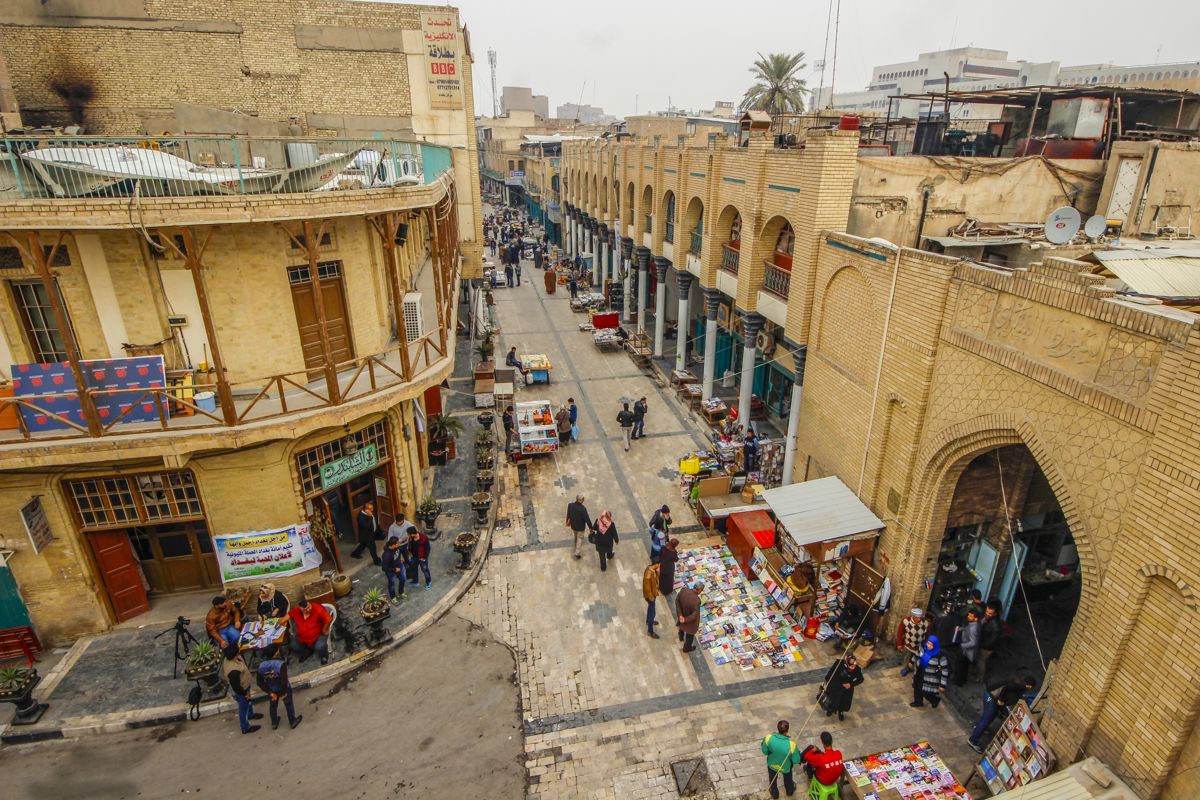
Almost everything that makes Baghdad special for a first-time visitor sits in one walkable square kilometer of Rusafa, on the east bank of the Tigris between al-Maidan Square and the river. You could see it in a rushed morning. Give it a full day — ideally a Friday, when the book market is at full roar.
Mutanabbi Street: the book market that refused to die
Start here. Named for the 10th-century poet al-Mutanabbi, this pedestrian street has been Baghdad’s literary marketplace for centuries — stalls of Arabic novels, English paperbacks, Saddam-era schoolbooks, Qurans, engineering manuals, vintage magazines, all stacked in towers on the pavement. A 2007 car bomb killed 26 people here and gutted the street; Baghdadis rebuilt it, and its 2021 restoration made it the symbol of the city’s revival. The street now runs as a 24-hour space and evenings are as lively as mornings.
Friday morning is the main event, when the market spills into every side alley and half the city seems to come to browse, argue and recite. At the river end you’ll find the statue of al-Mutanabbi mid-declamation above the Tigris. The saying you’ll hear quoted — “Cairo writes, Beirut publishes, Baghdad reads” — stops feeling like a cliché about four minutes in.
Shabandar Café: a century of chai and memory
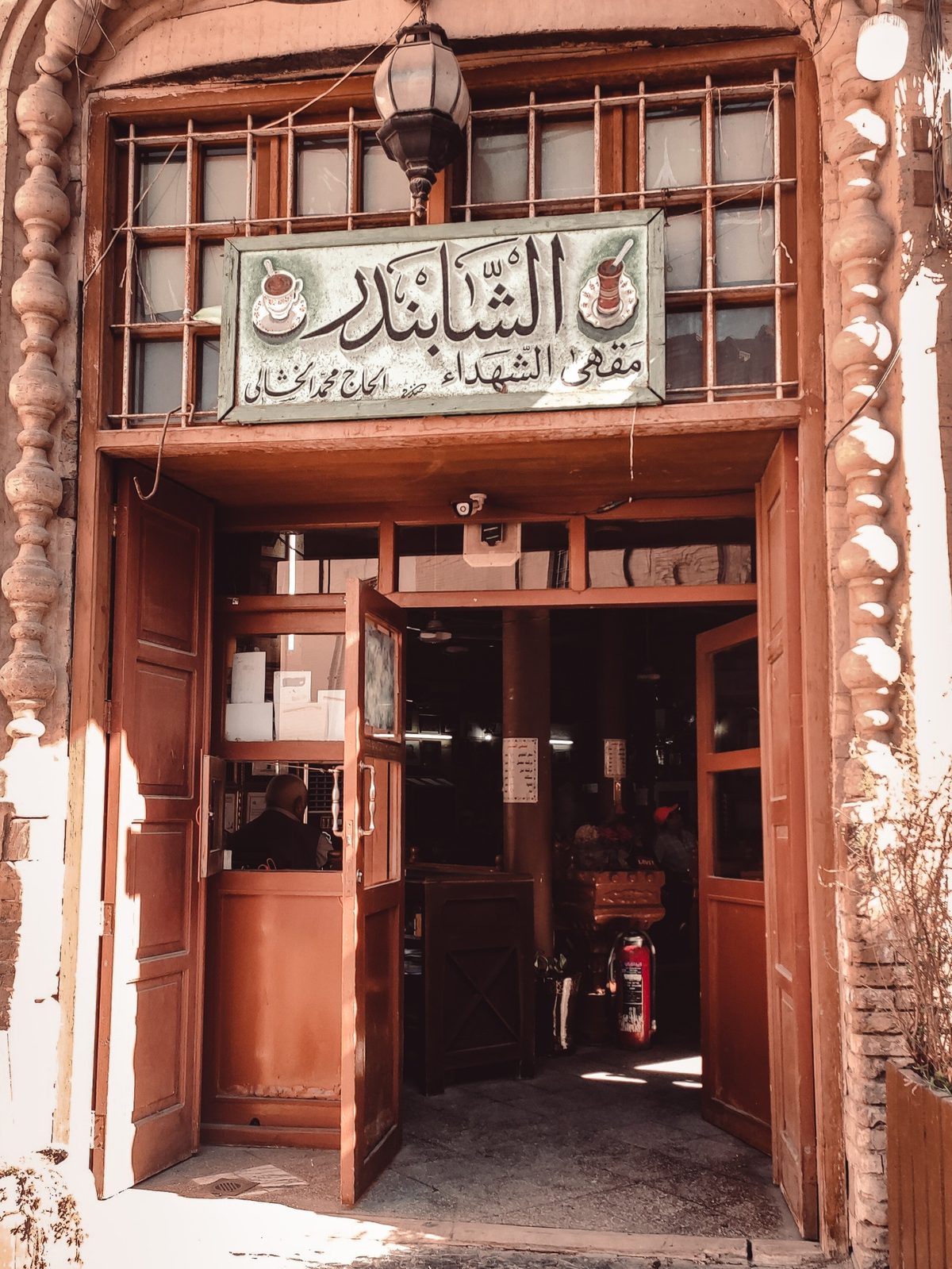
Halfway down Mutanabbi Street, the Shabandar has been serving tea since 1917 — pressed-tin ceilings, walls of sepia photographs, narghile smoke, and every stratum of Baghdadi intellectual life crammed onto wooden benches. It is also a place of pilgrimage: the owner, Haj Mohammed al-Khashali, lost four sons and a grandson in the 2007 bombing and reopened anyway. Locals call it the Martyrs’ Café. Order sweet chai (it’ll cost a few hundred dinars, basically nothing), sit where you can watch the door, and give it an hour. Conversations find you here.
Al-Qushla: the clock tower courtyard
Behind Mutanabbi Street, through an archway, the old Ottoman barracks of al-Qushla open onto riverside gardens around a clock tower gifted by King George V. On Fridays this is Baghdad’s open-air salon — poets declaiming to anyone who’ll listen, chess games, students sketching, families picnicking on the grass. Free to enter, and one of my favorite places in the entire country to do absolutely nothing in particular.
Mustansiriya School: the Abbasid university on the riverbank
A two-minute walk along the corniche brings you to one of the oldest universities on earth — founded in 1227, teaching law, medicine, mathematics and Quranic studies when Oxford was a muddy adolescent. The brickwork muqarnas around its courtyard portal are some of the finest Abbasid craftsmanship surviving in Baghdad. One honest caveat: the madrasa has been in and out of restoration closure recently — when I last checked it was closed for renovation works, though you can still admire the river facade. Ask your hotel or guide for the current status rather than trusting any website, including this one.
Souq al-Safafeer: the copper market
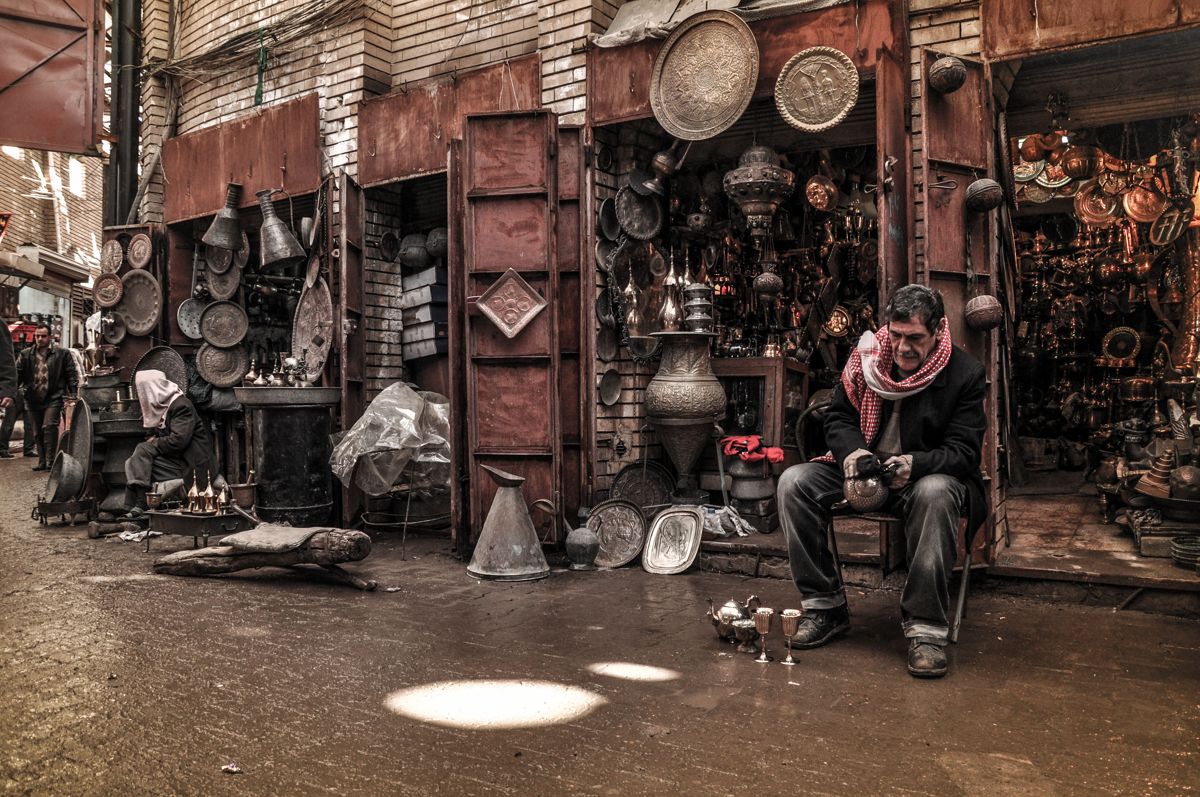
The coppersmiths’ souk is the sound of old Baghdad: hammers on metal, a rhythm that has echoed off these arcades since Abbasid times. The craft survives on a handful of workshops now — engraved trays, coffee pots, lanterns, and yes, plenty of made-for-tourists pieces alongside genuine antiques. Prices are negotiable but fair; a small hand-worked piece costs a few thousand dinars, a museum-quality tray considerably more. Even if you buy nothing, walk it slowly. The artisans are used to cameras and mostly delighted by interest.
Souq al-Saray and a 1930s kubba lunch
The stationers’ souk next door — paper, pens, printing — hides one of Baghdad’s great cheap lunches: the kubba al-Saray cafés, frying spiced meat-stuffed bulgur dumplings to the same recipe since the 1930s. A plate with bread and pickles costs pocket change and tastes like the entire 20th century. Pair it with fresh pomegranate juice from a street press.
The Abbasid Palace: Baghdad’s oldest standing building
Near al-Maidan Square, the 12th-13th century Abbasid Palace (possibly a madrasa itself — historians argue) is the last great secular building of the caliphate still standing in the city that was once the capital of the world. Two stories of pointed-arch arcades around a courtyard, with brick muqarnas vaulting that will break your neck from staring up. It keeps government hours and has historically closed Fridays and Saturdays; entry has hovered around 25,000 IQD for foreigners. It’s often nearly empty, which makes it feel like a private audience with the 1200s.
Al-Rasheed Street and the Haydar-Khana Mosque
Walk the restored stretch of al-Rasheed Street for the colonnades alone — hundreds of columned arcades fronting what was, from the 1920s to the 1950s, the Champs-Élysées of the Middle East. The Haydar-Khana Mosque, the street’s Ottoman-era jewel with a tiled dome and a history of nationalist plotting in its courtyard, anchors the middle section. Look up constantly: above the shop signs, the crumbling-elegant facades are the real exhibition.
Haji Zbala: the juice stand of champions
On al-Rasheed near the Hafidh al-Qadhi intersection, this century-old juice institution serves one thing perfectly: thick raisin juice (sherbet zbib) ladled from steel basins, cold and absurdly refreshing at the end of a souk walk. A glass costs about 1,000 dinars. Drink it standing on the pavement like everyone since 1920 has.
Museums and monuments: Baghdad’s grand statements
The Iraq Museum: the honest 2026 status
Let’s deal with the question I get asked most. The Iraq Museum — home of the treasures of Ur, the Nimrud gold, the Warka Vase, five thousand years of Mesopotamian civilization under one roof — closed in mid-2025 for a top-to-bottom renovation, its biggest since the building opened. The State Board of Antiquities announced a reopening in 2026, reporting the project 90% complete and some 27,000 recovered artifacts returned to the building. As I write this in June 2026, reopening has been announced but not yet delivered on a confirmed public date; recent visitors have only managed special-arrangement visits through guides.
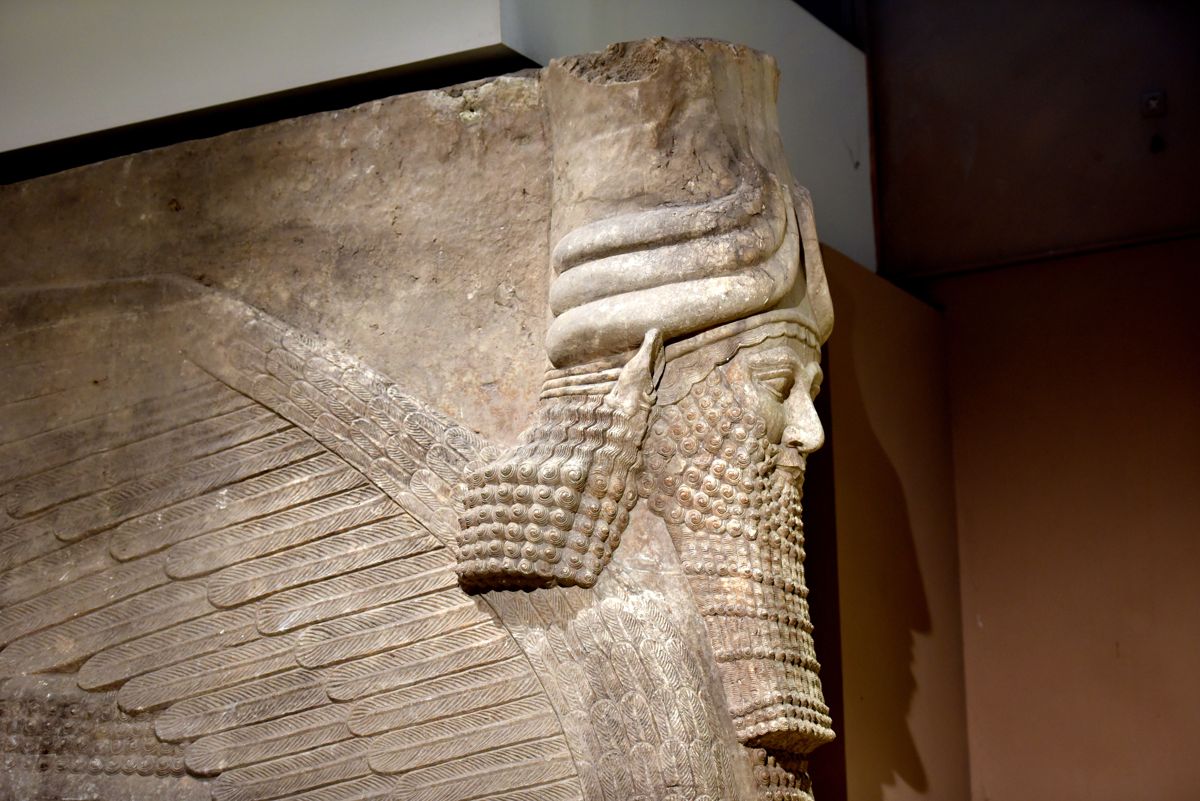
So: check before you build your trip around it — the museum’s official site or any Baghdad guide will know. If it has reopened by your visit, clear half a day. The Assyrian gallery’s human-headed winged bulls from Khorsabad, the processional lions, the cuneiform halls — this collection rivals the Louvre’s Mesopotamian rooms, except these objects are standing a few hundred kilometers from where they were made. Pre-closure, foreigner entry was 25,000 IQD with Sun–Thu morning hours; expect both to change with the relaunch.
If the doors are still shut, don’t write the city off — between the Baghdadi Museum, the monuments below and the old city itself, Baghdad earns its days regardless.
The Baghdadi Museum: the city’s memory in plaster
Down on the corniche near al-Shuhada Bridge, this folk museum recreates old Baghdad street life in 70-odd life-size dioramas — the coffeehouse storyteller, the circumcision procession, the bread bakers, the dowry negotiation. It sounds kitsch. It is kitsch. It’s also genuinely loved by Baghdadis, who come to show their kids how their grandparents lived, and at a few thousand dinars’ entry it’s the easiest history lesson in town. I dare you not to smile in there.
Al-Shaheed Monument: the most beautiful war memorial you’ll ever see
Across the river in eastern Baghdad, a 40-meter turquoise dome — split in two, the halves sliding apart around an eternal flame and an underground museum of names — commemorates the Iraqi dead of the Iran–Iraq War. Designed by sculptor Ismail Fattah al-Turk and finished in 1983, it manages to be both Saddam-era propaganda architecture and one of the most moving public artworks in the Middle East. The complex emerged from restoration recently; current visitor reports have it open daily roughly 8am–3pm with entry around 3,000 IQD. Go in the last hour, when the low sun sets the glazed tiles on fire. A Careem from the old city runs around 5,000–7,000 IQD.

Tahrir Square and the Freedom Monument
Baghdad’s central square is crowned by Jawad Salim’s 50-meter bronze frieze — fourteen scenes of Iraq’s 1958 revolution reading right-to-left like a verse of Arabic poetry. It is the single most important piece of modern Iraqi art, and it presides over the square that hosted the 2019 protest movement; the muralled underpass beneath is an open-air gallery of that moment. Visit, look up, and you’re reading the country’s modern history in one panorama.
Firdos Square: where the statue came down
A short walk southeast, between the Palestine Hotel and the former Sheraton, is the square the whole world watched on April 9, 2003, when the statue of Saddam was hauled off its plinth. The plinth now carries an unremarkable green monument; the square itself is just traffic. It takes five minutes, and those five minutes are strangely heavy. Combine it with a stroll up Sadoun Street’s faded mid-century cinemas.
The Victory Arch and the Green Zone
The crossed swords of the Qadisiyah arches — two pairs of 43-meter blades held by fists modeled on Saddam’s own forearms, cast partly from melted Iranian weapons, with captured helmets scattered at the base — are the most notorious monuments in Iraq. They stand on the old parade grounds inside the former Green Zone, which has been progressively reopened to normal traffic. As of recently you can usually drive through the zone and photograph the arch; on some days, with a guide who knows the right gate and mood, you can walk right up to it. Treat photography around government buildings with care and follow your driver’s lead — this is the one part of Baghdad where the security theater is still real theater.
Baghdad Tower: the city from 200 meters
West of the river in Mansour, the rebuilt telecom tower (the old “Saddam Tower”) reopened its revolving observation deck, and it’s the only place to grasp Baghdad’s scale — a flat, palm-stitched sea of low rooftops cut by the brown S-curves of the Tigris, seven million people to the horizon. Entry is a modest fee (a few thousand dinars; more for the small rotating café). Clear winter days are best; summer haze flattens everything.
Sacred Baghdad: shrines, mosques and churches
Baghdad is a city of golden domes that most outsiders never associate with it. A respectful non-Muslim visitor is welcome at all of the below outside prayer times — dress modestly (long sleeves and trousers; abayas for women are lent or sold cheaply at shrine gates) and follow the flow. If the spiritual side of Iraq is a major thread of your trip, our full ziyarat and holy cities guide covers etiquette, dress and the shrine cities in depth.
Kadhimiya: the golden shrine quarter
In the city’s northwest, the shrine of the two Imams — Musa al-Kadhim and Muhammad al-Jawad, the seventh and ninth Shia Imams — raises two golden domes and four golden minarets above a walled old quarter of pilgrim hotels, gold souks and kebab smoke. It is one of the four great Shia shrine cities of Iraq, and the only one inside Baghdad itself. Non-Muslims can enter the courtyards; phones go through scanners, bags get checked, women borrow or buy an abaya (around 5,000 IQD) at the gate. Go in the evening when the tilework glows and the courtyard fills with families. The surrounding souk is the best place in Baghdad to watch pilgrimage and daily life braid together — and the shrine sits one stop from the old city on the city’s busiest minibus corridor.

Abu Hanifa Mosque: the Sunni counterweight
Directly across the Tigris in Adhamiya stands the tomb-mosque of Abu Hanifa, founder of the Hanafi school of Sunni jurisprudence — the largest in the Sunni world. The two shrines facing each other across the river, Kadhimiya and Adhamiya, are Baghdad’s sectarian geography in one image; crossing between them in fifteen minutes is its own quiet lesson in how this city actually coexists. The clock tower and the calm, carpeted prayer hall are worth the detour, and Adhamiya’s riverside cafés are some of the city’s most pleasant.
The shrine of Abdul Qadir Gilani
The 12th-century Sufi saint’s complex — green-tiled dome, vast courtyard, an atmosphere thick with pilgrims from Pakistan, India and Central Asia — is the most international religious space in Baghdad and one of the most welcoming. Sufi orders worldwide trace their lineage here. It’s a ten-minute walk from the old city’s southern edge, and almost no tourists bother. Their loss.
Christian Baghdad: Our Lady of Salvation and the old churches
Baghdad’s Christian community, though diminished, still worships across the city. The Syriac Catholic cathedral of Sayidat al-Nejat (Our Lady of Salvation) on Sadoun Street — site of the 2010 massacre, now a shrine to its martyrs — receives respectful visitors, as do the Armenian church of Miskinta in the old city and St Joseph’s Latin cathedral. Sunday services are full and visitors are met with disarming warmth. Ask permission before photographing people at prayer, here as anywhere.
The Tigris and modern Baghdad
Masgouf on Abu Nuwas: the essential Baghdad evening
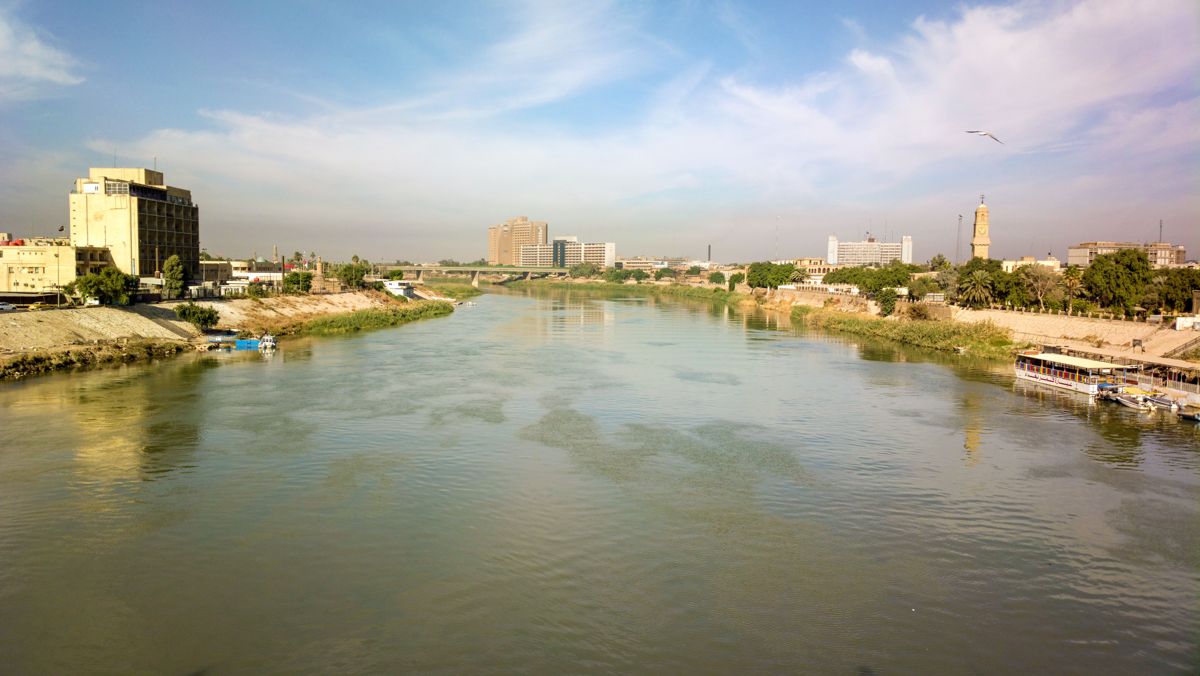
If you do exactly one thing from this guide, do this. Masgouf — river carp butterflied, staked beside an open wood fire for an hour, lacquered with tamarind and turmeric — is Iraq’s national dish, and the rehabilitated Abu Nuwas corniche is its spiritual home. Pick your live fish, drink chai while it grills, then eat it by the water with raw onion, amba, pickles and hot tannour bread. It’s priced by weight; a fish that feeds two generally runs around 20,000–35,000 IQD at the corniche restaurants. Go after 8pm, when the riverfront is families, fairy lights and shisha smoke to the water’s edge. The statue of Abu Nuwas — the 8th-century poet of wine and pleasure — watching over it all is the most quietly subversive monument in the city.
Cross the Tigris by boat
Small motorboats work the river from the corniche and near the Jadriya and Sinak bridges, especially on weekend evenings — a ten-minute crossing or a half-hour putter costs a few thousand dinars after a friendly haggle. Baghdad was built to be seen from its river; from the water, with the bridges lit and the call to prayer ricocheting between banks, you understand why every empire wanted this exact spot.
Karada: street food, sweets and the Baghdad evening promenade
Karada is Baghdad’s liveliest commercial district and its best straightforward evening out: juice bars stacked with pomegranates, date shops run by men with strong opinions, falafel stands, and the famous Abu Afif sweets house piling up baklava and the cardamom-heavy local daheen. This is also where you’ll feel the city’s ordinary prosperous normalcy hardest — teenagers in knock-off streetwear, wedding convoys honking down the boulevard, everyone out until midnight. No sights as such. That’s the point.
Zawra Park and the zoo
Baghdad’s central park is enormous, and on Friday afternoons half the city is in it — picnics, paddle boats, a Ferris wheel with skyline views, and the rebuilt Baghdad Zoo of “Lawrence Anthony rescued the lions” fame. As a sight it’s skippable; as a window into the city at leisure it’s unbeatable, and solo travelers will collect more selfie requests and tea invitations here than anywhere else in Iraq.
Mansour and the new skyline
West-bank Mansour is Baghdad’s money district — malls, café culture, the Baghdad Tower — and the easiest place to see where the city is headed. Across the river in Jadriya, the 170-meter Central Bank of Iraq tower, one of Zaha Hadid Architects’ final projects, has been rising toward completion and now dominates the southern skyline. You can’t visit a central bank, obviously, but its silhouette behind the masgouf smoke is the new Baghdad postcard.
Day trips from Baghdad
Baghdad sits in the middle of ancient Mesopotamia, which means some of the best places to visit in Iraq are under two hours from your hotel. All of the below work as half- or full-day trips with a hired driver (figure $60–100 for the car) or app taxi one-way plus a negotiated return.
Ctesiphon and the Arch of Taq Kasra (45 minutes)
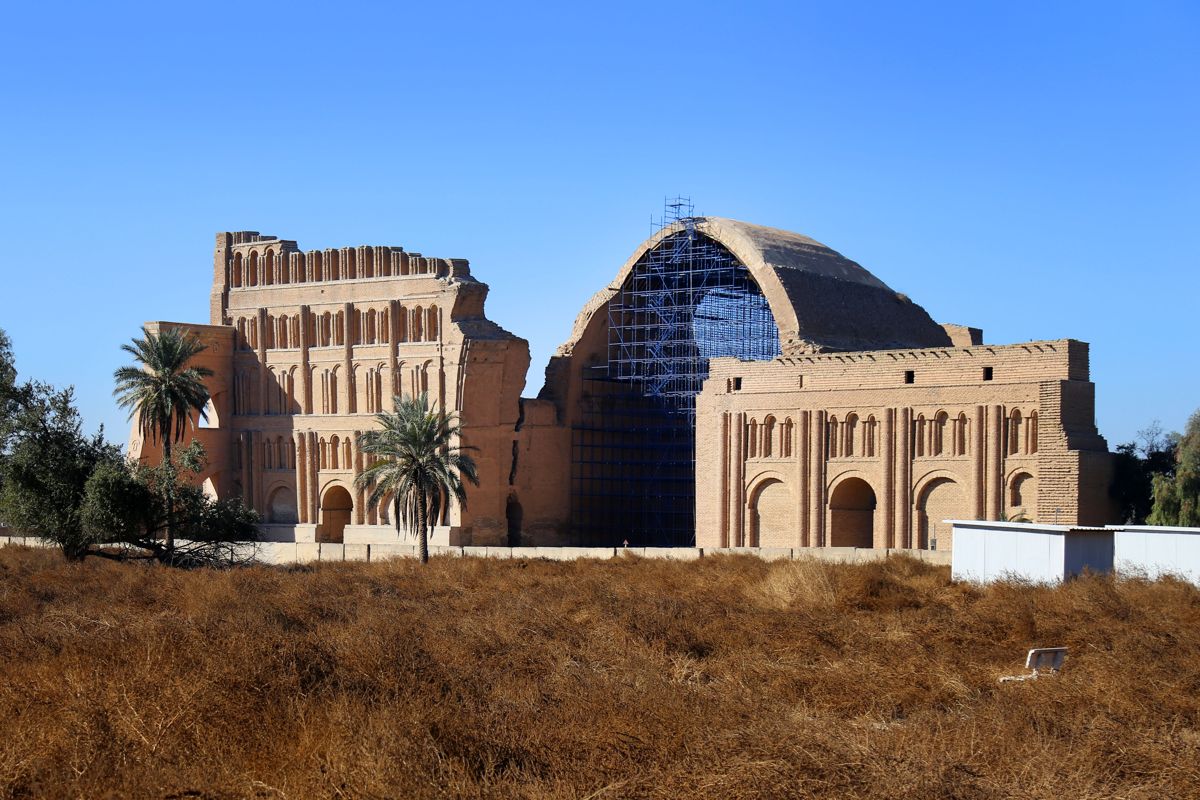
The largest single-span unreinforced brick vault ever built — the 37-meter throne-room arch of the Sasanian Persian capital — stands alone in the fields at Salman Pak. It has been undergoing long-running stabilization works, and recent visitors have found the site fenced with the arch viewable from a respectful distance rather than from directly beneath; even so, it is worth every minute of the drive. You’re looking at the building that humbled the medieval world’s architects. The riverside fish restaurants of Salman Pak handle lunch.
Dur-Kurigalzu: the ziggurat almost nobody visits (45 minutes west)
The 3,400-year-old Kassite ziggurat of Aqar Quf rears 50-odd meters out of the plain west of Baghdad, its mudbrick core striped with reed layers, and on most days you will have it entirely to yourself. It was the skyline marker travelers used to know they were a day from Baghdad. Combine it with a Friday-morning Mutanabbi visit for the single best one-day contrast the capital offers: bronze-age engineering before lunch, book market after.
Babylon (90 minutes south)
Yes, that Babylon — Ishtar Gate (the in-situ original lower walls plus a replica), the Lion of Babylon, Saddam’s reconstructed palace walls bearing his inscribed bricks, all now UNESCO-listed. It pairs naturally with the Shia shrine city of Karbala for a long, magnificent day. We cover both properly in our 25 best places in Iraq roundup.
Samarra (2 hours north)
The spiral minaret of the Malwiya — the 52-meter corkscrew you’ve seen in every Iraq photo essay — plus the vast 9th-century Great Mosque and the golden-domed al-Askari shrine. The drive crosses checkpoints where foreign passports get scrutinized; bring patience and ideally a guide. Doable independently, smoother on a tour.
Karbala and Najaf (1.5–2.5 hours south)
The shrine cities of Imam Hussain and Imam Ali are day-trippable from Baghdad, but they reward an overnight — the evening atmosphere in the shrine courtyards is the point. If that pull is why you’re coming to Iraq at all, our dedicated ziyarat in Iraq guide walks through both cities, the dress codes and where to stay.
Is Baghdad safe to visit in 2026?
The honest two-sided answer, compressed — the full version, with the timeline and region-by-region detail, lives in our Is Iraq safe? guide.
The official position is unambiguous: the US State Department holds Iraq at Level 4 — Do Not Travel, ordered non-emergency embassy staff out of the country on March 2, 2026, and issued further citizen alerts through the spring. The UK FCDO advises against travel to most of Federal Iraq. Those advisories void most standard travel insurance, which is why Iraq travelers carry specialist policies — that’s a planning fact, not a footnote.
The on-the-ground position, June 2026: the February–March regional escalation has cooled, a ceasefire has held since spring, airspace and airports reopened in April, and travelers — including solo women — continue to report calm, friendly, checkpoint-punctuated trips through the capital. Central Baghdad’s daily-life areas (the old city, Karada, Kadhimiya, Mansour, the corniche) feel ordinary, watched over by a heavy but courteous security presence. The genuinely elevated risks are localized and mostly avoidable: don’t approach demonstrations, don’t photograph checkpoints or government buildings, don’t drive the rural belts at night, and keep your itinerary boring in the political sense.
My practical Baghdad rules: use app taxis at night rather than street-hails; carry your passport for the checkpoints; let your hotel know your day plan the first day (they’ll tell you if anything’s off); and treat the security men with the same cheerful patience they’ll show you. Thousands of travelers did Baghdad safely last year. None of them did it by pretending the advisories don’t exist.
Getting to Baghdad and out of the airport
Baghdad International (BGW) receives direct flights from Istanbul, Dubai, Doha, Amman, Cairo and the Gulf; most travelers connect through Istanbul (often cheapest) or Dubai. You’ll need your e-visa approval before boarding — Iraq ended visa-on-arrival for most nationalities in March 2025, and airlines check. The application walk-through, costs and the Kurdistan exception are all in our Iraq visa guide.
The airport run is Baghdad’s one famous logistical quirk: the terminal sits inside a security perimeter that ordinary taxis can’t enter. Your three options, in order of preference:
- Hotel pickup: most hotels arrange an authorized car for around $25–35 — worth it after a night flight, and mandatory peace of mind for first-timers.
- Official taxi desk: fixed-rate cars into central Baghdad at around 40,000–45,000 IQD. Safe, regulated, no haggling.
- The budget classic: the airport shuttle bus to the perimeter checkpoint at Abbas ibn Firnas Square (~8,000 IQD), then a Careem from there into town for 12,000–15,000. Add buffer time; the shuttle fills before it leaves.
Ignore anyone quoting more, and change a $50 bill at the airport for the taxi and your first day — then do your real money exchange in town at better rates. Iraq runs on cash; our main Iraq guide explains the crisp-dollars ritual, and our Iraq SIM card guide covers buying a Zain or Asiacell line on day one along with the other arrival practicalities.
Getting around Baghdad
Two apps solve the city: Careem (the regional Uber) and Baly (the Iraqi app locals favor, usually a shade cheaper). Both work in English, kill the fare-haggling problem, and a cross-town ride rarely tops 5,000–7,000 IQD. Uber, whatever older guides claim, does not operate in Iraq.
For the full local experience, the white-and-orange shared minibuses (“coasters”) run fixed routes for about 500 IQD — say nazel (“getting off”) when your stop nears. Old Baghdad itself is strictly a walking proposition: the souks, Mutanabbi, Qushla, Mustansiriya and the Abbasid Palace all sit within fifteen minutes of each other. Traffic is the city’s real adversary; do neighborhood clusters (old city morning, Kadhimiya afternoon, corniche evening) rather than criss-crossing.
Where to stay in Baghdad
| Budget | What you get | Names to know |
|---|---|---|
| $20–40 | Simple, clean, central; the traveler standbys around Sadoun Street/Karada with hot water and wifi that mostly works | Palm Beach Hotel, Kasr al-Barakat and the cluster near Tahrir Square |
| $50–100 | The sweet spot: boutique comfort, rooftop breakfasts, staff used to foreign travelers’ paperwork | Shanasheel Palace (the heritage-style favorite), Andalus Hotel, Oscar Hotel |
| $150–250+ | Full international five-star apparatus, river views, pools, serious security perimeters | Babylon Rotana, Grand Millennium al-Rasheed, Mövenpick (the rebranded landmark hotels) |
Stay east bank for atmosphere (Karada or near Tahrir — walkable to the old city) or west bank Mansour/Jadriya for comfort and calm. Booking platforms list only some Iraqi hotels; WhatsApp messages and a same-week booking culture are normal here, and the traveler community (the Iraqi Travelers Café group is the institution) keeps a current list of vetted cheapies. More on booking quirks in the main guide.
What to eat in Baghdad (beyond masgouf)
Baghdad eats magnificently and cheaply — a proper restaurant meal runs 10,000–20,000 IQD, street food a fraction of that.
- Kahi with geymar: the Baghdad breakfast — crisp layered pastry drowned in syrup with a slab of buffalo-cream geymar. Best before 9am from the dedicated breakfast houses; locals will fight about which one. Around 4,000–6,000 IQD and you won’t need lunch.
- Kubba al-Saray: the souk dumpling lunch mentioned above — eat it where it was invented.
- Tashreeb: bread soaked in spiced broth under slow-cooked lamb or chicken; the Friday-family dish, done gloriously at the old-school diwan restaurants.
- Quzi: rice mountain, whole roasted lamb shank, nuts and raisins — the celebration plate.
- Heritage-house dining: restored Baghdadi courtyard houses serve traditional menus with live oud some evenings — Dar al-Atraqchi and its peers in the 15,000–25,000 IQD range; touristy in the best possible way.
- Sweets and juice: Abu Afif’s baklava in Karada, date-syrup-and-tahini (dibis w’rashi) anywhere, raisin juice at Haji Zbala, fresh pomegranate everywhere from October.
Alcohol exists in Baghdad — licensed liquor stores cluster in Karada and some Christian-owned venues and big hotels serve — but it’s discreet, and the social default is chai. Follow the default; the tea is genuinely better than the beer (a local Farida costs more than your lunch anyway).
When to go, how long, and two itineraries that work
October to April is Baghdad’s season — crisp mornings, 18–28°C afternoons, the parks and corniche in full evening swing. November and March are the bullseye. May through September is brutal: 45–50°C afternoons that empty the streets between noon and six (and which we map out month by month in the main Iraq guide). If summer is your only window, do as Baghdad does — sights at 8am, siesta, then the city after dark, when everything from Mutanabbi to the corniche comes back to life.
How long: two full days minimum, three to four ideally.
The essential two days:
- Day 1 — Old Baghdad: Mutanabbi Street early, chai at Shabandar, Qushla gardens, the copper souk and kubba lunch in Souq al-Saray, Abbasid Palace, restored al-Rasheed Street; evening masgouf on Abu Nuwas.
- Day 2 — Domes and monuments: Kadhimiya shrine and souk in the morning, cross to Abu Hanifa in Adhamiya, Iraq Museum (if reopened — otherwise the Baghdadi Museum), late-afternoon al-Shaheed Monument, Karada food crawl at night.
With a third and fourth day: Ctesiphon plus Dur-Kurigalzu as a bookends day-trip, then Tahrir/Firdos squares, the Gilani shrine, Baghdad Tower at sunset and a Tigris boat ride — or push out to Babylon or Samarra. Doing Baghdad as part of a longer route? Our best places in Iraq guide strings the capital into one- and two-week national itineraries.
Things to do in Baghdad: your questions, answered
Is Baghdad worth visiting?
Emphatically, yes — for the layered history (Abbasid caliphate to 2003 in one walkable city), the book market and café culture, the shrines, and a population so hospitable it borders on logistical hazard. It’s not a polished destination; it’s an honest, fascinating, occasionally exasperating one. That’s precisely its value.
How many days do you need in Baghdad?
Two full days cover the old city, shrines, monuments and a corniche evening. Three to four let you add the Iraq Museum (when reopened), Ctesiphon and Dur-Kurigalzu, or a Babylon day trip, at a humane pace with the long lunches this city deserves.
Is Baghdad safe for tourists right now?
Official advisories say no — the US holds Iraq at Level 4 after the spring 2026 tensions — while actual travelers report calm, warm visits to a heavily-policed but functioning capital. Read both sides, insure properly, follow the local playbook in our safety guide, and make your own informed call.
Can Americans visit Baghdad?
Yes. US citizens are e-visa eligible (~$160, applied online before flying) and visit every month. Be clear-eyed: Level 4 advisory, minimal consular help — the embassy suspended routine services in 2026 — and insurance that must explicitly cover Iraq. On the street, Americans report the same enthusiastic welcome as everyone else.
Is the Iraq Museum open in 2026?
It closed mid-2025 for a major renovation, with reopening announced for 2026 — but as of June it hadn’t yet reopened to general visitors on a confirmed date. Check the official museum site or ask any Baghdad guide before you go; if it’s open, it instantly becomes the city’s number-one sight.
What is Baghdad famous for?
Being the capital of the Islamic Golden Age — the Abbasid “round city” of Harun al-Rashid, the House of Wisdom, the Thousand and One Nights. Today it’s known for Mutanabbi Street’s books, its golden shrines, masgouf fish, the Tigris corniche and a defiantly warm citizenry.
Can you drink alcohol in Baghdad?
Legally yes, within limits: licensed shops (mostly in Karada), certain hotels and discreet venues sell it. There’s no bar scene to speak of, drinking in public is a hard no, and during religious commemorations everything dries up. Treat it as a private indulgence, not a social plan.
What should I wear in Baghdad?
Lightweight long trousers and sleeves for everyone; women need a headscarf only inside mosques and shrines, where abayas are lent or sold for around 5,000 IQD. Standard modest-conservative city dress — think “smart casual in the heat” — and you’ll match what Baghdadis themselves wear.
How do you get from Baghdad airport to the city?
Hotel pickup (~$25–35), the official taxi desk (40,000–45,000 IQD fixed), or the shuttle-plus-Careem combination (~8,000 IQD to Abbas ibn Firnas Square, then 12,000–15,000 by app). Ordinary taxis can’t enter the perimeter, so don’t follow touts promising otherwise.
Final thoughts: the city that reads
Baghdad will not flatter you with infrastructure, and it will occasionally test you with bureaucracy and heat. What it gives back is bigger: the feeling of standing in the city that was, for five centuries, the capital of human civilization — and that is now, quietly and stubbornly, rebuilding itself into something worth crossing the world for again. Come before the museum reopening crowds do. Start with the e-visa, land softly via the main guide’s checklist, and save your first Friday morning for Mutanabbi Street. The books, the chai and the welcome are already waiting.
Photo credits
All images via Wikimedia Commons: Jafaralshamma at English Wikipedia (CC BY-SA 3.0); Karrarheydar (CC BY-SA 4.0); Manar Al-Obaidi (CC0); Mondalawy (CC BY-SA 4.0); Osama Shukir Muhammed Amin FRCP(Glasg) (CC BY-SA 4.0); Safa.daneshvar (CC BY-SA 4.0); Samir Al-Ibrahem (CC BY-SA 4.0); Taisir Mahdi (CC BY-SA 4.0). Full attribution and source links available on request.