Last updated: June 6, 2026 — opening status, entry fees and access notes for every site below were re-checked this week against official sources and recent traveler reports.
The first time I pressed my palm flat against the Ziggurat of Ur, I did the math and had to stop and do it again: the bricks under my hand were stacked there 1,500 years before Rome existed. Nobody hurried me along. There was no queue, no rope, no gift shop — just wind, brick and four thousand years.
The archaeological sites in Iraq are the densest concentration of ancient places on Earth: roughly 150,000 registered sites, six UNESCO World Heritage listings, and the ruins of the world’s first cities — Babylon, Ur, Uruk, Nineveh, Hatra. Nearly all of them welcome visitors in 2026. Entry usually costs 25,000 IQD, and this guide explains how to reach every one.
One thing worth clearing up first, because Google muddles it: ancient Mesopotamia — “the land between the rivers” — stretched across modern Iraq and into slices of Syria, Türkiye and Kuwait, but its heartland sat squarely between the Tigris and Euphrates in Iraq. Sumer, Akkad, Babylonia, Assyria: every one of those civilizations rose, ruled and fell inside Iraq’s borders. If you want to stand in Mesopotamia rather than read about it, Iraq is where you go.
I’ve written this as the guide I wish I’d had: every major site, what’s actually there now (original, rebuilt, or rubble — I’ll always tell you which), what it costs, and how the permits, checkpoints and guides really work. If you’re still at the “can I even go?” stage, start with the e-visa guide and the honest safety breakdown, then come back.
In this guide: All sites at a glance · The six UNESCO sites · A five-minute timeline · Babylon & the middle Euphrates · Day trips from Baghdad · The deep Sumerian south · The Assyrian north · Erbil & Kurdistan · How visiting actually works · The museums · Routes · FAQ

Iraq’s archaeological sites at a glance
Fifteen sites make up the core of any Mesopotamian trip. Here’s the honest shortlist — what each one is, what you’ll pay, and how hard it is to reach in 2026:
| Site | Where | Era & builders | The draw | Entry & access (2026) |
|---|---|---|---|---|
| Babylon | Near Hillah, 85 km S of Baghdad | Neo-Babylonian, Nebuchadnezzar II (6th c. BC) | THE name; Ishtar Gate replica, Lion of Babylon, rebuilt palace | 25,000 IQD; easy, open daily |
| Borsippa | 20 min SW of Babylon | Babylonian; ziggurat of Nabu | The “Tower of Babel” of local legend, crowd-free | Small fee; easy add-on to Babylon |
| Kish | 20 min E of Babylon | Sumerian; first post-flood kings | Sprawling low tells for completists | Unstaffed; go with a guide |
| Ctesiphon (Taq Kasra) | Salman Pak, 35 min S of Baghdad | Sasanian Persian (6th c. AD) | World’s largest single-span brick vault, 37 m high | Small fee; restoration works open/close it — check locally |
| Aqar Quf | 30 km W of Baghdad | Kassite, Kurigalzu I (14th c. BC) | A raw, unrestored ziggurat with zero crowds | Small fee; easy half-day |
| Samarra | 125 km N of Baghdad | Abbasid caliphate (9th c. AD) | The 52 m spiral Malwiya minaret; UNESCO-listed | 25,000 IQD; climbing currently barred |
| Ur | 20 min from Nasiriyah | Sumerian, Ur III (21st c. BC) | Iraq’s postcard: the restored Great Ziggurat | 25,000 IQD; easy, open daily |
| Eridu | 40 min SW of Ur | Ubaid/Sumerian (founded c. 5400 BC) | The oldest city on the Sumerian King List | No ticket office; arrange with a guide |
| Uruk (Warka) | 30 km E of Samawah | Sumerian (c. 4500 BC) | The world’s first true city; where writing began | No ticket office; guide arranges entry with the site guards |
| Girsu (Tello) | NE of Nasiriyah | Sumerian, Gudea (3rd mill. BC) | World’s oldest standing bridge; active British Museum digs | Arrange locally; enthusiasts only |
| Nineveh | Mosul‘s east bank | Assyrian, Sennacherib (7th c. BC) | 12 km of city walls; gates rising again after ISIS | Walls free to see; mounds restricted |
| Nimrud | 35 km SE of Mosul | Assyrian, Ashurnasirpal II (9th c. BC) | Palace blown up in 2015, being pieced back together | Restricted; via Mosul guide with permission |
| Hatra | 110 km SW of Mosul | Parthian-era Arab kingdom (1st–2nd c. AD) | Iraq’s first UNESCO site; colonnaded desert temples | Reopened 2024; guide handles permissions |
| Ashur | Qal’at Sherqat, between Baghdad & Mosul | Assyrian; the first capital | Tigris-bluff ruins of Assyria’s holy city | Checkpoint-sensitive; guide essential |
| Erbil Citadel | Central Erbil, Kurdistan | Layered, 6,000+ years | Claimed as the world’s oldest continuously inhabited town | Free; wander at will |
If you only have time for three: Babylon for the name, Ur for the image, and either Hatra (if the north fits your route) or Uruk (if you like your history raw). For how these sites slot into a broader Iraq trip — shrines, marshes, mountains and all — my guide to the best places to visit in Iraq zooms out to the full picture.
The six UNESCO World Heritage Sites in Iraq
Iraq has six World Heritage listings, and they make a tidy framework for a trip: Hatra (listed 1985, Iraq’s first), Ashur (2003), Samarra Archaeological City (2007), Erbil Citadel (2014), the Ahwar of Southern Iraq (2016) and Babylon (2019, after a thirty-year campaign). The Ahwar listing is the clever one — a “mixed” property bundling the marshes themselves with three Sumerian cities: Ur, Uruk and Eridu.
Three of the six — Ashur, Samarra and Hatra — also sit on UNESCO’s List of World Heritage in Danger: Ashur over a long-shelved dam project that has never quite died, Samarra over years of conflict-era neglect, and Hatra because of the ISIS occupation. Don’t read “in danger” as “closed” — all three can be visited in 2026, with the caveats I’ll get to below.
Behind the six sits a tentative list fifteen deep — Nineveh, Nimrud, Nippur, the desert fortress of Al-Ukhaidir, the Old City of Mosul, the Yazidi sanctuary of Lalish, and (added January 2025) the ziggurat of Aqar Quf among them. UNESCO recognition moves slowly; the ruins don’t care. Visit on your schedule, not the committee’s.
From Sumer to Samarra: a five-minute timeline
Iraq’s sites span five thousand years, and knowing which empire built what turns a pile of brick into a story. The short version, southern marshes upward:
Sumer (c. 5400–2000 BC). Civilization’s first draft, written in the far south: Eridu (the first city, says the Sumerian King List), Uruk (the first real city — walls, bureaucrats, and writing itself, around 3300 BC), Ur (whose Third Dynasty raised the great ziggurat), plus the temple cities of Girsu and Nippur. Sites: Ur, Uruk, Eridu, Girsu, Kish.
Akkad and Babylon (c. 2334–539 BC). Sargon of Akkad built the first empire from a capital nobody has ever found. Hammurabi made Babylon great in the 18th century BC; Nebuchadnezzar II rebuilt it in the 6th as probably the largest city on Earth, all glazed blue brick and processional avenues. The Kassites, Babylon’s longest dynasty, left the ziggurat at Aqar Quf. Sites: Babylon, Borsippa, Aqar Quf.
Assyria (c. 2000–612 BC). The north’s turn: merchant-city Ashur became the holy capital of the empire that swallowed the Middle East. Ashurnasirpal II built Nimrud’s palaces; Sennacherib made Nineveh “the exceeding great city” of the Bible until Babylon and the Medes burned it in 612 BC. Sites: Ashur, Nimrud, Nineveh.
Persians, Parthians, Sasanians (539 BC–637 AD). Mesopotamia became the rich western province of successive Persian empires. Caravan wealth built Hatra’s round desert city; the Sasanians threw the staggering arch of Taq Kasra over their throne room at Ctesiphon. Sites: Hatra, Ctesiphon.
Islamic golden age (637 AD onward). Baghdad became the world’s largest city; when the caliphs decamped upriver for fifty-six years, they built Samarra — whose spiral minaret is the most cheerful structure ancient Iraq ever produced. Sites: Samarra, Al-Ukhaidir, and the medieval fabric of Baghdad itself.
Babylon & the middle Euphrates
Babylon: bigger than the hype, stranger than you expect
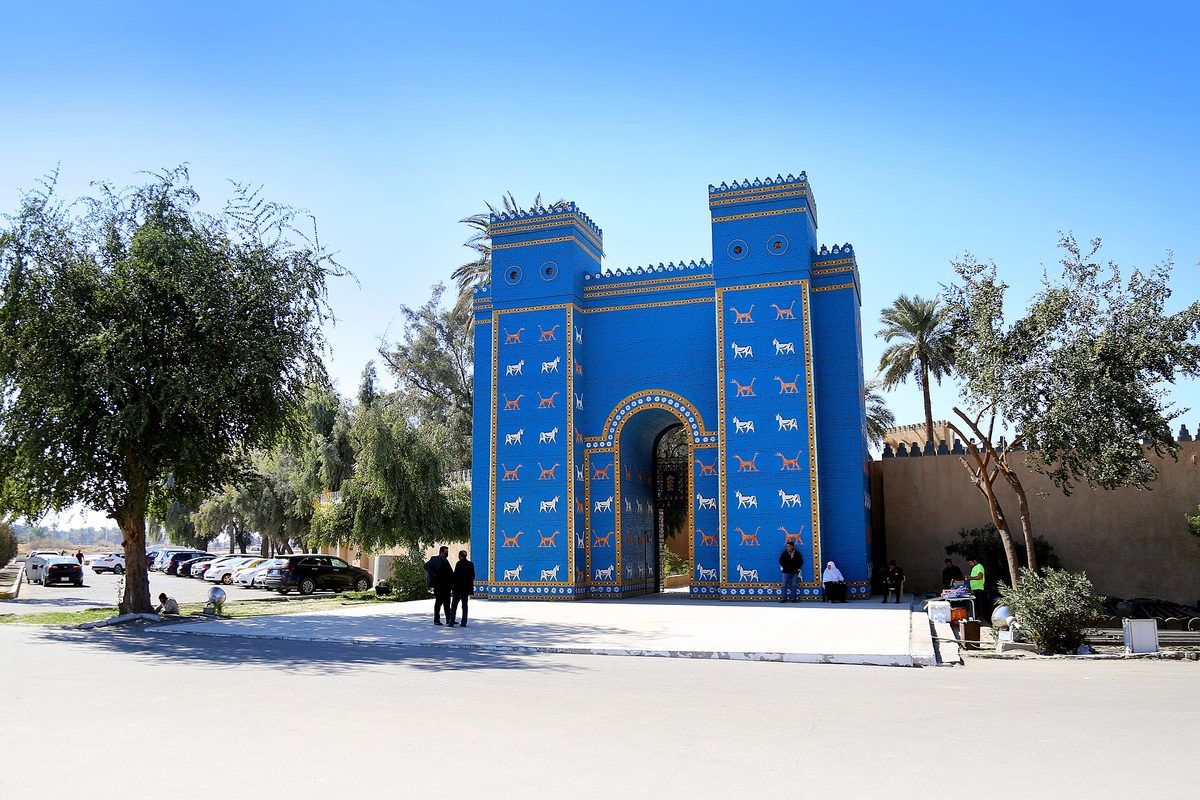
Let me set expectations, because Babylon disappoints people who arrive wanting Berlin’s glazed-brick splendor and delights everyone who arrives wanting Babylon. What you’ll find 85 kilometers south of Baghdad — an easy 90-minute drive, or 15 kilometers from Hillah if you’re staying locally — is a 10-square-kilometer palimpsest: genuine 2,600-year-old foundations, Saddam Hussein’s 1980s reconstruction stacked on top of them, and a UNESCO-supervised restoration slowly sorting one from the other.
You enter past a half-scale replica of the Ishtar Gate, painted that impossible blue. The original — excavated here a century ago — stands in Berlin’s Pergamon Museum, which is itself closed for renovation until at least 2027, its Babylon halls not due back on display until the 2030s. Right now, the best place on the planet to feel Babylon is Babylon.
Inside, the Processional Way runs straight as a ruler between walls that mix ancient brick below and Saddam-era brick above; look for the originals stamped with cuneiform, and the 1980s ones stamped, without a flicker of irony, with Saddam’s own name — “rebuilt in the era of Saddam Hussein.” The basalt Lion of Babylon, the city’s unofficial mascot, crouches over a fallen enemy nearby; scholars still argue whether it’s Mesopotamian at all or a war trophy hauled from Anatolia. Deeper in: the rebuilt Southern Palace where Alexander the Great died (probably; Babylon keeps its secrets), the Ninmah Temple fresh from a World Monuments Fund restoration completed with the Ishtar Gate retaining walls in 2025, and the surviving lower courses of the real Ishtar Gate, animal reliefs intact, slowly being rescued from the groundwater that drowns Babylon’s oldest layers.

Climb the hill afterward to Saddam’s abandoned palace — graffiti, gutted marble, and the best view of the ruins and the Euphrates you’ll get. Entry to the site is 25,000 IQD, plus a token 1,500 for the palace; an on-site guide runs about 15,000 and is worth it here more than anywhere, because Babylon without explanation is just very famous brick. Visitors are returning fast — 43,530 Iraqis and 5,370 foreigners in 2024, per the site’s antiquities inspectorate, up sharply on 2023 — but “fast” is relative. Most mornings you’ll still share Nebuchadnezzar’s throne room courtyard with pigeons.
And the Hanging Gardens? No trace has ever been found at Babylon. The best current scholarship puts them — if they existed — in Sennacherib’s Nineveh, 400 kilometers north. Any guide who points you to “the Hanging Gardens ruins” is being kind to your imagination.
Babylon pairs naturally with Karbala, 45 minutes west, whose shrines anchor my Iraq pilgrimage guide — even non-Muslim visitors find the evening atmosphere unforgettable, and the hotel scene is far better than Hillah’s.
Borsippa: the “Tower of Babel” nobody visits
Twenty minutes southwest of Babylon, the shattered ziggurat of Borsippa — Birs Nimrud locally — rears off the plain with a fused, vitrified core that local tradition says was lightning-blasted Babel itself. It was actually the temple tower of Nabu, god of writing, and the medieval brick tower on top is part of the shrine of Ibrahim al-Khalil, because in Iraq the layers never stop. You’ll likely have all of it to yourself; pay the small fee if the gate is staffed, and tack it onto your Babylon day.
Kish: for the completists
East of Hillah, the tells of Kish — where “kingship descended from heaven” after the flood, per the King List — spread across a dusty plain: an eroded ziggurat core, brick scatter, and the deep satisfaction of standing somewhere that mattered five thousand years ago and is now perfectly, totally quiet. Unstaffed; bring your guide and your imagination.
Day trips from Baghdad: an arch, a ziggurat and a spiral
Basing in Baghdad puts three heavyweights within day-trip range — and the Iraq Museum, which I cover in the museums section below, for the morning you need air conditioning.
Ctesiphon & Taq Kasra: the arch that shouldn’t be standing

Thirty-five minutes south at Salman Pak, the throne-hall arch of the Sasanian capital hangs 37 meters over the floodplain — the largest single-span unreinforced brick vault ever raised, and it’s been hanging there for some fourteen centuries. Photos do not prepare you for the scale. The site has spent recent years in restoration limbo: a Czech-led stabilization finished in 2017, a partial collapse in 2019 restarted the work, and scaffolding has come and gone since. Some weeks visitors walk right up; others it’s photos from the fence. Have your driver call ahead, pay the small fee if the gate’s open, and go anyway — even scaffolded, Taq Kasra is worth the detour, and the riverside fish restaurants at Salman Pak finish the trip properly.
Aqar Quf: Baghdad’s secret ziggurat

Thirty kilometers west of the city center, the Kassite ziggurat of Dur-Kurigalzu is what Ur would look like without the restoration: a gnarled 3,400-year-old mudbrick core punching 50-odd meters out of the plain, reed matting still visible between the courses. Baghdadi families picnic here on Fridays; foreign visitors barely register it exists. UNESCO finally noticed, adding it to the tentative World Heritage list in January 2025, and Italian-Iraqi teams have been digging the palace quarter since 2022. Small fee at the gate, an hour to see, and the best ziggurat-to-effort ratio in Iraq. Pair it with Ctesiphon for a tidy one-day “bookends of Mesopotamia” loop.
Samarra: the minaret you know from every photo
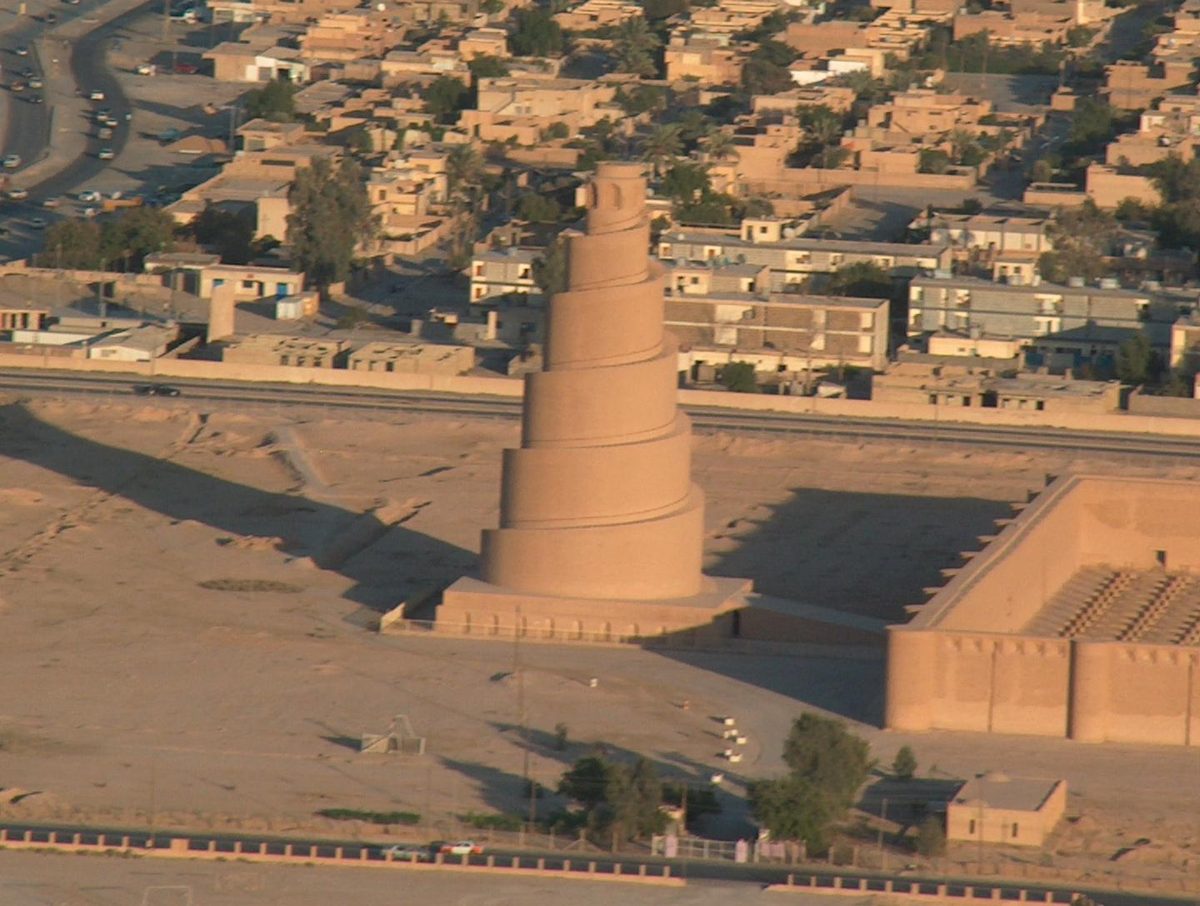
Ninety minutes north of Baghdad (count on checkpoint time — it sits in Saladin governorate), Samarra was the Abbasid caliphate’s purpose-built capital for fifty-six years, and its leftovers are vast: the walls of what was once the world’s biggest mosque, the caliphal palaces, and the 52-meter spiral Malwiya minaret, the most photogenic structure in the country. I have to be straight with you about climbing it: the famous spiral walk has been closed for several years now between restoration work and safety concerns (a fatal fall in 2017 changed the mood), and in 2026 the answer at the gate is consistently no. The complex itself charges 25,000 IQD and is open daily. Samarra is also home to the gold-domed Al-Askari Shrine, one of Shia Islam’s holiest sites — rebuilt after the 2006 bombing — so dress conservatively and expect security to be brisk and businesslike about cameras near the shrine.
The deep Sumerian south: Ur, Eridu, Uruk and Girsu
The far south is where civilization started, and it still feels like the edge of something. Base yourself in Nasiriyah (for Ur, Eridu and Girsu) with Samawah as the stop for Uruk; both are workaday Iraqi cities where a foreigner at breakfast still earns a double-take and three invitations to tea. The southern checkpoint culture is the country’s most relaxed — this is the easiest region of federal Iraq to travel independently.
Ur: the postcard, with one honest update

Twenty minutes from Nasiriyah, the Great Ziggurat of Ur is ancient Iraq’s defining image: the moon god Nanna’s temple platform, raised around 2100 BC and re-faced by Saddam’s restorers in the 1980s, golden and colossal against a flat horizon. Entry is 25,000 IQD for foreigners (3,000 for Iraqis), it’s open daily, and the site is professionally run by southern standards — walkways, signage, a guard who’ll materialize with a ticket book.
The honest update: you can no longer climb the great staircase. For years, walking up those hundred brick steps was the canonical Iraq travel moment — many older guides still describe it — but the stairs have been fenced off for preservation, and recent visitors confirm the ban is being enforced. You can still walk right up to the base and put your hands on bricks stamped with Ur-Nammu’s name. I’d trade the summit view for the close-up anyway; the view is mostly desert and the Ali Air Base fence line.
Give the rest of the site its due: the Royal Cemetery pits where Leonard Woolley pulled out the golden lyres and headdresses now split between Baghdad, London and Philadelphia; the brick vaults he called the world’s oldest standing arches; and the rebuilt “House of Abraham,” venerated as the patriarch’s birthplace — Pope Francis said Mass beside the ziggurat in 2021, the event that quietly restarted tourism here. Allow two hours, more at golden hour, which is the photograph.
Eridu: where the King List starts
Forty minutes southwest of Ur, Eridu is the oldest city in the world by Sumer’s own accounting — “when kingship descended from heaven, kingship was in Eridu,” founded around 5400 BC and home to the shrine of Enki, god of fresh water and wisdom, rebuilt on the same spot for four thousand years. What’s physically there: low mounds, a ziggurat stump, and a desert floor literally paved with five-thousand-year-old pottery sherds. There’s no ticket office, no fence, no shade — just you, the silence and the spot where cities began. Access is by arrangement: your guide squares it with the checkpoint and the local antiquities men. Purists leave moved; everyone else leaves dusty. Know which you are.
Uruk: the first city on Earth

Uruk invented the city. Five and a half thousand years ago it held tens of thousands of people inside a nine-kilometer wall ascribed to King Gilgamesh himself; its accountants, pressing reeds into clay around 3300 BC, invented writing. Today it’s Warka, a half-hour east of Samawah past date gardens and then nothing — a vast brown moonscape of mounds where German teams have dug, on and off, for a century. You’ll see the eroded Anu ziggurat that once carried the White Temple, deep excavation trenches through the Eanna precinct, clay cone mosaics still studding a rebuilt wall section, and sherds underfoot in every direction.
There’s no ticket booth; visits run on the local system — your guide or driver phones ahead, the site guards open the gate, and a respectful tip changes hands. (A German Archaeological Institute team maintains the dig house, and active seasons can adjust where you’re allowed to wander.) It’s a half-day from either Samawah or Nasiriyah, and it is, for my money, the most affecting site in Iraq: Babylon has the name, Ur has the image, but Uruk has the idea — everything a city has ever been started in this exact dirt.
Girsu: the oldest bridge in the world
Northeast of Nasiriyah at Tello, Girsu is the connoisseur’s stop: the sacred city of the god Ningirsu, source of most of the Sumerian statuary in the Louvre, and since 2015 the home of the British Museum’s flagship Girsu Project. Their teams re-exposed the world’s oldest known bridge — third millennium BC, mistaken for a temple when it surfaced in 1929 — and in 2023 uncovered the “Lord Palace of the Kings” and a lost temple of Gudea’s dynasty. It’s a working dig site rather than a tourist one: no ticketing, occasional closures in season, arrange through your guide and don’t expect interpretation panels. For Sumerophiles, that’s the appeal.
One more pairing while you’re down south: the Ahwar World Heritage listing ties these ruins to the living Mesopotamian Marshes an hour east, and a reed-boat afternoon out of Chibayish is the perfect counterweight to a morning of dead cities — details in my best places in Iraq guide.
The Assyrian north: Nineveh, Nimrud, Hatra and Ashur
The north carries different weight. These are the sites ISIS filmed itself destroying in 2015–2016, and visiting them now means watching the most determined heritage comeback on Earth — cranes over mosque minarets, archaeologists piecing reliefs back together like jigsaw conservators. It also means more checkpoints and more paperwork than the south; read the northern sections of my Iraq safety guide and work with a Mosul-based guide, who will handle the permissions that several of these sites still require.
Nineveh: the great city, rising again
Across the Tigris from Mosul’s old city, Nineveh was the largest city on Earth in 700 BC — Sennacherib’s “palace without rival,” twelve kilometers of walls, the library of Ashurbanipal whose clay tablets gave us Gilgamesh. ISIS bulldozed the rebuilt Mashki and Adad gates in 2016; the answer has been remarkable. Reconstruction teams working on the Mashki Gate found seven 2,700-year-old marble reliefs of Sennacherib’s campaigns in 2022 — carvings nobody had seen since Assyria fell — and the gate is being rebuilt as an educational center about the ancient city. In 2026 you can trace long stretches of the wall circuit and watch the gates rising; the palace mounds of Kuyunjik open only intermittently for works, so treat anything beyond the walls as a bonus your guide may or may not unlock.
Give the rest of your Mosul day to the old city itself: the Al-Nuri Mosque and its famous leaning Al-Hadba minaret were re-inaugurated on September 1, 2025 after UNESCO’s “Revive the Spirit of Mosul” rebuild, and walking the restored riverside lanes — bombed flat seven years ago, now full of juice stands and wedding photographers — is the most hopeful thing you’ll do in Iraq.
Nimrud: the hardest visit, and the most important
Thirty-five kilometers southeast of Mosul, Ashurnasirpal II’s capital — biblical Calah — held the Northwest Palace and its winged-bull lamassu until ISIS dynamited it in 2015, an act calculated for the cameras. What you’ll see now is sobering and oddly stirring: terraces of numbered fragments, conservation tents, Iraqi and international teams literally reassembling smashed reliefs piece by piece. Access remains restricted and runs through your guide’s relationship with the antiquities police; some months it’s a yes, some a no. Go if you can. Nimrud teaches what the glossy sites can’t — that this heritage survives on purpose, because people keep choosing to save it.
Hatra: the desert city that came back
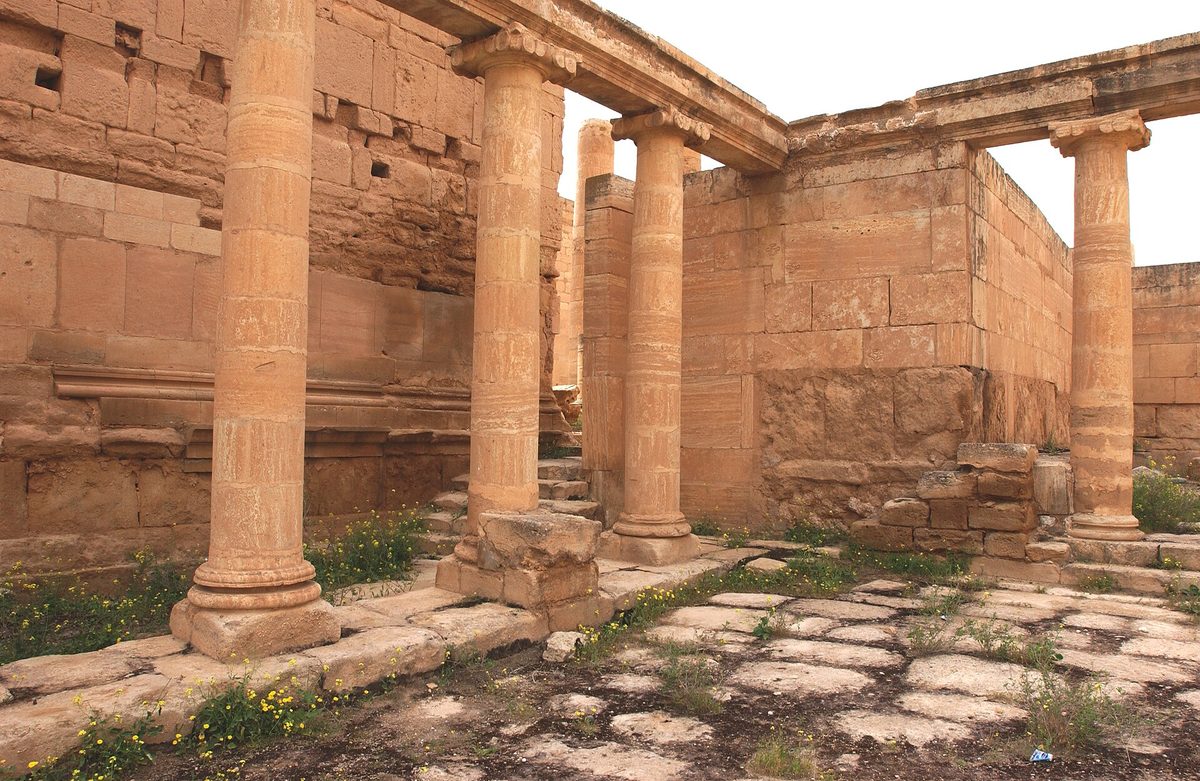
A hundred and ten kilometers southwest of Mosul, alone on the steppe, Hatra is the site that converts people. A round caravan city of the first and second centuries AD, it fused Greek columns, Roman arches and Arab gods into honey-colored temple facades that survived two Roman sieges and very nearly survived ISIS, who used it as a training camp and took hammers to its reliefs for a propaganda video. The damage touched perhaps 15 percent of the carvings; the bones of the place stood firm. Hatra reopened to tourists in early 2024, restorers unveiled three resurrected sculptures in February 2025, and visits in 2026 run as guided day trips from Mosul — your operator arranges the approvals, you bring water, lunch and a hat, because there are no facilities for fifty kilometers in any direction. Iraq’s first World Heritage Site (1985) is once again its most atmospheric.
Ashur: Assyria’s holy city
On a bluff over the Tigris at Qal’at Sherqat, halfway between Baghdad and Mosul, Ashur was Assyria’s first capital and its eternal religious heart — every king came home here to be crowned and buried beside the god who shared the empire’s name. The ruins are romantic in the proper sense: a ziggurat core, palace foundations, and the river bend below. It sits in a checkpoint-heavy stretch of Saladin governorate, so it’s a site you visit with a guide who’s called ahead, usually woven into the drive between Baghdad and Mosul rather than as its own excursion. UNESCO listed it (and flagged it as in-danger) in 2003 over a dam proposal downstream that has been shelved and revived more than once since — see it while the Tigris still runs free beneath it.
Erbil Citadel & the Kurdish north
Iraqi Kurdistan plays by its own rules — separate visa, separate vibe, and a gentler introduction to Iraq generally. Its archaeological centerpiece is the Erbil Citadel, a UNESCO-listed oval mound rising thirty meters above the bazaar with a claim to six thousand years of continuous habitation; one family famously remains resident inside so the streak never breaks. Entry is free, the textile museum is worth your hour, and renovation scaffolding is part of the view. Beyond Erbil, the region hides Neanderthal burials at Shanidar Cave and rock reliefs in valleys the Assyrians once marched through; my full Iraqi Kurdistan guide covers the circuit, including how the Kurdish visa differs from the federal one.
How visiting archaeological sites in Iraq actually works
Everything below is the system as it actually functions in June 2026 — not the rulebook version, because there isn’t really a rulebook.
Tickets and hours. The staffed headline sites — Babylon, Ur, Samarra, the museums — charge foreigners 25,000 IQD (about $19) almost as a flat rate, Iraqis around 3,000, cash only, no advance booking, gates roughly 8 or 9 a.m. to around sunset. Fridays bring local families, which I count as a feature. Everywhere else — Uruk, Eridu, Girsu, Kish, Nimrud — there is no ticket office at all: entry happens because your guide or driver called the right person, the gate opened, and hospitality plus a modest tip did the rest.
Guides and permits. You don’t need a permit-in-advance from Baghdad to see the famous staffed sites independently. The unstaffed tells and anything in the north (Hatra, Nimrud, Ashur, parts of Nineveh) are a different game: access runs through Iraq’s State Board of Antiquities and Heritage via local fixers and the antiquities police, and a good guide makes those calls before you’ve finished breakfast. Don’t free-lance your way onto a remote tell; from a checkpoint’s point of view, an unannounced foreigner wandering a ruin looks like trouble, and at worst like a looter.
Checkpoints. The texture of Iraqi road travel. Carry your passport always, expect your driver to do the talking, never photograph the checkpoint itself, and budget real time for them in Saladin and Nineveh provinces (the Samarra, Ashur, Mosul runs). The south barely slows you down.
Heat, water, shade. None of these sites has meaningful shade and only Babylon and Ur reliably have toilets and a kiosk. October to March is the season I recommend; April is pushing it; June through September means 45–50°C and dawn starts or heatstroke — I’ve done Uruk in July and don’t recommend that version of me to anyone. Two liters of water per person minimum, closed shoes (the ground is all sherds and camel thorn), hat, and sunscreen you’ll actually reapply.
Dress and manners. Site-wise, normal modest travel clothes are fine for everyone; women only need a headscarf at shrines, not ruins. Pocket the drone unless you enjoy long conversations with security men. And leave every sherd where it lies — export of antiquities is a serious crime, and the checkpoint on your way out knows it.
The paperwork and the bigger picture. Most nationalities now enter on the federal e-visa (about $160 via evisa.iq, insurance included — visa-on-arrival ended March 2025); the full process is in my Iraq visa guide. Security-wise, the tourist corridors have run calm for years while official advisories remain at their sternest — I unpack that gap, region by region, in the safety guide, and the practical logistics of drivers, buses and hotels live in the main Iraq travel guide.
The museums: where Mesopotamia’s treasures actually live
Here’s the expectation-setter no other guide gives you: the sites hold the architecture; the portable masterpieces live indoors, scattered across Baghdad, Mosul, Berlin, London and Paris.
The Iraq Museum, Baghdad. The mothership — the Warka Vase, the Ram in the Thicket, the Hatra statuary, the world’s deepest Mesopotamian collection. It closed in July 2025 for its biggest renovation in decades, with reopening promised for 2026 and some 27,000 recovered artifacts being reinstalled; as I write this the doors are not yet confirmed open, so check locally before building your Baghdad day around it (entry has been 25,000 IQD, closed Fridays). When it’s open, go first, before Babylon: an hour with the originals makes the empty pedestals out at the sites make sense. More in my Baghdad guide.
Mosul Cultural Museum. Smashed on camera by ISIS in 2015, rebuilt since by an alliance of the Louvre, the World Monuments Fund, the Smithsonian and ALIPH — conservators have spent years reassembling the Banquet Stele and the great Nimrud lion from fragments. Reopening is slated for 2026; if it’s open when you visit Mosul, it instantly becomes the north’s essential indoor stop.
The site museums. Babylon keeps a modest one near the Ishtar Gate replica; Erbil’s citadel hosts the lovely Kurdish Textile Museum; the Sulaymaniyah Museum, over in Kurdistan, quietly holds Iraq’s second-best collection, including serene second-century heads from Hatra.
And abroad: the original Ishtar Gate is in Berlin (locked away until the Pergamon’s Babylon wing returns, currently projected for the 2030s); Ur’s royal gold is split between the British Museum and Penn Museum; the Louvre has Girsu’s statues; Nineveh’s best reliefs line London. I find this less depressing than motivating — you can see Mesopotamia’s treasures on three continents, but you can only stand in Mesopotamia here.
How to string the sites together
One day (from Baghdad): Ctesiphon’s arch at opening time, Aqar Quf after lunch — the two best ruins within an hour of the capital, bracketing 2,000 years. Or give the whole day to Babylon and Borsippa with a Karbala evening.
Three days (the Sumerian south): drive Baghdad–Babylon–Nasiriyah day one; Ur at golden hour; day two Uruk via Samawah or Eridu plus Girsu depending on your guide’s phone calls; day three the marshes from Chibayish, then on to Basra or back north. This is the route I’d defend in an argument.
Three days (the Assyrian north): Mosul old city and Nineveh’s walls day one, Hatra day two, Nimrud and/or Ashur day three as permissions allow, with Erbil as your decompression exit into Kurdistan.
Ten days (the full Mesopotamia): Baghdad and its day trips (3), Babylon–Karbala (1), the deep south (3), then fly or drive north for Mosul–Hatra–Erbil (3). That’s every era of the timeline above, in order, in a week and a half.
Archaeological sites in Iraq: your questions, answered
Can you visit Babylon in Iraq today?
Yes — Babylon is open daily to independent visitors, no special permit needed. Entry is 25,000 IQD plus 1,500 for Saddam’s palace, it’s about 90 minutes’ drive south of Baghdad, and 2024 saw nearly 49,000 visitors. The UNESCO listing (2019) and ongoing restorations have steadily improved the experience.
How many UNESCO World Heritage Sites does Iraq have?
Six: Hatra (1985), Ashur (2003), Samarra Archaeological City (2007), Erbil Citadel (2014), the Ahwar of Southern Iraq with Ur, Uruk and Eridu (2016), and Babylon (2019). Three — Ashur, Samarra and Hatra — are also on the in-danger list, and about fifteen more sites sit on Iraq’s tentative list.
Can you climb the Ziggurat of Ur?
Not anymore. The grand staircase that visitors climbed for years is now fenced off for preservation, and recent travelers confirm the ban is enforced. You can still stand directly against the ziggurat’s walls and circle the whole structure — older guides describing the summit view are out of date.
Do the Hanging Gardens of Babylon still exist?
No identified trace of them has ever been found at Babylon, and the leading modern theory locates the gardens — if they were real — at Nineveh, built by Sennacherib. Treat any “Hanging Gardens ruins” at Babylon as folklore; the site’s genuine wonders are the Ishtar Gate remains and the processional way.
Where is the original Ishtar Gate?
In the Pergamon Museum in Berlin, excavated from Babylon in the early 1900s. The Pergamon has been fully closed for renovation since 2023; its Babylon halls aren’t expected back until the 2030s. Babylon itself displays the surviving lower courses in situ, plus the famous blue half-scale replica.
Did ISIS destroy Nineveh, Nimrud and Hatra?
They damaged all three between 2015 and 2016 — bulldozing Nineveh’s rebuilt gates, dynamiting Nimrud’s Northwest Palace, defacing statues at Hatra — but far more survives than the videos suggested. Hatra lost perhaps 15% of its carvings and reopened in 2024; Nineveh’s gates are being rebuilt; Nimrud’s reliefs are being reassembled fragment by fragment.
Do you need a guide or permit to visit archaeological sites in Iraq?
For Babylon, Ur, Samarra, Aqar Quf and Erbil: no — buy a ticket and walk in. For unstaffed southern tells (Uruk, Eridu, Girsu, Kish) and most northern sites (Hatra, Nimrud, Ashur), access is arranged through local guides who coordinate with antiquities authorities and checkpoints. No tourist obtains these permissions alone.
Is the Iraq Museum in Baghdad open?
It closed in July 2025 for a major renovation, with officials promising reopening during 2026 and 90% of works reported complete by early in the year. Confirm its current status locally (or via recent traveler reports) before planning around it — and when it reopens, it’s the single best indoor experience in Iraq.
What is the oldest city in the world — Eridu or Uruk?
Both have a claim. Eridu is older as a settlement (c. 5400 BC) and the Sumerian King List names it first; Uruk (c. 4500 BC) became the first true city — tens of thousands of people, monumental temples, and the invention of writing around 3300 BC. My answer: Eridu is the oldest place, Uruk the first city.
Is it safe to visit Iraq’s archaeological sites in 2026?
The sites travelers actually visit — everywhere in this guide — sit in regions that have been calm for several years, and thousands of foreign tourists did this trip last year. Advisories remain strict, the north needs more care than the south, and conditions can change; read a current, region-by-region breakdown before you book.
Final thoughts: the cradle, while it’s quiet
Somewhere in your trip — maybe on the ziggurat plain at dusk, maybe alone in Nebuchadnezzar’s courtyard — it will land on you that the crowds are coming. The restorations are accelerating, the museums are reopening, the tour groups multiply every season, and one day there will be turnstiles and audio guides and a queue at the Lion of Babylon. Not yet. Right now the world’s oldest places are open, welcoming and astonishingly empty, and the people who look after them are delighted you came. Sort the visa, pick a cool month, and go stand where everything started.
Photo credits
All images via Wikimedia Commons: Michael Lubinski (CC BY-SA 2.0); Alli Khalil (CC BY-SA 4.0); Osama Sarm (CC BY-SA 4.0); Hamody al-iraqi (CC BY-SA 4.0); Safa.daneshvar (CC BY-SA 4.0); Jim Gordon (CC BY 2.0); 138th Public Affairs Detachment, U.S. Army (public domain); Osama Shukir Muhammed Amin FRCP(Glasg) (CC BY-SA 4.0); SAC Andy Holmes, RAF (OGL v1.0). Full attribution and source links available on request.