Last updated: 6 June 2026 — advisory status, visa rules and flight resumptions checked against primary sources on that date. See our 25 Iraq travel tips guide.
The first time you cross from the checkpoint queue into Erbil’s evening bazaar crowd, you understand why everyone calls Iraqi Kurdistan “the other Iraq.” Same passport stamp says Iraq; everything else — the flag, the language, the visa, the mood — says somewhere else entirely.
Iraqi Kurdistan is the autonomous northern region of Iraq — Erbil, Sulaymaniyah, Duhok and the Zagros mountains — with its own visa-on-arrival for most Western passports, its own airports and the calmest security picture in the country. It’s Iraq’s easiest first step: citadels, monasteries, canyon roads and serious hiking, no tour required.
I’ve structured this the way you’ll actually plan: the honest safety picture first, then the visa, then the places — Erbil to the Hamilton Road — then the logistics that make or break the trip. It’s long because it’s complete; the table of contents will save you.
In this guide: At a glance · Why Kurdistan first · Safety in 2026 · The Kurdistan visa · Getting there · Erbil · Sulaymaniyah · Duhok, Lalish & the north · The Hamilton Road · Lakes, caves & mountains · One-week itinerary · Getting around · Money & costs · Culture & rules · Where to stay · When to go · FAQ
Iraqi Kurdistan at a glance (June 2026)
| Question | The short answer |
|---|---|
| Visa | 100,000 IQD (~$70–80) on arrival at Erbil/Sulaymaniyah for ~50 eligible nationalities, or e-visa in minutes at visit.gov.krd. Kurdistan-only — never valid for Federal Iraq |
| Safety | Calmest part of Iraq on the ground; note that since early 2026 Western advisories no longer exempt it — full breakdown here |
| Airports | Erbil (EBL) and Sulaymaniyah (ISU); both back to normal schedules since May–June 2026. Istanbul–Sulaymaniyah resumed November 2025 after 2.5 years |
| Currency | Iraqi dinar, ~1,310 IQD to the dollar. Cash region — bring crisp USD; a few ATMs work (Bank of Baghdad, Byblos) |
| Language | Kurdish (Sorani in Erbil/Sulaymaniyah, Kurmanji around Duhok); Arabic understood but not loved; young people surprise you with English |
| Best time | Mid-March–April (green hills, Newroz fire festival) and October–mid-November. Summer hits 45°C; mountain winters get real snow |
| Daily budget | $40–60 backpacker, $80–150 mid-range — hotels are the big line; food and shared taxis are cheap |
| Getting around | Shared taxis and minivans from each city’s “garaj” — no trains, no real buses. Erbil–Sulaymaniyah from ~10,000 IQD |
| Alcohol | Legal and easy — liquor shops everywhere, bars in Erbil and Sulaymaniyah |
| SIM | Korek has the best mountain coverage; Asiacell strong in Sulaymaniyah. Counters at both airports, passport required |
One country, two systems — and why Kurdistan is the easier door
Everything about travel in Iraq starts with one fact: the country runs two parallel systems. Federal Iraq (Baghdad, the holy cities, the marshes, Mosul) and the Kurdistan Region (Erbil, Sulaymaniyah, Duhok) have separate visas, separate security forces, different dress norms and noticeably different rhythms. I’ve written about that split at length in the main Iraq travel guide; here’s what it means for a Kurdistan trip specifically.
The Kurdistan Region has governed itself since 1991, fields its own army (the Peshmerga), and runs its own immigration. Arriving at Erbil airport feels closer to landing in Tbilisi than in Baghdad: the visa is paid by card at a counter in minutes, nobody asks for a tour operator, and the city outside runs on espresso, construction cranes and a startling number of shopping malls.
The practical consequences, in both directions:
- Easier in: visa on arrival for most Western passports (Federal Iraq abolished VoA in March 2025 — e-visa only, ~$160). Kurdistan’s costs 100,000 IQD and takes minutes.
- Calmer on the ground: Erbil at midnight is families eating ice cream under the citadel walls. Checkpoints exist but wave tourists through with a smile and occasionally a selfie.
- But it’s a sealed garden: the Kurdish visa is valid only inside the Kurdistan Region. The internal boundary with Federal Iraq is enforced at checkpoints, and travelers attempting the Erbil-to-Baghdad continuation on a Kurdish visa get turned around. If you want Baghdad, Babylon or the holy cities on the same trip, enter on the federal e-visa instead — it covers the whole country, Kurdistan included.
That last point is the single most expensive mistake people make planning Iraq, so I’ll say it twice more in this guide and won’t apologize for it.
Is Iraqi Kurdistan safe in 2026? The honest version
Two true things, and you need both. On the ground, Iraqi Kurdistan remains what it’s been for a decade: the lowest-friction, most independently walkable part of Iraq — a place where solo women report easier trips than in half the Mediterranean, where petty crime is genuinely rare, and where the main daily annoyances are checkpoint waits and mountain-road drivers with opinions about overtaking.
On paper, 2026 changed the wording. After the regional escalation between Iran, Israel and the United States in early 2026 — which shut Iraqi airspace for several weeks in March and April — Western governments hardened their advisories and, for the first time in years, stopped carving Kurdistan out:
- The US State Department renewed Iraq at Level 4 “Do Not Travel” on March 2, 2026, ordered non-emergency staff out, and names the Kurdistan Region explicitly in its militia-threat language.
- The UK FCDO currently advises against all travel to Iraq including the Kurdistan Region — a post-February 2026 change. For years Kurdistan carried only the softer “all but essential” wording; that exemption is gone for now.
What does June 2026 actually look like? The ceasefire is holding on Iraqi territory, airspace reopened in late April, and Erbil airport returned to effectively full schedules by early June — Turkish Airlines and Pegasus resumed on May 8, Qatar Airways on May 10. Travelers are moving through Erbil, Sulaymaniyah and the mountains without incident, and the region’s own security apparatus remains the most professional in Iraq. I cover the advisory-versus-reality gap, region by region, in the full Iraq safety guide — the short version is that advisories price in embassy capacity and escalation risk, not street crime, and Kurdistan’s street-level record is still excellent.
The honest caveats I’d give a friend:
- Insurance: traveling against a “do not travel” advisory voids most mainstream policies. Specialist insurers (IATI is the one most Iraq travelers use) still cover Kurdistan — read the exclusions line by line.
- The border strips are not the region: the Turkey and Iran frontier zones see periodic Turkish airstrikes against PKK positions and occasional drone incidents. Tourist Kurdistan — the cities, Lalish, the Hamilton Road, Dukan — sits well away from them. Don’t camp near either border, and don’t hike off-trail near Choman without a local guide.
- Old ordnance: landmines from the Iran–Iraq war persist off-trail in the high mountains. Marked paths, local knowledge, no freelancing.
- Americans, one more thing: any travel to Iraq (Kurdistan included) ends your ESTA/Visa Waiver eligibility for future trips — you’ll need a regular US visa interview if you’re not a citizen. Factor it in.
The Kurdistan visa in 2026: on arrival, in minutes
The Kurdistan Region runs its immigration through the official portal visit.gov.krd, and it’s the friendliest system in Iraq. The full two-system explanation lives in the Iraq visa guide; here’s the Kurdistan half, verified against the portal this week.
| Country List A (US, UK, EU, Canada, Australia, Japan and ~50 others) | Country List B (everyone else) | |
|---|---|---|
| How | E-visa online in minutes, or on arrival at any Kurdistan entry point | E-visa only, via a registered guarantor in the region (hotels and tour companies do this) |
| Cost | 100,000 IQD (~$70–80), card payment fine | 100,000 IQD + whatever your guarantor charges |
| Processing | Minutes (e-visa) or at the counter | Up to five working days after the guarantor submits |
| Stay | 30 days from entry; the visa itself is valid 90 days from issue | |
| Passport | Six months’ validity and one blank page | |
| Valid for Federal Iraq? | No. Never. Checkpoints enforce it. The federal e-visa (~$160 at evisa.iq) covers Kurdistan; the Kurdish visa does not work in reverse | |
Three fine-print notes worth knowing — our Iraq entry requirements guide sets the two systems side by side. First, on paper Baghdad declared the federal e-visa portal the single national system in late 2025, Kurdistan’s airports included — in practice the Kurdish system runs on, unbothered, and arrivals at Erbil report the same card-payment counter as ever; I’d still carry a printed e-visa rather than rely on the counter in 2026’s shifting environment, because it costs you nothing and removes the one variable you can’t control. Second, overstays are charged per day and exit officers do count. Third, if your trip is “Kurdistan now, Baghdad someday,” think hard about doing the whole country on one federal e-visa instead — two separate trips means two visas and two flights, and the maths rarely favors it.
How to get to Iraqi Kurdistan
By air: Erbil and Sulaymaniyah
Erbil International (EBL) is the region’s main gateway and, after the spring 2026 airspace closure, was back to a near-normal board by early June: Turkish Airlines and Pegasus from Istanbul, flydubai and Emirates from Dubai, Qatar Airways via Doha, Royal Jordanian from Amman, Egypt Air from Cairo, plus Iraqi Airways. Istanbul and Dubai are almost always the cheapest doors. Budget one airport quirk: security here is layered — vehicle scan, terminal scan, gate scan — so the standard advice is three hours, not two.
Sulaymaniyah (ISU) is the comeback story. Turkey banned flights over PKK allegations in April 2023 and lifted the ban in October 2025 after the PKK’s disbandment and an Erdoğan–Barzani meeting; Turkish Airlines returned on November 2, 2025 and went daily with the March 2026 summer schedule, with Pegasus back on the Sabiha Gökçen run. If your route is Sulaymaniyah-first — and there’s a case for it — you no longer need to backtrack through Erbil.
One warning that survives every news cycle: regional escalations close this airspace fast, as March proved. Book refundable where you can, and check your airline’s status the week you fly, not the month before.
By land: the Turkey crossing and the Iran options
The classic overland entry is Ibrahim Khalil (Habur on the Turkish side), near Zakho. Direct buses run Diyarbakır–Erbil for around $30 in roughly 8 hours when the border behaves, and through-tickets are bookable on Turkish bus platforms. Entering Iraq is usually the quick direction — under an hour of stamps and a bag scan. Exiting toward Turkey is the famous one: three hours is normal, and holiday-weekend horror stories run much longer. Kurdish visa rules apply at this crossing — List A nationalities can pay on arrival, but I’d arrive with the e-visa done.
From Iran, two crossings work for travelers: Bashmaq (near Marivan, an hour from Sulaymaniyah) and Haji Omaran, which deposits you at the top of the Hamilton Road for what might be the most scenic border arrival in the Middle East. Both are pilgrim-heavy and functional; have your visa sorted before you show up.
From Federal Iraq — Baghdad or Mosul — you’ll pass the internal boundary checkpoints. With a federal e-visa this is routine (shared taxis Baghdad–Erbil run daily); with a Kurdish visa heading south it’s a refusal, as covered above. Routes and the checkpoint rhythm are in the main guide’s getting-around section.
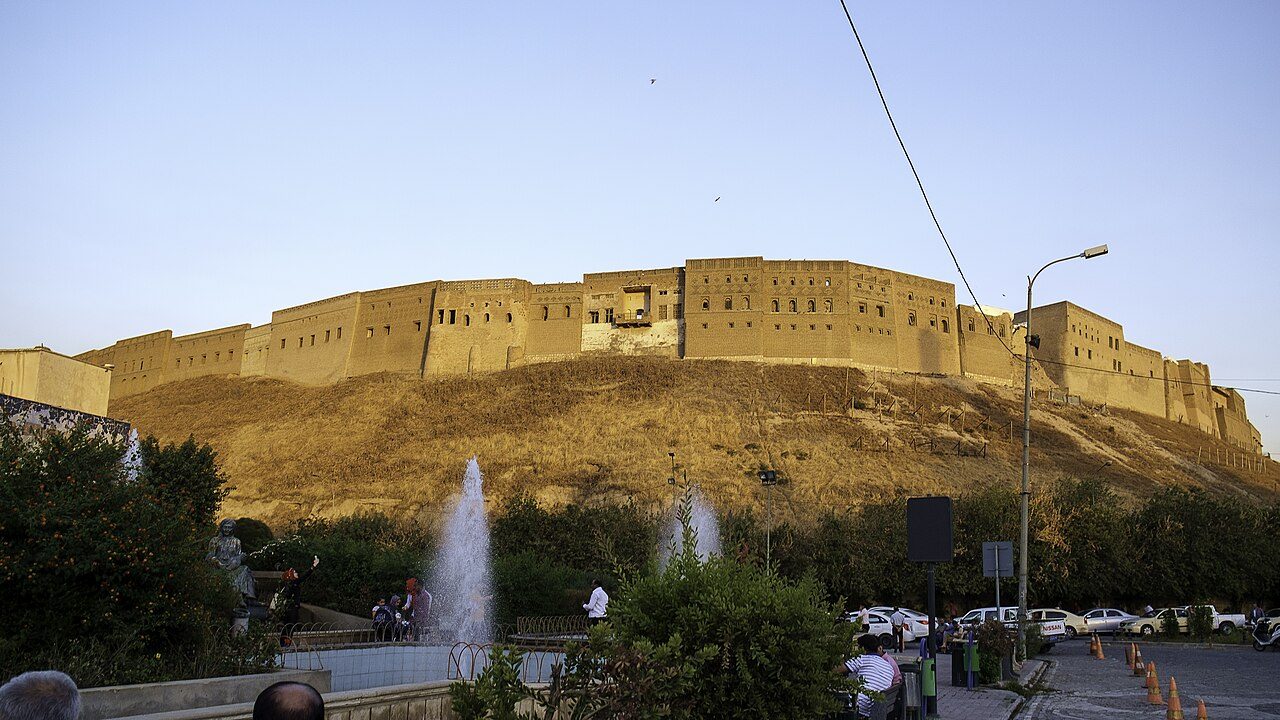
Erbil travel guide: the citadel and the city around it
Erbil (Hawler in Kurdish) is built like a dartboard, and the bullseye is the Citadel — a raised oval mound that’s been continuously inhabited for something like 6,000 years, which makes “old town” feel like an understatement. UNESCO listed it in 2014; restoration has been running ever since, so expect a mix of beautifully restored mansions, active workshops and scaffolding. Entry is free, the Kurdish Textile Museum inside is small and worth it, and the rampart view over the fountain square at sunset is the region’s signature photograph.
What I actually recommend in Erbil, in the order I’d do it:
- The Qaysari Bazaar, directly below the citadel — gold alleys, spice pyramids, tea shops and the general sense that commerce here predates most countries. Go hungry; leave with honey, dates and at least one carpet you didn’t plan on.
- Machko Chai Khana, a century-old teahouse built into the citadel wall, papered with photographs of Kurdish writers and revolutionaries. Tea costs pennies; the people-watching is priceless. It’s the room where Erbil talks to itself.
- The fountain square (Shar Garden) at dusk, when half the city turns out for ice cream and the citadel glows. This, more than anything, is the “is this really Iraq?” moment.
- Jalil Khayat Mosque — Erbil’s grandest, Ottoman-meets-modern, open to respectful visitors outside prayer times.
- Sami Abdulrahman Park, a vast green lung built on a former military base — Friday picnic culture at full volume.
- Ankawa, the historically Christian district near the airport: liquor stores, Assyrian restaurants, and the bars where Erbil’s expats and locals mingle. Friday nights are lively in a way that re-calibrates your assumptions about Iraq.
Give Erbil a day or two, not a week — it’s the region’s comfortable base and transport hub more than its main event. The mountains are the main event. Day trips worth bolting on: Shaqlawa (a green hill resort town 50 minutes northeast, famous for sweets), and the Mar Mattai monastery on the Nineveh plain — though note Mar Mattai technically sits in federally-administered territory, so check your visa situation and the checkpoint mood before committing; I cover it properly in the 25 best places in Iraq.

Sulaymaniyah: the café capital with the hardest museum
Three hours southeast of Erbil (via the Dukan road — more on that routing below), Sulaymaniyah is Kurdistan’s cultural counterweight: younger, artier, more liberal, historically the PUK’s city where Erbil is the KDP’s. If Erbil is the region’s office, Suli is its bookshop-café, and plenty of travelers end up liking it more.
The essential stop is Amna Suraka — the “Red Security” building, Saddam’s former intelligence headquarters and prison, kept bullet-pocked exactly as it fell in 1991 and turned into a museum. The hall of mirrors with a shard for every Anfal victim, the cells, the kit left where it stood: it’s the museum that explains modern Kurdistan, and it’s free (closed Fridays — and hours shift, so go mid-morning, midweek). Pair it with the Slemani Museum, Iraq’s second museum after Baghdad’s, with Paleolithic material from Shanidar Cave among much else.
Then let the city do its actual thing: the Grand Bazaar, bigger and less polished than Erbil’s; the bookshop cafés around Salim Street, full of students who will adopt you mid-espresso; Mount Goyzha at sunset for the city-bowl view (Chavi Land’s cable car runs up it in season). Sulaymaniyah is also the natural base for Halabja, 1.5 hours southeast — the town gassed on 16 March 1988, where the memorial and museum are sobering, necessary and handled with more grace than you might brace for. Shared taxis run from Suli’s garaj all morning; combine Halabja with the Ahmadawa springs area on the Iran border ridge if you have a driver.
A practical note travelers miss: Sulaymaniyah hosts the region’s one real backpacker institution (the Dolphin Hostel), which makes it the easiest place in Iraq to find trip partners for splitting drivers to the mountains.

Duhok, Lalish and the north
Duhok, the third city, sits in a bowl of mountains near the Turkish border and works best as a base rather than a destination: a likeable bazaar, a dramatic gorge dam at the city’s edge, and the Kurmanji-speaking north’s easier access to Lalish, Amedi and Akre. Coming overland from Turkey, it’s your first real stop after Zakho — where the elegant old Delal Bridge deserves your first chai break in Iraq.
Lalish: the Yazidi holy valley
Lalish is the holiest place of the Yazidi faith — a temple complex folded into a green valley about an hour from Duhok, centered on the conical-spired sanctuary of Sheikh Adi. After everything the Yazidis survived in 2014, visits here carry weight; come with the respect you’d bring to someone’s family home, because that’s functionally what it is.
The rules, and they matter: everyone walks barefoot — the whole site, streets included, so bring socks for summer stone or winter cold; never step on a threshold, always over (they’re sacred); dress modestly; and skip blue clothing, traditionally avoided here. Visits are hosted rather than freelance these days — expect to be met and shown around by a local, often a young Yazidi volunteer, rather than wandering solo as older blog posts describe. Inside the sanctuary you’ll see pilgrims knotting and unknotting the colored silks on the tombs — each knot a wish tied, each untied knot someone else’s wish released. There’s no entry fee; donations are welcomed. No public transport runs there — take a taxi from Duhok or fold it into an Erbil–Duhok day with a driver.

Amedi and Akre: the two hill towns
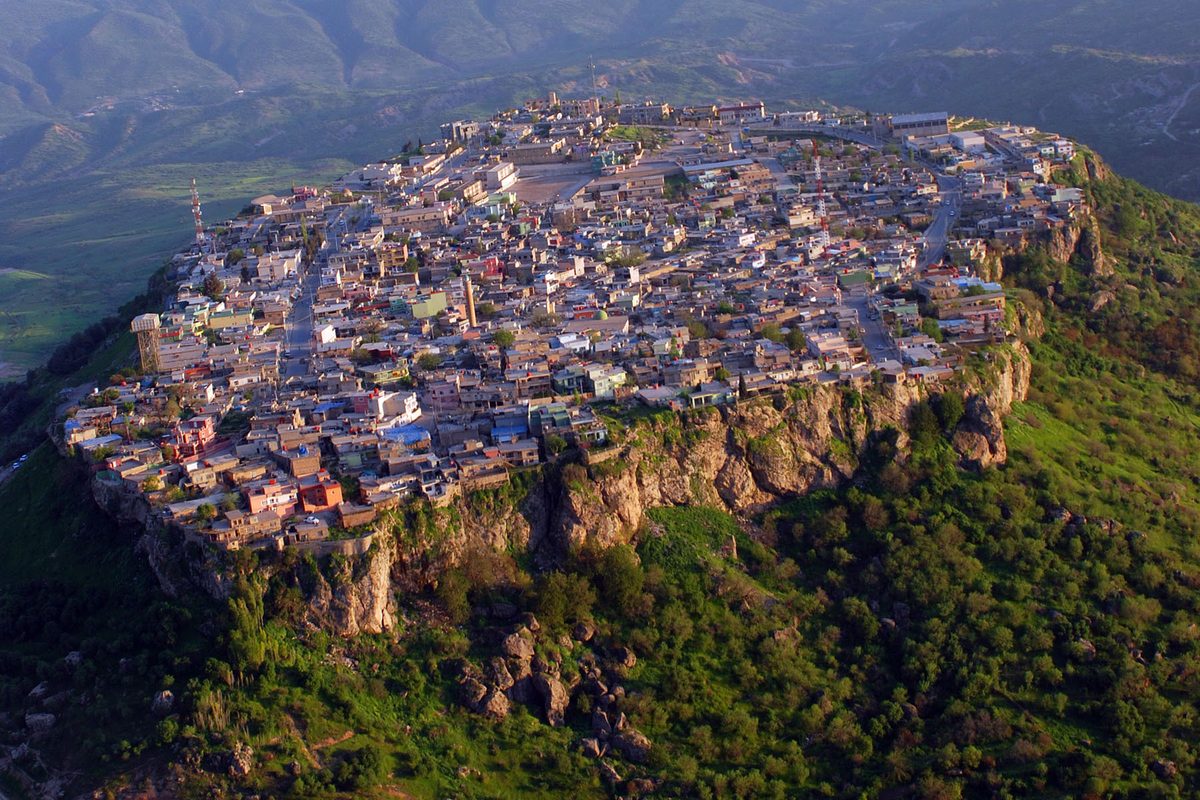
Amedi (Amadiya) is the one you’ve seen in photographs even if you don’t know it: a complete town on a flat-topped mesa at 1,200 meters, inhabited for millennia and traditionally claimed as home of the Magi. You come for the setting more than any single sight — the Bahdinan Gate, the minaret, the rim-walk views — and that’s enough. The Sulav resort strip below the mesa handles lunch under walnut trees. Go April–June when the valley is impossibly green.
Akre (Aqrah) argues with Amedi for the title of Kurdistan’s prettiest town — old stone houses stacked up a mountain saddle, best seen from the zigzag path above the old quarter. Akre’s party trick is Newroz (March 20–21), when torch-bearing processions snake up the hillsides after dark and the town becomes the Kurdish new year’s televised heart. If you’re anywhere in the region those dates, rearrange your trip around it — and book beds weeks ahead or plan it as a long day trip from Erbil or Duhok.
The Hamilton Road: Rawanduz, waterfalls and Korek Mountain
The Hamilton Road is the drive that justifies the whole trip: a route blasted through the Zagros from Erbil toward the Iranian border at Haji Omaran between 1928 and 1932 by New Zealand engineer A.M. Hamilton, threading gorges that swallow the road whole. Modern asphalt has tamed it without ruining it.
The set pieces, in driving order from Erbil:
- Gali Ali Bag waterfall — the one on the 5,000-dinar note. Touristy in the cheerful Kurdish-picnic way: expect families, kebab smoke and paddle boats, not wilderness.
- Bekhal waterfall, just up the road, roaring through tea stalls built almost into the spray.
- Rawanduz, the canyon town perched above a genuinely vertiginous gorge — stand on the rim, recalibrate your sense of scale, and spare a thought for everyone who took this road before guardrails.
- Korek Mountain, where a 4-kilometer teleferic (cable car) rises from near Bekhal to a 2,100-meter resort — snow and a ski lift in winter, cool air and views the rest of the year. It’s Kurdistan’s one purpose-built mountain resort, and a popular splurge stay.
Base yourself in Soran, the workaday hub town ten minutes from Rawanduz with the area’s hotel stock (the long-running Zagros Hotel has closed; there are serviceable mid-range options in town — don’t overthink it). You can see the headline sights in one long day trip from Erbil with a driver (figure $100–120 for the car), but an overnight lets you catch the canyon in morning light and continue deeper — toward Choman, the high passes, and the Haji Omaran border ridge — without the clock running.

Lakes, caves and serious mountains
What surprises people most about Iraqi Kurdistan is how much of it is genuinely wild. The highlights worth building days around:
- Dukan Lake — the big turquoise reservoir an hour from Sulaymaniyah, and the region’s weekend living room: pebble beaches, boat trips, lakeside fish restaurants serving masgouf-style carp. Go on a Friday if you want Kurdistan at leisure, midweek if you want the lake to yourself.
- Darbandikhan Lake, Dukan’s quieter southeastern sibling near the Iran border mountains — almost no foreign visitors, dramatic dam-gorge scenery.
- Shanidar Cave — the archaeology heavyweight: Neanderthal burials excavated here (the famous “flower burial” debate) rewrote how we think about our cousins. The cave mouth is huge, the walk up gentle, the small visitor display earnest. It sits neatly between Akre and the Rawanduz road, near Barzan.
- Hiking and Mount Halgurd — the Zagros around Choman hosts Iraq’s highest terrain: Halgurd at 3,607 m is the highest summit entirely inside Iraq (Cheekha Dar, on the Iranian border, edges it at 3,611 m). Halgurd is a serious but non-technical climb in the May–June window with local arrangement in Choman — and this is emphatically guided territory: old minefields from the Iran–Iraq war persist off-trail, and the border strips see military activity. Day hikes around Rawanduz, Shaqlawa and Sulaymaniyah’s Goyzha ridge scratch the itch with none of the admin.

A one-week Iraqi Kurdistan itinerary that works
Seven days is the sweet spot for a first visit — enough for all three cities and the mountains without sprinting. This is the route I’d hand a friend:
| Day | Where | What |
|---|---|---|
| 1 | Erbil | Land, citadel at golden hour, Machko tea, bazaar dinner |
| 2 | Erbil | Museums and Ankawa, or a Shaqlawa half-day; prep cash and SIM |
| 3 | Hamilton Road | Driver day or overnight: Gali Ali Bag, Bekhal, Rawanduz canyon, Korek teleferic (sleep Soran or back in Erbil) |
| 4 | → Sulaymaniyah | Morning shared taxi via the Dukan road; Amna Suraka, bazaar, café evening |
| 5 | Halabja or Dukan | Halabja memorial half-day, or Dukan Lake decompression |
| 6 | → Duhok via Erbil | Long travel morning; Duhok bazaar and dam gorge at dusk |
| 7 | Lalish + Amedi | Driver day: barefoot morning at Lalish, Amedi mesa afternoon, exit via Erbil or Ibrahim Khalil |
With 10–14 days, slow everything: add Akre, Shanidar Cave and Darbandikhan, an overnight at Korek or Dukan, and a real hiking day around Choman. With 4 days, do Erbil, the Hamilton Road and a Sulaymaniyah overnight, and promise yourself the north. And if you’re combining Kurdistan with Federal Iraq — Baghdad, Babylon, the holy cities — read the full 25-places guide for how the two halves stitch together into one route (on the federal e-visa, in that case — one more reminder, as promised).
Getting around Iraqi Kurdistan
There are no trains and no real intercity buses — what Kurdistan has instead is the garaj system: every city keeps informal taxi garages, one per destination, where shared taxis and minivans leave the moment they fill. Show up, say the city name, drink the offered tea, and you’ll be moving within the half hour. It’s cheap, social and surprisingly efficient.
| Route | Shared taxi (per seat) | Minivan | Time |
|---|---|---|---|
| Erbil ↔ Sulaymaniyah | 15,000–20,000 IQD | ~10,000 IQD | 3–4.5 hr |
| Erbil ↔ Duhok | ~15,000 IQD | ~10,000 IQD | 2.5–3 hr |
| Erbil ↔ Soran (Hamilton Rd) | ~10,000 IQD | — | 1.5–2 hr |
| Sulaymaniyah ↔ Halabja | ~6,000–8,000 IQD | — | 1–1.5 hr |
| Duhok ↔ Amedi (Sulav) | ~6,000 IQD | — | 1.5 hr |
| City rides (Erbil/Suli) | 3,000–6,000 IQD by meterless negotiation | — | |
Fares drift with fuel prices — treat these as June 2026 ballparks, and confirm the price before the door closes. Three route notes that matter more than fares. One: between Erbil and Sulaymaniyah, traffic uses the mountain road past Dukan specifically to avoid Kirkuk, which sits in federal territory; make sure any vehicle you board isn’t “shortcutting” through Kirkuk if you’re on a Kurdish visa (drivers know; ask anyway). Two: Duhok–Erbil vans skirt close to the Mosul boundary — same logic, rarely an issue on the standard road. Three: checkpoints between cities are constant and friendly to tourists; keep your passport reachable, not packed. The main guide has the full checkpoint etiquette.
For the mountain day-trips — Hamilton Road, Lalish-plus-Amedi — a private driver is the practical answer at roughly $100–120 per day for the car. Hotels arrange them; hostel noticeboards split them. Hitchhiking, for what it’s worth, is common, safe-feeling and often ends in a lunch invitation — the usual caveats apply. Domestic Erbil–Sulaymaniyah flights exist but make no sense at these distances.
Money and what Kurdistan costs
Kurdistan runs on the Iraqi dinar at about 1,310 IQD to the dollar, and it runs on cash. Bring crisp, recent-series US dollars and change as you go — the open-air exchange stalls with their brick-sized money stacks are safe, normal and give honest rates. ATMs accepting foreign cards exist in Erbil and Sulaymaniyah (Bank of Baghdad and Byblos branches are the reliable names, some dispensing both USD and IQD) but they’re machines you plan around, not count on. Cards work at upscale hotels and almost nowhere else. The full cash playbook is in the Iraq travel guide.
| Daily budget | Per day | What it looks like |
|---|---|---|
| Backpacker | $40–60 | Hostel dorm or basic hotel (20,000–35,000 IQD), shawarma and bazaar meals (1,500–8,000 IQD), shared taxis, one paid sight |
| Mid-range | $80–150 | Three-star hotel ($35–60), restaurant dinners (12,000–16,000 IQD), a private-driver day split two ways |
| Comfortable | $150–250+ | Erbil international hotels or Korek resort, driver daily, no arithmetic at dinner |
Kurdistan is not the bargain Iran is — accommodation is the budget-killer, since the bottom end is thin outside Sulaymaniyah. Food never hurts: a kebab plate that defeats you runs 8,000 IQD, tea is 250–500, and the fruit-juice stands’ fresh pomegranate glass at 2,000 IQD remains the region’s best transaction.
Culture, food and the rules that matter
Kurds are not Arabs — starting there explains most of what you’ll notice. Different language (Sorani Kurdish around Erbil and Suli, Kurmanji in the Duhok north), different flag on every roundabout, and a national story — Anfal, Halabja, 1991, the 2017 independence referendum — that people will share over tea with startling openness. The region is majority Sunni Muslim and conspicuously relaxed about it, with deep-rooted Christian and Yazidi communities; you’ll hear church bells in Ankawa and see the Yazidi sun temple at Lalish within a day of each other.
The practical culture notes I’d actually brief a friend on:
- Dress: men, long trousers read as respect (shorts mark you as lost); women, conservative-casual works — shoulders and knees covered covers nearly everything, headscarves needed only inside mosques and at Lalish. Erbil’s café crowd dresses sharper than you will. Rural areas and Duhok run a notch more conservative than Suli.
- Women traveling solo report Kurdistan as one of the region’s easier rides: staring exists, hassle is rare, and the deputizing instinct — someone’s mother adopting you on a minibus — is real. The full women’s-safety discussion is in the safety guide.
- Alcohol: legal and unhidden — liquor shops cluster in Christian districts and along highways, Erbil and Suli both have actual bars. A shop beer is 1,500–2,500 IQD; the same bottle in a bar is 8,000+. Don’t drink on the street.
- Friday is the dead day: bazaars shuttered, museums variable, parks and lakes packed with picnics. Plan transit or nature for Fridays.
- Hospitality has gravity here. You will be bought tea you didn’t order and fed food you didn’t ask for. Accept twice, reciprocate where you can, and budget time for it — the unscheduled hour is where the trip happens.
- Photography: people, generally delighted — ask women first. Checkpoints, soldiers, anything antenna’d: never. And leave the drone at home entirely; travelers have been detained over them, and no canyon shot is worth a security interview.
- Eat: the kebab economy is real, but look for shila u brinc (the white-bean-and-rice national comfort dish), dolma Friday spreads, kunafa and fresh baklava in Shaqlawa, and the bazaar honey-and-yogurt breakfasts that make hotel buffets feel like a punishment.
Where to stay: the short version
Erbil has the range — from $25 family-run places around the bazaar to the international five-stars of Ankawa and the Citadel-view towers; for first trips, staying within walking distance of the citadel square beats a mall-district tower every time. Sulaymaniyah has the region’s backpacker anchor (Dolphin Hostel, dorm beds, trip-partner noticeboard energy) plus solid mid-range around Salim Street. Duhok’s stock is thinner and plainer — fine for a night or two. For a splurge with a difference, the Korek Mountain resort puts you at 2,100 m with the teleferic as your driveway. Booking platforms cover Erbil and Suli reasonably; elsewhere, recent traveler reports and a phone call still beat the internet.
When to visit Kurdistan — and the Newroz answer
Two windows, one festival. Mid-March through April is the region at its absurd best: hills genuinely green, snow still on the high Zagros, waterfalls at full volume — and Newroz, the Kurdish new year on March 20–21, when Akre’s torchlit processions provide one of the great festival spectacles anywhere. Book early, expect crowds, consider it worth both. October to mid-November is the calmer mirror: golden light, harvest fruit, perfect hiking temperatures.
Summer (June–September) means 40–45°C in the cities — the season works only if you treat the trip as mountain-hopping with air-conditioned transfers. Winter is underrated: Erbil stays mild-ish, the mountains take real snow, Korek’s lift runs, and you’ll have Rawanduz’s canyon mist to yourself. Month-by-month detail for the whole country is in the main Iraq guide.
Iraqi Kurdistan: your questions, answered straight
Is Iraqi Kurdistan safe to visit right now?
On the ground it remains Iraq’s calmest region — walkable cities, rare crime, professional security. On paper, since early 2026 the US (Level 4) and UK advisories no longer exempt Kurdistan, reflecting regional escalation risk rather than street conditions. The June 2026 reality: ceasefire holding, airports running normally, travelers circulating without incident. Read both halves before deciding.
Do I need a visa for Iraqi Kurdistan?
Yes, but it’s the easy one: around 50 nationalities (US, UK, EU, Canada, Australia and more) get a 30-day visa on arrival at Erbil or Sulaymaniyah for 100,000 IQD (~$70–80), or an e-visa in minutes at visit.gov.krd. Other passports apply via a local guarantor. Six months’ passport validity, one blank page.
Can I visit Baghdad or Mosul with a Kurdistan visa?
No — and this catches someone every week. The Kurdish visa stops at the region’s internal boundary, checkpoints enforce it, and southbound travelers get turned around. The reverse works fine: the federal e-visa (~$160 via evisa.iq) covers all of Iraq, Kurdistan included. Whole-country trip? Federal e-visa, full stop.
Is Erbil safe at night?
Erbil is the city I’d nominate to convert nervous first-timers: the citadel square buzzes with families past midnight, solo walking feels unremarkable, and the main nighttime risk is a pothole. Standard city sense applies, and keep distance from government and foreign-military-linked sites as a general principle.
How many days do you need in Iraqi Kurdistan?
Seven days covers the classic loop — Erbil, the Hamilton Road, Sulaymaniyah with Halabja, then Duhok with Lalish and Amedi — at a humane pace. Four days buys Erbil, the canyon and a Suli overnight. Two weeks adds Akre, Shanidar, the lakes and real hiking. It’s a slow-cooked region; rushing it wastes it.
Can you drink alcohol in Iraqi Kurdistan?
Yes — legally and easily. Liquor stores operate openly (often Christian- or Yazidi-run), Erbil’s Ankawa district and Sulaymaniyah have genuine bars, and nobody blinks at the supermarket beer fridge. Drink indoors or at licensed venues rather than on the street, and note Federal Iraq is far stricter — another way the two systems differ.
What should women wear in Iraqi Kurdistan?
Conservative-casual: shoulders and knees covered handles almost every situation; jeans and a t-shirt are normal in Erbil and Sulaymaniyah. A headscarf is needed only inside mosques and at Lalish (where modest dress and bare feet apply to everyone). Rural valleys and Duhok skew a notch more conservative than the big cities.
Do shared taxis between Erbil and Sulaymaniyah pass through Kirkuk?
The standard route deliberately doesn’t — traffic uses the Dukan mountain road precisely to stay inside the Kurdistan Region, since Kirkuk is federally controlled. Confirm with the driver before departure (“Dukan road?”) if you’re on a Kurdish visa. It’s a known issue; drivers navigate it daily.
Is there reliable internet and can I buy a SIM card?
Yes — 4G is decent in cities and patchy in the gorges. Korek has the strongest Kurdistan coverage, Asiacell is excellent around Sulaymaniyah, Zain works region-wide — see our Iraq SIM card and internet guide for prices and registration rules; airport arrival counters sell tourist packages (bring your passport for registration, expect $10–20 with generous data). eSIM aggregators work for arrival-day cover but local SIMs beat them on price immediately.
Is Iraqi Kurdistan expensive?
Middling. Food and transport are cheap (kebab feast 8,000 IQD, intercity minivan 10,000), but accommodation starts higher than Iran or Türkiye — realistic budgets run $40–60 backpacker and $80–150 mid-range per day. The teleferic, drivers for mountain days and Newroz-season beds are the line items that move the total.
Final thoughts: the easy Iraq is still Iraq — that’s the point
I keep meeting travelers who treat Iraqi Kurdistan as a warm-up for “real” Iraq, and travelers who treat it as the only sane part to visit. Both are selling it short. This is a region with its own language, its own martyrs, its own mountains and its own idea of a good Friday — joined to the rest of Iraq by history’s least boring border. Come for the citadel and the canyon road; stay for the tea you didn’t order, poured by someone who survived things you’ve only read about and would still rather talk about the football.
Start with the visa, read the safety picture with both eyes open, and give it the full week. The other Iraq is waiting — and so, when you’re ready, is the rest of the country.
Photo credits
All photographs are used under their respective free licenses, with thanks to the photographers:
- Erbil Citadel above the fountain square — Hardscarf, CC BY-SA 4.0, via Wikimedia Commons
- Qaysari Bazaar, Erbil — Sarchia Khursheed, CC BY-SA 4.0, via Wikimedia Commons
- Amna Suraka, Sulaymaniyah — Levi Clancy, CC0, via Wikimedia Commons
- Sheikh Adi shrine spires, Lalish — Levi Clancy, CC BY-SA 4.0, via Wikimedia Commons
- Amedi (Amadiya) — U.S. Army photo by SGT Daniel Nelson, public domain, via Wikimedia Commons
- Rawanduz canyon — Khoshhat, CC BY 4.0, via Wikimedia Commons
- Dukan Lake — Zirguezi, public domain, via Wikimedia Commons
Sources consulted for this guide (June 2026): the official Kurdistan e-visa portal (visit.gov.krd), the federal e-visa portal (evisa.iq), the US State Department Iraq Travel Advisory (renewed 2 March 2026), UK FCDO Iraq travel advice (updated April 2026), Turkish Airlines route announcements (November 2025), and current airport schedules. Prices and hours change — treat numbers as June 2026 ballparks and re-verify the official pages before you fly.