Mosul is the comeback story of Iraqi travel. A decade ago it was the de-facto capital of ISIS; today its great mosque and leaning minaret have been rebuilt, its airport has reopened, and travelers are walking the lanes of the Old City again. This is the most moving place I’ve visited in Iraq, and one of the most surprising.
If you want the short version: you can visit Mosul in 2026, and a small but growing number of independent travelers and tour groups do, almost always with a local guide and usually as a day trip or overnight from Erbil, about ninety minutes away. The headline sights — the reborn al-Nuri Mosque and al-Hadba minaret, the ruins of ancient Nineveh, the Christian towns of the Nineveh Plains and the mountain monasteries beyond — are extraordinary. The catch is the security picture, which remains serious on paper, so this guide is built to be honest about both.
This is the northern hub of our complete Iraq travel guide, and I’ve written it as the regional companion I wish existed when I started planning: a thorough, opinionated walk through Mosul and the wider Nineveh region — what’s been rebuilt and what’s still rubble, how to get in, where the line between federal Iraq and Kurdistan actually falls, and the ancient and Christian heritage that makes the north unlike anywhere else in the country. Let’s set expectations properly, because this is a destination that rewards travelers who arrive informed.
Mosul & northern Iraq at a glance
“Mosul” on a trip-planning map really means a whole region — the city itself plus the plains, ruins, monasteries and Christian and Yazidi towns scattered across Nineveh province. Most visits combine the city with two or three sites around it. Here’s the orientation I give friends before they plan a route.
| Place | What it is | Why go | From Mosul | Time needed |
|---|---|---|---|---|
| Mosul Old City | The historic west-bank core, rebuilt after ISIS | Al-Nuri Mosque, reborn churches, the souqs, the river | — | Half to full day |
| Ancient Nineveh | The Neo-Assyrian capital, on Mosul’s east bank | City gates, lamassu, the Tomb of Jonah | In the city | 2–3 hours |
| Nineveh Plains (Qaraqosh, Bartella) | Iraq’s Christian heartland | Living churches, the post-ISIS return, Pope Francis history | 20–35 km SE | Half day |
| Mar Mattai | 4th-century mountain monastery | One of the oldest monasteries on earth, huge views | ~20 km NE | Half day |
| Alqosh & Rabban Hormizd | Assyrian town + cliff monastery | Atmospheric pilgrimage site, Christian heritage | ~45 km N | Half day |
| Lalish | Holiest Yazidi temple | A unique, ancient faith’s spiritual home | ~60 km N (KRG side) | Half day |
A few honest framing notes before we go deeper. Mosul is federal Iraq, not Kurdistan — that single fact governs your visa and your checkpoints, and I’ll untangle it below. The reconstruction is real but uneven: the marquee monuments reopened in 2025, while whole neighborhoods of the Old City are still being pieced back together. And the security caveats are the same serious ones that apply to the rest of federal Iraq, which I’ll cover next without sugar-coating. For where Mosul sits among the country’s headline destinations, our best places to visit in Iraq guide puts it in context, and if you’re weighing north against the deep south, our southern Iraq guide covers the other end of the country.
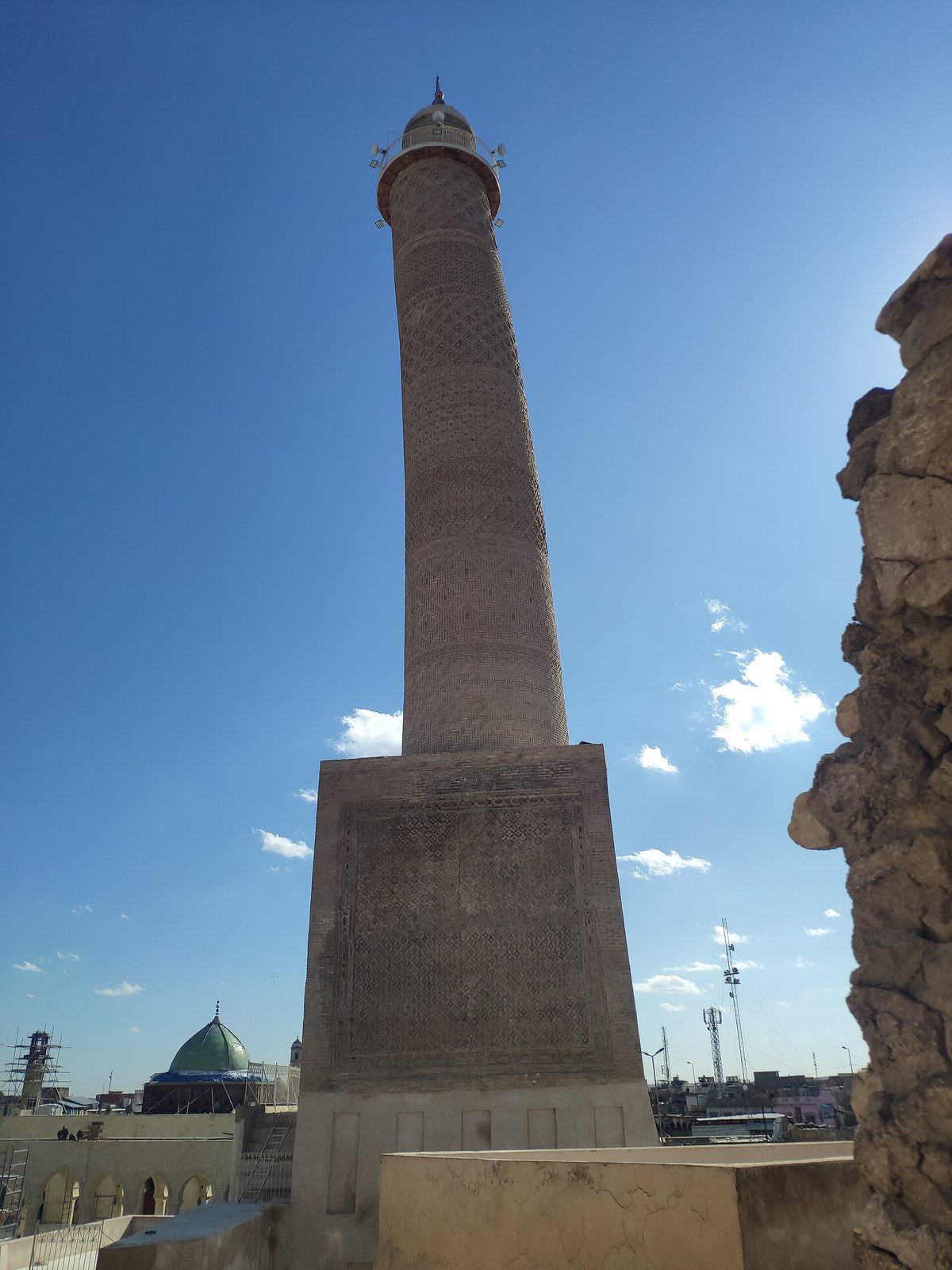
Why Mosul matters now: a city reborn
To understand why Mosul is suddenly a place people talk about visiting, you need the recent history, and it’s brutal. ISIS seized the city in June 2014 and held it for nearly three years as the largest city in its self-declared caliphate — it was from the pulpit of the al-Nuri Mosque that Abu Bakr al-Baghdadi declared that caliphate. The battle to retake Mosul ran from October 2016 to July 2017, nine months of grinding urban warfare that killed thousands and left roughly 80% of the historic Old City in ruins. As the militants retreated in June 2017, they blew up the al-Nuri Mosque and its beloved leaning minaret rather than surrender them.
What’s happened since is the reason this guide exists. Under UNESCO’s “Revive the Spirit of Mosul” initiative — launched in 2018 and backed by more than US$115 million from the United Arab Emirates, the European Union and others — the city’s most important monuments have been painstakingly rebuilt, stone by salvaged stone. The program was declared complete in early 2025, and on 1 September 2025 Iraq’s prime minister formally reopened the al-Nuri Mosque, the rebuilt al-Hadba minaret, and two historic churches in a single landmark ceremony. Add a reopened airport and a national museum coming back to life, and Mosul in 2026 is a fundamentally different proposition than the rubble field the world watched in 2017.
Here’s where things actually stand, because most travel articles you’ll find are working from outdated information. I keep this tracker current.
| Site | What happened | Status (mid-2026) | Can you visit? |
|---|---|---|---|
| Al-Nuri Mosque & al-Hadba minaret | Blown up by ISIS, June 2017 | Rebuilt & reopened Sept 2025 | Yes — exterior freely; mosque is a working place of worship |
| Al-Tahera & Al-Saa’a churches | Gutted under ISIS | Restored & reopened Sept 2025 | Yes |
| Mosul Cultural Museum | Ransacked 2014 | Restoration finishing; reopening expected 2026 | Not yet — check before you go |
| Old City fabric & souqs | ~80% destroyed 2016–17 | Partly rebuilt; reconstruction ongoing | Yes — walkable, raw in places |
| Mosul International Airport | Wrecked 2014–17 | Reopened to flights Nov 2025 | Yes — domestic flights to Baghdad |
| University of Mosul library | Burned by ISIS 2014 | Rebuilt, reopened 2022, restocked | Yes |
I’ll go through the headline sites one by one below. But the takeaway is this: the icons are back, the logistics have eased, and the window for seeing a genuinely historic city in the middle of its rebirth — before it’s polished and busy — is open right now.

Is Mosul safe to visit in 2026?
I’ll give it to you straight, because trust is the whole point of this site. On paper, the answer from Western governments is an unambiguous no. The U.S. State Department has Iraq at Level 4 — Do Not Travel, its highest tier, and the situation has been volatile: Washington ordered the departure of non-emergency government staff from Iraq in March 2026 and ordered another departure on 11 June 2026 amid renewed regional tensions tied to the Iran–Israel conflict. The UK Foreign Office (FCDO) advises against all travel to Mosul and the wider Nineveh province. These advisories are real, they will void most standard travel insurance, and you should read them yourself — our honest Iraq safety guide breaks the country down region by region and is updated as the picture changes.
Now the on-the-ground nuance those headlines don’t capture. Travelers who have visited Mosul through 2025 and 2026 consistently report a calm, welcoming, low-crime city: people walk the Old City and the riverfront freely, locals are overwhelmingly warm to the rare foreign visitor, and the violence of the ISIS era is genuinely over. The realistic day-to-day risks are not someone targeting tourists; they’re the things you can’t control — the regional instability that periodically closes Iraqi airspace, the residual threat of unexploded ordnance in unreconstructed ruins (don’t go clambering into bombed-out buildings), and the sheer number of checkpoints you’ll pass, where authorities are still getting used to seeing tourists at all.
The honest bottom line: Mosul belongs firmly in “experienced, risk-aware traveler with a local guide” territory, not “first independent trip abroad” territory. A guide isn’t a legal requirement, but it solves the checkpoints, the language, the access and the safety unknowns in one move, and I’d consider one essential here. Many people make their first Iraqi trip to the calmer, far more developed Kurdistan Region and add Mosul as a guided day trip once they have their bearings. Whatever you decide, keep your paperwork in order, build flexibility into your plans, and re-check the advisories and airspace status close to departure, because this is a fast-moving situation.
How to get to Mosul (and the visa trap)
Mosul is more accessible than its reputation suggests — but there’s one bureaucratic trap that strands more travelers than any security issue, so read this section carefully. The essential rule: Mosul is under federal Iraqi control, and you need a federal Iraq visa to be there.
Here’s the trap. Iraq runs two parallel visa systems: a federal one (covering all of Iraq, including Mosul, Baghdad and Kurdistan) and a Kurdistan-only visa-on-arrival issued at Erbil and Sulaymaniyah. If you fly into Erbil and pick up the Kurdistan visa, it does not permit you to enter Mosul — and because there’s no formal international border on the Erbil–Mosul road, there’s nowhere to “upgrade” it en route. The clean solution is to arrange the federal Iraq e-visa or a visa on arrival at a federal international airport (Baghdad, Najaf, Basra) before you head to Mosul; that single document covers the whole country. Sort this out in advance and the rest is easy. Our full Iraq visa guide walks through every nationality and entry point.
| From | How | Time | Notes |
|---|---|---|---|
| Erbil → Mosul | Private car / shared taxi | ~1.5 hrs (~95 km) | The standard approach; two checkpoints en route |
| Baghdad → Mosul | Shared taxi from a northern garage | ~5–6 hrs | ~25,000–30,000 IQD per seat |
| Baghdad → Mosul | Flight (airport reopened Nov 2025) | ~1 hr | Iraqi Airways domestic; schedule still limited |
| Duhok → Mosul | Private car | ~1.5 hrs | Handy if combining with Lalish / the north |
By far the most common approach is a day trip or overnight from Erbil, roughly 95 km and ninety minutes away. You’ll pass two checkpoints — one leaving the Kurdistan Region, one entering Mosul — where you’ll show your passport and federal visa, and possibly explain where you’re going; a guide makes this frictionless. The big 2026 development is the airport: Mosul International Airport reopened to passenger flights in November 2025, when an Iraqi Airways flight to Baghdad became the first scheduled departure since 2014. Service is still thin and domestic-only for now, with international routes planned, so for most itineraries the Erbil road remains the practical choice. For the full national picture — garages, apps, the train network and border crossings — see our getting around Iraq guide, and our Baghdad travel guide covers the capital end of that flight.
The Old City: walking Mosul’s rebirth
The heart of any Mosul visit is the Old City on the west bank of the Tigris — the dense warren of lanes, mosques, churches and merchant houses that bore the worst of the 2017 battle and is now the focus of the reconstruction. Walking it is the most powerful experience the city offers: you pass freshly rebuilt monuments, half-restored heritage houses, piles of rubble still being cleared, and ordinary life returning to all of it. It’s a place that earns the overused word “poignant.” A dedicated walking guide to this quarter is coming in our Mosul Old City companion piece; here’s the orientation.
The Great Mosque of al-Nuri & the al-Hadba minaret
This is the symbol of Mosul, and of its destruction and rebirth. The Great Mosque of al-Nuri was founded in the 12th century by Nur al-Din Zangi, and its al-Hadba (“the hunchback”) minaret — leaning for centuries like a Mesopotamian tower of Pisa — was so beloved it appears on Iraq’s 10,000-dinar banknote. ISIS blew both up in June 2017. The reconstruction, led by UNESCO and funded with US$50 million from the United Arab Emirates, rebuilt the minaret on its original foundations using salvaged bricks and the traditional techniques that gave it its famous tilt, deliberately restoring the lean rather than “correcting” it. The mosque and minaret reopened on 1 September 2025.
You can take in the minaret and the mosque’s exterior freely — seeing that hunchbacked tower standing again, where for years there was only a stump of rubble, is genuinely stirring. The al-Nuri is a functioning mosque, so dress modestly and be respectful if you enter, and as always, photograph people only with permission. A deeper dive into the mosque’s story and its reconstruction is coming in our dedicated al-Nuri Mosque guide.
The churches reborn: Al-Tahera & Al-Saa’a
Reopened in the very same September 2025 ceremony were two of Mosul’s great Christian landmarks, restored by UNESCO with UAE and EU funding. Al-Tahera Church (Our Lady of the Immaculate Conception), Syriac Catholic, and the Al-Saa’a Church — the Dominican “Convent of the Clock,” whose famous four-faced clock tower was a gift connected to Empress Eugénie of France in the 1880s, the first public clock in Iraq. That these churches were rebuilt alongside the city’s great mosque, by an Emirati-funded, UN-led project, is the kind of detail that tells you what Mosul is trying to become again: a city of many faiths. Their restoration is bound up with the wider story of the region’s Christian community, which I cover in the Nineveh Plains section below.
The river, the souqs & the library
Beyond the headline monuments, the Old City rewards slow wandering. The historic souqs — Bab al-Saray and the lanes around them — are trading again, a good place to feel the city’s everyday rhythm and to find a glass of tea. Down at the Tigris, the bridges that were destroyed in the battle have been a slow, frustrating rebuild for residents, and the riverfront remains a mix of restoration and ruin; ask your guide what’s currently crossable rather than trusting older blog posts. And don’t miss the University of Mosul’s Central Library: ISIS torched it in 2014, destroying over a million books and manuscripts, and its reopening in 2022 — restocked by donations from around the world — is one of the quieter, more moving recovery stories in the city. To understand the customs and etiquette you’ll navigate in all of this, our Iraqi culture and etiquette guide is worth a read before you go.

Ancient Nineveh: the Assyrian capital
Mosul grew up across the river from one of the most important cities of the ancient world. Nineveh was the capital of the Neo-Assyrian Empire — at its height around 700 BCE, under kings Sennacherib and Ashurbanipal, the largest city on earth — and its ruins sprawl across Mosul’s east bank as two great tells, Kuyunjik and Nebi Yunus, ringed by the remains of a fifteen-kilometre city wall studded with monumental gates. This is the deep-history heart of the north, and it ties directly into the broader story told in our ancient Mesopotamia guide.
Be clear-eyed about what you’ll see, though. ISIS targeted Nineveh’s heritage for deliberate destruction, and much of what stands today is damaged, reconstructed or under active restoration rather than pristine. The greatest Assyrian treasures — the winged-bull lamassu, the carved palace reliefs — largely left for the British Museum, the Louvre and Baghdad more than a century ago. What remains is atmospheric, historically staggering, and best brought to life by a good guide.
Nebi Yunus: the Tomb of Jonah & the palace beneath
On the larger of the two tells stands Nebi Yunus, traditionally the Tomb of the Prophet Jonah (Yunus) — yes, the Jonah of the whale, revered by Muslims and Christians alike. ISIS dynamited the shrine in July 2014 in one of its first major acts of cultural destruction. Then came an extraordinary twist: as the militants dug looting tunnels beneath the shrine, they broke into a previously unknown Neo-Assyrian palace — built by Sennacherib and expanded by Esarhaddon and Ashurbanipal — hidden under the hill for 2,700 years. Archaeologists have since documented cuneiform inscriptions and reliefs in those tunnels. A new shrine is rising on the site, and the layers here — prophet, palace, and the violence in between — make it one of the most resonant stops in the city.
The gates of Nineveh
Stretches of Nineveh’s ancient wall and several of its gates have been reconstructed and are visitable on the city’s edge. The Nergal Gate is the famous one, flanked by guardian lamassu. The Mashki Gate tells the current chapter best: ISIS bulldozed it in 2016, but during a 2022 restoration led by Iraqi archaeologists with the University of Pennsylvania and the ALIPH foundation, workers uncovered eight 2,700-year-old marble reliefs from the reign of King Sennacherib, buried and forgotten — destruction inadvertently leading to discovery. The Adad Gate rounds out the trio usually shown to visitors. Together they’re the most tangible way to stand inside the old Assyrian capital.
Nimrud and Hatra
Two further ancient sites sit within reach for the committed. Nimrud (ancient Kalhu), about 30 km south of Mosul, was another Assyrian capital and one of the most spectacular archaeological sites in Iraq — until ISIS bulldozed and blew up roughly 90% of the excavated city in March 2015. A decade-long restoration began in 2025, and Italian conservators have even produced a full-scale 3D-printed replica of one of its great lamassu; for now, manage expectations and treat it as a moving, active worksite rather than a polished attraction. Further out, the magnificent 2,000-year-old desert fortress-city of Hatra — a UNESCO site roughly 110 km southwest of Mosul — survived ISIS largely intact despite some damage and is again being visited; tickets are typically arranged in Mosul rather than on-site, and there’s no public transport, so you’ll need a driver. Both feature in our roundup of the country’s best places to visit.

Mosul Cultural Museum: a museum coming back to life
Iraq’s second-largest museum became infamous in 2014 when ISIS filmed itself taking sledgehammers and drills to its ancient Assyrian statues, including monumental lamassu and the great lion of Nimrud. The Mosul Cultural Museum has been undergoing a remarkable international rehabilitation ever since, a partnership of the Musée du Louvre (conserving the objects), the World Monuments Fund (rebuilding the structure), the Smithsonian Institution (training staff) and the ALIPH foundation (funding and coordination). Conservators have been painstakingly reassembling smashed sculptures from thousands of fragments.
As of mid-2026 the museum is expected to reopen during 2026, though the date has slipped before, so treat it as “imminent but unconfirmed” and check locally before building a visit around it. When it does reopen it will instantly become one of the most meaningful museum experiences in the Middle East — a building that was a global symbol of cultural destruction, brought back to life. I’ll cover what to expect inside in our dedicated Mosul Museum guide once doors open. In the meantime, the more you know about the civilizations it represents, the more it will mean; our ancient Mesopotamia guide is the primer.
The Nineveh Plains: Iraq’s Christian heartland
Spread across the flat farmland east and southeast of Mosul are the towns of the Nineveh Plains, the historic homeland of Iraq’s Assyrian, Chaldean and Syriac Christians and one of the most distinctive corners of the country. Qaraqosh (also called Bakhdida or Hamdaniya) is the largest Christian town in Iraq; its tens of thousands of residents fled overnight when ISIS swept in during 2014, and the town was looted and burned before its liberation. Many have since returned, and the rebuilt Al-Tahira al-Kubra church — where Pope Francis celebrated Mass during his historic March 2021 visit to Iraq — is the symbol of that fragile recovery. Nearby Bartella, Karamlesh and Tel Keppe tell similar stories of return and uncertainty.
Visiting the plains is to witness a living question mark. The honest 2026 reality is sobering: Mosul itself, once home to tens of thousands of Christians, now counts only a few dozen Christian families, with many who worship at its restored churches actually living in Erbil and visiting on weekends. The towns of the plains are where the community is making its stand. Going there respectfully — attending a service, buying lunch, talking with people about what they’ve lived through — is both a remarkable travel experience and a small act of support. A fuller exploration of these towns is coming in our Nineveh Plains companion guide; for the religious and cultural context, our Iraqi culture guide sets the scene, and the area folds naturally into trips through Iraqi Kurdistan.

Monasteries & sacred mountains around Mosul
The hills and plains around Mosul hold some of the oldest continuously active monasteries in Christendom, plus the spiritual home of the Yazidi faith. These are, for me, the most atmospheric day trips in the north — ancient stone, mountain air, and a sense of deep time. Here’s how they compare.
| Site | What it is | Distance from Mosul | Territory | Notes |
|---|---|---|---|---|
| Mar Mattai | Syriac Orthodox monastery, founded 363 AD | ~20 km NE (Mt. Alfaf) | Disputed / accessible | Active; sweeping plains views |
| Rabban Hormizd / Alqosh | Cliff monastery (~640 AD) above an Assyrian town | ~45 km N | KRG-administered | Atmospheric; paved road up |
| Mar Behnam | Syriac Catholic monastery, ISIS-damaged, restored | ~30 km SE | Nineveh Plains | Near Qaraqosh; fine carving |
| Lalish | Holiest Yazidi temple | ~60 km N | KRG-administered | Remove shoes; no photos of rituals |
Mar Mattai, the mountain monastery
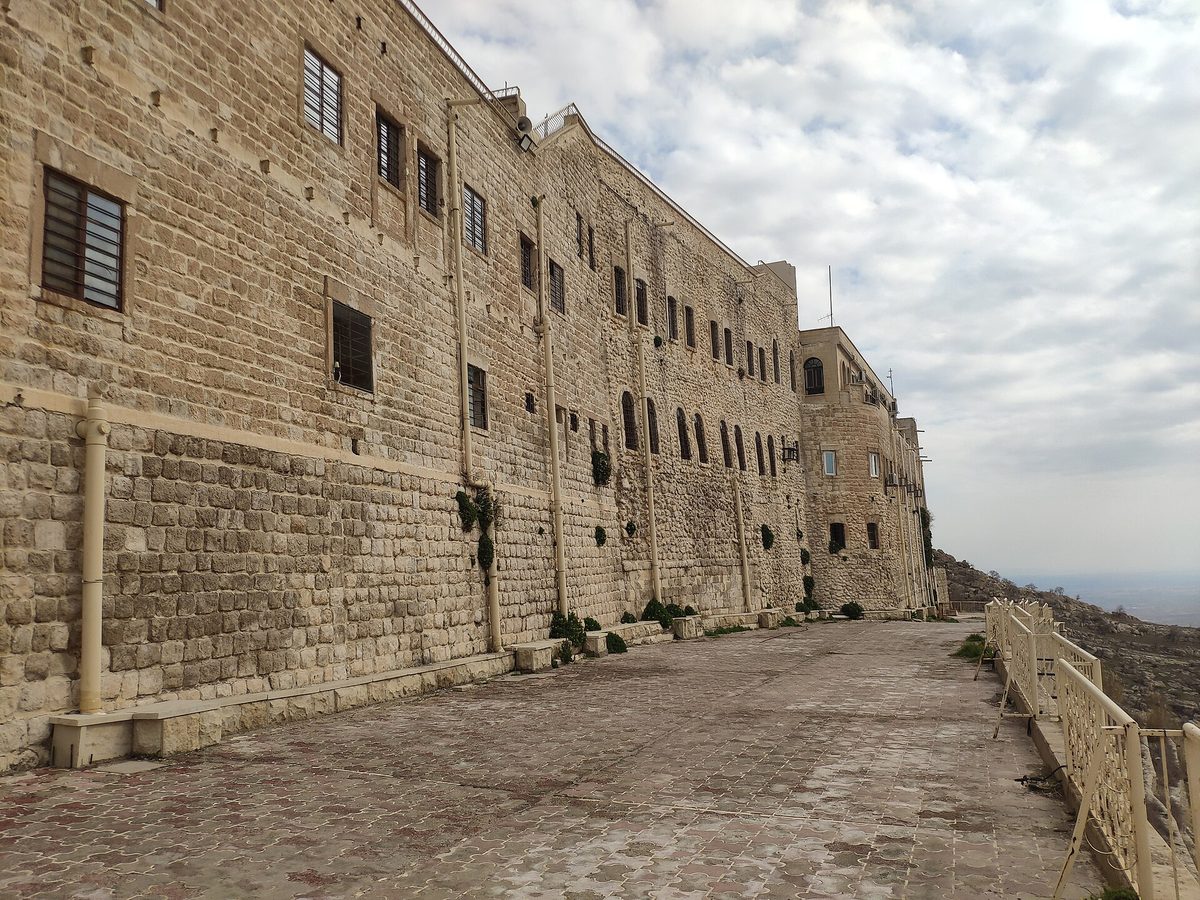
Mar Mattai (Saint Matthew’s) clings to the slopes of Mount Alfaf about 20 km northeast of Mosul, and it’s a stunner. Founded in 363 AD, it’s one of the oldest monasteries in the world, a fortress-like complex of honey-coloured stone with a still-active Syriac Orthodox community, a historic library famed across the region, and a terrace with views that stretch clear across the Nineveh plains. The drive up the mountain is half the pleasure. It’s an easy and rewarding half-day from Mosul, and the monks are welcoming to respectful visitors. A full guide to Mar Mattai is coming in our Mosul cluster.
Alqosh & Rabban Hormizd
About 45 km north, the Assyrian Christian town of Alqosh sits beneath a dramatic mountain, and carved into the cliffs above it is Rabban Hormizd Monastery, founded around 640 AD and for centuries the seat of the Chaldean patriarchs. Scrambling among its rock-cut cells and chapels, with the plain spread out below, is one of the most evocative things you can do in the north — and a paved road now gets you most of the way up. Alqosh itself is a gentle, deeply traditional place worth lingering in. We’ll cover both in depth in our dedicated Alqosh guide.
Lalish: the Yazidi holy of holies
Roughly 60 km north of Mosul, tucked into a green valley, Lalish is the holiest site of the Yazidi faith — an ancient, monotheistic religion whose people suffered genocide at the hands of ISIS in 2014. Its conical fluted spires shelter the tomb of Sheikh Adi ibn Musafir, and visitors are welcomed warmly, but the etiquette is strict and non-negotiable: you enter barefoot, you must never step on a threshold, and you should avoid wearing blue. It’s a profound, peaceful place. Note that Lalish sits on the Kurdistan-administered side of the line, so it’s most easily reached from Duhok or Erbil; our Iraqi Kurdistan guide covers that side of the north.
Mosul food: kubbat Mosul & the Moslawi table
Moslawi cuisine has a real identity of its own, and eating well is one of the simple joys of a visit. The signature dish is kubbat Mosul — a large, flat disc, quite unlike the little torpedoes of kubba you’ll meet elsewhere in Iraq: a thin shell of fine bulgur and semolina enclosing spiced minced meat, sometimes with raisins or nuts, simmered and then sliced into wedges. It’s the taste of the city. Mosul is also famous for its pacha (a slow-cooked dish of sheep’s head, trotters and stomach beloved in winter), its distinctive flat kubba variations, and a particularly good local kanafeh for those with a sweet tooth.
The street-food markets — around Bab al-Jadeed and near Nebi Yunus — are the place to graze, and a guide will steer you to whichever grill or sweet shop is the current favourite. Tea, as everywhere in Iraq, is the social glue, poured strong and sweet in little tulip glasses. For the full national menu — masgouf, kebabs, breakfasts, sweets and the rules around alcohol — see our Iraqi food guide, and we’ll do a deep dive on the city’s specialties in our Mosul food companion piece.
Where to stay in Mosul (or day-trip from Erbil)
The honest first question is whether to sleep in Mosul at all. Because Erbil is only ninety minutes away and far more set up for visitors, many travelers day-trip from Erbil and never overnight in Mosul — a perfectly good plan that lets you base in a comfortable Kurdish city and see the highlights in a long day. That said, Mosul’s hotel scene has come back to life, and staying over lets you experience the city in the evening and start early.
You won’t find most Mosul hotels on the big booking sites; they’re found on the ground or through a guide. Reliable mid-range and budget options that travelers have used recently include the Modern Palace Hotel, and there are simpler, cheaper guesthouses around the city, plus an OTA-listed riverside option on the Corniche. Don’t expect international polish — expect clean, functional, generator-backed rooms and genuine hospitality. (Ignore older references to grand Tigris-view hotels like the old Nineveh International; that landmark has stood derelict for years.) For how Mosul fits into accommodation across the country, see our where to stay in Iraq guide.
Best time to visit Mosul
Northern Iraq has a more forgiving climate than the scorching south, but timing still matters. Spring (March–May) and autumn (October–November) are ideal, with warm days, cool evenings and green plains — spring in particular, when the Nineveh countryside and the monastery hills are at their loveliest. Summers are hot and dusty, regularly into the low 40s Celsius, making midday walks in the unshaded Old City and Nineveh ruins hard going. Winters are cool and can be genuinely cold and wet, with the occasional dusting of snow on the mountains around Mar Mattai. If your trip coincides with a major Christian feast, the Nineveh Plains churches come alive. Our best time to visit Iraq guide breaks the seasons down month by month and flags the dates worth planning around.
A Mosul & northern Iraq itinerary
Here’s how I’d actually structure a northern trip, depending on how much time you have. These slot neatly into the longer national routes in our Iraq itinerary guide.
- The Mosul day trip (1 day, from Erbil): Drive over in the morning, spend the day on the Old City (al-Nuri Mosque, the reborn churches, the souqs) and ancient Nineveh (a gate or two and Nebi Yunus), eat kubbat Mosul, and return to Erbil by evening. The essential city in a tight, guided window.
- The northern heartland (2–3 days): Add the Nineveh Plains (Qaraqosh and a monastery), Mar Mattai on its mountain, and a run up to Alqosh and Rabban Hormizd, with Lalish folded in on the Kurdistan side. An overnight in Mosul or Erbil makes this unhurried. The trip this guide is really built for.
- North-and-Kurdistan (5+ days): Combine Mosul and the Nineveh region with Erbil, the Kurdish mountains and Sulaymaniyah for a full northern loop — the most rewarding way to see this half of the country. Pair it with our Iraqi Kurdistan guide.
Whichever you choose, anchor it on a good guide and a sensible pace, and check site-by-site what’s currently open and accessible before you set out — in a city mid-reconstruction, that changes faster than guidebooks can keep up.
What a Mosul trip costs
Mosul is inexpensive once you’re there, with the big variable being how you handle transport and guiding. Iraq is largely a cash economy for foreigners — carry clean US dollars and change them into dinars as you go (in mid-2026 the dinar trades around 1,300 to the dollar officially, but nearer 1,540 on the street), because foreign cards and ATMs are unreliable. A guide-and-driver for a day from Erbil is the main cost and well worth it; meals, tea and small site tips are cheap. Budget independent travelers get by on roughly $45–65 a day on the ground before transport and guiding, but for Mosul specifically I’d build in the cost of a guide as non-negotiable. Our Iraq travel cost guide breaks down a full budget, and the pilgrimage-and-history routes in our guide to Iraq’s holy cities and ziyarat show how the north slots into a longer cultural trip.
Mosul travel FAQ
Is Mosul safe to visit in 2026?
On paper, no: the U.S. has Iraq at Level 4 (Do Not Travel) and ordered the departure of non-emergency government staff in both March and June 2026, and the UK FCDO advises against all travel to Mosul. In practice, travelers who visit — almost always with a local guide — report a calm, welcoming, low-crime city with the ISIS era genuinely over. It’s a destination for experienced, risk-aware travelers, not a casual first trip. Read our safety guide and re-check advisories before you go.
Can you visit Mosul as an independent traveler?
Yes, it’s possible, and some do it without a guide. But given the checkpoints, the language barrier, the unfamiliarity of local authorities with tourists and the safety unknowns, I strongly recommend going with a local guide. It turns a potentially tense day into a smooth and far richer one, and it’s the single best money you’ll spend here.
Do you need a guide to visit Mosul?
It’s not a legal requirement, but it’s the sensible choice. A guide handles the checkpoints, knows what’s currently open in a fast-changing reconstruction zone, keeps you clear of unsafe ruins, and unlocks the city’s stories. Many travelers book a guide-and-driver day trip from Erbil.
How do you get to Mosul from Erbil?
By road, about 95 km and ninety minutes by private car or shared taxi. You’ll pass two checkpoints — one leaving the Kurdistan Region and one entering Mosul — where you’ll show your passport and federal Iraqi visa. A day trip from Erbil is the most popular way to see the city.
Do you need a federal Iraq visa for Mosul, or does a Kurdistan visa work?
You need a federal Iraq visa. Mosul is under federal control, and the Kurdistan-only visa-on-arrival issued at Erbil does not cover it — and there’s no border post on the Erbil–Mosul road to upgrade it. Arrange the federal Iraq e-visa or a visa on arrival at a federal airport (Baghdad, Najaf, Basra) in advance; it covers the whole country, Kurdistan included. See our visa guide.
Is Mosul airport open? Are there flights?
Yes — Mosul International Airport reopened to passenger flights in November 2025, when an Iraqi Airways service to Baghdad became the first scheduled flight since 2014. Service is still limited and domestic for now, with international routes planned, so most visitors still arrive by road from Erbil.
Has the al-Nuri Mosque and its leaning minaret been rebuilt?
Yes. Both the Great Mosque of al-Nuri and its famous leaning al-Hadba minaret — destroyed by ISIS in 2017 — were rebuilt by UNESCO with UAE funding and reopened on 1 September 2025. The minaret was reconstructed on its original base with its historic lean intact. You can see the exterior freely; the mosque is again a working place of worship.
When is the Mosul Museum reopening?
It’s expected to reopen during 2026 after a major international restoration involving the Louvre, the World Monuments Fund, the Smithsonian and the ALIPH foundation. The date has slipped before, so treat it as imminent but unconfirmed and check locally before planning a visit around it.
Can you visit ancient Nineveh, Jonah’s Tomb and Nimrud?
Yes, with caveats. Reconstructed sections of Nineveh’s walls and gates (Nergal, Mashki, Adad) are visitable on Mosul’s edge, and the Tomb of Jonah (Nebi Yunus), destroyed in 2014, is a moving site where an Assyrian palace was discovered in tunnels beneath it. Nimrud, 30 km south, was about 90% destroyed by ISIS and is an active restoration site — go for the history and the recovery story, not polished ruins.
How many days do you need in Mosul?
One full day covers the city’s Old City and Nineveh highlights as a trip from Erbil. To add the Nineveh Plains, Mar Mattai, Alqosh and Lalish, give the region two to three days. Folded into a wider Kurdistan loop, five days or more lets you see the whole north unhurried.
Can you visit Mar Mattai monastery and the Christian towns?
Yes. Mar Mattai, a 4th-century monastery about 20 km northeast on Mount Alfaf, is active and welcomes respectful visitors, as do Alqosh and its cliff monastery of Rabban Hormizd further north. The Christian towns of the Nineveh Plains, like Qaraqosh — where Pope Francis said Mass in 2021 — are visitable and deeply worth your time.
What food is Mosul known for?
The signature dish is kubbat Mosul, a large flat disc of fine bulgur and semolina stuffed with spiced minced meat, sliced into wedges. Mosul is also known for winter pacha, distinctive flat kubba, and an excellent local kanafeh. The street-food markets near Nebi Yunus and Bab al-Jadeed are the place to eat.
Final thoughts: the city that came back
No place in Iraq moved me the way Mosul did. To stand beneath the rebuilt al-Hadba minaret, or in a church where the Pope prayed in a town ISIS tried to erase, or on a monastery terrace founded when Rome still ruled, is to watch a city and a region insist on their own future. It is also, still, a serious place to travel — read the advisories, respect the risks, go with a good guide, and keep your expectations honest about the rubble that sits beside the restoration.
But if you’re already the kind of traveler who would consider Iraq at all, the north belongs near the top of your list. Few journeys anywhere offer this much history, faith, tragedy and stubborn hope in one short drive. When you’re ready to build the wider trip, start with our complete Iraq travel guide, sort the paperwork, read the situation honestly in our safety guide, and map your days with the itinerary planner. Mosul is open again — go gently, and go with respect.
Sources & further reading: the reopening of the al-Nuri Mosque, the al-Hadba minaret and the Al-Tahera and Al-Saa’a churches on 1 September 2025, and the UNESCO “Revive the Spirit of Mosul” program (US$115M+ raised; US$50M UAE-funded mosque), via UNESCO, The National and PBS NewsHour (September 2025); the reopening of Mosul International Airport to passenger flights on 6 November 2025 via The National, Al Jazeera and Iraq Business News (2025); the Mosul Cultural Museum rehabilitation (Louvre, World Monuments Fund, Smithsonian, ALIPH) and its expected 2026 reopening via the Smithsonian Magazine, the Louvre and the World Monuments Fund; the discovery of eight Sennacherib-era reliefs during the 2022 Mashki Gate restoration via Al Jazeera, The Art Newspaper and the Penn Museum; the destruction and ongoing restoration of Nimrud via PBS and Syriac Press; the Nebi Yunus / Sennacherib palace discovery via contemporary reporting; Pope Francis’s March 2021 Mass at Al-Tahira al-Kubra in Qaraqosh via Vatican News and Al Jazeera; and current safety framing via the U.S. State Department (Level 4, Do Not Travel; ordered departures in March and June 2026) and the UK FCDO (advises against all travel), checked June 2026. Conditions, reconstruction status, opening hours and the security picture in Mosul change quickly — treat every figure here as a researched starting point and confirm the current situation before you travel.
Photo credits: The rebuilt al-Hadba minaret and Great Mosque of al-Nuri, Mosul, by Al-Dabbouni (CC BY-SA 4.0); Mosul’s old city alon