Getting around Iraq is easier than its reputation suggests: intercity travel runs on shared taxis from “garages” ($5–15 a seat), a daily Baghdad–Basra sleeper train, cheap domestic flights, and ride-hailing apps in the big cities. Getting to Iraq means flying into Baghdad, Erbil, Najaf or Basra — or crossing overland from Turkey, Iran, Jordan or Kuwait — each with its own entry requirements. The practical ground rules, from garages to checkpoints, are collected in 25 Iraq travel tips.
That’s the short version. The long version — the one with the airport taxi hack that saves you $25, the checkpoint that holds your passport, and the night train nobody believes still runs — is what this guide is for. I’ve structured it the way you’ll actually use it: the current security picture first (because in June 2026 that genuinely matters for flights), then getting to Iraq by air and land, then every way of moving around the country once you’re in. Fares are in Iraqi dinar (IQD) with dollar equivalents at roughly 1,400 IQD to the dollar, the street rate as I write; where a price was last verified in an earlier year, I say so instead of pretending it’s fresh.
This is the transport hub of our complete Iraq travel guide. If you’re still deciding where these buses and trains should take you, start with our guide to the best places to visit in Iraq and our day-by-day Iraq itinerary planner.
Before you book: the airspace and security picture (updated June 10, 2026)
I’d be doing you a disservice if I opened a transport guide in June 2026 with anything other than this. Iraq’s skies have had a rough year, and flight disruption — not safety on the ground — is currently the single biggest practical risk to your travel plans.
Here’s the honest timeline. During the Iran–Israel war this spring, Iraq closed its airspace entirely for around 40 days, from early March until the Iraqi Civil Aviation Authority reopened all commercial airports on April 8, 2026. Airlines came back through May — Turkish Airlines resumed Erbil on May 8 and Baghdad on May 14, and Qatar Airways returned to Baghdad, Basra and Erbil on May 10. Then, after renewed missile exchanges in the region, Iraq announced another precautionary 72-hour closure on June 7 — and reopened a day later, on June 8, when Iran announced a cessation of operations. As I write, airports in Baghdad, Erbil, Basra, Najaf and Sulaymaniyah are operating, but European regulators and conflict-zone monitors still advise carriers to avoid Baghdad’s flight region, several Western airlines are overflying rather than landing, and individual cancellations continue day to day.
What this means for you, practically:
- Book flexible tickets, and book carriers that have proven they come back. Iraqi Airways, Turkish Airlines, Qatar Airways, FlyDubai, Pegasus, Air Arabia and Royal Jordanian have all restored Iraq service after each closure. Connections via Istanbul, Doha, Dubai and Amman are the resilient routings.
- Have an overland plan B. When the airspace shut in March, travelers already in Iraq left by land through Turkey, Kuwait and Jordan without drama. This guide covers all those crossings below.
- Check status the week you fly. Airline apps, your carrier’s Iraq page, and conflict-airspace trackers like Safe Airspace are more current than any blog — including this one.
- Know the official advisories. The US State Department has Iraq at Level 4 (Do Not Travel, reaffirmed March 2, 2026, alongside an ordered departure of non-emergency embassy staff), and the UK FCDO regionalised its Iraq advice on 22 July 2026 — against all travel to some governorates, against all but essential travel to the rest, Baghdad and the Kurdistan Region included. Either way it has real consequences for travel insurance. Our honest, regularly updated assessment is in Is Iraq Safe to Visit? — read it before you commit money.
None of this is a reason to abandon the idea of Iraq; tours kept running through spring and travelers on the ground reported normal life in the cities between the headline events. It is a reason to build slack into your plans and never book a tight onward connection out of an Iraqi airport.
How getting around Iraq actually works
Iraq has almost no tourist transport infrastructure — no Flixbus, no rail passes, no hop-on-hop-off anything. What it has instead is a dense, cheap, self-organizing network that Iraqis use every day, and once you understand its logic you can go nearly anywhere in the country for a few dollars.
The keystone is the garage (pronounced garaaj) — a city’s informal terminal where shared taxis, GMC vans and minibuses gather, each one leaving whenever its seats are full. Every city has at least one; bigger cities have several, organized by destination. You show up, say the city you’re going to (or just repeat “garage Najaf?” to any taxi driver, who will deliver you to the right lot), pay for a seat, and wait — usually ten to thirty minutes — for the car to fill. Want to leave immediately, or want the whole back seat? Buy the empty seats. It’s that simple, and it runs from dawn until early evening.
Here’s how the options compare for intercity travel:
| Mode | Typical cost | Speed | Comfort | Best for |
|---|---|---|---|---|
| Shared taxi (saloon car) | $5–15 per seat | Fast — leaves when full | Cramped if you’re in the middle | Most intercity hops, especially the south |
| GMC / van (“kia”) | $4–10 per seat | Slower, more stops | More luggage room | Budget travel, busy pilgrimage corridors |
| Minibus | $3–8 | Slowest | Basic | Short hops, Kurdistan valleys |
| Night train (Baghdad–Basra) | $8–28 | 8.5 hours overnight | Sleeper berths, A/C | The full south run while you sleep |
| Domestic flight | $60–120 | ~1 hour | Normal economy | Baghdad–Erbil or Baghdad–Basra in a hurry |
| Private driver | $60–120/day | On your schedule | Best available | Site-hopping days, groups, families |
| Ride-hailing apps (Careem, Baly) | $2–5 per city ride | — | Clean, priced upfront | Within Baghdad, Erbil, Basra, Najaf and more |
Two structural things to internalize before we get specific. First, Iraq is two transport systems in one country: Federal Iraq and the Kurdistan Region run separate checkpoints, and crossing between them involves a real internal border where your visa gets scrutinized — more on that in the checkpoints section and in our Iraqi Kurdistan guide. Second, cash rules everything. Drivers, garages, train ticket offices and most airport taxi desks take dinar only; carry small notes and treat ATMs as unreliable. Bring US dollars and change as you go.
Getting to Iraq by air: airlines and routes
Flying is how most travelers arrive, and the route map in mid-2026 is better than you’d expect — when the airspace is open. The pattern: no nonstop flights from North America, the UK or Australia; one-stop connections via Istanbul, Doha, Dubai, Sharjah or Amman cover almost everyone.
| Airline | Hub | Flies to | Notes (June 2026) |
|---|---|---|---|
| Iraqi Airways | Baghdad | Baghdad, Erbil, Basra, Najaf + Istanbul, Dubai, Cairo, Amman and more | National carrier; full network restored after the April reopening; also flies most domestic legs |
| Turkish Airlines | Istanbul | Baghdad, Erbil, Sulaymaniyah | Resumed Erbil May 8, Baghdad May 14; Sulaymaniyah daily since March 27 after the 2023–25 ban ended |
| Qatar Airways | Doha | Baghdad, Erbil, Basra | Returned May 10, 2026; the comfortable one-stop from the Americas and Asia |
| FlyDubai | Dubai | Baghdad, Erbil, Najaf, Basra | Workhorse of the Gulf routes |
| Pegasus | Istanbul (SAW) | Baghdad, Erbil | Usually the cheapest Europe option |
| Air Arabia | Sharjah | Baghdad, Najaf, Basra, Erbil | Low-cost Gulf alternative |
| Royal Jordanian | Amman | Baghdad, Erbil | Short hop, frequent |
| Middle East Airlines | Beirut | Baghdad, Erbil | Useful from the Levant |
| FlyBaghdad / UR Airlines | Baghdad | Regional routes incl. Iran and the Gulf | Iraqi low-cost carriers; book direct, expect schedule changes |
Booking tips from experience: fares into Erbil often run cheaper than Baghdad from Europe (thank Pegasus); Najaf can be the cheapest entry of all during pilgrimage seasons because so many carriers compete for it; and one-way tickets into one city and out of another (Erbil in, Baghdad out, or the reverse) cost little more than returns and save you a backtrack. Whatever you book, remember the visa: most Western travelers should arrive with the federal e-visa sorted in advance — the process, fees and the Kurdistan wrinkle are all in our Iraq visa guide.
Iraq’s airports, one by one
Baghdad International (BGW): the main gate
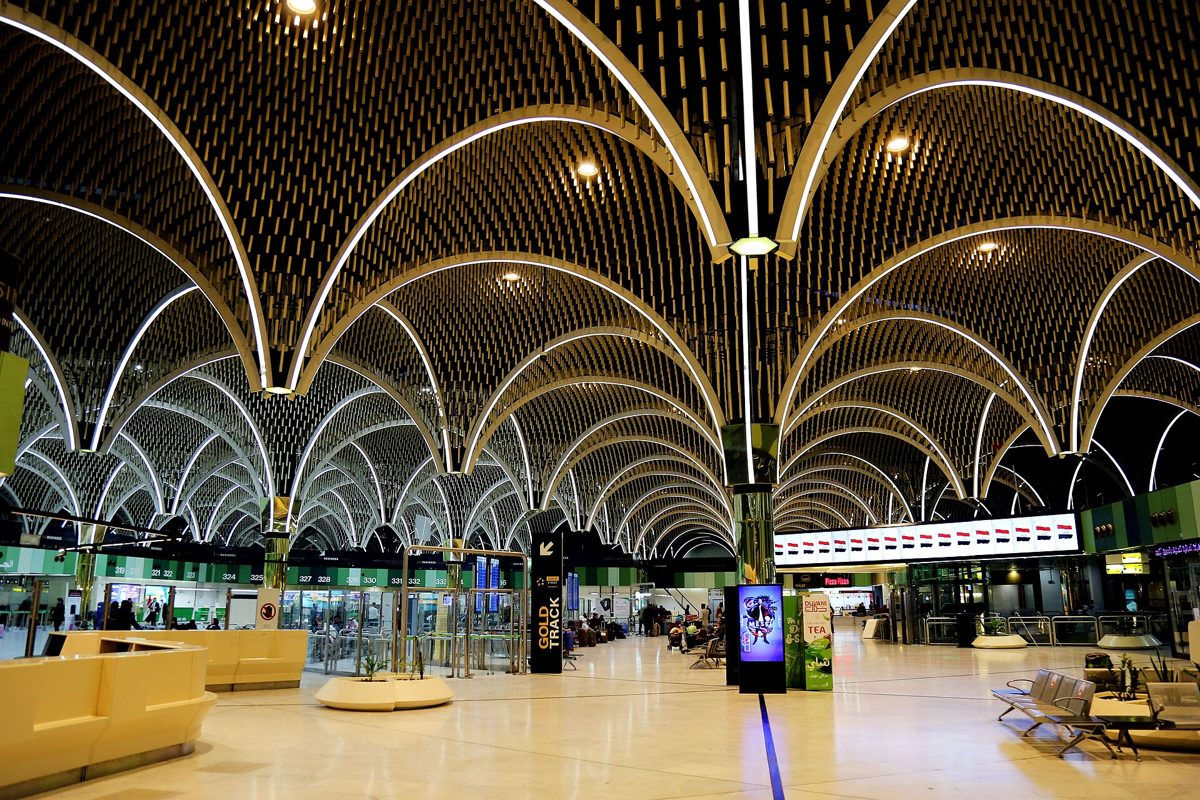
Baghdad’s airport sits about 16 km west of the city center at the end of the once-notorious airport road, which is now just a road with checkpoints. The terminal — all soaring latticed arches, genuinely one of the region’s more handsome buildings — is small for a capital, so arrival is quick: visa-on-arrival and e-visa desks before immigration, a Zain SIM-card stall after customs, and you’re out.
Getting into the city is where newcomers get fleeced, because the airport sits inside a security perimeter that ordinary taxis and ride-hailing cars can’t enter. Your options, cheapest to easiest:
- The two-step hack: take the shuttle/minibus from outside arrivals to the perimeter checkpoint at Abbas ibn Firnas Square (around 8,000–9,000 IQD / $6, last verified 2024), then order a Careem or Baly from there — 12,000–15,000 IQD to central Baghdad. Total: about $15.
- The official airport taxi desk: fixed-ish rates around 40,000–45,000 IQD ($29–32) to the center. Painless, safe, overpriced.
- Hotel pickup: most Baghdad hotels arrange airport transfer with security clearance for $25–40 — worth it for a midnight arrival.
One scam to know: drivers or “agents” at arrivals claiming your hotel booking needs a “re-confirmation fee” of $50 or so. It doesn’t. Walk on. For what to do once you’ve made it in, our Baghdad city guide takes over from the curb.
Erbil International (EBL): the easy landing

Erbil is the gentlest arrival in Iraq — a modern, calm terminal that feels like a mid-sized European airport, with visa-on-arrival for eligible nationalities (100,000 IQD for the Kurdistan entry — note carefully that Kurdistan’s visa does not cover Federal Iraq; if Baghdad or the south is on your route, you need the federal e-visa instead, as we explain in the visa guide). Security means you can’t walk to the terminal: all passengers transit a remote check-in/pickup terminal connected by shuttle. Taxis from the airport into central Erbil run about 15,000–20,000 IQD; agree the price first or have your hotel send a car.
Najaf (NJF): the pilgrimage gateway
Najaf’s airport exists for one reason — the shrine of Imam Ali a few kilometers away — and it’s busiest around the great pilgrimage seasons. Iran-based carriers, Iraqi Airways, FlyDubai, Air Arabia and Jazeera Airways all serve it, and during Arbaeen the schedule multiplies. If your trip is built around the holy cities, landing here puts you 10 minutes from Najaf’s old city and 80 km from Karbala — our ziyarat and holy cities guide covers the whole circuit, and seats sell out weeks ahead for Arbaeen (which falls August 3–4 in 2026, per our best time to visit guide).
Basra (BSR): the southern door
Basra International handles Gulf routes (FlyDubai, Air Arabia, Qatar Airways since May 10) plus domestic legs, and it’s the natural arrival if your Iraq is the deep south: the marshes, Ur via Nasiriyah, and the date-palm country. It’s also 50 minutes by road from the Kuwait border at Safwan, which makes Kuwait City a legitimate budget gateway to southern Iraq when fares cooperate.
Sulaymaniyah (ISU): back on the map
Sulaymaniyah spent two years cut off from its most important route after Turkey banned flights in 2023; Turkish Airlines returned on November 2, 2025 and has flown daily since March 27, 2026. With FlyDubai and regional carriers alongside, ISU is again a practical way into eastern Kurdistan — and Sulaymaniyah is the better base than Erbil for Halabja and the Zagros east anyway, as we argue in the Kurdistan guide.
Crossing into Iraq by land

Iraq shares borders with six countries, and as of June 2026 you can realistically enter from four of them as a tourist. Overland arrival is not just a budget trick — when the airspace closed twice this year, the land borders were how everyone kept moving. The status board:
| Crossing | From | Leads to | Status for foreign travelers (June 2026) |
|---|---|---|---|
| Ibrahim Khalil (Habur) | Turkey (Silopi) | Zakho → Duhok/Erbil | Open, busy, reliable. Kurdistan visa-on-arrival for eligible nationalities |
| Bashmaq (Penjwen) | Iran (Marivan) | Sulaymaniyah | Open; crossed on foot between posts; Kurdistan entry |
| Haji Omaran | Iran (Piranshahr) | Choman → Erbil | Open; mountain crossing, slower, mostly trade |
| Shalamcheh | Iran (Khorramshahr) | Basra | Open; heavy pilgrim traffic, federal visa required |
| Zurbatiyah (Mehran) | Iran | Kut → holy cities | Open; the main Arbaeen pilgrim funnel, federal visa required |
| Trebil / Al-Karameh | Jordan (Ruwaished) | Ramadi → Baghdad | Open; long desert run, doable in a day from Amman |
| Safwan / Abdali | Kuwait | Basra | Open; quick and underrated — but recheck after June’s regional strikes |
| Arar (Jadidat Arar) | Saudi Arabia | Najaf/Karbala | Open mainly for pilgrim convoys; not a casual tourist route |
| Al-Qaim | Syria (Albu Kamal) | Anbar → Baghdad | Officially reopened to travelers and cargo (June 2025), but western Anbar is no place for casual tourism — I don’t recommend it as an entry |
From Turkey: Ibrahim Khalil, the classic
This is the overland route, worn smooth by decades of traders and backpackers. Direct buses run from Diyarbakir, Mardin and even Istanbul to Erbil (Diyarbakir–Erbil around €25–30, eight hours including the border), or you can do it in hops: dolmuş to Silopi, cross-border taxi over the Habur bridge (the drivers handle the queueing choreography), then you’re in Zakho — first tea in Iraq, ideally beside the 2,000-year-old Pira Delal bridge. Erbil is another 2.5–3 hours by shared taxi via Duhok. Exit formalities on the Turkish side can crawl on truck-heavy days; budget two to four hours for the whole crossing and you’ll usually be pleasantly surprised.
From Iran: four working doors
Bashmaq is the traveler favorite — you walk the few hundred meters between posts, get the Kurdistan stamp, and shared-taxi down to Sulaymaniyah in about 90 minutes. Haji Omaran serves Erbil through genuinely beautiful Zagros scenery. Shalamcheh (for Basra) and Zurbatiyah (for the holy cities via Kut) are the southern, federal-visa crossings, and during Arbaeen they process staggering numbers of pilgrims — if you’re crossing within two weeks of the observance, expect crowds unlike anything you’ve seen, and read our pilgrimage guide first.
From Jordan and Kuwait: the desert runs
Amman to Baghdad is a single 11–12 hour push: shared taxis and cars leave Amman’s eastern garages around dawn (roughly $75–90 a seat, last verified 2023, prices drift with fuel), cross at Trebil, and run the Anbar highway escorted through a string of checkpoints. It’s long, flat, and oddly satisfying. From Kuwait City, it’s the opposite — almost too easy: two hours to the Safwan crossing, walk through, and Basra is 50 minutes beyond. Just double-check the Kuwait side’s status when you travel; early June’s regional strikes briefly rattled schedules across the Gulf.
The garage system: shared taxis, GMCs and minibuses
Now the part you’ll use every second day. Intercity Iraq runs on shared taxis, and they are cheap, fast, safe in the road-culture sense of “the driver does this every day,” and occasionally hair-raising in the overtaking sense. Some real numbers — seat prices, dinar, as reported by travelers between 2022 and 2024 (quote them as a starting point, not gospel; add 20–30% for post-devaluation 2026 reality):

| Route | Distance / time | Shared-taxi seat | ~USD |
|---|---|---|---|
| Baghdad → Karbala | 120 km / 1.5–2 h | 10,000–15,000 IQD | $7–11 |
| Karbala → Najaf | 80 km / 1 h | 7,000–10,000 IQD | $5–7 |
| Baghdad → Hillah (Babylon) | 100 km / 1.5 h | 8,000–12,000 IQD | $6–9 |
| Najaf → Nasiriyah (for Ur) | 260 km / 3.5 h | 10,000–15,000 IQD | $7–11 |
| Nasiriyah → Basra | 190 km / 2.5–3 h | 12,000–15,000 IQD | $9–11 |
| Baghdad → Samarra | 125 km / 2 h | 15,000 IQD | $11 |
| Baghdad → Erbil | 360 km / 5 h | 35,000–50,000 IQD | $25–36 |
| Erbil → Mosul | 85 km / 1.5 h | 10,000 IQD taxi / 4,000 minibus | $3–7 |
| Erbil → Sulaymaniyah | 195 km / 3 h | 15,000–25,000 IQD | $11–18 |
Field notes that save friction. In Baghdad, garages are scattered by direction — Al-Nahda area serves the north and Kurdistan; ask any city taxi for “garage” plus your destination city and they’ll know which lot you need. The front passenger seat is the prized seat; the middle-rear is purgatory for anyone over 5’10”. A solo traveler in a hurry buys two seats; a pair traveling with bags buys the car (“khususi” — private) for roughly four seat-prices and leaves immediately. Drivers stop on request, pray on schedule, and will hand you their phone to talk to an English-speaking cousin when negotiation stalls. Buses barely exist as a scheduled intercity network in Federal Iraq — a handful of companies run Baghdad–Basra and Baghdad–Erbil coaches, but I’d treat anything you can’t see in the garage with your own eyes as theoretical. In Kurdistan, white shared taxis and minibuses connect Erbil, Sulaymaniyah, Duhok and the valley towns from each city’s North/South garage terminals all day long.
Iraq by train: the Baghdad–Basra night sleeper

Yes, Iraq has a working passenger train, and it’s one of my favorite travel experiences in the country. The overnight sleeper leaves Baghdad Central Station daily at about 8:00 pm and rolls into Basra’s Maqal station around 4:30 am; the return leaves Basra about 7:00 pm and reaches Baghdad around 6:15 am. The Chinese-built carriages are air-conditioned, there’s a buffet car, and the berths are flat and clean — book the 2-berth sleeper and you’ll sleep most of the 540 km.
| Class | Fare (one way) | ~USD | What you get |
|---|---|---|---|
| 2-berth sleeper | 37,000 IQD | $28 | Private-feeling compartment, two flat beds |
| 4-berth sleeper | 31,000 IQD | $24 | Shared compartment, still very comfortable |
| 1st-class seat | 15,000 IQD | $11 | Reclining seat |
| 2nd-class seat | 10,000 IQD | $8 | The people-watching option |
The catch, and it’s a charming one: there is no online booking. You buy tickets in person at the station, same day (the Baghdad ticket office runs roughly 9 am to 7 pm), passport and visa in hand, and check any big luggage about an hour before departure. The train stops at Hillah, Diwaniyah, Samawah and Nasiriyah along the way — which means you can, in principle, ride it to the doorstep of Babylon or Ur country, though the smaller stations’ arrival hours are unsociable. Schedules in Iraq are written in pencil; confirm the departure time at the station a day ahead, and treat seat61’s Iraq page as the best independent reference. Slot it into a south-bound route with our itinerary planner — overnight train down, sites of ancient Mesopotamia on the way back up is the classic play.
Domestic flights: the one-hour shortcut
Iraqi Airways (with FlyBaghdad and UR Airlines on some legs) connects Baghdad with Erbil, Sulaymaniyah, Basra and Najaf in about an hour per hop, with fares typically $60–120 one way. The full domestic network came back after the April 8 airspace reopening. When to bother: Baghdad–Erbil, where flying spares you five highway hours and the federal–Kurdistan checkpoint shuffle; and Baghdad–Basra when the train timings don’t suit. Book on the airline sites or through any Iraqi travel agency (often cheaper, always cash), carry your passport for domestic check-in, and pad your plans — domestic schedules shift with little notice, doubly so in a year like this one.
Getting around Iraqi cities: taxis, Careem, Baly and tuk-tuks

First, the question every visitor asks: no, there is no Uber in Iraq — and you won’t miss it. Two apps cover you. Careem (the Dubai-based regional player) operates in Baghdad, Erbil, Basra and Najaf and is the comfortable default with an English interface and card payment. Baly, Iraq’s homegrown super-app and the market leader in the capital, runs ride-hailing plus food delivery in Baghdad, Basra, Najaf, Karbala, Hilla, Kirkuk, Mosul, Nasiriyah and beyond — rides are cheap (a 5 km hop costs around 3,000–5,000 IQD / $2–4), drivers are plentiful, and having it installed marks you as someone who knows the place. Download both before you arrive; you’ll need an Iraqi SIM for the OTP, which is another reason that airport Zain stall is your first stop.
Street taxis — the white-and-orange saloons that are roughly a third of all traffic in Baghdad — are everywhere and unmetered. Agree the fare before you get in: short hops 3,000–5,000 IQD, longer cross-city runs 5,000–10,000. If the price sounds wrong, smile, close the door, and flag the next one; there is always a next one. In Najaf, Karbala and the old quarters of Basra you’ll also find tuk-tuks swarming the shrine perimeters — fun, cheap (1,000–3,000 IQD), and the only thing that fits down some alleys. Baghdad has no metro and city buses follow routes known only to the initiated; nobody will judge you for skipping them.
Checkpoints: what actually happens
Checkpoints are the defining texture of Iraqi road travel, and they’re far less dramatic than they sound. On a Baghdad–Erbil run you’ll pass through about six; in the south, they thin out between cities. The routine: the car slows, the soldier leans in, everyone murmurs a greeting, your driver says “tourist” (or in Kurdistan, “biyani” — foreigner), passports get a glance or a collection, and 90 seconds later you’re moving. Have your passport and a printed copy of your e-visa within reach — never buried in the trunk — and expect the occasional soldier to puzzle over the visa date format; patience and a smile solve it.
Three places deserve special mention. The federal–Kurdistan internal boundary is a real border: entering Kurdistan from federal Iraq (or vice versa) means a proper document check, and your visa must be valid for the side you’re entering — the single most common traveler mistake in Iraq, covered in depth in our visa guide. Samarra runs its own rules: the city checkpoint (controlled by the Saraya al-Salam) typically holds foreign passports at the entrance, assigns or requires a local taxi inside, and doesn’t permit foreigners to stay overnight — go as a day trip from Baghdad, see the spiral minaret (currently no climbing, mid-restoration), and collect your passport on the way out. Nasiriyah‘s checkpoints are simply slow and thorough; the sponsor-letter days are gone, but build in twenty spare minutes. None of this is hostile — in two trips I’ve been waved through with more tea offers than suspicion — but it is why intercity travel always takes longer than the map math suggests.
Should you drive yourself? (Mostly: no)
Self-drive Iraq exists in theory — Hertz has historically kept a desk at the Babylon Rotana in Baghdad (reported around $39/day plus a checkpoint authorization letter), rentals are easier to arrange in Erbil, and you’d want an International Driving Permit either way. In practice I talk almost everyone out of it. Iraqi driving is freeform jazz, signage is sparse, checkpoints treat a foreigner behind the wheel as a curiosity to be unpacked at length, and the math rarely beats the alternative: a private driver at $60–120/day who knows every checkpoint commander’s mood, finds the unsigned turn-off to Aqar Quf without GPS, and waits in the shade while you wander ruins. For most itineraries, the winning formula is shared taxis or the train for the long legs and a hired driver for site-heavy days — exactly how we structure the routes in our Iraq itinerary guide.
Transport notes for women travelers
Iraqi transport has unwritten seating rules that work in your favor once you know them. In shared taxis, a woman traveling alone is normally given the front seat or seated beside other women — drivers arrange this automatically, and you can request it (“yamm al-mara,” next to the woman) or buy two seats for guaranteed space. On the night train, solo women are typically berthed with families or other women; the 2-berth compartment with a companion is the comfortable play. Ride-hailing apps are a genuine asset here — named driver, tracked route, no negotiation — and in the shrine cities, abaya-wearing is expected in and around the holy precincts (details in our pilgrimage guide). The consistent report from women we trust: curiosity is constant, harassment on transport is rare, and the protective instinct of Iraqi aunties on public transport is a force of nature.
What transport in Iraq costs: a budget cheat sheet
Transport is the cheapest part of an Iraq trip. Working figures for 2026: intercity shared-taxi legs $5–15; the night train $8–28 depending on class; domestic flights $60–120; city rides $2–5 by app; a private driver $60–120/day. A two-week independent loop — Erbil to Baghdad to the holy cities to Basra and back up by train — spends maybe $120–180 total on transport if you ride shared, or $700–900 if you hire drivers throughout. Stack that against accommodation and the $40–65/day overall budget reality of independent Iraq travel, and the lesson is clear: transport is not where your money goes. We break down the full daily numbers in our Iraq travel cost guide, publishing soon.
How I’d wire it together: three sample transport plans
The classic south loop (8–10 days, ~$60 transport). Fly into Baghdad. Two days in the capital on Careem and your feet (the Baghdad guide has the neighborhood logic). Shared taxi to Karbala from the southern garage, hop to Najaf the same way, day-trip Kufa by tuk-tuk and taxi. Najaf garage to Nasiriyah for Ur — hire a local driver at the garage for the site run, since Ur sits 17 km out of town with nothing public passing it. Continue to Basra by shared taxi for the Shatt al-Arab corniche, then the night train back to Baghdad: board at Maqal at 7 pm, wake up home. Every leg of this is a garage departure that runs all day; nothing needs booking except the train, and that only on the day.
The Kurdistan circuit (5–7 days, ~$50 transport). Fly or bus into Erbil via Ibrahim Khalil. White shared taxis from Erbil’s garages cover the whole region: Duhok and the Amedi valleys one day, Shaqlawa and the Hamilton Road’s gorges the next, Sulaymaniyah (3 hours) for the bazaar and museums after that. Minibuses fill the gaps between valley towns for pocket change. This is the one region where I’d consider self-driving — roads are better, checkpoints relaxed — but shared transport is so frequent and cheap that it’s a preference, not a need. Full route detail in the Kurdistan guide.
The full traverse (2–3 weeks). Enter overland from Turkey at Zakho, work south: Duhok, Erbil, (Mosul when you’re ready for it), then cross the internal boundary to Baghdad — fly it if checkpoint patience is short — then the south loop above, exiting via Basra and the Kuwait border at Safwan, or flying out of Basra direct. This sequence means your federal e-visa clock starts only when you cross from Kurdistan into federal Iraq, which matters for 30-day visas. Day-by-day versions, with timings, live in the itinerary planner.
Seven transport mistakes to avoid in Iraq
Arriving without the right visa for your entry point. The Kurdistan visa-on-arrival does not let you continue to Baghdad; the federal e-visa covers everywhere. Decide your route first, then your visa.
Booking a same-day onward connection out of an Iraqi airport. Between security pauses and schedule drift, give yourself an overnight buffer in the connecting city.
Showing up at the garage after 4 pm for a long leg. Cars fill with the morning and early-afternoon flow; late-day departures take ages to fill or charge you the empty seats. Travel mornings, always.
Paying airport-taxi prices for city rides. Outside that security perimeter, no ride in Baghdad should cost 40,000 IQD. Install Baly and Careem before you land and let the apps set the anchor price.
Treating Samarra like a normal stop. It’s a day trip with its own passport-deposit ritual, not an overnight base — plan it from Baghdad and keep the afternoon loose.
Planning road travel during Arbaeen without knowing what Arbaeen is. In the weeks around it (August 3–4 in 2026), millions of pilgrims move between the holy cities, roads close to vehicles entirely on key corridors, and hotel transport pricing goes feral. Either build your trip around it deliberately — it’s one of the great human gatherings on earth — or route well clear; our best time to visit guide maps all the dates.
Running out of small dinar notes. The whole system runs on 1,000s and 5,000s. A 50,000 note at a garage at 7 am is a small diplomatic incident. Change money in the bazaar, hoard small bills like the treasure they are.
Getting around Iraq: your questions answered
Is there Uber in Iraq?
No. Careem covers Baghdad, Erbil, Basra and Najaf, and Iraqi super-app Baly leads the market in Baghdad and operates in nine-plus cities. Both work like Uber: app booking, upfront pricing, cash or card.
Can you take a train in Iraq?
Yes — a daily overnight sleeper links Baghdad and Basra (about 8:00 pm to 4:30 am), with berths from $8–28. Tickets are sold same-day at the station only; bring your passport.
How do you get from Baghdad to Erbil?
Fly (about an hour, $60–120) or take a shared taxi/GMC from the Al-Nahda garage area (about five hours, 35,000–50,000 IQD, around six checkpoints including the federal–Kurdistan boundary). The train doesn’t run north of Baghdad for passengers.
How do I get from Baghdad airport to the city?
Cheapest: shuttle to Abbas ibn Firnas Square (~8,000–9,000 IQD) then a Careem/Baly onward (~12,000–15,000 IQD). Easiest: the official taxi desk at 40,000–45,000 IQD, or a hotel transfer for $25–40.
What is a “garage” in Iraq?
The informal terminal where shared taxis, vans and minibuses depart from — every city has them, organized by destination. Cars leave when full, seats cost $5–15 intercity, and any local taxi driver can drop you at the right garage.
Can foreigners cross into Iraq by land?
Yes: from Turkey (Ibrahim Khalil), Iran (Bashmaq, Haji Omaran, Shalamcheh, Zurbatiyah), Jordan (Trebil) and Kuwait (Safwan) as of June 2026. Match your visa to your entry point — Kurdistan visas don’t cover federal Iraq.
Are flights to Iraq operating right now?
As of June 10, 2026: yes, with caveats. Airspace reopened June 8 after a 72-hour precautionary closure, and Baghdad, Erbil, Basra, Najaf and Sulaymaniyah are receiving flights — but disruption recurs with regional tensions, so verify with your airline the week you fly.
Is it safe to travel by road in Iraq?
The main intercity corridors are routine daily life for millions of Iraqis, punctuated by checkpoints that exist precisely to keep them that way. The bigger real-world risk is driving style, not security — pick saloon shared taxis over minibuses for the better drivers, and read our full Iraq safety assessment for the current picture.
Sources & further reading: Iraqi Civil Aviation Authority announcements via Iraqi News and Kurdistan24 (airspace closures March 1 and June 7, 2026; reopenings April 8 and June 8, 2026); US State Department Iraq Travel Advisory (Level 4, March 2, 2026); UK FCDO Iraq travel advice (June 2026); Safe Airspace conflict-zone monitor (Baghdad FIR advisory, June 2026); The Man in Seat 61’s Iraq rail page (train schedules and fares); visit.gov.krd (Kurdistan visa rules); careem.com and Baly app coverage maps; traveler fare reports 2022–2024 (Against the Compass, Globetrotting Detective, Laure Wanders), adjusted to 2026 exchange rates. Fares and schedules in Iraq change without notice — treat every number here as a well-researched starting point and verify locally.
Photo credits: Baghdad International Airport terminal by Safa.daneshvar (CC BY-SA 4.0); Erbil International Airport by EIA Airport (CC BY 4.0); Baghdad Central Station by Mondalawy (CC BY-SA 4.0); Palestine Street, Baghdad by Ahmedamn (CC BY-SA 4.0); Pira Delal bridge, Zakho by Levi Clancy (CC BY-SA 4.0); Baghdad taxi by Chatham House (CC BY 2.0). All via Wikimedia Commons.
Last updated: June 10, 2026. We re-verify flight, border and advisory information regularly — if you spot something that’s changed on the ground, tell us.