Last updated: September 2026. We re-checked the FCDO’s Iraq advice and entry rules on gov.uk on 25 September 2026, the festival dates against Kurdistan24’s April 2026 guide to Yazidi festivals and the Kurdistan Regional Government’s official 2026 calendar, and the layout of the sanctuary against the Mesopotamia heritage survey of the site.
Most Kurdistan itineraries, including the routes we sketch in our Iraqi Kurdistan travel guide, treat Lalish as an easy outing from Duhok, and on the ground that is how it works: the valley is run by the Kurdistan Regional Government and you reach it on Kurdish roads. On Iraq’s federal map, though, the temple sits in Shekhan district of Nineveh governorate, a province the UK Foreign Office advises against all travel to. That gap between who runs a place and where it sits on paper is the first thing to understand about a visit, and hardly anyone writing about Lalish mentions it.
Lalish is the holiest place of the Yazidi faith: a walled sanctuary built around the tomb of Sheikh Adi ibn Musafir, at about 861 metres in a narrow valley roughly 60 km north of Mosul. Visitors of other faiths are welcome if they come barefoot and modestly dressed, and no source we found mentions an entry fee.
The practical questions are harder than the spiritual ones: which advisory band applies, which weeks belong to the community, how you get there and how to behave once you are through the gate. This guide answers them, walks through the courtyards and springs, and ends with what we could not pin down.
The short answer
| Question | Answer |
|---|---|
| Where is it? | A valley in Shekhan district, about 60 km north of Mosul and 14 km west of Ain Sifni, administered by the Kurdistan Regional Government |
| Can non-Yazidis visit? | Yes, barefoot inside the sacred area and modestly dressed |
| Entry fee | None mentioned by any source we found |
| FCDO position (25 September 2026) | Shekhan is in Ninawa on the federal map, where the FCDO advises against all travel; Lalish is not carved out |
| The week to plan around | The Jama feast, 6 to 12 October on the KRG’s 2026 calendar |
| Visa | You arrive from the Kurdistan Region, whose visa is valid in the Region only |
| Getting there | Hired car and driver from Duhok or Erbil; no official drive time is published |
Where exactly is Lalish, and why does the map matter?
The valley lies among three mountains, Hizrat to the west, Misat to the south and Arafat to the north, about 14 km west of Ain Sifni, the town at the centre of Shekhan district. The sanctuary covers roughly 4,500 square metres, according to the architectural survey published by the Mesopotamia heritage project, with a cliff along its northern edge and a stream running through the valley from north to south.
Shekhan is one of Iraq’s disputed territories. The district belongs to Nineveh governorate on the federal map, but the Kurdistan Regional Government has administered it since 1991, and Duhok governorate’s district list files Shekhan, Akre and Bardarash as areas “under de facto control” of the KRG rather than inside the Region proper. Duhok governorate was itself carved out of Nineveh in May 1969, which is part of why the lines still blur. Ask four sources where Lalish is and you get four answers, each accurate about what it measures.
| Source | What it says | What it actually measures |
|---|---|---|
| KRG day-trip listing (gov.krd) | Duhok governorate, Shekhan district | Who runs the valley day to day |
| Iraq’s federal administrative map | Shekhan district, Nineveh governorate | The legal boundary, disputed since 1991 |
| Duhok governorate’s district list | Shekhan “under de facto control” of the KRG | The same dispute, acknowledged on the Kurdish side |
| FCDO travel advice, checked 25 September 2026 | Against all travel to Ninawa province; against all but essential travel to the Kurdistan Region; Lalish not named | A UK risk band, and the FCDO warns that travelling against it could invalidate insurance |
What does that mean in practice? The FCDO has not carved Lalish out of its Ninawa line, and it has not placed it inside its Kurdistan Region line either. If your insurance depends on following FCDO advice, the careful reading is that the stricter band applies, and the only way to learn how your insurer reads it is to ask in writing, naming Shekhan district; our guide to travel insurance for Iraq covers what to ask.
Is it safe to visit Lalish in 2026?
We can’t answer that for you, but we can set out what governments say and what the Yazidi community itself decided, as of 25 September 2026.
The FCDO’s Iraq page, last updated on 22 July 2026 and unchanged when we checked on 25 September, advises against all but essential travel to the whole Kurdistan Region, with none of the old exceptions for particular border districts. It advises against all travel to Ninawa province, which on the federal map includes Shekhan. Its safety page, when we read it in August, noted that Iranian strikes on Iranian-Kurdish opposition groups had continued in parts of the Region, including around Rawanduz and Koya. Rudaw counted 19 drone and missile attacks on the Kurdistan Region in the first two weeks of August 2026 alone.
The US State Department rates Iraq Level 4, Do Not Travel. It reissued that advisory on 2 March 2026 and ordered non-emergency US government staff to leave the country the same day. For flights, the European Union Aviation Safety Agency’s bulletin telling airlines not to operate in Iraqi airspace at any altitude (CZIB-2026-05, since revised) was valid to 30 September 2026 when we checked. Check with your airline in the week you fly.
The FCDO’s wording on insurance applies here in full: “Your travel insurance could be invalidated if you travel against advice from the Foreign, Commonwealth & Development Office (FCDO).”
The signal we would weigh most heavily comes from the community. In April 2026 the Yazidi Spiritual Council cancelled the public New Year ceremonies at Lalish on security grounds, keeping the rituals to villages and homes. That is not a rule for visitors, but it shows how the people who know the valley best were reading the risk. For the wider picture, read our assessment of safety in Kurdistan and the dated summary on our Iraq travel advisory page.
Who was Sheikh Adi, and why do Yazidis come here?
The Yazidis, a name many in the community now spell Ezidi, are a Kurdish-speaking religious minority whose homelands are Sinjar, to the west, and the Shekhan country around this valley. The faith has hereditary religious lineages, the sheikhs and pirs; a secular and spiritual prince, the Mir, currently Hazim Tahsin Beg; and a senior religious figure, the Baba Sheikh. Lalish is where all of it meets.
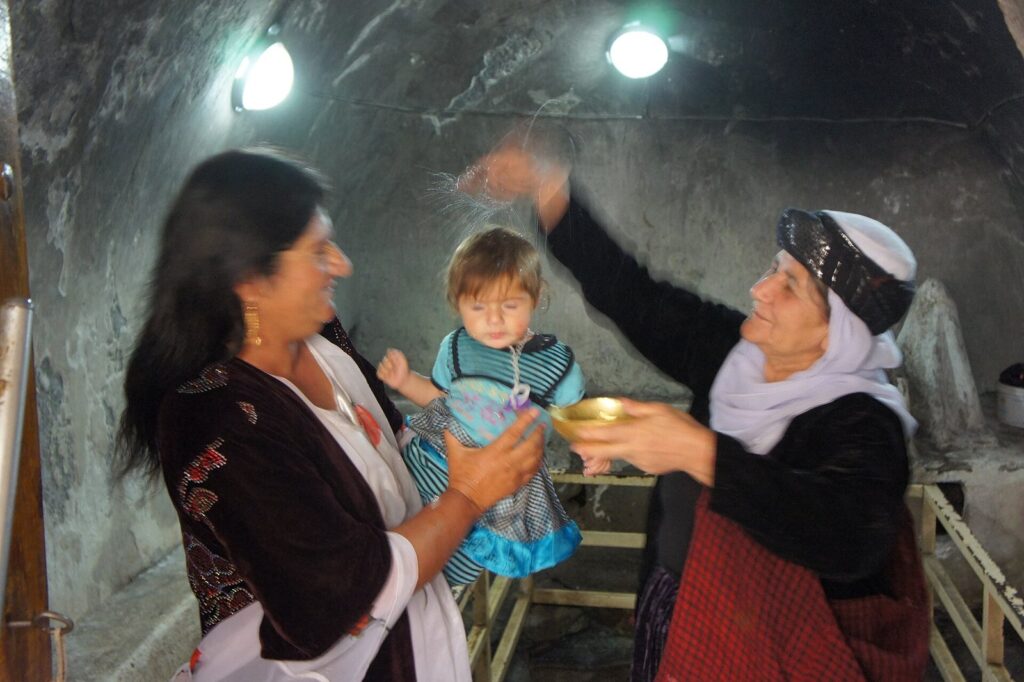
Sheikh Adi ibn Musafir settled in the valley early in the 12th century and founded a zawiya there, a lodge where a religious teacher lived with his followers. He died in 1162, and his mausoleum, built in the second half of that century, is the heart of the sanctuary. Every Yazidi is expected to make the pilgrimage to Lalish at least once in a lifetime, traditionally a six-day stay, and families from across the region return each autumn for the seven-day Jama feast. Children are baptised at the valley’s White Spring by a female sheikh or pir. A small group of resident guardians, whom the heritage survey calls monks, lives here all year and looks after the buildings; pilgrims stay only during festivals.
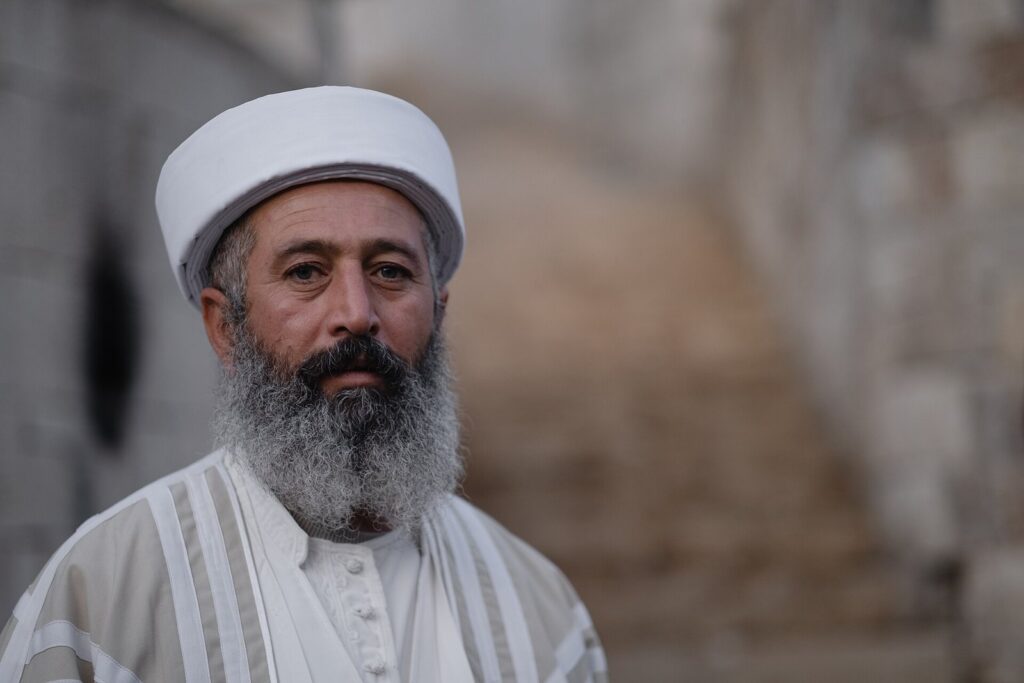
There is no honest way to write about Yazidis in 2026 without 2014. On 3 August 2014 the Islamic State group overran Sinjar. Kurdistan24’s figures, published around the twelfth anniversary this August, count more than 5,000 Ezidis killed, thousands of women and children abducted, about 2,820 people still missing and nearly 97 mass graves identified. More than 400,000 people fled to the Kurdistan Region; about 100,000 have returned to Sinjar, more than 270,000 remain in displacement camps and around 100,000 have sought refuge abroad. In the first days of the genocide, families escaping Sinjar sheltered inside the temple at Lalish.
Some of the people you meet here will have lost relatives in those weeks. You don’t need to raise it, and nobody owes a visitor their story. Sinjar itself is in Ninawa, where the FCDO advises against all travel, and Lalish is not a stepping stone towards it.
What will you see inside the sanctuary?
The most careful description of the complex we have found is the Mesopotamia heritage project’s survey, written by the art historian Birgül Açıkyıldız-Şengül, whose research catalogued 88 Yazidi monuments. What follows draws on it.
The stream and the Silat bridge
The valley’s stream rises at the Zemzem spring and runs north to south past the sanctuary. A stone bridge, the Silat bridge, crosses it, and the survey describes it as the line between secular and sacred space. Treat it that way yourself: beyond it you are a guest in someone else’s holy place, not a sightseer.
The forecourt and the inner courtyard
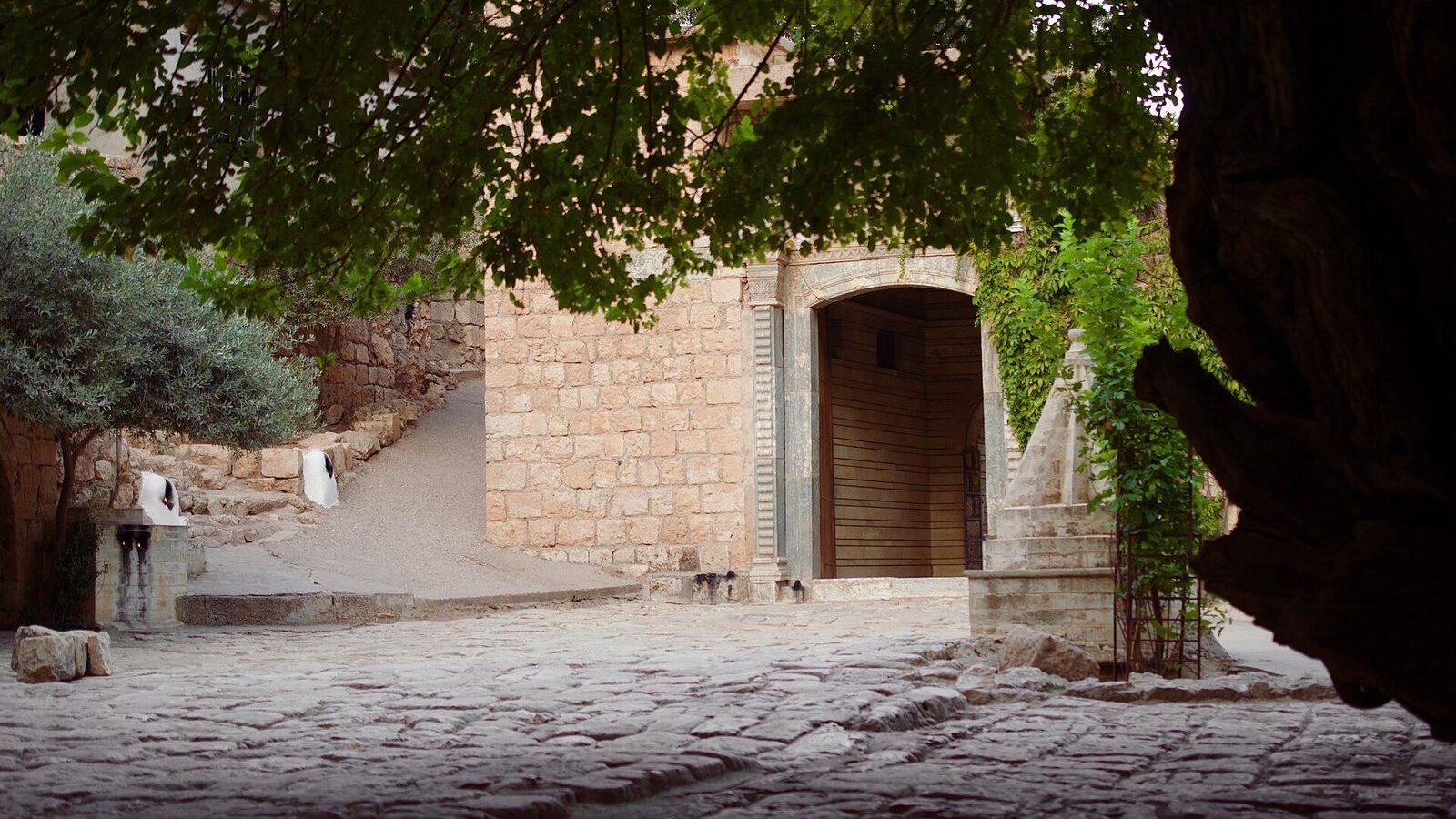
The main entrance is on the west. A forecourt and a flight of steps lead down into the inner courtyard, where the Baba Sheikh has traditionally held court during visits. There is a secondary entrance on the south side and an eastern door used only by the resident guardians. A southern side court holds arcades, a kitchen, washrooms and bedrooms, mostly 20th-century additions.
The fluted spires
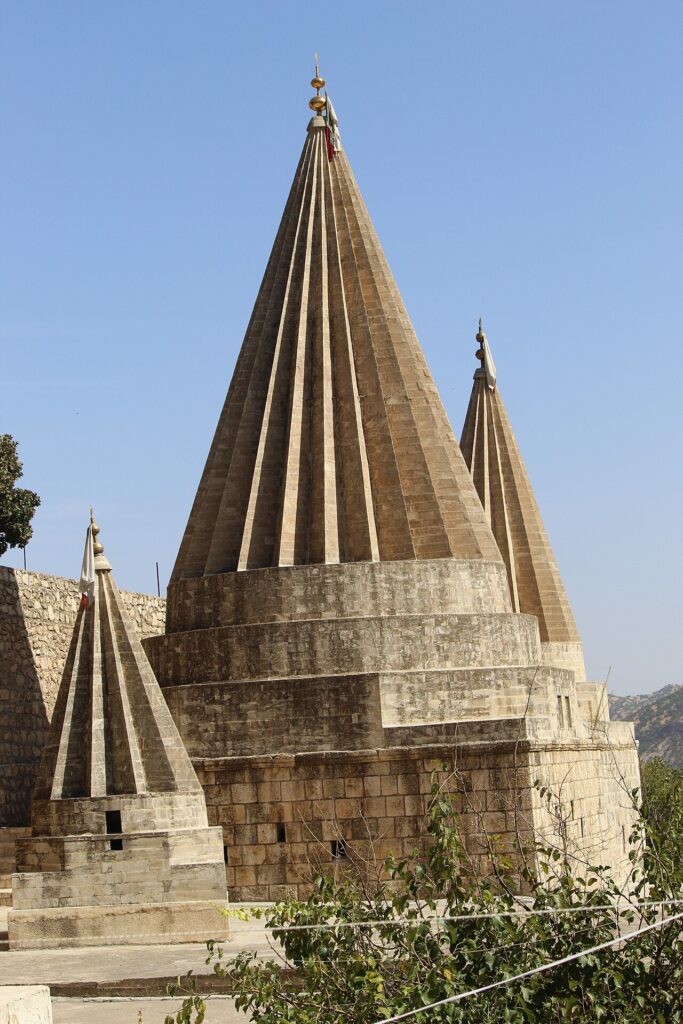
The ridged, conical roofs are what everyone photographs. In the survey’s words, “Mausoleums with a conical, striped dome are emblematic of Yazidi sacred art.” Each cone sits on a cube-shaped base and a drum, and its ridges are read as the rays of the sun falling on the earth. At the tip, a bronze finial carries one or more spheres, a ring, a crescent and a sun or a hand, and coloured cloth is knotted around it. Cones rise over the mausoleums, including those of Sheikh Adi and of Sheikh Hasan, who died in 1254.
Sheikh Adi’s tomb and the meeting room
The central meeting room is the focal point of the complex. The mausoleum of Sheikh Adi, the most sacred space in Lalish, is entered through its west door, and the hall of Sharaf al-Din lies to the east of the meeting room. The inner walls of the Sheikh Adi and Sheikh Hasan mausoleums were faced in marble in 1989, and the meeting room’s walls in cut stone. This is where the rules about thresholds and bare feet matter most.
The oil store
Three rectangular rooms hold jars of ceremonial olive oil. Light is at the centre of the big festivals: at New Year the Baba Sheikh and the Spiritual Council light 365 lamps, one for each day of the year, and during the Jama feast 365 are lit every evening.
Zemzem, the spring in the cave
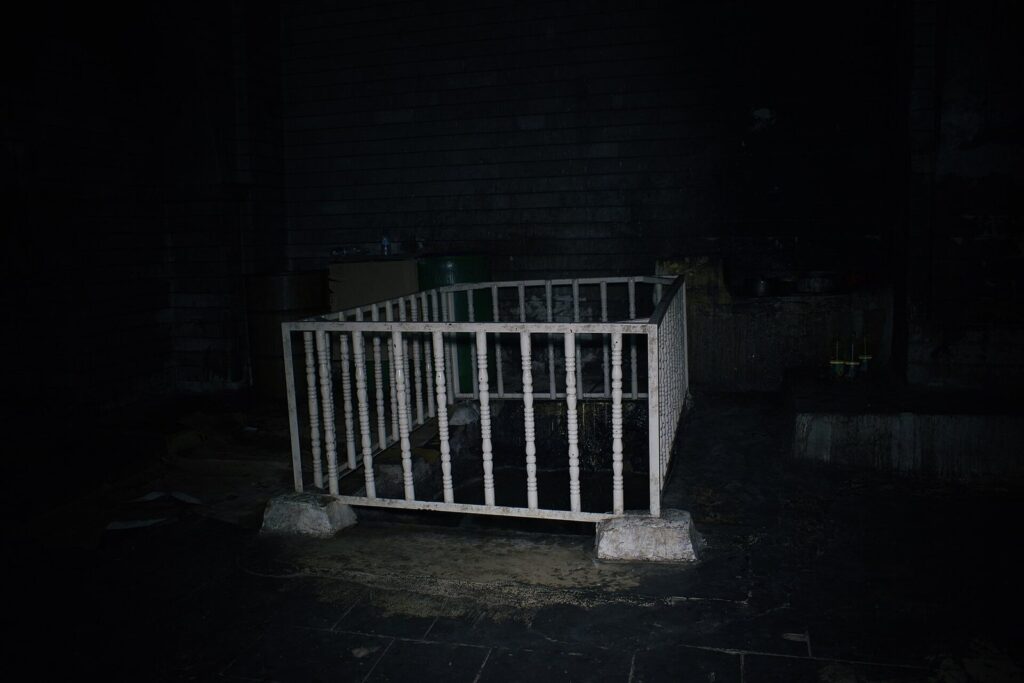
The Zemzem spring rises in an underground cave reached through a north door. Its name is the same as the well at Mecca, and the mountain to the north is called Arafat: the faith is not Islamic, but its sacred geography shares a vocabulary with its neighbours.
Kaniya Spî, the White Spring
South-west of the sanctuary is Kaniya Spî, the White Spring, which serves as the baptistery. The survey lists baptism here, performed by a female sheikh or pir with water from the spring, among the core acts of pilgrimage, alongside going barefoot, knotting and unknotting cloth on the wish trees, giving gifts to consecrated people and kissing the sanctuary’s sacred places. If a baptism is under way when you pass, keep your distance and your camera down.
How should you behave at Lalish?
Visitors are received kindly and the customs are few, but they are not optional. The table gives each one with how firmly we could source it, because some of what gets repeated about Lalish online is true but surprisingly hard to cite.
| Custom | What it involves | How firmly sourced |
|---|---|---|
| Bare feet | Shoes come off and stay off in the sacred area, in any season | The heritage survey lists it as a sign of respect; our August 2026 notes put the shoes-off point at the police post at the village entrance, which we could not re-confirm |
| Thresholds | Step over them, never on them | A long-standing custom, reported consistently; we found no 2025 or 2026 source that states it |
| Knotted cloth | Pilgrims knot and untie cloth on the wish trees | Listed in the survey; leave other people’s knots alone |
| Dress | Modest clothing for men and women | Our August 2026 notes; no written dress code has been published |
| Wednesdays | The sacred fire is lit on Wednesdays, the weekly day of observance | Listed in the survey; expect more worshippers |
| Photography | No published rule | Unconfirmed; ask a guardian before photographing people or interiors |
Bare feet in every season means hot stone in summer and cold stone in winter, so go in the cooler part of the day and bring a bag for your shoes. Modest dress means long trousers or a long skirt and covered shoulders; our Iraq packing list has clothing that works across Kurdistan and federal Iraq. If someone offers you tea, accept it.
On photographs, the absence of a published rule is not permission: the valley and the spires are one thing, faces, rituals and the tomb chamber another. Our guide to photography in Iraq covers photographing people and religious sites, and our overview of Iraqi customs and culture explains greetings and invitations.
When should you go? The Yazidi calendar at Lalish
Lalish is most alive during its festivals and easiest for an outsider outside them. The calendar below follows Kurdistan24’s April 2026 guide to Yazidi festivals, checked against the KRG’s official 2026 calendar where the two overlap. The New Year moves each year and always falls on a Wednesday in mid-April.
| Occasion | When | What happens at Lalish | For a visitor |
|---|---|---|---|
| Belenda | First Friday of January | Communal fires, prayers, food shared in memory of the dead | Mostly a village and family occasion |
| End of the winter forty-day fast | Early February | Candles and Sema, a sacred ritual performed with music | A religious gathering; come as a quiet guest or not at all |
| Red Wednesday (New Year) | Mid-April; 15 April in 2026 | The Baba Sheikh and the Spiritual Council light 365 lamps; eggs are dyed | Public ceremonies at Lalish were cancelled in 2026 |
| Sacrifice feast | June | Animals sacrificed and the meat shared with the poor and with visitors | Busy; guests are included in the sharing |
| End of the summer forty-day fast | Late July to early August | Rites and ceremonies at the sanctuary | Expect worshippers rather than a quiet visit |
| Jama (Feast of the Assembly) | 6 to 12 October on the KRG’s 2026 calendar | Sema, 365 lamps lit each evening, a sacrifice near the end | The largest gathering of the year; more than 200,000 came in 2025 |
The Jama is the one date every visitor should know. In 2026 the KRG’s official calendar lists 6 to 12 October as “Jama Feast (for Yazidis)”, a public holiday in the Region, and for that week the valley belongs to Yazidi families from Iraq and the diaspora. If you are not Yazidi and have a choice, go another week; if a Yazidi friend invites you, your host’s guidance outranks anything written here.
| Source | Jama dates given | What it actually measures |
|---|---|---|
| KRG official calendar, 2026 | 6 to 12 October | Public holiday days in the Kurdistan Region |
| Kurdistan24, 15 April 2026 | 6 to 12 October, seven days | The festival as the community keeps it |
| Reference entries on Lalish (Wikipedia) | 6 to 13 October | A span one day longer, not explained in the entries |
Outside the festivals, a weekday that is not a Wednesday is quietest. Our guide to the best time to visit Iraq covers the seasons; spring and autumn are gentler on bare feet than high summer.
A short history of the sanctuary
Lalish has been rebuilt, seized, returned and restored several times, and its history is written in its walls rather than in inscriptions: the survey notes that no dated inscriptions survive inside the sanctuary and that poor-quality restorations make the fabric hard to read.
| When | What happened |
|---|---|
| Early 12th century | Sheikh Adi ibn Musafir settles in the valley and founds a zawiya |
| 1162 | Sheikh Adi dies; his mausoleum follows in the second half of the century |
| 13th century | Sheikh Hasan’s mausoleum (he died in 1254), the meeting room and the hall of Sharaf al-Din are added |
| 1414 or 1415 | Sheikh Adi’s tomb is razed in a campaign led from Mosul, then rebuilt |
| 1890s to 1900s | The Ottoman state turns the sanctuary into a Sunni madrasa; the Yazidis recover it under Mir Ali Beg |
| 1979 and 1989 | The Mir’s door is rebuilt; marble goes onto the mausoleum walls |
| August 2014 | Families fleeing Sinjar shelter in the temple |
| 2020 | Lalish Temple is added to Iraq’s UNESCO Tentative List |
Two of those dates depend on which source you read, and neither is wrong in its own terms.
| Source | Figure | What it actually measures |
|---|---|---|
| Mesopotamia heritage survey | Tomb destroyed 1414; madrasa period 1890 to 1907 | Building phases, including the Ottoman-era restoration works |
| Reference accounts (Wikipedia’s Lalish entry) | Tomb razed 1415; valley annexed 1892 and recovered in 1904 under Mir Ali Beg | Political events: the seizure and the handover back to the Yazidis |
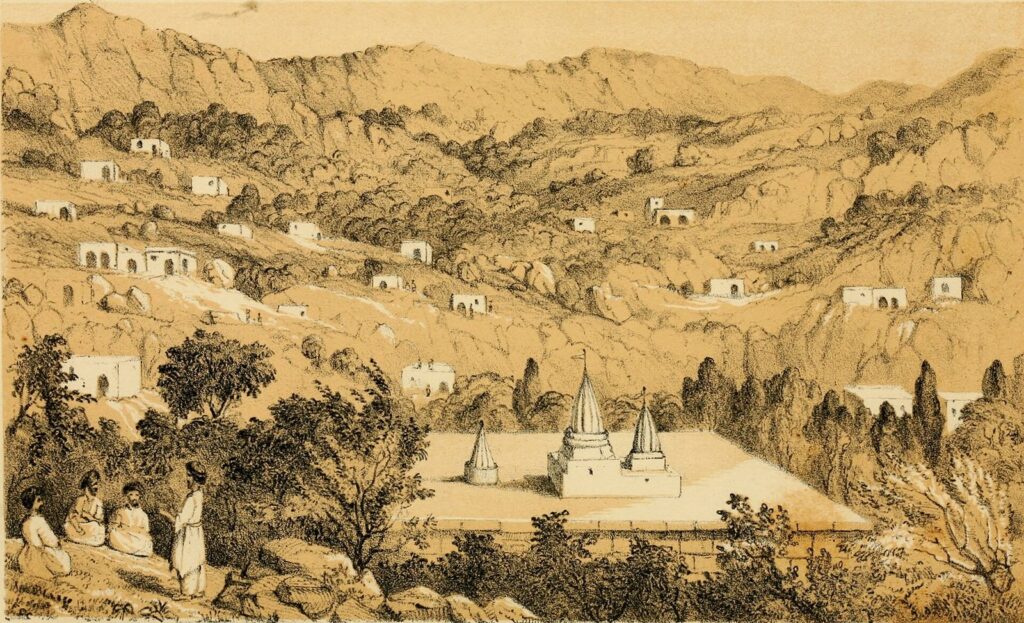
Lalish Temple is on Iraq’s UNESCO Tentative List, added in 2020 under reference 6467, which is not the same as being a World Heritage Site; our guide to Iraq’s UNESCO World Heritage sites explains which places are inscribed and which are still on the waiting list.
How do you get to Lalish?
We found no scheduled bus or shared taxi to the valley, so the options are a hired car with a driver or an organised trip from Duhok or Erbil. We found no visitor accommodation in the valley either, so plan it as a day out from a city base.
From Duhok
The KRG files Lalish under Duhok governorate, and Duhok is the natural base: a city with hotels, restaurants and drivers used to the Shekhan roads. Our Duhok city guide covers where to stay and how the city fits into a wider trip. We have no verified road distance or drive time from Duhok to Lalish, and we would rather say so than repeat an estimate we can’t source.
From Erbil
From the capital, the main Erbil to Duhok highway runs via Akre and Ba’adre, and Ba’adre is itself in Shekhan district. The KRG is building the Ba’adre to Etit Strategic Highway, a 26 km project, and says that when it is finished the entire Erbil to Duhok road will be a modern dual carriageway; Invest Kurdistan listed “improved routes toward Lalish” among highways under construction in May 2025. Expect roadworks along the corridor. Our list of things to do in Erbil includes Lalish among the longer day trips.
Checkpoints, papers and visas
Roads between governorates in Iraq pass security checkpoints, and our guide to Iraq’s checkpoints explains what they generally ask for. We have not found a dated, first-hand account of the checkpoints on the Shekhan roads, so we won’t describe one. Carry your passport, a photocopy and a phone photo of the visa page, and let your driver do the talking.
Arriving from Duhok or Erbil, you are likely to be travelling on a Kurdistan Region visa, issued online at visit.gov.krd or, for eligible nationalities, on arrival at Erbil and Sulaymaniyah airports. The FCDO says plainly that Kurdistan visas are “valid for travel in KRI only”. Our Kurdistan visa guide covers the fee and validity. If your trip also takes in federal Iraq, you need the federal e-visa, which the FCDO says costs $160, is valid for 60 days and must be applied for at least 24 hours before travel, with no visa on arrival; our Iraq e-visa walkthrough has the steps. Whether Shekhan’s disputed status makes any difference to a Kurdistan-only visa holder is on our unconfirmed list below.
Prefer an operator? Our guide to Iraq tours sets out what to ask before booking.
Combining Lalish with other places
Nearby Alqosh, with the Rabban Hormizd monastery above it, is in Tel Kaif district of Nineveh, inside the FCDO’s Ninawa line too, and so is Mosul; our Mosul guide sets out that advisory position. Heading east, the Gali Ali Beg waterfall on the Rawanduz road honours Mîr Elî Beg, a Yazidi prince of the Shekhan principality.
What we could not confirm
- Opening hours. No source publishes visiting hours; go in daylight and outside festival days.
- Where shoes come off in 2026. Our August 2026 notes say the police post at the village entrance; no 2025 or 2026 source confirms that exact point.
- Which rooms are open to non-Yazidis. Visitors are welcome in the sanctuary, but we could not confirm whether the tomb chamber and the Zemzem cave are open to outsiders on an ordinary day.
- Photography rules. None is published. Ask a guardian before photographing people, rituals or interiors.
- Whether women are expected to cover their hair. Modest dress is the consistent advice, but we found no written rule on head coverings.
- Donations. No entry fee is mentioned anywhere we looked, and we could not confirm whether a donation is expected or where to leave one.
- Distances and drive times. No official source gives a road distance or time from Duhok or Erbil. Travel blogs suggest about two hours from Erbil; we can’t verify that.
- Checkpoints on the Shekhan roads. The roads cross from Kurdistan Region districts into disputed ones, and no dated source describes the checkpoint procedure or whether a Kurdistan-only visa is ever questioned there.
- The last day of the Jama. The KRG and Kurdistan24 say 6 to 12 October; reference entries say 6 to 13. One Kurdish media report expected 25,000 to 30,000 visitors a day at the feast, but we could not tie it to a year.
- The security picture in late September 2026. News reports describe drones shot down over Erbil in September 2026 and a brief suspension of flights at Erbil airport; we could not confirm the dates from an official source. We also could not load the State Department’s own advisory page in September, so we cite its 2 March 2026 reissue.
- The 2027 New Year date and whether public ceremonies return. The Spiritual Council cancelled the 2026 gathering at Lalish; no decision about 2027 has been published.
Frequently asked questions
Can non-Yazidis visit Lalish?
Yes. Visitors of other faiths are welcome at the sanctuary, provided they go barefoot in the sacred area, dress modestly and step over thresholds rather than on them. We could not confirm which inner rooms are open to outsiders on a given day, so follow the guardians’ lead.
Is there an entry fee at Lalish?
We found no source, official or otherwise, that mentions a ticket or entry fee. The sanctuary is a working religious centre looked after by resident guardians, not a managed heritage site with a ticket office. Whether a donation is expected, and where you would leave it, is something we could not confirm; if you want to give, ask a guardian rather than pressing money on anyone.
Why do you have to go barefoot at Lalish?
Going barefoot is a sign of respect for sacred ground, and it applies in every season, so the stone is hot in summer and cold in winter. Our August 2026 notes put the point where shoes come off at the police post at the village entrance, well before the temple itself. We could not re-confirm that for 2026, so watch what others do and follow them.
Is Lalish in Kurdistan or in Nineveh?
Both, depending on whose map you use. Lalish is in Shekhan district, which Iraq’s federal map places in Nineveh governorate, but the Kurdistan Regional Government has administered it since 1991 and lists it under Duhok. The FCDO advises against all travel to Ninawa province and has not carved Lalish out, which matters if your insurance follows FCDO advice.
Is Lalish a UNESCO World Heritage Site?
No. Lalish Temple is on Iraq’s UNESCO Tentative List, added in 2020 under reference 6467. The Tentative List is a country’s inventory of places it may nominate in future, not an inscription. Some tour listings call Lalish a World Heritage Site, and as of September 2026 that is simply wrong.
When is the Jama feast at Lalish in 2026?
The KRG’s official 2026 calendar lists 6 to 12 October as the Jama Feast holiday for Yazidis, and Kurdistan24’s festival guide gives the same seven days; some reference entries say 6 to 13 October. Expect very large crowds, since more than 200,000 people came in 2025. If you are not Yazidi and have a choice, a quieter week is kinder to everyone.
How far is Lalish from Duhok and Erbil?
We don’t know precisely, and we would rather say so than guess. Lalish is about 60 km north of Mosul and 14 km west of Ain Sifni, but no official source we found gives a road distance or drive time from Duhok or Erbil. Ask your driver for an estimate on the day, and allow for checkpoints and roadworks on the Erbil to Duhok corridor.
Can I visit Lalish on a Kurdistan Region visa?
Coming from Duhok or Erbil you are likely to hold one, and the valley is run by the KRG. The FCDO’s wording is that Kurdistan visas are “valid for travel in KRI only”, and Shekhan is formally part of Nineveh. We found no official statement on whether that matters at the Shekhan checkpoints, so it stays on our unconfirmed list.
Final thoughts
Lalish rewards the visitor who arrives with the right expectations. It is not a monument that happens to have worshippers; it is a living sanctuary that lets outsiders in, barefoot, for a while. The courtyards are small and the important things are quiet: a knot tied on a branch, a child carried down to the White Spring, a kiss on a doorframe. You will understand more if you go slowly, ask little and accept the tea.
The harder part is the paperwork of risk: Lalish sits on the line between the FCDO’s two bands, and the Yazidi Spiritual Council cancelled its own public New Year at the temple this spring. None of that makes a visit impossible, but it should make it deliberate: the right insurance, the right visa, a driver who knows the Shekhan roads and a date that isn’t the community’s own.
For the rest of the trip, Erbil Citadel is the obvious counterpart in the Region’s capital, Sulaymaniyah is the cultural pole at the eastern end of the Region, and the rest of our coverage of Kurdistan’s cities, mountains and visas fills in the gaps between them.
Photo credits
Courtyard entrance of the main temple, Lalish (featured image): Levi Clancy, Wikimedia Commons (CC BY-SA 4.0). Yazidi cleric at Lalish: Levi Meir Clancy, Wikimedia Commons (CC0). Conical spires of the Lalish sanctuary: Luay Qassim Hassan, Wikimedia Commons (CC BY-SA 4.0). Sacred pool inside the main temple, Lalish: Levi Clancy, Wikimedia Commons (CC0). Baptism at Kaniya Spî, Lalish: MikaelF, Wikimedia Commons (CC BY-SA 4.0). Front of the Temple of Sheikh Adi, 1852 lithograph: George Percy Badger; C. Graf, lithographer, Wikimedia Commons (public domain). All images via Wikimedia Commons under the licences shown.