Last updated: August 2026. Flight schedules, museum hours, visa fees, the FCDO advisory and the Halabja governorate timeline were all re-checked in mid-August 2026 against the operators, the KRG and gov.uk. Several of the security bulletins quoted here expire before the end of September — re-check them before you book.
Most people who fly into Iraqi Kurdistan land at Erbil, spend two days there and go home. Sulaymaniyah is the other city — the Kurdistan Region’s cultural capital, about 198 km northeast of Erbil by the KRG’s own figure, and the one that rewards a slower visit. It is where modern Kurdish poetry was written, where the Region’s two independent newspapers are printed, where the country’s second-largest museum sits behind a modest 1980s frontage, and where the old Ba’athist security headquarters has been left standing with its shell holes intact and turned into a museum about what happened inside it. Sulaymaniyah is the region’s second city, introduced in our Iraqi Kurdistan travel guide.
The practical headline first, because it changed twice in a year. Sulaymaniyah’s airport was officially renamed Jalal Talabani International Airport on 19 March 2026, by decision of the Iraqi Civil Aviation Authority — the codes are unchanged, so you will still book ISU or see ORSU on charts. And Türkiye’s three-year ban on flights to Sulaymaniyah ended in October 2025, though the airline you would expect to see there is the one that is not currently flying. More on both below, with the schedule data and the dates.
The harder headline is that all of this sits inside a live security situation. The FCDO advises against all but essential travel to the entire Kurdistan Region of Iraq, with no exceptions carved out anywhere in it, and travelling against that advice can invalidate your travel insurance. We set out what the advisory actually says, what the attacks of July and August 2026 were aimed at, and where they were — and then leave the decision with you, which is the only honest place to leave it.
This guide covers getting to Sulaymaniyah by air and overland, the visa rules that catch people out at ISU, Amna Suraka and the Slemani Museum with the sourcing behind their published hours, the bazaar and the mountains, Halabja and its memorial, day trips to Ahmed Awa and Dukan Lake, money, alcohol, the law, when to go, and a long section on the things we could not confirm — which on this subject is a longer list than most sites will admit to.
The short answer
| Question | Answer, as at mid-August 2026 |
|---|---|
| Where is it? | Northeast Iraq, in the Kurdistan Region. KRG puts it 198 km from Erbil and 385 km from Baghdad. Elevation 882 m. |
| Do I need a visa? | The Kurdistan Region runs its own regime. Visa on arrival still exists at ISU for eligible nationalities; the KRG e-visa costs 100,000 IQD. It is valid in the Kurdistan Region only. |
| Can I fly there? | Yes. Eight airlines are listed at ISU. Doha, Amman, Dubai, Istanbul Sabiha Gökçen and Baghdad are the live routes. There is no scheduled Erbil–Sulaymaniyah flight. |
| What does the FCDO say? | Against all but essential travel to the whole Kurdistan Region, updated 22 July 2026. Insurance can be invalidated by travelling against it. |
| What is the one thing to see? | Amna Suraka, the former security headquarters. Reported free, but no 2026 confirmation of its hours exists. |
| How long do I need? | Two days for the city. Three or four if you want Halabja, Dukan Lake or Ahmed Awa. |
| Cash or card? | Cash. Foreign debit cards are rarely accepted. The dinar was trading around 1,530 to the dollar on 15 August 2026 against an official 1,320. |
Why Sulaymaniyah reads differently from Erbil
Erbil is older, richer and more built. It has the citadel, the international hotel brands, the airport with the long runway and the diplomatic quarter. If you only have three days in the Kurdistan Region, Erbil’s sights and logistics are the easier introduction, and the citadel there is the region’s one UNESCO-inscribed monument.
Sulaymaniyah is younger — founded in 1784 by the Ottoman-Kurdish prince Ibrahim Pasha Baban, a fact the KRG’s own tourism board states in the same words as Wikipedia — and it has spent most of its short life being the place where things get written down. The KRG’s General Board of Tourism puts it plainly on its own page: “From the cultural perspective, Sulaimani is considered to be the capital of Kurdish culture.” That is an official source for a claim travel writers usually assert without one.
The evidence behind it is specific rather than atmospheric. The poets Nalî (1800–1873), Mahwi (1830–1906) and Piramerd (1867–1950) are the city’s own; Abdulla Goran (1904–1962), generally credited as the founder of modern Kurdish poetry, and Sherko Bekas (1940–2013) came from here too, as did the novelists Ibrahim Ahmad and Bachtyar Ali. Two independent newspapers, Hawlati and Awena, and two independent political magazines, Lvin and Shock, are published in the city — a genuine marker of a looser media environment than you find elsewhere in Iraq. The American University of Iraq – Sulaimani opened in 2007 and teaches entirely in English; the University of Slemani, founded 1968, is the largest in the Region. An international film festival has run since 2016 out of the University of Sulaymaniyah’s College of Fine Arts, and Slemani is the only city in the Iraqi Kurdistan Region that regularly marks the Fête de la Musique.
If you want proof that this is a living thing rather than a heritage plaque: in August 2026 the city hosted its first book fair devoted entirely to Kurdish-language publishing, at the Family Mall, with 45 publishing houses taking part and doors open 11:00 to 23:00 daily. It ran until 23 August 2026 and is over by the time you read this. The point is not the fair; it is that a city of roughly 847,000 people can fill a mall with Kurdish books for two weeks and call itself the capital of culture without anyone laughing.
What that means practically is that Sulaymaniyah is a city for walking, reading, eating and talking rather than a city with a monument checklist. The two museums are serious. The mountains are half an hour away. The politics are more openly argued about than in Erbil. And it is quieter — noticeably less international, fewer contractors, fewer glass towers. Some travellers find it flat after Erbil. Others never quite leave.
One small thing that trips up searches: the name has at least five common English spellings. Sulaymaniyah, Sulaimani, Sulaimaniyah, As-Sulaymaniyah and Slemani all refer to the same city, and locals overwhelmingly say Slemani. The Kurdish is Silêmanî. Booking sites and airline schedules mostly use Sulaymaniyah; street signs and the museum’s own frontage use Slemani. Search both.
Is Sulaymaniyah safe right now?
The honest answer has three parts, and skipping any of them would be misleading.
First, the advisory. As of its 22 July 2026 edition — still current when we checked on 15 August — the FCDO’s entry for the Kurdistan Region is one sentence: it advises against all but essential travel to the Kurdistan Region of Iraq. There are no longer any geographic sub-divisions inside that. Earlier editions carved out specific bands at the higher “against all travel” rating, including the Amedi mountains and strips along the Turkish and Iranian borders; those carve-outs have been deleted, and the regional risks page now contains no KRI sub-divisions at all. That is uniformly worse for the three cities and materially better for the border areas, and if you have read an older guide (including, we should say, older material on this site), the carve-out list it gives you is out of date. The practical consequence is the one most pages bury: the FCDO states that your travel insurance could be invalidated if you travel against its advice. Check the wording of your policy against the current advisory position before you assume you are covered, and read our guide to insuring a trip to Iraq for what that actually means at claim time.
The US State Department has Iraq at Level 4, Do Not Travel, reissued 2 March 2026 — and on the same date ordered non-emergency US government employees to leave the country. It makes no distinction for the Kurdistan Region.
Second, what has actually been happening. Since 8 July 2026 the FCDO has recorded strikes and retaliatory attacks by Iran in a number of locations across the region, including the Kurdistan Region, against US military and civilian infrastructure. Shafaq’s own audit of the four weeks from 17 July to 12 August 2026 counted at least 21 drones plus missiles across the Region, with at least nine people killed and eight wounded. Rudaw counted 19 attacks on the Kurdistan Region in the first two weeks of August alone. The KRG’s prime minister told Al Jazeera the Region has absorbed more than 1,000 drones and missiles since the conflict began and has no air defences of its own.
Third, what those attacks were aimed at — because the scoping matters and almost nobody publishes it. In Sulaymaniyah province the targets in that period were bases belonging to Iranian-Kurdish opposition parties: a Komala position at Zargwez near Sulaymaniyah on 17 July, where nine opposition fighters were killed; a PAK headquarters on 22 July; Peshmerga positions at Tekeran on 28 July and Tasluja on 2 August; a strike near Jasana Cave on 1 August; Komala positions again on 8 August, with Iran explicitly named; and three missiles on a Komala headquarters in the Alana Valley on 11–12 August. These are not attacks on the city, on tourist sites or on the airport. They are attacks on the rural bases of Iranian-Kurdish exile parties, and they are a long-running feature of this province rather than a new development.
The two qualifications on that reassurance are real, though. Tasluja is the hill and industrial area immediately west of the city — the same area the intercity taxi garage sits in. And air travel is the thing that reliably breaks: Iraq closed its entire airspace for 38 days between 28 February and 8 April 2026, closed it again for 72 hours from 7 June, and on 24 July suspended all flights to Erbil, Baghdad and Basra before reopening on 8 August. The FCDO’s own regional risks page says routes in and out of the Kurdistan Region, naming both Erbil and Sulaymaniyah airports, may close at short notice, and that land borders back up when they do.
Everything in this section is dated to mid-August 2026 and will have moved by the time you travel. Read it as a description of how the risk behaves — episodic, aimed at specific rural targets, disruptive mainly through aviation — rather than as a live status report. Our wider pieces on safety in the Kurdistan Region and safety in Iraq generally go into the underlying picture in more depth.
Two everyday risks are worth more of your attention than the geopolitics. Iraq’s roads are genuinely dangerous — 2,351 recorded road deaths in 2025 — and landmines and unexploded ordnance remain a real hazard in border and rural areas, where the FCDO’s advice is to stick to well-trodden paths and well-driven tracks and never pick up metal objects. That applies to the Hawraman highlands east of Halabja as much as anywhere.
Flying to Sulaymaniyah: the airport has a new name and Turkish Airlines is missing
The airport sits 14 km west of the city. It opened on 20 July 2005, has three terminals, a single runway (13/31, 3,500 × 45 m) and — a detail worth knowing in winter, when fog settles on the Sulaymaniyah plain — no instrument landing system. It handled 428,609 passengers in 2022, making it Iraq’s fifth-busiest.
Two things have changed recently that no page-one competitor has picked up.
The name. By decision of the Iraqi Civil Aviation Authority, after Council of Ministers and prime ministerial approval, the airport became Jalal Talabani International Airport with effect from 19 March 2026, applying in all official correspondence, aeronautical charts and technical documentation. The IATA and ICAO codes are unchanged: ISU and ORSU. There is a wrinkle — +964 reported in May 2026 that the change had happened around seven months earlier, which points to an autumn 2025 announcement with legal effect in March 2026 — and the airport’s own website still brands itself Sulaymaniyah International, with a flight board frozen on April 2025 data. Book ISU; expect to see both names on signage and in older guides.
The Turkey ban. Türkiye closed its airspace to Sulaymaniyah flights on 3 April 2023, citing PKK activity, and the airport’s director put the losses at over US$5 million. The ban was lifted on 9–10 October 2025, after Nechirvan Barzani met President Erdoğan. Turkish Airlines resumed from 3 November 2025, four times weekly from Istanbul; AJet started Sabiha Gökçen four times weekly from 2 December 2025; Pegasus returned on 26 December 2025, three times weekly to Sabiha Gökçen.
And then the counter-intuitive part. As of 15 August 2026, Turkish Airlines is not flying to Sulaymaniyah. The schedule feed shows zero departures on the Istanbul route and an empty weekly grid through the whole of August. Its route page says the service begins 2 October 2026; the airport page on the same source says 2 September. We could not reconcile the two dates and we could not find any announcement explaining the absence, so we are giving you the conflict rather than picking a side. What is running is AJet and Pegasus — seven flights a week combined to Sabiha Gökçen, not Istanbul’s main airport.
| Airline | Route | Status, 15 August 2026 |
|---|---|---|
| Qatar Airways | Doha | Operating — the largest carrier at ISU |
| Royal Jordanian | Amman | Operating |
| flydubai | Dubai | Operating |
| AJet | Istanbul Sabiha Gökçen | Operating, 4x weekly |
| Pegasus | Istanbul Sabiha Gökçen | Operating, 3x weekly |
| Iraqi Airways | Baghdad | Operating (domestic) |
| Turkish Airlines | Istanbul (IST) | Zero departures; restart quoted as 2 Sep or 2 Oct 2026 |
| Condor | Düsseldorf | Starts 18 December 2026 |
Middle East Airlines, Cham Wings, Fly Baghdad, Mahan Air, Emirates and Austrian were checked and are not serving ISU. There is no scheduled flight between Erbil and Sulaymaniyah — if a guide tells you there is a hundred-dollar hop between the two, it is out of date. And there is a live European complication: EASA’s Iraq bulletin CZIB-2026-05, issued 8 July 2026, advises operators not to enter the Baghdad flight information region at any altitude, and it runs to 31 August 2026. France and Italy have companion notices. That bulletin expires before this article publishes, so check the current position with your airline rather than assuming either way.
Practical advice that follows from all of this: never book a same-day onward connection out of Iraq, build slack into the itinerary, and take a fare rule that lets you change. Our Iraq itinerary planning guide assumes exactly this kind of slack.
Visas: the trap at ISU that nobody covers
This is the single most useful practical fact for anyone landing in Sulaymaniyah, and no page-one competitor mentions it.
Federal Iraq and the Kurdistan Region run two separate visa regimes, and only one of them still does visa on arrival.
For federal Iraq, the FCDO now states it plainly: you are no longer able to get a visit visa on arrival. You must apply on the Government of Iraq’s e-visa portal at least 24 hours before you travel, the visa costs US$160 and is valid for 60 days. That $160 is the government price, not an operator markup — earlier figures circulating around US$114, including in our own older material, are superseded. Our detailed pages on the Iraq e-visa process and general entry requirements go through the application step by step, and our page on visa on arrival explains what is left of it.
For the Kurdistan Region, visa on arrival is alive. Nationals on the KRG’s List A can apply online through visit.gov.krd, issued within a few minutes according to the KRG, or simply get the e-visa on arrival at any Kurdistan Region entry point, ISU included. List B nationalities need a guarantor code from a sponsor inside the Region and should allow up to five working days. The fee is quoted in dinars, not dollars: an administrative fee of 100,000 IQD to the KRI Ministry of Interior Visa Department, roughly US$65 at mid-August 2026 street rates. Validity is 90 days from issue to enter; length of stay is 30 days from entry. Your passport needs six months’ validity and at least one blank page. The eligibility checker on visit.gov.krd is the live authority on which list you are on — see also our Kurdistan visa guide and the broader Iraq visa overview.
Now the trap. The FCDO’s wording is unambiguous: “Both types of visas are valid for travel in KRI only.” A Kurdistan Region visa or entry stamp does not let you travel south into federal Iraq. Travellers who have tried report being turned back at the first military checkpoint. Several tour operators and blogs have claimed since January 2025 that a KRI visa now permits onward federal travel for e-visa-eligible nationalities; no official Iraqi or KRG source confirms this, and there are 2026 reports of people being turned back between Erbil and Mosul. Plan around the restrictive rule. If you want Sulaymaniyah and Baghdad on the same trip, sort the federal e-visa first. If you overstay or need longer, our page on extending an Iraqi visa covers the mechanics.
Two more entry-side details. Customs requires you to declare local currency over 200,000 IQD and any currency or items over US$10,000 on entry or exit. And if you lose your passport in Iraq, you are legally required to publish the details in two local newspapers after reporting it to the police, and may be refused an exit stamp until you do — an odd rule that catches people out badly.
Getting to Sulaymaniyah overland
Here is where we have to be more honest than most guides are willing to be. There is no published drive time for any city pair in the Kurdistan Region. Not Erbil to Sulaymaniyah, not Sulaymaniyah to Baghdad, not Sulaymaniyah to Duhok. The only official distance figures anywhere are the KRG’s: 198 km from Erbil and 385 km from Baghdad, with no route specified for either. Crowd-sourced traveller accounts put the Erbil run at two to three hours on good roads. We are not going to turn that into a confident number, and you should be suspicious of any guide that does.
What we can tell you is the shape of the system. Intercity travel runs on shared taxis from garages, not scheduled buses. Sulaymaniyah’s intercity terminal is known as the “Garage of Baghdad” and sits in Tasluja, west of the city. Asking a taxi for the garage of your destination city is generally enough. Fares are all crowd-sourced and none of them are fresh: a seat between Erbil and Sulaymaniyah has been reported at around 15,000 IQD, though that instance is stamped September 2022, and intercity seats across the Region run somewhere in the 7,000–20,000 IQD band. Minibuses cost roughly half a shared-taxi fare and take about half as long again.
The Erbil route has a decision in it that most guides skip. There are two ways. Via Kirkuk is shorter, and is a live, heavily used freight corridor: in August 2026 truck drivers on the Kirkuk–Sulaymaniyah road were threatening to strike over delays at the Jamjamal checkpoint, so it is very much open and very much checkpoint-heavy. Via Dukan, Koya and Taqtaq is the normal tourist routing. The Kirkuk road’s problem is not physical, it is legal: the FCDO advises against all travel to Kirkuk province, so that route crosses a higher-rated zone and can invalidate insurance in a way the northern route does not. The northern route is not blameless either, because the FCDO’s safety page names Koya as one of the areas where Iranian strikes on Kurdish opposition groups have continued. We could not establish which route drivers actually take, and we found no source either way on whether foreigners are turned back on the Kirkuk road. State the trade-off to your driver and decide with them.
One further warning worth repeating: intercity minibuses are reported to be less safe than shared taxis specifically because they may stop in Kirkuk or Mosul — both in provinces the FCDO rates against all travel. If you are heading on to Mosul, understand that you are crossing both an advisory boundary and a visa boundary at once.
Expect several checkpoints on any intercity run, where soldiers may ask everyone in the car for a passport. Carrying photographic ID is a legal requirement in Iraq. Our guide to Iraqi checkpoints explains what actually happens at one, and getting around Iraq covers the wider transport picture.
For an overland entry from Iran, the Bashmaq–Penjwen crossing east of Sulaymaniyah is the closest of the two crossings realistic for foreign passport holders (the other is Piranshahr–Haji Omaran on the Hamilton Road). The FCDO’s standing note is that crossing points may close with little or no notice. Foreign nationals who have crossed into the Region illegally have been arrested and face up to five years’ imprisonment or fines of several thousand dollars — use the designated crossings.
Things to do in Sulaymaniyah
Amna Suraka: the Red Security building
Amna Suraka is the reason a lot of people come to Sulaymaniyah, and it should be approached as a memorial rather than an attraction. Between 1979 and 1991 the complex was the northern headquarters of the Da’irat al-Amn, the Iraqi Interior Ministry’s security directorate. Students, Kurdish nationalists and dissidents were imprisoned, tortured and raped inside it.
In the 1991 uprising, Iraqi security officials retreated into the compound — the Ba’athist stronghold in the city — and held off the rebels for nearly two days before Peshmerga took it in a two-hour assault. What followed is documented in Human Rights Watch’s 1992 report Endless Torment: around 300 security agents were summarily executed, civilians killed many more, and one group of mothers whose sons had been killed there stoned and axed to death 21 men. Between 700 and 800 secret policemen and soldiers died. Many conscripts were pardoned and sent home to the south. The building’s exterior has been left as the fighting finished it, and the shell and bullet damage across the façade is the first thing you see.
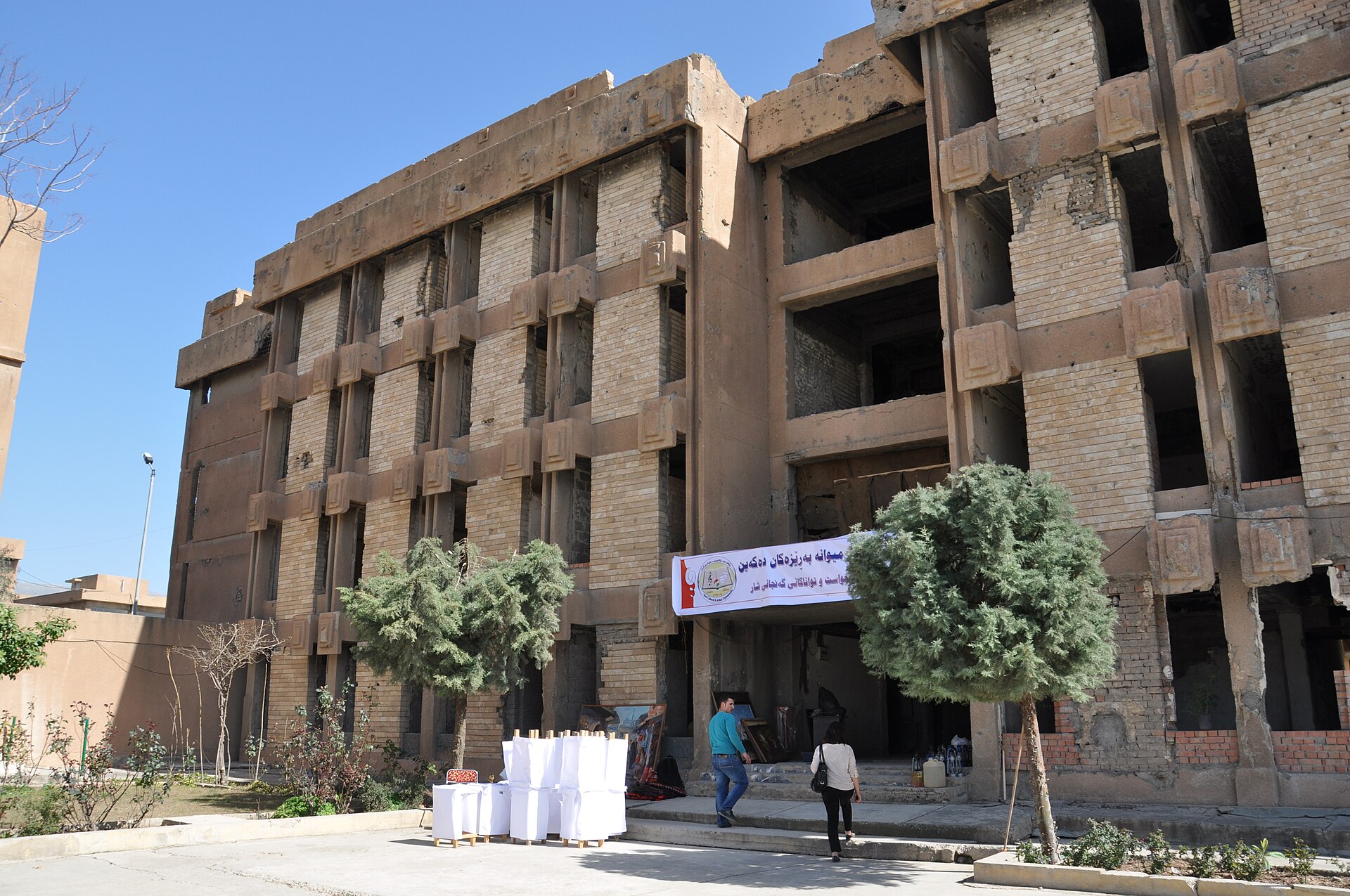
The museum opened in 2003. Inside, the best-known space is the Hall of Mirrors: a corridor lined with 182,000 shards of broken mirror, one for each Kurd killed in the Anfal campaign, lit by 4,500 backlights, one for each village destroyed. Those numbers are widely repeated and they do check out at encyclopedia level — but be precise about what they are. 182,000 is the official Kurdish figure for the Anfal dead, not an independently verified forensic count, and it should be attributed rather than stated as a fact of arithmetic. We could not confirm the name of the artist who made the hall; several sites give one, none of them source it, and we are not going to add to that.
Elsewhere there are mannequin tableaux reconstructing the torture methods used in the building, a second exhibition on Anfal with photographs of exhumed bodies and the names of prominent Kurds killed or disappeared, a later hall commemorating Peshmerga killed fighting ISIS, and a yard of artillery and armour outside. It is not a museum to bring children to without thinking about it first, and it is not a museum to photograph yourself grinning in front of. People in this city lost family in the events it documents.
It is also worth knowing who runs it: funding comes largely from the PUK — a political party — along with the Talabani family and the Qaiwan Group. Academics who study it read it explicitly as a project of Kurdish national memory-making rather than a neutral state museum. That does not make what it documents untrue. It does mean you are looking at a curated national narrative, and knowing that makes for a better visit, not a worse one.
On practicalities we have to be straight with you. The only citable statement of Amna Suraka’s admission and opening pattern that we could find is Vice, 31 October 2013, which reported it as free and open six days a week. That is a thirteen-year-old source. There is no operator-published set of hours, no 2026 confirmation that the pattern still holds, and no confirmation of its current open status. A search of 964media’s English archive for “Amna Suraka” returned nothing at all. The museum’s Facebook page is the live authority; check it, or ask your hotel to call, before you build a morning around it. Free admission is the better-sourced of the two claims.
The Slemani Museum
The Slemani Museum — Sulaymaniyah Museum on older signs and in most catalogues — is the second-largest museum in Iraq after the National Museum in Baghdad, a claim that is sourceable to UNESCO rather than to tourist-board enthusiasm. It opened on 14 July 1961 in the Shorsh district and moved to its present 6,000 m² single-storey building on Salim Street in 1980. It closed through the Iran–Iraq War, reopened briefly in 1990, closed again after the invasion of Kuwait, and was officially reopened by Jalal Talabani on 20 August 2000. It closed again for refurbishment between October 2018 and October 2019.
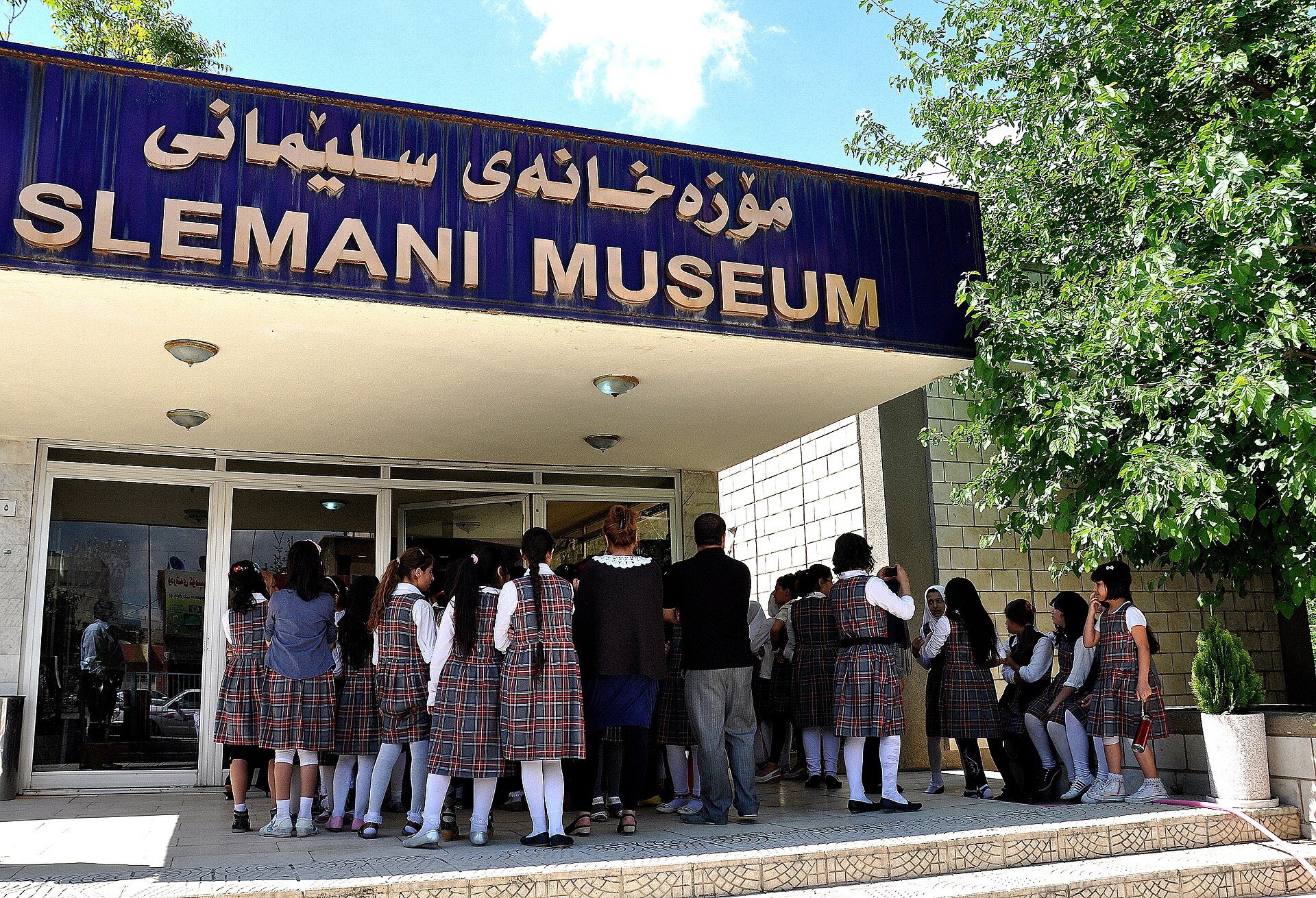
Hours and fee, with the caveat it deserves. The museum’s own website carries a banner reading, verbatim, “Free, open daily 9:00 Am – 1:00 Pm Sunday- Thursday”. Taken at face value that is free admission, 09:00–13:00, Sunday to Thursday — and the “daily” in the same sentence contradicts the “Sunday–Thursday”, so treat Sunday to Thursday as the operative pattern. This directly contradicts a page-one competitor that quotes a 5,000–10,000 IQD ticket, unsourced. But the museum’s site is not a healthy source. Its news items all date to 2018–19, it serves through an archive mirror, and it carries an injected casino-spam link in its main navigation — the classic signature of an abandoned or compromised content system. So: the operator says free, 09:00–13:00, Sunday to Thursday; the operator’s website has not been meaningfully maintained since about 2019; confirm locally before you plan around it. That nuance is the point. We would rather tell you the source is shaky than launder it into confidence.
What is inside is genuinely first rank. The museum holds Tablet V of the Epic of Gilgamesh, an Old Babylonian tablet bought from a smuggler in 2011 for around US$800, which added roughly twenty previously unknown lines to the epic. A point of precision, because it is confused everywhere: this is not the “Gilgamesh Dream Tablet” seized from Hobby Lobby and repatriated in 2021. Different object. Also here: the Stela of Iddi-Sin, King of Simurrum; blocks from the Paikuli inscription, with two galleries devoted to the Sasanian king Narseh opened in 2019 and 2021 in partnership with Sapienza University of Rome; Nimrud ivories including the “lady at the window” plaque; gold earrings inscribed with the name of Shulgi of Ur; and a brick stamped for Ur-Nammu. The Prehistory Gallery, two large halls sponsored by the US Embassy and inaugurated on 2 February 2021, holds material from Iraqi Kurdistan’s Palaeolithic caves and from the Bestansur excavation. If any of that is your reason for coming to Iraq at all, read our overview of ancient Mesopotamia and our round-up of Iraqi museums alongside it.
“Slemani Museum Kids”, opened 5 September 2019, was the first museum space in Iraq designed specifically for children, co-created with a University of Glasgow project funded by the British Council’s Cultural Protection Fund. It is barely mentioned anywhere in English travel writing.
One uncomfortable part of the museum’s history is worth knowing because it explains half the collection. After the 2003 invasion and the looting of the Baghdad museum, the Slemani helped recover stolen artefacts through the controversial practice of buying looted objects from smugglers. The Gilgamesh tablet was one such purchase. It rescues objects; it also puts money into the trade that produced them. The museum has never pretended otherwise.
Several tablets have been 3D-scanned and published freely through Heidelberg University’s research repository, which makes for a good look at the collection before you go.
The bazaar and the streets around it
Sulaymaniyah’s central market is the heart of the old city and the best hour you will spend in it — and it is also the part of this article where we have the least published fact to offer, which is itself worth saying.
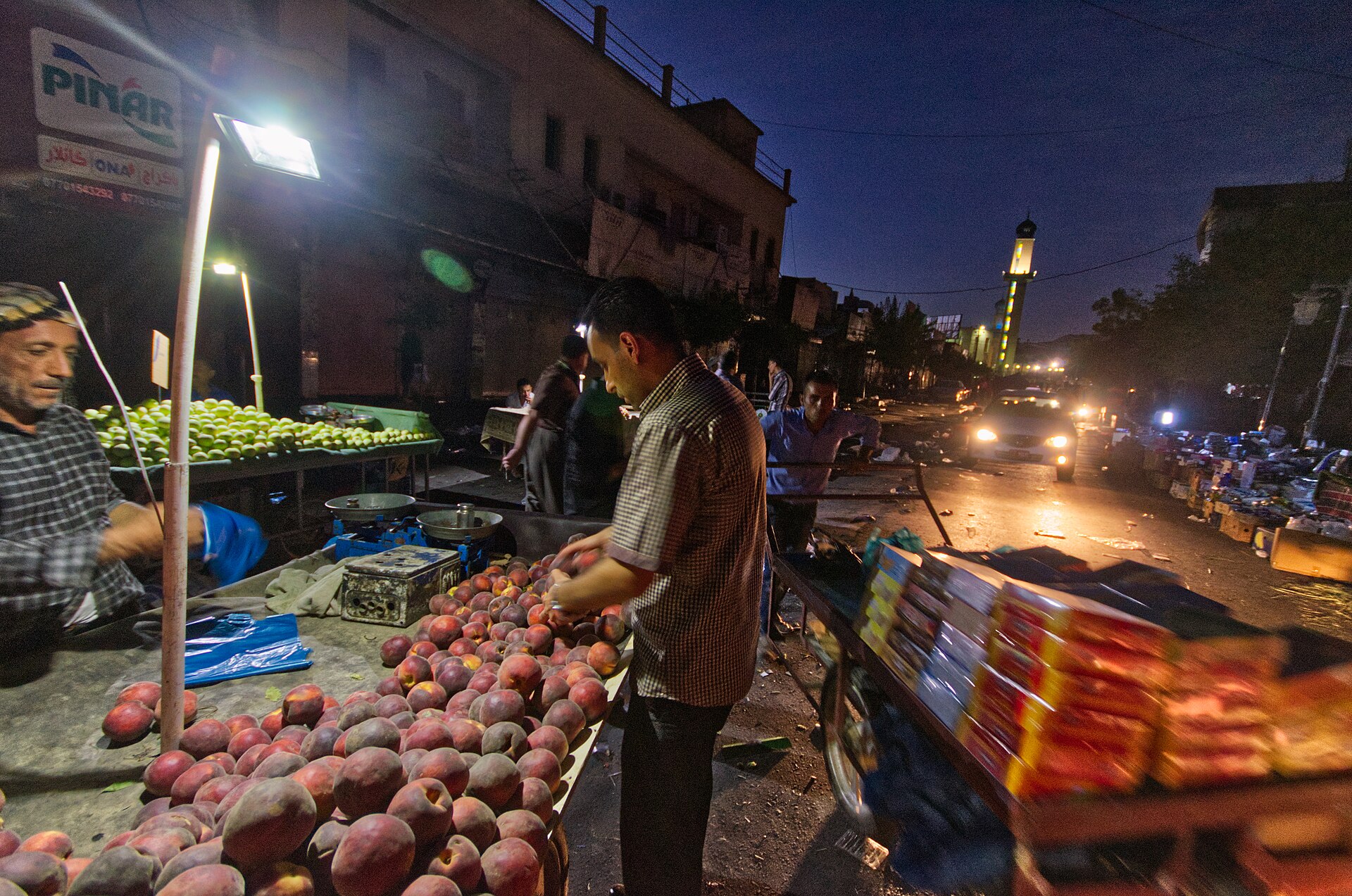
No opening hours, no official description and no named sections for Sulaymaniyah’s bazaar are published by the KRG, by the municipality or by any news source we could reach. The one sourced historical reference is that Ibrahim Pasha Baban erected trading halls called qeyserîs and bazaars when he founded the city in 1784 — history, not a description of what trades today. If you see a guide calling Sulaymaniyah’s market the “Qaysari Bazaar”, that is wrong: Qaysari is Erbil’s covered bazaar, and at least one page-one result has borrowed it. Another confuses Saholaka Street with Salim Street. Treat confident, specific market copy about this city with suspicion.
What we can say is that the market district is compact, walkable, busiest in the early evening in summer when the heat has come off, and organised the way Iraqi markets generally are, by trade rather than by aisle. Tea is offered freely and refusing it three times is not rudeness. Prices are negotiated. If you want the food side of it, our guide to Iraqi food covers what you will be looking at on the stalls, and Iraqi culture and etiquette covers the social rules around haggling and hospitality.
One hard legal warning that applies in any Iraqi market: do not buy antiquities. Iraqi law allows the death penalty for intentional export of antiquities, and a British geologist, Jim Fitton, was sentenced to 15 years for picking up fragments on an organised tour. Pottery shards are not souvenirs here.
Sarchinar, the parks and Chavy Land
Sarchinar is the city’s traditional escape — the KRG’s own tourism page places it about 5 km west of Sulaymaniyah (not north, as several guides have it), describes it as wooded and crossed by a freshwater spring, and lists a restaurant, a kids’ club, a swimming pool and a zoo, with the Nawroz and Jekjek resorts in the same area. No hours or fees are published, and the page’s copyright line reads 2015, so whether the zoo still operates is an open question.
Chavy Land, which the KRG calls one of the largest tourist complexes in the Region, is built on Goizha mountain above the city. The KRG publishes no hours, no ticket prices and no ride list for it. The city’s parks — Hawari Shar chief among them — are large and heavily used at weekends; one page-one competitor gives Hawari Shar’s area as 1,000 square kilometres, which is wrong by roughly two orders of magnitude and a useful signal about that page generally.
Azmar and Goizha
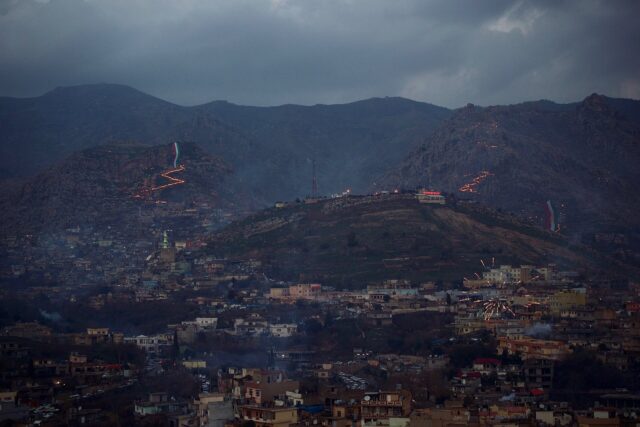
The mountains directly northeast of the city are Azmar, Goizha and Qaiwan, with Baranan to the south and the Tasluja hills west. They are what makes the city’s setting, and the drive up the Azmar side for the view over the plain is the classic Sulaymaniyah photograph — worth pairing with our list of photography spots in Iraq.
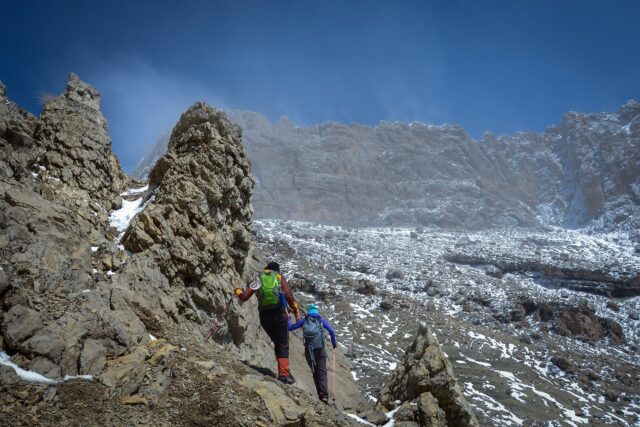
The KRG’s entire official entry on them is two sentences: people go up in winter for the snow and in summer for the cool. No heights are published for Azmar, Goizha, Qaiwan, Baranan or Piramagrun. No trailheads, no named viewpoints, no route descriptions, no guidance on whether a 4×4 is needed. We looked hard. If a guide gives you a summit elevation for Azmar, ask where it came from. Take a driver who knows the road, go early, and treat it as a drive with stops rather than a hike with a plan. Our piece on nature and landscapes in Iraq gives the wider picture of what the Zagros edge looks like.
Setak, “behind the Azmar Mountain, roughly 20 km north of Sulaymaniyah” in the KRG’s words, is where the Azmar road eventually goes, and is a reasonable target if you want the drive to end somewhere.
Halabja: a memorial, a town and now a governorate
Halabja sits about 14 km from the Iranian border, in the Hawraman highlands southeast of Sulaymaniyah, and it is the most-visited day trip from the city. It should be visited carefully.
What happened. On the evening of 16 March 1988, Iraqi aircraft attacked the town with chemical weapons over roughly five hours. Kurdish commanders described up to fourteen bombing runs in sorties of seven or eight aircraft, coordinated by helicopters; some eyewitnesses put conventional bombardment from around eleven that morning. Human Rights Watch’s 1991 reporting refers to the bombings of 16 and 17 March. The town had been taken by Iranian forces two days earlier. Survivors described a smell of sweet apples.
On the agents, be precise. The 1988 United Nations medical investigation confirmed mustard gas plus unidentified nerve agents, and could not obtain definitive information about reported hydrocyanic gas. The four-agent list that circulates everywhere — mustard, tabun, sarin and VX — comes from a BBC report, which is a media account rather than a forensic finding. Most of the wounded evacuated to Tehran showed mustard exposure; Iranian physicians also described cyanide-type symptoms.
On the casualty figures, the honest position is that there has never been a full forensic tally. The numbers that circulate measure different things, and the differences are not trivial.
| Figure | Source | What it measures |
|---|---|---|
| 3,200–5,000 killed; 7,000–10,000 injured | Attributed to HRW; the commonly quoted headline range | Deaths in and immediately after the attack, plus injuries |
| “Up to 5,000 civilians, mostly women and children” | Human Rights Watch / Middle East Watch, 11 March 1991 | Deaths only — this is HRW’s own ceiling |
| “More than 5,000 martyrs and 10,000 wounded” | KRG General Board of Tourism (official, undated) | Deaths plus wounded, official Kurdish framing |
| At least 21 chemical attacks on Iraqi Kurds before Halabja | Channel 4, via Wikipedia | Prior attacks, not Halabja casualties |
| “Thousands — most likely tens of thousands” killed | HRW, 11 March 1991 | The entire chemical campaign against the Kurds, not Halabja alone |
“At least 5,000 killed and 7,000–10,000 injured” is a media convention rather than a single authoritative count, and no source we found publishes a body-count methodology. Halabja is described in multiple sources as the largest chemical attack ever directed against a civilian-populated area. Surveys of the affected area have found elevated rates of cancer and birth defects. Survivors and their families still live in the town.
Accountability, dated. The attack was ordered under Ali Hassan al-Majid — “Chemical Ali” — Ba’ath Party Northern Bureau Secretary General from March 1987. He was captured on 17 August 2003, first convicted on 24 June 2007 over Anfal, and on 17 January 2010 received a fourth death sentence, issued by the Iraqi High Tribunal specifically for the gassing of the Kurds; the former defence minister Sultan Hashim was convicted the same day specifically for Halabja and given fifteen years. Al-Majid was hanged eight days later, on 25 January 2010. In 2010 the Supreme Iraqi Criminal Tribunal defined the attack as a genocidal massacre against the Kurds, and the Parliament of Canada condemned it as a crime against humanity the same year. One historical footnote worth a single sentence, because it explains why the record was contested for years: the US Defense Intelligence Agency initially blamed Iran, a claim comprehensively rejected and later undercut by Iraq’s own admission of using poison gas at Halabja.
The Halabja Monument and Peace Museum
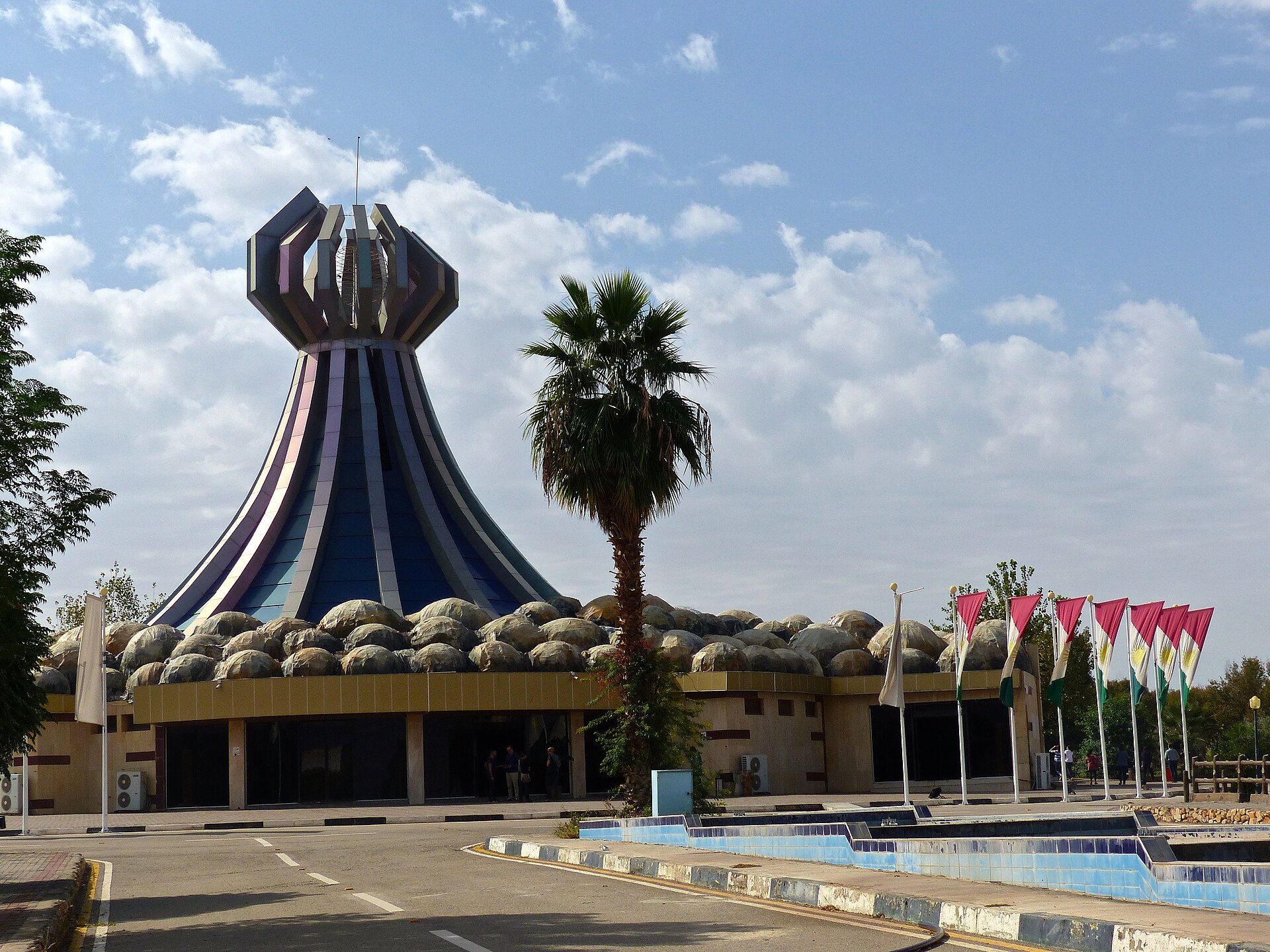
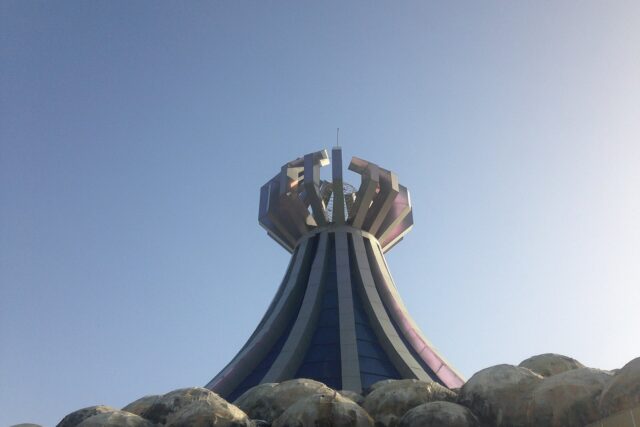
The monument stands at the entrance to the town. Accounts of its building differ slightly — Wikipedia gives construction in 2002–03 and an opening on 15 September 2003; the official Halabja Trails project gives a foundation stone in 2001 and unveiling in 2003 — and both agree that Colin Powell attended the opening. Inside are photographs and the names of the dead, images of the wounded, artefacts documenting Ba’athist crimes, artwork and poems by Kurdish artists, and life-sized models representing victims. Notably, the first hall is not about the attack at all: it is devoted to Halabja’s own life, traditions, arts and culture. That is a deliberate curatorial choice and it changes how the rest of the building reads.
In March 2006, during the eighteenth anniversary commemoration, around 2,000 protesters stormed the monument and set it on fire, angry at poor living conditions and the absence of compensation. Security forces opened fire; a 17-year-old protester, Kurda Ahmed, was shot in the abdomen and died in Halabja hospital, with eyewitnesses alleging a security officer shot him again at close range. Several others were injured. No source we could find gives a date for the monument’s reopening after that fire. The building was subsequently restored and the city received funding, but the year is not published anywhere we could reach.
In 2025 the Kurdistan Region’s Council of Ministers approved 600 million IQD — roughly US$400,000 — to renovate and expand the monument: updating the existing structure, building an auditorium and designing a new monument on 47 dunams while preserving the main features. No completion date, no closure notice and no 2026 progress report has been published, so whether that work is affecting access when you visit is genuinely unknown.
Hours and fees: none are published, by anyone. The KRG General Board of Tourism’s own page for the monument gives a location, an “all weather” tag and nothing else — no hours, no fee, no phone number. The official Halabja Trails page publishes none either. The “daily 8am–5pm” figure that circulates comes entirely from user-generated aggregators. Treat the admission fee as unknown rather than assuming it is free, and check locally.
The cemetery holds mass graves of the victims; the most photographed marker is for the Omar Khawar family, from the photograph of a father shielding his infant that became the defining image of the attack. A sign at the entrances, in Kurdish, Arabic and English, states that Ba’athists are not permitted to enter; English transcriptions of it vary, so we will describe it rather than quote it. 16 March is the annual commemoration — thousands gather, officials and bereaved families attend, and it is both the most meaningful and the most sensitive day to be there.
Halabja is now Iraq’s 19th governorate
This is recent and almost nobody covers it. The Iraqi parliament passed the bill on 14 April 2025 with 178 of the 329 members present; President Abdul Latif Rashid ratified it on 29 April 2025; and the law was published in the Official Gazette on 5 May 2025, which is the date it took effect. If you have read that this happened in 2024, that is wrong.
The governorate comprises the central Halabja district plus Khurmal, Biyara, Bamo and Sirwan — though sources use “district”, “sub-district” and “town” interchangeably for those four, and we could not resolve which is formally correct. Three other Sulaymaniyah Governorate districts were offered the chance to join and declined. The sourced population is 113,926 at the 2024 Iraqi census, which is the governorate rather than the city, and which makes Halabja the least populated governorate in Iraq. The figure of roughly 120,000 that circulates is close but is not the census number.
Nuxsha Nasih was inaugurated as acting governor on 20 March 2025 and was widely described as Iraq’s first female governor; born in Halabja in 1978, she was director of the Biyara sub-district from 2008 to 2015 and mayor of Halabja from 2016. “Acting” is the word used throughout, and we found no 2026 source confirming she is still in post. As for what the new status has actually delivered: a 2025 projection spoke of roughly US$200 million a year in direct federal allocations for roads, hospitals and memorial sites. That is a projection, not an appropriation, and no 2026 budget line, provincial council election or administrative milestone could be sourced.
What it means for a visitor is small but real: Halabja is still inside the Kurdistan Region, so your KRI visa covers it and there is no new entry requirement. But it is administratively separate from Sulaymaniyah Governorate now — and Ahmed Awa moved with it, which every older guide gets wrong.
Day trips from Sulaymaniyah
Ahmed Awa
A cascade down a wooded mountainside in the Hawraman highlands east of Halabja, near Khurmal, fed by the Zalm river. The KRG puts it about 84 km east of Sulaymaniyah. A strip of shops, teahouses and restaurants leads up towards the falls, with paths climbing alongside, shaded picnic areas and newly built cabins. It is a mass-market destination for Kurdish families at Eid and on holidays rather than a wilderness, and that is part of its charm. Best in spring, when the water is highest after the rains, and in summer for the cool air.
No entrance or parking fee is published by the KRG or any official source, and no drive time exists. Access without a car is shared taxi or minibus to Halabja, then a local taxi. One correction to a premise that circulates widely: there is no 5 km Iranian-border exclusion zone in the Kurdistan Region — the FCDO’s 5 km border rule applies to Wasit, Maysan and Basra. Ahmed Awa carries exactly the same advisory rating as Sulaymaniyah city centre. What does apply near the border is landmine risk and the law on illegal crossings.
Dukan Lake and the dam
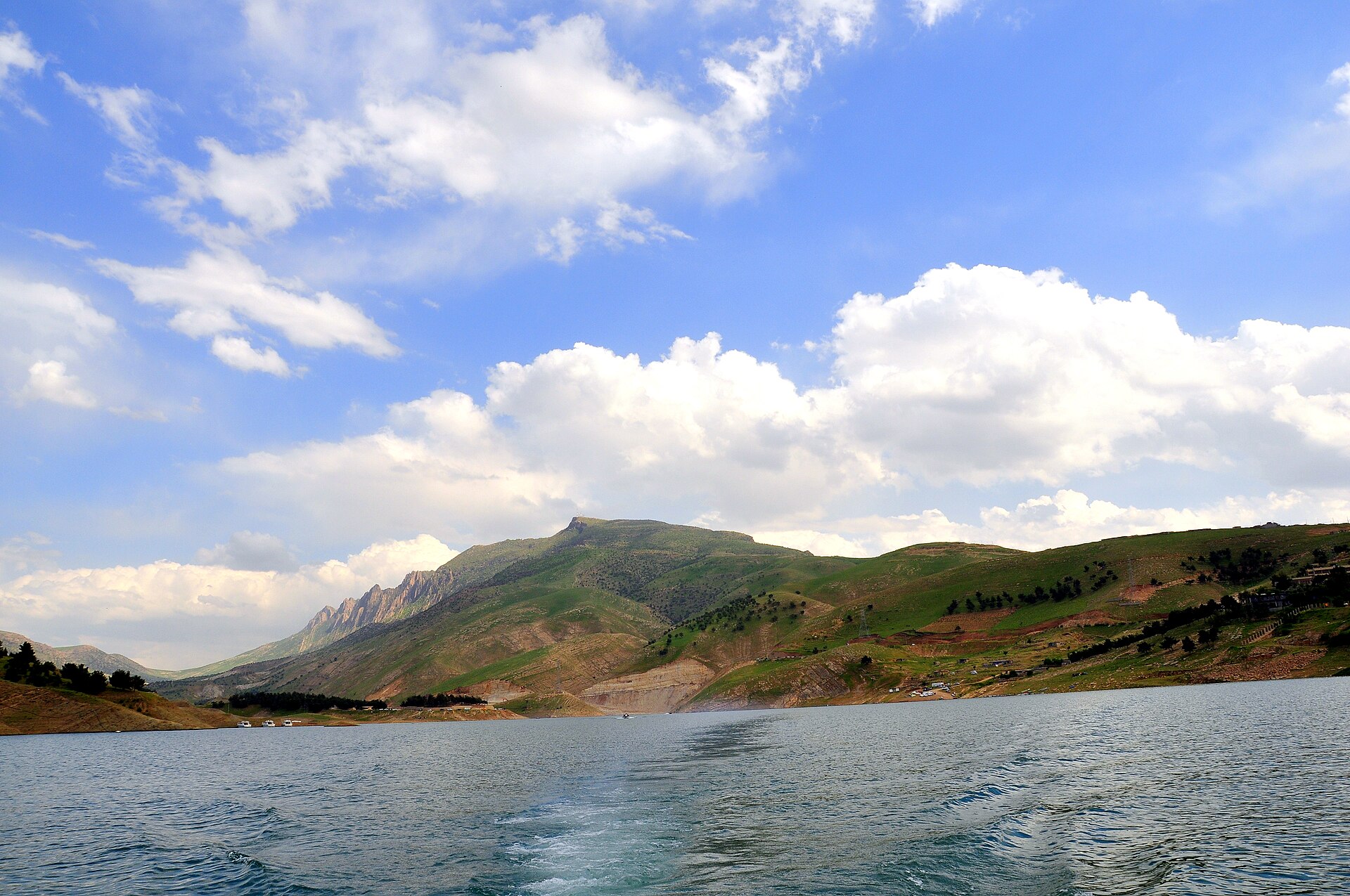
The KRG gives Dukan as 70 km from Sulaymaniyah, which is the only official figure available. The dam itself is a concrete arch structure on the Little Zab, built between 1954 and 1959 to a design by the British firm Binnie & Partners, with structural analysis at Imperial College involving Letitia Chitty, one of the first women elected to the Institution of Civil Engineers. It is 360 m long and 116.5 m high. The power station, designed by Soviet engineers and fully operational in 1979, runs five Francis turbines of 80 MW each. The reservoir covers around 270 km², and the emergency bell-mouth spillway, the great circular “hole in the lake”, is what visitors photograph.
The lake’s story in the last two years is water. In June 2025 the dam’s director said reserves stood at about 1.6 billion cubic metres of a possible seven billion, roughly 24 per cent and the lowest in some twenty years, after a winter that delivered 220 mm of rain against a typical 600 mm; satellite analysis put the surface area down 56 per cent against 2019. Around four million people downstream in Sulaymaniyah and Kirkuk were affected. Then in April 2026 heavy rain reversed it: levels rose 32 cm in a single day and the lake was reported as nearing full capacity with about nine metres to go, with the seasonal Badawan waterfall — which only appears in high-rainfall years — flowing again. What the level is now, after a hot summer, is not documented anywhere we could find. Do not assume either the drought photographs or the full-lake photographs are current.
The KRG lists Dukan Lake Resort with sixteen new projects, Qashqoli Resort on both banks of the Little Zab, Kanye Too at the foot of Mount Rchka, and Jami Rezan with the Baval waterfall 57 km west of Sulaymaniyah. It calls the lake ideal for swimming, boating and fishing. No prices, hours or boat fares are published for any of them.
One piece of history under the water: before the valley was flooded, a survey of the Ranya Plain documented around forty archaeological sites going back to the sixth millennium BC, five of which were excavated — including Tell Shemshara, which produced an early second-millennium palace with a clay tablet archive. Around fifty villages, and a thousand to twelve hundred families, were resettled.
The deep past: Hazar Merd, Bestansur and Jarmo
This is Sulaymaniyah’s quiet speciality and the reason the Prehistory Gallery in the Slemani Museum exists. Hazar Merd Cave, 13 km west of the city, was first excavated by Dorothy Garrod in 1928 and is Palaeolithic; the KRG calls it the second-oldest cave in the Region, possibly more than 50,000 years old. Bestansur, 30 km southeast on the Shahrizor plain, is on Iraq’s UNESCO tentative list and radiocarbon-dates to 7700–7100 BC — UNESCO describes it as the only archaeological site in Iraqi Kurdistan providing evidence for the period 8000–7100 BC, with the earliest rectilinear structures found in the Region and up to 28 human burials beneath the floors. Jarmo, 65 km northwest of Bestansur, was excavated by Robert Braidwood from 1948; the 1954–55 season is generally credited as the first use of a multidisciplinary excavation team in archaeology.
None of these has a visitor centre, published hours, a fee or interpretive signage. Bestansur is fenced with a resident guard; the others are open ground. They are working excavations, not attractions, and the practical way to see the material is the museum. If you want context on where they sit in the wider story, our page on Iraq’s UNESCO sites and tentative list is the place to start.
Sherwana Castle, Kalar
A nineteenth-century fortified house in Kalar, southwest of Sulaymaniyah in the Garmian administration. It was built by Mohamed Pasha Jaff in 1866, not by the Babans, who were the Jaff’s rivals; the family built it against pro-Baban factions and the Hemevand tribe after the Babans were driven out in 1850. The British spared it when destroying other Kurdish fortresses because of their relations with the Jaff. It was damaged by military activity in the 1990s, by heavy rain in 2014 and by the 2017 earthquake, which took out around 35 per cent of the structure, and was restored in 2018. A museum installed in 2003 holds around 400 artefacts from the Kalar area (Kassite, Sasanian, Umayyad and Abbasid) plus historical photographs, in a building with a basement, two floors and a large octagonal hall. No hours, fee, sourced distance from Sulaymaniyah or post-restoration visitor status could be found.
Getting around Sulaymaniyah, and what things cost
Taxis have no meters. Agree the fare before you get in. They are beige or white with orange squares. Reported intra-city fares run 2,000–6,000 IQD, though that figure is undated crowd-sourced guidance and should be treated as a rough anchor rather than a tariff.
At the airport, only approved taxis reach the terminal; other passengers are shuttled by a small bus to and from the roundabout at the entrance where the initial security screening happens. The airport publishes no taxi tariff — unlike Erbil, which publishes a flat US$25 city fare, cash only. Do not assume the two are similar.
On ride-hailing, most guides get this wrong. Lezzoo, founded in Erbil in 2018 and the only Iraqi company to graduate Y Combinator, does serve Sulaymaniyah, Halabja, Chamchamal, Ranya, Kalar, Qaladze and Koye — but its published products are food, groceries, pharmacy, courier, e-commerce and a wallet. It lists no passenger ride-hailing product at all, despite being widely described as a taxi app. Whether Careem operates anywhere in Iraq we could not confirm from Careem itself; Uber and Bolt show no evidence of operating. Plan on street taxis and your hotel’s driver.
Money. Iraq runs on cash. ATMs accept credit cards; foreign debit cards are rarely accepted; shops, restaurants and hotels mostly do not take cards. On 15 August 2026 the dollar was trading in Erbil at around 153,000 IQD per 100 dollars — roughly 1,530 dinars to the dollar against an official rate of 1,320. That parallel-market gap is the thing to understand: bring clean, new US dollars and change them at a shop rather than relying on cards. Our breakdown of what a trip to Iraq costs works through the budgeting side, and getting an Iraqi SIM card covers connectivity — a Sulaymaniyah footnote there: Asiacell was founded in this city in 1999 and was Iraq’s first mobile operator.
Alcohol, dress and the law
The Kurdistan Region is not federal Iraq on any of this, and the difference is sharper than most guides allow.
Alcohol. In federal Iraq the FCDO describes the position as fines of up to 25 million dinars for the import, manufacture or selling of alcoholic drinks — note that what is criminalised is import, manufacture and sale, not personal consumption — and adds that it is not aware of any instances of officials stopping travellers carrying alcohol for personal use. Enforcement against sellers in federal Iraq is real and ongoing. In Sulaymaniyah alcohol is sold and served openly; many restaurants serve it and hotels have bars, and the KRG’s own hotel listings advertise “bar” and even “disco” as amenities.
But there is a genuine trap, and it is one very few travellers know about. In February 2025, Sulaymaniyah announced a ban on public alcohol consumption and the closure of liquor stores for the whole of Ramadan, in the words of the report, “to preserve the sanctity of Ramadan”. The headline, standfirst and date are solid; the body of the article would not load for us, so the issuing authority and exact scope are unconfirmed, and whether it was repeated in 2026 is unconfirmed too. If you are travelling during Ramadan on the assumption that alcohol is simply legal in the Kurdistan Region, budget for the possibility that it is not, in this city, for that month. Ramadan 2026 ran from 19 February to 19 March, with Eid al-Fitr on Friday 20 March; the 2027 dates will fall roughly eleven days earlier.
Dress. No sourced Sulaymaniyah-specific dress rule for men or women exists, and we are not going to invent one. The FCDO gives no Iraq-specific requirement outside Ramadan, when it notes that clothing not meeting local dress codes may cause more offence. Observed norms in the city are relaxed by regional standards — you will see a wide range on the street — but modest cover works everywhere and is the easy default in the bazaar and at religious sites. Our Iraq packing list works through it, and solo female travel in Iraq deals with it in more depth.
What is hard law and belongs in any guide to this region: under the July 2024 amendment to Iraq’s Anti-Prostitution and Homosexuality Law, if the Iraqi authorities consider your actions, clothing or other items to promote LGBT+ identities or prostitution, you face up to seven years’ imprisonment and a fine of 10–15 million IQD; same-sex relationships carry 10 to 15 years. This applies across Iraq, the Kurdistan Region included. Our page on Iraqi laws that affect tourists sets out the rest.
Drones are effectively contraband. The KRG prohibits sharing footage of drones being launched or of target locations, with legal consequences for violations, and travellers report that bringing a drone into the Region risks detention. Given what has been flying over the Kurdistan Region this year, do not take one.
Where to stay, and when to go
Sulaymaniyah has a normal range of hotels, from budget rooms near the centre to a handful of larger properties with bars and pools. We are not going to publish price bands, because no reliable current data exists — the only official-looking figures sit on KRG pages carrying a 2015 copyright line, which is a decade out of date and worse than useless. Book through a mainstream platform, read recent reviews, and expect to pay in cash on arrival. Our general guide to where to stay in Iraq covers how accommodation works across the country.
Climate. Sulaymaniyah sits at 882 m, which makes it meaningfully cooler and drier than Baghdad or Basra, but summer is still severe.
| Period | What to expect |
|---|---|
| June–August | July mean daily maximum 41.3 °C, August 39.2 °C. Effectively no rain. July humidity around 19% — dry heat, but heat. |
| March–May | The best window. Rain tapering off, the mountains green, Ahmed Awa at full flow. |
| October–November | The other good window. Warm days, first rains arriving. |
| December–February | January mean minimum −0.6 °C, mean maximum 11.2 °C. About four snowy days a year on the city’s own climate table. |
| Annual rainfall | 722 mm, almost all of it October to May |
Note the internal contradiction in the sources here: the city’s climate table shows snow in most winters at low totals, while the accompanying text describes significant snowfall “every year or two”. We would trust the table. Four governorates in Iraq hit 50 °C on 15 August 2026, so do not assume the extreme heat ends neatly in mid-August.
Newroz falls on 21 March and the KRG’s own 2026 calendar lists it as a three-day national holiday, 21–23 March. In 2026 it ran straight on from Eid al-Fitr, making 20–23 March a continuous four-day holiday — peak domestic travel, full hotels and closed government offices. The same window carries Halabja Day on 16 March and the anniversary of the 1991 uprising on 20 March, which makes it a heavy and meaningful time to be in this particular part of Iraq. If you are timing a wider trip, see the best time to visit Iraq.
How long to stay? Two days covers the city properly: a morning at Amna Suraka, a morning at the Slemani Museum, an evening in the bazaar, and a drive up towards Azmar. Three or four gets you Halabja with the monument, or Dukan Lake, or Ahmed Awa — one big day trip each. A week is not too long if you are the kind of traveller who likes sitting in the same tea house twice.
What we could not confirm
This is a longer list than we would like, and publishing it is more useful than filling the gaps with plausible-sounding numbers.
- Amna Suraka’s 2026 opening hours, days closed, and whether it is currently open at all. The only citable source for the pattern is a 2013 magazine article. No operator hours are published anywhere.
- The artist who created the Hall of Mirrors. A name circulates; no source we could reach attributes it.
- Whether the Slemani Museum’s published hours and free admission are still accurate. Its own website has not been substantively updated since around 2019 and shows signs of compromise.
- Every drive time in this article. Sulaymaniyah to Halabja, Ahmed Awa, Dukan, Kalar, Erbil, Baghdad or Duhok — no published figure exists for any of them, and there is no sourced road distance to Halabja or Kalar at all.
- Whether foreigners are turned back on the Kirkuk road between Erbil and Sulaymaniyah. No source either way. What is sourced is the reverse problem: a Kurdistan Region visa gets you stopped at the first military checkpoint heading into federal Iraq.
- Whether Turkish Airlines restarts Istanbul–Sulaymaniyah on 2 September or 2 October 2026, and why it is absent this summer. The same schedule source gives both dates on different pages.
- The Halabja Monument’s opening hours and entrance fee. None are published by the operator, the KRG or the municipality. Treat the fee as unknown, not free.
- The year the Halabja monument reopened after the 2006 fire, and whether the 2025 renovation is affecting access now.
- Whether Nuxsha Nasih is still Halabja’s acting governor, and anything that changed for the governorate in 2026.
- Heights of Azmar, Goizha, Qaiwan, Baranan or Piramagrun, and any trailhead, route or named viewpoint on them.
- Opening hours, fees or current status for Chavy Land, Sarchinar, Sherwana Castle, the Museum of Modern Art, or any archaeological site in the governorate.
- Any description of the Grand Bazaar’s sections, hours or trades from an official or news source.
- Dukan Lake’s water level as of August 2026. The last data point is April 2026.
- The issuing authority and exact scope of the Ramadan alcohol ban, and whether it was repeated in 2026.
- Any current hotel price data, and any Sulaymaniyah-specific dress code.
Frequently asked questions
Is Sulaymaniyah safe to visit?
The FCDO advises against all but essential travel to the entire Kurdistan Region, and travelling against that advice can invalidate your insurance. The attacks recorded in this province through July and August 2026 targeted Iranian-Kurdish opposition party bases in rural areas rather than the city. Ordinary crime risk in the city is low by regional standards, and the road traffic risk is the one most likely to affect you.
Is it worth visiting, or should I just do Erbil?
Erbil has the bigger monument and the easier logistics. Sulaymaniyah has the better museums, a more open intellectual life and a quieter feel. If you have four days in the Kurdistan Region, do both. If you have two and want a monument, do Erbil. If you have two and want to understand the place, come here.
Are there direct flights from Istanbul?
Yes, but to Sabiha Gökçen rather than Istanbul’s main airport, and not on Turkish Airlines. AJet flies four times a week and Pegasus three, as of mid-August 2026. Turkish Airlines shows zero departures with a restart quoted as either 2 September or 2 October 2026. Check directly with the carrier.
Do I need a visa for Sulaymaniyah?
Yes, but the Kurdistan Region has its own regime. Visa on arrival still exists at ISU for eligible nationalities, or you can apply online at visit.gov.krd for 100,000 IQD. It gives a 30-day stay within a 90-day entry window and it is not valid in federal Iraq.
Is Amna Suraka free, and what are its opening hours?
Free admission is reported and is the better-sourced of the two claims. The “open six days a week” pattern traces to a single article from 2013 and has no 2026 confirmation. There are no operator-published hours. Check its Facebook page or have your hotel call ahead.
Can I visit Halabja as a day trip?
Yes — it is the standard day trip from Sulaymaniyah, and it is within the Kurdistan Region so your KRI visa covers it. No published drive time exists. Since May 2025 Halabja has been Iraq’s 19th governorate, administratively separate from Sulaymaniyah, though that changes nothing for a visitor’s paperwork.
Cash or card?
Cash, in US dollars, changed locally. Foreign debit cards are rarely accepted and most businesses do not take cards at all. The street rate was around 1,530 dinars to the dollar in mid-August 2026, against an official 1,320.
Can I drink alcohol in Sulaymaniyah?
Normally yes — it is sold and served openly, and hotels have bars. The exception to plan around is Ramadan: in February 2025 the city announced a ban on public consumption and closure of liquor stores for the whole month. Whether that was repeated in 2026 is unconfirmed.
Goizha or Azmar for the better view?
Both overlook the city and both are used for the same thing — snow in winter, cool air in summer. No official source names a viewpoint, gives a height or describes a route on either. Take a driver who knows the roads and treat it as a drive rather than a hike.
How many days do I need?
Two for the city, three or four with a day trip. Anything less and you will spend most of it in transit, because there is no flight from Erbil and the road journey has no published duration.
Final thoughts
Sulaymaniyah is not a difficult city to be in. It is a difficult city to plan for, because so little about it is published — no museum hours you can rely on, no drive times, no fees, no tariffs, and an airport whose own website is frozen on last year’s timetable. The gap between how easy the place is and how hard the information is turns out to be the whole story, and the answer is to arrive with the shape of a plan rather than a schedule, and to ask people when you get there.
What the city gives you in return for that flexibility is the most serious pair of museums in the Kurdistan Region, a market that is still a market rather than a heritage exercise, mountains you can be in within half an hour, and a memorial at Halabja that repays a full morning of your attention and your quiet. Approach Amna Suraka and Halabja as memorials, not as sights — the people around you in both places are as likely as not to be connected to what is on the walls.
If you are building a wider trip, our Iraqi Kurdistan pillar guide is the place to start, our round-up of the cities of Iraq puts Sulaymaniyah in context against Erbil, Baghdad and Basra, and our practical Iraq travel tips cover the day-to-day things this article has not had room for. If you are going alone, read solo travel in Iraq first, and if you would rather not organise the checkpoints and drivers yourself, the tour operator landscape is covered separately.
Photo credits
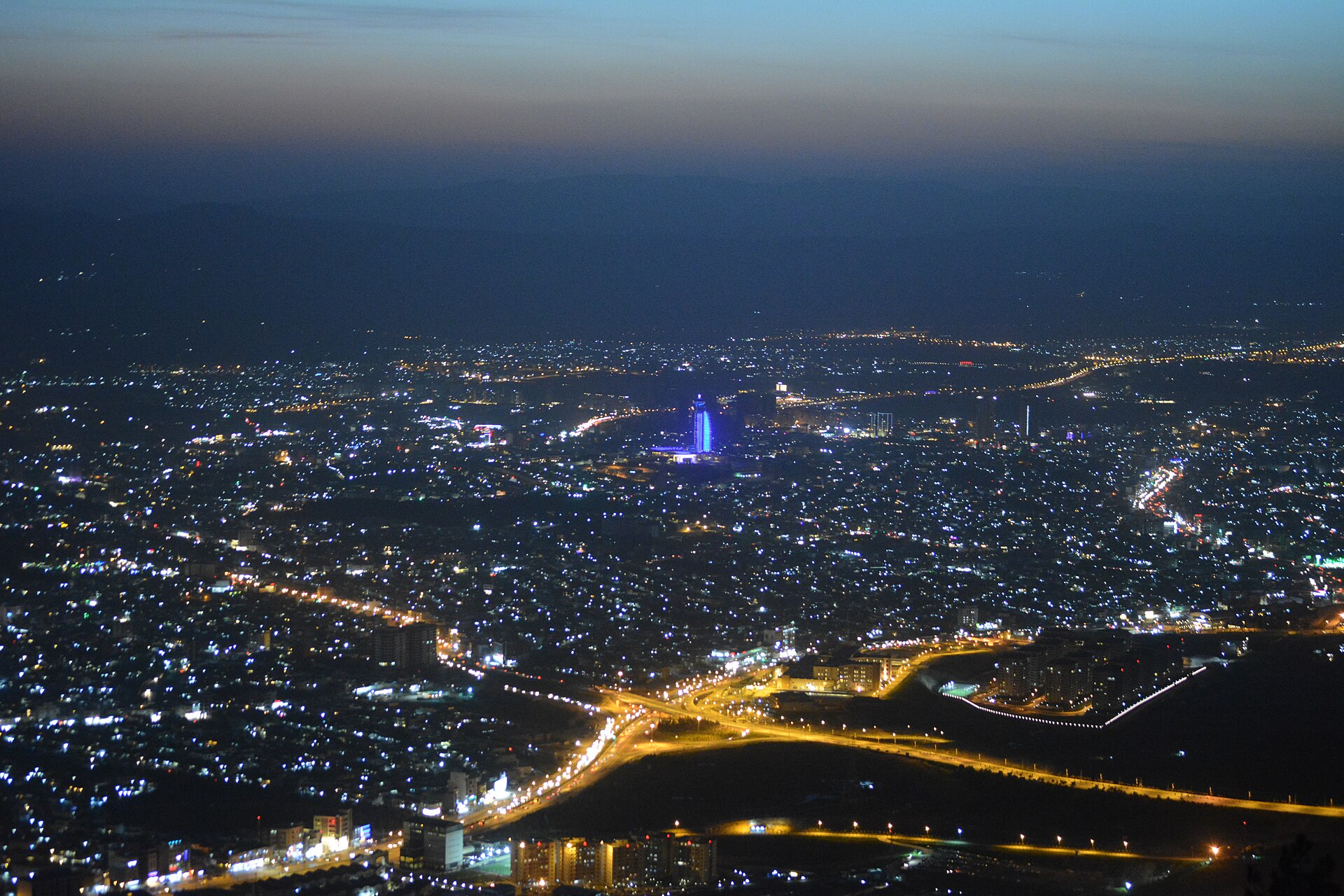
Sulaymaniyah at night — Sarbast.T.Hameed (CC BY-SA 4.0). Amna Suraka, Slemani Museum entrance and Dukan Lake — Osama Shukir Muhammed Amin FRCP(Glasg) (CC BY-SA 4.0). Sulaymaniyah bazaar at night — Enno Lenze (CC BY 2.0). Halabja Martyrs Monument — John Crane (CC BY 2.0). All images via Wikimedia Commons.