Last updated: August 2026. We re-checked the access situation, the UNESCO inscription record, the current restoration contract and the KRI entry rules on 15 August 2026, and we have dated every claim in this guide so you can see how fresh it is.
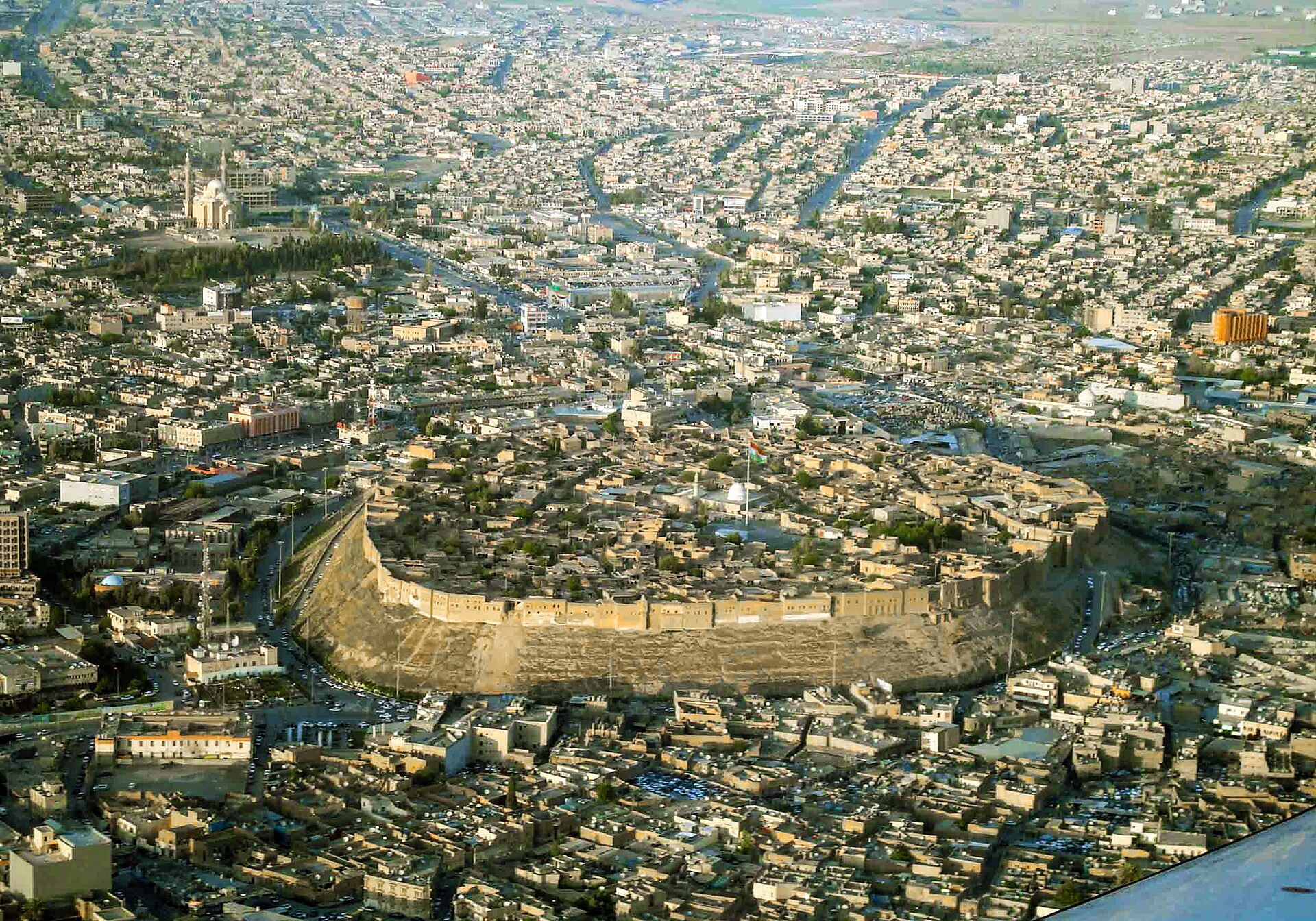
There is a photograph almost everyone has seen of Erbil: a flat-topped brown mound standing thirty metres above a modern city, ringed by a continuous wall of old houses that never quite ends. That is the Erbil Citadel — you will also see it written as Erbil Castle, or as the Citadel of Erbil — and it is genuinely one of the strongest candidates anywhere on earth for the longest-inhabited spot on the planet. It is also, right now, the single most misdescribed attraction in Iraq. The citadel is the single most-visited site in our guide to Iraqi Kurdistan.
The interior of the Erbil Citadel has been closed, or open only intermittently, through 2025 and 2026 — travellers were turned away at the gate in June 2025 and October 2025, and an Erbil-based reviewer reported it still locked in June 2026. Page one of Google tells you otherwise. Wikipedia’s infobox says “Open to the public”. Atlas Obscura’s entry, published in November 2017 and never updated, coaches you on which buildings inside are safe enough to walk into. If you plan a day around what those pages say, there is a real chance you will climb the ramp and find a gate.
The honest position is this: the mound, the walls, the Grand Gate forecourt and the entire lower town around it are yours. The town on top is not reliably yours, and nobody — not the Kurdistan Regional Government, not the High Commission that manages the site, not UNESCO — publishes an opening time or a ticket price that would let you check. That absence is not an oversight on our part. It is the finding.
This guide covers what you can actually reach in 2026 and what you cannot, the dated evidence for the closure, the two gates and which one you want, the genuine archaeology under the mound and what it does and does not prove, the corrected version of the famous “one family still lives there” story, the nearly ten-million-dollar conservation project signed in October 2025 that had made no measurable progress a year later, and the visa, advisory and legal rules that apply to anyone travelling into the Kurdistan Region at the moment.
The short answer
| Question | Answer, as of mid-August 2026 |
|---|---|
| Can you go inside? | Not reliably. Closed or partly closed for long stretches of 2025–26; last on-the-ground report (4 June 2026) says locked. Assume no, hope for yes. |
| Opening hours | None published by any official body. The outer terrace has been reported opening around 10:00. Nothing else is verifiable. |
| Entrance fee | None published. When the citadel has been open it has been free — it is gated and guarded, not ticketed. |
| Is the Erbil Citadel a UNESCO World Heritage Site? | Yes — ref 1437, inscribed 21 June 2014, under criterion (iv) only. 15.6 ha property, 268.34 ha buffer zone. |
| Is it “the oldest continuously inhabited settlement” per UNESCO? | No. That claim is made by the KRG, by journalists and by UNESCO’s own press office — but not by the inscription, which rejected the continuity criteria. |
| Does one family still live there? | Documented from 2013 to November 2024. Not confirmable for 2025–26, and the restoration lead said in June 2025 that other families would begin moving back. |
| How long do you need? | An hour for the walls, the gate and the views. Half a day if you fold in the bazaar, the square and the tea houses below. |
Can you actually go inside the Erbil Citadel right now?
We could not find a single dated, first-hand account of anyone getting inside since 2024. What we could find is a consistent, and consistently ignored, trail of people being turned away. Here it is in order, with sources, so you can weigh it yourself rather than take our word for it.
| Date | What was reported | Source type |
|---|---|---|
| 18 Jan 2025 | KRG announces 10,600 m² of stone paving finished; next phase is seating, lighting and trees. “Once complete, the site will welcome visitors both day and night” — future tense. | gov.krd press release |
| 26 Feb 2025 | “The citadel is gorgeous from the outside, thus nobody knows when the citadel will be open.” | Traveller review |
| 5 Jun 2025 | Guard at the Grand Gate tells a visitor the citadel is “closed for renovation. Two months, maybe.” Scaffolding visible behind the walls. | Traveller blog, dated visit |
| 26 Aug 2025 | KRG: “extensive restoration is underway“, under the direct supervision of the Prime Minister. | gov.krd press release |
| 17 Oct 2025 | Erbil-resident blogger: “I couldn’t go inside during my visit due to ongoing renovations and maintenance.” | Resident blog, dated visit |
| 4 Jun 2026 | “The citadel and thus the textile museum are not accessible. No one can say when the construction work will be completed… one can go to the terrace in front of the entrance from 10:00 AM, but the citadel itself remains locked.” | Traveller review, reviewer based in Erbil |
| 21 Jul 2026 | UNESCO: “A new phase is about to begin… Before the work begins on the ground, preparations are already underway.” | unesco.org feature |
Read that last row twice. In late July 2026, the agency running the conservation programme was still describing physical work as something that had not started. That is not the language of a site being handed back to visitors in the next few weeks.
There is one datapoint that pulls the other way, and we will give it to you rather than hide it: a Kurdish news outlet ran a feature on 5 July 2026 about cold mastaw — the salted yoghurt drink — drawing summer crowds “at Erbil Citadel”. We could not retrieve the article body on re-fetch, and the crowds described are just as plausibly at the Grand Gate square and the bazaar below, which are open and busy. We would not build a trip on it.
Why every page above us says the opposite
Because none of them have looked at the Erbil Citadel since the closures began. Wikipedia’s restoration timeline stops in January 2017, and its infobox access field carries no date at all. Atlas Obscura’s entry was published on 2 November 2017 and has never been revised; its “Know Before You Go” section tells you that some buildings “have been restored and seem reasonably safe, while others are on the verge of collapsing” — advice that only makes sense if you are standing among them. One widely-read travel blog, last touched in January 2022, states flatly that the citadel is “free to enter and roam around inside”. A long-running open wiki says the citadel “is currently closed to cars. Visitors can still access the site on foot”, which is the exact inverse of the 2025–26 situation.
Two of the better travel blogs do flag the closure, to their credit — but each gives it a single undated line and no fallback plan. Nobody explains that the Kurdish Textile and Cultural Museum, inside the Erbil Citadel,, which several of those same pages recommend as the highlight of a visit, sits inside the locked perimeter and is therefore shut too.
What you can do when the gate is closed
Quite a lot, and this is the part no competing page bothers to write.
- Walk the perimeter. The ring of houses that forms the Erbil Citadel’s outer wall is the single most photogenic thing in Erbil, and you see it from below. The mound’s slopes run at 35–45 degrees, so the wall reads as a fortress even though most of it is domestic architecture from the mid-19th to early 20th century.
- Go up to the Grand Gate terrace. The forecourt outside the south gate has stayed accessible through the closures — the June 2026 report puts it opening around 10:00. You get the gate itself, the ramp, and a view straight down over the square.
- The rampart café. There is an open-air café on the terrace just outside the entrance, with a panorama over Shar Park and the bazaar roofs. A blogger drank tea there on 5 June 2025 while the gate beside him was locked, which tells you what you need to know about its reliability.
- Machko Chaikhana. The tea house pressed against the Erbil Citadel’s southern wall, opened in 1940 by Muhammed Machko and run by the same family since. France 24 called it “the Erbil teahouse that never closed” — it stayed open through the mid-1990s Kurdish civil war and through 2014. Walls of photographs, shelves of donated books, tea in a stemmed istikan glass.
- Qaysari Bazaar. Directly below and south, under corrugated and vaulted roofing, alleys specialising by trade.
- Shar Park. The main square below the mound, with its fountain and clocktower. Busiest late afternoon and evening.
Put together, that is a genuinely good half-day, and it is the half-day most visitors get. If you want the wider picture of what else the city holds, our guide to things to do in Erbil covers the museums, parks and day-trip country beyond the old town, and our roundup of the best places to visit in Iraq sets Erbil against the rest of the country. If you want tea and a plate of something afterwards, our guide to Iraqi food covers what to order.
Erbil Citadel opening hours and entrance fee: nobody publishes either
We went looking for official visitor information and came back empty-handed, which is itself worth reporting because every aggregator on the internet will confidently give you a number.
The Kurdistan Regional Government’s own General Board of Tourism has pages for both the Kurdish Textile Museum and the citadel bath house. Both have an empty “Visitor information” block — no hours, no price, no phone. The site footer reads “General Board of Tourism 2015 ©”. The domain erbilcitadel.org, which used to belong to the High Commission for Erbil Citadel Revitalization, is no longer theirs: it now runs a generic WordPress install serving scraped listicle content dated mid-to-late 2025, and it should not be cited as an official source by anyone. The Kurdish Textile Museum’s own domain returns an empty response.
| Figure in circulation | Where it actually comes from | Our view |
|---|---|---|
| Erbil Citadel “09:00–17:00 winter / 09:00–18:00 summer” | A travel blog cosmetically stamped January 2026, written by an author who left Erbil in 2024 | Pre-dates the closures. Do not plan around it. |
| Terrace opens 10:00 | A dated traveller review, 4 June 2026 | The most current figure available, but one person’s observation. |
| Textile Museum “09:00–18:00 daily except Friday” | An aggregator site with no dated primary sourcing. Appears on no official page. | Not corroborated. We will not print it as fact. |
| Friday closure at the Textile Museum | A single traveller review of 10 October 2022 | Weak but real: traveller reports suggest Fridays are bad. Nothing stronger exists. |
| Textile Museum ticket 1,000 IQD | A 2020 review | Six years old, for a museum currently inaccessible. |
| Parking below the north gate 1,000 IQD | A resident blogger, 2022–24 | Plausible and small. Carry change. |
The defensible statement is: there is no officially published opening time and no officially published entrance fee for the Erbil Citadel. When the site has been open, entry has been free — it is gated and guarded rather than ticketed. Anyone quoting you a confident “open daily 09:00–20:00, entry free” box is generating it, not sourcing it.
The Erbil Citadel gates, and which one you actually want
There are two entrances that matter, and they behave completely differently.
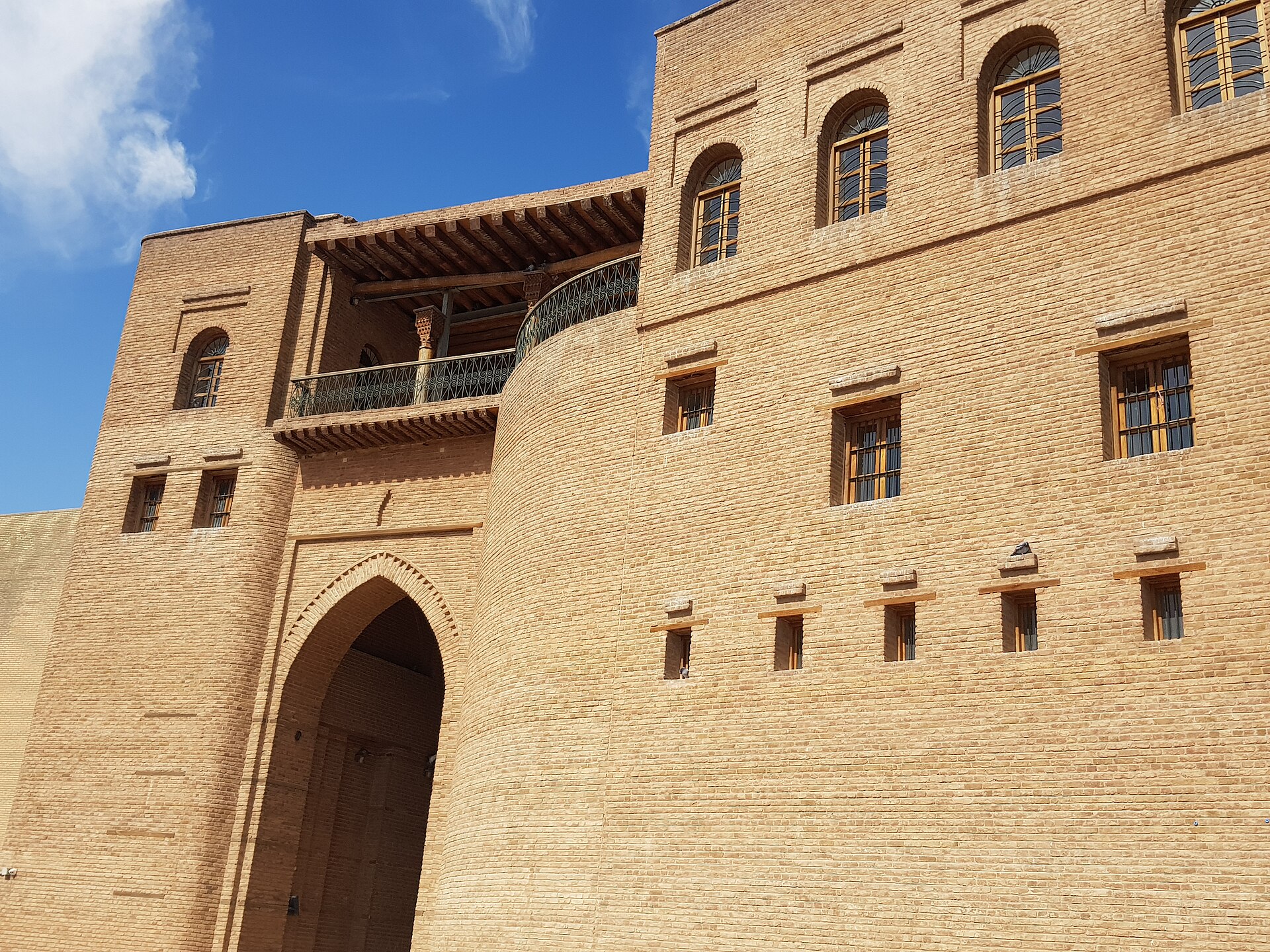
The Grand Gate (south) is the one in every photograph and the one the whole Ottoman street plan radiates from. Its forecourt is the piece that has stayed open when the citadel itself is locked, and it is where the statue of Ibn al-Mustawfi stands — the 12th–13th-century historian of Erbil, shown reading, which is a nicer piece of civic self-image than most cities manage. Five exploratory trenches dug in 2011–12 located the foundations of the mid-19th-century gate that stood here before the road cut.
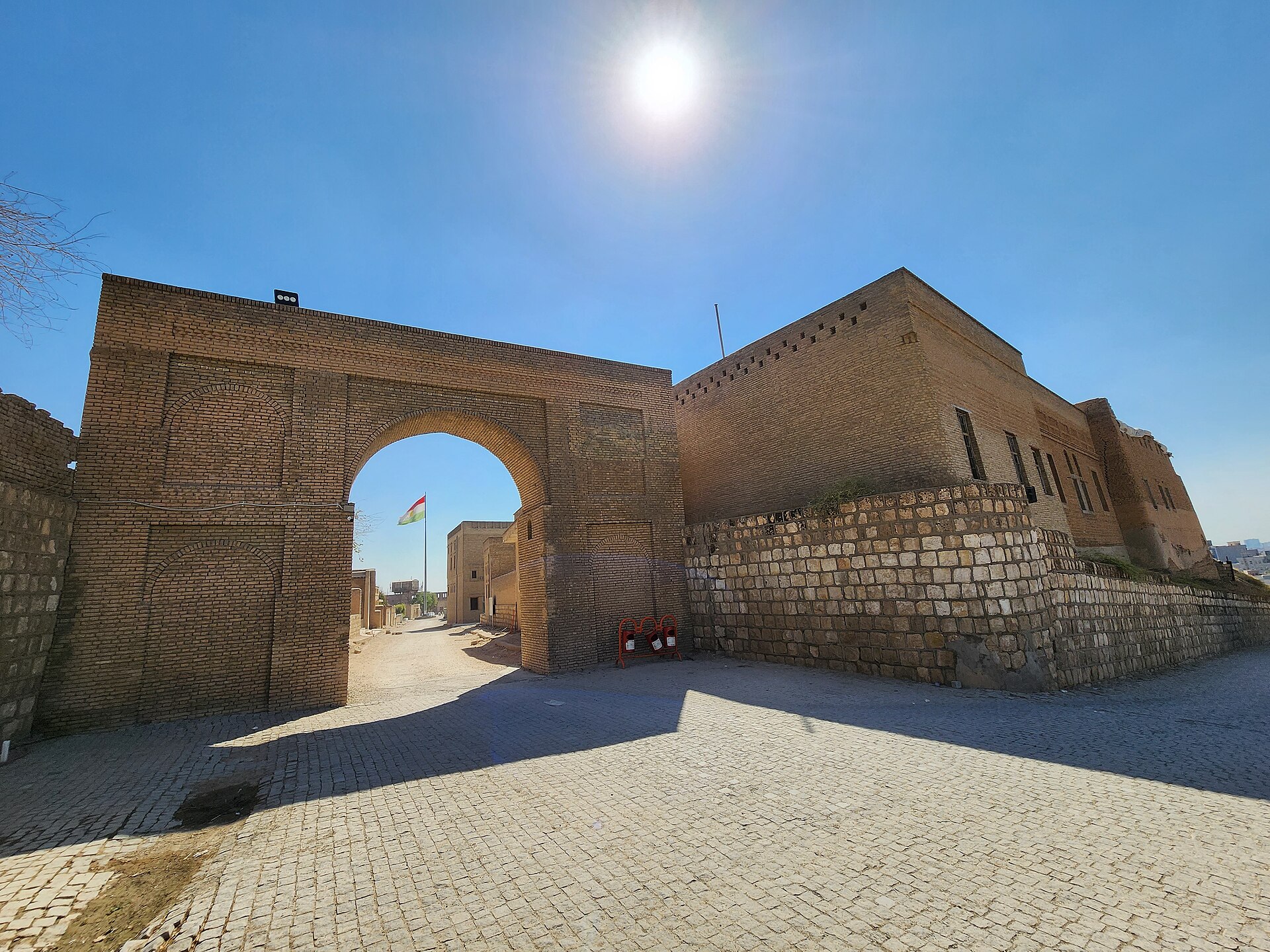
The Ahmadi Gate (north), sometimes written Ahmedi or Amedi, was opened through the perimeter in the 1920s–30s and is the practical side: you drive to it, park in the field below for around 1,000 dinars, and walk through. When the citadel has been open, the standard route has been in at the north and out at the south, ending in the square. That is worth knowing even now, because it tells you which side to have a driver drop you if you want to try your luck.
Wikipedia mentions a “Harem” gate and a 2017 Kurdish news list refers to a “Citadel Upper Gate”. We could not confirm either as a working visitor entrance, and we could not confirm whether vehicles are ever allowed up onto the mound itself — only that you drive to the north gate, not through it. If you are working out how to move around the city more generally, our notes on getting around Iraq cover taxis, shared cars and the things that go wrong.
What UNESCO actually inscribed — and the claim it rejected
This is where almost every page on the internet goes wrong, and the correction is free because the evidence is a public document.
The Erbil Citadel — Qelat in Kurdish, which simply means castle — is World Heritage site reference 1437, inscribed on 21 June 2014. The property covers 15.6 hectares with a 268.34-hectare buffer zone. Iraq nominated it under three criteria — (iii), (iv) and (v). ICOMOS, the advisory body that evaluates nominations, rejected all three and recommended deferral. The Committee inscribed it anyway, but under criterion (iv) alone: the one about being an outstanding example of a building type or landscape. The two criteria that carried the continuity-of-habitation argument were not accepted.
So “UNESCO recognises Erbil Citadel as the oldest continuously inhabited settlement in the world” is false. Worse for the folklore, ICOMOS’s 2014 evaluation says the opposite in plain words: “It is currently not inhabited”, and “The fact that Erbil Citadel is currently not inhabited detracts from its sense of place as a town.” It also found that “the tangible evidence does not appear sufficient, at this stage, to support the claim of uninterrupted continuity of occupation going back several millennia” and that “material evidence of occupational continuity is scarce.”
There is no Guinness World Record either. None of the sources we reached mentions one. The claim belongs to the KRG, to the High Commission, and to a long chain of journalists — and, awkwardly, to UNESCO’s own newsroom, which repeated “one of the oldest continuously inhabited sites in the world” in a feature on 21 July 2026. The inscription and the press office do not agree with each other. You can see the whole of Iraq’s inscribed list, and how thin it is, in our overview of UNESCO World Heritage sites in Iraq.
Every Erbil Citadel age figure, and what it measures
| Figure | Who says it | What it actually rests on |
|---|---|---|
| “At least six millennia of occupation” | Iraq’s nomination dossier, 2013/14 | State Party claim about accumulated layers; not independently demonstrated |
| “Remains going back at least 6,000 years” | Al Yaqoobi et al., Archaeological investigations on the Citadel of Erbil, 2016 | A surface survey of potsherds. The authors add “the likelihood is that it will in fact be older.” |
| “Settlement continuity of ca. 6000 years” | Sapienza University of Rome’s MAIKI project | Explicitly conditional — “if confirmed by future excavations” |
| “7,000 years” | Atlas Obscura; Salahaddin University | Local framing; the same university page also gives a different figure for the city |
| “8,000 years of continuous history” | A 2015 engineering paper; repeated on Wikipedia | Unsourced in the paper itself |
| “5th millennium BC, and possibly earlier” | Salahaddin University; RASHID International | The defensible figure. Ubaid-period potsherds from the mound. |
| “Chalcolithic period (4500–3200 BC)” | ICOMOS’s own 2014 summary of the evidence | The most conservative reading in any official document |
Our own headline says 6,000 years because that is the number the world uses. It is a reasonable shorthand for the popular claim. It is not a finding, and you should know the difference.
So how old is the Erbil Citadel, really?
Old. Genuinely, seriously old — just not provably old in the way the marketing says, because almost nobody has dug.
ICOMOS put it bluntly in 2014: the tell “has not been excavated, and should therefore be largely intact”. That cuts both ways. It means the archaeological potential is enormous and it means the continuity claim is, for now, an inference from potsherds and a name.
What has been done: Karel Nováček of the University of West Bohemia ran the first real operations in 2006, collecting surface ceramics and running micro-gravimetry, shallow seismics and resistivity, plus a four-metre-square trench in a house in the eastern citadel. Four bore holes in 2008 established that at the centre of the mound, occupational layers extend 22 metres down from the surface. Italian geophysics followed from 2010. Ground-penetrating radar was found not to work here, probably because of groundwater — it picked up the fortification wall but could not reach the deeper levels. In 2013, electrical resistivity tomography and seismic refraction imaged north–south transects across nearly the whole mound.
The only real stratigraphy published comes from Area E, a trench on the perimeter just west of the Ahmadi Gate, dug from March 2013 to 2015. Inside the wall it is mostly 19th- and 20th-century foundations and pits. The upper fortification wall stands 2.80 m high in baked and unbaked brick, with a solid cylindrical tower 7.50 m across built in three phases — a firman of Sultan Mahmoud I in 1745 ordered the walls repaired, and the baked-brick repair may be that work. Then the interesting part. More than five metres below the top of that tower is a completely separate, much earlier and much more massive city wall, faced in thick red mud plaster, built of bricks 40 cm square.
The High Commission’s 2015 report to UNESCO dates it: optical luminescence puts part of the upper fortification “well before 1000 AD”; the lower layer was in use during the Assyrian empire of the ninth to seventh centuries BC, with associated ceramics reaching the Late Bronze Age of 1500–1000 BC. Separating the two is a destruction layer radiocarbon-dated to the early second century AD — very likely the sacking of the city by the Roman emperor Trajan, who attacked Erbil in AD 115. That is the best-dated single event on the mound, and it is Roman, not Mongol.
One number worth correcting
| Source | Figure | What it is measuring |
|---|---|---|
| UNESCO’s adopted Statement of Outstanding Universal Value, 2015 | “Over thirty metres of archaeological deposits” | Appears to be the mound’s height above the city, not measured deposit thickness |
| High Commission report to UNESCO, 2015 | “In the order of 22 m thick at the lowest point” | Geophysical survey of cultural deposits |
| Bore holes, 2008 | 22 m | Physical coring at the centre of the tell |
| Excavation plan for the unexcavated central Area A | “A stratigraphic sequence of the order of 22 m” | What the archaeologists expect to dig through |
The archaeologists say 22 metres. UNESCO’s own summary text says 30-plus. Do not quote “30 metres of deposits” as an archaeological figure — it is almost certainly the height of the hill.
On the mound’s height above the surrounding streets, the honest answer is a range. ICOMOS gives 20–32 m and is the only source that explains the spread: the height varies around the perimeter and drops towards the centre. Others give “about 30 m”, “32 m”, “25–32 m” or “about 100 feet”. Take roughly 25–32 metres, commonly rounded to 30.
For the wider Mesopotamian frame — Ur, Uruk, Nineveh, Babylon and how Erbil fits among them — see our guide to ancient Mesopotamia.
Assyrian Arbela and the temple of Ishtar
The earliest written trace of the place is not local. It is in the palace archive at Ebla in Syria, around 2300 BC, some 500 miles west: messengers issued five shekels of silver to pay for a journey to Arbela. ICOMOS dates the earliest records mentioning Erbil — as Urbilum — to the 23rd–21st centuries BC. After that the city appears steadily. The Gutian king Erridu-Pizir boasts of capturing its governor. Ur III absorbs it. Around 1800 BC, Shamshi-Adad I and Dadusha of Eshnunna besiege “all the fortified cities of the land of Urbilum”, and the king of Arbela is beheaded.
Under the Neo-Assyrians, Arbela mattered enormously. Its temple was Egašankalamma, “House of the Lady of the Land”, the temple of Ishtar of Arbela, mentioned in texts from the 13th century BC. Under Ashurbanipal (669–627 BC) the city became something close to a second capital after Nineveh and Assur. Esarhaddon claimed he made the temple “shine like the day”, probably a coating of electrum. Ashurbanipal wrote: “I knew no father or mother. I grew up in the lap of the goddess.” A court poem from Nineveh’s archives opens simply, “Heaven without equal, Arbela!”
A bas-relief from Ashurbanipal’s North Palace at Nineveh depicts Arbela itself — its walls, its acropolis and the temple of Ishtar. A stela found in northern Syria shows the statue that stood in it. The goddess appears 265 times in Assyrian texts, enough for a Helsinki scholar to write a study of her alone.
So where is the temple? Nobody knows. It has not been found, has not been excavated, and has not been shown to lie under the citadel at all. The best evidence is geophysical: a Sapienza team detected two structures buried around fifteen metres below the surface at the centre of the mound. Nováček’s reading was that “this is the rubble of large stone buildings”, possibly in late Assyrian levels, possibly the temple. Even the technique is disputed — one account credits ground-penetrating radar, the archaeologists’ own paper says GPR failed at depth and it was the 2013 resistivity and seismic work that imaged it. Area A, the proposed twenty-metre-square trench down to bedrock in the centre where the mosques, the cathedral and the temple are all expected to be, has never been dug: a fifty-foot trench in the middle of a high, unstable mound is a serious engineering problem, which is why the team started on the rim instead.
Off the tell, more has survived. A Neo-Assyrian baked-brick vaulted tomb was excavated between 2008 and 2011 about 500 metres northwest of the citadel — a 7th-century chamber with three sarcophagi holding five people, a bronze bowl, lamps and pottery. Traces of a 22-kilometre underground canal from the Bastura river, from Sennacherib’s reign, were found at Bastura in 1946. And using 1950s RAF aerial photographs and 1960s Corona satellite imagery, Nováček identified two lower-town wall circuits, one medieval and one probably Assyrian, the latter including a sixty-foot-thick wall with a defensive slope and moat — bulldozed in the 1960s. Unusually for an Assyrian city, that circuit was an irregular round wall enclosing citadel and lower town together, which is a southern Mesopotamian pattern rather than a northern one. Nováček’s own comment: “This conjecture desperately needs empirical verification.”
Arbela was spared when the Babylonians and Medes destroyed the Assyrian capitals in 612 BC — which is a large part of why there is still a hill here at all. Around 500 BC, Darius I impaled a rebel on its ramparts.
Gaugamela was not fought here
Every travel page will tell you Alexander the Great defeated Darius III “at Erbil” in 331 BC. He did not.
The battle of Gaugamela was fought in the western part of the Navkur Plain, near Tell Gomel, roughly 85–90 kilometres north-northwest of Erbil. “Battle of Arbela” is ancient shorthand, because Arbela was the nearest notable city and Darius had his campaign headquarters there. The Gaugamela Project at the Jagiellonian University in Kraków, working with the Italian archaeological mission in Assyria, put it as flatly as academics ever do: “there can be nowadays no doubt that the Gaugamela battlefield was exactly located in the western part of the Navkur Plain near Tell Gomel.”
Their case rests on four legs: the name Gaugamela surviving in Tell Gomel; an ancient long-distance route running between Arbela and Nisibis; the topography and geomorphology of the plain; and monumental rock reliefs at Gali Zerdak and Nirok that probably commemorate the battle. Sir Aurel Stein proposed the Tell Gomel plain first, in a report written in 1938–39 and not published until 1985.
Published distances from Erbil range from 40 km to 90 km, and the classical sources contradict each other outright — Arrian against Quintus Curtius Rufus. Arrian’s figure is conventionally rendered as 600 stadia, about 110 km. The straight-line calculation from the citadel comes out at 85–90 km. Give the range; anyone quoting one number is picking a side without saying so.
What did happen at Erbil: Alexander pursued Darius across the Greater Zab to the citadel, Darius escaped east into the Zagros and was eventually killed by his own men, and Alexander stopped briefly in Erbil before marching on Babylon. He may — the hedge is in the sources, not ours — have taken the title King of Asia in a ceremony at Arbela’s temple of Ishtar, whom he possibly equated with Athena.
The town on top: Serai, Takya and Topkhana
What sits on top of the Erbil Citadel is not an ancient city. It is a nineteenth- and early-twentieth-century Ottoman town, with a handful of buildings reaching back to the mid-eighteenth century, built on top of everything that came before. ICOMOS reckons most of the surviving fabric’s building periods begin after 1743, when Nadir Shah besieged and took the place.
Since the late nineteenth century the town has been divided into three quarters, or mahallas, running east to west: Serai, Takya and Topkhana. The usual reading gives Serai to the notable and aristocratic families, Takya to religious leaders — takyas being dervish lodges — and Topkhana, from the Turkish for artillery or gun-house, to craftsmen and farmers. A 2021 academic report substitutes Khanaqa for Takya and places the great mosque and the hammam in the northeastern corner. The alleys between them run 1 to 2.5 metres wide, with one dead-end only 60 centimetres across; major alleys exceed 300 metres, cul-de-sacs 30 to 50.
The perimeter “wall” is not a wall. At some point in the decades after 1745 the city wall was replaced by a line of substantial houses that grew until they encircled the mound — roughly a hundred of them, of various vintages, sitting on retaining walls that taper from 1.7 m to 1.2 m. That is why the citadel looks fortified from below and residential from above. The site has been legally protected since 1937, under the Iraqi antiquities law of 1936, now superseded by law 55 of 2002.
The buildings, one by one
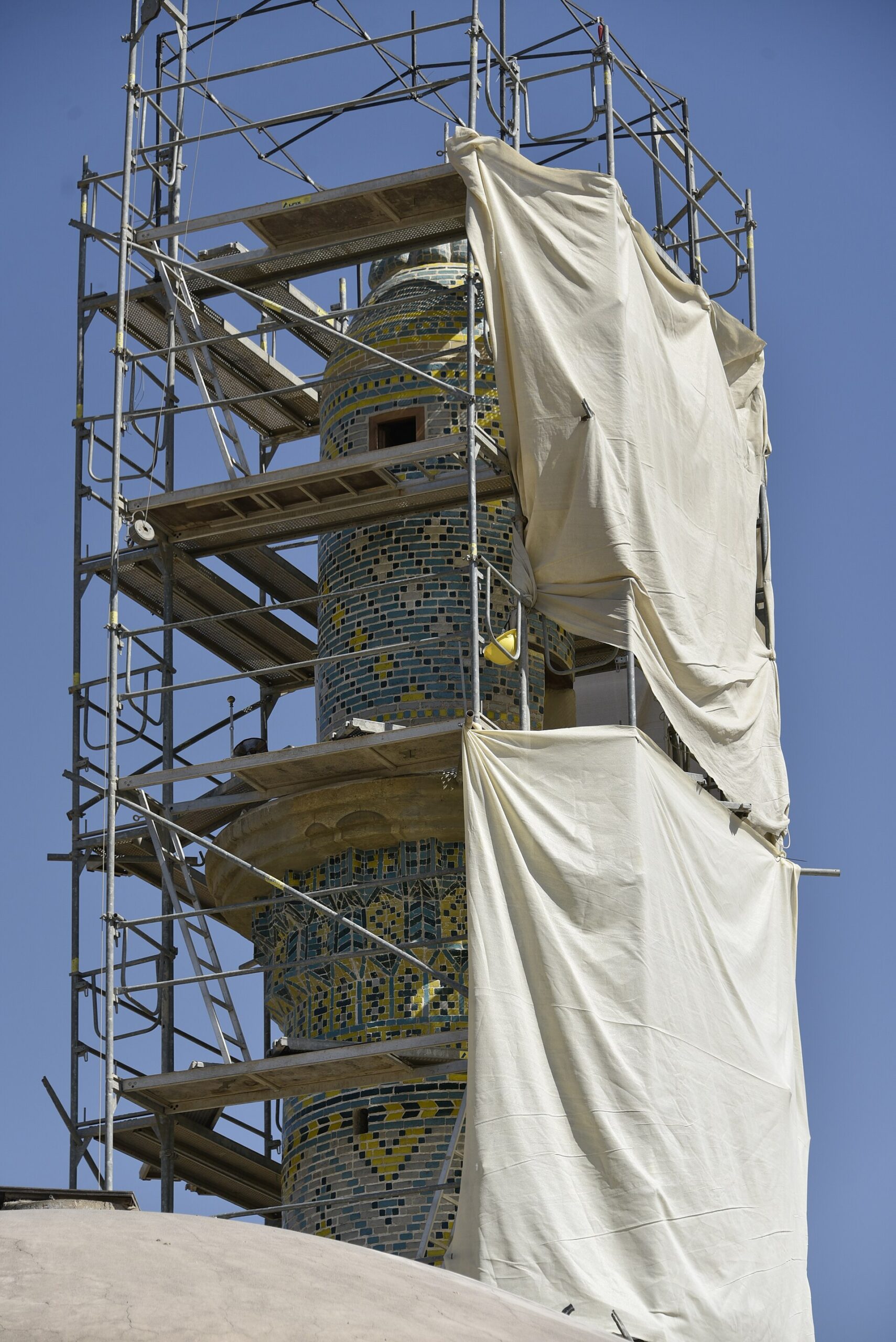
The Mulla Afandi Mosque, also called the Citadel Grand Mosque, is the only religious structure surviving on the Erbil Citadel. Almost nothing of the original fabric remains except the minbar and the minaret. The present single-domed roof was rebuilt in 1959, replacing a multi-domed one — one architectural database records 21 domes on arches and columns — with an austere modern flat reinforced-concrete slab. Its restoration appears on the contractor’s completed-works list from October 2025 and on the KRG’s own August 2025 list. Whether non-Muslim visitors may enter it, we could not establish. No source says either way.
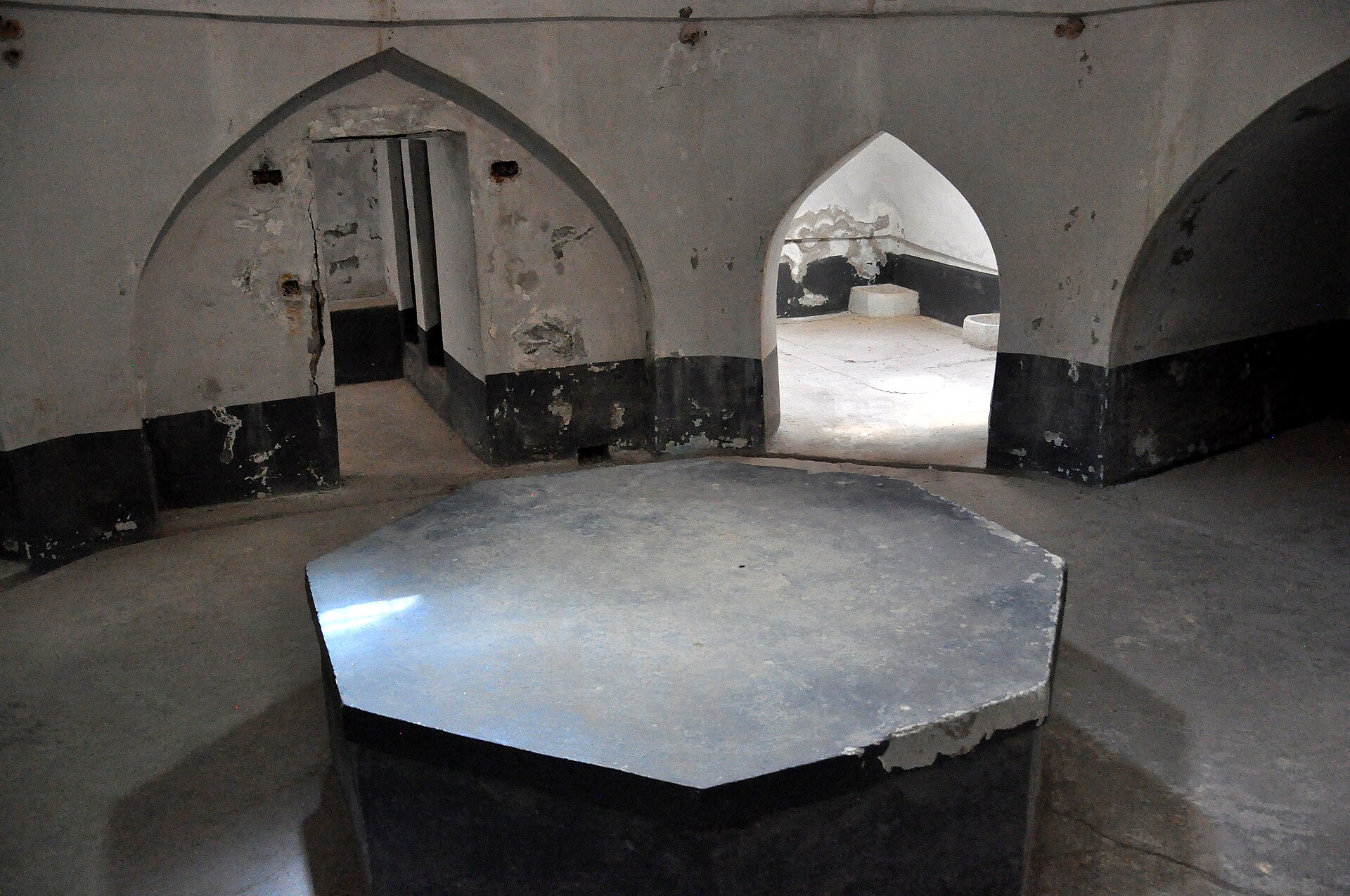
The hammam is the oldest surviving building on the Erbil Citadel, dated 1775 and founded by Qassim Agha Abdullah. Summer and winter sections sit under two domes, with a 45-metre well on the north side. It was heavily reworked in the 1950s and has been out of use since the 1960s. The World Monuments Fund signed a conservation agreement with the High Commission, funded by the US Embassy in Baghdad, originally due for completion in 2020. The KRG said on 18 January 2025 that the restoration was “nearly finished, with funding provided by the United States government”. No inauguration or opening has been announced since. Treat it as restored or being restored, not as open.
The Kurdish Textile and Cultural Museum occupies a restored mansion in the southeast quarter. Established in 2004 by the carpet expert Lolan Mustefa — also written Lolan Sipan; same person — it holds kilims, costume, naturally dyed wool and weaving tools, with a café upstairs and a gift shop. It recorded 56,369 visitors in 2008. As of June 2026 it is not accessible, because the citadel around it is locked. Our roundup of museums in Iraq has more on what is and is not currently open across the country.
Everything else is nine years stale in the record. A 2017 Kurdish news list named eighteen restored and open citadel sites, including a rocks and jewels museum, a guest reception centre, a Kurdish traditional clothing museum, a hand-made carpets centre, a cultural centre and a French institute. The High Commission’s 2022 report to UNESCO confirms a Cihan University Cultural House, a new gemstone museum and an interpretation children’s centre. All of it predates the 2024–26 closures, and none of it has a current status, an hour or a fee attached.
The Jewish quarter
An underused piece of the citadel’s story. A 2021 fellowship study of the synagogues of Erbil records three historical knešta in the city, two of them now gone. “The Knešta of the citadel no longer exists, as it disappeared among the houses of the Topkhana district. The elders also called it Knešta district. It was the oldest.” The Kurdish-Jewish community lived in Topkhana, in the western part of the mound, until the nineteenth century, then moved down to the Taajeel district beside the bazaar after the Ottomans dismantled the citadel walls. A 1951 aerial photograph maps Topkhana, Taajeel and the cemetery; the Jewish graveyard east of Taajeel was removed by the municipality after the 1951 emigration, and a residential district was built over it.
The eviction of 2006–07, and what it cost
The reason there is a beautiful empty town on the hill is that in 2006 the Kurdistan Regional Government emptied it.
The stated reasons for emptying the Erbil Citadel were sanitary conditions and squatter occupation. The head of the High Commission described “thousands of squatters living in the citadel, many of whom were refugees”. The best reading of the timing is that the decision was taken in late 2006 — November, according to one heritage organisation — and that the eviction ran through 2006 and 2007. The High Commission itself was created in 2007 by the same act.
The number of families varies: 840 in the most-repeated account, 830 in a 2015 engineering paper, 900 in the earliest detailed reporting. There is no sourced figure for the number of people. The often-quoted “around 7,000 evicted” appears nowhere we could find; the only attributable population figure is the High Commission’s own statement that the Erbil Citadel housed 6,000 residents at its height.
Where they went is the part that rarely gets printed. They were moved to a planned community eleven kilometres from the centre, nicknamed by the government and then by the residents “the New Citadel”. A 2013 report by a journalist working with the Pulitzer Center recorded that the families “were given a few thousand dollars to vacate their homes and start anew, in a swathe of undeveloped desert on the outskirts of Erbil” — while the houses they had left were being renovated at, in the words of the High Commission’s own head, “at least half a million dollars on each”, to turn them into exclusive residences for the city’s new wealthy. That is a single source and we flag it as such, but it is the only reporting we found that specifies both the destination and the compensation, and it deserves to be in the record.
The exodus was not sudden, incidentally. The nomination file notes that the wealthier families began leaving in the 1930s, followed by much of the rest, partly because of the sanitary conditions; the population held inside the walls until the 1950s, then successive waves of immigration and squatting filled the vacated houses between the 1960s and 2006.
The one family who stayed on the Erbil Citadel — the corrected version
Here is the story you have read: one family has lived on the Erbil Citadel continuously for over a century, and their presence alone preserves the world’s oldest continuously inhabited settlement.
Roughly half of that is right.
The family is real and was reported continuously from 2013 to 2024. The earliest detailed account, from August 2012, names them as the Qadr family and identifies the head of household as the Erbil Citadel’s Director of Water, responsible for its water supply. It also names the mechanism outright: “The Qadr family had to stay amidst the construction because of a technicality: without them, the ‘longest continuously inhabited city in the world’ would cease to be inhabited.” In September 2015 the head of the High Commission confirmed on the record to a Kurdish outlet that “a single family still lives there and watches the gate.” The New York Times ran the story in October 2017 under a headline that has done more than anything else to fix the legend in English.
The fullest account is from November 2024, and it corrects the folklore. It names Rebwar Mohammed, born on the Erbil Citadel in 1986, his wife Nazanin Qadir, and four children. They live in a small house near the southern gate, two rooms joined by a glass patio. And crucially: they are not an ancient citadel dynasty. Rebwar’s parents arrived in Erbil in 1978 from villages in the Balisan Valley, 75 kilometres north, and settled in an abandoned hut on the Erbil Citadel for ten dinars a month. They have been the sole residents for eighteen years — that is, since about 2006, when everyone else was moved out. Rebwar’s own summary: “It’s a responsibility that we didn’t choose, but one that we’ve accepted with pride.”
So the residence dates to 1978, not to 1900 or earlier, and the sole occupancy dates to the eviction, not to time immemorial. We cannot tell you whether the 2013 “Qadr family” and the 2024 household are the same people — under Kurdish patronymic naming it is entirely plausible, but no source states it.
And we cannot tell you whether anyone lives up there today. The last detailed report is November 2024. In June 2025 the man leading the restoration team said that “Kurdish families will soon start moving back into their old homes inside the citadel, some as early as this year”, with families chosen for their real historical ties to the place. The long-standing plan is for 50 families to return once the work is done.
The institutional view has never endorsed the one-family device at all. ICOMOS in 2014 wrote “It is currently not inhabited” and recommended that returning former inhabitants be considered. An academic assessment published in May 2026 describes the site as “uninhabited since 2006”, without exception. The world’s leading heritage body called the citadel empty in the same year the one-family story was going global.
The US$9.8 million project — and UNESCO’s own zero
This is the current chapter, and no page ranking for this keyword has it.
| Item | Detail |
|---|---|
| Project | “Reviving the World Heritage Site of Erbil Citadel”, UNESCO with the High Commission for Erbil Citadel Revitalization |
| Funder | KAR New Ventures Limited (KAR Group), an Iraqi energy company |
| Budget | US$9,836,782 (project ID 570IRQ4002) |
| Signed | 14 October 2025, at UNESCO headquarters in Paris |
| Launched on the ground | 3 May 2026, in Erbil |
| Ends | 31 October 2029 |
| Progress at UNESCO’s own last published benchmark | 0% as of 31 December 2025 |
Put those last two rows beside UNESCO’s July 2026 phrasing — “before the work begins on the ground” — and you have the shape of it. The money went up roughly tenfold in October 2025. Eight months after the ceremony, the agency was still describing groundwork as pending. Technical oversight has been subcontracted to a Prague conservation firm. The planned components are adaptive reuse for a religious library, a research and documentation centre, a museum on Kurdish extraction and the energy industry, visitor projects along the alleys, and a public-private framework — still to be established — to bring in cafés, shops and cultural businesses.
Which brings us to the hotel. In January 2025 the KRG announced that “future plans include establishing teahouses, a hotel, and restaurants within the site”. A Kurdish paper repeated it later that month as a “planned construction” of an international restaurant and a renowned hotel. The KRG repeated it again in August 2025. UNESCO’s project page, last updated 10 June 2026, still lists cafés and shops as things the project will develop. As of August 2026, no hotel and no restaurant has opened inside the Erbil Citadel. If a page tells you that you can stay the night on a six-thousand-year-old tell, it is reading a press release as a booking page. Our guide to where to stay in Iraq deals with what actually exists.
Where UNESCO’s oversight has got to
Three facts, all checkable on the World Heritage Centre’s own site, and all more interesting than they sound:
- The citadel has not been examined by the World Heritage Committee since 2021. There are decisions on file for 2021, 2018, 2016, 2015 and 2014, and nothing for the 2023, 2024, 2025 or 2026 sessions.
- Iraq did file the report it was asked for. The High Commission’s State of Conservation report met the 1 December 2022 deadline. The Committee simply never put it on an agenda.
- No reactive monitoring mission has ever been sent. The “missions to the property” field is blank.
The citadel is not on the List of World Heritage in Danger, and there is no danger-listing threat or warning language anywhere in the file. Iraq’s in-danger properties are Samarra, Ashur and Hatra. The recorded factors affecting Erbil as of 2021 are a legal framework needing improvement, insufficient involvement of former inhabitants and Erbil civil society, an inappropriate proposed location and design for the Kurdistan National Museum, and one physical threat: unstabilised slopes.
The slopes are the real risk
In April 2023 the uppermost section of the old palace of Ali Pasha, on the upper edge of the Erbil Citadel, collapsed. Photographs are dated 19 April 2023. The cause was not war or weather but the slow physics of an unstable slope.
In May 2026 two academics from Komar University and Cihan University-Erbil published an assessment finding that “cracks now run along the slopes themselves and through some of the perimeter houses that ring the mound”. Their argument is that the restoration programme has been substantial but that far less attention has gone to the ground holding it up. Their list of basics still undone: a rainwater drain along the uppermost slope edge, removal of fallen retaining-wall blocks, a ban on adding new weight or construction on the slopes, motion sensors, and GPS-tracked monitoring points.
The underlying mechanism goes back to UN-funded water and electricity works installed in the 1990s without matching drainage, which waterlogged the tell. The High Commission costed slope stabilisation and façade foundation works at around US$11 million back in 2015. As of May 2026 an academic assessment says it still has not been done systematically. Whatever the closure is officially about, this is the physical problem sitting underneath it.
What is around the Erbil Citadel while it is shut
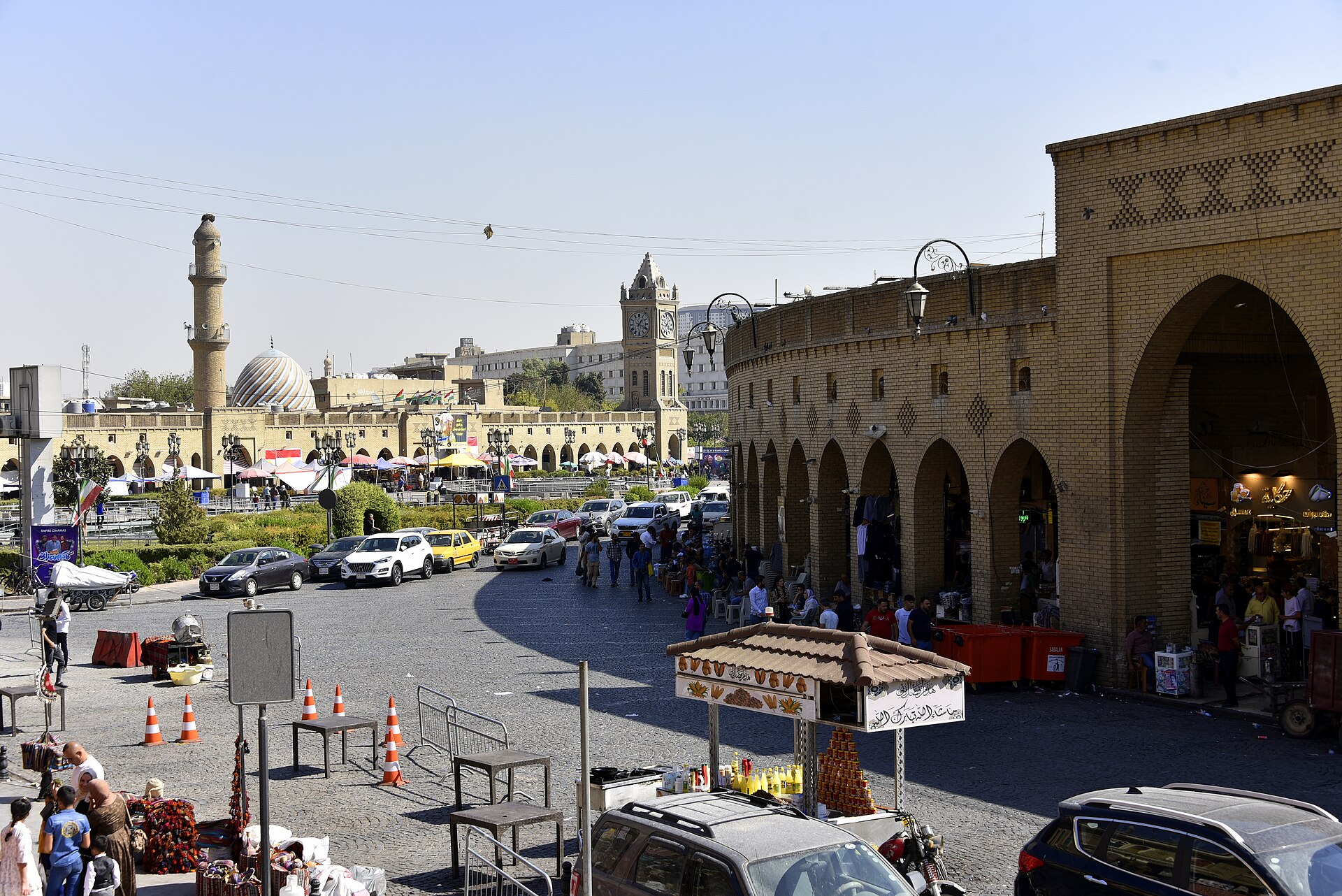
Qaysari Bazaar runs directly below and south of the mound: a roofed market of around 4,000 shops, entered from many alleys, with trades clustered by alley — gold, textiles, household goods, spices, handwoven rugs, copperware and silver. A north–south alley in the northeast corner sells honey and dairy. Money changers work the edges with cash on glass cases, and some of them sell Saddam-era dinar notes as souvenirs. Many shops will hand you tea for nothing.
You should know what happened here, because no English travel page mentions it. On 5 May 2024 a fire destroyed roughly 227 shops and seven warehouses and injured 132 people, fifteen seriously enough for hospital. (One Kurdish outlet prints the date as April; the weight of reporting and the Chamber of Commerce’s second-anniversary marking in May 2026 both point to 5 May.) Rebuilding cost 5.3 billion dinars, about US$3.6 million, from the Erbil governorate. 105 shops were fully restored by January 2025, a partial reopening came before Ramadan that March, and the governor announced completion of the second and most critical phase on 6 April 2025. So the bazaar you walk into in 2026 is largely rebuilt — but it is not the bazaar in the photographs on page one.
Shar Park, locally Baghi Shar, “the city garden”, is the square between the mound and the bazaar: a large central fountain with benches, raised boardwalks, a second smaller water display, lawns and a clock tower. Built around 2009–10. In the afternoon and evening a small pavement market runs on the east side near the clocktower — prayer beads, clothes, antique watches. A dated first-hand account from October 2025 describes families walking the paths, men over tea and shisha, and children feeding the pigeons. It is the best free hour in Erbil.
One thing to get right: the famous leaning minaret is not at the citadel. The Mudhafaria or Choli Minaret, 36–37 metres, built for Muzaffar al-Din Gökböri between about 1190 and 1233, stands in Minare Park roughly a kilometre west. ICOMOS noted with some irritation that it sits in the buffer zone and not in the inscribed property. The minaret you can see from inside the citadel is a different one — the Grand Mosque’s. Confusing the two is the most common error in Erbil photography, and if you are shooting the city, our notes on Iraq photography spots and on the country’s most beautiful places may help you plan the light.
Getting there, and the rules that apply once you are
Visas: the asymmetry nobody explains
The Kurdistan Region runs its own entry system, and this catches people out badly.
Federal Iraq’s visa on arrival was suspended on 1 March 2025 and is gone. You now apply on the government e-visa portal at least 24 hours before travel; the FCDO states the cost as US$160 for 60 days. The Kurdistan Region, by contrast, still issues visas on arrival at Erbil and Sulaymaniyah for many nationalities, and runs its own e-visa through the KRG portal at an administrative fee of 100,000 Iraqi dinars — roughly US$65 at the mid-August 2026 street rate of about 1,530 dinars to the dollar — with a 90-day window to enter and a 30-day stay.
Then the trap, in the FCDO’s own words: “Both types of visas are valid for travel in KRI only.” A Kurdistan visa does not let you travel south into federal Iraq. Several operators have claimed since January 2025 that it now does. No official Iraqi or KRG source confirms this, and there are 2026 reports of travellers being turned back on the Erbil–Mosul axis. Plan on the restrictive rule. If you want both halves of the country, sort the federal visa first. We cover the mechanics in detail in our guides to the Kurdistan visa and the Iraq visa, and the paperwork you need at the border in Iraq entry requirements.
Your passport needs six months’ validity beyond arrival and one blank page. Declare local currency over 200,000 dinars, and any currency or goods over US$10,000, on entry and exit. Carrying photo ID is a legal requirement in Iraq.
Advisories and the current security picture
Be clear-eyed about this. As of the FCDO’s 22 July 2026 edition, still current on 15 August 2026, the entire Kurdistan Region of Iraq is under “advise against all but essential travel”. That entry is now two lines with no sub-divisions — the intra-region carve-outs that used to exist for the Amedi mountains and the border strips have been deleted, which makes the rating uniformly worse for Erbil city than it was a year ago. The US State Department has Iraq at Level 4, Do Not Travel, reissued 2 March 2026, the same day it ordered non-emergency government employees out of the country.
The practical consequence most pages bury: travelling against FCDO advice can invalidate your travel insurance. Check the wording of any policy before you rely on it — our notes on Iraq travel insurance explain what to ask.
The regional picture as of mid-August 2026: since 8 July 2026 there have been strikes and retaliatory attacks by Iran across the region, including in Iraq and the Kurdistan Region, aimed at US military and civilian infrastructure. Kurdish outlets counted 19 attacks on the Region in the first two weeks of August 2026, and three explosive drones were intercepted over Erbil in the early hours of 14 August 2026. Flights to Erbil, Baghdad and Basra were suspended on 24 July and resumed on 8 August. EASA’s Iraq bulletin advising European operators out of the Baghdad flight information region runs to 31 August 2026, and an Iraqi NOTAM warning of GPS jamming and spoofing over northern Iraq runs to 4 October 2026.
Every one of those bulletins expires before or around the time you read this. They are here as a picture of a moment, not a forecast. Re-check the FCDO page, your government’s advisory and your airline before you book anything. No report of drone, missile or earthquake damage to the citadel itself has surfaced in 2023–2026. Our standing pages on whether Kurdistan is safe, the current Iraq travel advisory picture and the broader question of whether Iraq is safe are updated more often than this one.
Laws worth knowing before you land
One law needs stating plainly because it carries serious penalties and is easy to be unaware of. Under the July 2024 amendment to Iraq’s Anti-Prostitution and Homosexuality Law, if the authorities judge that your actions, your clothing or items in your possession promote LGBT+ identities or prostitution, you face up to seven years’ imprisonment and a fine of 10 to 15 million Iraqi dinars. Same-sex relationships carry 10 to 15 years. This applies across Iraq, including the Kurdistan Region.
Two more. Drones are effectively contraband — the KRG prohibits sharing footage of drone launches or target locations, and bringing a drone into the Region risks detention. And on alcohol, get the shape right: federal Iraqi law criminalises the import, manufacture and sale of alcohol, with fines up to 25 million dinars, not personal consumption; in the Kurdistan Region alcohol is sold and served openly, with Ankawa in Erbil the visible centre. The wider legal picture is in our guide to Iraq’s laws for tourists, and there is more on movement and documents in our piece on Iraqi checkpoints.
When to come
Erbil’s August mean daily maximum is 42.5 °C and July’s is 42.4 °C. Four Iraqi governorates hit 50 °C on 15 August 2026. There is no shade on the citadel mound and very little in the square. April, at a mean maximum of 25.5 °C, and October at 30.1 °C are the sensible windows; January is mild at around 13 °C. Note that the structure of Kurdish domestic tourism is that in summer people go to the mountains, not to Erbil city — which is worth knowing if you want the bazaar quiet. Local advice is to avoid the bazaar and citadel area from 3pm on Fridays, when it is at its busiest. Our guide to the best time to visit Iraq works through the seasons in more detail, and the Iraq itinerary page has route ideas that fold Erbil in.
What we could not confirm
A long list, and the length is the point. On a site this famous, the amount of unverifiable detail in circulation is remarkable.
- Any official opening hours or entrance fee for the Erbil Citadel. None exist on any KRG, High Commission or UNESCO page.
- Whether the interior will reopen, or when. The most recent official language, from July 2026, still describes physical works as not yet begun.
- Whether the hammam restoration is finished or open. “Nearly finished” in January 2025 is the last word. No inauguration was announced.
- Whether non-Muslim visitors may enter the Mulla Afandi Mosque. No source says either way.
- The Kurdish Textile Museum’s much-copied “09:00–18:00 daily except Friday”. It traces to a single aggregator with no primary sourcing. Friday closure has weak 2022 traveller support only.
- Whether the one family still lives on the citadel in 2026. Last detailed report: November 2024. Reporting from June 2025 suggests other families were due to begin returning.
- Whether the 2013 “Qadr family” and the 2024 household are the same people. Plausible; unstated.
- The current status of the gemstone museum, the Cihan Cultural House and the other interpretation facilities opened before 2022.
- Whether an east or “upper” gate functions as a visitor entrance, and whether vehicles are ever permitted onto the mound.
- Evening or night opening. The KRG’s January 2025 statement is future tense and nothing confirms it has happened.
- Official on-site guided tours. Tour platforms sell “citadel” products, but with the interior closed these are city tours.
- Whether the Ishtar temple lies under the citadel at all. ICOMOS stated in 2014 that the tell has not been shown to coincide with Assyrian Arbela.
- The technique that detected the two buried stone structures beneath the centre of the mound. Accounts disagree.
- The number of people evicted in 2006–07. Only the number of families is sourced, and that varies between 830 and 900.
- Any drive time between Erbil and another Kurdish city. The only official intercity figure published anywhere is 198 km from Erbil to Sulaymaniyah, with no route and no time. We will not invent one.
- Unresolved date conflicts we are presenting as conflicts: the road cut of 1958 or 1960; the Ottoman conquest of 1534, 1535 or “the early 16th century”; the Mongol arrival in 1258 or 1259 — and on that one, the stronger reading is that Erbil negotiated its surrender and escaped destruction.
Frequently asked questions
Are the Erbil Citadel and its museums open to visitors in 2026?
Not reliably. The interior has been closed or only intermittently open through 2025 and 2026, and the most recent on-the-ground report we could find, from 4 June 2026, says it was locked. The terrace outside the Grand Gate has stayed accessible. Assume the interior is shut, ask at the gate, and have the bazaar and square as your plan.
How much does it cost to enter the Erbil Citadel?
No entrance fee is published by any official body. When the site has been open, entry has been free — it is gated and guarded rather than ticketed. Any specific price you see online is unsourced.
Is Erbil Citadel really the oldest continuously inhabited place on earth?
It is one of the strongest candidates, but it has not been demonstrated. The defensible archaeological claim is Ubaid-period settlement from the fifth millennium BC, based on potsherds from the mound. UNESCO inscribed the site under criterion (iv) only and its advisory body explicitly rejected the continuity-of-occupation argument in 2014. There is no Guinness record.
Does anyone still live in the Erbil Citadel?
One family was documented living there from 2013 to November 2024 — Rebwar Mohammed, Nazanin Qadir and their children, in a house near the southern gate. Their residence dates to 1978, not to 1900 as the folklore has it, and they became sole residents only after the 2006 eviction. Whether they are still there in 2026 is not confirmable, and the restoration lead said in June 2025 that families would start moving back.
Was the Battle of Gaugamela fought at Erbil Citadel?
No. It was fought on the Navkur Plain near Tell Gomel, roughly 85–90 km north-northwest, in 331 BC. “Battle of Arbela” is ancient shorthand because Arbela was the nearest notable city and Darius III’s campaign headquarters. Alexander did pass through Erbil afterwards, briefly, before marching on Babylon.
How long should I spend at the Erbil Citadel?
An hour covers the walls, the gate, the terrace and the views if the interior is closed. Half a day is more realistic once you add Qaysari Bazaar, Shar Park and a tea house at the foot of the mound. If the interior has reopened by the time you go, add another hour or two.
Can I stay in a hotel inside the Erbil Citadel?
No. A boutique hotel and restaurant have been announced repeatedly — January 2025, August 2025, and again in UNESCO project material updated June 2026 — but nothing has been built. As of August 2026 there is no accommodation and no restaurant on the citadel.
Is it safe to visit Erbil?
That is your decision, and it should be an informed one. Erbil is a functioning city and is not among the provinces the FCDO rates “against all travel”. But the entire Kurdistan Region carries an “against all but essential travel” rating, drones have been intercepted over the city as recently as 14 August 2026, and flights were suspended for two weeks in late July. Read the current advisory, understand what it does to your insurance, and choose deliberately.
What is the Kurdish Textile Museum, and can I visit it?
It is a museum of Kurdish kilims, costume and weaving tools in a restored mansion in the southeast quarter of the citadel, founded in 2004. Because it sits inside the citadel perimeter, its accessibility follows the citadel’s — and as of June 2026 it was reported inaccessible. Its own website is dead.
What is the difference between the Erbil Citadel minaret and the leaning minaret?
The Mudhafaria or Choli Minaret, 36–37 metres and built between about 1190 and 1233, stands in Minare Park roughly a kilometre west of the citadel and is not part of the inscribed World Heritage property. The minaret visible on the mound belongs to the citadel’s Grand Mosque. They are frequently confused.
Final thoughts
The frustrating thing about the Erbil Citadel — Erbil Castle, if you prefer the other name — is that the reality is more interesting than the legend. The legend is a tidy line about six thousand years and one family. The reality is a twenty-two-metre column of unexcavated stratigraphy with a Roman destruction layer in it, an Assyrian city wall five metres below an Ottoman one, a temple that may or may not be down there, a town emptied of eight hundred and forty families in 2006 and never properly refilled, a ten-million-dollar conservation contract that had produced no measurable progress a year after signing, and a hillside that two engineers say is cracking while everyone photographs the walls on top of it.
None of that makes it a bad place to go. It makes it a place worth understanding before you stand under it. Go to the Erbil Citadel expecting the gate to be shut, and you will spend an unhurried afternoon on the best square in Iraqi Kurdistan with a rebuilt bazaar behind you and a six-thousand-year-old hill in front. If the gate happens to be open, you will have got something almost nobody has had since 2024.
Before you book, read our practical Iraq travel tips — updated far more often than this page — and start your planning from the Iraqi Kurdistan pillar, which links out to the rest of the region. If you would rather not arrange it all yourself, our page on Iraq tours explains what operators actually deliver, and what a trip to Iraq costs sets expectations on budget. If Erbil is one stop on a longer trip, the Iraq travel guide is the place to start, and our pages on Iraq’s cities, on Mosul and on Baghdad will tell you what the rest of the country looks like right now — bearing in mind that the road between Erbil and either of those crosses provinces the FCDO rates against all travel, and that your Kurdistan visa will not carry you there. Related reading: Sulaymaniyah Travel Guide.
Photo credits
Aerial view of the citadel by jan kurdistani (CC BY-SA 2.0). The Grand Gate by Sima awat (CC BY-SA 4.0). Ahmadi Gate, Grand Mosque minaret, hammam interior and Shar Park by Osama Shukir Muhammed Amin FRCP(Glasg) (CC BY-SA 4.0). All images sourced from Wikimedia Commons.