Last updated: September 2026. We re-checked the FCDO’s Iraq advice and entry rules on gov.uk on 25 September 2026. Distances, fees and the 2026 projects come from Kurdistan24, 964media, Invest Kurdistan and our August 2026 research files, and each is dated where it appears.
The figure most often attached to Gali Ali Beg is 800 metres, and it is wrong. That is roughly the altitude of the town of Rawanduz; the waterfall itself drops about 12 metres. The mistake is a fair introduction to this corner of our Iraqi Kurdistan travel guide, because the scenery is every bit as good as people say, and a lot of the information attached to it has been copied from page to page without anyone checking.
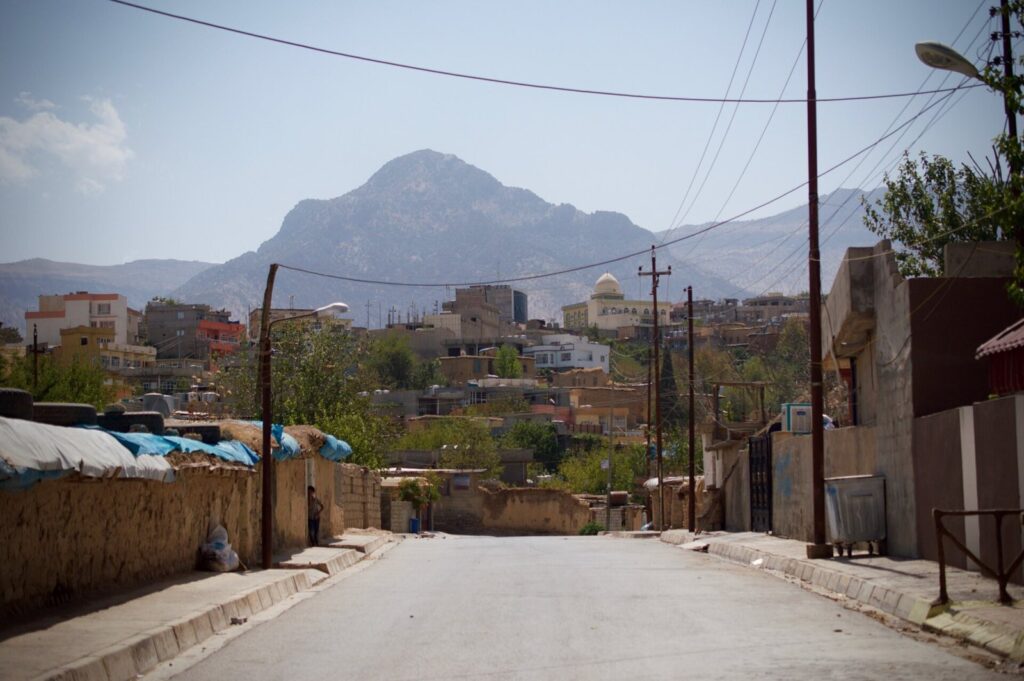
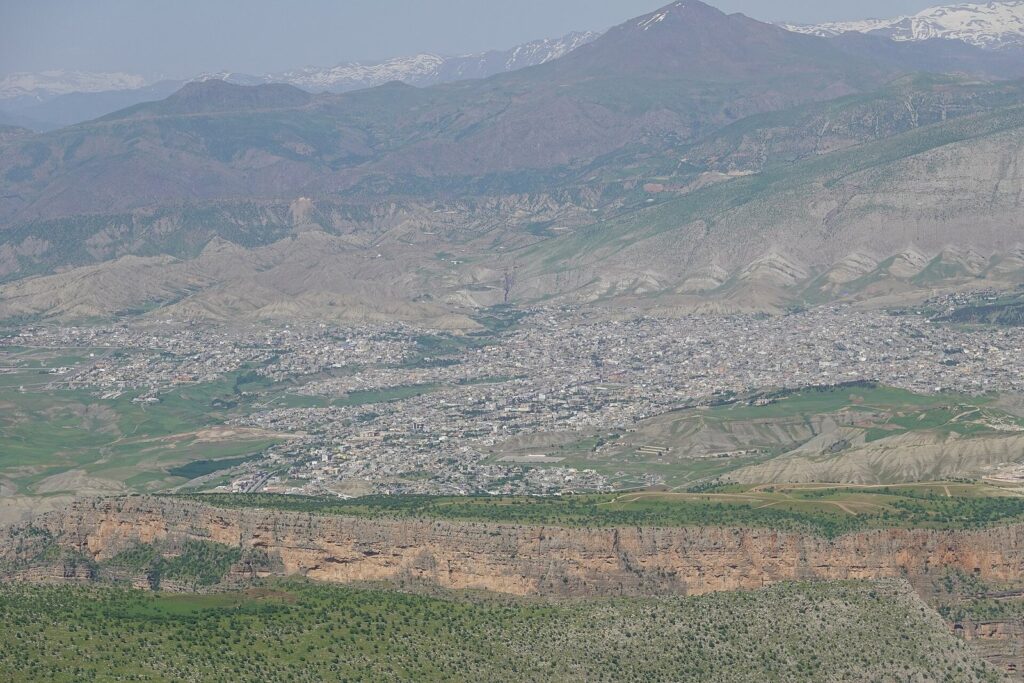
Rawanduz is a small mountain town in Erbil governorate, about 123 km from Erbil, set above a deep gorge on the Hamilton Road, the British-built strategic road that A. M. Hamilton engineered between 1928 and 1932. The Gali Ali Beg and Bekhal waterfalls, the Korek cable car and the town of Soran are all within a short drive.
This page covers the gorge, the two waterfalls and the road, the FCDO line that names Rawanduz directly, the distances that don’t add up, the Yazidi prince the most famous waterfall is named after, and the things we could not confirm.
The short answer
| Question | Answer |
|---|---|
| Where is it? | Soran district, Erbil governorate, under the Soran Independent Administration; 7 km from Soran town |
| How far from Erbil? | About 123 km by Wikipedia’s figure; no official road table or drive time is published |
| Gali Ali Beg | A 12 m waterfall, the one on the 5,000-dinar note; free, parking 2,000 to 5,000 IQD (August 2026) |
| Bekhal | Spring-fed and flowing all year; free, parking 1,000 to 5,000 IQD |
| FCDO (25 September 2026) | Against all but essential travel to the whole Kurdistan Region, and it names Rawanduz as an area of intermittent Iranian strikes |
| Hamilton Road | Built 1928 to 1932, about 185 km from Erbil to the Iranian border |
| Visa | A Kurdistan Region visa covers it; that visa is valid in the Region only |
Where is Rawanduz, and how far is it from Erbil?
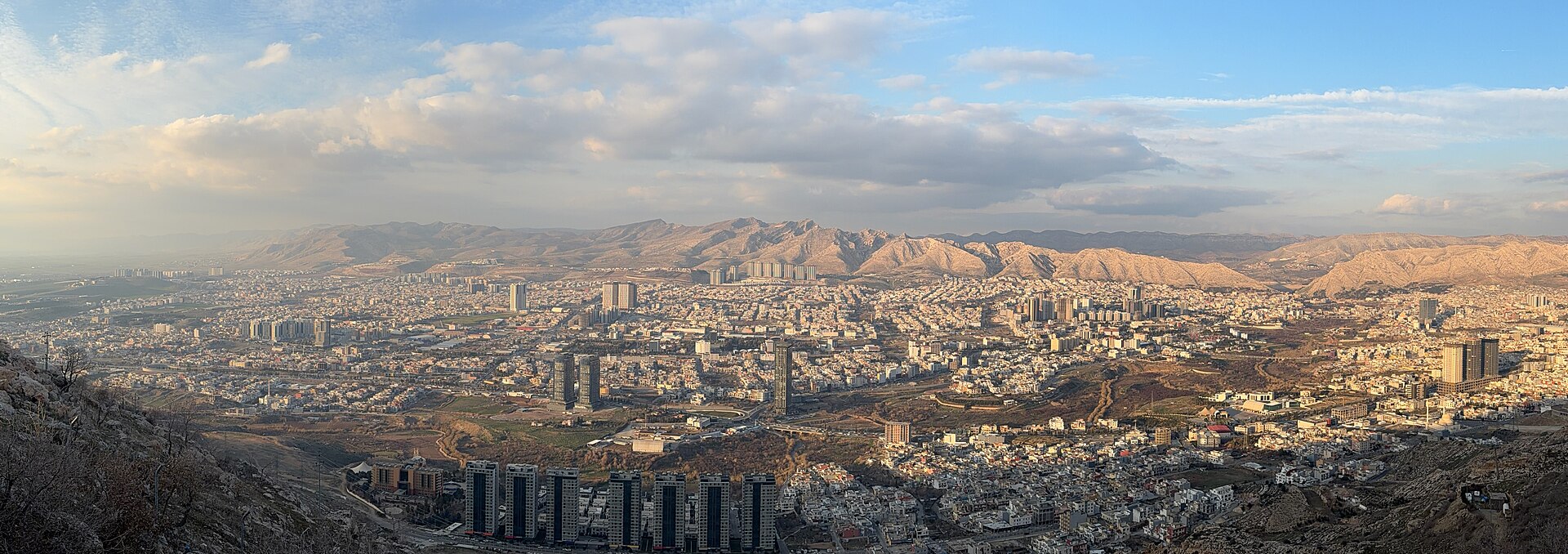
Rawanduz sits in a bowl of the Zagros, with Korek mountain to the south, Hindren to the north, Zozik to the west and Bradost to the east. It is in Soran district of Erbil governorate, and the cluster of sights around it, from Gali Ali Beg and Bekhal to Korek, falls under the Soran Independent Administration. Soran town, the district capital also known as Diana, is only 7 km away.
That last point matters for planning, because unlike Lalish or Alqosh, everything on this page lies inside Erbil governorate and inside the Kurdistan Region proper. There is no disputed district on the way and no federal province line to think about. The advisory question here is a different one, and we come to it below.
Distances are another matter. Every source we trust gives a figure, and the figures don’t agree with one another.
| Source | Figure | What it actually measures |
|---|---|---|
| Wikipedia, Rawandiz entry | Rawanduz 123 km from Erbil; Bekhal 10 km to the west | Not stated: could be road or straight-line |
| Wikipedia, Gali Ali Beg entry | “Some 130 km north of Erbil” | A rough direction and distance, not a route |
| Wikipedia, Bekhal entry | 135 km from Erbil; 10 km west of Rawanduz | Not stated; 123 plus 10 would give 133, not 135 |
| Our August 2026 research files | Bekhal 7 km from Rawanduz | Endpoint not stated; we could not reconcile it with the 10 km figure |
| Our August 2026 research files | Hamilton Road about 185 km, Erbil to Haji Omaran via Rawanduz and Choman | The full historic route to the Iranian border |
The discrepancies are small, but they tell you something useful: we found no official road table for these mountains, and the numbers you see online are copies of a handful of estimates. No source we trust gives a drive time from Erbil either. Ask your driver the day before, and allow for the roadworks around Khalifan.
Is it safe to visit Rawanduz in 2026?
Rawanduz is unusual in having its name written into British travel advice. The FCDO’s Kurdistan Region section, which we read on 15 August 2026, says: “Iranian targeting of Iranian-Kurdish opposition groups within the KRI increased during the recent conflict. Intermittent strikes targeting these groups have continued since in areas across the KRI, including around Rawanduz and Koya.” The strikes are aimed at Iranian-Kurdish opposition groups, not at tourist sites, but the FCDO names the area and you should read that sentence before anything else on this page.
As of 25 September 2026, the rest of the frame is this. The FCDO advises against all but essential travel to the whole Kurdistan Region, with no exceptions for particular districts; its page was last updated on 22 July 2026 and was unchanged when we checked. The US State Department rates Iraq Level 4, Do Not Travel, reissued on 2 March 2026. Rudaw counted 19 drone and missile attacks on the Kurdistan Region in the first two weeks of August 2026. The European aviation regulator’s bulletin telling airlines not to operate in Iraqi airspace at any altitude was valid to 30 September 2026 when we looked, so check with your airline in the week you fly.
And the FCDO’s insurance line applies in full: “Your travel insurance could be invalidated if you travel against advice from the Foreign, Commonwealth & Development Office (FCDO).” Our guide to travel insurance for Iraq explains which policies still cover the Kurdistan Region and what to ask in writing.
There is a second, more ordinary risk here: water. Gali Ali Beg ran completely dry in June 2025, flows change with the rain, and people swim and paddle inflatable boats in the plunge pools. The Kurdistan Tourism Board issued new water-tourism safety regulations around July 2026; we could not read their full text, so follow whatever lifeguards, signs or site staff tell you on the day. For the regional picture, see our assessment of safety in Kurdistan and the dated summary on our Iraq travel advisory page.
The Hamilton Road: who built it, and what is left?
Between 1928 and 1932, a young New Zealand engineer named Archibald Milne Hamilton was principal engineer of a British-built strategic road across southern Kurdistan, running from Erbil through Rawanduz to the Iranian border near today’s Piranshahr. Hamilton, born in Waimate on 18 November 1898 and trained at Canterbury College, wrote the build up in Road through Kurdistan (Faber, 1937; reissued 1958 and 2004). In it he relates that the Rawanduz gorge “was said to be the finest in Asia”. He went on to design the Callender-Hamilton bridge, and his son was the evolutionary biologist W. D. Hamilton.
Hamilton hoped the road would bring the peoples of the region together. Instead it has been fought over many times, and it remains the spine of the Soran country: the main road to Rawanduz, Soran and Choman, and onward to the Haji Omaran crossing opposite Piranshahr, one of only two Iran to Kurdistan crossings that are realistic for foreign passport holders. The FCDO warns that crossing points “may close with little or no notice”.
| Stretch | What you pass | What to know |
|---|---|---|
| Erbil to Khalifan | The approach from the Erbil plain into the hills | The KRG plans 12 km of new highway from Khalifan to Gali Ali Beg; expect construction |
| Gali Ali Beg gorge | The waterfall and its bridge | A truck collision closed the bridge on 27 December 2024; a detour stayed open while it was repaired |
| Bekhal | Spring-fed falls beside the road | Free; parking 1,000 to 5,000 IQD |
| Rawanduz | The town above the gorge | About 123 km from Erbil by Wikipedia’s figure |
| Soran (Diana) | The district capital, 7 km on | Future base of a 10 km cable car, expected by 2027 |
| Choman and beyond | High valleys towards Halgurd | Halgurd-Sakran National Park exists on paper only; Peshmerga checkpoints control access |
| Haji Omaran | The border crossing to Piranshahr, Iran | Crossings “may close with little or no notice” (FCDO) |
We have not found a source that confirms Haji Omaran as the road’s original terminus; Wikipedia says only “the Iranian border near Piranshahr”, and the crossing opposite Piranshahr is Haji Omaran. It is a fine distinction, but it is the kind of detail that gets repeated with more confidence than the evidence allows.
What is there to see around Rawanduz?
The honest answer is: water and rock, a road with a story, and a string of resorts built for Iraqi families escaping the heat of the plains. Our guide to nature in Iraq puts these valleys in the context of the country’s other landscapes; here is what each stop offers.
| Sight | Where | Entry | Worth knowing |
|---|---|---|---|
| Rawanduz gorge | Around the town and along the road | Free, from the roadside | No published depth or length |
| Gali Ali Beg waterfall | On the road from Khalifan | Free; parking 2,000 to 5,000 IQD | Ran completely dry in June 2025 |
| Bekhal waterfall | 7 to 10 km west of Rawanduz, depending on the source | Free; parking 1,000 to 5,000 IQD | Spring-fed, so it flows all year |
| Pank Resort | Rawanduz area | Not published | Opened 2007; its Aqua Park Mero is one of Iraq’s largest |
| Korek cable car | Korek mountain, south of Rawanduz | Not verified | Hours, prices and ride time circulate online, unconfirmed |
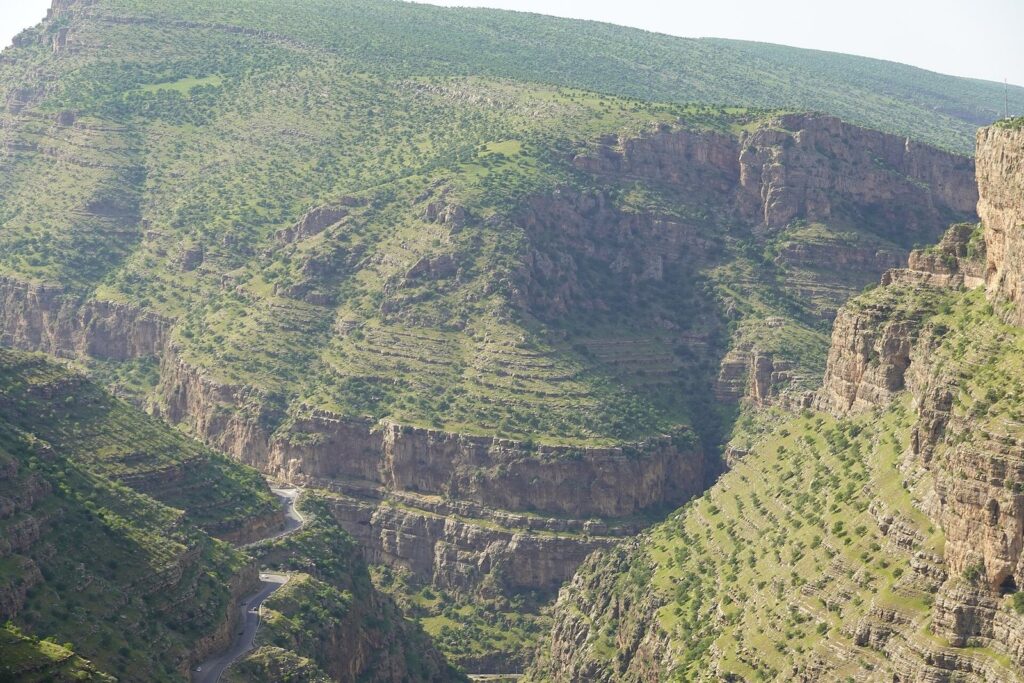
The gorge
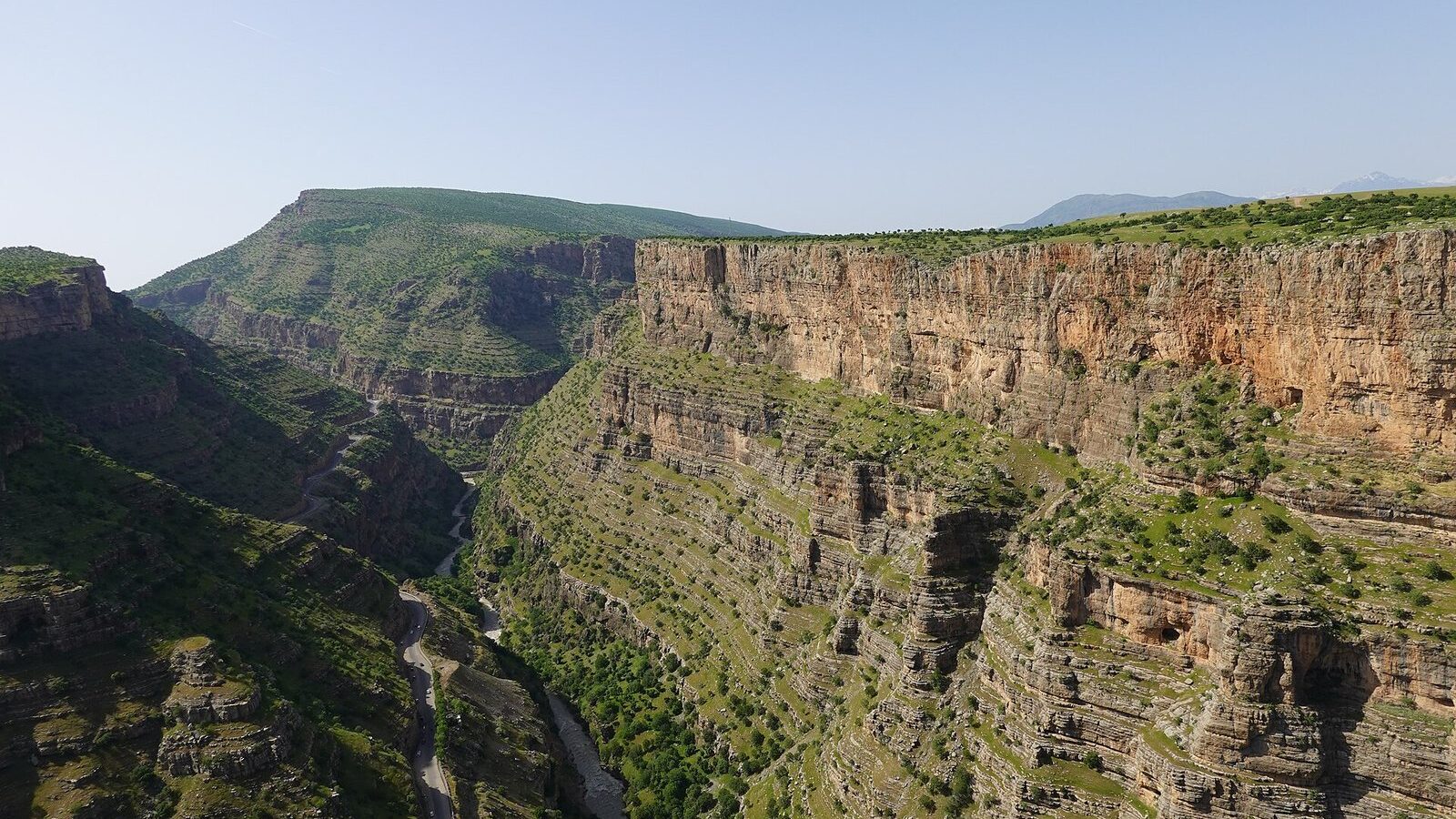
The gorge is the reason the “Grand Canyon of Kurdistan” label exists, and although it is a tourism slogan, it is not a silly one. Layered rock walls drop to a river on the valley floor, the slopes are terraced with scrub and grass, and a road winds along the bottom. Nobody publishes a depth or length for it, so we won’t give one. The best way to see it is simply to stop wherever the road opens out and it is safe to pull over. Our guide to photography in Iraq covers when you can and can’t point a camera, which matters near checkpoints and security posts in the Soran valleys.
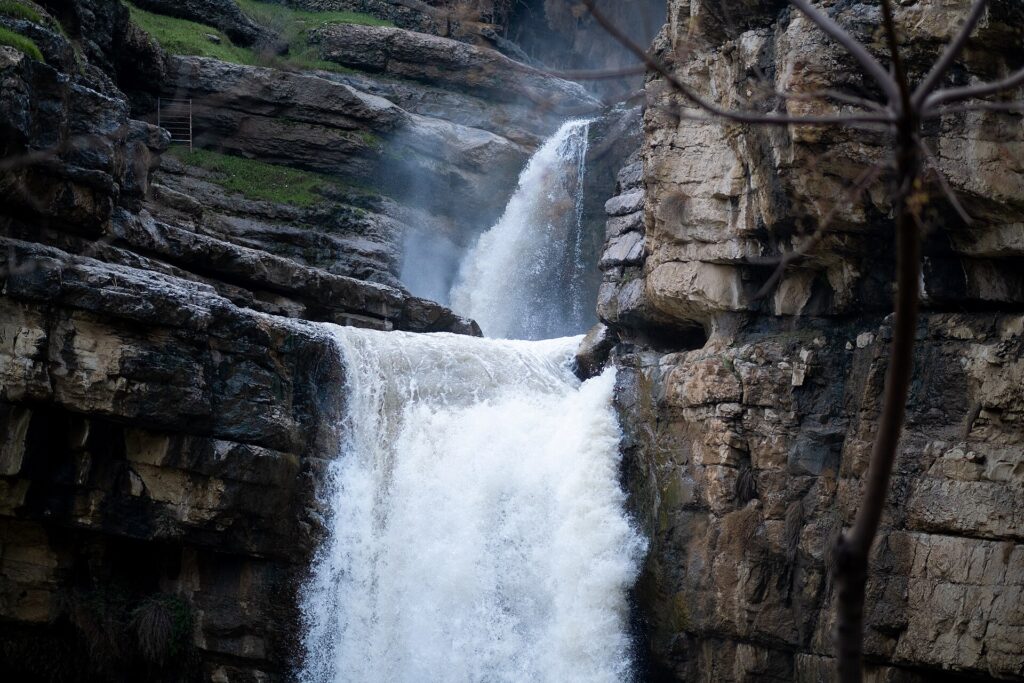
Gali Ali Beg waterfall
Gali Ali Beg is the waterfall on Iraq’s 5,000-dinar note: it appears on the front of the current series notes of 2003, 2013 and 2021, with the Ukhaidir fortress on the back. That makes it the most recognisable natural sight in the country, and on holiday weekends it can feel like it. It is a 12-metre drop into a plunge pool in a narrow gorge, reached from the road, with free entry and car parking at 2,000 to 5,000 IQD as of our August 2026 research.
The water is not guaranteed. Gali Ali Beg ran completely dry in June 2025 and only recovered in the wet 2025 to 2026 season. If you are travelling in a dry summer, check recent photos or ask your driver before you commit a day to it. Our list of beautiful places in Iraq puts it alongside the country’s other landscapes.
Bekhal waterfall
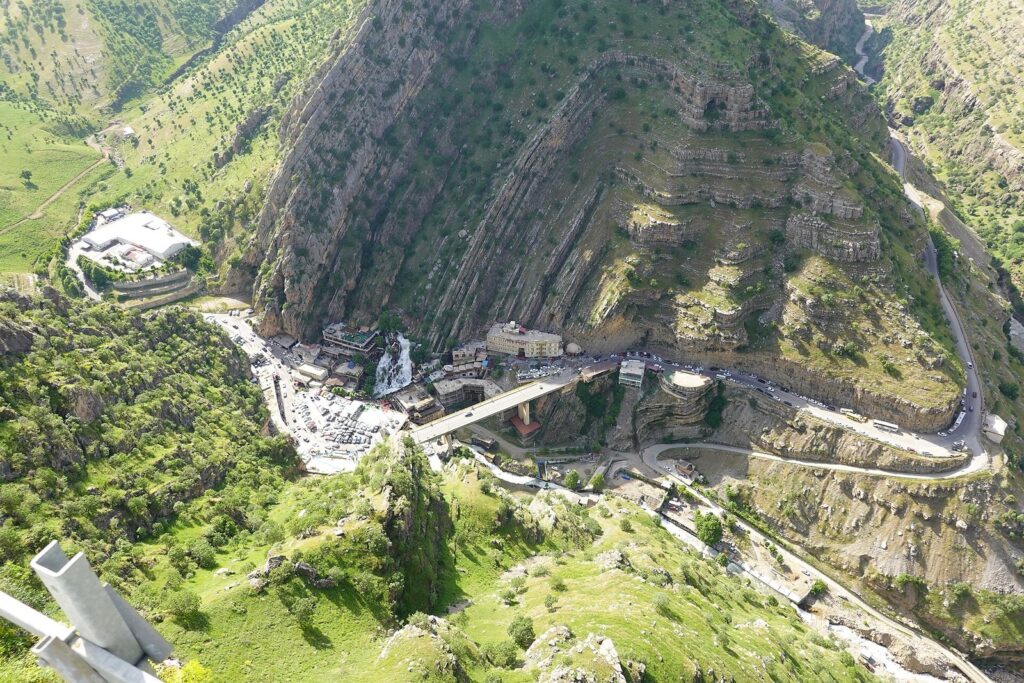
Bekhal is the reliable one. It is spring-fed and keeps flowing when rain-fed falls fail, which makes it the safer bet in late summer. It is free, with parking at 1,000 to 5,000 IQD, and it sits right beside the road west of Rawanduz, 7 km or 10 km away depending on which source you believe. The setting is busier and more built-up than at Gali Ali Beg, with the falls tumbling between roadside buildings under a bridge, so come for the sound and spray rather than for solitude.
Pank Resort and Korek
Pank Tourist Resort opened in 2007 and was described by the Guardian at the time as the first resort of its kind in Iraq, with a Ferris wheel, a toboggan run, a five-star hotel, pools and mini golf. Invest Kurdistan said in May 2025 that its Aqua Park Mero “is one of the largest in Iraq”. We could not confirm which rides are running in 2026.
On the other side of the valley, Korek mountain has a cable car resort. The hours, ticket price, ride length and distance that circulate online all trace back to a single search summary we could not verify, so we won’t repeat them. Separately, rumours of a zipline or glass bridge at Rawanduz or Gali Ali Beg turned up nothing when we searched; the only bridge in recent news is Soran’s Landmark Bridge, a road bridge.
Soran, Choman and the high country
Soran, 7 km on, is the district capital and the practical centre of the area. Beyond it the road climbs towards Choman and the high valleys under Halgurd, where the Halgurd-Sakran National Park was created by regulation in 2011 but never staffed: its management committee was never formed and work stopped in 2014. There is no entry fee and no park permit, but access is controlled by Peshmerga checkpoints. Shanidar cave and Barzan, further afield in Erbil governorate, are excursions in their own right.
Why is the waterfall named after a Yazidi prince?
Gali Ali Beg means the valley of Ali Beg, and the Ali Beg in question was Mîr Elî Beg, the Yazidi prince of the Sheikhan principality. At the end of 1833, during the Soran emirate’s campaign against the Yazidis, he was executed in this valley by Muhammad Pasha of Rawanduz for refusing to convert to Islam. The account rests on serious scholarship, including Majid Hassan Ali’s 2019 article in Genocide Studies International and Christine Allison’s 2001 study of Yazidi oral tradition.
Rawanduz was the emirate’s seat and Muhammad Pasha its ruler. The waterfall printed on every 5,000-dinar note therefore carries the name of a massacre victim from a different faith, killed by the rulers of the town you are visiting. It is worth knowing, if only because it changes how the place looks. The Yazidi heartland he ruled lies to the west, around the sanctuary described in our guide to Lalish, the Yazidi holy temple.
When is the best time to visit Rawanduz?
The waterfalls decide it. Gali Ali Beg depends on rain and snowmelt, ran completely dry in June 2025 and recovered only in the wet 2025 to 2026 season, so spring is the safest season to see it in full flow. Bekhal, being spring-fed, runs all year, which makes it the fallback for summer visitors. In winter the higher valleys get snow.
Crowds follow the holidays. For the New Year break at the end of 2024, Soran’s tourism director, Faisal Sadiq, told 964media he expected around 50,000 visitors, and Eid and Nowruz are when Iraqi families travel too. If you want the gorge to yourself, go midweek outside the holidays. Our guide to the best time to visit Iraq sets these seasons against the rest of the country.
How do you get to Rawanduz, and where can you stay?
Rawanduz has no airport or railway; the nearest airport is Erbil. We found no official timetable for buses or shared taxis on the route, so plan on a car with a driver or an organised day trip from Erbil. Our guide to getting around Iraq explains how drivers and shared taxis work in general, and our list of things to do in Erbil includes the Rawanduz loop among its longer day trips.
The whole route stays inside Erbil governorate and the Kurdistan Region, so the papers are simple. A Kurdistan Region visa, issued online at visit.gov.krd or, for eligible nationalities, on arrival at Erbil airport, covers the trip; the FCDO says such visas are “valid for travel in KRI only”, which only matters if you continue into federal Iraq. Our Kurdistan visa guide covers the fee and validity. You will still pass security checkpoints on the Hamilton Road; carry your passport and read our guide to Iraq’s checkpoints for what they typically ask.
Staying overnight makes the trip far easier, since it lets you see the gorge in the early morning and push on to Choman or Korek the next day. Soran and Rawanduz have hotels, and Pank Resort was built around one. We don’t quote nightly rates, because they move with demand, and demand peaks on public holidays. Our guide to where to stay in Iraq explains the hotel tiers, and our Iraq travel cost breakdown helps you budget for drivers and meals.
What is changing around Rawanduz in 2026?
Quite a lot, on paper. In August 2026 Kurdistan24 reported that the Kawlokan Corniche project in Rawanduz district was in implementation under a tourism master plan for Soran, Choman and Rawanduz approved by Prime Minister Masrour Barzani, with Rawanduz’s mayor, Ahmed Qadir, saying the designs for several sites were complete. The plan’s stated aim is “an international tourism hub” that draws visitors in all four seasons. In January 2026 the same outlet reported a 10 km cable car project in Soran, with ten stations, hotels and cafés, due by 2027. The 12 km of new highway between Khalifan and Gali Ali Beg is the one project most likely to affect your drive, and the new water-tourism safety rules are the one most likely to affect your day at the falls.
What we could not confirm
- The official distance from Erbil. Search results quote the Kurdistan Board of Tourism’s Rawanduz page as saying 107 km, against Wikipedia’s 123 km, but the board’s site refused our connection, so we could not read it.
- Drive times. No official source publishes one for Erbil to Rawanduz, Gali Ali Beg or Bekhal.
- The depth and length of the gorge. Frequently described, never measured in any source we found.
- Public transport. We found no official bus or shared-taxi timetable from Erbil to Soran or Rawanduz.
- Korek cable car details. Hours, prices, ride time and distance from Erbil all trace back to one unverifiable search summary.
- Which Pank Resort rides operate in 2026. The resort and its aqua park are documented; this season’s operations are not.
- The water-tourism rules. We know regulations were issued around July 2026, but not whether they restrict swimming or boats at Gali Ali Beg.
- The Hamilton Road’s original terminus. Sources say the border near Piranshahr; none names Haji Omaran as the end of the 1932 road.
- The town’s early history. Search summaries give the Soran emirate’s capital here as 1399 to 1835 and the town’s name as coming from a poet named Rawn plus duz, “tower”; we could not check either against a primary source.
- Visitor numbers. A 964media report put Soran’s visitors at nearly 400,000 from the start of 2025 to an Eid holiday, but we could not confirm which Eid or the method.
- The late-September 2026 security picture. News reports describe drones shot down over Erbil in September 2026 and a brief suspension of flights at Erbil airport; we could not confirm the dates from an official source, and the State Department’s own page would not load for us.
Frequently asked questions
How far is Rawanduz from Erbil?
About 123 km, according to Wikipedia’s entry for the town, though other sources for nearby sights give figures that don’t quite add up, and search results quote the tourism board at 107 km. No official source gives a drive time. Treat it as a long day trip or, better, an overnight, and ask your driver for a same-day estimate that allows for the Khalifan roadworks.
How tall is Gali Ali Beg waterfall?
About 12 metres. The figure of 800 metres that appears on many websites is roughly the altitude of Rawanduz, not the height of the fall. Gali Ali Beg is famous for its setting in a narrow gorge and for appearing on the 5,000-dinar note, not for its size, and in a dry year it can stop altogether, as it did in June 2025.
Is Rawanduz safe to visit?
We can’t make that call for you. As of 25 September 2026 the FCDO advises against all but essential travel to the whole Kurdistan Region and names the area around Rawanduz as one where intermittent Iranian strikes on Iranian-Kurdish opposition groups have continued. The US rates Iraq Level 4. Read both, check your insurance in writing, and watch the news in the week before you go.
What is the Hamilton Road?
It is the strategic road built across southern Kurdistan between 1928 and 1932 under the New Zealand engineer A. M. Hamilton, running from Erbil through the Rawanduz gorge to the Iranian border near Piranshahr, about 185 km in all. Hamilton described the build in Road through Kurdistan. Today it is still the main road to Rawanduz, Soran and Choman.
Does Bekhal waterfall flow in summer?
Yes. Bekhal is spring-fed and flows all year, which is why it is the better summer choice when rain-fed Gali Ali Beg runs low or dry. It is free to visit, with parking at 1,000 to 5,000 IQD as of August 2026, and it sits beside the road a short distance west of Rawanduz, so it combines easily with the gorge.
Do I need a special permit to visit Rawanduz?
No special permit is needed for the town, the gorge or the waterfalls. A Kurdistan Region visa covers the trip, since everything here is inside Erbil governorate. Carry your passport for the checkpoints on the Hamilton Road. If you head on towards Halgurd, access there is controlled by Peshmerga checkpoints rather than a park permit.
Which waterfall is on the Iraqi 5,000-dinar note?
Gali Ali Beg. It appears on the front of the 5,000-dinar notes of the 2003, 2013 and 2021 series, with the Ukhaidir fortress in the desert near Karbala on the back. The waterfall’s name comes from Mîr Elî Beg, a Yazidi prince executed in the valley in 1833.
Final thoughts
Rawanduz works best when you stop treating it as a checklist of waterfalls. The gorge is the main event, the road is the story, and the falls are pleasant punctuation, one of them unreliable in a dry year and the other crowded on a holiday one. Give it a night, drive the Hamilton Road in the morning light, and read a chapter of Hamilton’s book on the way if you can find a copy.
The advisory position is harder to set aside here than almost anywhere else in the Kurdistan Region, because the FCDO names the area. That doesn’t make a visit reckless, but it does make it a decision to take with your eyes open, your insurance checked and the news read in the week before you travel.
If you are building a longer loop, Duhok is the gateway to the western mountains, Sulaymaniyah anchors the east, and Erbil Citadel is the obvious first or last morning of the trip. The rest of our coverage of the Kurdistan Region fills in the valleys between them.
Photo credits
Rawanduz canyon near Kharand (featured image): Khoshhat, Wikimedia Commons (CC BY 4.0). Rawanduz town: Leviclancy, Wikimedia Commons (CC BY-SA 4.0). Rawanduz gorge: Khoshhat, Wikimedia Commons (CC BY 4.0). Gali Ali Beg waterfall: Levi Clancy, Wikimedia Commons (CC0). Bekhal waterfall: Khoshhat, Wikimedia Commons (CC BY 4.0). Soran town: Khoshhat, Wikimedia Commons (CC BY 4.0). All images via Wikimedia Commons under the licences shown.