Last updated: August 2026. Every Iraq travel advisory quoted here was read on its own government’s website on 7 August 2026, including the FCDO’s regionalised advice of 22 July 2026, the US Level 4 of 2 March 2026, and the current French, German, Canadian, Irish, Australian, New Zealand and Japanese texts. Aviation bulletins were checked against EASA and the FAA the same day.
Put the British Iraq travel advisory and the French one side by side and you would struggle to believe they were written in the same month about the same country. The FCDO splits Iraq into three tiers and names individual towns. France colours a band running from Zakho through Erbil to Halabja in orange, which is a lower tier than most of the rest of the country, and its own summary names Baghdad, Basra, Mosul, Erbil and Sulaymaniyah as being inside that band. The United States, meanwhile, says do not travel to Iraq for any reason. What those advisories actually translate to on the ground is the subject of our honest Iraq safety guide.
So here is the honest version. Every major government currently has an Iraq travel advisory at or near its highest level, but they disagree sharply about where, how much, and why — and that disagreement is not noise. It is the most informative thing on the page, because it tells you that an Iraq travel advisory is not a measurement of danger. It is a government’s assessment of the risk to its own nationals, filtered through what that government can do for them if things go wrong, and through how much political and legal exposure it is willing to carry.
This article is not a summary of what the advisories currently say — or rather, it is that, but only in the first third. The rest teaches you to read the primary sources yourself, because the advisories will change and this page will age. It covers who writes them and on what cycle, what the US risk-indicator letters actually stand for, what “ordered departure” means, why nine governments looking at identical intelligence produce five different answers, the exhaustive list of things an advisory quietly costs you (insurance is only the first), the separate aviation layer that decides whether your flight operates at all, and the significant list of real risks in Iraq that no Iraq travel advisory mentions. It sits underneath our main Iraq safety guide, which answers the question this one deliberately refuses to answer for you.

The short answer
If you came for the current state of play and nothing else, this is it. Everything after it is how the sausage is made and why it matters to you.
| Question | Answer, as of 7 August 2026 |
|---|---|
| Does any government say Iraq is fine? | No. Not one. The mildest position anywhere is France’s “orange” tier, which still means advised against except for compelling reasons. |
| Is the UK’s advice a blanket ban? | No, and this is where most pages are wrong. Since 22 July 2026 the FCDO advice is regionalised, with three different levels across Iraq. |
| Is the US advice regionalised? | No. The American Iraq travel advisory is Level 4, Do Not Travel, for the whole country with no carve-out. Reissued 2 March 2026. |
| Is the Kurdistan Region treated separately? | By the UK and France, yes. By the US, Canada, Australia, Germany and Japan, no — it sits at the same level as everywhere else. |
| Will my travel insurance still work? | Usually not, on a standard policy, if you travel against your own government’s advice. This is the single biggest practical consequence. |
| Does an Iraq travel advisory decide whether flights operate? | No. That is a separate system — EASA bulletins and FAA regulations — and it changes on its own timetable. |
What nine governments say about Iraq right now
These are the headline positions as published on each government’s own site and read on 7 August 2026. Dates are the date each ministry last revised the advice, not the date you happen to load the page.
| Country | Headline advice | Regionalised? | Last revised |
|---|---|---|---|
| United Kingdom (FCDO) | Against all travel to named provinces and zones; against all but essential travel to most of the rest, including all of the Kurdistan Region | Yes, in detail | 22 July 2026 |
| United States (State Dept) | Level 4 — Do Not Travel. “Do not travel to Iraq for any reason.” | No | 2 March 2026 |
| Australia (Smartraveller) | Do not travel, “including the Kurdistan Region of Iraq” | No | Under continuous review; no carve-out published |
| Canada (Global Affairs) | Avoid all travel. “You should leave Iraq at the earliest opportunity while commercial options are available.” | No | 29 July 2026 (editorial change) |
| Ireland (DFA) | Do Not Travel — the department’s highest warning level | No | 16 April 2026, still current at 7 August 2026 |
| New Zealand (SafeTravel) | Do not travel | No | 8 June 2026 |
| Country | Headline advice | Regionalised? | Last revised |
|---|---|---|---|
| Germany (Auswärtiges Amt) | Formal Reisewarnung: “Vor Reisen nach Irak wird gewarnt” — travel to Iraq is warned against. Kurdistan-Irak included, no exemption | No | Unchanged since 21 July 2026 |
| France (Conseils aux voyageurs) | Zone map in red and orange only. Red = formally advised against; orange = advised against except for compelling reasons. Its own summary places Baghdad, Basra, Mosul, Erbil and Sulaymaniyah in orange | Yes, in detail | 1 July 2026, alerts page 19 July 2026 |
| Japan (MOFA) | Level 4 — evacuate, do not travel. All areas, Kurdistan included, raised from Level 3 on 18 March 2026 | No (levels were merged upward) | 18 March 2026 |
Read that twice. Nine governments, one country, one week, and the spread runs from “Erbil is in our second tier” to “evacuate immediately.” Nobody is lying. They are answering different questions.
The FCDO map, province by province
The British advice is the most granular in the world for Iraq, which is why it is worth reproducing accurately — and why so many pages get it wrong. Until 2026 the shorthand “the FCDO advises against all travel to Iraq except the Kurdistan Region” was roughly right. It is now wrong, and pages still running that line are stale. Here is what the 22 July 2026 text actually says.
Advises against all travel
| Area | Detail |
|---|---|
| Anbar | Everything west of, and not including, Ramadi City |
| Diyala | The whole province except Baqubah City |
| Kirkuk, Ninawa, Salah al-Din | Entire provinces. Ninawa includes Mosul |
| Jurf al-Sakr, Babil | The single town, on the Karbala approaches |
| Sadr City, Baghdad | The district only, not the rest of the city |
| Iranian border | Within 5km, in Wasit, Maysan and Basra |
| Saudi and Kuwaiti borders | Within 5km |
Advises against all but essential travel
| Area | Detail |
|---|---|
| Baghdad province | All of it except Sadr City |
| Karbala and Najaf | Karbala province; the rest of Najaf province |
| The southern provinces | Basra (including Highways 1 and 8 and the Safwan–Kuwait crossing), Dhi Qar, the rest of Maysan, the rest of Wasit, the rest of Al-Muthanna, Al-Qadisiyah |
| Babil and Anbar | Babil except Jurf al-Sakr; the rest of Anbar |
| Baqubah and its roads | Baqubah City, Highway 34 Baghdad–Baqubah, Highway 2 Baqubah–Erbil |
| Kurdistan Region | The entire region — Erbil, Sulaymaniyah, Duhok, Halabja |
Within the Kurdistan Region the FCDO also carves out three “all travel” pockets that are easy to miss because they sit on the regional risks page rather than the front page: within 5km of the Turkish border, except the Ibrahim Khalil crossing; the Amedi Mountains Region; and within 5km of the Iranian border north of the Choman–Haji Omaran road. If you are planning mountain driving in Duhok or Erbil governorates, those three lines matter more to you than the headline. Our Kurdistan safety guide goes through them in the context of actual routes, and the wider Iraqi Kurdistan regional guide covers what is in those areas in the first place.
Two consequences follow from the granularity. First, a British traveller can now construct an itinerary — Baghdad, Karbala, Basra, Erbil — that is entirely inside the “all but essential” tier and never touches an “all travel” zone, which was not cleanly possible before. Second, the overland Erbil–Mosul run crosses from “all but essential” into “all travel” the moment you enter Ninawa, which is a real consideration if you are weighing up whether to visit Mosul and what the city is like now.

The US Level 4, and what those letters mean
The American advisory is short, absolute and reissued on a fixed cycle. The current text dates from 2 March 2026 and includes the sentence “Do not travel to Iraq for any reason,” together with the note that on that date the Department ordered non-emergency US government employees to leave the country. US government personnel in Baghdad are prohibited from using Baghdad International Airport.
Down the right-hand side of every State Department advisory sits a row of letters, and the Iraq travel advisory is no exception. Almost nobody knows what they are, and they are the most compressed information on the page. Iraq currently carries all nine, which is unusual.
| Letter | Stands for | Why it is flagged for Iraq |
|---|---|---|
| C | Crime | Violent and organised crime, robbery, carjacking |
| T | Terrorism | Daesh remnants and other groups; attacks on security forces and civilians |
| K | Kidnapping or hostage taking | Westerners, journalists, aid workers and dual nationals are named targets |
| D | Wrongful detention | Risk of detention by state or non-state actors without due process |
| U | Civil unrest | Protests, militia activity, short-notice curfews |
| Letter | Stands for | Why it is flagged for Iraq |
|---|---|---|
| H | Health | Limited medical capacity; active outbreaks |
| N | Natural disaster | Extreme heat, dust storms, seismic activity |
| E | Time-limited event | A specific current situation rather than a standing condition |
| O | Other | Armed conflict, and constraints on the government’s own ability to assist |
The letters matter because they let you separate a Level 4 driven by one acute event (“E”) from a Level 4 driven by a permanent environment. A country flagged only “T” is a different proposition from a country flagged “C T U H N E K D O”. They also tell you what a downgrade would need to look like: an advisory carrying nine indicators is not going to fall two tiers because one line of headlines improves.
The DNA sample paragraph
The American Iraq travel advisory contains a bullet list headed “For U.S. citizens in Iraq” that includes two lines which get quoted, out of context, in almost every article about Iraq travel:
“Draft a will and designate appropriate insurance beneficiaries and/or power of attorney.” And: “Leave DNA samples with your medical provider in case it is necessary for your family to access them for identification purposes.”
It is worth understanding what that is rather than treating it as a rhetorical flourish. It is standing contingency-planning language that appears essentially verbatim on every Level 4 advisory State publishes, from Iraq to Haiti to Libya. It is not a probability statement. It is the same category of instruction as designating a next of kin on a job application: a low-cost step that removes a specific administrative problem if the worst happens. The advisory does not say you are likely to die. It says that if you do, the US government may not be in a position to help your family identify you, because it has already told you it may not be in a position to help you at all.
Ordered departure and authorised departure
These two phrases carry a lot of signal and are frequently used interchangeably by people who should know better. The State Department’s own Foreign Affairs Manual defines them precisely.
Authorised departure is “an evacuation procedure, short of ordered departure, by which post employees and/or eligible family members are permitted to leave post in advance of normal rotation.” It is requested by the chief of mission and approved in Washington. The key word is permitted: people may go if they want to.
Ordered departure is “an evacuation procedure by which the number of U.S. government employees, eligible family members, or both, at a Foreign Service post is reduced.” It is mandatory, and it can be initiated by the chief of mission or by the Secretary of State.
The 2 March 2026 ordered departure in Iraq matters for two reasons. First, it is compulsory, which means Washington judged the risk high enough to override individual choice for its own staff. Second, under the same manual, an ordered departure routinely triggers a public travel advisory urging private citizens to leave — which is precisely how the current Iraq travel advisory came to be reissued that day. The advisory and the evacuation are not two independent signals that happen to agree — one produces the other. If you are cross-reading advisories and you see one government go to ordered departure, expect its public advisory to move within days, and expect allied governments to look hard at their own posture.
Why nine governments disagree
This is the part almost nobody writes about, and it is the part that makes the rest legible. Five things drive the divergence between one government’s Iraq travel advisory and the next.
1. The threat is nationality-specific
An Iraq travel advisory assesses risk to that country’s nationals. That is not a formality. Iran-aligned armed groups in Iraq have historically targeted American and Israeli interests specifically, and to a lesser extent British ones. A Japanese, Spanish or Irish passport holder walking down the same street in Baghdad is not exposed to the same targeting risk as an American one, even though the ambient risks — road traffic, crime, being near something that was aimed at someone else — are identical. When the US says Level 4 and France says orange, part of the gap is a genuine difference in who is being hunted.
This cuts both ways and it is worth being blunt about it. It does not make Iraq safe for non-Americans. It means the specific category of risk that dominates the American assessment is a smaller share of a French or Japanese traveller’s total risk, and other things — roads, heat, health — are a larger share.
2. Whether the country has anyone on the ground
An Iraq travel advisory is partly a statement about consular capacity. Ireland has no embassy in Iraq at all; Irish citizens are covered from Amman, and the DFA says plainly that its ability to assist is “extremely limited.” Canada’s embassy in Baghdad operates from inside the British compound in the International Zone, and Ottawa states it has “a very limited ability to provide consular services.” Australia’s Baghdad embassy offers limited services by appointment only. France, by contrast, has both an embassy in Baghdad and a consulate general in Erbil.
Now look back at the table. France, the country with a permanent post in Erbil, is the country that treats Erbil most leniently. That is not a coincidence, and it is not simply that having staff there makes a government relaxed. It is that a government with people, vehicles, relationships and a building in a city has options if a citizen is hurt there. A government with nobody nearer than Jordan does not, and its advisory has to price that in. Read every advisory as answering two questions at once: how dangerous is this place, and what could we actually do for you here.
3. Liability and domestic politics
Advisories are also, unavoidably, a liability shield. A foreign ministry that has published “do not travel” and then loses a citizen faces a very different press conference and a very different set of parliamentary questions than one that had softened its language a month earlier. There is no personal or institutional upside to being the official who downgraded the advisory for Iraq in the week before something happens.
Nobody in these ministries is acting in bad faith. The asymmetry is structural: the cost of being too cautious is diffuse and falls on travellers and on the destination country’s tourism economy, while the cost of being too relaxed is concentrated, public and career-ending. That asymmetry is one reason advisories are quick to rise and slow to fall.
4. Institutional inertia
Related, but not the same thing. Raising an advisory requires only that something has happened. Lowering one requires an active judgement that a set of conditions has durably improved, usually assembled from post reporting, and it requires someone senior to sign it. The default action in any week is to leave the text as it is. Watch for the tell: an advisory whose substantive wording has not changed in six months while the situation on the ground demonstrably has, in either direction. Japan’s Iraq advisory was last substantively revised on 18 March 2026. Ireland’s on 16 April. Those are not statements that nothing has happened since; they are statements that nothing has happened that triggered a rewrite.
5. They are not written for tourists
This is the one that reframes everything. The primary audience for an Iraq travel advisory is not someone considering a ten-day trip. It is citizens who already live and work in the country — contractors, oil and gas staff, NGO and UN personnel, journalists, academics, dual nationals visiting family — plus the companies and insurers who need a defensible reference point. Read the Australian advice again: it is full of instructions about reviewing your security arrangements, varying your movements, and getting professional security advice from a reputable company. That is guidance for someone with a residence and a routine, because a predictable pattern of movement is what makes kidnapping planning possible.
Almost none of it is written with a person on a fourteen-day guided itinerary in mind, which is a materially different risk profile — different exposure, different duration, different visibility. That does not mean the advisory does not apply to you. It means you are reading a document aimed at someone else and have to do the translation yourself. Our guide to how organised Iraq tours actually work covers what that difference looks like in practice, and the solo travel guide covers the case where you don’t have that structure.
Who writes an Iraq travel advisory, and when it changes
In the UK, travel advice is produced by the FCDO’s travel advice team working with the relevant embassy. The department’s own “About FCDO travel advice” page sets out the inputs: “We base our travel advice on evidence from different sources, including: local knowledge from our embassies abroad; information provided by the local authorities in each country; in some cases, information gathered by the intelligence services.”
The same page is unusually candid about thresholds. On terrorism: “For terrorist threats, we only advise against travel: in situations of extreme and imminent danger; where the threat is sufficiently specific, large-scale or widespread to affect British nationals severely.” That is a high bar, and it explains why a general elevated threat produces “all but essential” rather than “all travel.”
And on the phrase that trips everyone up: “We sometimes advise against all but essential travel. You must decide whether your travel is essential… Only you can make an informed decision based on your individual circumstances and the risks.” The FCDO deliberately does not define essential travel. It will not tell you whether your trip qualifies, and neither will your insurer until you claim. On update speed, the department says that when it is aware of an incident that might significantly affect British people it updates “as quickly as possible” and “may publish several updates each day during a crisis.”
In the US, advisories are issued by the Bureau of Consular Affairs drawing on embassy reporting and Diplomatic Security. State’s published practice is that Level 1 and Level 2 advisories are reviewed at least every twelve months and Level 3 and Level 4 at least every six, with out-of-cycle updates whenever conditions change substantially. A press release accompanies any advisory that moves to or is reissued at Level 3 or 4. The practical implication for Iraq is that a scheduled reissue is due roughly twice a year, and a reissue with unchanged risk indicators — which is what happened on 2 March 2026 — is a different event from a genuine escalation, even though both produce a fresh date at the top of the page.
“Still current at” versus “Updated”
On gov.uk, and on the Irish DFA site which uses the same convention, two dates sit at the top of every advisory and they mean completely different things.
Updated is the date the content last changed. Still current at is today’s date, generated automatically, confirming only that the page has not been withdrawn. A page reading “Still current at: 7 August 2026 / Updated: 16 April 2026” has not been reviewed today. It has been looked at, at some point since April, and left alone.
Underneath those, gov.uk carries a “Latest update” line describing what actually changed. On the Iraq page, that line currently refers to updated information about regional tensions following recent strikes and retaliatory attacks by Iran, on the warnings and insurance page. That single sentence is the most useful thing on the site for a returning reader, because it tells you whether the change was substantive or cosmetic. Canada does the same thing and is refreshingly explicit: its 29 July 2026 revision is tagged “editorial change,” which is a polite way of saying nothing about the risk assessment moved.

What an Iraq travel advisory actually costs you
This is the section that changes behaviour, and it is the section competitors reduce to one boilerplate line. An Iraq travel advisory is not just information. It is a trigger written into dozens of contracts you have already signed.
| What it affects | What typically happens |
|---|---|
| Standard travel insurance | Cover is usually void for the whole trip if you travel against your own government’s advice — not just for war-related claims |
| Medical evacuation cover | The coverage that matters most in Iraq, and the first thing a standard policy excludes |
| Employer travel policy | Many corporate policies simply prohibit travel to a top-tier destination; some void your employer’s own duty-of-care insurance |
| Universities | Most US institutions ban university-sponsored travel to Level 4 countries outright; some allow case-by-case exceptions |
| Credit card travel benefits | Frequently mirror the underwriter’s standard exclusions, including advisory-linked ones — check the benefits guide, not the marketing |
| Airlines and cruise lines | Rarely refuse to carry you, but their own conditions of carriage and disruption liability shift when airspace bulletins are live |
| Tour operators | Operators in advisory-affected countries usually carry their own specialist cover and will tell you what it does and does not extend to you |
The insurance mechanics, properly explained
Here is the thing most people miss: policies key off the traveller’s own government’s advice. A Briton and a German standing on the same pavement in Erbil can have completely different cover, because the British policy references the FCDO and the German one references the Auswärtiges Amt, and those two documents say different things about that pavement. The nationality on your passport is an insurance variable.
The FCDO’s own wording is careful and worth quoting exactly: “Your travel insurance could be invalidated if you travel against advice from FCDO.” And further down: “Travel insurance companies sometimes refer to our travel advice in their policies. For example, your policy may not provide cover if you travel to a country where FCDO advises against travel… However, each individual insurance policy is different. Only your travel insurance company can decide whether to accept an insurance claim.”
Note the hedges. The FCDO does not void your policy; your insurer’s contract does. Insurer wording is usually blunter. One UK provider states that if someone travels to an area the FCDO advises against all travel to, “this would immediately invalidate the policies we refer to above.” Separately, most standard policies carve out acts of terrorism unless you were compliant with government advice at the time.
Two refinements that matter. First, the industry position, as stated publicly by the Association of British Insurers, is that cover generally continues if the advice changes after you have departed, provided you were compliant when you left — so the advisory that counts is the one live on your departure date, not the one live when you booked or when you claim. Second, “all but essential travel” is legally murkier than “all travel.” Some policies void on either; some only on the higher tier; some ask you to self-certify that your travel was essential, which puts the definition the FCDO declined to write into your hands and then tests it at claim time.
Specialist high-risk insurers exist precisely for this gap, and they price it. Providers such as battleface and High Risk Voyager write cover explicitly for destinations where the FCDO advises against all or all but essential travel, and both list Iraq. Published limits on one UK-regulated high-risk product run to £1,000,000 for emergency medical expenses and a further £1,000,000 for emergency medical evacuation and repatriation, plus £25,000 for PTSD assessment and counselling, £2,500 for hijacking, mugging, piracy and wrongful detention, and £10,000 political and natural disaster cover. A dated detail worth noting: as of early August 2026 that provider’s list of destinations requiring case-by-case referral included Israel, Lebanon, Syria, Sudan, Yemen, Ukraine and Venezuela — and not Iraq. Which tells you something about how a professional underwriter, with money at stake, currently prices the country relative to its neighbours.
Our dedicated Iraq travel insurance guide works through what to ask a broker, what medical evacuation actually buys you and what to check in the exclusions before you pay. Do that before you book flights, not after — if you cannot get cover you can live with, the trip is a different proposition.
Does declaring the trip change anything?
For insurance, mostly no — declaring the destination is not a waiver, and disclosure does not create cover the policy does not contain. What it does do is prevent a separate, avoidable failure: non-disclosure. If your policy asks and you answer inaccurately, you have handed the insurer a second, cleaner reason to decline.
For your government, registering does not buy protection either, and every foreign ministry says so. Ireland, New Zealand and Australia all run citizen registration schemes, and all three describe them as a way to send you updates and to contact you in a crisis. Registering will not get an aircraft sent for you. New Zealand states it directly: the government will not arrange an evacuation for New Zealand citizens. Register anyway — it costs five minutes and it means somebody has your details — but do not mistake it for an insurance policy.
How to read an Iraq travel advisory critically
Six habits for reading an Iraq travel advisory yourself. They take about fifteen minutes in total and they will tell you more than any summary article, including this one.
Check both dates, then read the “latest update” line. Establish when the text actually changed and what changed. A fresh “still current at” date on stale content is the most common way people are misled, and it is not anyone’s fault — the page is telling the truth, it is just telling two truths at once.
Read the regional risks page, not the front page. On gov.uk the granular detail lives on a separate tab. The front page will tell you Iraq has three tiers; only the regional page tells you which side of the line the Amedi Mountains or the Erbil–Baqubah highway falls on. The same is true of the French zone map, where the useful information is in the zone descriptions and not in the colour.
Separate environment from event. Is this advice driven by a standing condition — terrorism risk, weak state capacity, an unpoliced border — or by a specific thing that happened last month? The US “E” indicator tells you explicitly. Elsewhere you have to infer it from the language. Event-driven advice can move quickly; environment-driven advice usually cannot.
Notice when the wording has not changed. If a significant event occurred and the advisory did not move, that is information. It may mean the ministry judged the event to be within the risk already described. It may mean nobody has got to it. Either way, do not read an unchanged advisory as a considered “nothing has changed.”
Cross-read three or four countries. Fifteen minutes across the UK, US, France and Canada will show you where the assessments agree and where they diverge. Agreement across governments with different interests, different posts and different threat exposure is a much stronger signal than any single document. Divergence tells you which of the five drivers above is doing the work.
Remember what the document is measuring. An Iraq travel advisory blends the risk to you with the state’s ability to help you. Those are different quantities, and in Iraq the second one is doing a lot of the lifting for governments with no embassy, no evacuation capability, and no way to reach a citizen in a hospital in Nasiriyah. That is a real constraint on you, but it is not the same as a claim about the street.
The aviation layer, which is a separate system entirely
Here is a distinction that catches out experienced travellers. Your government’s Iraq travel advisory has no bearing on whether your flight operates. That is decided by a different set of institutions, on a different timetable, and for Iraq it is currently the more immediate practical constraint.
EASA Conflict Zone Information Bulletins. The European Union Aviation Safety Agency publishes CZIBs for airspace where it judges there is a risk to civil aviation. The Iraq bulletin is CZIB-2026-05, issued 8 July 2026 and valid until 31 August 2026 unless reviewed earlier. It covers the Baghdad Flight Information Region at all levels and advises operators not to use it. The bulletin’s own background section cites recurrent drone and missile activity, the activation of air defence systems, and the continued presence of military forces, notwithstanding the June 2026 US–Iran understanding. Critically, a CZIB is advisory, not mandatory: it is guidance to EU operators and third-country operators under the EU air operations regulation, and individual airlines and national regulators make their own calls. That is why you will sometimes see a European carrier flying a route another European carrier has suspended.
The FAA. The American system is not advisory. Special Federal Aviation Regulation 77, at 14 CFR 91.1605, prohibits US operators and FAA-certificated airmen from operating in the Baghdad FIR below Flight Level 320, with narrow exceptions for government contract work and in-flight emergencies. The regulation text states it remains in effect until 26 October 2027 unless amended, rescinded or extended. The FAA also maintains a standing pointer NOTAM for Iraq.
Two things follow. First, the airspace layer changes on its own clock — CZIB-2026-05 expires at the end of August 2026 and will either lapse, be extended or be replaced, and none of those events will necessarily coincide with a change in anyone’s travel advisory. Second, the practical consequence for you is cancellations and short-notice closures rather than an outright inability to fly. Iraqi airspace closed entirely after strikes on 28 February 2026 and reopened to limited commercial traffic in April; in the July 2026 escalation, eight explosive-laden drones were brought down over Erbil on the evening of 15 July and further attacks on 17–18 July caused airline cancellations.
What you do about it is boring and effective. Build slack into the itinerary. Never book a same-day onward connection out of Baghdad, Erbil or Basra. Buy the flexible fare. Check the airline’s own status page in the 48 hours before departure rather than relying on an aggregator, and have a local number that works so the airline can reach you — our guide to getting an Iraqi SIM covers why a roaming eSIM is not a substitute here. If you want the fuller picture on internal movement, the getting around Iraq guide covers the domestic flights and the road alternatives when a flight falls over.

What an Iraq travel advisory does not tell you
An advisory is a security document written by a foreign ministry. It is not a risk assessment of your trip, and the gap between the two is larger than most people assume. Here is a partial list of things that will not appear meaningfully on any Iraq travel advisory, and that are considerably more likely to affect you than a militia is.
The roads. Iraq recorded 2,351 road deaths in 2025 according to national statistics, with Baghdad accounting for roughly 19.5% of national crashes. Road traffic injures and kills far more visitors to Iraq than anything political, and it is the single risk most consistently underweighted by people who have spent a week reading about terrorism. Advisories mention roadside bombs and false checkpoints; they say very little about ordinary driving standards on Highway 1 at dusk.
The heat. July to September, daytime temperatures routinely exceed 50°C. That is not an inconvenience; it is a medical risk, particularly for older travellers, and it is the reason the shoulder seasons dominate any sensible plan. Our guide to when to visit Iraq goes through the month-by-month reality, and the packing list is built around it.
The water. Tap water is not reliably potable anywhere in Iraq. This barely registers in an advisory and will define your first two days if you get it wrong.
Crimean-Congo haemorrhagic fever. Iraq has recorded 313 confirmed cases and 24 deaths in 2026 as of the health ministry bulletin reported on 7 August, with Dhi Qar the worst-affected province at 119 cases and 9 deaths; the most recent week added 14 cases and one death in Ninawa. CCHF spreads by tick bite and by contact with the blood or tissue of infected livestock, with a case fatality rate reported up to 40%. Read that proportionately: this is an occupational risk for people handling animals or visiting livestock markets and abattoirs, not a meaningful risk to someone eating cooked food in a restaurant. It is also exactly the kind of specific, current, actionable health information a security advisory is not designed to carry.
Landmines and unexploded ordnance. Roughly 4,800 km² of Iraq remained contaminated as of June 2026, with around 200 km² outstanding in the Kurdistan Region alone and 34,249 recorded casualties between 2003 and 2024. In Mosul’s Old City, roughly 11 million tonnes of rubble and some 10,000 damaged buildings remain, and UNMAS estimates more than another decade to clear. Stay on made surfaces; do not walk into rubble to take a photograph.
Petty crime rates, and the texture of a visit. No advisory will tell you what it is like to be a foreigner in a Baghdad café, how long the checkpoint queues run on a Thursday, what Iraqis will ask you, or whether anyone will let you pay for your own tea. That is not a criticism of the advisories — it is simply not what they are for. It is what the rest of this site is for: Baghdad, the south, the culture and the food all have their own guides.

Check it yourself before you go
Bookmark these. Read the ones for your own nationality plus two others, in the week before you fly and again the day before you fly. Nothing on this page is a substitute for the primary source.
| Source | URL |
|---|---|
| UK FCDO — Iraq | gov.uk/foreign-travel-advice/iraq (see the regional risks and warnings and insurance tabs) |
| US State Department — Iraq | travel.state.gov, Travel Advisories, Iraq |
| US Embassy Baghdad security alerts | iq.usembassy.gov — the alerts are far more current than the advisory |
| Australia — Smartraveller | smartraveller.gov.au/destinations/middle-east/iraq |
| Canada — Global Affairs | travel.gc.ca/destinations/iraq |
| Ireland — DFA | ireland.ie/en/dfa/overseas-travel/advice/iraq |
| New Zealand — SafeTravel | safetravel.govt.nz/destinations/iraq |
| Source | URL |
|---|---|
| Germany — Auswärtiges Amt | auswaertiges-amt.de, Länder, Irak, Reise- und Sicherheitshinweise |
| France — Conseils aux voyageurs | diplomatie.gouv.fr, information par pays, Irak (note: the older conseils-par-pays-destination path still serves outdated content) |
| EASA Conflict Zone Information Bulletins | easa.europa.eu, air operations, CZIBs |
| FAA airspace prohibitions and restrictions | faa.gov/air_traffic/publications/us_restrictions |
| Live NOTAMs | pilotweb.nas.faa.gov |
Frequently asked questions
Is there a travel ban on Iraq?
No. No Western government prohibits its citizens from travelling to Iraq. An Iraq travel advisory is advice, not law, and every one of them describes what to do “if you travel despite our advice,” which tells you they expect some people to. What you cannot do is travel and keep the protections — insurance, employer cover, consular expectations — that assume you followed the advice.
Why does the FCDO advise against travel to Kurdistan when it feels safe there?
Because the FCDO is assessing the whole region including its borders and the possibility of rapid deterioration, not the experience of walking around central Erbil. The specific drivers named are Turkish military operations in the north, the Daesh residual threat, and drone and missile activity — eight drones were brought down over Erbil on 15 July 2026. The lived experience of the city centre and the formal risk assessment of the region are genuinely different things and both can be accurate.
Does travelling against advice actually void my insurance?
On most standard policies, yes, and usually for the whole trip rather than only for conflict-related claims. The precise trigger varies: some policies void on “advise against all travel” only, others on “all but essential” as well. The only way to know is to read your own policy wording or ask the insurer in writing before you go. Specialist high-risk insurers will cover Iraq, at a price.
What is the difference between a travel advisory and a travel warning?
Mostly terminology and vintage. The US retired the old “Travel Warning” and “Travel Alert” labels in 2018 in favour of the four-level advisory system, but “Iraq travel warning” is still what a lot of people search for when they mean the Iraq travel advisory. Other countries use their own vocabulary: Germany’s Reisewarnung is a formal top-tier category, while Canada’s “avoid all travel” and Ireland’s “Do Not Travel” are the equivalent tiers under different names.
How often is the US Iraq travel advisory updated?
Level 3 and Level 4 advisories are reviewed at least every six months, so Iraq gets a scheduled look roughly twice a year, plus out-of-cycle updates when something substantial happens. The current text dates from 2 March 2026. A reissue with unchanged risk indicators is a routine administrative event, not a new warning — check the indicators and the substantive text rather than reacting to the date.
Which country’s advisory should I follow?
Your own, because your own country’s Iraq travel advisory is the one your insurer, your employer and your consulate will reference. Read the others for information, not for permission. If you hold two passports, work out in advance which nationality your policy was written against and which government you would actually turn to for help, because those are not always the same.
Do tour operators still run trips to Iraq?
Yes, a number of specialist operators run scheduled group departures to both federal Iraq and the Kurdistan Region, and Iraq issued visas to substantial numbers of leisure visitors through 2025 and 2026. They operate with their own security arrangements and their own insurance, and the good ones will tell you plainly what their cover does and does not extend to you. Our guides to whether Iraq is open to tourists and what a realistic itinerary looks like cover the practical side.
Does an advisory affect my visa application?
No. Iraqi visa policy is set in Baghdad and Erbil and is entirely independent of what your foreign ministry thinks. The federal e-visa became mandatory for most nationalities on 1 March 2025 when visa on arrival was suspended, and the Kurdistan Region runs a separate regime. See our Iraq visa guide and the detail on entry requirements — including the important point that a Kurdistan visa does not admit you to federal Iraq.
Will my embassy help me if something happens?
Less than you think, and every advisory says so in its own words. Canada describes “a very limited ability to provide consular services.” Ireland, which has no post in Iraq at all, says its ability to assist is “extremely limited.” Australia’s Baghdad embassy operates by appointment only. New Zealand says outright that it will not arrange an evacuation. Plan on the basis that getting yourself out is your problem, and that your insurer’s assistance line is more likely to be useful than your consulate’s.
Final thoughts
The most useful thing about an Iraq travel advisory is not what it concludes. It is what you can see when you lay several of them next to each other: nine governments with access to broadly similar information, arriving at answers that range from a granular French zone map with Erbil in the second tier to a Japanese instruction to evacuate. That spread is not a failure of the system. It is the system doing exactly what it is designed to do — assess risk to a particular set of citizens, in the light of what that particular government could do for them, under that particular government’s tolerance for being wrong in public.
None of which tells you whether to go. That was never the question an advisory was built to answer, and this article is not going to answer it either. What it should have given you is the ability to open gov.uk or travel.state.gov or diplomatie.gouv.fr yourself, in six months, when everything on this page has been superseded, and know what you are looking at: which date is real, which page holds the detail, which risk is environmental and which is event-driven, what the letters mean, and what the words will cost you in a claim. That skill outlasts any summary.
Then do the boring part. Read your policy before you book. Ask your broker in writing whether “all but essential travel” triggers an exclusion. Check the airspace bulletin as well as the advisory. And when you have done all that, read the things advisories were never meant to cover — start with the full Iraq travel guide, then the specifics of Baghdad, Basra and the south, Mosul’s reconstruction, the pilgrimage cities and the practical tips that no foreign ministry will ever write down.
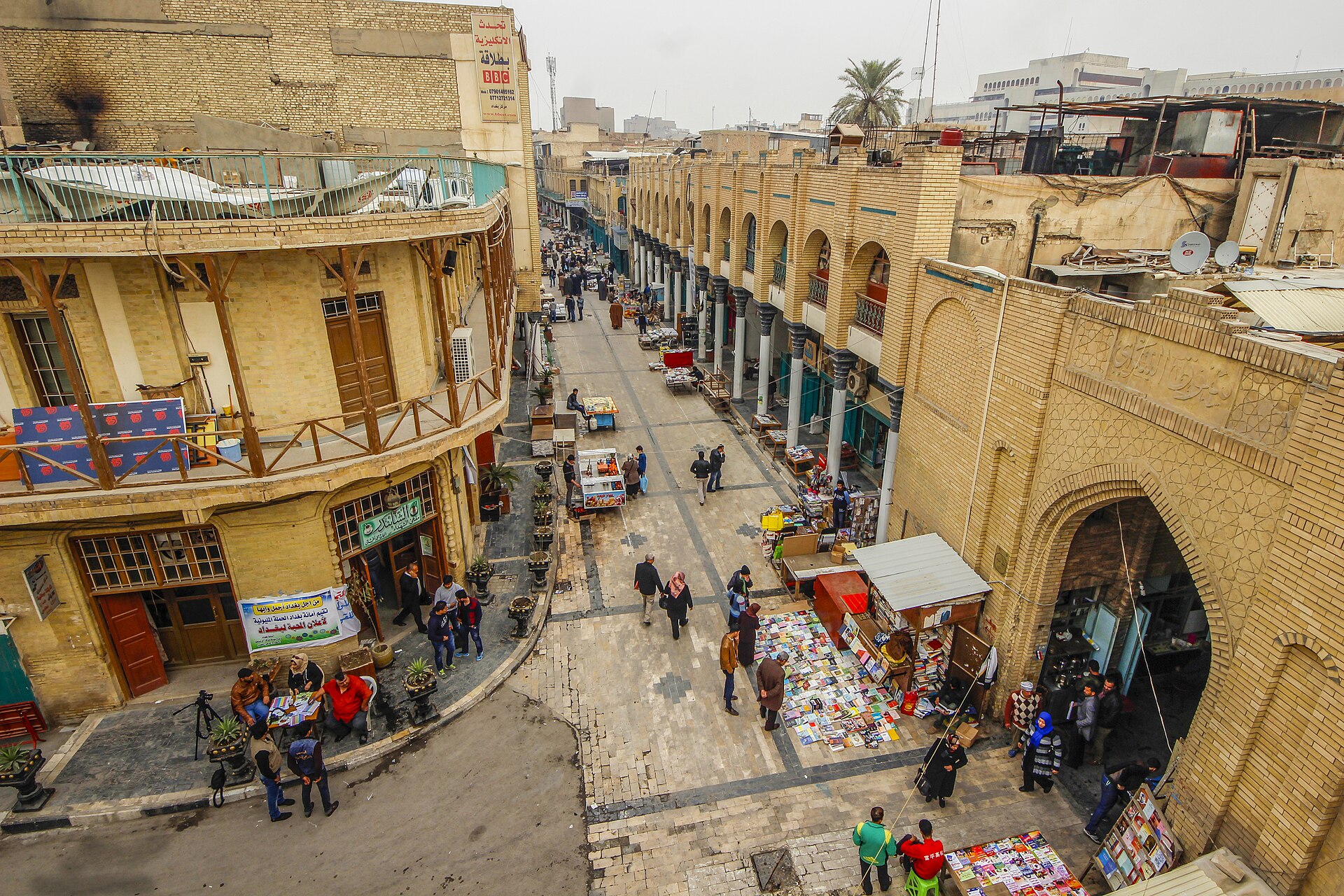
Photo credits
Erbil Citadel, Ahmadi Gate — Osama Shukir Muhammed Amin FRCP(Glasg), CC BY-SA 4.0. Al-Rashid Street, Baghdad — Thegiantofgiants, CC0. Iraqi Airways Airbus A321 at Erbil International Airport — Jeffrey Beall, CC BY-SA 2.0. Imam Ali Shrine, Najaf — Goudarz.memar, CC BY-SA 4.0. Shanashil houses, Basra — David Stanley, CC BY 2.0. All images via Wikimedia Commons.