Last updated: August 2026. Re-checked against the FCDO’s 22 July 2026 advice, the KRG visa portal, Erbil airport’s own guide, UNESCO’s citadel project record and Kurdish reporting to 15 August 2026.
Almost every list of things to do in Erbil opens with the citadel and quietly assumes you can walk into it. Erbil really is one of the few cities in Iraq where a visitor can leave a hotel, take a taxi to a 6,000-year-old mound, drink tea in the shade of its walls and be back for lunch without a fixer, a permit or a police escort, and that is why the city carries the whole Kurdistan Region’s tourism reputation. But the two questions that actually decide the trip — can you get inside the citadel, and what is the security and entry position right now — are answered badly or not at all by most of what ranks for this search. Erbil is the gateway to the region covered in our Iraqi Kurdistan travel guide.
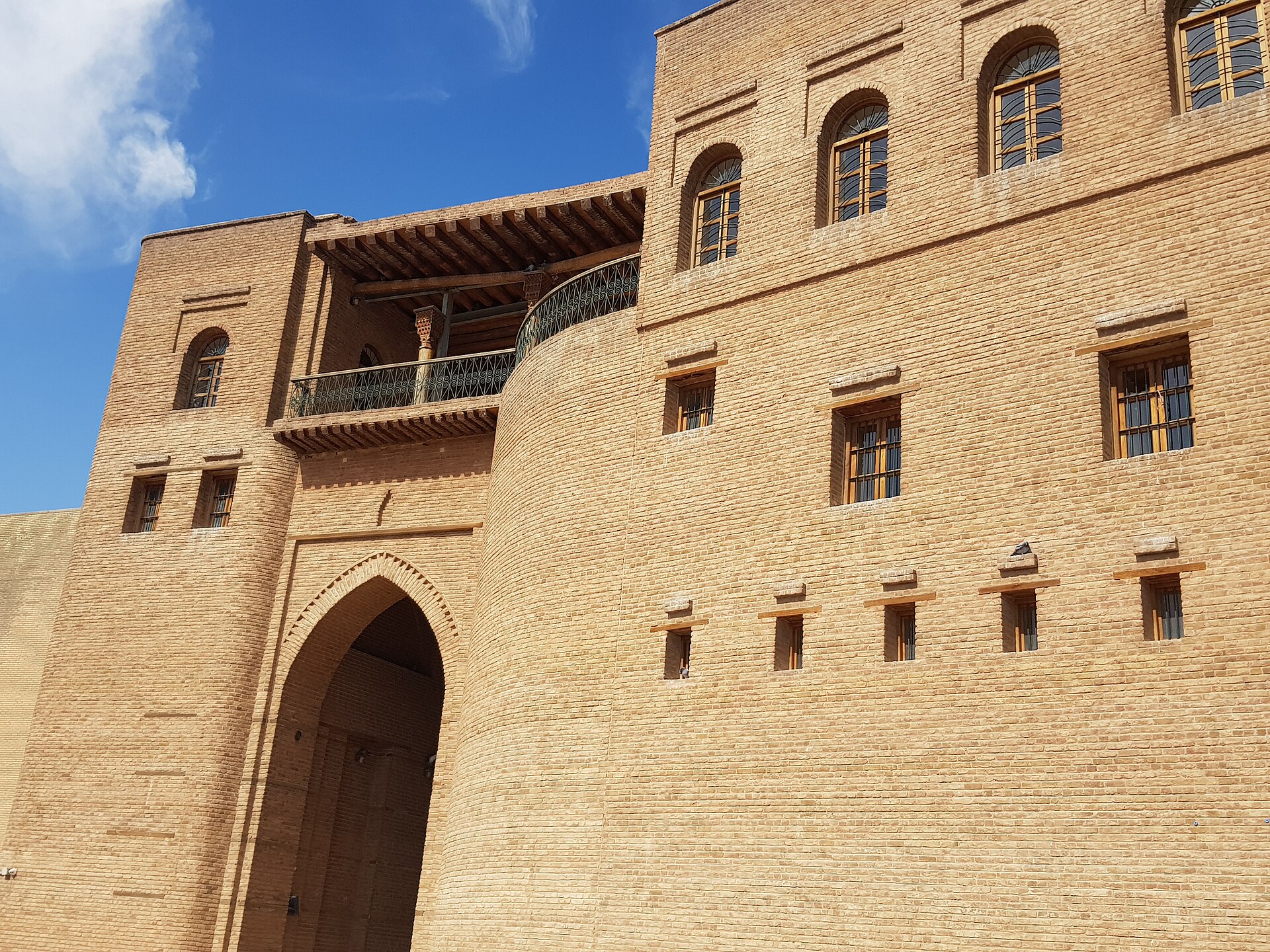
So, directly: the best things to do in Erbil are the citadel mound and its Grand Gate frontage, the rebuilt Qaysari Bazaar underneath it, the fountains of Shar Park, the leaning Choli Minaret in Minare Park, Sami Abdulrahman Park, the Erbil Civilization Museum, the Jalil Khayat Mosque and the bars and churches of Ankawa — with Shaqlawa, Rawanduz and the Hamilton Road within a day’s drive. The catch is the first item on that list. The citadel interior has been closed or only intermittently open through 2025 and 2026 while a restoration runs, and several of the pages that rank for this query still tell you to walk straight in.
This guide covers the sights one by one, with what is sourced and what is not; the day trips, and which governorate each one sits in; the airport and its unusual outer security cordon; taxis, ride-hailing and the ring-road system that everybody misreads; where to stay by district; the Kurdistan-versus-federal visa split; the laws that catch visitors out; and an honest account of the drone attacks and airspace closures of 2026. It ends with a list of the things we could not confirm, because on this subject that list is more useful than a confident guess.
The short answer
If you only read one block, read this one. It answers the questions that decide whether the things to do in Erbil on your list are actually doable this month. Everything in it is expanded below.
| Question | Answer, as of mid-August 2026 |
|---|---|
| Can you go inside the citadel? | Not reliably. Visitors were turned away in June and October 2025, and a June 2026 review reports it locked. The ramparts, Grand Gate and views over Shar Park are the dependable experience. |
| Is the Qaysari Bazaar open? | Yes. It burned on 5 May 2024 and was rebuilt for 5.3bn IQD; the critical second phase finished 6 April 2025 and it is trading. |
| What visa do you need? | The Kurdistan Region issues its own. Visa on arrival still exists at Erbil airport for eligible nationalities; the KRG e-visa costs 100,000 IQD for a 30-day stay. It is not valid in federal Iraq. |
| What does the UK government say? | FCDO advises against all but essential travel to the entire Kurdistan Region (22 July 2026 edition). Travelling against that advice can invalidate your insurance. |
| Is alcohol legal? | Yes, sold and served openly in the Kurdistan Region, Ankawa especially. Do not carry it south — it gets confiscated at checkpoints. |
| Airport taxi to the city? | US$25, cash only, per the airport’s own published guide. Arrive 2.5 hours before departure and expect an outer checkpoint and a shuttle bus. |
| Best months? | March to May and October to November. August averages 42.5 °C. |
Erbil Citadel: what you can actually see in 2026
The citadel is an oval tell rising out of the middle of the city — roughly 430 by 340 metres, somewhere between 102,000 and 110,000 m² depending on whether you take Wikipedia’s figure or the KRG Department of Media and Information’s. Its height above the surrounding streets is reported as anything from 25 to 32 metres by the same writer four months apart, which tells you something about the state of published data here. It was inscribed on the UNESCO World Heritage list on 21 June 2014 as site 1437.
Here is the thing page one gets wrong. Since the 2007 restoration programme began, all but one family were moved off the mound, and large parts of the interior have been fenced off because the walls and infrastructure are unstable. Through 2025 and 2026 the interior access has been on and off. A visitor turned up on 5 June 2025 and was told it was closed for renovation — the guard said “two months, maybe” — with scaffolding visible; the same traveller was turned away again on 17 October 2025. A TripAdvisor review dated 4 June 2026 describes it as locked. Meanwhile Wikipedia’s infobox still says “Open to the public,” and at least one popular guide states outright that it is “free to enter and roam around inside.”
What is definitely happening is a restoration. UNESCO and the High Commission for Erbil Citadel Revitalization signed a project called “Reviving the World Heritage Site of Erbil Citadel” on 14 October 2025, worth US$9,836,782 and running to 31 October 2029. It was launched on the ground on 3 May 2026. A UNESCO feature dated 21 July 2026 and updated on the 27th still describes work as being about to begin, so as of late July 2026 the physical conservation had not visibly started. Separately, the KRG said in August 2025 that the historic mosque had been restored, that stone paving of the streets was 95% complete, that anti-collapse work and lighting were done, and that a Children’s Museum was in preparation.
So the honest plan: treat the citadel as a live building site with an uncertain front door. Walk the perimeter road below the walls, come up to the Grand Gate on the south side, stand on the frontage looking down over Shar Park — that view at sunset is the single best thing the site gives you and nobody can close it — and ask at the gate on the day. Take note that the Kurdish Textile Museum and the Kurdish Music Museum are both inside the citadel and share its access status; a June 2025 visitor found the Textile Museum shut with nobody able to say when it would reopen. Any page recommending a 1,500 IQD ticket for it is quoting a price from January 2022.
Two claims worth killing while we are here. The citadel is often described as “recognised by UNESCO as the oldest continuously inhabited settlement in the world.” It is not: it was inscribed under criterion (iv) only, for its architectural and urban form, and ICOMOS noted in 2014 that the mound was not then inhabited at all. And the boutique hotel and restaurant announced for the citadel in January 2025, repeated in August 2025 and again in June 2026, have not been built. We cover the site properly — history, gates, the one-family story, and what the restoration actually funds — in our dedicated guide, which publishes the day after this one. For a wider view of Iraq’s inscribed sites, see our roundup of the country’s UNESCO World Heritage sites.
Qaysari Bazaar, and the fire almost nobody mentions
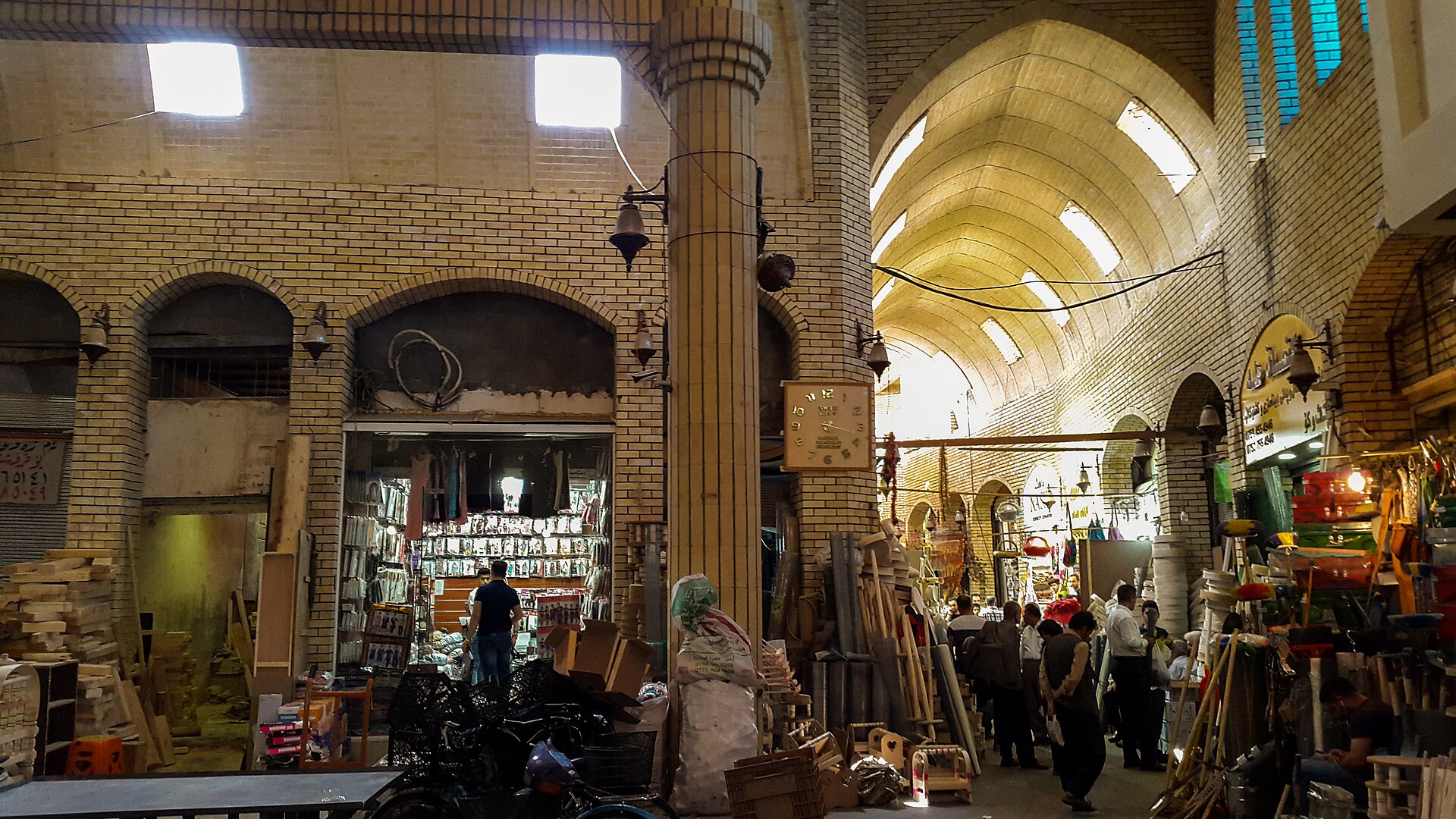
The Qaysari sits directly below and south of the citadel, a warren of covered alleys under corrugated roofing that specialise by product: gold in one lane, fabric in another, honey and dairy along a north–south alley in the north-east corner, spices, copperware, hand-woven rugs, tools, kitchenware, PlayStation games. Money changers work the edges with cash spread on glass cases and will also sell you Saddam-era dinar notes as souvenirs. Around 4,000 shops trade here, per the mayor of Erbil’s central district.
On the night of Sunday 5 May 2024, a large part of it burned. The fire took about three hours to bring under control. Nobody died; 132 people were injured. Gold traders were filmed carrying stock out in bags under armed escort, and arrests for theft followed. The cause has never been publicly established — a committee was formed the same night and no finding was ever published.
You will find two wrong dates in circulation. Kurdistan24’s own retrospective of 6 April 2025 prints “Apr. 5, 2024,” and at least one travel blog says March 2024. Contemporaneous AFP, Middle East Eye, Rudaw and Kurdistan24 reporting all put it on 5 May 2024. The damage figures also depend on who counted and when:
| Figure | What it counts | Source |
|---|---|---|
| More than 370 shops, “10% of the market” | Shops entirely consumed, next-day assessment | Mayor Nabaz Abdulhamid, Kurdistan24, 6 May 2024 |
| Over 200 shops and depots | Shops plus depots | Middle East Eye, 6 May 2024 |
| 227 shops and 7 warehouses | Later official tally | 964media, February 2025 |
| Nearly 250 shops, seven storage units | Later official tally | Kurdistan24, 6 April 2025 |
The rebuild was funded from the Erbil governorate budget at 5.3 billion IQD, roughly US$3.6 million, on the KRG prime minister’s instruction. Work started on 6 June 2024 with two contractors, new CCTV and a civil-defence system. By January 2025, 105 shops were fully restored. On 6 April 2025 the governor announced completion, including the second phase on the ancient core, done — in his words — with sensitivity to the market’s original design. A first-hand visit in October 2025 found it busy with merchants selling spices, textiles, jewellery and sweets. In other words: you are walking into a market that burned down and was put back, and no other English-language guide will tell you that.
The bazaar’s own history has three layers, and the safest formulation uses all of them. There has been a market on this spot since the reign of Muzaffar al-Din Gökböri, who ruled Erbil from 1190 to 1232 and founded the bazaar along with two schools and a mosque. But the two monumental qaisariya buildings still standing inside it — roofed, two-storey, barrel-vaulted, with identical shop units, the eastern one belonging to the tailors — were built in the late 19th century by wealthy long-distance merchant families, and were surveyed and conserved by the Kurdistan Department of Antiquities with TU Berlin and the German Archaeological Institute. If you like markets, our guide to Baghdad’s souks and bazaars covers a very different southern tradition.
Machko Chaikhana
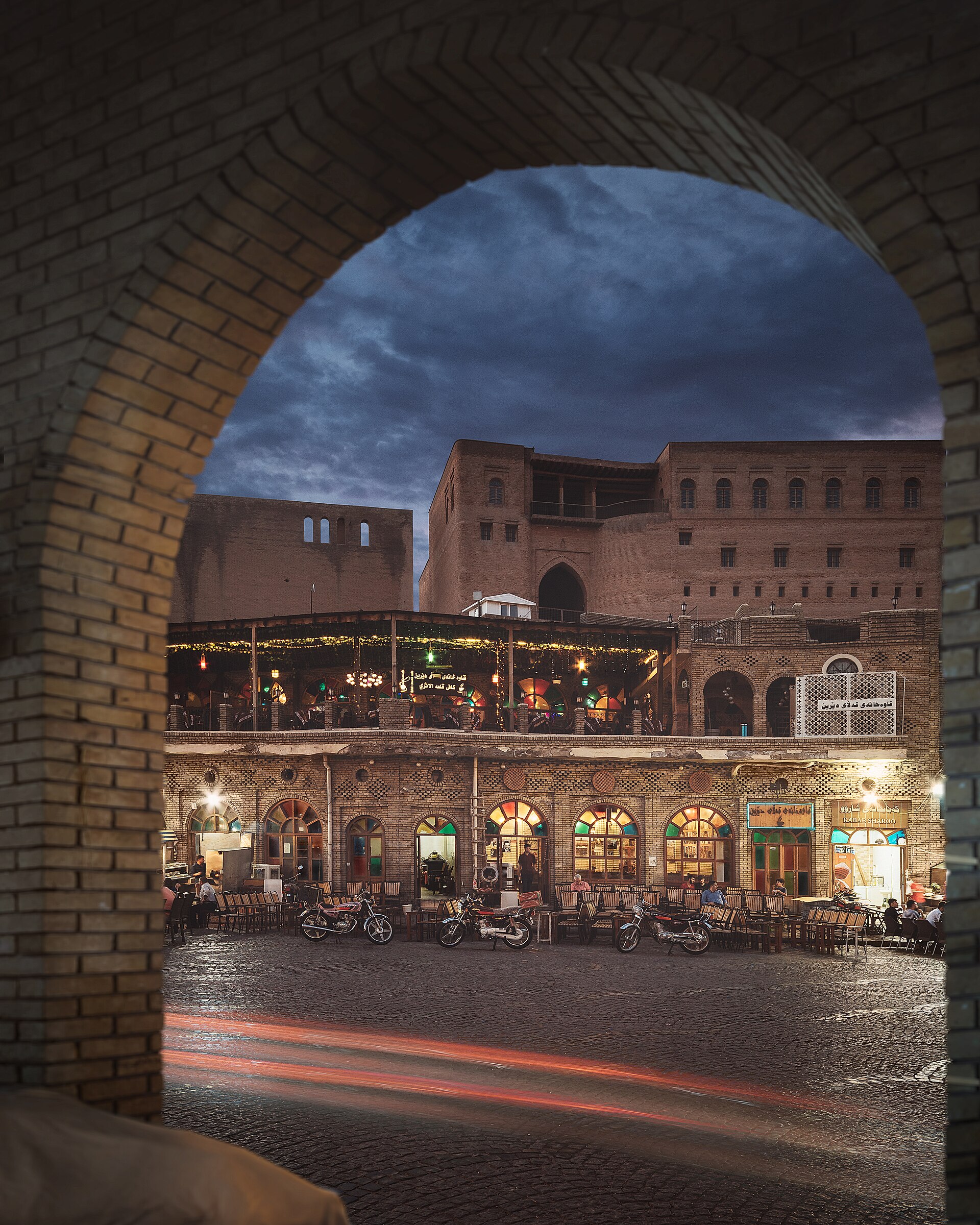
Machko hugs the southern wall of the citadel, at the base of the mound between the fortress and the square, with street tables outside. It opened in 1940 under Muhammed Machko, who ran it until his death in 1962; his elder son took it to 1991, and Mohsin Majeed Machko, born in Erbil in 1956, has had it since. Its claim to fame is that it has never closed — not during the KDP–PUK civil war of the mid-1990s, not in 2014 when Islamic State took Mosul.
The walls are plastered with photographs of writers, musicians and shayirs, alongside Mullah Mustafa Barzani, Qazi Muhammad, Massoud Barzani and Jalal Talabani. Shelves hold books donated by writers and politicians, free to read at the tables, and students and older men do exactly that. It functions as a political salon; France 24 used it as its vox-pop venue during the 2017 independence referendum. Tea arrives in the stemmed istikan glass.
One trap: a widely-syndicated snippet claims “Mam Khalil was opened in 1952” in answer to questions about Machko. Mam Khalil is a different tea house, inside the bazaar itself, its walls covered in vintage photographs. Both are worth an hour. Neither publishes hours or prices, so we are not going to invent any.
Shar Park and Fountain Square
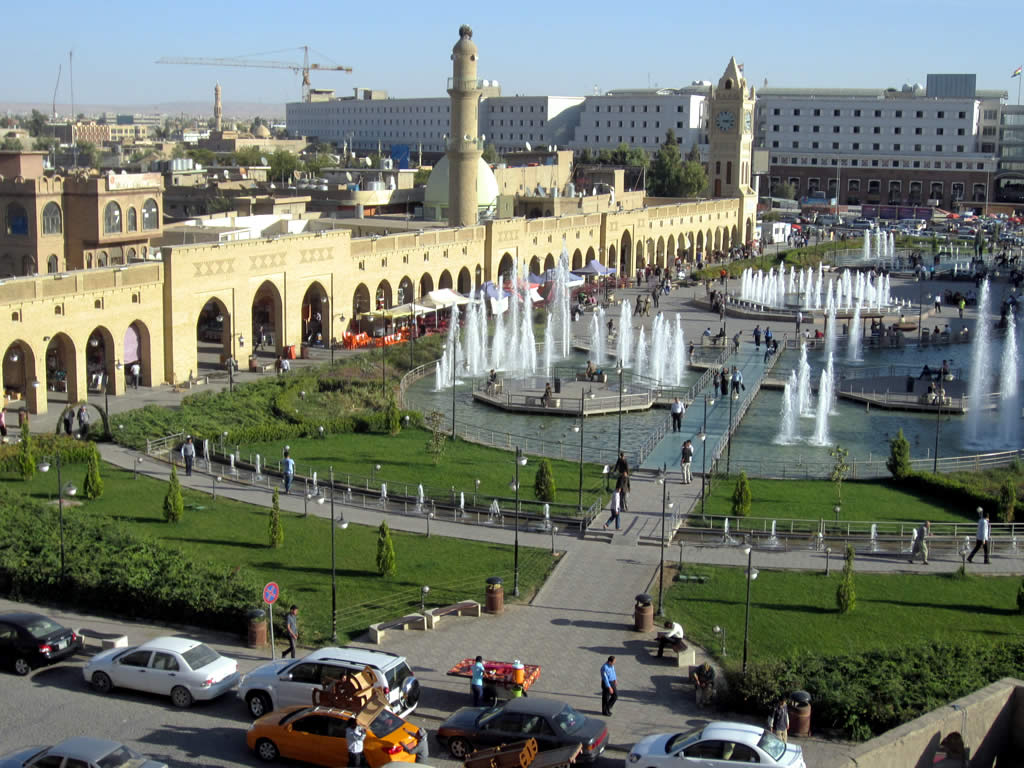
Kurdish speakers call it Baghi Shar, the city garden; it is also called Shar Square, and functionally it is Erbil’s main square. It lies directly below the citadel, between the mound and the bazaar, with Kirkuk Road running alongside. It was built around 2009–2010 as part of a city beautification programme.
What is there: one large central fountain with benches around it, raised boardwalks, a second smaller water display, lawns, a clock tower, tea shops, and the arcade of shops curving round the edge. In the late afternoon and evening, and especially at weekends, this is where Erbil comes — families walking the paths, men over tea and shisha, children throwing crumbs at the pigeons. On the east side near the clock tower a small pavement market sets up in the afternoons selling prayer beads, clothes and antique watches.
Do not confuse it with Rashkin Park, a separate new development in western Erbil near the 120 Metre ring road: a 120,000 m² site with a 5,000-seat “Roman theatre” and what is billed as Iraq’s largest musical fountain, 6,500 m² with jets to 25 metres. Construction began in May 2024 on an 18-month timetable. We could not confirm whether it has opened.
Minare Park and the Choli Minaret
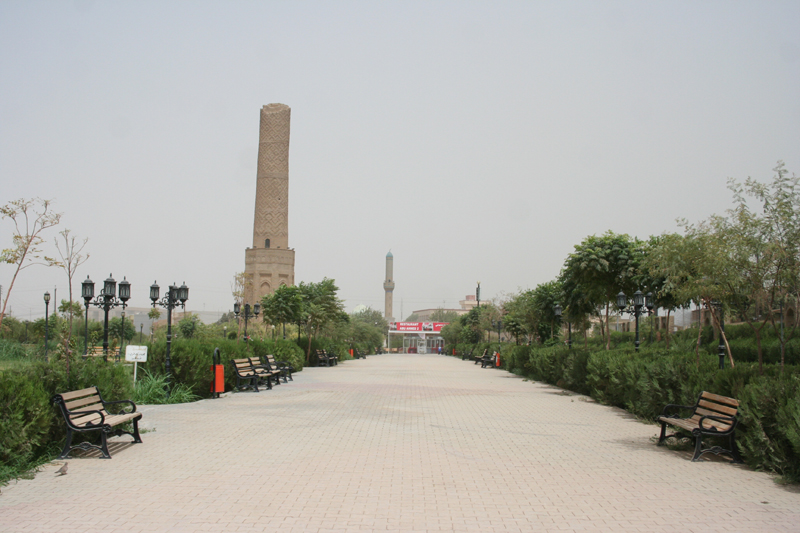
About a kilometre west of the citadel, in the middle of a park, stands a leaning brick minaret with no mosque attached to it. The Mudhafaria Minaret — popularly the Choli Minaret, choli meaning “desolate” or “empty,” because it spent centuries alone in undeveloped ground — is believed to be the only surviving element of the vanished Muzaffariya Mosque. Erbil’s nickname is the City of the Citadel and the Minaret, and this is the minaret.
It was built by the same Gökböri who founded the bazaar, the Turkmen atabeg who submitted to Saladin without a fight and married his sister. Groundbreaking is given as 586 AH (1190/91 CE) and completion as 630 AH (1232/33 CE). The height is reported as 36 metres by Wikipedia and Bradt, broken down by the Kurdistan Chronicle as a 15-metre octagonal base plus a 21-metre shaft; Kurdistan24 and the KRG’s own media department say approximately 37 metres. The shaft was probably taller before a partial collapse, and the second balcony is gone.
Two details make it worth the walk. The lower section starts seven-faceted and becomes eight-sided at the 7-metre mark, probably because it originally abutted the mosque wall. And it has two doors, one west and one east, each opening onto a separate spiral staircase, and the two staircases never meet — a design Kurdistan24 calls exceptionally rare. The base carries two tiers of pointed-arch niches, two on each of its eight faces; the balcony parapet has 24 small niches; the shaft is banded with interlocking diagonal hazarbaf brickwork and Kufic calligraphy naming the builders.
Yes, it leans. Nadir Babakr, Director General of Antiquities and Heritage of Erbil, told Kurdistan24 in August 2025 that there is “absolutely no immediate danger of the minaret collapsing” and that the lean has been stable and unchanged since the previous renovation, nearly two decades ago. A Czech team restored it around 2008 and had completed a fresh structural study by August 2025, with a new programme — fence, CCTV, crack-filling — scheduled to start soon. Whether that work began or finished, we could not find out. The site remains freely accessible.
Minare Park itself is described by the KRG General Board of Tourism as one of the region’s most attractive recreation grounds, sitting opposite Shanidar Park, with toilets, cafés, children’s facilities and parking. No hours, no fee. A 2019 visitor found shaded benches, fountains, a rose garden, a scale model of the citadel and a tethered hot-air balloon that may or may not go up. The park also holds one terminal of a gondola lift running across to Shanidar Park — see below, because that one needs care.
Sami Abdulrahman Park
The big green space west of the centre, on 60 Metre Street opposite the Kurdistan Parliament, is not just a park. Under Saddam Hussein it was the base of the Iraqi Army’s Fifth Corps, and it was the site where Kurds — Peshmerga especially, and anyone the regime considered a critic — were tortured and killed. Kurdistan24 quoted a 70-year-old Peshmerga veteran there in 2021: “I have lost my closest friends in this military base.” The KRG’s tourism board describes the park as built on the site of one of Saddam’s detention centres. It is worth knowing that before you sit down on the grass.
Clearance began in 1998; the first phase finished in 2000 and it opened to the public on 14 March 2000. It is named for Sami Abdulrahman, the KRG deputy prime minister who supervised the project personally and was killed aged 71 in a suicide bombing on 1 February 2004, during Eid al-Adha. Twin bombings hit the KDP and PUK offices that day; the KRG puts the toll at over 100 dead and hundreds injured. The Martyrs Monument stands in the park, inscribed “Freedom is not free,” and the anniversary is marked there every year.
The size is genuinely disputed. The Erbil Governorate says 800,000 m², or 80 hectares, of land reserved from the former military camps. Wikipedia’s infobox says 200 hectares, and Kurdistan24 repeats the same 200-hectare claim in a loose conversion. Both are official or semi-official; they are 2.5 times apart; we are not going to pick one. What is there is not in dispute: two artificial lakes, a rose garden, around 400,000 trees, 18 gardens, four forests, fountains, an open-air cinema, restaurants, a sports centre and stadium, an open-air theatre, playgrounds, the Zaytun Public Library, statues of Kurdish figures including the poet Mastura, a running track, and the Erbil International Fair Ground. Entry is free — the Erbil Governorate says so explicitly, for this park and all the others. About 5,000 people come on an ordinary day and up to 30,000 on a Friday, and the Erbil Marathon finishes here. One honest caveat from a resident: several gas-powered generators run inside the park and can foul the air.
Two more things are planned here — the Kurdistan Region’s largest art gallery and a modern Anfal genocide museum, both announced in July 2026 for this park. No opening date has been published.
The Erbil Civilization Museum, and the hours problem
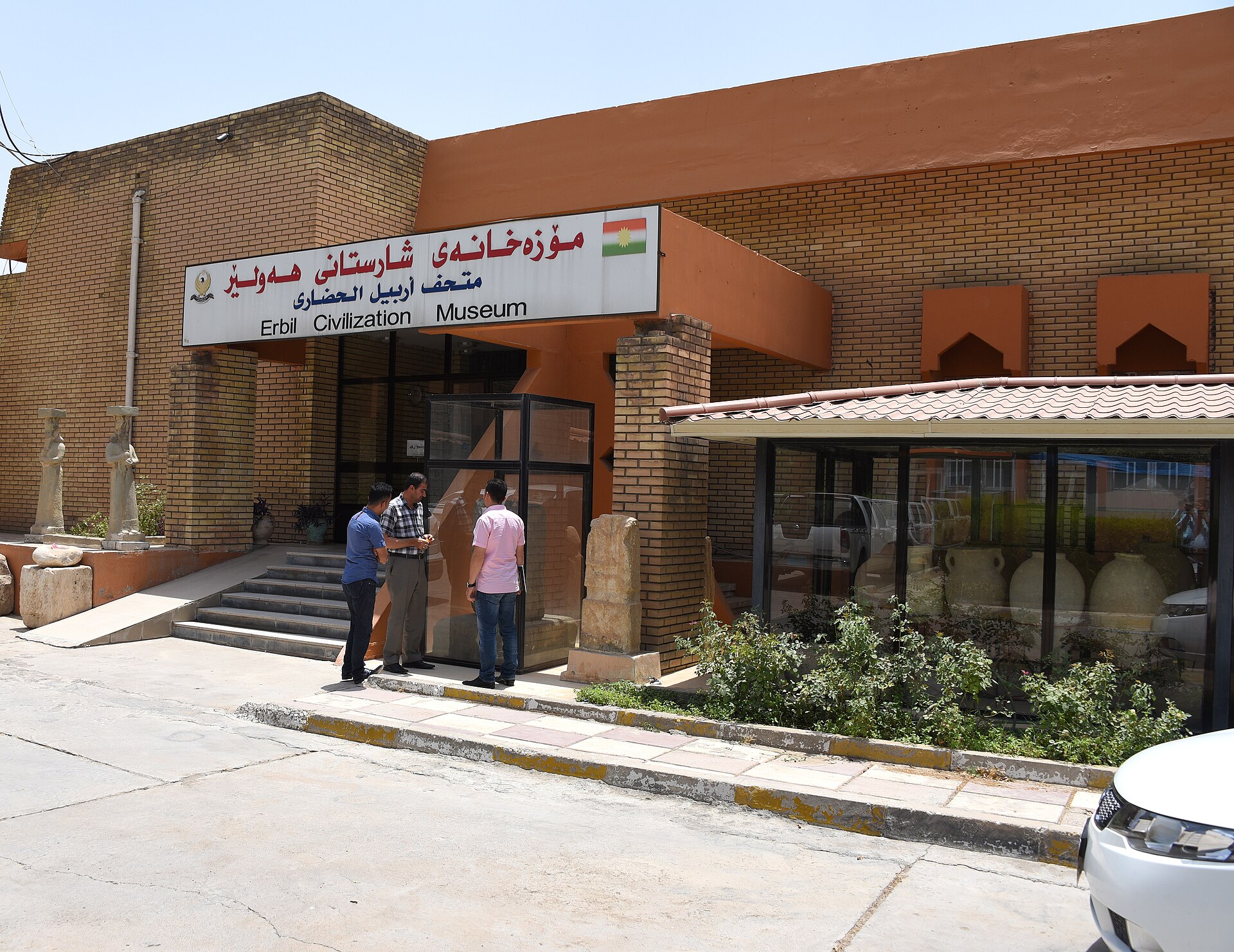
This is the museum every guide skips and the one with the best objects. It is the second-largest in the Kurdistan Region after Sulaymaniyah’s, and it sits in the city centre opposite Erbil City Hall — not, despite the confusion, inside the citadel. It was founded in 1960 in the Minarah district, moved into the citadel in the mid-1970s under Baghdad’s General Directorate of Archaeology with many pieces transferred from the Iraq Museum on permanent loan, and moved into its current building in 1989. Many of its archives were lost after 1990, during the 1991 uprising and the Kurdish civil war, so a lot of objects have no provenance data at all.
Three halls run chronologically. The first covers the Palaeolithic through the early second millennium BC — Jarmo, Halaf, Samarra, Ubaid, Uruk, Eridu, Early Dynastic, Akkadian, Neo-Sumerian. The second is Urartian, Hurrian, Middle and Neo-Assyrian, Seleucid and Hatran, with no Neo-Babylonian material at all. The third is Sassanid and Islamic, mostly Abbasid. Highlights include a Hurrian incense burner from Tell Bazmusian, now drowned under Lake Dukan; a temple foundation cone of Gudea of Lagash; a Halaf pottery jar from 4900–4300 BC; a door socket inscribed for Shu-Sin of Ur; the statue of Sanatruq I from Hatra; a Nimrud ivory plaque of a striding bull; an Esarhaddon cylinder from Fort Shalmaneser; and the Urartian Topzawa Stele from Sidekan. If those names mean something to you, our primer on ancient Mesopotamia sets them in order.
Now the part no competitor prints. There are no official opening hours for this museum. The “Monday to Thursday, 09:00 to 13:00, free entry” you will see repeated across dozens of pages traces to a single uncited sentence on Wikipedia. Wikitravel gives a confidently different figure, “Sunday to Thursday 09:00–14:00.” The KRG’s own tourism page for the museum publishes no hours and no fee whatsoever — it lists “toilets” and “all weather” and nothing else. And no dated report from 2024, 2025 or 2026, from news, the KRG or any traveller, confirms whether it is currently open. There is no closure announcement either. So: do not build a day around it, go early, and treat a locked door as a real possibility. Our wider guide to museums in Iraq has the same problem across the country and says so.
Jalil Khayat Mosque
Erbil’s largest mosque, on 60 Metre Street opposite the Van Royal Hotel, was begun by the businessman Jalil Khayat, who died in 2005, and finished by his sons in his memory in 2007. Architecturally it is a deliberate quotation: sources compare it to the Mosque of Muhammad Ali in Cairo and to Istanbul’s Blue Mosque, and the family’s own construction company describes it as a modern reading of Abbasid and Ottoman forms. The main dome is 48 metres high and 20 metres across, ringed by four half-domes and twelve quarter-domes. Figures of 15,000 m² for the complex and a capacity of 1,500–2,000 rest on a now-dead hobbyist site, so treat them loosely.
Can non-Muslims go in? Yes. A long-term Erbil resident, writing on a page updated in June 2026, reports that the mosque is open to visitors and tourists outside prayer hours, that it was built with visitors in mind, that when they found it locked someone came and opened it and gave them a tour, and that photography was permitted. Parking is free and it is best reached by car, though it is only about a two-kilometre walk from the citadel. Access can still fail — one visitor found it shut up entirely during Eid in August 2019. Go outside prayer times, expect that you may need to find someone with a key, and do not plan it for a festival day. There is no published dress code for this mosque specifically; covered shoulders and knees, a headscarf for women and shoes off is ordinary etiquette rather than a posted rule. Our notes on Iraqi culture and etiquette go further.
Ankawa, and the alcohol question
Ankawa is a predominantly Assyrian Christian district north of the centre, administratively its own municipality, most of its people Chaldean Catholic. Wikipedia says it is eight kilometres north-west of downtown; computed from the published coordinates it is about 4.4 km from the citadel in a straight line and lies almost due north, so the eight-kilometre figure is presumably by road. Its entrance is at Ankawa Road and 100 Metre Road. Population figures disagree too: the 2024 Iraqi census gives the municipality 40,708 people, while a 2018 estimate from the Assyrian Policy Institute put the town at around 60,000, roughly 80% Christian. Nationally, Iraq’s Christian population has fallen from about 1.2 million under Saddam to an estimated 250,000.
The set piece is St Joseph’s Cathedral, Mar Yousif, seat of the Chaldean Catholic Archeparchy of Erbil. Construction began in 1978 on a 1,000 m² site at the entrance to Ankawa, at government expense with volunteer labour from local residents, and it was consecrated in 1981. It is built in what is described as a Babylonian style, with a main gate modelled on the Ishtar Gate. In 2014 it became a shelter for people displaced by Islamic State. Ankawa also holds Tell Qasra, a six-metre mound in the centre of the district registered as an archaeological site in 1945, the Mariamana shrine of Mary which draws Christians and Muslims alike, Mar Gewargis Church and the Mar Yohanna al-Ma’amadan Cathedral. In 2015 the Assyrian Church of the East moved its patriarchal see here from Chicago.
On 6 August 2014, when Islamic State swept the Nineveh Plains, up to 120,000 Christians fled and roughly 75,000 initially converged on Erbil, with Ankawa as the main shelter. Aid to the Church in Need puts the return rate at about 60% by 2024; many never went back and stayed here. Kurdistan24 reported in 2026 that armed groups and security vacuums still block returns to parts of the Nineveh Plains. If you are heading that way, read our pieces on Mosul and on whether Mosul is safe before you commit — and see the visa section below, because that route has a legal problem as well as a security one.
Now the alcohol answer, because it is the thing people quietly want to know. Iraq’s federal parliament banned the import, manufacture and sale of alcohol by amending Law No. 84 of 1935; it surfaced publicly in early 2023 and customs were ordered to enforce the import ban in March 2023. Note what is criminalised — import, manufacture and sale, with fines up to 25 million IQD — and what is not: personal consumption. The Kurdistan Region does not enforce it. The KRG runs its own customs posts on the Turkish border and applies its own rules. Middle East Eye’s 2024 investigation, carried by Shafaq News, found that all alcohol entering Iraq comes through Kurdistan and that Kurdistan is the only part of the country where it is still cheap; in Ankawa, cars queue outside shops stacked with whisky and beer, and the businesses hold regional government approval. Erbil Rotana lists two operating bars on its own 2026 website, so licensed service is normal across the city, not confined to Ankawa.
The asymmetry is the part that catches people. The same reporting says the KRG ignores the sales ban while still applying other parts of the legislation, confiscating alcohol at checkpoints. Buying and drinking in Erbil is fine. Carrying a bottle south towards federal Iraq is not. Our guide to Iraqi checkpoints explains what those stops are actually looking for.
Ankawa is also one of the city’s principal night-time districts. Kurdistan24’s report on New Year 2026 lists the main gathering areas as central Erbil near the citadel, Ankawa, Peshmerga Park, Iskan Street and the Empire and Boulevard areas. We are not going to name bars: every source we found that names Ankawa venues is either blacklisted or unattributable, and bars in this part of the world open and close fast. Walk the main street and look. For contrast, Baghdad after dark works on completely different rules.
Shanidar Park — and the cave it is named after
These are two different places about 100 kilometres apart, and conflating them is a common error.
Shanidar Park is a city park opposite Minare Park, roughly a kilometre west of the citadel. That location is officially attested, because the KRG’s tourism board describes Minare Park as sitting opposite it. Beyond that, the sourcing is thin. The only usable description is a first-hand account from August 2019: open 07:00–23:00, free, two Neanderthal statues at the gate, a lake, cafés and the Shanadar Gallery built in the shape of a cave. That is seven years old. The park is also, oddly, absent from the KRG tourism board’s own directory of Erbil parks and attractions, which lists the zoo, Sami Abdulrahman, Hanara and others. We could not confirm its current hours, fee, area or whether the gallery still operates.
The gondola lift between Minare Park and Shanidar Park is real infrastructure — the towers and cabins appear in photography from 2011 onwards. Whether it runs is another matter. Every dated first-hand account hedges: a 2019 visitor called it the terminal “if it is in operation”; a writer who lived in Erbil from 2022 to 2024, updating in June 2026, says there is a cable car “but I’m not sure if it works.” No KRG, operator or news source confirms current operation, hours or fares, and one popular reference site asserts the link as fact, which is exactly the error to avoid. Treat it as a maybe and look up when you are in the park. It is not the same thing as the Korek Mountain cable car, which does operate.
Shanidar Cave is the Neanderthal site, in the Bradost Mountain in Mergasur district, near the Great Zab and about 640 metres up. Ralph Solecki and a Columbia team excavated it between 1957 and 1961 and found the remains of ten Neanderthals, 35,000 to 65,000 years old, plus two later proto-Neolithic cemeteries. Shanidar 1, “Nandy,” had survived multiple serious injuries, which implies care from others in his group. Shanidar 3, with a rib puncture wound that may be the earliest known evidence of interpersonal violence in the human record, is on display at the Smithsonian in Washington. Several of the others may have been lost during the 2003 invasion, though casts survive.
The famous “flower burial” should be presented as contested rather than settled. Pollen clumps around Shanidar 4, analysed by Arlette Leroi-Gourhan and published in 1975, suggested whole flowering plants had been laid with the body. Sommer attributed the pollen to burrowing Persian jirds in 1999, and Paul Pettitt considers deliberate flower placement convincingly eliminated — while still concluding that the Shanidar burials, spread over many years, represent genuine Neanderthal mortuary practice. A 2023 paper raised the possibility that some pollen was deposited by nesting solitary bees. More recently, Shanidar Z — announced in 2020, a woman in her mid-forties or older, laid in a hand-formed gully — had her face reconstructed by a Cambridge team and revealed on 2 May 2024.
Is the cave visitable? Qualified yes: the KRG General Board of Tourism lists it as a destination, though that page carries a 2015 copyright footer. There is no published distance or drive time from Erbil, no road report, no fee, no hours and no information on whether excavation seasons close it. Do not let anyone sell you a precise itinerary for it without checking first.
Malls, towers and the modern city
Erbil is a ring-road city of about 115 km² with a skyline that has gone up fast, and a lot of local leisure happens in air conditioning. Majidi Mall on Kasnazan Road opened to visitors on 23 November 2009 and calls itself the first and biggest shopping centre in Iraq; its own site is live and current and publishes a working-hours page, which is the one you should check rather than any third party. Family Mall on 100 Metre Road reportedly opened in December 2010 with a Carrefour hypermarket, a food court, a multiplex and well over a hundred shops — but its own website did not respond and every one of those numbers comes from aggregators, so treat them as unverified.
Empire World is the enormous mixed-use development on the western side: five Empire Business Towers, the central one 27 floors and the four around it 23 each; 3,856 apartments across 30 residential buildings from 9 to 31 floors; 300 villas over 565,000 m²; a pedestrian boulevard called Empire Avenue; and the ten-metre, fifty-tonne Welat or “Homeland” statue, carved by the Italian sculptor Mosti Alessandro between 2010 and 2012. A JW Marriott with 207 rooms and 96 serviced apartments is part of the east wing, but we found no opening announcement and cannot tell you it is trading — do not book on our say-so.
Empire World also carries one of the hardest facts in this article. Peshraw Dizayee, its chairman and one of Iraq’s wealthiest businessmen, was killed in the IRGC ballistic missile strike on Erbil on 15 January 2024. Eleven of fifteen missiles hit the city; four civilians died and 17 were injured. That is the kind of thing the glossy city-guide framing tends to leave out.
On hotels: Erbil Rotana on Gulan Street, overlooking Sami Abdulrahman Park and about six kilometres from the airport, publishes 201 rooms, four food and drink venues, a 1,000-guest ballroom, 2pm check-in and no free airport shuttle. It also publishes its security arrangements, which is worth reading before you arrive so it is not a shock: the hotel is surrounded by T-walls, with detection dogs at the entrance and 24-hour surveillance inside and around the building. That is normal at Erbil’s international-brand hotels, not a sign that something is wrong.
Day trips from Erbil
Some of the best things to do in Erbil are not, strictly, in Erbil. The city sits at the edge of the plain with the Zagros behind it, and most of what people love about the Kurdistan Region is within a few hours’ drive. One thing to get straight first: not everything sold as an “Erbil day trip” is in Erbil governorate, and the boundary matters for permits, checkpoints and advisories.
| Destination | Governorate | Note |
|---|---|---|
| Shaqlawa, Salahaddin/Pirmam, Rawanduz, Bekhal, Gali Ali Beg, Korek, Shanidar Cave, Barzan, Balakayati | Erbil | All within Erbil governorate; the Rawanduz group under the Soran Independent Administration |
| Lalish, Khinis (Bavian) reliefs, Akre | Duhok | Different governorate, still inside the Kurdistan Region |
| Jerwan aqueduct | Nineveh | Different governorate and outside KRI administration — federal Iraq |
Shaqlawa is the classic short run: a hill town about 50 kilometres north-east at the foot of Safeen mountain, with waterfalls, orchards and honey stalls, and more than double Erbil’s annual rainfall. Its elevation is given as both 966 and 1,066 metres on the same Wikipedia page, so take your pick. The Pirmam Tunnel has cut journey times towards Shaqlawa and Soran, according to the KRG’s investment board — but no authority publishes a drive time and we are not going to guess one.
Salahaddin, properly Pirmam or Masif Salahaddin, is about 36 kilometres north-east at 1,107 metres. Its appeal is specific and slightly unusual: it is one of the few natural vantage points from which Erbil is actually visible, because almost everything to the south and west is flat. People drive up, park on the hillside and picnic looking back at the city. Wikipedia’s “30–45 minute drive” is uncited.
Rawanduz and its gorge sit 123 kilometres east. A. M. Hamilton, the New Zealand engineer who built the road through here between 1928 and 1932, recorded that the Rawanduz gorge was said to be the finest in Asia. The Hamilton Road itself runs from Erbil through Rawanduz to the Iranian border near Piranshahr and is the drive, rather than a thing you go and look at. Pank Tourist Resort opened nearby in 2007 as the first resort of its kind in Iraq. A tourism master plan approved by the KRG prime minister is now in implementation across Soran, Choman and Rawanduz, with the Kawlokan Corniche under construction as of August 2026.
Gali Ali Beg waterfall, about 130 kilometres north, is the one on the 5,000-dinar note in circulation today — the obverse, with Al-Ukhaidir Fortress on the reverse, across every printing from 2003 to 2023. What almost nobody writes is where the name comes from. Mîr Elî Beg was the Yazidi prince of the Sheikhan principality, executed at this valley at the end of 1833 by Muhammad Pasha of Rawanduz during the Soran Emirate’s genocide of the Yazidis, for refusing to convert. The waterfall is named after a massacre victim. Bekhal waterfall is ten kilometres west of Rawanduz, free and open around the clock.
Korek Mountain has Iraq’s only aerial lift, and unlike the Minare Park cable car this one demonstrably runs: the operator describes a four-kilometre teleferic, built and installed by Doppelmayr, climbing from around 650 metres to a top station at 2,000 metres. The resort opened in 2014 at a cost of US$95 million, has 132 villas, gets between 60 and 100 days of snowfall a year and turns into a ski destination in winter. Do not trust the circulating “95 km from Erbil,” “11:00–20:00” or “12-minute ride” figures — none could be sourced, and the distance conflicts with Bekhal at 135 km near the same bottom station. No ticket price is published anywhere.
Lalish, the holiest Yazidi temple and the tomb of Sheikh Adi ibn Musafir, is in Duhok governorate at about 861 metres among three mountains, with the sacred springs of Zamzam and Kaniya Spî. It has been on Iraq’s UNESCO Tentative List since 2020. The Feast of the Assembly runs 6–13 October and the KRG’s 2026 calendar marks 6–12 October as a holiday for it — avoid those dates unless that is why you are going. We are covering Lalish, Rawanduz and Amedi properly in their own articles later in this series, so this is deliberately brief. And a warning: the barefoot-entry etiquette, the threshold rule and the question of whether non-Yazidis may enter are repeated everywhere and we could not source any of it. Ask a Yazidi authority or a reputable operator before you go.
The Khinis (Bavian) reliefs, also in Duhok governorate, were carved for Sennacherib around 690 BC to celebrate a canal system built to water Nineveh, and were later reused as a hermitage by monks of the Church of the East. The Great Relief there is described in the scholarly literature as the largest single Assyrian sculpture in existence. UNDP-supported work has cleared debris, cleaned the tunnel waterways, installed benches and added solar lighting. Downstream, the Jerwan aqueduct — built of more than two million dressed stones between 703 and 690 BC, and considered by some the oldest aqueduct in the world — sits in Nineveh province, reached by a dust track off the Erbil–Duhok road. In 2025 it was used, controversially, as the set for a Lexus advertisement in which a car was driven along the top; Toyota’s response noted that the site had previously been unguarded. That tells you all you need to know about how protected it is. If ruins are your thing, our roundups of the most beautiful places in Iraq and Iraq’s lesser-known sites will give you more. For the southern equivalent of this section, see day trips from Baghdad.
One current data point worth having: more than 30,000 people visited the Balakayati area of Choman district in July 2026 alone, according to the local tourism directorate, where summer temperatures rarely top 30 °C and snow lingers in the high ground year-round. That is the real shape of Kurdish summer tourism — Iraqis go up into the mountains, not into Erbil city, which is why the city can feel quiet in August. More on the landscape in our guide to nature in Iraq.
Getting to Erbil, and the airport’s outer cordon
Erbil International Airport (EBL/ORER) sits about six to seven kilometres west-north-west of the citadel — several aggregators say north-east, which is simply wrong. The current terminal opened on 5 July 2005 at a cost of US$550 million, on the site of a 1970s military airbase, and the runway is 4,800 by 75 metres, among the longest in the world, with CAT II ILS. It handled 1,862,854 passengers in 2022, third-busiest in Iraq. Rotana’s own site quotes both “10 minutes” and “approximately 15 minutes” for the drive into town, which is a good illustration of how soft even hotel-published numbers are here.
The thing to know, and the thing almost no guide explains properly, is that you cannot drive to the terminal door. Per the airport’s own guide, there is a public car park near the airport entrance holding 500 cars; a shuttle bus runs between the checkpoint by that car park and the passenger terminal, and takes five minutes. So the sequence is: dropped at an outer transport hub, cleared through an initial security check, then shuttled in. The airport advises arriving at least 2.5 hours before departure, and given the double security process that is a floor, not padding. We could not confirm whether the shuttle is free or how often it runs — the airport states neither, and the “every 15 minutes, free” you may see elsewhere is unsourced.
The single most solid price in this entire guide also comes from the airport: the standard taxi fare between Erbil city centre and the airport is US$25, cash only, with a 24/7 service by prior booking or phone and English, Kurdish and Arabic spoken. That figure is published by Erbil International Airport itself.
On airlines, be careful. The published network for EBL includes Aegean, Air Arabia, AJet, Austrian, EgyptAir, Eurowings, Fly Baghdad, flydubai, FlyErbil, Iraqi Airways, Lufthansa, Mahan Air, Middle East Airlines, Pegasus, Qatar Airways, SunExpress and Turkish Airlines — but you must verify with the carrier, because a live EASA advisory is telling European operators to stay out of Iraqi airspace entirely. More on that in the safety section. One piece of history worth clearing up: Baghdad’s ban on international flights to Erbil ran from 29 September 2017 to 14 March 2018 and has not been reimposed, and Turkey’s separate flight ban applied to Sulaymaniyah, not Erbil.
Getting around Erbil
Erbil is radial. The citadel is the centre and the roads ring outward, and there are five completed rings, innermost to outermost: 30 Metre, 40 Metre, 60 Metre, 100 Metre and 120 Metre, with a sixth 150 Metre ring under construction. The number is the road’s width in metres, not its distance from the centre. That sounds obvious once said, but it is misunderstood constantly — the 120 Metre Road is 38 kilometres long and obviously does not sit 120 metres from anything. Because each successive ring was built wider and further out, the number does work as a rough proxy for how far out you are: a hotel “on 100 Metre” is further from the citadel than one “on 60 Metre.” The 120 Metre ring was completed in 2017 with a 110 km/h limit and no traffic lights; a full lap takes about twenty minutes.
Taxis have no meters. The KRG’s tourism board says plainly that taxis are the best way to get around any Kurdistan Region city and that you should negotiate the price before you get in. Its published guidance of 3,000–5,000 IQD for a one-way city fare sits on a page carrying a 2015 copyright footer, so treat the advice as structural and the number as a decade old.
Ride-hailing: Careem’s own Iraq page lists ride-hailing in four Iraqi cities including Erbil, which is the only first-party source we found. One competitor claims Careem is unavailable at the airport; we could not verify that for 2026. Lezzoo is not a taxi app, despite being described as one everywhere — the Erbil-founded company runs food, groceries, pharmacy, courier, e-commerce and wallet products, with no passenger ride-hailing service listed. Uber and Bolt have no evidence of operating anywhere in Iraq, and Baly, which dominates Baghdad, has no confirmed Erbil launch.
There is no public transport worth the name. The KRG’s own tourism board says the Kurdistan Region does not yet have a public bus system and relies on private buses that sometimes have no designated stops. There is no metro, tram or urban rail: four tramways totalling 67 kilometres were designed in 2013–14 at a projected US$2 billion and never built because of budget cuts from Baghdad, and a 25-kilometre light rail circle line was designed and shelved. Say what you like about that, it is at least a clear answer. For intercity travel, the system is garage-based — shared taxis leaving from a garage in each city rather than scheduled coaches. A serious warning attaches: intercity minibuses may make stops in Kirkuk or Mosul, both inside provinces the FCDO advises against all travel to. Our guide to getting around Iraq covers the wider network.
Walking: the citadel, Qaysari Bazaar and Shar Park form a genuinely walkable core, and the Choli Minaret is about a kilometre west. Beyond that, a 115 km² city organised around 38-kilometre ring highways at 110 km/h is car-dependent by geometry. Nobody publishes anything on pavement quality or pedestrian crossings, so we will not pretend to know. Sort a local data connection before you rely on maps — see our Iraq SIM card guide.
Where to stay, by district
Three clusters cover almost every reasonable choice.
The centre, around the citadel and Qaysari Bazaar, is the walkable option and puts you inside the historic core — with the caveat that citadel access is unreliable, so you are buying the square and the bazaar rather than the mound. Gulan Street and the “Golden Zone”, west of the centre near Sami Abdulrahman Park, is where the international-brand hotels sit; “Golden Zone” is Rotana’s own term for it. Ankawa, to the north, is the Christian quarter and the expat, NGO and diplomatic cluster, and where the liquor stores and bars are.
We are not going to publish price bands, and here is why. The only official-looking hotel rates we could find sit on KRG tourism board pages carrying a 2015 copyright footer — a decade out of date, quoting things like a single room at US$75. There is no reliable published price data for Erbil accommodation in 2026. Check a booking site on your dates and treat any blog quoting exact nightly rates with suspicion. For the wider picture see where to stay in Iraq and our Iraq travel cost breakdown.
Visas: Kurdistan and federal Iraq are two different entries
This is the most useful practical thing in the article and it is missing from every page that currently ranks for this keyword.
| Kurdistan Region | Federal Iraq | |
|---|---|---|
| Visa on arrival | Still available at Erbil and Sulaymaniyah airports for List A nationalities | Abolished. No visit visa on arrival |
| How to apply | visit.gov.krd, or on arrival; List B nationalities need a guarantor code and up to 5 working days | Iraqi government e-visa portal, at least 24 hours before travel |
| Cost | 100,000 IQD administrative fee (roughly US$65 at the mid-August 2026 street rate) | US$160 |
| Validity | 90 days from issue to enter; 30-day stay | 60 days |
| Where it is valid | Kurdistan Region only | All of Iraq |
The FCDO puts the restrictive rule in terms: “Both types of visas are valid for travel in KRI only.” A Kurdistan entry stamp does not let you drive south. Several operators and blogs have claimed since January 2025 that a KRI visa permits onward travel into federal Iraq for nationalities eligible for the federal e-visa. No official Iraqi or KRG source confirms this, and there are 2026 reports of travellers being turned back between Erbil and Mosul. We are publishing the restrictive rule and labelling the permissive claim unconfirmed, because being wrong about this strands you at a checkpoint. If you want both halves of the country, sort the federal visa first.
Other entry mechanics: your passport needs six months’ validity beyond arrival and at least one blank page; declare local currency over 200,000 IQD and any currency or goods over US$10,000 on entry or exit. The HIV and hepatitis blood-test requirement that circulates does not apply to visit visas. Full detail is in our Kurdistan visa guide, with the federal side covered in the Iraq e-visa guide, visa on arrival and the general entry requirements.
Safety, advisories and the 2026 escalation
Erbil is the safest place to be a tourist in Iraq and it has still been attacked repeatedly in the past two years. Both of those are true, and any page that only tells you one of them is selling something.
What the advisories say. The FCDO advises against all but essential travel to the entire Kurdistan Region of Iraq. That is the complete entry as of the 22 July 2026 edition — two lines, no exceptions. Earlier editions carved out parts of the Region at a higher risk level and carved out the Ibrahim Khalil crossing; those carve-outs have been deleted, and if you find them on a travel page, that page is out of date. The FCDO also names Rawanduz and Koya specifically as areas where Iranian strikes on Kurdish opposition groups have continued. The US State Department has Iraq at Level 4, Do Not Travel, reissued 2 March 2026, on which date it also ordered non-emergency US government employees to leave the country. The practical consequence most pages bury: travelling against your government’s advice can invalidate your travel insurance. That is worth understanding properly before you book — see our guide to Iraq travel insurance and our summary of the current Iraq travel advisories.
What actually happened. On 15 January 2024 an IRGC ballistic missile strike hit Erbil: eleven of fifteen missiles landed in the city, four civilians were killed and 17 injured. In June 2025 all Iraqi and Kurdish airports closed for what Rudaw called a ten-day and Kurdistan24 a twelve-day shutdown. Iraq closed its entire airspace from 28 February to 8 April 2026 — 38 days, extended ten times — and again for 72 hours in June 2026. Since 8 July 2026 there have been strikes and retaliatory attacks by Iran across the region, including in Iraq and the Kurdistan Region, against US military and civilian infrastructure. Through July 2026 coalition air defences repeatedly intercepted explosive drones over Erbil, launched from the outskirts of Mosul by armed groups outside KRG control.
The most recent sequence, and please read the date on it. On 21 July 2026 six drones were intercepted over Erbil and airport operations were suspended for about an hour. On 24 July all flights to Erbil, Baghdad and Basra were suspended. On 8 August the airspace reopened; Qatar Airways resumed with the first Doha–Erbil flight landing at 13:30, and seven commercial flights landed at Erbil between 05:00 and 11:25. On 14 August, between 02:17 and 02:25, three explosive drones were intercepted over the city. Rudaw counted 19 drone and missile attacks on the Kurdistan Region in the first two weeks of August 2026; the prime minister has said more than a thousand drones have been launched at the Region since the conflict began. All of this was current on 15 August 2026 and none of it will be current when you read it. Check before you fly.
The aviation picture, which is separate from the security picture. As of mid-August 2026, EASA’s Iraq bulletin CZIB-2026-05 advised operators not to enter the Baghdad flight information region at any altitude, valid to 31 August 2026. France had a NOTAM in force to 26 August and Italy one to 5 September. Most usefully for anyone flying into Erbil specifically: Iraq’s own NOTAM ORBB A0279/26, running to 4 October 2026, warns of GPS jamming and spoofing in northern Iraq — which is exactly the Erbil area, and which no travel blog will tell you. US operators are barred below FL320 under SFAR 77 to October 2027. The upshot: the airport is open and the KRG says the airspace is open, but European carriers’ Erbil services sit under a live regulatory advisory. Do not treat a Lufthansa or Austrian booking as settled without checking, and never book a same-day onward connection out of Iraq.
Day-to-day, none of this is what a visitor experiences. A resident writing from Erbil in March 2026 described an unusual heavy calm in which you get used to sleeping through distant drone noise while daily life continues. City-centre tourism was carrying on normally in mid-August 2026. The honest framing is that the risk here is not street crime and not, on any ordinary day, terrorism — it is that a regional conflict can shut the sky over your head with a few hours’ notice and strand you. Build slack into the itinerary. Our fuller treatment is in is Kurdistan safe? and, for the country as a whole, is Iraq safe?.
One more geographic point. The Erbil–Kirkuk and Erbil–Mosul roads cross into provinces the FCDO advises against all travel to — Kirkuk and Ninawa respectively. Combine that with the visa rule above and an overland run from Erbil to Mosul is both an advisory problem and a legal-status problem. The same applies to the shorter Erbil–Sulaymaniyah routing via Kirkuk; the alternative via Dukan and Koya avoids Kirkuk province but passes through an area the FCDO names for continuing strikes. There is no clean option, only a trade-off, and no source we found establishes which route drivers actually use or whether foreigners get turned back on the Kirkuk road.
Laws worth reading before you fly
Kurdistan feels relaxed compared with much of the region and it is still Iraq legally, with some provisions that will surprise European and North American visitors.
The July 2024 amendment to Iraq’s Anti-Prostitution and Homosexuality Law applies here. If the authorities consider your actions, clothing or possessions to promote LGBT+ identities or prostitution, the penalty is up to seven years’ imprisonment and a fine of 10 to 15 million Iraqi dinars. Same-sex relationships carry 10 to 15 years. That is the law as the FCDO states it, and LGBT+ travellers should factor it into the decision rather than discover it on arrival.
Drones are effectively contraband. The KRG prohibits sharing footage of drone launches or target locations with media or on social media, and violations may result in legal action. Practical guidance from people on the ground is blunter: bringing a drone into the Region risks detention. Given the events described above, this should not need explaining.
Carrying photo ID is a legal requirement in Iraq. If you lose your passport you must report it to the police and then publish the details in two local newspapers, and you may be refused an exit stamp until you have. On alcohol, see the Ankawa section: buy and drink in the Region, do not carry it south. On antiquities, the federal position is severe — Iraqi law allows the death penalty for intentional export of antiquities, and a British geologist received a 15-year sentence for fragments picked up on a tour. Do not pick anything up off the ground at an archaeological site. Our guide to Iraqi laws for tourists goes through the rest.
On dress: there is no sourced Kurdistan-specific dress rule for men or women, and we are not going to invent one. What residents describe is that most people wear long trousers rather than shorts, and that women do not need to cover their hair or ankles — unlike parts of federal Iraq. During Ramadan, clothing that does not meet local norms causes more offence than at other times. Closed shoes in the bazaar are a good idea; the floor gets wet and dirty. Solo female travellers generally report Erbil as the easiest city in the country.
When to go
The headline is heat. These are the 2012–2023 normals for Erbil; note that they come from a modelled reanalysis dataset rather than a national meteorological service, because no Iraqi Meteorological Organisation station normals for Erbil could be found.
| Month | Mean daily max °C | Mean daily min °C |
|---|---|---|
| January | 13.2 | 2.9 |
| April | 25.5 | 11.4 |
| June | 38.9 | 22.9 |
| July | 42.4 | 26.5 |
| August | 42.5 | 25.9 |
| October | 30.1 | 16.0 |
| December | 15.4 | 5.1 |
March to May and October to November are the comfortable windows. Summer in the city is brutal — four Iraqi governorates hit 50 °C on 15 August 2026, so do not assume the heat breaks in mid-August — and the local response is to leave: Iraqis go up to Balakayati, Korek and Shaqlawa, where it rarely tops 30 °C. Rain falls between November and May and essentially not at all from June to September; annual precipitation is about 420 mm. A downpour on 17 December 2021 caused flash floods that killed 14 people, so winter is mild rather than trivial. Erbil gets around 62 rainy days and about one snowy day a year, while Korek gets 60 to 100 days of snowfall and runs as a ski resort from December to March. Our best time to visit Iraq guide compares the regions.
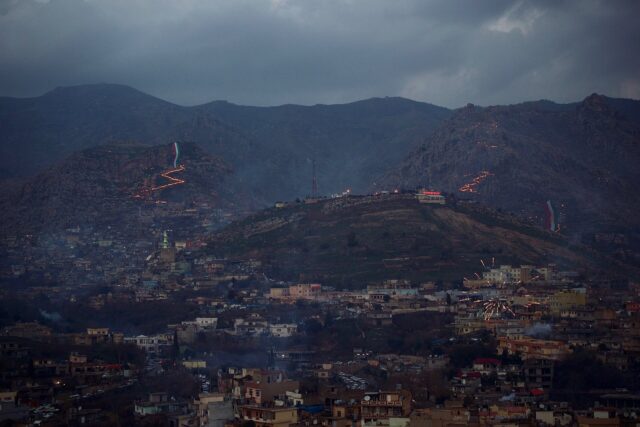
Newroz is 21–23 March and is a three-day national holiday in the Kurdistan Region, not a single day. There is a quirk in 2026 worth knowing about if you are planning a return trip: Eid al-Fitr fell on 20–22 March 2026, which made 20–23 March effectively a continuous four-day public holiday — peak domestic travel, full hotels, closed offices. The flagship Newroz spectacle is at Akre in Duhok governorate, where torch-carrying processions climb the hillsides at dusk and bonfires are lit; it is not in Erbil. Other dates that cluster in the same window: 11 March, Liberation of Erbil; 16 March, Halabja Day; 20 March, anniversary of the 1991 uprising; 21 March, Liberation of Kirkuk.
A two-day plan for things to do in Erbil
Two days does the city, three does it without hurrying. This is the order that works, and it is built around the fact that the afternoons are hot and the square is best at dusk.
Day one, on foot. Start early at the citadel: walk the perimeter road under the walls, come up to the Grand Gate, and see whether the interior is open before you plan anything around it. Drop down into the Qaysari Bazaar while the gold and fabric alleys are still cool, and let yourself get lost — the honey and dairy alley in the north-east corner is worth finding. Break for tea at Machko against the citadel’s southern wall, or at Mam Khalil inside the bazaar. Retreat somewhere air-conditioned in the worst of the afternoon, then come back out to Shar Park around five, when the fountains are running and half the city is out. Finish with the pavement market by the clock tower.
Day two, by taxi. Take the kilometre west to Minare Park for the Choli Minaret in the morning light; if the museum is your priority, do the Erbil Civilization Museum first thing instead, because a locked door costs you less at 09:00. Then the Jalil Khayat Mosque on 60 Metre Street, outside prayer times. Sami Abdulrahman Park in the late afternoon for the lakes, the Martyrs Monument and the reason the place exists. Dinner in Ankawa, which is also the answer if you want a drink.
If you have a third day, get out of the city. Shaqlawa or Salahaddin for a short run and cooler air; the Rawanduz gorge, Gali Ali Beg and Korek for a long one. Agree the car and the price the night before, and remember nobody publishes a reliable drive time for any of it. Guided options are covered in our notes on Iraq tours, and photographers should read our photography spots guide before pointing a lens at anything official.
How many people visit Erbil? The official numbers disagree
This matters because “Erbil received X million tourists” is quoted constantly, and the figures do not reconcile — including two figures from the same press conference on the same evening.
| Figure | What it claims to measure | Source and date |
|---|---|---|
| More than 3.4 million | Erbil arrivals, full year 2025 | Governor Omed Khoshnaw citing the KRG Tourism Board, via Kurdistan24, 1 Jan 2026 |
| More than 1.5 million | Erbil visitors, full year 2025 | Shafaq, reporting the same press conference, 31 Dec 2025 |
| Over 8 million | Kurdistan Region tourists, 2024 | Kurdistan Board of Investment, 12 May 2025 |
| 700,000 in 2015 | Kurdistan Region baseline for the above | Kurdistan Board of Investment, 12 May 2025 |
| Roughly 2.2 million in 2015 | Kurdistan Region, same year | KRG Board of Tourism’s own 2007–2023 chart |
Two outlets, one podium, a 2.3-times gap on Erbil in 2025. Two KRG bodies, two numbers for 2015, roughly three times apart. The explanation is almost certainly that “tourist” is not defined consistently — arrivals against visits against domestic day-trippers — and that domestic tourism, which is the largest segment by everyone’s account, is counted differently by different offices. No numeric domestic-versus-foreign split is published anywhere. The safe formulation is that official KRG figures put Erbil’s 2025 arrivals somewhere between 1.5 and 3.4 million depending on the outlet, and to be suspicious of anyone quoting a single confident number.
What is solidly sourced is the money. Tourism took US$7.68 billion of the US$22 billion-plus invested in the Kurdistan Region over seven years — about 35% of all investment. The tourism minister reported in June 2026 that more than 80 strategic tourism projects had been completed, that there are over 3,000 tourism facilities region-wide, and that more than 20,000 jobs had been created, 80% of them local. The “Visit Kurdistan” campaign launched by the prime minister on 11 June 2025 targets more than 20 million tourists by 2035. And Condé Nast Traveler named Erbil one of the Best Places to Go in Asia in 2026, describing the city as “a calm spot in a volatile region.” You will see that reported as Erbil being ranked number one in Asia; that is the KRG’s framing of the listing, and we could not verify a ranking against the magazine itself, so we are not repeating it.
Looking forward, the projects worth watching are a ten-kilometre cable car with ten stations at Soran, expected in 2027, which would dwarf Korek’s four kilometres; the Araban Cultural District in the citadel buffer zone, announced July 2026 with no opening date; the Erbil Green Belt Project launched in October 2025; and the art gallery and Anfal museum planned for Sami Abdulrahman Park.
What we could not confirm
This list is the point of the article as much as anything above it. Every item here is repeated confidently somewhere on page one, and none of it could be sourced.
- Whether the Erbil Civilization Museum is currently open, and its hours. The “Mon–Thu 09:00–13:00, free” traces to an uncited Wikipedia sentence; Wikitravel gives a different figure; the KRG publishes neither.
- Whether the Minare Park to Shanidar Park cable car operates, and any hours or fare for it. The infrastructure exists. Two dated first-hand accounts, from 2019 and 2026, both say the writer does not know whether it runs.
- Whether the airport shuttle is free, and how often it runs. The airport’s own guide states neither.
- Which of the airlines listed for Erbil are genuinely operating in August 2026, given the live EASA advisory. Verify with the carrier.
- Any intercity drive time in the Kurdistan Region. The only official distance published anywhere is the KRG’s 198 km for Erbil to Sulaymaniyah, and it does not specify a route. No published drive time exists for any city pair here. Anyone giving you one to the minute is guessing.
- Whether Careem operates at Erbil airport, and whether Baly has launched in Erbil at all.
- Shar Park’s area, cost and hours, and Sami Abdulrahman Park’s opening hours — no figure of any kind exists in any reachable source, official or otherwise.
- Whether the 2025 Czech-led Choli Minaret restoration began or finished. Announced in August 2025 as “scheduled to soon” start; no follow-up found.
- Korek Mountain’s distance from Erbil, its hours, ride duration and ticket price; the widely-copied “95 km” conflicts with a sourced 135 km for nearby Bekhal.
- Lalish visitor etiquette — the barefoot rule, thresholds, whether non-Yazidis may enter, any dress code, and the distance from Erbil.
- Whether the JW Marriott at Empire World has opened, whether Rashkin Park has opened, and whether any new mall, hotel or tower opened in Erbil in 2025–26 at all. No published data was found, which is itself informative.
- Any reliable 2026 hotel price data for Erbil. The only official-looking rates carry a 2015 copyright footer.
- That Condé Nast Traveler ranked Erbil first in Asia. The listing is confirmed; the ranking is the KRG’s framing.
Frequently asked questions
Is Erbil worth visiting?
If you want a Middle Eastern city that is genuinely walkable at its core, has a 6,000-year-old mound in the middle of it, sells alcohol openly and can be reached without a fixer, yes. If your trip depends on going inside the citadel, the answer is more complicated, because that has been unreliable since 2025. Most visitors find two or three days in the city plus a mountain day trip is the right shape.
What are the best things to do in Erbil in one day?
Start at the citadel’s Grand Gate and walk the perimeter and the frontage, drop down into the Qaysari Bazaar for an hour, take tea at Machko or Mam Khalil, cross into Shar Park in the late afternoon when the fountains and the families come out, and finish with the Choli Minaret a kilometre west in Minare Park. That is a full day on foot, and it is the core of the city.
Do I need a visa for Erbil, and does it work for Baghdad?
You need a Kurdistan Region visa, available on arrival at Erbil airport for eligible nationalities or online at 100,000 IQD for a 30-day stay. It is valid in the Kurdistan Region only. A separate federal Iraqi e-visa, US$160 for 60 days, is required for the rest of the country and must be applied for at least 24 hours before you travel. Do not assume a Kurdistan stamp gets you to Baghdad.
Can you go inside the Erbil Citadel right now?
Probably not, and certainly not reliably. Visitors were turned away in June and October 2025 and a June 2026 review reports it locked, while a UNESCO-backed restoration runs to 2029. The ramparts, the Grand Gate frontage and the view down over Shar Park are the dependable part. Ask at the gate on the day.
Is alcohol available in Erbil?
Yes. The 2023 federal ban on import, manufacture and sale is not enforced in the Kurdistan Region, which runs its own customs posts. Liquor shops and bars are normal, concentrated in Ankawa but not confined to it, and international hotels operate bars. Do not carry alcohol towards federal Iraq — it gets confiscated at checkpoints.
How do I get from Erbil airport to the city?
Airport taxis charge a standard US$25 to the city centre, cash only, per the airport’s own guide. Expect an outer security cordon: private cars stop at a checkpoint by a 500-space public car park and a shuttle bus covers the last five minutes to the terminal. Allow 2.5 hours before departure on the way out.
How many days do you need in Erbil?
Two days covers the city properly, three if you want the museums and Ankawa without rushing. Add a day for Shaqlawa or Salahaddin, and a longer day for the Rawanduz gorge, Gali Ali Beg and Korek. If Erbil is part of a wider trip, our Iraq itinerary ideas will help you slot it in.
Is Erbil expensive?
Not by regional standards, but we cannot give you honest numbers. The only published hotel rates for the city are a decade old, and the one price we can stand behind is the airport’s US$25 taxi fare. Taxi fares within the city are negotiated, not metered, so agree them before you get in.
Which other Iraqi cities pair well with Erbil?
Within the Kurdistan Region, Sulaymaniyah and Duhok are the obvious pairings and both are reachable by shared taxi. Going south is a bigger decision because of the visa and advisory position. Our roundup of Iraq’s cities and of things to do in Iraq covers the options.
Final thoughts
The reason to write another guide to Erbil is not that the city is under-covered. It is that the coverage has aged badly in a place where a year is a long time. A market burned down and was rebuilt and the guides did not notice. A citadel closed and half the guides still say walk in. A visa regime split in two and almost nobody explains what that means at a checkpoint outside Mosul. The city itself is easy; the information about it is not. The things to do in Erbil have not changed much in a decade — what has changed is whether you can get into them.
So go with the plan loosely held. Assume the citadel interior is shut and be pleased if it is not. Assume the museum might be locked. Assume your flight could move, because a lot of them did in 2026, and do not book anything that depends on landing on a particular morning. Then spend the time you save sitting on the square in the late afternoon watching a city that has spent forty years being described in terms of what has happened to it get on with an ordinary evening.
This article opens our coverage of the region, and the place to go next is the pillar guide to Iraqi Kurdistan, which sets Erbil in the wider context of Sulaymaniyah, Duhok and the mountains. If you are still deciding whether to come at all, read is Iraq open to tourists? alongside our main Iraq travel guide, and pack accordingly with the Iraq packing list. Related reading: Erbil Citadel: Visiting the 6,000-Year-Old City. Related reading: Sulaymaniyah Travel Guide.
Photo credits
Erbil Citadel Grand Gate — Sima awat (CC BY-SA 4.0). Qaysari Bazaar interior — Lamacchiacosta (CC BY-SA 4.0). Shar Park and Fountain Square — David Stanley (CC BY 2.0). Mudhafaria (Choli) Minaret, Minare Park — Joao Leitao (CC BY-SA 3.0). Teahouses below the citadel wall — Harem sewaisi (CC BY-SA 4.0). Erbil Civilization Museum — Osama Shukir Muhammed Amin FRCP(Glasg) (CC BY-SA 4.0). All images via Wikimedia Commons.