Last updated: September 2026. Travel advice re-checked on 25 and 26 September 2026 against the FCDO’s Iraq pages and the US State Department’s 29 August 2026 reissue; site history checked against published excavation summaries, and access details against Iraqi press reports from 2026.
Most people have met Uruk before without knowing it. It is the Erech of the Book of Genesis, the city whose walls Gilgamesh was said to have raised, and one possible root of the word Iraq. Of all the places in our guide to Iraq’s ancient Mesopotamian sites, it has the biggest claim and the plainest ruins: a spread of pale mounds in the Muthanna desert, a weathered ziggurat, and ground scattered with broken pottery from four thousand years of occupation.
Uruk, now called Warka, was the largest city in the world around 3100 BC, home to perhaps 50,000 people, and it has yielded some of the earliest writing ever found. It is an open archaeological site in Muthanna province, southern Iraq, part of a UNESCO World Heritage property since 2016, and foreign visitors have started coming back.
This page covers what Uruk was and why the “first city” label is argued over, what is visible on the ground today, where its famous finds ended up, how a visit works from Samawah, the travel advice for Muthanna as of late September 2026, and the questions we could not get answered.
The short answer
| Question | Answer |
|---|---|
| Where is it? | Warka, in Muthanna province, southern Iraq, east of the modern Euphrates on a long-dried river channel; 93 km north-west of Ur in a straight line |
| What was it? | A Sumerian city lived in for more than four thousand years, and the largest urban centre on earth around 3100 BC |
| UNESCO status | World Heritage since 2016, as one of seven components of the Ahwar of Southern Iraq |
| Can you visit? | Yes. More than 1,000 foreign visitors were reported in the months before May 2026, and there is now a visitor path, signage in three languages, a rest area and a permanent antiquities police post |
| Fee and opening hours | Not published anywhere we could find |
| UK advice | FCDO: against all but essential travel to Al-Muthanna (unchanged as of 25 September 2026) |
| US advice | Level 4, Do Not Travel, for all of Iraq (reissued 29 August 2026) |
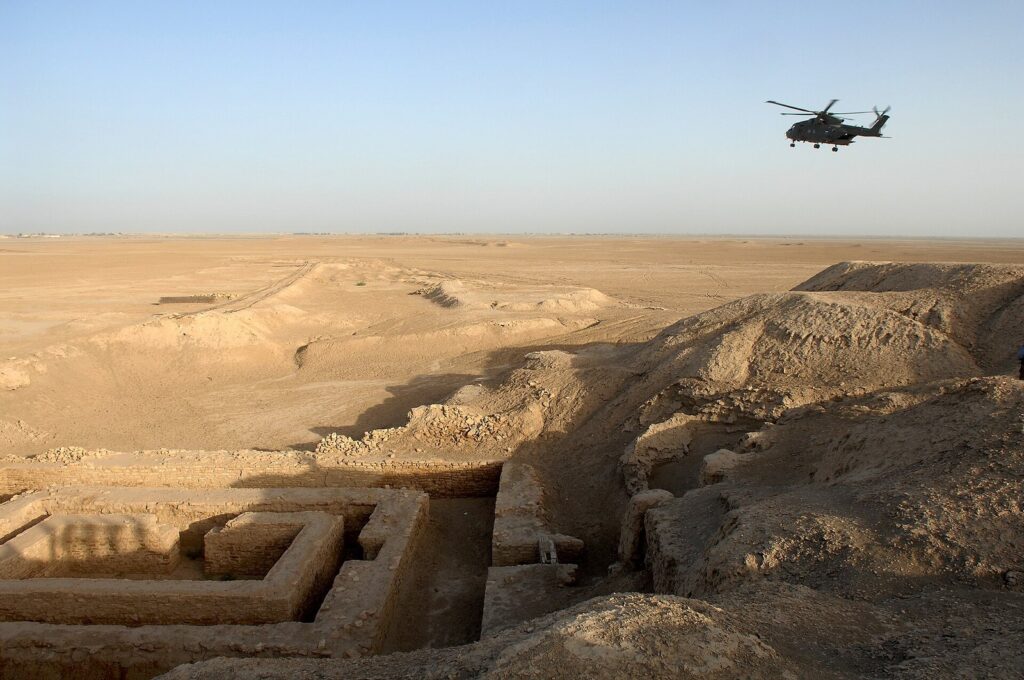
Why is Uruk called the world’s first city?
Because for a few centuries in the fourth millennium BC nothing else came close. The city gave its name to a whole era of Mesopotamian history, the Uruk period: Early Uruk runs from about 4000 to 3500 BC, Late Uruk from 3500 to 3100 BC. By the end of that span the settled area covered roughly 250 hectares. Around 2800 BC it had spread to something like 600 hectares, ringed by a brick wall about nine kilometres long and 12 to 15 metres high, which was probably built around 3000 BC.
Population is harder to pin down. The figure you will see most often is up to 50,000 people in the city around 3100 BC, with another 80,000 to 90,000 in the villages and farmland around it. Those are estimates built from the area of the mounds and assumptions about how densely people lived, not counts, and they move a good deal when the assumptions change.
The “first city” label is also a question of definition. Towns existed thousands of years earlier, at Jericho and Çatalhöyük, and Tell Brak in north-east Syria was growing into something urban at much the same time. The Sumerians themselves said kingship first came down from heaven at Eridu, further south near Ur. What sets Uruk apart is the whole package arriving together, at a scale no one else reached: tens of thousands of people, full-time administrators, monumental temples, specialist workshops, and the record-keeping that turned into writing. That combination is what most archaeologists mean by a city, and Uruk has it earliest and biggest.
Its influence travelled too. Pottery, buildings and seals in its style turn up far up the Euphrates at sites such as Habuba Kabira in Syria, a spread that archaeologists call the Uruk expansion and still argue about: colonies, trading posts or imitation.
The city through time
| Period | Approximate dates | What was happening |
|---|---|---|
| Early Uruk | 4000–3500 BC | A growing town around two sacred districts, Eanna and the Anu precinct |
| Late Uruk | 3500–3100 BC | About 250 ha; monumental temples in Eanna; the first tablets; up to 50,000 people (estimate) |
| Uruk III / Jemdet Nasr | 3100–2900 BC | The nine-kilometre wall (c. 3000 BC); about 600 ha by c. 2800 BC |
| Neo-Sumerian | 21st century BC | The Eanna ziggurat, E.SAR.A, “House of the Universe” |
| Seleucid | c. 312–141 BC | About 300 ha and perhaps 40,000 people; the Bit Resh and Irigal temples; the Anu ziggurat rebuilt |
| Parthian and later | to c. AD 700 | Last dated cuneiform tablet AD 79/80; mostly empty by AD 300; abandoned by about AD 700 |
Why the numbers disagree
Figures for the city get quoted without their dates, so the same city seems to be three sizes at once. Here is what each commonly repeated number actually measures.
| Source | Figure | What it actually measures |
|---|---|---|
| Excavation summaries (Wikipedia’s Uruk article) | Up to 50,000 residents c. 3100 BC; 80,000–90,000 in the environs | Two different populations, city and hinterland, both estimated from settled area |
| Popular summaries in search results | “More than 50,000” at its height around 2900 BC | A later date and a rounded version of the same estimate |
| Excavation summaries | About 250 ha c. 3100 BC; about 600 ha c. 2800 BC | The area lived in at a given moment |
| Site measurements | About 5.5 km², at most 3 km by 2.5 km | The whole archaeological site, every period together |
| Seleucid-period estimates | About 300 ha, perhaps 40,000 people | The late city, more than two thousand years after its peak |
What was found at Uruk
Most of what made Uruk famous came out of the ground during the German campaigns of the twentieth century, and almost none of it is at the site now.
The earliest writing
Excavators recovered thousands of very early tablets from the Eanna precinct: about 190 numerical tablets from the level called Uruk V (around 3500 BC), 1,776 from Uruk IV (around 3300 BC) and 3,094 from Uruk III (3200 to 2900 BC). They are not literature. The great majority are accounts, tallying grain, beer, livestock, textiles and workers’ rations in a mix of number signs and pictographs. A smaller group are standard word lists, apparently copied out to train scribes, and those lists show writing being taught as a system rather than improvised. Whether writing was invented only here is still debated, but Uruk holds the largest and earliest body of evidence.
The script outlived the city’s greatness by a very long way. The last dated cuneiform tablet from the site, an astronomical almanac catalogued as W22340a, was written in AD 79 or 80, so scribes worked in cuneiform here for well over three thousand years.
Temples, cone mosaics and the White Temple
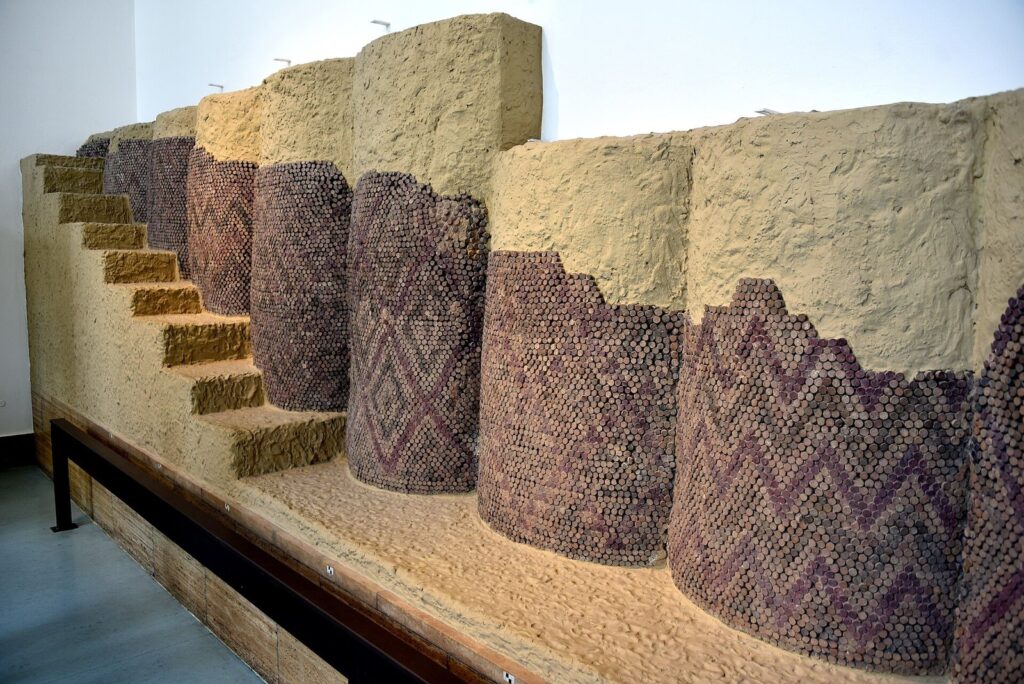
The city had two sacred districts. Eanna, the precinct of the goddess Inanna, was walled off from the rest of the city and filled with huge buildings and workshops, torn down and rebuilt again and again. Its walls and columns were covered in cone mosaics: thousands of small clay or stone cones pushed into wet plaster, their heads coloured red, black and white to make zigzags and lozenges. The other district belonged to Anu, the sky god. There a temple stood on a high terrace and was whitewashed, which is why the excavators called it the White Temple. That stepped terrace is an ancestor of the ziggurat.
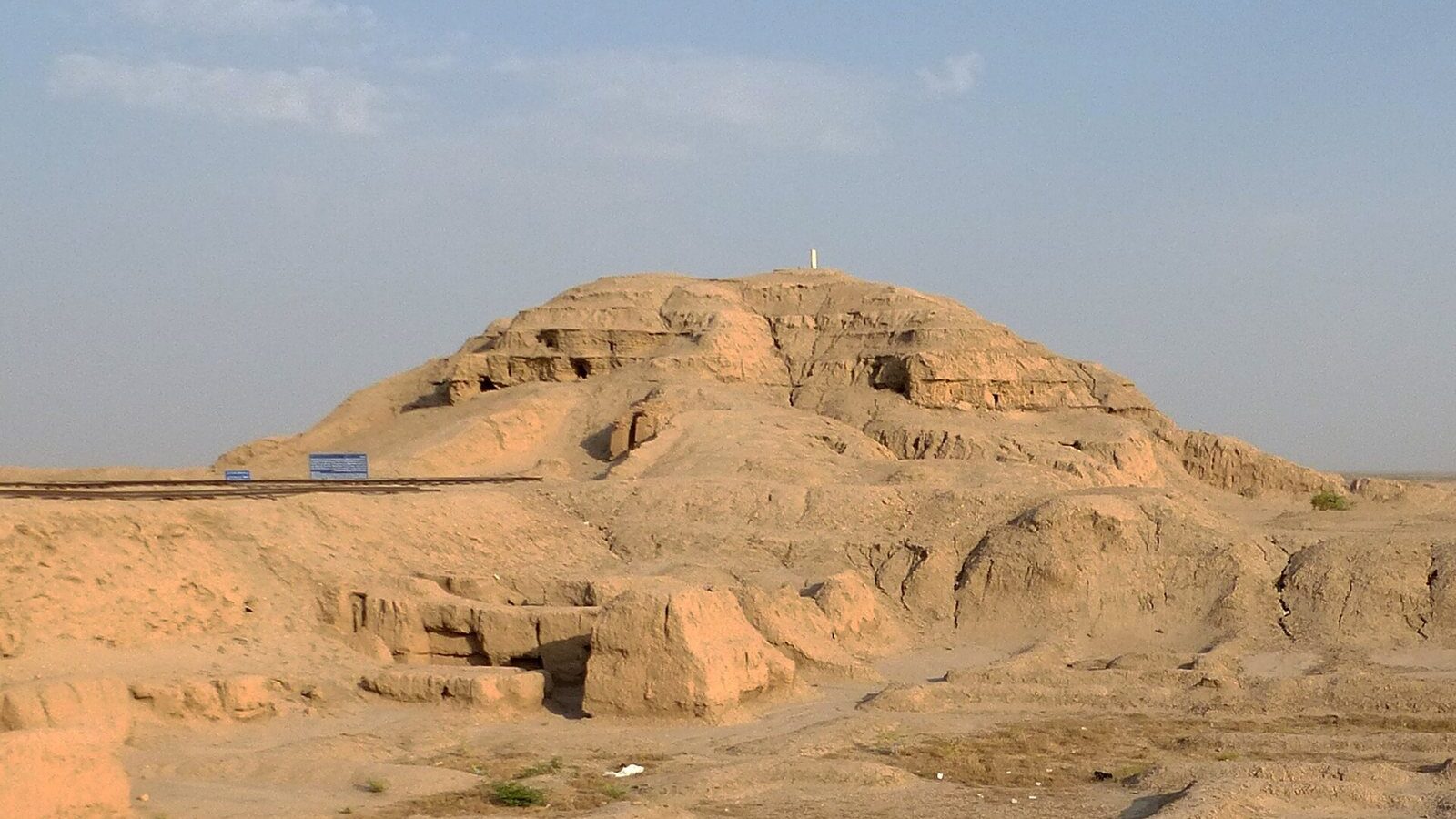
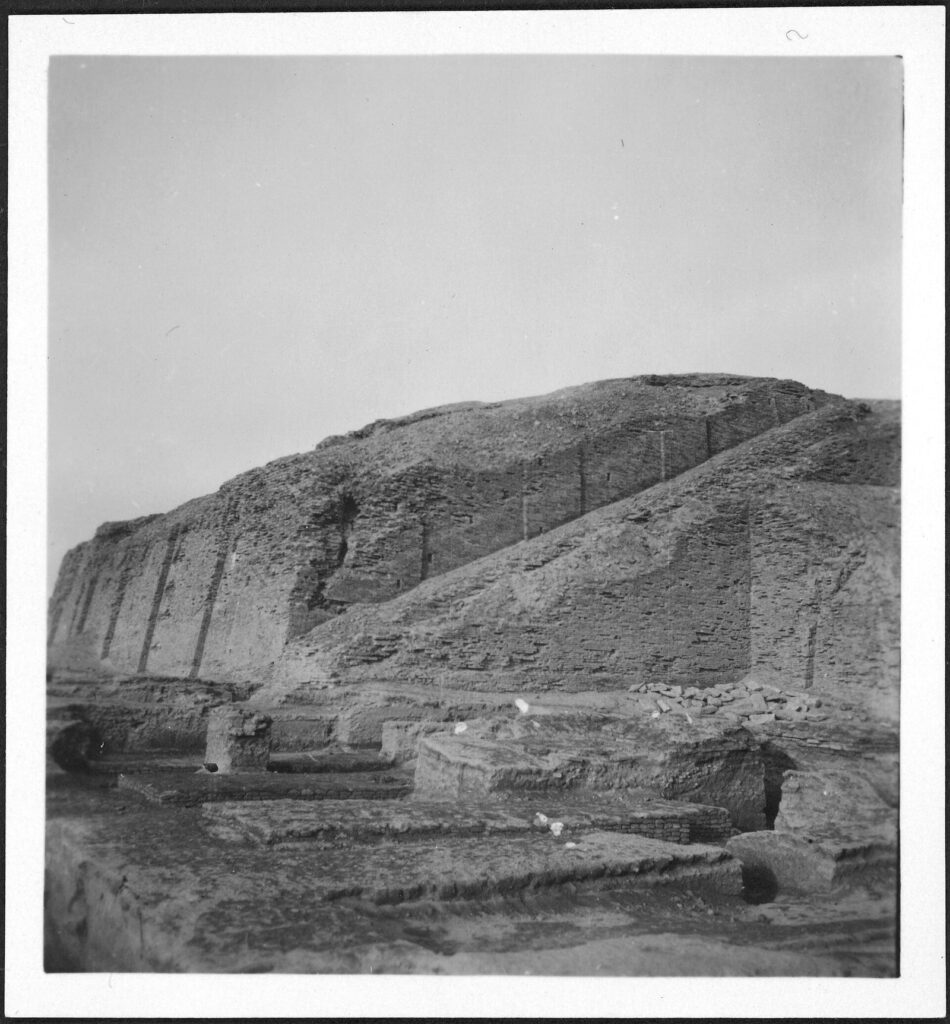
Two things confuse visitors. First, “the ziggurat of Uruk” can mean two structures: the Anu terrace that carried the White Temple in the late fourth millennium BC, and the Eanna ziggurat, E.SAR.A or “House of the Universe”, built far later in the Neo-Sumerian period, the era of the Third Dynasty of Ur that raised the great ziggurat at Ur. Second, the Anu sanctuary was rebuilt on an enormous scale under the Seleucids around 200 BC, when a ziggurat went up that some reckon the largest ever built in Mesopotamia. The Bit Resh, or “Head Temple”, was added by 250 BC and a second great sanctuary, the Irigal, about 200 BC. Much of what you read about “Gilgamesh’s city” is really about this late, Greek-ruled city.
Cylinder seals and mass-produced bowls
Two small objects say as much about the city as its temples. The cylinder seal, a carved stone cylinder rolled across wet clay to leave a repeating picture, appears in this period and was used to mark goods, doors and documents. The bevelled-rim bowl, a crude, mould-made bowl found in enormous numbers at Uruk-period sites, looks like one of the first mass-produced objects in history. Many archaeologists read it as a standard ration measure; others think it was a bread mould. Either way, it is the kitchenware of an administration.
The Warka Vase and the Mask of Warka
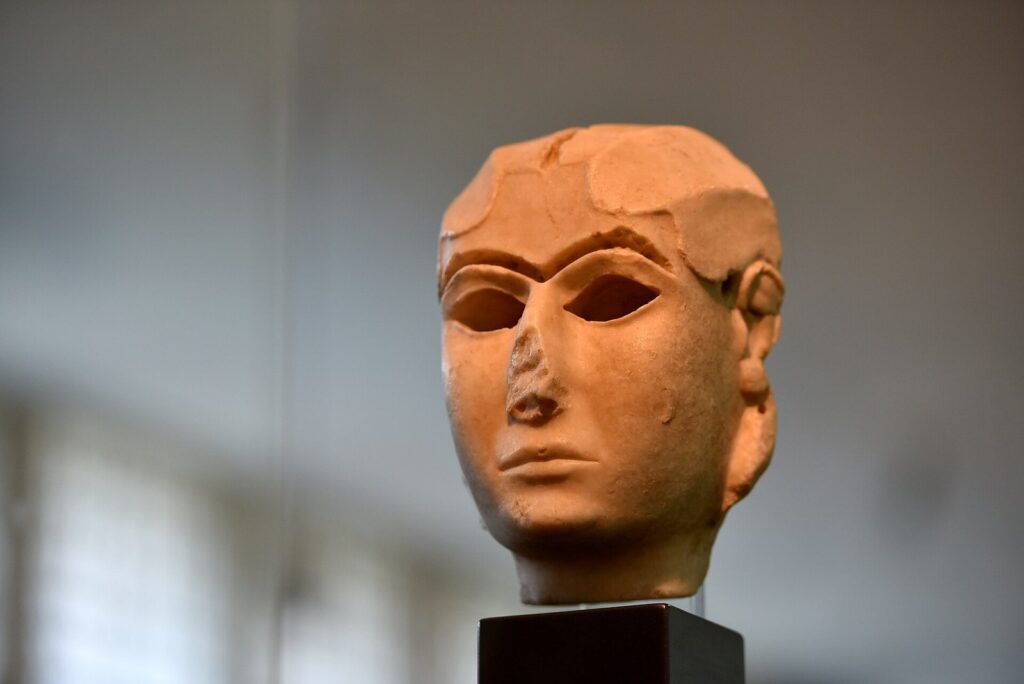
The two most famous objects from the site are both in the Iraq Museum in Baghdad, and both went missing in 2003. The Warka Vase, found in the 1933–34 season, is a tall alabaster vessel about a metre high, carved around 3000 BC with a procession climbing towards the goddess: water and plants at the bottom, then animals, then naked men carrying baskets and jars, and at the top a female figure, Inanna or her priestess, receiving gifts beside the reed-bundle symbols of her shrine. It was looted and later recovered. The Mask of Warka, a near life-size marble woman’s face found in 1939 and sometimes called the Lady of Uruk, was taken from the museum in April 2003 and recovered that September.
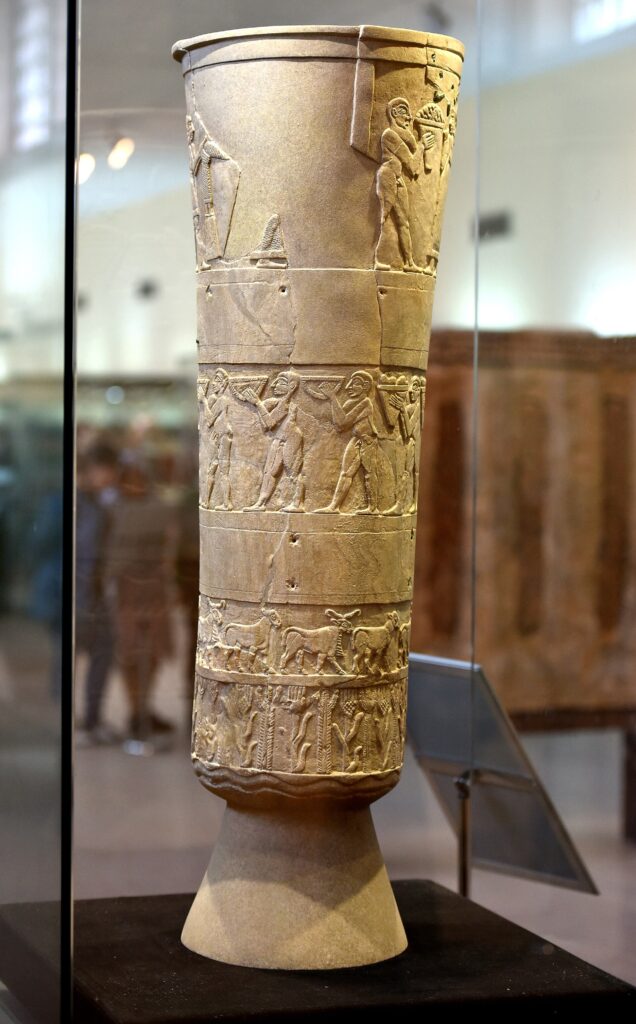
The catch is that you probably can’t see them yet. The museum’s Sumerian Hall has been closed since 2019 for refurbishment. In February 2026 the head of the museums department said it should reopen in June or July; that target slipped, and by August the museum as a whole was still closed. The museum is also restoring a seven-metre Sumerian boat from Uruk, dated to around 3200 BC, in a hall of its own with a German team. Our guide to the Iraq Museum in Baghdad tracks the reopening.
Where the finds are now
| Object or group | Where it is | Status and note |
|---|---|---|
| Warka Vase | Iraq Museum, Baghdad | Looted in 2003 and recovered; Sumerian Hall closed since 2019 |
| Mask of Warka | Iraq Museum, Baghdad | Looted April 2003, recovered September 2003 |
| Cone-mosaic panels | Iraq Museum, Baghdad | Panels from the temples |
| Cone-mosaic columns (reconstruction) | Vorderasiatisches Museum, Berlin | A share of the German excavations’ finds under the division rules of the time |
| Seven-metre Sumerian boat, c. 3200 BC | Iraq Museum, Baghdad | Being restored in a dedicated hall (reported February 2026) |
Gilgamesh, Inanna and the Uruk of legend
The city’s most famous resident may or may not have existed. The Sumerian King List, compiled long after the events it describes, names early kings of Uruk including Enmerkar, Lugalbanda and Gilgamesh, and gives them reigns lasting centuries. Gilgamesh became the hero of the poem now called the Epic of Gilgamesh, which opens and closes on the city walls: the narrator invites the reader to climb them, walk them and admire the brickwork. Many historians think a real ruler lies behind the legend, perhaps around 2700 BC, but no inscription of his own has been found.
The city’s goddess was Inanna, known to later Akkadian speakers as Ishtar, goddess of love, sex and war, and her Eanna precinct was the heart of the city for three thousand years. Anu, the sky god, was the other great patron, and by the Seleucid period his temple had become the main sanctuary.
The name travelled. Genesis 10 lists Erech, which is Uruk, among the cities of Nimrod’s kingdom, and one theory traces the Arabic name al-‘Iraq back to Uruk through Aramaic. It is an attractive idea and a contested one: other explanations point to a Middle Persian word for lowlands, or to an Arabic word for well-rooted, well-watered land.
Who dug Uruk, and when
The site has been excavated on and off for more than 170 years, almost entirely by German teams, and it escaped the looting that stripped many southern sites after 2003.
| Years | Who | What came of it |
|---|---|---|
| 1849–1854 | William Kennett Loftus | First survey and the first excavations |
| 1912–1913 | German Oriental Society, led by Julius Jordan | The Ishtar temple and the city wall |
| 1928–1939 | German Oriental Society (Jordan, then Arnold Nöldeke, Ernst Heinrich and Heinrich Lenzen) | The Eanna and Anu districts, archaic tablets, the Warka Vase and the Mask of Warka |
| 1954 onwards | German teams under Lenzen (to 1967), J. Schmidt (from 1968) and R.M. Boehmer (from 1978) | 39 German seasons in all by the time work stopped |
| 2001–2002 | German Archaeological Institute (DAI): Margarete van Ess with Jörg Fassbinder and Helmut Becker | A magnetometer survey mapping buried structures without digging |
| 2016 to now | DAI | Work on the city wall, a “digital twin” of the site, geophysics, and 25 sediment cores up to 13 m deep in 2024 and 2025 |
The 2001–02 survey read the ground with magnetometers, which pick up the faint magnetic difference between mud brick, ditches and soil, and produced a plan of buried houses and water channels far beyond the excavated trenches. It also fed some excitable headlines, including claims that Gilgamesh’s tomb had been located; nothing of the kind has been confirmed by digging. The current work is quieter and more useful: the sediment cores are reconstructing where the Euphrates channels ran when the city was alive.
What you actually see at Uruk today
Arrive with the right picture in your head. This is not a Roman town with streets and columns. It is about 5.5 square kilometres of mounds, at most 3 km north to south and 2.5 km east to west, made of mud brick that has been slumping back into the plain for two thousand years. The colours are sand and grey, broken by the red of pottery. The point is scale, and you only feel it from the high ground.
- The Anu ziggurat. The eroded mud-brick massif that carried the White Temple, and the obvious first stop.
- The Eanna district. Where the great temple complexes and most of the tablets were excavated. What survives are foundations in old trenches, not standing buildings.
- The Eanna ziggurat. The Neo-Sumerian stage tower of the 21st century BC.
- The city wall. The focus of the DAI’s work since 2016; its line runs for about nine kilometres around the site.
- Pottery everywhere. Leave every sherd where it lies. Iraq’s Antiquities and Heritage Law No. 55 of 2002 protects the whole site, and removing even a fragment is an offence you do not want to explain at an airport.
Facilities are new and basic. Iraqi reports in May 2026 described a visitor path built with the DAI, signage in three languages, a rest area, and antiquities police stationed permanently on site. Muthanna’s antiquities officials announced a second phase to extend the rest house and finish the path, and a television channel reported a new visitor centre; we could not date or confirm either. Bring water, a hat and sun cream, and don’t count on buying anything.
Photography is straightforward if you keep it personal. At ticketed archaeological sites the gate ticket covers ordinary photos, while professional or documentary filming needs permission from the State Board of Antiquities and Heritage (SBAH). Leave the drone at home: Iraq’s civil aviation authority treats drone flying as unregulated, which in practice means foreigners may not fly and drones are confiscated at customs. Don’t point a camera at the police post or at any checkpoint on the way, and read our rundown of the Iraqi laws that catch tourists out before you go.
How do you get to Uruk?
Start with the paperwork. Muthanna is in federal Iraq, so you need the federal visa: a Kurdistan Region visa is valid in the Kurdistan Region only. Apply on the Government of Iraq’s e-visa portal at least 24 hours before you travel; as of 25 September 2026 the FCDO put the fee at $160 for a visa valid 60 days, and a return or onward ticket is expected. Our step-by-step guide to the Iraq e-visa covers the form.
The site lies in open desert east of Samawah, the provincial capital, and east of the modern Euphrates. We know of no public transport to the site. There are three realistic approaches:
- From Samawah, with a hired car and driver. The closest base. SBAH listed Samawah’s museum as open in February 2026, which makes a useful second stop; our guide to museums in Iraq has the wider picture.
- From Nasiriyah, as part of a southern circuit. The site is 93 km north-west of Ur in a straight line; the road distance is longer, and we found no published drive time.
- With a tour from Baghdad. The simplest option: a local operator or driver-guide will know the current procedure at the gate. Our guide to choosing a tour of Iraq explains what to ask.
The nearest airports with international flights are Basra and Najaf, both operating in August 2026, though Najaf’s schedule is dominated by pilgrims and it halted flights for four days in July 2026. Baghdad is the usual gateway for tours. Airspace is part of the frame this year: as of 25 September 2026, the EU Aviation Safety Agency’s conflict-zone bulletin told European operators not to fly in the Baghdad flight information region at any altitude until at least 30 September. Check with your airline the week you travel.
Expect checkpoints between cities. At the Ziggurat of Ur, visitors in 2026 reported having their passports photographed at the gate, and it would be sensible to expect the same here. Carry your passport and a printout of your visa; our guide to getting through Iraqi checkpoints covers what gets asked.
What does it cost?
Bring dinars in cash. The site has no published fee, so the comparisons below are the best guide to what you might pay; for the rest of the budget, see our breakdown of what a trip to Iraq costs.
| Site | Foreign visitor fee | Source and date |
|---|---|---|
| Uruk (Warka) | Not published | Ask your operator; carry cash |
| Ziggurat of Ur | 25,000 IQD (Iraqis 3,000) | Visitor reports, 2026; a ticket is often not issued |
| Babylon | 25,000 IQD | Iraqi operator, March 2026 |
When is the best time to visit Uruk?
Go between November and March, and go early in the day. Southern Iraq’s summer is brutal: in August 2026 Basra reached 51°C and six governorates were back at 50°C, and the site has no shade worth the name. Operators running Babylon leave Baghdad at 07:00 for the same reason, and the logic applies doubly here. Winter has its own hazards, with flash floods possible from November to March, and dust storms are common in spring and summer. Our guide to the best time to visit Iraq has the month-by-month picture.
Is it safe to visit Uruk?
Here is the frame as of late September 2026, set out so you can make your own decision.
- UK. The FCDO advises against all but essential travel to Al-Muthanna, as it does for most of southern and central Iraq, including Baghdad, Babil, Dhi Qar and Basra. It advises against all travel within 5 km of the Saudi and Kuwaiti borders. Its Iraq travel advice, last updated 22 July 2026, was unchanged when we checked on 25 September 2026.
- US. The State Department’s advisory is Level 4, Do Not Travel, for the whole country, reissued on 29 August 2026.
- Insurance. The FCDO warns that travelling against its advice can invalidate your insurance. Read your policy’s Iraq wording before you book, and see our guide to travel insurance for Iraq.
- The wider picture. Iraq’s 2026 has been shaped by the confrontation between Iran and the United States. Iraqi airspace closed for 38 days from 28 February to 8 April; drones and missiles have repeatedly struck the Kurdistan Region in the far north, aimed mostly at Iranian Kurdish opposition groups and US facilities; and the US-led coalition’s mission was scheduled to end on 30 September 2026. Muthanna is a long way from all of that, but flight disruption reaches the whole country.
None of this tells you whether a morning at Uruk is risky in itself. We found no incident reports involving the site, and there is a police post on it. But “against all but essential travel” is the official UK position, and sightseeing is not essential in the FCDO’s sense. For the full reasoning, read our assessment of whether Iraq is safe to visit and how the UK and US advisories for Iraq work.
Combining Uruk with Ur, Eridu and the marshes
UNESCO’s Ahwar of Southern Iraq listing ties Uruk to two other ancient cities, Ur and Tell Eridu, and to four marsh areas: Hawizeh, the Central Marshes, and East and West Hammar. It is Iraq’s only mixed natural and cultural property, and one of the country’s six UNESCO World Heritage Sites. Unlike Hatra, Ashur and Samarra, it is not on the danger list.
| Stop | Why go | What to know (September 2026) |
|---|---|---|
| Uruk | The first great city; the earliest writing | Fee and hours unpublished; visitor path and rest area |
| Ur | The best-preserved ziggurat in Iraq | Closed for a restoration campaign due to end in July 2026; reopening unconfirmed when we checked |
| Tell Eridu | Where Sumerian tradition put the first kingship | We found no published visitor information |
| Central Marshes | Reed villages and boat trips on the water | Base at Al-Chibayish, about 90 km from Nasiriyah; boats reported at 25,000–35,000 IQD an hour; see our guide to nature in Iraq |
What we could not confirm
- The entry fee. No ministry, SBAH or Muthanna page publishes one. Ur and Babylon charge foreigners 25,000 IQD, but don’t assume Uruk matches.
- Opening hours and days. None are published. Plan for a morning visit, which the heat demands anyway.
- Whether a guide or prior permission is required. Travel listings say you need an arrangement with a local guide to be let in. We found no official statement either way.
- The new visitor centre. An Iraqi television channel reported that Muthanna had opened one at the site, but we could not see a date on the report and nothing else confirmed it.
- Phase two of the path and rest house. Muthanna’s antiquities officials announced it for “the next season”; we could not find whether work has started.
- The road distance and drive time from Samawah. Reference works put the site about 30 km east of the city, but no route or journey time is published.
- Which parts you may walk on. Nothing published says whether visitors may climb the Anu ziggurat or enter excavated areas. Follow the path and the police.
- When the Iraq Museum’s Sumerian Hall reopens. The June–July 2026 target slipped, and no new date had been given by August.
Frequently asked questions
Is Uruk the same place as Warka?
Yes. Warka, sometimes spelled Warqa, is the modern Arabic name of the mound where Uruk stands, and archaeologists often write Uruk-Warka. The Bible calls the same city Erech. Famous finds carry the modern name, which is why the Warka Vase and the Mask of Warka come from the same place.
Is Uruk a UNESCO World Heritage Site?
Yes, since 2016, but not on its own. It is one of seven components of the Ahwar of Southern Iraq, a mixed natural and cultural property that also includes Ur, Tell Eridu and four marsh areas. Unlike Hatra, Ashur and Samarra, the Ahwar is not on UNESCO’s List of World Heritage in Danger.
Can tourists visit Uruk?
Yes. Iraqi officials reported more than 1,000 foreign visitors in the months before May 2026, and the site now has a visitor path, signage in three languages, a rest area and a permanent antiquities police post. No fee or hours are published, and the FCDO advises against all but essential travel to Muthanna, so a local operator who knows the current gate procedure is the practical choice.
How old is Uruk?
The city grew through the Uruk period, roughly 4000 to 3100 BC, and was the largest in the world by around 3100 BC. People went on living there for thousands of years: the last dated cuneiform tablet from the site was written in AD 79 or 80, and the city was fully abandoned by about AD 700.
Where are the Warka Vase and the Mask of Warka?
Both are in the Iraq Museum in Baghdad. Both were looted in 2003 and recovered; the mask came back in September that year. The museum’s Sumerian Hall, where they are shown, has been closed since 2019, and a reopening planned for mid-2026 had not happened by August, so check before building a day around them.
Was Gilgamesh a real king of Uruk?
Possibly. The Sumerian King List names him among Uruk’s early rulers, and many historians place a real king behind the legend around 2700 BC. But no inscription of his own has been found, and the reigns the list gives are impossibly long. The Epic of Gilgamesh, which credits him with Uruk’s walls, is literature rather than a chronicle.
Is it safe to visit Uruk?
As of 25 September 2026 the FCDO advises against all but essential travel to Al-Muthanna, and the US rates all of Iraq Level 4, Do Not Travel, in an advisory reissued on 29 August 2026. We found no incident reports involving the site, which has its own police post, but travelling against FCDO advice can invalidate your insurance. Re-read both advisories the week you go.
Does the name Iraq come from Uruk?
Maybe. One theory traces the Arabic al-‘Iraq back to Uruk through Aramaic, which would make the country’s name around five thousand years old. Other explanations point to a Middle Persian word for lowlands or an Arabic word for fertile, well-rooted land. None is proven, so treat it as a good story rather than a settled fact.
Final thoughts
Uruk asks more of a visitor than almost anywhere in Iraq. There is no gate that opens onto a recognisable street, no site museum holding its treasures, and on a hot afternoon the mounds could pass for any stretch of desert. What it gives back is scale and sequence. From the top of the Anu ziggurat you can take in a place that held tens of thousands of people when most of humanity lived in villages, and you are standing where some of the first written accounts were kept: grain and beer and labour first, then, over the following centuries, laws, letters, astronomy and the Epic of Gilgamesh.
That makes it a site to prepare for rather than stumble on. Read up before you go, bring someone who can read the ground, and pair the mounds with the objects, whenever Baghdad’s Sumerian Hall reopens. The practical questions matter more than usual here: the right visa, a clear view of the FCDO and US positions, insurance that actually covers you, and a plan for the heat.
If you are building a southern route, add Babylon on the way down from Baghdad, use our overview of travel in southern Iraq for the logistics, and go back to the full list of Mesopotamian sites you can visit to see how it fits with the rest.
Photo credits
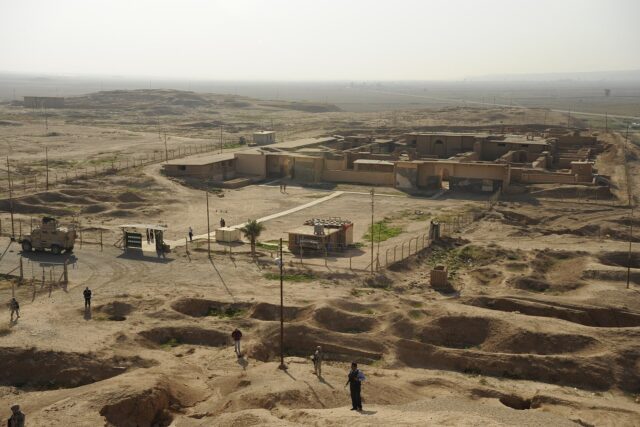
Anu ziggurat and White Temple terrace, Uruk (featured image): tobeytravels, Wikimedia Commons (CC BY-SA 2.0). Excavations at Uruk (Warka), 2008: SAC Andy Holmes (RAF), Wikimedia Commons (OGL v1.0). Cone-mosaic columns from Uruk, Berlin: Osama Shukir Muhammed Amin FRCP(Glasg), Wikimedia Commons (CC BY-SA 4.0). Warka Vase, Iraq Museum: Osama Shukir Muhammed Amin FRCP(Glasg), Wikimedia Commons (CC BY-SA 4.0). Mask of Warka, Iraq Museum: Osama Shukir Muhammed Amin FRCP(Glasg), Wikimedia Commons (CC BY-SA 4.0). Ziggurat at Uruk, 1933–34: Annemarie Schwarzenbach, Wikimedia Commons (public domain). All images via Wikimedia Commons under the licences shown.