Last updated: September 2026. We re-checked the FCDO’s Iraq advice and entry rules on gov.uk on 25 September 2026. The restoration status comes from 964media (April 2026) and The New Region (May 2026); fees, access and health notes from our August 2026 research files; history from standard reference works, named where they are used.
The first thing to know about the Ziggurat of Ur in 2026 is that you may not be able to get close to it. In the spring it was closed to visitors for its seventh major restoration campaign, with completion expected in July. We have found no report that it reopened, and in any case climbing the great staircase was already banned. Plan the trip with that uncertainty in mind; our guide to ancient Mesopotamia puts Ur among the country’s essential sites for good reason, and a closed staircase doesn’t change that.
The Ziggurat of Ur is the stepped temple of the Sumerian city of Ur, near Nasiriyah in Dhi Qar province, built in the 21st century BC under King Ur-Nammu and dedicated to the moon god Nanna. It is the best-preserved ziggurat in Iraq, and since 2016 Ur has been part of a UNESCO World Heritage property.
This guide covers what the 2026 restoration means for a visit, what is original, what else survives of the city, how the checkpoint and fee work, the advisory and a health warning specific to Dhi Qar, the marshes nearby, and what we could not confirm.
The short answer
| Question | Answer |
|---|---|
| Where is it? | Ur, Dhi Qar province, near Nasiriyah |
| Is it open? | Closed for restoration in spring 2026, with a July 2026 target; reopening unconfirmed |
| Fee | 25,000 IQD for foreign visitors (3,000 IQD for Iraqis), paid past a checkpoint, often with no ticket |
| Can you climb it? | No: climbing the staircase is banned |
| Getting there | Taxi from Nasiriyah, about 8,000 IQD each way; an overnight trip from Baghdad, not a day trip |
| UNESCO status | Part of the Ahwar of Southern Iraq World Heritage property since 2016 |
| FCDO (25 September 2026) | Dhi Qar: against all but essential travel |
Is the Ziggurat of Ur open in 2026?
This is the question that matters most, and the honest answer is that we don’t know for certain. Here is what the sources say, in date order.
| Source | What it says | What it actually tells you |
|---|---|---|
| 964media, 24 April 2026 | Under restoration and closed to visitors; a six-month campaign on the stairs and stones; completion expected in July | The ziggurat was closed in spring 2026 |
| Egyptian and Iraqi press, May 2026 | Completion by early July, with reopening then | A target, repeated from the same officials |
| The New Region, 9 May 2026 | The Tourism Authority says Ur is “approaching a tourism revolution if conditions remain stable” | Official optimism, not an opening date |
| Our research file, August 2026 | Reopening targeted for July 2026; whether it happened unconfirmed | No reopening report found by mid-August |
| Our check, 25 September 2026 | Still no report of a reopening | Assume works may be ongoing; confirm locally |
The restoration, according to reports summarised from Iraqi and regional press, covers the first level and its three main staircases, cracks in the second level and reconstruction on the third level from archaeological evidence, using traditional binders, reported as lime and gypsum mixed with water. The supervisor, Kazem Hisoun, told 964media he expected to finish in July; the director of antiquities for Dhi Qar is Shamel al-Rimaidh. If you are planning a trip, ask your hotel or driver in Nasiriyah the day before whether visitors can reach the ziggurat, and be ready for the answer to be that you can see it only from outside the works.
What is the Ziggurat of Ur?
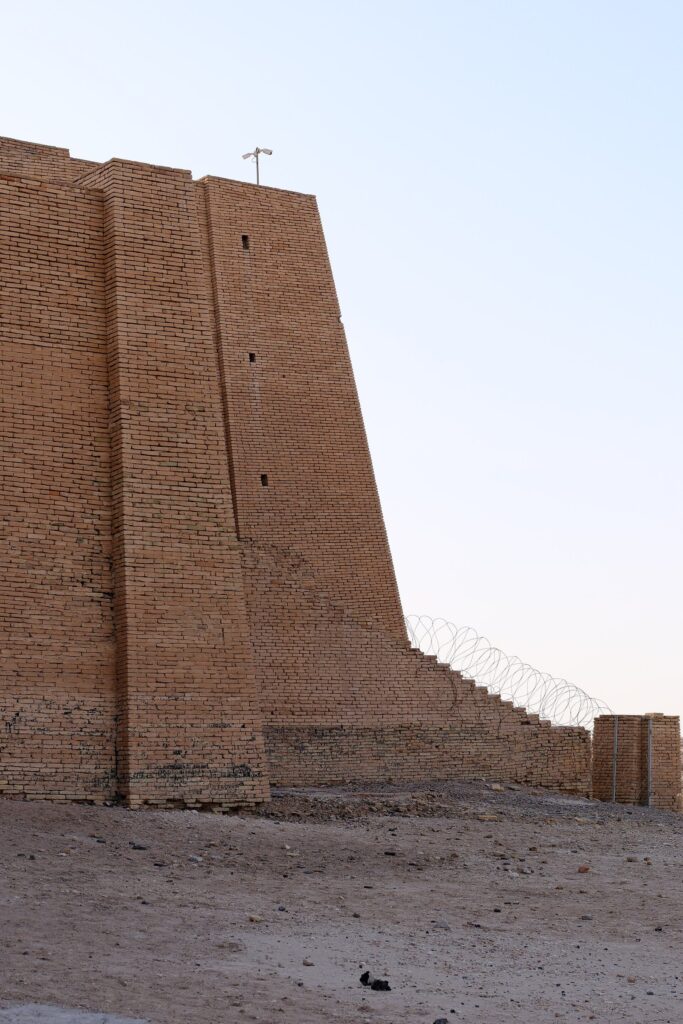
A ziggurat is a stepped temple platform, and Ur’s is the best preserved in Iraq. According to Britannica, it was built in the 21st century BC by Ur-Nammu, founder of the Third Dynasty of Ur, whose reign a stamped brick in the Sulaymaniyah Museum dates to 2112 to 2094 BCE. It was dedicated to Nanna, the Sumerian moon god and the patron of the city. The base measures about 64 by 46 metres, it rose in three terraces of mud brick faced with baked brick, and it originally stood around 30 metres high. Today only the first level and parts of the second survive.
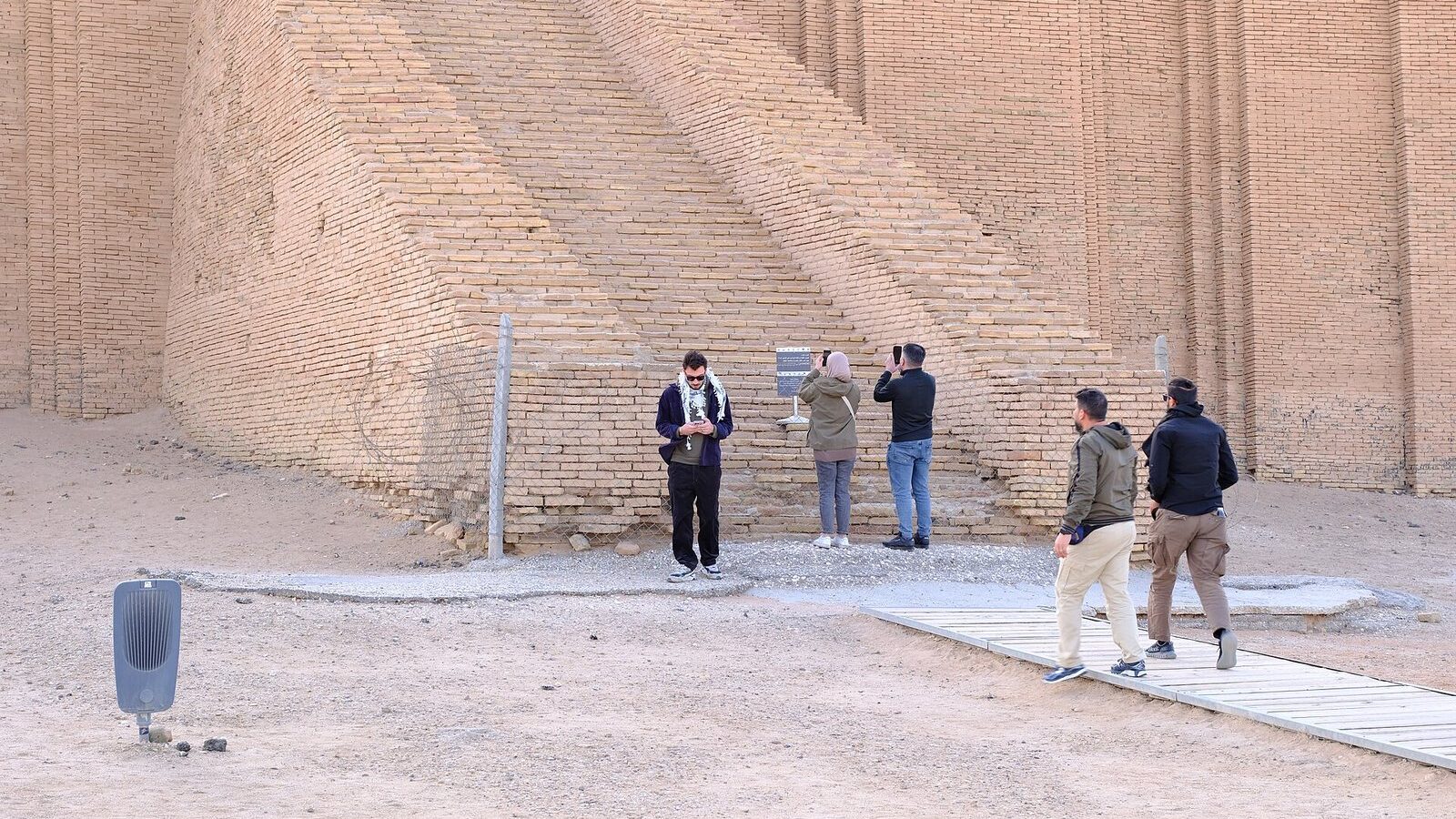
What you see is not entirely ancient. In the 1920s the British archaeologist Leonard Woolley revealed the whole monument in a joint excavation for the British Museum and the University of Pennsylvania Museum. In the 1980s Saddam Hussein’s government partly reconstructed it, and it was damaged in the 1991 Gulf War. The current campaign is the latest in a long line. None of that makes it less impressive in person: a sloping wall of brick, the three staircases converging at the top of the first stage, and flat desert in every direction.
| Part | Original or rebuilt? | What to look for |
|---|---|---|
| Core of the first level | Original mud brick, 21st century BC | The mass of the platform and its sloping walls |
| Outer facing and staircases | Restored and reconstructed, 1980s and 2026 | The three staircases meeting at the top of the first stage |
| Upper levels | Largely lost; partial remains of the second | Where the shrine to Nanna once stood |
Why Ur matters: the Third Dynasty in brief
The ziggurat belongs to the age when Ur ruled much of Mesopotamia, the Third Dynasty of Ur, often shortened to Ur III, at the end of the third millennium BC. Traces of that state turn up far beyond Dhi Qar, including in the Kurdistan Region’s museums, which is one of the pleasures of travelling the whole country.
| When | What |
|---|---|
| 2112 to 2094 BCE | Reign of Ur-Nammu, builder of the ziggurat, as dated on a stamped brick in the Sulaymaniyah Museum |
| Ur III period | Ur’s kings rule a wide state; cuneiform records of the time name Erbil as Urbilum |
| Ur III period | Shulgi and Shu-Sin of Ur leave inscribed objects now in the Sulaymaniyah and Erbil museums |
| 1920s and 1930s | Leonard Woolley excavates the ziggurat and the Royal Cemetery for the British Museum and Penn Museum |
| 1980s | Partial reconstruction under Saddam Hussein |
| 1991 | Damage during the Gulf War |
| 2016 | Inscribed as part of the Ahwar of Southern Iraq World Heritage property |
| 2021 | Pope Francis visits Ur |
| 2026 | Seventh major restoration campaign on the ziggurat |
If Erbil is on your itinerary too, it is worth knowing that the city’s name first appears, as Urbilum, in the records of this same dynasty; our guide to Erbil Citadel tells that story.
What else is there at Ur?
The ziggurat stands within the ruins of the city itself, and the rest of Ur is worth as much of your time. Most of it is low walls and mounds, so a guide or a good plan helps.
The residential quarter and the “House of Abraham”
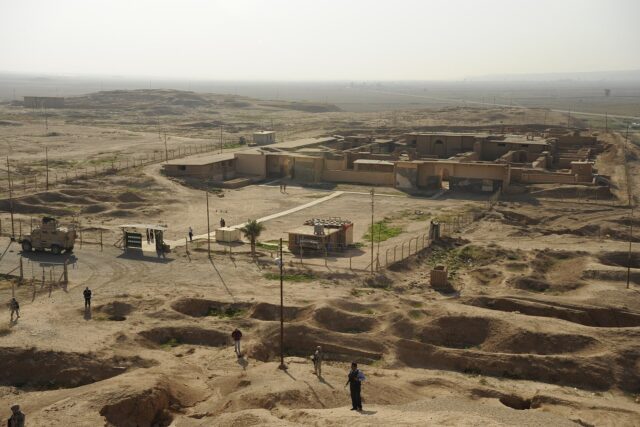
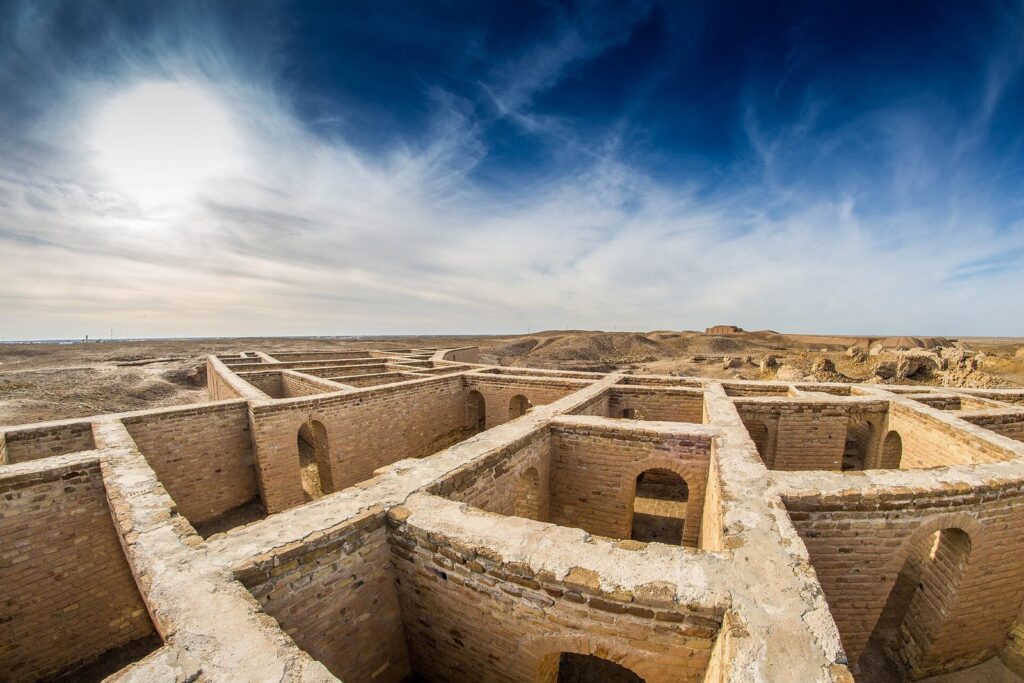
Ur is traditionally linked with Abraham, father of the three monotheistic faiths, and a reconstructed house in the excavated residential quarter, about a kilometre from the ziggurat, is shown to visitors as the “House of Abraham”. It is a tradition rather than an identification, but walking the lanes of brick houses gives a real sense of the city’s streets. Pope Francis visited Ur in March 2021 for an interfaith meeting, and an interfaith dialogue centre is among the projects now being built near the site.
The Royal Cemetery
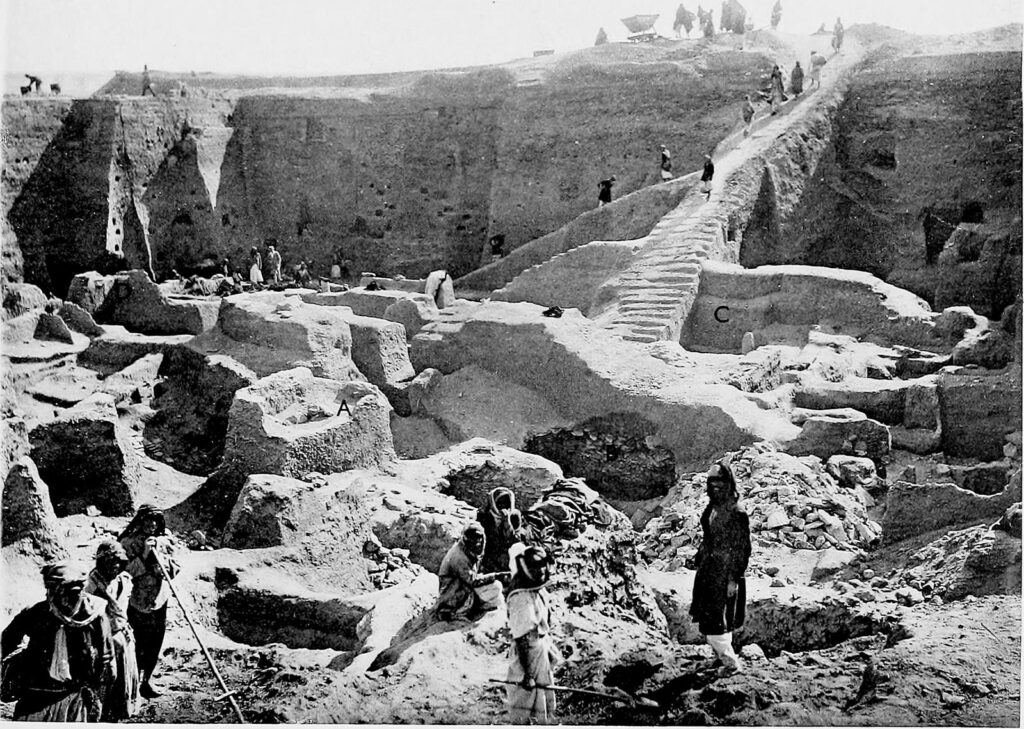
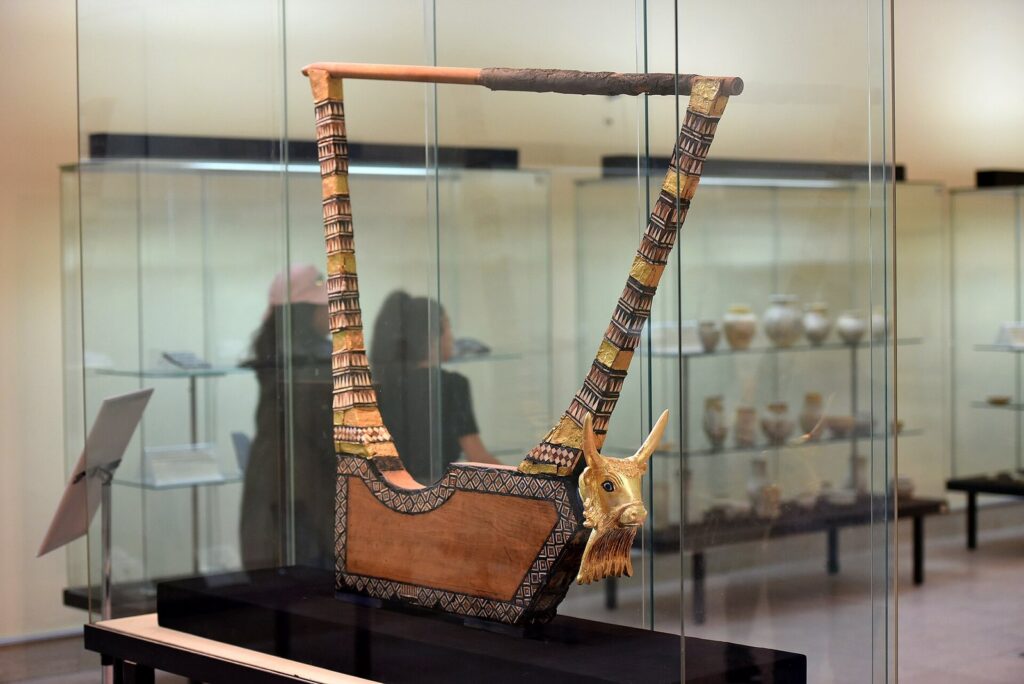
Woolley’s most famous finds came from the Royal Cemetery, dug in the 1920s and 1930s: gold jewellery, lyres and the other treasures that made Ur famous. The cemetery itself is now a set of pits and mounds; the treasures are elsewhere. Part of the finds went to the expedition’s sponsors in London and Philadelphia, and the Iraq Museum in Baghdad holds the rest. The Ur cemetery gold was moved into a Central Bank vault in 1990 and has since been returned to the museum for display in a specially designed hall, which makes Baghdad the place to see what came out of these tombs.
Where to see Ur’s treasures inside Iraq
| Museum | What from Ur-era Mesopotamia |
|---|---|
| Iraq Museum, Baghdad | The Ur cemetery gold, returned from a Central Bank vault to a purpose-built hall, and the Great Lyre |
| Sulaymaniyah Museum | Gold earrings inscribed with the name of Shulgi of Ur and a brick stamped with Ur-Nammu’s name |
| Erbil Civilization Museum | A door socket inscribed for Shu-Sin of Ur |
| Nasiriyah Museum | Listed as open by the State Board of Antiquities in February 2026; its displays were not detailed |
Our guides to Sulaymaniyah and things to do in Erbil cover those two museums.
Is Ur a UNESCO World Heritage Site?
Yes, but not on its own. In 2016 UNESCO inscribed “The Ahwar of Southern Iraq”, Iraq’s only mixed natural and cultural World Heritage property, with seven components: four marsh areas, Hawizeh, the Central marshes and East and West Hammar, and three ancient cities, Ur, Uruk and Tell Eridu. So Ur is World Heritage as a component of the Ahwar, not as a separate listing, which is why you won’t find it on UNESCO’s list under its own name. Unlike Samarra, Ashur and Hatra, the Ahwar is not on the List of World Heritage in Danger. Our guide to Iraq’s UNESCO World Heritage sites explains all six properties.
How do you visit the Ziggurat of Ur?
Ur is not a day trip from Baghdad; it is an overnight or fly-in destination, and Nasiriyah is the base. From Nasiriyah, a taxi to the site costs about 8,000 dinars each way, according to our August 2026 research. The archaeological site sits behind a checkpoint, and the fee, 25,000 dinars for foreign visitors and 3,000 for Iraqis, is paid past it, often with no ticket issued and your passport photographed. No separate camera fee is documented. Climbing the staircase is banned, restoration or not.
| Step | What to expect |
|---|---|
| Nasiriyah to the site | Taxi, about 8,000 IQD each way; agree the fare and the waiting time |
| The checkpoint | Passport and federal visa; your passport may be photographed |
| The fee | 25,000 IQD for foreigners, 3,000 IQD for Iraqis, often with no ticket |
| On site | No climbing; stay on paths and away from restoration works |
| Time needed | Allow a morning for the ziggurat, the residential quarter and the cemetery |
Carry your passport, cash in dinars and plenty of water. Our guides to Iraq’s checkpoints and getting around Iraq explain the routine, and if you would rather travel with an operator, our guide to Iraq tours explains what to ask. Ur combines naturally with the marshes and Basra; our guide to southern Iraq covers the region.
A half-day route around the site
| Stop | What to do there |
|---|---|
| 1. The ziggurat | Walk round the base, or view it from outside the works if restoration continues |
| 2. The Royal Cemetery | See where Woolley found the gold, and picture the treasures now in Baghdad |
| 3. The residential quarter | Walk the lanes of brick houses, including the one shown as the House of Abraham |
| 4. Back to Nasiriyah | Lunch, the museum if it is open, and a rest from the heat |
What to bring
| Item | Why |
|---|---|
| Passport and federal visa | Needed at the checkpoint, where your passport may be photographed |
| Cash in dinars | 25,000 IQD for the fee and money for the taxi |
| Water, a hat and sunscreen | No shade anywhere on site |
| Long trousers and insect repellent | Protection against ticks during the 2026 Crimean-Congo haemorrhagic fever outbreak |
| Modest clothing | The norm in southern Iraq |
Nasiriyah
Nasiriyah, the provincial capital, is a city of about 705,000 people by the 2024 census, and its museum was among those the State Board of Antiquities listed as open in February 2026. Nasiriyah’s airport is being developed, with runways expected to open in 2026 according to 964media, and a luxury hotel is under construction near Ur; we could not confirm either as operating. Most visitors sleep in the city.
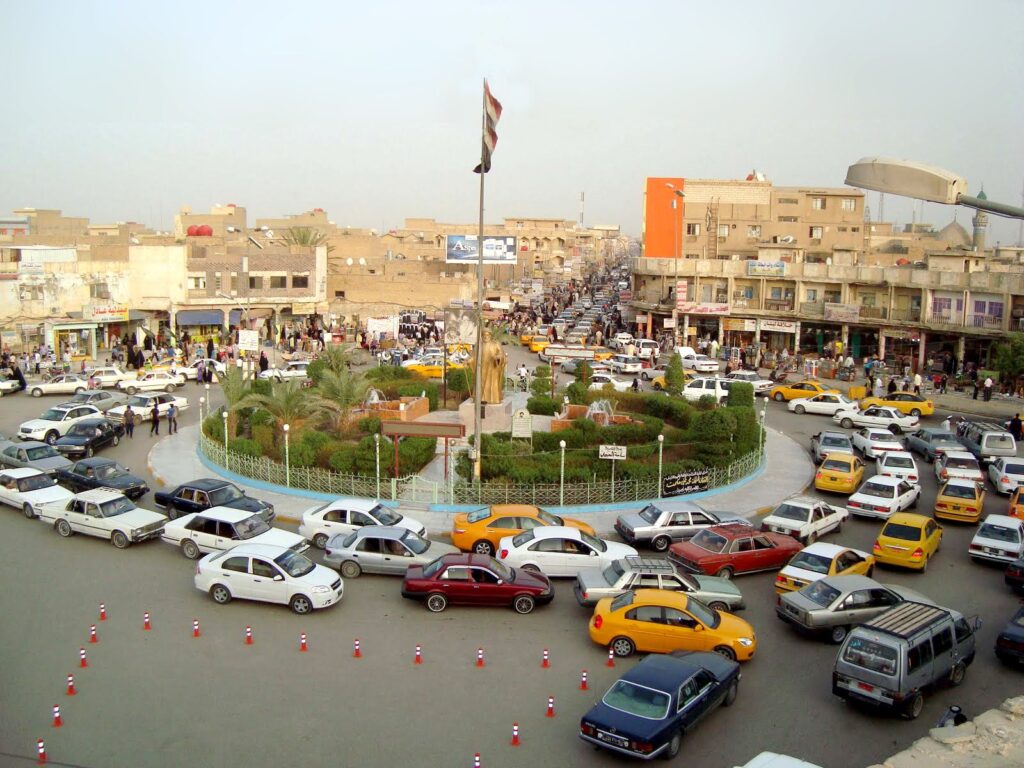
Getting to Nasiriyah
From Baghdad, Nasiriyah is a long drive south, and no official drive time is published; most visitors travel with a driver or join a southern tour that links Babylon, Ur, the marshes and Basra. Basra, a city of about 1.3 million by the 2024 census, has the south’s main international airport and makes a sensible start or end point; our guide to safety in Basra covers the city’s advisory position. We could not confirm whether passenger trains between Baghdad and Basra are running in 2026, so don’t plan around them.
The real danger on these roads is traffic rather than anything else. During the 2026 Arbaeen pilgrimage, every one of the 46 pilgrim deaths recorded was a road accident, including a rollover near Nasiriyah. Choose a driver who doesn’t race, avoid driving at night, and wear a seatbelt even when nobody else does.
Is it safe to visit Ur in 2026?
As of 25 September 2026, the FCDO advises against all but essential travel to Dhi Qar province, as it does for most of federal Iraq; its page was last updated on 22 July 2026 and was unchanged when we checked. The US State Department rates Iraq Level 4, Do Not Travel, reissued on 2 March 2026. The FCDO warns that “your travel insurance could be invalidated” if you travel against its advice; our guide to travel insurance for Iraq explains what to ask, and our pages on whether Iraq is safe and the current travel advisory give the wider picture.
Dhi Qar has a specific health risk in 2026. Iraq’s health ministry reported 313 confirmed cases of Crimean-Congo haemorrhagic fever and 24 deaths nationally by 6 August 2026, and Dhi Qar was the worst-affected province, with 119 cases and nine deaths. The virus spreads through tick bites and contact with infected livestock and their blood, so at rural sites and in the marshes wear long trousers, use insect repellent, check for ticks and avoid handling animals or butchered meat. Our guide to vaccinations and health in Iraq covers the wider picture.
Papers matter too. Ur is in federal Iraq, so a Kurdistan Region visa does not cover it; you need the federal e-visa, which the FCDO says costs $160, is valid for 60 days and must be applied for at least 24 hours before travel. Our Iraq e-visa walkthrough has the steps.
When is the best time to visit Ur?
Between November and March. Southern Iraq’s summer is ferocious, and the site is open desert with no shade; even in Baghdad, the average July maximum is about 44 °C, with days above 50 °C from mid-June to mid-August. Whenever you go, arrive early. For the marshes nearby, 2026 was a better year than most: between 32 and 36 per cent of the marshland was inundated, against no more than 8 per cent in each of the previous five years. Our guide to the best time to visit Iraq covers the seasons.
Ur and the marshes: the best combination in the south
Ur’s World Heritage partner, the marshes, is the natural pairing. The usual base is al-Chibayish in Dhi Qar, about 90 km from Nasiriyah, reached by shared taxi for 3,000 to 5,000 dinars. A mashoof, the narrow marsh boat, costs about 25,000 to 35,000 dinars per boat per hour, and a full six- to seven-hour private trip about 40,000 to 50,000 dinars for four people, according to our August 2026 research; overnight stays in a mudhif, the reed guesthouse, also operate. The 2026 water levels are a partial reprieve inside a longer decline, not a recovery. Our guide to nature in Iraq covers the marshes in more depth.
If you are working north towards Baghdad afterwards, Babylon is the other great Mesopotamian city within the FCDO’s all-but-essential band, and Baghdad’s Iraq Museum holds the treasures of Ur’s Royal Cemetery.
What we could not confirm
- Whether the ziggurat has reopened. The July 2026 target was widely reported; no reopening report had appeared by 25 September 2026.
- Whether the rest of the site stayed open during the works. We found no statement either way on the residential quarter and the cemetery.
- Opening hours. None are published.
- Nasiriyah airport. Runways were expected to open in 2026; we could not confirm scheduled flights.
- New hotels and the “tourist city”. A luxury hotel, an interfaith centre and a “drama city” with an opera house have been announced or are under construction; none is confirmed open.
- The ziggurat’s precise original height. Around 30 metres is the reference figure; the surviving height after the 2026 works is not published.
- Health figures. Other agencies’ Crimean-Congo haemorrhagic fever counts for 2026 differ from the health ministry’s; we cite the ministry’s, dated.
- Drive times from Baghdad or Basra. Not officially published.
Frequently asked questions
Can you visit the Ziggurat of Ur?
Usually yes, from Nasiriyah, for 25,000 dinars as a foreign visitor, but in 2026 the ziggurat was closed for restoration with a July completion target, and we could not confirm that it has reopened. Check locally before you travel, and remember that climbing the staircase is banned. The FCDO advises against all but essential travel to Dhi Qar.
Who built the Ziggurat of Ur?
King Ur-Nammu, founder of the Third Dynasty of Ur, in the 21st century BC; a stamped brick in the Sulaymaniyah Museum dates his reign to 2112 to 2094 BCE. It was dedicated to Nanna, the moon god. Much of what you see today was restored or reconstructed in the 1980s and again in 2026.
Can you climb the Ziggurat of Ur?
No. Climbing the staircase is banned, and in 2026 the ziggurat was also closed for restoration of its staircases and upper levels. You can see it from the base and from the surrounding ruins; the view across the flat desert is part of the experience.
Is Ur a World Heritage Site?
Yes, as one of the seven components of “The Ahwar of Southern Iraq”, inscribed in 2016, alongside Uruk, Tell Eridu and four marsh areas. It is Iraq’s only mixed natural and cultural World Heritage property, and it is not on the Danger List.
How old is the Ziggurat of Ur?
About 4,100 years. It was built in the 21st century BC under Ur-Nammu, whose reign is dated to 2112 to 2094 BCE on a brick in the Sulaymaniyah Museum. Much of the outer facing and the staircases have been restored since, in the 1980s and again in 2026, but the core is ancient mud brick.
Where can you see the treasures from Ur?
Inside Iraq, at the Iraq Museum in Baghdad, which displays the Royal Cemetery gold in a purpose-built hall along with the Great Lyre. Part of the finds went to the British Museum in London and the Penn Museum in Philadelphia, which sponsored Woolley’s excavations in the 1920s and 1930s.
Can you visit Ur as a day trip from Baghdad?
Not realistically. Ur is an overnight or fly-in destination, with Nasiriyah as the base. From Nasiriyah it is a short taxi ride, about 8,000 dinars each way. Combine it with the marshes at al-Chibayish, about 90 km from Nasiriyah, to make the long journey south worthwhile.
Is Abraham’s house really at Ur?
A reconstructed house in Ur’s residential quarter is shown to visitors as the House of Abraham, reflecting a long tradition that links the patriarch with Ur. It is a tradition, not an archaeological identification. Pope Francis visited Ur in 2021 for an interfaith meeting, which has renewed pilgrim interest.
Final thoughts
The Ziggurat of Ur is one of the few places on earth where you can stand in front of a building that is more than four thousand years old and still recognisably what it was. Even half-restored, fenced and closed to climbing, it is the monument that makes Sumer real.
The 2026 restoration is a nuisance for this year’s visitors and good news for everyone after them. Check whether the works are finished, go in winter, take the tick warning seriously, and give the trip two days: one for Ur and Nasiriyah, one for the marshes.
For the wider picture, our guide to Iraq’s ancient cities covers the rest of Mesopotamia, our guide to museums in Iraq shows where the finds ended up, and our Baghdad guide is the starting point for most trips south.
Photo credits
Ziggurat of Ur staircase (featured image): Alli Khalil, Wikimedia Commons (CC BY-SA 4.0). Ziggurat of Ur: Alli Khalil, Wikimedia Commons (CC BY-SA 4.0). Residential quarter, Ur: Aziz1005, Wikimedia Commons (CC BY 4.0). Royal Cemetery of Ur excavations: Joint Expedition of the British Museum and of the Museum of the University of Pennsylvania to Mesopotamia Hall, H. R. (Harry Reginald), 1873-1930, ed Woolley, Leonard, Sir, 1880-1960 Legrain, Leon, 1878- ed, Wikimedia Commons (No restrictions). Great Lyre of Ur, Iraq Museum: Osama Shukir Muhammed Amin FRCP(Glasg), Wikimedia Commons (CC BY-SA 4.0). Nasiriyah city centre: Mohamad.bagher.nasery, Wikimedia Commons (CC BY-SA 3.0). All images via Wikimedia Commons under the licences shown.