Last updated: September 2026. Travel advice re-checked on 25 and 26 September 2026 against the FCDO’s Iraq pages and the US State Department’s 29 August 2026 reissue; the arch’s condition and conservation checked against ALIPH’s project record and Iraqi press reports from 2026.
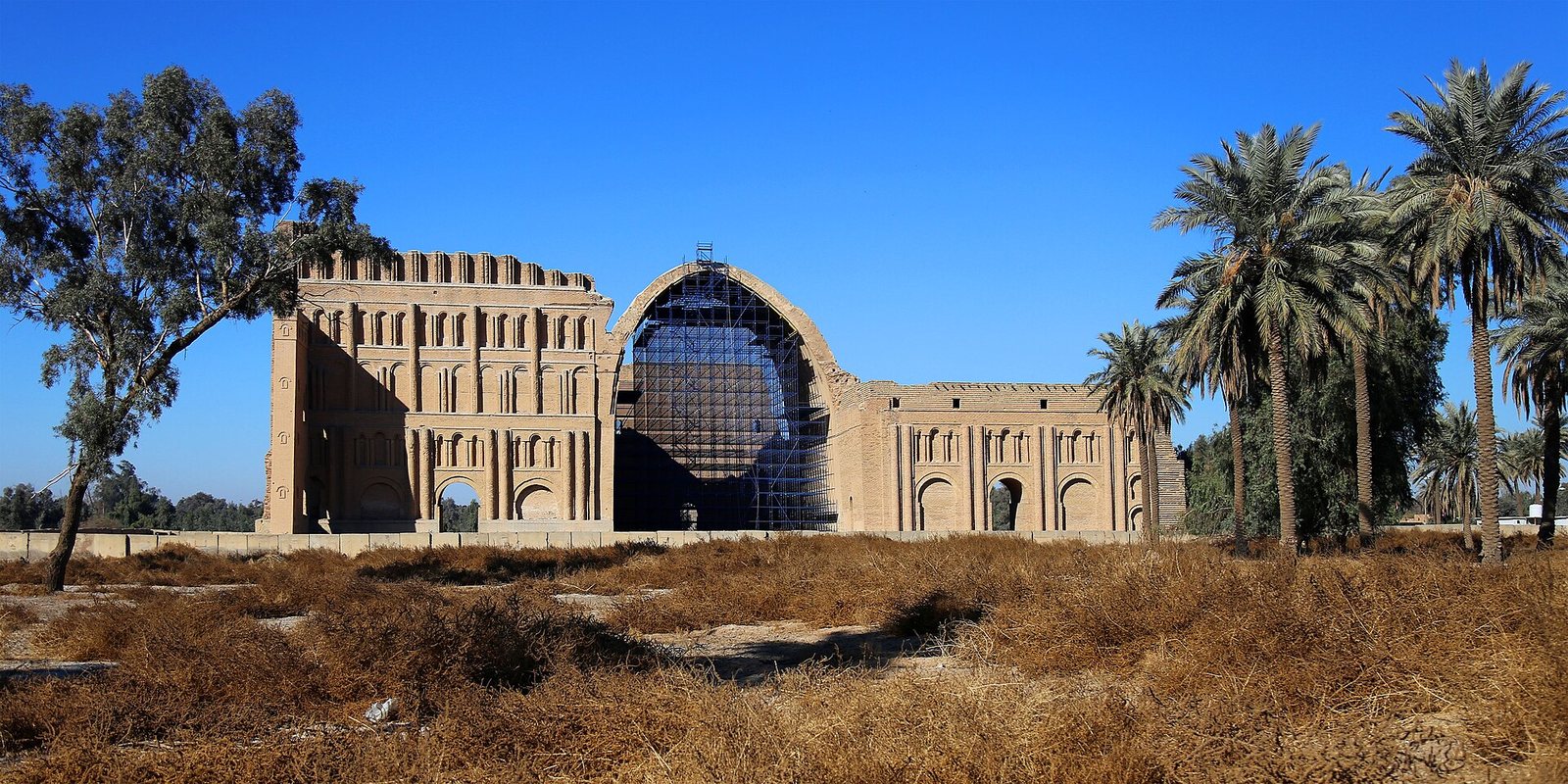
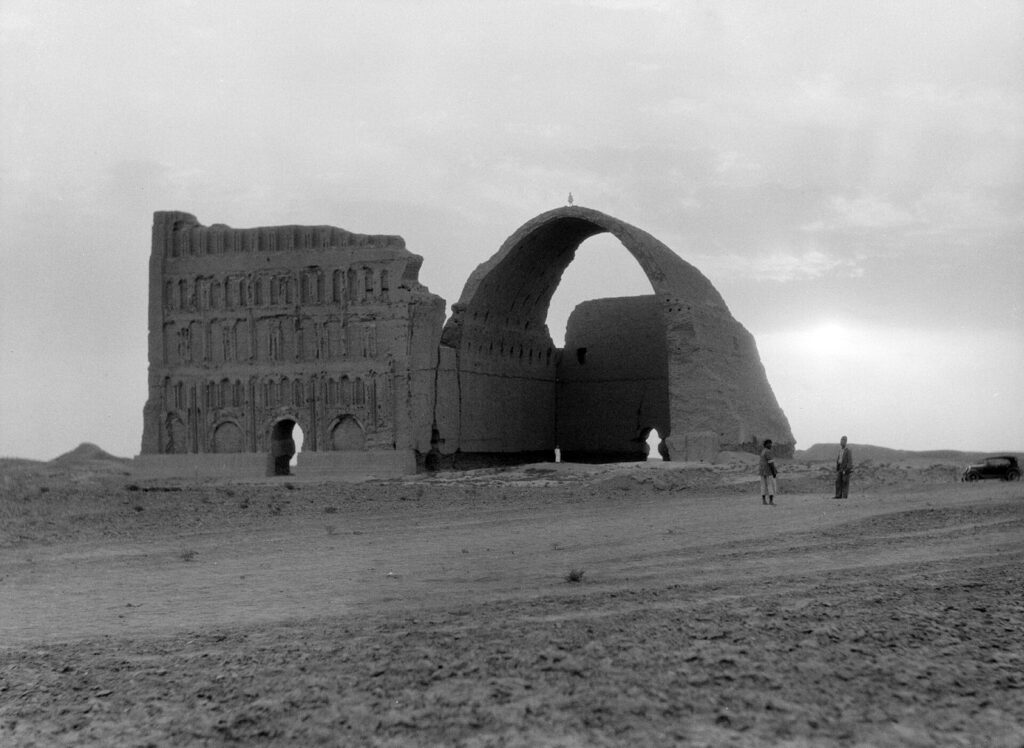
Of all the monuments in our guide to Iraq’s ancient Mesopotamian sites, the great arch at Ctesiphon is the one most visibly fighting for its life. It has been coming down, slowly and then suddenly, for about 140 years. A Tigris flood took its north wing in 1888. Parts of the vault fell in 2019 and again in 2020. Since the end of 2021 a cage of steel scaffolding has stood inside the opening, holding up the brickwork while engineers work out how to save it. If your picture of the place is the old photograph of a clean brick parabola against an empty sky, adjust it before you go.
Then go anyway. Ctesiphon was a royal capital of the Parthian and Sasanian empires for the better part of eight centuries, on the east bank of the Tigris south-east of Baghdad. Its one standing monument, Taq Kasra, is a brick vault about 37 metres high and 26 metres across, the largest built before the modern era. It is open to visitors, and it is one of the easiest ancient sites in Iraq to reach from the capital.
This page explains what Ctesiphon was, how big the arch really is and why the figures disagree, what has gone wrong with it and who is trying to fix it, what you will see when you get there, how to reach it from Baghdad, the travel advice as of late September 2026, and what we could not pin down.
The short answer
| Question | Answer |
|---|---|
| Where is it? | Salman Pak, in the Al-Mada’in district of Baghdad province, on the east bank of the Tigris; published distances from Baghdad range from 30 to 40 km |
| What survives? | Taq Kasra, the great vaulted hall of the Sasanian palace, with the south wing of its façade; the rest of the city is low mounds |
| How big is the arch? | About 37 m high and 26 m wide, according to ALIPH, the foundation funding its rescue |
| Can you visit? | Yes. No permit is needed, visitor numbers were rising in 2026, and the vault has been propped by scaffolding since late 2021 |
| Fee and hours | None published |
| UK advice | FCDO: against all but essential travel to Baghdad province outside Sadr City, which includes Salman Pak (unchanged as of 25 September 2026) |
| US advice | Level 4, Do Not Travel, for all of Iraq (reissued 29 August 2026) |
What was Ctesiphon?
Ctesiphon was never a single city so much as one half of a pair, and later one of a cluster. The story starts on the opposite bank of the Tigris with Seleucia, founded around 305 BC by Seleucus I, one of Alexander the Great’s successors. Seleucia drew people and trade away from Babylon, and for a time it was one of the biggest cities in the Greek-speaking world.
The Parthians, a dynasty from north-east Iran, took Mesopotamia from the Seleucids in the 140s BC and built up Ctesiphon on the east bank, facing Seleucia, as a royal seat. It grew into their capital. Rome coveted it and took it repeatedly: Trajan in AD 116, the general Avidius Cassius in 165, and Septimius Severus around 197–198. While it was the Parthian capital, far to the south the last scribes at Uruk were still writing cuneiform, a reminder of how long the old Mesopotamian world overlapped with this new one.
The Sasanians, who overthrew the Parthians in the 220s, kept Ctesiphon as their capital and founded a new city, Veh-Ardashir, on the west bank near the ruins of Seleucia. The whole group of towns on both banks became known in Arabic as al-Mada’in, “the cities”, which is still the name of the district and the word you will see on road signs. The Roman emperor Carus took Ctesiphon again in 283, and Julian fought a battle beneath its walls in 363 but could not take it, and died on the retreat.
The end came from a different direction. In 637, a year after defeating the Sasanian army at al-Qadisiyyah, Arab forces under Sa’d ibn Abi Waqqas took al-Mada’in, and the last Sasanian king, Yazdegerd III, fled east. The spoils included an enormous palace carpet remembered as the Spring of Khosrow, which was cut into pieces and shared out. Salman al-Farsi, the Persian Companion of the Prophet Muhammad, became governor of al-Mada’in and was buried there, and the modern town, Salman Pak, carries his name. When the Abbasid caliph al-Mansur founded Baghdad upstream in 762, the old capital’s fate was sealed; medieval historians tell of him starting to pull down the great hall for its bricks and giving up when the work cost more than the bricks were worth.
Ctesiphon through time
| Date | What happened |
|---|---|
| c. 305 BC | Seleucus I founds Seleucia on the west bank of the Tigris |
| 140s BC | The Parthians take Mesopotamia and build up Ctesiphon on the east bank |
| AD 116, 165, c. 198 | Roman armies under Trajan, Avidius Cassius and Septimius Severus capture the city |
| 220s | The Sasanians overthrow the Parthians and keep Ctesiphon as their capital |
| 3rd or 6th century | Taq Kasra is built (the date is disputed) |
| 363 | Julian’s Roman army fights outside the walls but fails to take the city |
| 637 | Arab forces take al-Mada’in; Yazdegerd III flees |
| 762 | Baghdad is founded upstream and Ctesiphon declines |
| 1888 | A Tigris flood brings down the north wing of the arch’s façade |
| 1915 | The Battle of Ctesiphon, between British-Indian and Ottoman forces |
Taq Kasra: how big is the arch, really?
Big enough that the figures stopped mattering to most people long ago, which is partly why they are so muddled. ALIPH, the Geneva-based heritage foundation that has funded the emergency work, gives the arch as 37 metres high and 26 metres wide, and calls it the largest brick vault and free-standing arch in the world built before the modern era. The more common shorthand, “the largest single-span brick arch in the world”, says roughly the same thing with less care.
What you are looking at is the front of an iwan, a vaulted hall closed at the back and open at the front, a form the Parthians and Sasanians made their own and which later became a staple of Islamic architecture from Isfahan to Samarkand. The vault is a tall, parabola-like curve, higher than it is wide, and it was built without centering, the timber framework normally used to hold an arch while the mortar sets. The usual explanation is that the builders laid the bricks in rings leaning back against the rear wall, each ring resting on the one before, so the vault could rise over empty space.
Why the numbers disagree
| Source | Figure | What it actually measures |
|---|---|---|
| ALIPH project page | 37 m high, 26 m wide | The arch opening: height to the crown and span |
| Britannica | 26 m (84 ft) | The span only |
| Iraqi press, May 2026 | 37 m high | Height only, repeated from official statements |
| Figures circulating online | Height 35–37 m; depth 48–50 m; walls about 7 m thick at the base | Height, the hall’s length from front to back, and the base walls; none of the last two traced to a primary source |
The date is just as contested. The name, Taq Kasra or Taq-i Kisra, means the Arch of Khosrow, and many scholars attribute the hall to Khosrow I Anushirvan, who reigned from 531 to 579. Others date it to Shapur I in the third century. ALIPH dates it to the sixth century. Both views have serious defenders; nobody has settled it.
Why is the arch in danger?
Mud-brick and fired-brick buildings in Mesopotamia fail from the bottom up: groundwater and salt eat the lower courses, cracks open, and rain does the rest. Taq Kasra has had all of that, plus floods, war, neglect and at least one repair that went wrong.
| When | What happened to the arch |
|---|---|
| 1888 | A Tigris flood brings down the north wing of the façade |
| 2017 | A Czech firm, Avers, completes a restoration contract |
| 2019 | Part of the vault collapses; heritage reports say the 2017 work failed with it |
| 2020 | A further partial collapse; Iraq’s State Board of Antiquities and Heritage (SBAH) asks ALIPH for help |
| 2020–2022 | ALIPH funds four emergency grants totalling about $1.27 million, with the University of Pennsylvania, Iconem and SBAH |
| End of 2021 | Steel scaffolding installed inside the vault, with sensors monitoring the cracks, after a high-resolution 3D scan |
| May 2025 | Iran’s Islamic Culture and Communication Organization repeats an offer to fund and staff repairs if Iraq invites it |
| May 2026 | Baghdad’s antiquities directorate reportedly forms an Iraqi team, with an Italian expert, to treat the cracks |
ALIPH’s own record lists three of its four grants as completed and the third, $748,000 for final stabilisation and conservation planning, as ongoing. Heritage reporting has described the site as having had no regular security or authority on site since the early 1990s, with vandalism and visitors climbing the arch for selfies adding to the damage. And despite its fame, Ctesiphon is not on Iraq’s UNESCO Tentative List, the first step towards World Heritage status; when we checked in August 2026 the list held 15 sites and this was not one of them. See our guide to Iraq’s UNESCO World Heritage Sites for the ones that are.
Poets, caliphs and a battle: the arch in memory
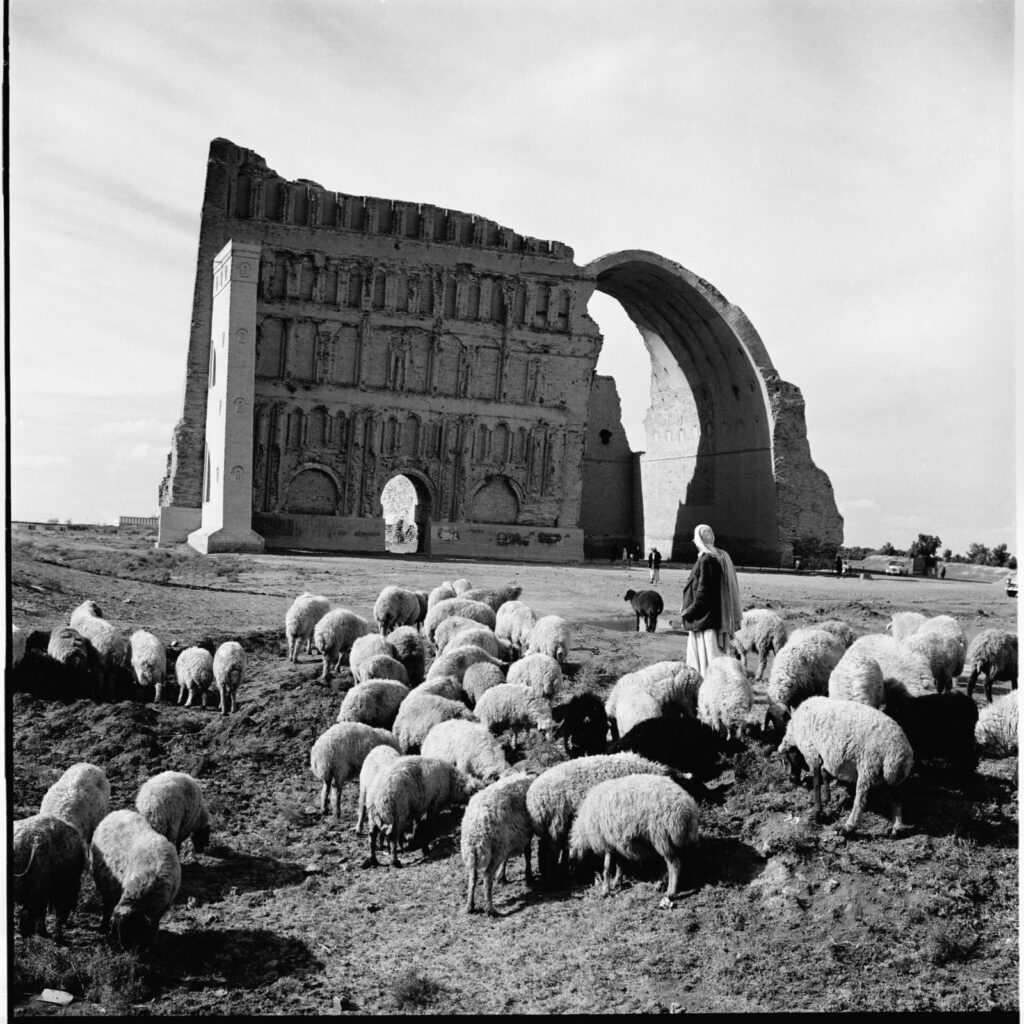
Few buildings have been written about for as long. In the ninth century the Arab poet al-Buhturi wrote a celebrated ode on the ruined hall, the iwan of Kisra, reading in its cracked walls a meditation on the passing of empires. Three centuries later the Persian poet Khaqani wrote his own famous lament on the ruins of al-Mada’in. The arch is a fixture of both literatures, which is part of why Iran and Iraq both take such an interest in it now.
It also became a modern Iraqi symbol. In 1959 the architect Rifat Chadirji built Baghdad’s Unknown Soldier monument as a modern adaptation of the arch; it was demolished in 1982. The Victory Arch in Baghdad, the crossed swords over the parade ground, draws on the same memory of al-Qadisiyyah and the fall of Ctesiphon. Our guide to the Al-Shaheed Monument and Baghdad’s modern landmarks tells that story from the other end.
And it gave its name to a First World War battle. In November 1915 a British-Indian army under Charles Townshend, advancing on Baghdad, fought the Ottomans at Ctesiphon within sight of the arch. After heavy losses on both sides it fell back to Kut, where it was besieged and surrendered in April 1916. That is the “Battle of Ctesiphon” you will find in military histories; it has nothing to do with the Sasanians.
Who excavated Ctesiphon, and where are the finds?
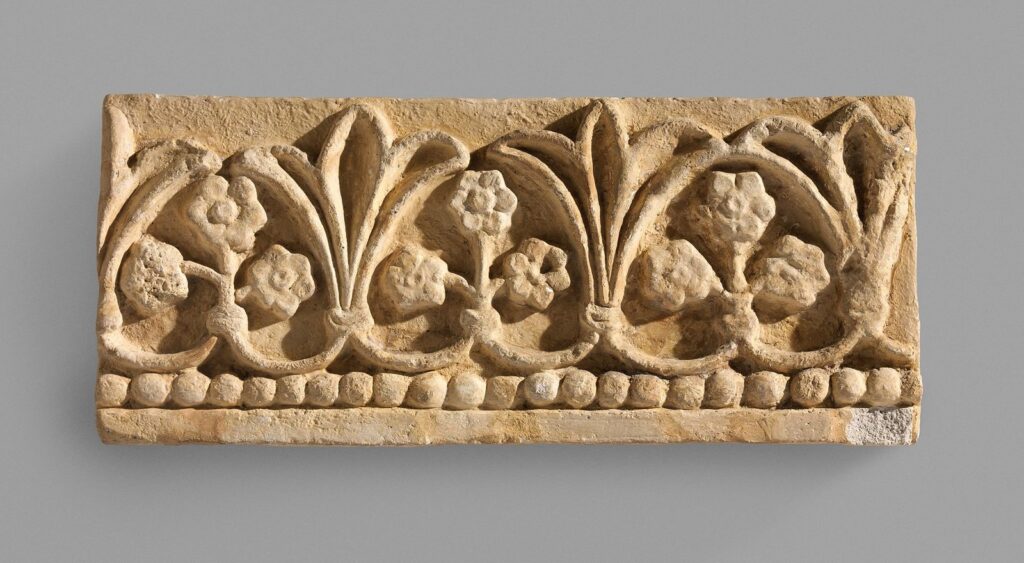
German archaeologists dug at Ctesiphon in 1928–29, and a joint German and Metropolitan Museum of Art expedition followed in 1931–32. Their best-known finds are carved stucco panels from Sasanian houses and palaces: rosettes, vines, birds, rams and royal emblems, cast and carved in plaster. Much of it went to Berlin and New York under the division rules of the time. The Met’s pieces, bought through its Rogers Fund in 1932, include the wall decoration pictured below, dated to about the sixth century.
On the ground, almost everything except the arch has gone back to earth. Seleucia and Veh-Ardashir survive as mounds across the river, and the rest of Ctesiphon is low ridges and scattered brick. The arch is what people come for.
What you see when you visit
The arch stands in a small park of scrub and date palms, and its scale is hard to take in from a distance. The surviving south wing of the façade rises in tiers of blind arches and half-columns, built in fired brick the colour of sand. Beside it the vault opens like a vast mouth, and inside it, since late 2021, stands the scaffolding: a lattice of steel reaching up into the curve. It spoils the famous silhouette and it may be the only reason the arch is still there.
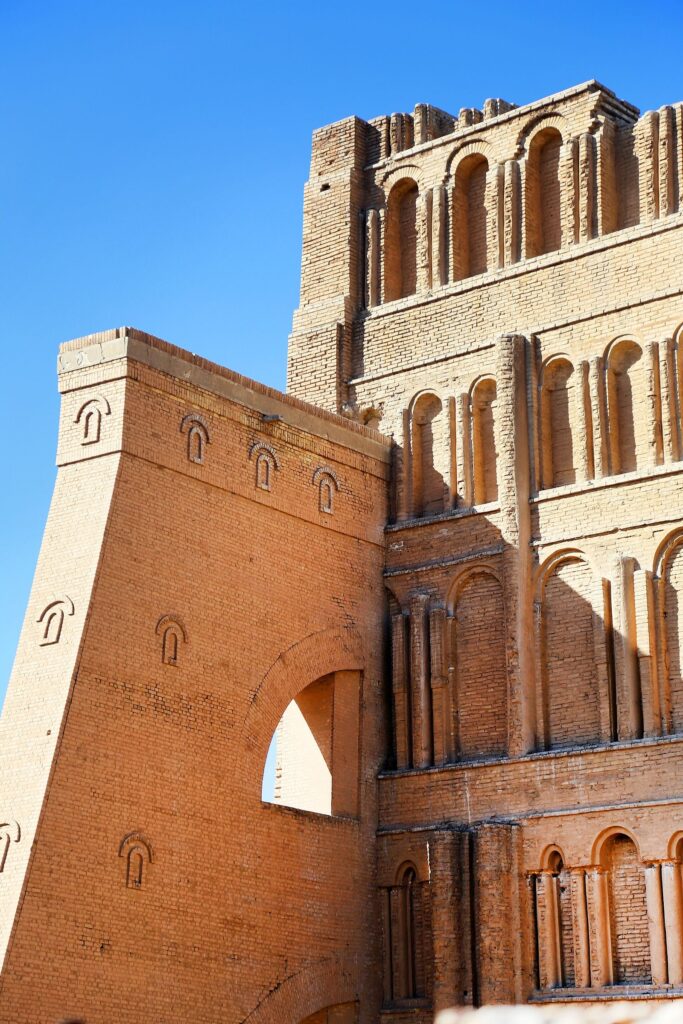
- The façade. Walk its length for the brickwork: the blind arcades, the half-columns and the broken edge where the north wing stood.
- The vault. Stand back to see its profile, and check with any staff present whether the area beneath it is open; we could not confirm current rules.
- The mounds. Low remains of the palace complex and the city spread out around it; there is little to read without a specialist.
- Salman Pak. The town is named after Salman al-Farsi, whose tomb and shrine are there. Whether non-Muslim visitors are welcome inside in 2026 is something we could not confirm, so ask your driver and dress modestly either way.
A short checklist
- Documents. Passport and a printout of your visa for the checkpoints.
- Cash. Small dinar notes, in case a fee or a tip for a guard or guide is expected.
- Sun. Water, a hat and sun cream; the palms shade the park, not the approach.
- Clothes. Covered shoulders and knees, and a scarf if you hope to enter the shrine of Salman al-Farsi.
- Drone. Leave it at home.
Two rules of thumb. Don’t climb anything: the damage from visitors scrambling up for photos is part of the arch’s recent history. And keep photography personal: tourist photos are fine, but drones are, in practice, banned for foreigners and confiscated at customs, and you should never point a camera at the checkpoints on the way. Our list of Iraq’s best photography spots has more ideas for photographers.
How do you get to Ctesiphon from Baghdad?
It is a half-day trip. You need the federal Iraqi visa, applied for on the Government of Iraq’s e-visa portal at least 24 hours before you travel; as of 25 September 2026 the FCDO put the fee at $160 for 60 days, and a Kurdistan Region visa is not valid here. Our guide to the Iraq e-visa walks through the form.
No permit is required for Ctesiphon, and people do reach it independently. In practice that means a taxi or car and driver hired for the morning in Baghdad. Ride-hailing apps work in the city (Baly is the dominant one, Careem also operates), but whether a driver will take a trip out to Salman Pak, wait and bring you back is a matter for negotiation; our guide to getting around Iraq covers the options. A tour removes the negotiation: see our advice on choosing a tour operator in Iraq.
Expect checkpoints leaving Baghdad and on the road south-east. Carry your passport and a printout of your visa, and read our guide to how Iraqi checkpoints work before you set off.
How far is it? The distances disagree
| Source | Distance from Baghdad | What it probably measures |
|---|---|---|
| Iraqi press (Shafaq News), 2026 | About 30 km south | A rounded figure from the city |
| Britannica | About 32 km (20 miles) south-east | The ancient city, likely in a straight line |
| Encyclopaedic sources | 35 km (22 miles) south-east, “in the village of Salman Pak” | The ruins at Salman Pak |
| ALIPH | 40 km south | Probably a road distance from central Baghdad |
None of these sources gives a drive time, and we won’t invent one: traffic out of Baghdad and the number of checkpoints decide it on the day. Plan on leaving early, spending an hour or two at the arch, and being back for lunch.
Ctesiphon, Aqar Quf or Babylon?
Most visitors to Baghdad have time for one or two ancient sites. Here is how the three closest compare, using the figures we hold as of August and September 2026.
| Ctesiphon | Aqar Quf | Babylon | |
|---|---|---|---|
| What you see | The Sasanian arch, under scaffolding | The eroded core of a Kassite ziggurat | Nebuchadnezzar’s city, heavily rebuilt in the 1980s |
| Province | Baghdad (Salman Pak) | Baghdad (Abu Ghraib district) | Babil |
| Distance from Baghdad | 30–40 km south-east (sources differ) | About 30 km west | 85 km south |
| Permit | None | None reported | None; one checkpoint |
| Foreigner’s fee | Not published | Not published | 25,000 IQD (March 2026) |
| UNESCO | Not listed | Tentative List since 2025 | World Heritage since 2019 |
| FCDO (25 Sep 2026) | All but essential travel | All but essential travel | All but essential travel (Jurf al-Sakr: against all travel) |
| Time needed | Half a day | Half a day | A full day, 8–9 hours door to door |
Our full guide to day trips from Baghdad covers these and the harder ones further out, including Samarra, where the FCDO advises against all travel.
When to go
From November to March, and in the morning. From April to October the heat around Baghdad is punishing by midday, and in August 2026 six governorates hit 50°C; the park has some palm shade, the approach and the mounds have none. Dust storms are common in spring and summer. Our guide to the best time to visit Iraq has the month-by-month detail.
Is Ctesiphon safe to visit?
Here is the frame as of late September 2026, so you can weigh it yourself.
- UK. Salman Pak is in Baghdad province, which the FCDO rates against all but essential travel, except Sadr City, where it advises against all travel. Ctesiphon adds no extra grade: it carries the same advice as Baghdad itself. The FCDO’s Iraq travel advice, last updated 22 July 2026, was unchanged when we checked on 25 September 2026.
- US. The State Department’s advisory is Level 4, Do Not Travel, for all of Iraq, reissued on 29 August 2026.
- Insurance. The FCDO warns that travelling against its advice can invalidate your cover. Check the policy wording; our guide to travel insurance for Iraq explains what to look for.
- The wider picture. Iraq’s 2026 has been dominated by the confrontation between Iran and the United States: Iraqi airspace was closed for 38 days from 28 February to 8 April, drones and missiles have repeatedly struck the Kurdistan Region in the north, and the US-led coalition’s mission in Iraq was scheduled to end on 30 September 2026. As of 25 September, the EU’s aviation safety agency was telling European operators not to fly in the Baghdad flight information region until at least 30 September, so check your airline the week you travel.
Salman Pak was heavily contested during the violence of 2006 to 2014, and ISIS came close to it in 2014. Its security today is not assessed separately from Baghdad province’s rating, and nothing in the 2026 reporting we found mentions incidents involving visitors to the arch. For the capital’s picture, read our assessment of whether Baghdad is safe, and for how the advisories themselves work, our guide to the UK and US travel advice for Iraq.
What we could not confirm
- An entry fee. No ministry or SBAH page publishes one, and none of the 2026 reports mentions a ticket. Carry small dinar notes in case.
- Opening hours. None are published. The site appears to work as an open park, but we could not verify gate times.
- Whether you can stand under the vault. With scaffolding in place and work reported in 2026, the area beneath the arch may be fenced. Nothing published says either way.
- The status of the 2026 repairs. The Iraqi team with an Italian expert, reported in May 2026, came to us only through a news summary, and ALIPH’s third grant is still listed as ongoing without an end date.
- The arch’s depth and wall thickness. Figures of 48–50 m deep and about 7 m thick at the base circulate widely, but we could not trace them to a primary source.
- A drive time from Baghdad. None is published by any source we trust.
- Access to the shrine of Salman al-Farsi. Whether non-Muslims may enter, and on what terms, is not documented.
- The 2013 stabilisation. An Iraqi and US-funded stabilisation around 2013, with a World Monuments Fund role, is often mentioned; we could not confirm its details.
Frequently asked questions
Where is Ctesiphon?
On the east bank of the Tigris at Salman Pak, in the Al-Mada’in district of Baghdad province, south-east of the capital. Published distances from Baghdad range from 30 km to 40 km depending on the source and what it measures. The ruins of Seleucia, its twin city, lie across the river.
How big is the Arch of Ctesiphon?
About 37 metres high and 26 metres wide, according to ALIPH, the heritage foundation that has funded its emergency stabilisation. That makes it the largest brick vault built before the modern era. Figures for its depth and wall thickness vary between sources and none has been confirmed against a primary survey, so treat them as approximate.
Who built Taq Kasra?
The Sasanian kings of Iran, but which one is disputed. The name means the Arch of Khosrow, and many scholars credit Khosrow I Anushirvan, who reigned from 531 to 579; others date it to Shapur I in the third century. ALIPH dates it to the sixth century. Nobody has produced evidence that settles the question.
Can you visit Taq Kasra?
Yes. No permit is needed, visitor numbers were rising in 2026, and it makes a standard half-day trip from Baghdad. The vault is propped by scaffolding installed at the end of 2021, so you will not see the clean silhouette of older photographs. No fee or opening hours are published, and the FCDO advises against all but essential travel to Baghdad province.
Is Ctesiphon a UNESCO World Heritage Site?
No, and it is not even on Iraq’s Tentative List, the list of sites a country intends to nominate. When we checked in August 2026 that list held 15 sites and Ctesiphon was not among them, which is surprising for a monument of its fame. Its conservation has been funded mainly by ALIPH, not through UNESCO.
What is the connection between Ctesiphon and Salman Pak?
They are the same place in different eras. Salman Pak is the modern town at the ruins, named after Salman al-Farsi, the Persian Companion of the Prophet who governed al-Mada’in after the Arab conquest and is buried there. Al-Mada’in, “the cities”, is the old Arabic name for Ctesiphon and its neighbours, and the name of the district today.
Is Ctesiphon safe to visit?
As of 25 September 2026 the FCDO advises against all but essential travel to Baghdad province outside Sadr City, which covers Salman Pak, and the US rates all of Iraq Level 4, Do Not Travel. Ctesiphon carries no extra warning of its own. Travelling against FCDO advice can invalidate insurance, so read both advisories the week you go.
What was the Battle of Ctesiphon?
A First World War battle fought in November 1915, when a British-Indian army under Charles Townshend attacked Ottoman positions near the arch on its way to Baghdad. Both sides lost heavily; the British withdrew to Kut, where they were besieged and surrendered in April 1916. It is unrelated to the ancient city’s own wars.
Final thoughts
Taq Kasra has survived by being remembered. Poets wrote about it in Arabic and Persian for a thousand years, a caliph gave up trying to demolish it, and a modern republic borrowed its outline for a national monument. What it has lacked is steady care: for most of the last century the arch was admired from a distance and left to the weather, and the recent history of botched repair, collapse and emergency scaffolding is the result.
That makes a visit now a slightly odd experience. You will see one of the great structures of the ancient world wearing its life-support, and you will not know whether the next decade brings a proper restoration or another collapse. That is still worth a morning, and the more visitors treat it with respect, the stronger the case for looking after it.
If you are in Baghdad for a few days, start with our Baghdad city guide, go south for the older Mesopotamia at the Ziggurat of Ur, and use our overview of Iraq’s ancient sites to plan the rest.
Photo credits
Taq Kasra, Ctesiphon, 2022 (featured image): Safa.daneshvar, Wikimedia Commons (CC BY-SA 4.0). Taq Kasra, 1932: Unknown authorUnknown author (American Colony Photo Department), Wikimedia Commons (public domain). Taq Kasra, 1963: لطيف العاني (Latif al-Ani), Wikimedia Commons (public domain). Sasanian stucco from Ctesiphon, Metropolitan Museum of Art: Metropolitan Museum of Art, Wikimedia Commons (CC0). Taq Kasra façade, 2022: Safa.daneshvar, Wikimedia Commons (CC BY-SA 4.0). All images via Wikimedia Commons under the licences shown.