Last updated: August 2026. The alcohol ban, the 2024 anti-prostitution amendment, Kurdistan’s March 2026 drone directives and Iraq’s emergency numbers all re-checked against primary sources this month.
Buy a cold beer in a Sulaymaniyah shop and nobody blinks. Put the same can in the boot, drive south towards Baghdad, and somewhere on that road you pass out of one legal system into another without crossing a border or showing a passport. Nothing about the can is different. The law around it is. Legal exposure is a real part of the risk picture set out in our honest answer on Iraq safety.
That is the first thing to understand about Iraq laws for tourists: there is no single set of them. Federal statutes, Kurdistan Regional Government legislation, provincial council decisions and the working rules of whoever actually holds a given stretch of ground all sit on top of one another, and which layer applies to you depends on precisely where you are standing when you do the thing. A flat list of prohibitions will be wrong somewhere in Iraq, and usually is.
The reassuring half of that sentence is that the rules which genuinely matter are few, easy to follow, and largely a matter of not doing things you probably were not going to do anyway. The vast majority of visitors never come close to trouble. The unreassuring half is that the handful of ways a well-meaning tourist does get arrested here are not the obvious ones, and two of them look completely harmless at the moment you commit them.
This guide sets out the Iraq laws for tourists that genuinely matter, and it walks through the layers first, because they explain everything else. Then alcohol, drugs and medication, photography and drones, antiquities, same-sex relationships, speech, weapons, money, driving and Ramadan. Then a long section on customs rather than law, which is the part that actually shapes your trip. It closes with emergency numbers, what happens if you are detained, and what your embassy can and cannot do. It is a companion piece to our wider guide to safety in Iraq, which deals with risk rather than rules.
Iraq laws for tourists: the short answer
If you want the Iraq laws for tourists that matter in one screen, this is the compressed version. Everything below is the reasoning, the sourcing and the places where honest sources disagree.
| Question | Answer |
|---|---|
| Is alcohol illegal? | Import, manufacture and sale are banned across federal Iraq. Drinking and possession are not what the statute prohibits. In the Kurdistan Region it is sold openly and legally |
| Biggest genuine legal risk to a tourist? | Antiquities. Picking up a pottery fragment at an archaeological site is a real offence with a real prison history behind it |
| Fastest way to be detained? | Photographing a checkpoint, a soldier, a government building or an airport, or arriving with a drone |
| Drugs? | Trafficking carries death or life. Personal possession is one to three years plus a fine. There is no leniency for foreigners |
| Same-sex relationships? | Criminalised since July 2024, with 10 to 15 years for a same-sex relationship. Transgender expression and gender-affirming care also criminalised |
| Do I have to carry ID? | Yes. Carrying photographic identification is a legal requirement. Carry the original passport, not a photocopy |
| Emergency number? | 911 is the Interior Ministry’s unified line and the only one with a stated translation service. 104 police, 122 ambulance, 115 fire still work |
| Will my embassy get me out? | No. Consular support in Iraq is severely limited, and no government can interfere in Iraqi criminal proceedings |
Four layers of law, and why the answer is always “where exactly?”
Iraq is a federal state that has never fully settled what federal means. The 2005 constitution left large areas contested, the Kurdistan Region legislates for itself in many fields, provincial councils issue their own decisions, and in a number of places the practical authority is an armed group rather than a ministry. All four of those layers produce rules that a visitor can fall foul of, and they do not agree with each other.
| Layer | What it produces | Where it applies |
|---|---|---|
| Federal law | The Penal Code of 1969, the antiquities law of 2002, the narcotics law of 2017, the 2024 anti-prostitution amendment | All 18 governorates on paper, including the Kurdistan Region, though some federal laws need activation by the Kurdistan Parliament |
| Kurdistan Regional Government | Its own personal status act, its own media directives, its own approach to alcohol licensing and customs | Erbil, Sulaymaniyah, Duhok and Halabja |
| Provincial councils and governors | Local alcohol bans, “sanctity” ordinances in the shrine cities, Ramadan closure orders | One governorate, sometimes one district, and rarely published in English |
| De facto local control | Unofficial checkpoints, informal rules on movement, filming and behaviour | Varies. Jurf al-Sakr in Babil is closed even to its own displaced residents |
The practical consequence is that “is X legal in Iraq” is almost always the wrong question. The right one is “is X legal where I will be standing, and who is enforcing it there”. Most summaries of Iraq laws for tourists flatten those four layers into a single list, which is how you end up with advice that is confidently wrong two provinces further on. A guide or driver who works a route daily knows the answer for that route, which is a large part of why so many people travel here with one. That patchwork is also why the Kurdistan Region so often reads as a different country in traveller accounts. Legally, in several respects, it is.
Alcohol: the clearest illustration of the whole problem
What the law actually says
In October 2016, Iraq’s parliament passed a Municipal Revenues Law. Buried in it, at Article 14, was a clause prohibiting the import, manufacture and sale of alcoholic beverages of all kinds, with a fine of not less than 10 million and not more than 25 million dinars, roughly US$7,600 to US$19,000. Traders and Christian MPs have said the clause was inserted at third reading after being objected to in earlier ones. Then the law sat unpublished, and therefore inactive, for more than six years.
It was gazetted on 20 February 2023 as Municipal Revenues Law No. 1 of 2023, and the customs authority was ordered to enforce the import ban in the first days of March. Thirteen constitutional challenges were filed, by alcohol traders, by the Yazidi and Christian MPs whose communities dominate the trade, and by the then president of the republic. On 27 August 2023 the Federal Supreme Court dismissed all of them, by majority, on the ground that the ban breaches no constitutional provision. That ruling was final and binding, and no court has revisited it since.
Note precisely what Article 14 prohibits: import, manufacture and sale. It does not, on its face, criminalise drinking or possessing alcohol. That distinction is why the UK Foreign Office can state, in advice current on 22 July 2026, that it “is not aware of any instances of Iraqi officials stopping travellers carrying alcohol for personal use” while simultaneously warning about fines of up to 25 million dinars.
What actually happens, city by city
In Baghdad, enforcement has been real but patchy, and it has tightened. In November 2024 the ban was extended to social clubs and hotels, the last legally serving venues, through a chain of letters from the Tourism Board, the Interior Ministry and the prime minister’s NGO directorate. In December 2025 the Rusafa police commander announced that Karrada, historically the district for this, was “free of alcohol shops and unlicensed clubs”. Four licensed clubs were reported as still serving legally in the capital at that point. Shafaq News estimated in January 2026 that only 20 to 30 outlets had been closed nationwide since the law took effect, which tells you how much of the trade simply moved rather than stopped. Prices roughly tripled. Delivery replaced shopfronts.
In the Kurdistan Region, none of this happened. The KRG declined to implement the ban from day one, its customs director general stating publicly that federal decisions must pass through the Region’s own council of ministers first. Alcohol is imported, licensed and sold openly in Erbil, Sulaymaniyah and Duhok, and no KRG move to change that could be found for 2024, 2025 or 2026. Because the Region controls its own land borders, essentially all alcohol in Iraq now enters through it, which is precisely why federal checkpoints on the roads south search for it.
In Najaf and Karbala it is not a question. Alcohol has not been legally retailed in either for well over a decade, Najaf having banned it in 2009 citing the sanctity of the governorate, and Karbala operating under a local “sanctity” ordinance that also restricts music and shop displays. Several other provinces have their own bans: Salah al-Din since 2018, with a fresh closure campaign in Tikrit from 12 May 2026; Anbar by provincial council votes in April 2024 and May 2025; Diwaniyah from March 2024.
What a visitor should actually do
Do not bring alcohol into Iraq. Do not carry it between the Kurdistan Region and federal Iraq, which is the single scenario with a documented enforcement record. In February 2026 a lorry carrying hay through an internal checkpoint at Darman was found to be concealing 7,200 cans. Reports from 2025 describe cars belonging to tourists coming down from the Region being searched for bottles. Do not drink in public anywhere in the country, including in a vehicle. If you drink at all, do it privately, in the Kurdistan Region, and not during Ramadan, when Sulaymaniyah and Kalar closed liquor stores outright for the whole month in 2025.
Two footnotes. Baghdad International Airport’s duty-free zone still sells alcohol, which is a genuine and frequently disbelieved oddity of the current arrangement. And no case has been found, in English or Arabic, of a foreign tourist prosecuted over alcohol anywhere in Iraq. Every documented enforcement action has been against an Iraqi trader, driver or shopkeeper.

Drugs, and the medication in your washbag
This part is short because it is not complicated. Narcotics Law No. 50 of 2017 provides death or life imprisonment for importing, exporting, manufacturing or cultivating with intent to traffic. Possession or transport with intent to traffic carries life or a fixed term plus a fine of 10 to 30 million dinars. Possession for personal use is one to three years plus a fine of 5 to 10 million dinars. There is no bail for trafficking offences, an attempt is punished as the completed crime, and vehicles used are confiscated. Customs, airport and postal staff are designated judicial seizure officers, which means an airport bag search is legally a police search.
There is no leniency for foreigners and no sign of any. Of roughly 1,559 people arrested on drug charges in the first quarter of 2025, 194 were foreign nationals. In October 2025 a foreign traveller was arrested at the Shalamcheh crossing near Basra with half a kilo of crystal meth and tramadol pills hidden inside a water filter. The Interior Ministry stated in April 2026 that 349 death sentences had been carried out in drug cases between 2023 and 2026, though Amnesty International’s execution monitoring does not record drug executions in Iraq, so treat that figure as the ministry’s claim rather than an established fact.
The part that catches ordinary travellers is prescription medicine. Iraq has no published list of what you may bring in, in what quantity, with what paperwork. We looked hard for one; it does not exist in any public form, which is itself worth knowing. What the law provides, at Article 18 of the 2017 statute, is that you may possess your own treatment containing controlled substances for purely health reasons, within the quantities your doctor prescribed, and you may not pass it to anyone else.
Iraq’s controlled schedules follow the three UN drug conventions, so codeine, tramadol, morphine and oxycodone are controlled narcotics; Adderall, Ritalin and similar stimulants are controlled psychotropics; benzodiazepines are controlled. Tramadol in particular is treated in Iraq as a street drug rather than a mild painkiller, and it turns up repeatedly in trafficking prosecutions. Pseudoephedrine and ephedrine are precursors, and Iraqi law treats precursors on the same footing as drugs. There is no cannabis or CBD carve-out anywhere in the statute.
Practically: bring only what you need, in the original labelled packaging, with a copy of the prescription and a letter from your doctor naming the medication, the dose and the fact that it is for your personal use. That is standard advice from the Australian and Canadian governments rather than an Iraqi rule, but it is the documentation an official will understand. If you take something in the controlled categories, ask an Iraqi embassy in writing before you fly. Include the paperwork on your packing list for Iraq rather than leaving it to the morning of the flight.
Photography and drones: the most likely way an ordinary tourist gets detained
What not to point a camera at
Start with an honest observation, because it explains why advice on this varies so wildly. There is no Iraqi statute specifically prohibiting tourist photography that we could source, and the UK Foreign Office says nothing about photography in its Iraq advice at all. Australia’s Smartraveller, updated 25 July 2026, is the strongest official statement in existence and says it is illegal to photograph or film government buildings, checkpoints, military bases and embassies, that unauthorised filming in a public place is against the law, and that journalists lacking approvals have been arrested. Canada adds military activity and, importantly, damage or strike sites.
So the enforceable list, as against the theoretical one, is this. Do not photograph checkpoints, soldiers, police, military vehicles, government buildings, airports and their approaches, bridges, oil and gas infrastructure, border crossings, embassies, or anything inside or facing Baghdad’s International Zone. Do not photograph the aftermath of a strike or a downed drone. If you are in any doubt about a building, do not take the picture; nothing you will get is worth the next two hours.
People are a separate matter and mostly a question of manners. Ask. Iraqis are, in general, remarkably relaxed about being photographed and a great many will ask you to photograph them. Women are the exception and the request should be made through a male relative or not at all unless she has clearly invited it, and a refusal is final. Inside shrines and mosques, ask at the gate. The major Shia shrines run their own media operations and there is no published English rulebook for visitors, so the honest answer is that you find out by asking the person at the door.
Drones: leave it at home
The position hardened sharply in 2026. On 24 June 2026 Iraq’s Supreme Judicial Council directed courts to prosecute the manufacture, use or possession of drones deployed in illegal activities under the Anti-Terrorism Law, and the directive does not define a threshold for civilian or hobby use. That is the most severe body of criminal law Iraq has. Separately, the civil aviation authority’s stated position is that drone operations are simply not regulated, with no registration, no licence and no published permit route, while aggregator sources record that foreign visitors’ drone flights are not permitted and that drones are confiscated at the point of entry, including at Erbil airport. Australia states that individuals flying drones without permission have been detained.
In the Kurdistan Region there is a second, distinct rule that catches ordinary people rather than only pilots. Two directives, on 7 and 18 March 2026, issued after waves of drone attacks on Erbil and Sulaymaniyah, prohibit publishing images or footage showing the launch or direction of drones and missiles, revealing where they land, showing damaged sites, or filming or distributing images of intercepted drones and their wreckage. The 7 March directive applies expressly to social media users, not only to media outlets, and the 18 March one puts enforcement in the hands of the Kurdistan Counter-Terrorism Service. The Foreign Office carries this in its travel advice. If you are in the Region during an incident, do not post the video. If you come across debris, do not approach or touch it, and do not photograph it. For the wider security picture behind those directives, see our guide to safety in Iraqi Kurdistan.
What actually happens if you are caught
Here we have to be careful, because the internet is full of confident detail that no source supports. We could not find a single dated, documented account of a tourist being detained in Iraq over a photograph. What is documented is the treatment of journalists, and it is not gentle: in July 2025 Kurdish security forces detained three reporters in Duhok while they were broadcasting live, held them over 25 hours, beat them, forced them to unlock their phones and returned the devices with all data erased.
The realistic expectation, built from that pattern rather than from tourist anecdote, is that a soldier notices, you are taken aside, your phone is examined, images are deleted, and you answer questions for anywhere from a few minutes to several hours while somebody more senior decides you are a nuisance rather than a threat. A large camera body, a tripod or a gimbal makes you look like a journalist rather than a tourist, and journalists is the category with the documented arrest record. Put the phone away at checkpoints and this whole section stops applying to you. Our guide to getting around Iraq covers what checkpoints are actually like.

Antiquities: the one that catches good people
This is the most serious legal risk a well-meaning tourist can stumble into in Iraq, and it is worth the space.
The Antiquities and Heritage Law No. 55 of 2002 defines an “antiquity” as anything made by human hand that is not less than 200 years old. Not 150, which is a figure that circulates widely and is wrong. Anything younger with historical, national, religious or artistic value is “heritage material”, a separate and less severely punished category. Article 17 prohibits possession of any movable antiquity by any person. Article 15 extends protection to mounds and to artefacts scattered on the surface of the soil at sites that have never been gazetted, so “it wasn’t fenced or signposted” is not a defence on the face of the statute. Article 19 goes further and obliges anyone who finds an antiquity to report it within 24 hours.
There is no exception for small things. Age is the only test the statute applies. A fingernail-sized fragment of 4,000-year-old pottery is legally an antiquity in exactly the way a complete tablet is. And the penalties climb steeply the moment you head for an airport: possession runs to 10 years, minor breaches such as graffiti or interfering with a site carry up to two years and a fine, and Article 41 provides execution for anyone who exported, or intended to export, an antiquity from Iraq. That death penalty has, as far as any public record shows, never actually been imposed for an antiquities offence, and Iraqi commentators have described a fine as the normal outcome for a few sherds. It remains the statutory ceiling, and prosecutors have charged foreigners on that basis.
The case everybody in Iraqi tourism knows
On 20 March 2022, Jim Fitton, a 66-year-old retired British geologist on an organised archaeology tour, was arrested at Baghdad airport as his group prepared to fly home. Twelve stones and pottery fragments picked up at Eridu, a Sumerian site in Dhi Qar, were in his luggage, wrapped in tissue in his shaving kit. He had made no attempt to conceal them. He had, by his family’s account, collected them alongside his tour leader and in the presence of representatives of the State Board of Antiquities and local police.
He was sentenced to 15 years on 6 June 2022. The judge, Jaber Abdel-Jabir, reduced it from the maximum only on account of his age. When Fitton argued that the site had no signs, fences or guards, the judge’s answer was: “These places, in name and by definition, are ancient sites. One doesn’t have to say it is forbidden.” When Fitton pointed out that some fragments were no larger than his fingernail: “Size doesn’t matter.” His conviction was quashed on appeal on 26 July 2022 for lack of criminal intent and he reached his family in Malaysia three days later, having spent about six and a half weeks in Rusafa prison and missed his daughter’s wedding. A German traveller arrested with him was acquitted. Their 85-year-old tour leader, Geoff Hann, suffered a stroke at the end of the trip, was barred from leaving the country pending questioning, and died in a Baghdad hospital that April.
No comparable case involving a foreigner has been publicly reported since. That is genuinely reassuring and also not a guarantee, since a brief airport detention would rarely make the news.
What this means at Babylon, Ur and everywhere else
Do not pick anything up. Not a sherd, not a brick fragment, not a bitumen lump, not a “just to look at it and put it back” that ends up in a pocket. Do not scratch or write on anything. The Antiquities and Heritage Police keep a permanent presence at Ur and Uruk and patrol Eridu, and Babylon has a station near the site.
Buying is no safer than collecting. Genuine old coins and manuscripts may only be possessed if they are registered with the antiquities authority, and may only be transferred to an Iraqi citizen resident in Iraq, which means a foreign visitor cannot lawfully acquire one at all. Even trafficking a counterfeit antiquity without permission is an offence, so a fake Babylonian cylinder seal from a souk is not automatically safe. Canada’s advice names the trap most people would not think of: it is forbidden to take antiquities, archaeological finds or antique carpets out of Iraq. If a rug, a coin, a manuscript leaf or a brass piece looks old, assume it needs paperwork that does not exist for tourists, and buy something that is obviously new instead. Departure screening at Baghdad is looking for exactly this. If you want the history without the legal exposure, our guide to ancient Mesopotamia and the regional guide to southern Iraq cover the sites themselves.

Same-sex relationships and transgender travellers
Iraq criminalised same-sex relationships in 2024. The Council of Representatives passed the amendment on 27 April 2024, the president ratified it on 27 June, and it was published in the official gazette and entered into force on 1 July 2024 as Law No. 15 of 2024, renaming the 1988 anti-prostitution law as the Law on Combating Prostitution and Homosexuality.
The penalties are these. Establishing a same-sex relationship: 10 to 15 years’ imprisonment. Promoting prostitution or homosexuality by any means: around seven years plus a fine of 10 to 15 million dinars, roughly US$7,500 to US$11,500. Sources genuinely conflict on whether that seven years is a floor or a ceiling, with the UK and the ILO’s legislative database reading it as a maximum and Canada and several news agencies as a minimum, so treat the number as approximate and the exposure as serious either way. Undergoing or performing gender-affirming treatment, and “imitating women” in public, defined as wearing makeup and women’s clothing: one to three years. The law also disapplies the Penal Code’s mitigating-circumstances provisions, so there is no judicial route to leniency. Organisations promoting LGBT rights are banned and the media regulator is required to prevent online promotion. A death penalty appeared in an earlier draft and does not appear in the enacted text.
The sentence with the most practical bite for a traveller is the Foreign Office’s: if the Iraqi authorities consider your actions, clothing or other items to promote LGBT identities, you could be imprisoned for up to seven years and fined.
Two things need saying plainly alongside that. First, no prosecution under this law has been documented by anyone, anywhere, in 2024, 2025 or 2026. Human Rights Watch, the EU Agency for Asylum and the Human Dignity Trust have all surveyed the period and none records a case. What is documented, extensively, is discretionary police action, armed-group violence, extortion and killings, prosecuted where at all under vague public-decency articles that long predate the amendment. Second, the Kurdistan Region’s position is legally unresolved rather than liberal: the Kurdistan Parliament’s own legal adviser said in June 2024 that the federal law required activation by that parliament to apply, and no source covering 2025 or 2026 confirms whether it has been. Policing on the ground in the Region is not documented as gentler.
On dating apps, the only substantial evidence base is a 2023 Human Rights Watch investigation which documented 20 cases of online entrapment by security forces on Grindr and Facebook across Egypt, Iraq and Jordan, 16 of them ending in arrest, plus 17 cases of extortion by private individuals and 32 cases of online death threats by armed groups in Iraq specifically. In six extortion cases the victims went to the police and all six were themselves arrested. The single most detailed case in the report is a Sulaymaniyah entrapment run by KRG security officers. No government travel advisory mentions dating apps in Iraq at all. Draw your own conclusions about using them here; the sourced facts do not support treating it as low risk.
Relationships, hotels and unmarried couples
A point that is widely misstated: consensual sex between two unmarried adults is not an offence under the Iraqi Penal Code. The adultery articles, 377 to 380, all require one party to be married, and prosecution requires a complaint by the other spouse within three months. The only adult offence in the vicinity punishes a man who seduces a woman over 18 with a promise of marriage and then refuses to marry her, and it turns on the broken promise. The vaguer hook is Article 401, which punishes an “immodest act in public” with up to six months, and is undefined. Keep public affection to nothing at all and it never arises.
Hotels are a different question, governed by practice rather than statute. We could find no law requiring a hotel to demand a marriage certificate. Australia’s advice notes that hotels may not allow couples to stay without proof of marriage, and the consistent thread across traveller reports is that this is applied by appearance and documentation rather than by marital status: foreign couples checking in on foreign passports are very rarely asked, international and five-star properties effectively never ask, and mid-range or budget local hotels, especially in the shrine districts, often refuse couples who read as Iraqi. Since December 2025 hotels in Baghdad and several governorates have been electronically linked to the intelligence service and the Tourism Security Directorate, so assume your details are registered. If it matters to your trip, book the more expensive property and ask before you arrive. Our guide to where to stay in Iraq covers the tiers.
The real risk in this area does not fall on a foreign couple at all. It falls on an Iraqi partner, and it is family and community rather than the state. That is a much heavier thing and deserves to be named rather than skated over.
On ages, for completeness: the legal marriage age under the 1959 personal status law is 18, or 15 with a judge’s permission, and 16 in the Kurdistan Region under its own 2008 act. A 2025 amendment allowing couples to opt into a separate religious code, gazetted in October 2025, contains no numeric minimum, and the tension between the two texts has not been resolved by any court. Before the alcohol ban the World Health Organization recorded Iraq’s legal drinking age as 21; since sale became illegal in federal Iraq the question is largely moot there.
Speech: religion, the state, and your phone
Iraq prosecutes speech, and it does so increasingly through social media. Article 372 of the Penal Code punishes attacking a creed, pouring scorn on religious practices, desecrating sacred objects or publicly insulting an object of veneration, with up to three years or a fine. The text speaks of religious minorities but the courts apply it to the majority faiths and to “the divine entity” generally: in October 2025 a TikTok influencer was detained in Kirkuk under Article 372 for remarks made during a live broadcast, and in May 2026 the media regulator banned a television presenter from all Iraqi media for 30 days over an on-air comment held to insult the divine.
Criticism of the state carries more. Article 226 provides up to seven years for publicly insulting the National Assembly, the government, the courts, the armed forces or any other constitutional body or public authority. Article 229 covers insulting or threatening an official in the execution of their duties, with two years generally and three where a judge or court is the target, though the Supreme Judicial Council’s own public summary states three years for insulting a state employee in any position. These are prosecuted as offences against the public right, meaning the state can pursue them without a private complainant.
The workhorse of the current crackdown is Article 403, which punishes producing, importing, publishing or possessing material violating public integrity or decency with intent to distribute, with up to two years. An Interior Ministry committee formed in January 2023 has driven the campaign; official figures given to Shafaq News in April 2025 record more than 1,500 morality-linked cyber cases since 2023 and more than 200 arrests, with over 500 violations and 75 arrests in the first quarter of 2025 alone. The people prosecuted have overwhelmingly been Iraqi content creators, several of whom have been killed by gunmen after being publicly named.
No case has been documented, between 2023 and 2026, of a foreign tourist, expatriate or foreign influencer being arrested, charged or deported by Iraq over social media content or “insulting” material. That is an absence of reported cases rather than a guarantee. Australia’s advice is nonetheless explicit: travellers have been arrested for things they have said on social media, and you should not comment on local or political events online while you are here. The practical version is simple. Do not post opinions about Iraqi politics, security forces, militias, religious figures or sectarian questions while you are in the country, and do not argue about them on camera. There is no upside.
Weapons, driving, money
Weapons
Arms Law No. 51 of 2017 licenses Iraqi citizens over 25 to possess one light weapon per family, a pistol with 50 rounds and a rifle with 200. The Interior Ministry’s own spokesman has put the key point bluntly: the ministry permits ownership of firearms, not the carrying of them. There is no lawful civilian carry. Foreign nationals carrying weapons need a Weapon Authority Card, and the Foreign Office states that foreign nationals have been arrested for failing to produce the correct documentation when asked. That provision is aimed at private security contractors, but it is official confirmation that armed foreigners get arrested over paperwork.
For a tourist the rules are: do not handle a weapon, do not pose with one, do not accept an invitation to fire one, and do not travel with so much as a single stray round. Erbil airport’s own guidance says guns and ammunition are totally prohibited even in checked hold baggage. Iraq seized 54,227 weapons in the first quarter of 2026 alone and arrested 359 people for celebratory gunfire in the same period, which gives you a sense of how much hardware is in circulation. Separately, and importantly outside cities: do not pick up metal objects in rural or former front-line areas. Roughly 4,800 square kilometres of Iraq remain contaminated with mines and unexploded ordnance.
Drinking and driving
Iraq’s codified blood alcohol limit is 0.04 per cent under Traffic Law No. 8 of 2019. The head of Kirkuk’s external traffic directorate described the penalty in December 2025 as a 500,000 dinar fine, around US$350, plus a year’s imprisonment and revocation of the licence, as breathalysers were deployed on the Kirkuk-Baghdad highway for the first time. Because alcohol is separately illegal to sell across federal Iraq, any drinking driver there is already committing a second offence, and Canada’s advice describes the position as zero tolerance. Enforcement in the Kurdistan Region is older and denser. Do not drive here after drinking, and given that Iraq recorded 2,351 road deaths in 2025, think hard before driving at all rather than hiring a driver.
Cash and currency
On entering or leaving Iraq you must declare all local currency over 200,000 Iraqi dinars and all currency or items valued over US$10,000 or the equivalent. The dinar threshold is worth about US$130 at 2026 street rates, so almost anyone carrying Iraqi cash is over it, and almost nobody knows. The system is declare-on-entry and match-on-exit rather than a hard cap: Canada’s wording is that you cannot leave with more than US$10,000 unless you declared it when you arrived. Airline-facing customs data gives a separate export ceiling of 100,000 dinars for residents, which is a different concept and commonly conflated, so the safe rule is to declare anything over 200,000 dinars and not to attempt to carry more than 100,000 dinars out unless you declared it inbound.
Iraq is a cash economy and foreign cards are unreliable. The trap worth knowing is that ATMs dispense at the official rate while the street rate runs 15 per cent or more better, so withdrawing from a machine costs you that spread plus a withdrawal fee. Bring clean, undamaged US dollars dated 2006 or later in mixed denominations and change them at an established exchange house or your hotel. There is more detail in our breakdown of what a trip to Iraq costs, and the customs and declaration side is covered in the Iraq entry requirements guide.
Ramadan, and a legal technicality worth understanding
Here is something no competitor page seems to have noticed. Iraq has no article of its Penal Code criminalising eating, drinking or smoking in public during Ramadan. The Law Library of Congress lists eight Arab states that do have a codified Ramadan offence, and Iraq is conspicuously not among them. The prohibition is created annually by Interior Ministry directive and enforced through Article 240, a generic provision punishing anyone who violates orders issued by a public authority with six months to a year, or a fine. Iraqi lawyers describe public fast-breaking as an “observable crime”, permitting immediate arrest with the possibility of bail.
That technicality changes nothing about how you should behave. The 2026 directive, issued on 15 February, imposed an absolute prohibition on openly breaking the fast during fasting hours and stated that it covered citizens and foreign residents without exception. It banned the circulation of alcohol for the whole month, closed restaurants, cafés and hotel social clubs during fasting hours except licensed premises trading from iftar to dawn, and warned that penalties for non-Iraqis may include a ban on working in Iraq and deportation. Campaigns in the southern provinces during Ramadan 2026 resulted in dozens of detentions, though no named case of a foreign tourist being fined or charged over this could be found, in any Ramadan, ever.
The Foreign Office’s behavioural list is the most useful, and includes two details most articles miss: do not drink, smoke or chew gum in public in the daytime, including in your car, and do not play loud music, dance or swear in public. Hotels and restaurants serving during fasting hours may screen you off from other guests, which is a courtesy rather than a slight.
The Kurdistan Region is softer in practice if not in principle. Erbil governorate issued its own decree in 2022 permitting restaurants to serve if fully screened, and by 2026 restaurant owners in Sulaymaniyah were describing daytime restrictions as voluntary, with curtained entrances a common practice even without directives. A visibly foreign traveller will usually be served behind a curtain in the Region during daylight. In Baghdad and the south, assume nothing is open before iftar.
Ramadan 2026 ran from 19 February to around 19 March. Ramadan 2027 is expected to begin on or around 7 February, with Eid al-Fitr around 9 March, confirmed only by moonsighting a day or two ahead, and Iraqi communities regularly start a day apart from each other. If you would rather not travel during it, our guide to the best time to visit Iraq maps the year.
Customs, which are not laws, and matter more day to day
Nothing above will shape your trip half as much as this section. Iraqi social custom is generous, formal and much warmer than the legal apparatus suggests, and a visitor who gets a few things right is treated extraordinarily well. None of it is difficult.

Hospitality, and the ritual of refusing
You will be offered things constantly: tea, food, a seat, a lift, a place to stay, help you did not ask for. The convention is that an offer is made more than once and a first refusal is not taken as final. A polite “no thank you” is often the opening move rather than the end of the conversation, and the offer will be repeated, sometimes twice more. If you genuinely mean no, decline warmly and repeatedly. If you mean yes but felt you should demur first, that is exactly the expected shape of the exchange.
Tea is the constant. Small waisted glasses called istikan, dark, sweet, and produced at every possible opportunity in shops, offices and homes. Accepting tea costs you ten minutes and buys enormous goodwill. Refusing it outright reads as a rebuff. If you cannot drink it, take the glass, hold it, sip once and apologise for being slow.
One quiet piece of etiquette that surprises people: do not admire an object too warmly in someone’s home. Praising a bowl, a rug or a piece of jewellery with real enthusiasm can oblige the host to give it to you, and refusing then becomes its own awkwardness. Admire the room, not the item.
Shoes, hands and the small stuff
Take your shoes off when entering a home, unless you are clearly told not to, and always when entering a mosque or a prayer room. Eat and pass things with the right hand; the left is for washing and handing someone food with it lands badly, particularly with older people. Do not point the sole of your foot at anyone, which means watching how you cross your legs on a low seat. Do not point with a single finger.
Greetings are longer than you expect and it is rude to hurry them. Ask after health and family before business. Handshakes between men are common and often held; a man should not offer his hand to a woman unless she offers first, in which case take it. A hand placed on the heart is a graceful universal substitute. Dress conservatively, meaning covered shoulders and knees for everyone and long sleeves for women in the shrine cities, where an abaya is usually provided at the entrance.
Mosques, shrines and non-Muslim visitors
Non-Muslims can visit the great Shia shrines at Najaf, Karbala and Kadhimiya, though the position varies by shrine, by day and sometimes by who is on the door, and the shrines publish no English rulebook. Go with someone who knows the current arrangement. Women cover fully, including hair, and abayas are handed out at the gate. Everyone removes shoes. Phones and cameras may be checked at security. Do not walk in front of someone praying, do not turn your back on a tomb when leaving a chamber, and follow whatever the crowd is doing rather than improvising. If you are asked not to enter somewhere, that is the end of it; no amount of politeness overturns it, and pushing embarrasses the person who has to enforce it. The pilgrimage guide goes into the shrine cities in much more depth.

Muharram, Ashura and processions
For the first ten days of Muharram, and again at Arbaeen forty days later, large parts of Iraq are in formal mourning. Black banners go up, black clothing is widespread, music stops in many places, and processions move through the streets with chanting, chest-beating and, in some, self-flagellation. Arbaeen 2026 fell on 5 August and drew more than 22 million people to Karbala, around five million of them from abroad, which is the largest annual gathering on earth.
How to behave around it: wear dark or muted colours, do not wear bright red, do not eat, drink or smoke in the street while a procession passes, do not dance or play music, and do not put yourself in the middle of a procession for a photograph. Ask before filming; pilgrims film constantly and are generally relaxed about it, but the moment somebody is not, stop. Accept the food and water handed out along the routes if it is offered to you, because refusing a mawkib’s hospitality is a genuine slight. Do not treat any of it as spectacle. People are grieving an event they experience as present tense, not performing one.
Condolences, invitations and who pays
If you are anywhere near a bereavement, the expected form is to attend briefly, say a short set phrase, sit for a few minutes and leave. Your host will not expect eloquence from a foreigner. Presence is the point.
Then the thing every visitor to Iraq runs into: Iraqis will pay for you. For lunch, for the taxi, for the entry ticket, for the tea, occasionally for things you did not know you were getting. Arguing about it hard, in public, in front of others, will not win and can embarrass your host, because paying is a claim to the role of host and being refused it is a small loss of face. The graceful sequence is a genuine attempt to pay, a second attempt, and then gracious acceptance with thanks. Reciprocate later and elsewhere: get the next round, buy something for the family, pay for the driver’s meal, bring a gift from home. If you want to pay for a real meal, arrange it quietly with the waiter before the bill arrives. Our guide to Iraqi food is a good primer on what you are likely to be fed, and the broader Iraqi culture guide goes deeper into all of this.
Emergency numbers in Iraq, and what to do if things go wrong
The information environment here is poor. Sources contradict each other, one major government advisory still states that Iraq has no centralised emergency number, and the pages ranking for emergency numbers Iraq are mostly a couple of dozen words long with no date and no source. Here is what can actually be corroborated.
| Number | Reaches | Notes |
|---|---|---|
| 911 | Interior Ministry unified emergency line | The one to try first in federal Iraq. Free, works via roaming for foreign visitors, and the directorate says it offers instant translation in six languages. Rolled out in Baghdad from August 2025; nationwide coverage is claimed but not confirmed by a primary source |
| 104 | Police | The legacy police line and the most consistently corroborated number in Iraq. Works in the Kurdistan Region too. Assume Arabic, or Kurdish in the Region |
| 122 | Ambulance and medical emergency | In Erbil this is run by the governorate’s health directorate and is free, including transport. Corroborated across federal Iraq as well |
| 115 | Fire and civil defence | Consistent across every source checked |
| 130 | Traffic police | Verified for the Kurdistan Region. Unverified for federal Iraq, where one operator lists it only as a hotline |
| 112 | Uncertain | Described by the US State Department as a national hotline, but several sources say it does not reliably work in Iraq. Do not depend on it |
Do not assume 911 reaches a dispatcher in the Kurdistan Region. It is a federal Interior Ministry system and the KRG runs its own interior ministry; no source confirms it works there. In the Region, 122 is the number the KRG itself publicises. Assume the legacy lines answer in Arabic or Kurdish only, keep your hotel’s front desk and your guide’s number saved, and have an Arabic speaker you can put on the phone. The bottleneck in real emergencies, according to the KRG’s own reporting, is not language but the caller being unable to describe where they are. Save your accommodation’s location in your phone and make sure you have a working local number; see our guide to SIM cards and data in Iraq.
If you are detained
Iraqi law requires an investigative judge to question a detainee within 24 hours of their presentation, and the constitution requires the investigation file to reach a judge within 24 hours of arrest, extendable once. British and American government guidance both describe the practical position as 24 hours extendable to 72 before formal indictment. UN monitoring found the real-world range runs from under 24 hours to six months, with most cases falling between three or four days and several weeks. Once an investigative judge orders detention it can be renewed in 15-day blocks, and for offences carrying the death penalty it can be extended for as long as the investigation requires.
You have the right to remain silent with no adverse inference, and the right to an attorney, and questioning is not supposed to begin until you have one. Iraq acceded to the Vienna Convention in 1970 without reserving the consular notification article, so on request the authorities must notify your embassy without delay. The Foreign Office’s own prisoner pack for Iraq is franker about how that works: notification to the embassy by the Iraqi authorities normally takes place several weeks after arrest, friends and relatives usually reach them far faster, and in Iraq you do not have the right to make a telephone call when you are arrested.
So: be polite, be patient, do not argue, do not attempt to delete anything from your phone in front of anybody, ask clearly and repeatedly for your embassy to be notified, and get a message to someone outside as early as you can. If a guide, driver or hotel knows where you are, that is your fastest channel.
Your embassy, and the limits of what it can do
Every relevant government describes its ability to help in Iraq in strikingly weak terms. The UK says consular support is severely limited in areas where it advises against travel, which after the July 2026 revision means all 18 governorates. The United States cites its limited ability to provide emergency services and tells citizens to have departure plans that do not rely on government assistance. Australia says its ability to provide consular services in Iraq is extremely limited. Canada says very limited, and warns that if Iraqi authorities consider you an Iraqi citizen they may refuse consular access altogether, which matters to dual nationals. Ireland has no resident embassy and covers Iraq from Amman. New Zealand states flatly that it will not arrange an evacuation.
What no consulate anywhere can do is get you out of prison, interfere in criminal proceedings, give you legal advice, pay your legal bills, translate documents or investigate a crime. What they can do is notify your family, provide a list of local lawyers, visit you in detention subject to Iraqi approval, and raise mistreatment. The UK publishes two separate prisoner packs for Iraq, one federal and one for the Kurdistan Region, which is a small but telling reminder that you may be inside one of two different systems.
Keep your government’s 24-hour emergency line saved offline before you fly. It will be a number in your own capital, not in Baghdad. Note too that travelling against your government’s advice will invalidate most standard policies, which is the other reason to read our guide to travel insurance for Iraq before you book anything.
What a fixer or tour operator can and cannot do
A great deal, informally, and nothing at all, formally. No Iraqi, British or American source gives a tour operator, guide or fixer any recognised standing in a criminal file. They cannot represent you, cannot speak for you to an investigative judge, and are not your sponsor in any legal sense once you are on an ordinary tourist e-visa.
What a good operator genuinely provides is speed and access: they will know within minutes, they can reach your embassy and your family far faster than the Iraqi system will, they can put a licensed Iraqi lawyer in the room, and they know which checkpoint commander to talk to about a misunderstanding before it becomes a file. That is worth a great deal and is a serious argument for booking through an established Iraq operator rather than improvising, particularly if you are travelling solo.
One myth worth killing while we are here. You do not need to register with the police within seven or ten days of arrival. The Foreigners’ Residence Law sets a 15-day registration requirement and expressly exempts holders of visit and tourist visas. The genuine ten-day rule is a blood test for HIV and hepatitis, required within ten days of arrival and repeated every 90 days, and not required if you are on a visit visa. Details of what you actually need are in our Iraq visa guide.
Frequently asked questions
Can tourists drink alcohol in Iraq?
Legally, the ban covers import, manufacture and sale rather than drinking or possession, and the Foreign Office says it is not aware of officials stopping travellers carrying alcohol for personal use. In practice: drink privately in the Kurdistan Region if at all, never in public anywhere, never during Ramadan, and never carry it on the road between the Region and federal Iraq.
What are the emergency numbers in Iraq?
Try 911 first in federal Iraq, which is the Interior Ministry’s unified line, is free on roaming for foreign visitors and offers translation. The legacy numbers still work: 104 for police, 122 for ambulance, 115 for fire and civil defence. In the Kurdistan Region use 104, 122 and 115, and do not assume 911 reaches a dispatcher there.
What should I not do in Iraq?
Do not pick anything up at an archaeological site, do not photograph checkpoints, soldiers or government buildings, do not bring a drone, do not carry alcohol between regions, do not post about Iraqi politics or security while you are in the country, and do not eat, drink or smoke in public during Ramadan daylight hours. Everything else on the usual lists is manners rather than law.
Is it illegal to take photos in Iraq?
Not generally, and the UK’s advice does not mention photography at all. Australia’s does, and states that photographing government buildings, checkpoints, military bases and embassies is illegal and that unauthorised filming in public places is against the law. Treat ordinary street and site photography as fine, and anything with a uniform, a barrier or a government building in it as off limits.
Can I bring my prescription medication into Iraq?
Iraq publishes no list of permitted or banned medicines, which makes this genuinely uncertain. The statutory test is that you may possess your own treatment for health reasons, in the quantity prescribed, and may not give it to anyone else. Bring original packaging, a copy of the prescription and a doctor’s letter, and ask an Iraqi embassy in advance if your medication is an opioid, a stimulant or a benzodiazepine.
Are unmarried couples allowed to share a hotel room in Iraq?
There is no statute requiring a marriage certificate, and consensual sex between unmarried adults is not a Penal Code offence. Foreign couples on foreign passports are rarely questioned, particularly at international-standard hotels. Budget and mid-range hotels, especially in the shrine districts, often refuse couples who read as Iraqi. Ask when you book.
Is it safe for LGBT travellers to visit Iraq?
Same-sex relationships have been criminalised since July 2024, with 10 to 15 years’ imprisonment, and there are separate offences covering promotion and transgender expression. No prosecution under that law has been publicly documented, but discretionary policing, armed-group violence and dating-app entrapment are all documented. Every relevant government advisory tells LGBT travellers to consider the risks very carefully.
Do I need to carry my passport in Iraq?
Yes. Carrying photographic identification is a legal requirement and checkpoints are frequent on city streets and main roads. Carry the original rather than a photocopy, keep a digital copy stored separately, and note that if your passport is lost or stolen you are legally required to publish the details in two local newspapers after reporting it, and may be refused an exit stamp until you do.
Final thoughts
The honest summary is that Iraq’s legal landscape looks alarming written down and is almost entirely irrelevant to a normal trip. Nobody is going to arrest you for taking a picture of a mosque, drinking tea with a stranger, or getting the greeting slightly wrong. Of all the Iraq laws for tourists set out above, the genuinely risky ones come down to a short list and every one of them is a decision you make deliberately: putting a fragment in your pocket at Ur, pointing a lens at a checkpoint, packing a drone, carrying beer past a federal checkpoint, arguing about Iraqi politics on the internet from a hotel in Baghdad.
What deserves more of your attention than the criminal code is the part of this article that is not law at all. The customs are not a compliance exercise; they are how a country that has been badly treated by outsiders for two generations decides whether you are one of the good ones. Accept the tea. Take your shoes off. Let the man pay for lunch and get him back tomorrow. That currency buys you more in Iraq than anything in your wallet.
If you are still working out whether to come at all, start with our assessment of whether Iraq is open to tourists and the practical groundwork in the complete Iraq travel guide. When you are ready to build a route, the suggested Iraq itineraries and the collected travel tips for Iraq will save you a fortnight of forum reading. Two related reads: solo female travel in Iraq covers dress and behaviour in more depth, and our checkpoints guide explains the ID rules you will meet daily.
Photo credits
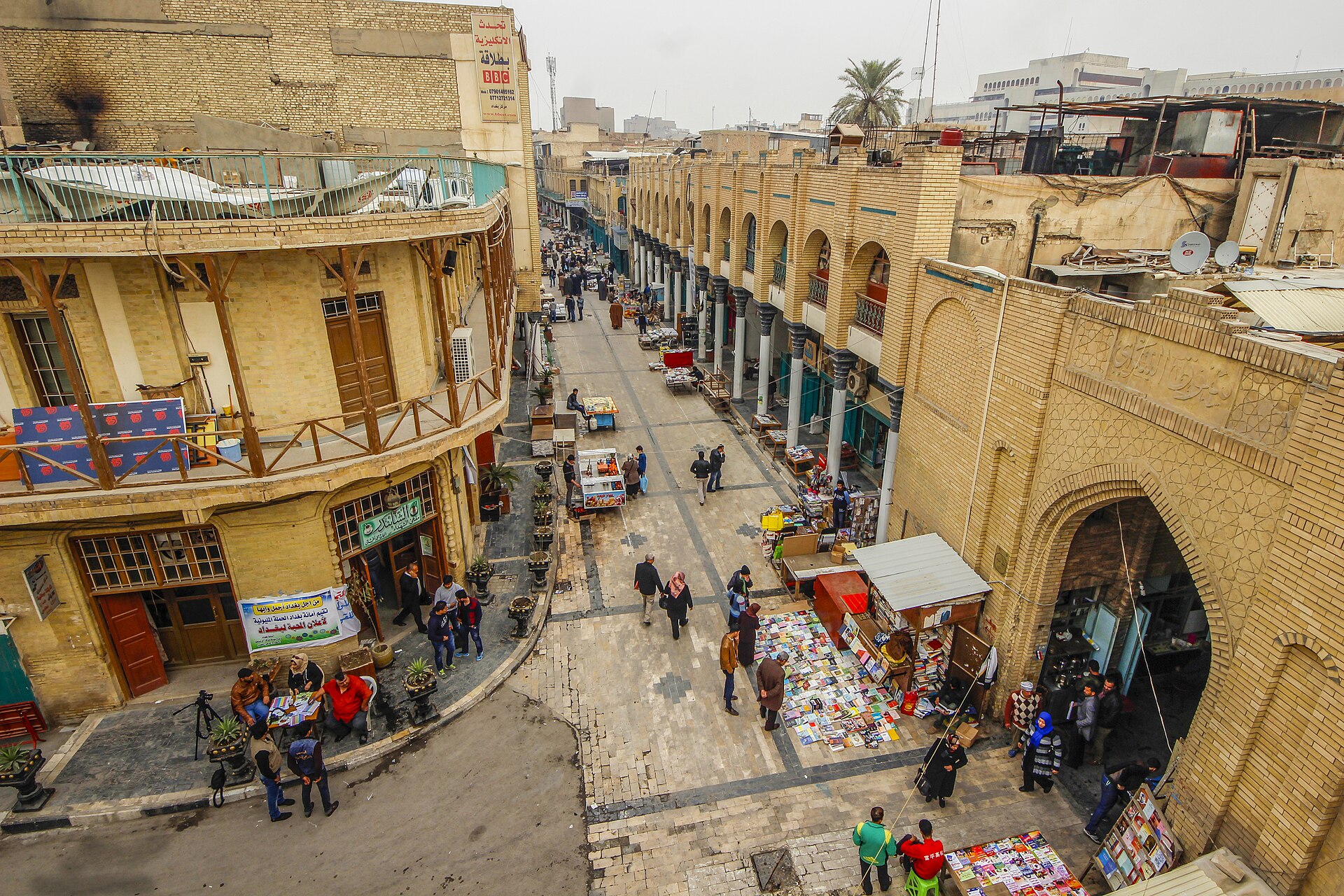
Al-Mutanabbi Street, Baghdad, by Mondalawy (CC BY-SA 4.0). Iraqi tea at the Shabandar cafe by Mustafa Waad Saeed (CC BY-SA 4.0). The Ziggurat of Ur by Alli Khalil (CC BY-SA 4.0). Iraqi police checkpoint in Dhi Qar by the U.S. Army (public domain). The Imam Ali shrine, Najaf, by Goudarz.memar (CC BY-SA 4.0). Sulaymaniyah by Diyar Muhammed (CC BY-SA 4.0). All images via Wikimedia Commons.


