Last updated: August 2026. We re-checked the Martyrs Foundation’s own website, 964media’s Arabic and English archives, the dated visitor record going back to 2019, and the FCDO’s 22 July 2026 advice, on 15 August 2026.
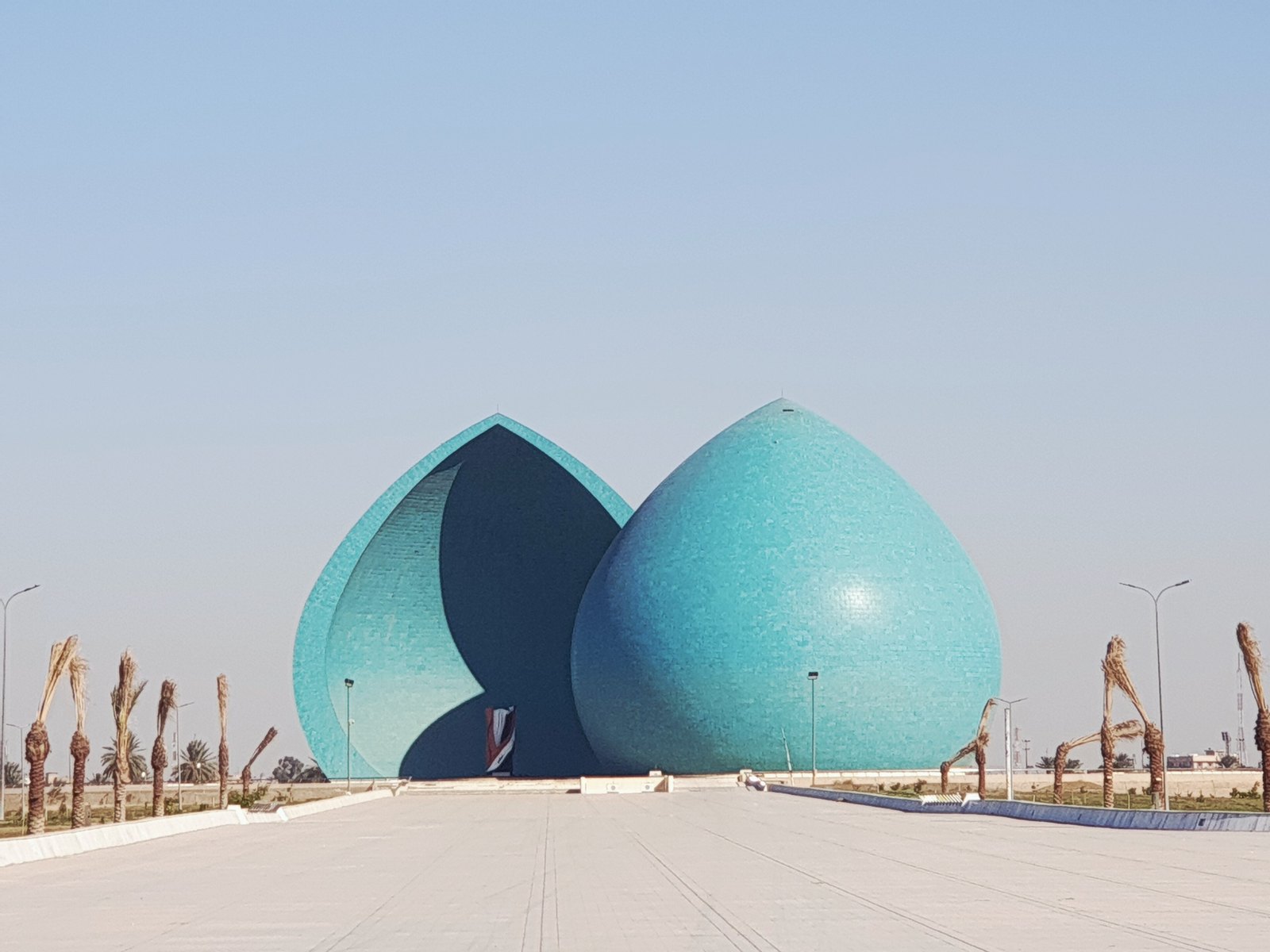
Two turquoise half-shells, sliced apart and slid past each other, standing on an island in an artificial lake off Palestine Street. From the road they look closed; as you drive towards them they open. The Al Shaheed Monument is the best piece of modern architecture in Iraq and one of the best in the region, and almost everything written online about visiting it is wrong. It is one stop on the wider circuit in our Baghdad travel guide.
So here is the honest answer up front. You can see the Al-Shaheed Monument from outside, and Baghdad tour operators still drive people to it, but there is no ticket desk, no published opening hours and no published admission price — and the last visitor who demonstrably got inside the underground museum did so in 2019. Every dated report since September 2023 describes a closure, a barrier, or being kept at a distance. The pages telling you the al shaheed monument opens at nine and closes at six are guessing.
The second thing worth saying early: the site is controlled by the Martyrs Foundation (مؤسسة الشهداء), a government body under the Council of Ministers. Not the Ministry of Culture, not the Baghdad municipality. We checked thirteen pages ranking for this monument and not one of them names the body that decides whether you get in. That single fact explains why nobody can find hours: the Foundation does not publish any, because it does not treat the monument as a ticketed attraction.
You will see the name written Al-Shaheed, Al Shaheed and simply the Martyr’s Monument in Baghdad. They are the same place, and the Arabic is نصب الشهيد. This guide covers what the Al Shaheed Monument is and who built it, the dated evidence on access, how to approach a visit realistically, and then the rest of Baghdad’s modern landmark set — the Victory Arch, the two Unknown Soldier monuments, the Freedom Monument at Tahrir, Mohammed Ghani Hikmat’s sculptures, Baghdad Tower and Zawra Park. It ends with a plain list of what we could not confirm, because on this subject that list is long and pretending otherwise would be dishonest.
The short answer
| Question | Answer as of August 2026 |
|---|---|
| Can you go inside? | Assume no. Last demonstrable interior visit was 2019; every dated report from Sep 2023 onward describes closure or being turned back. |
| Opening hours | None published anywhere. The “closed Friday and Saturday, mornings only” line circulating online traces to a single July 2021 traveller review. |
| Ticket price | None published anywhere. Two page-one sources flatly contradict each other and neither gives a figure. Do not budget for one. |
| Who controls it | The Martyrs Foundation (مؤسسة الشهداء), under the Council of Ministers. Founded 2005. |
| How people get in | Case by case, through a driver, fixer or tour operator’s local contacts. Discretionary, not a turnstile. |
| Which side of Baghdad | Rusafa, east bank of the Tigris, off Palestine Street, roughly 4.5 km north of Tahrir Square. |
| Is it the crossed swords? | No. That is the Victory Arch, on the other side of the river inside the Green Zone. Different monument, different sculptor, different decade. |
What the Al-Shaheed Monument actually is
The design competition was announced in 1978 with a brief of almost comic brevity: a memorial and a cemetery. The cemetery element eventually became a museum. Construction ran from 1981 to 1983 — Young Pioneer Tours puts it at 27 months — and the Al-Shaheed Monument opened in July 1983, during the Iran–Iraq war it was built to commemorate.
The sculptor was Ismail Fatah al-Turk (1934–2004), one of the major figures of twentieth-century Iraqi art. He worked with the architect Saman As’ad Kamal and a team from the Baghdad School of Architecture — Saad al-Zubaidi, Wijdan Maher, Ismail Kanna and Nada Zabbouni. Structural and services engineering came from Ove Arup and Partners in London, site supervision from M+R Consultants in Belgium, and the build itself from Mitsubishi Corporation and Kajima Corporation of Japan. This is worth stating because one of the tour-operator pages ranking for this monument omits al-Turk entirely and credits the architect alone.
The original proposal was gold-plated sheet cladding. In 1980 the contractor’s own studies killed that idea and replaced it with glazed blue Karbala’i ceramic tile on a backing of ultra-light carbon-fibre-reinforced concrete — reportedly the first use of that material anywhere in the world, on Ove Arup’s recommendation. Heat and longevity were the stated reasons. Whoever made that call saved the Al-Shaheed Monument: a gold dome in a city that hits 50 °C would have been a maintenance nightmare and a much worse object.
Why it is that particular blue
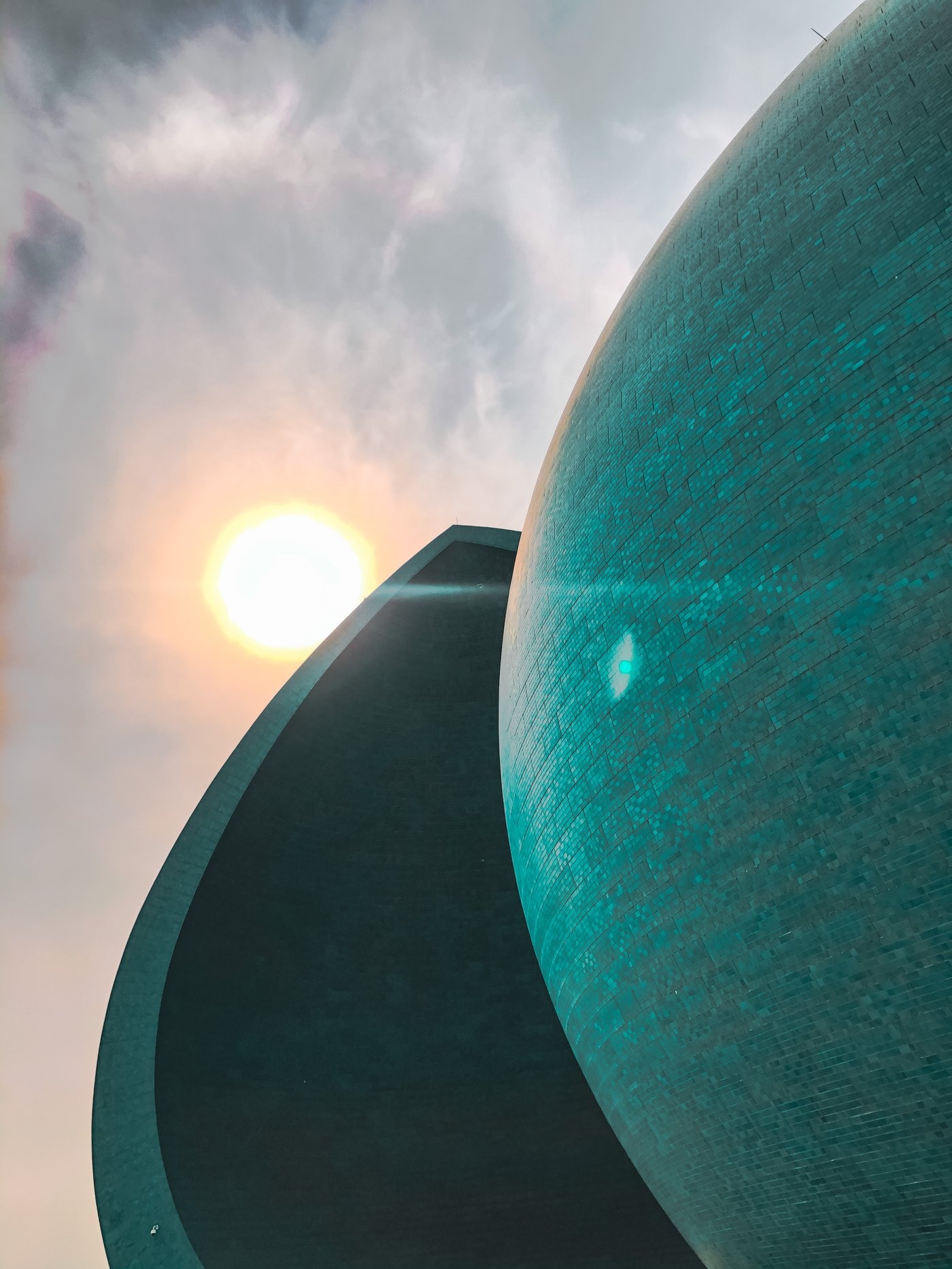
The best detail in the whole story, and it appears on no competitor page. Once the switch to tile was made, the design team went round six different Baghdad mosques collecting samples, and discovered that every dome had a different tone of blue. Rather than pick one, they decided each panel of the dome — about thirty tiles — would carry six different shades arranged at random, in varying proportions, to produce what they called an Iraqi blue rather than a Persian or Ottoman one.
You can see this if you get close, and it is why photographs of the Al Shaheed Monument never quite agree on the colour. In flat midday light it reads as a hard turquoise. At sunset the same surface goes green, then almost black. The tiles, their backing and the steel frames were manufactured in the contractor’s factories in Japan and assembled on site, after wind-tunnel tests on the two half-shells and a set of acoustic and light-reflection studies. Natural ventilation openings were built in to stop heat building up against the inner steel frame.
The dimensions, and the number everyone gets wrong
This is the most-mangled fact about the Al Shaheed Monument, so here it is as a table with what each figure actually measures.
| Figure | What it measures | Source |
|---|---|---|
| 40 m | Height of the dome, split in two | Archnet / Aga Khan Trust; English and Arabic Wikipedia |
| 190 m | Diameter of the circular platform the dome stands on | Wikipedia citing GlobalSecurity.org; Al Jazeera Net via Alsumaria, 1 Nov 2023 |
| 7 m | Width of the gap between the two half-shells | Round City architectural review, 20 Oct 2020 |
| 3 m below / 5 m above ground | Extent of the flag sculpture in the gap, first version | Round City, 20 Oct 2020 |
| More than 3 km | Length of the martyrs’ wall through the trench area and museum | Round City, 20 Oct 2020 |
| More than 150,000 | Names carved on that wall, by hand, 1988–1993 | Round City; repeated by Alsumaria, 1 Nov 2023 |
So: a 40-metre dome on a 190-metre platform. One widely-read tour-operator blog calls it “the turquoise 190-metre dome”, which would make it taller than most skyscrapers in the city, and another says it is “40 metres in diameter and 40 metres high”, which loses the platform altogether. If you see either figure attached to the wrong noun, you are reading a page that copied without checking.
On cost, be careful. English Wikipedia gives half a million US dollars, sourced to Al Jazeera’s 2004 obituary of al-Turk. That is implausibly low for a Mitsubishi build with Arup engineering and Japanese-manufactured cladding, and we would not repeat it without the hedge.
What the three elements mean
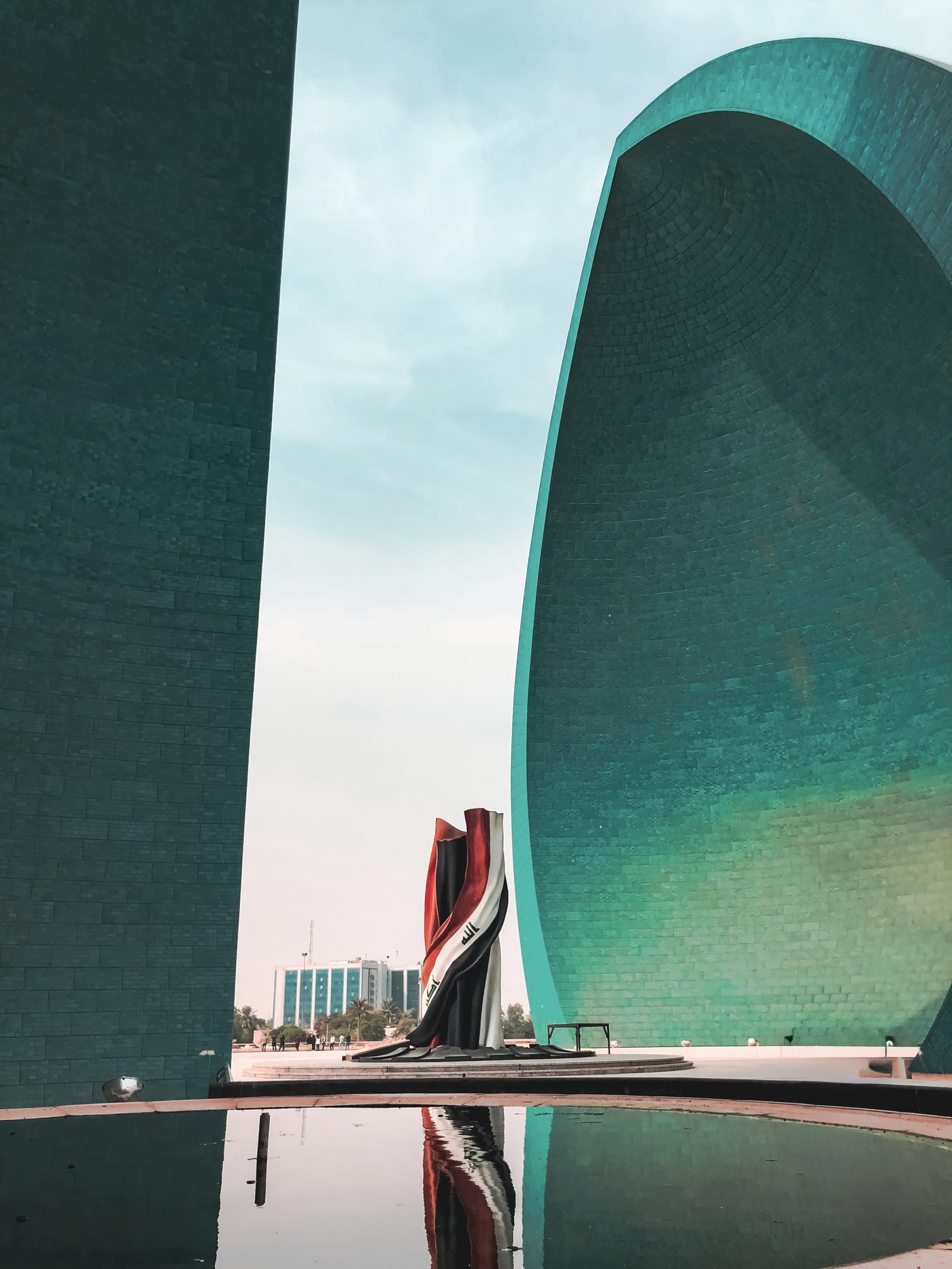
Al-Turk designed the Al-Shaheed Monument to be read as one abstract sequence rather than three objects. The dome is split by the force of martyrdom, the soul rising through the gap. The banner — the Iraqi flag, in bronze and later acrylic — is the martyr’s body wrapped in the flag, emerging from beneath the earth. The spring is the outpouring of what the dead gave, and the continuation of life afterwards. Standing between the two half-shells, the sound of falling water cuts the city out.
His own account, recorded by Kanan Makiya, is worth quoting because it is unusually unsentimental for a state commission: “I insisted on having a large open space… In the beginning, I had the idea of having a martyr bursting from the center. But I did not like it, it was too theatrical. Then, the idea of life versus death began to form.”
There is also a designed optical trick. Approached from the start of the street, the two halves appear closed; they open onto one another gradually as you get nearer, in the words of the archaeologist Kadhim Jabr Salman, “like a gate opening in preparation for something to emerge”. Salman also records that al-Turk was urged to model the dome on the Dome of the Rock in Jerusalem and refused, taking his reference from Abbasid-era Baghdad instead.
The banner itself has been remade twice, tracking changes to the Iraqi flag. The original was a steel structure clad in bronze and coloured with enamel. It was remade in acrylic after “Allahu Akbar” was added to the flag in 1991, and again after the three stars were removed and the script changed from Saddam Hussein’s handwriting to Kufic. The Al Shaheed Monument has quietly been re-edited by three different Iraqi states.
The martyrs’ wall and what is underground
The part almost nobody has seen is beneath the platform: a museum, a library, a cafeteria, a lecture hall and an exhibition gallery, on two levels. From inside the museum, looking up through a glass-sealed oculus, the flag and its pole appear to float in space.
Running through the trench area — the khandaq, a designed element read as a battlefield with the fighters at its edge — and continuing inside the museum is the martyrs’ wall. More than three kilometres of marble and stone panels carrying more than 150,000 names, alongside engravings of palm trees and running water. The names were carved by hand between 1988 and 1993, not machine-cut, a decision that put years of work into the hands of calligraphers, carvers and al-Turk’s own students, several of whom became well-known sculptors afterwards.
The dedication has broadened over time. It was built for the Iran–Iraq war dead. It is now generally understood as a memorial to all Iraqi martyrs, and the tour companies that still list it describe it that way. Given what has happened in Iraq since 1983, that shift was not really a choice.
Can you get inside the al shaheed monument in 2026?
Short version: probably not, and nobody can promise you otherwise. Here is the whole dated trail in one place, which is something no page ranking for the Al Shaheed Monument has assembled.
| Date | What was reported | Source |
|---|---|---|
| May–Nov 2019 | Three separate visitors describe the underground museum, one noting it is “not always open” | Dated TripAdvisor reviews |
| July 2021 | “The entrance is not free”; closed Fridays and Saturdays, mornings only. No price given | One traveller review, written 7 Aug 2021 |
| September 2023 | “Closed for repairs” — got just inside the gate, nowhere near the monument; told 5–6 months of works | Dated review, written 12 Oct 2023 |
| February 2024 | “They did not let us pass the access barrier to the square” | Dated review, written 1 Mar 2024 |
| April 2025 | “We could only take a look at the bus because it was closed” | Dated review, written 28 Apr 2025 |
| May 2025 | Craftsmen repairing the blue tiles; “they did not even let me near”; underground museum also closed | Dated review, written 11 Jul 2025 |
| 2 June 2025 | “Currently closed for renovations… you can always negotiate with the on-site guards for a closer look past the gate” | ArrivalGuides, the only editorially-dated status on page one |
That is the strongest evidence available, and it points one way. The last person who demonstrably walked the underground museum did so in 2019. Two independent 2025 visitors confirm closure and one of them identifies the cause: tile restoration. Nothing published since June 2025 says the situation has changed.
The line about being closed Fridays and Saturdays and open mornings only, which you will find presented as fact on several sites, comes from that single July 2021 review and nowhere else. It has been laundered into “opening hours” by pages that never say where they got it. Treat it as one traveller’s experience five years ago, not a schedule.
The Martyrs Foundation, and why there are no hours
The Al-Shaheed Monument belongs to the Martyrs Foundation (مؤسسة الشهداء), a government institution created in 2005 and answerable to the Council of Ministers. Its remit is compensation, welfare and commemoration for the families of Iraq’s dead, across every era. The monument is one asset among many.
In November 2023 the official newspaper Al-Sabah, relayed by Alsumaria TV, carried the fullest statement anyone has made about the site’s future. Ali Hadi, director of the Foundation’s Economic and Investment Department, said rehabilitation works had begun in mid-2023 after the monument “was subjected to neglect and vandalism” during the American occupation of the site. The works covered flooring, lighting, planting, the gardens, the fountains, the pavements and the attached service facilities. The stated aim was to open it to citizens and delegations as a tourist facility in the capital “at the beginning of next year” — early 2024. The Foundation was also, he said, working on establishing a museum for the martyrs inside the monument, holding belongings recovered from mass graves or handed over by families. He stressed the original design and specifications had been preserved unchanged, and that a full comprehensive rehabilitation needed sums the Foundation could not cover: the 2023 works were explicitly a first phase.
There is no traceable follow-up to any of that in 2024, 2025 or 2026. We fetched the Foundation’s website — rebuilt as version 1.0, last updated 10 May 2026, with news items current to 13 August 2026 — including its news archive, about page, locations map and the Economy and Investment Department’s own page. There is no page about the Al Shaheed Monument, no museum page, no hours, no ticket, no visitor section and no news item mentioning نصب الشهيد anywhere. The site’s news IDs now run from 1 to 208 only; the pre-2026 archive is gone.
We also searched 964media, which is the most granular outlet covering Baghdad in both Arabic and English, for نصب الشهيد, متحف الشهداء, “Shaheed”, “monument” and “Martyr Monument”, back to 2023. Not one item announces an opening, a museum, a ticket, hours or a completed restoration. For an outlet that reported the opening of a cultural street in Tikrit and a gateway monument in Halabja, that silence is itself a data point.
But the grounds are in use
“Closed” needs a qualifier, and this is where most write-ups go wrong in the other direction. The Al-Shaheed Monument is not derelict and it is not sealed. On 26 December 2025, 964media published photographs and video of a Popular Mobilisation Forces symbolic funeral procession — empty coffins, commemorating men killed in a strike on their camps at al-Qaim — that staged and set off from the Al Shaheed Monument grounds, as part of a month-long programme.
So the plaza is reachable, it is maintained, and it remains a working site of national commemoration. What that does not establish is that an individual foreign visitor can walk in on a Tuesday. Organised state and paramilitary use of the grounds and casual tourist entry to the interior are two different permissions.
How people actually get in
The most honest published description of the mechanism is five years old and still accurate in shape. Rocky Road Travel’s page, last modified in July 2021, says: “To visit you will need to find a driver to take you to the site and negotiate your entry. It is commonly closed.” The same page adds that the company’s own connections guarantee access — which is a sales line, but also a description of how the system works. It is the main practical argument for going through one of the companies running tours in Iraq rather than arranging a car yourself. ArrivalGuides, updated June 2025, says the same thing more mildly: negotiate with the on-site guards for a closer look past the gate.
Read across those and the picture is consistent. Access is discretionary and relationship-based. There is no form to fill in, no permit office we could find, and no published process. A Baghdad driver or fixer who knows the guards may get you onto the plaza. Nobody can sell you the underground museum with a straight face in 2026.
One more tell. Young Pioneer Tours, which published the only first-hand interior account on the whole search page back in 2022, now describes the stop on its live 2026 itineraries as “have a look at Al Shaheed Monument” — exterior wording, with no mention of the museum, the interior or the trench. On the same pages the company is explicit about access friction elsewhere, saying outright that the Samarra minaret will be seen from the entrance gate and that they may not be allowed inside al-Nuri. The change in wording may reflect lost access or simply a tighter itinerary; we could not confirm which. But it is a change.
How to plan an Al Shaheed Monument visit
Go for the exterior and treat anything more as a bonus. Practically that means:
- Build it into a half-day on the Rusafa side rather than making it the anchor of a day. If the gate is shut you want somewhere else to go — our sample Iraq itineraries show how a Baghdad day usually stacks up.
- Have your driver ask ahead. This is the one thing that changes the outcome, and it costs a phone call.
- Do not turn up alone expecting a ticket office. There isn’t one, and a foreigner wandering up to the barrier without a local is the worst version of this visit.
- Give it time from a distance. The optical effect of the two shells opening as you approach is the point, and it works from the road.
- Accept that the museum is a maybe. If you get in, you will have the most recent first-hand account of it in years, which tells you how rare it is.
Where the Al Shaheed Monument is, and getting there
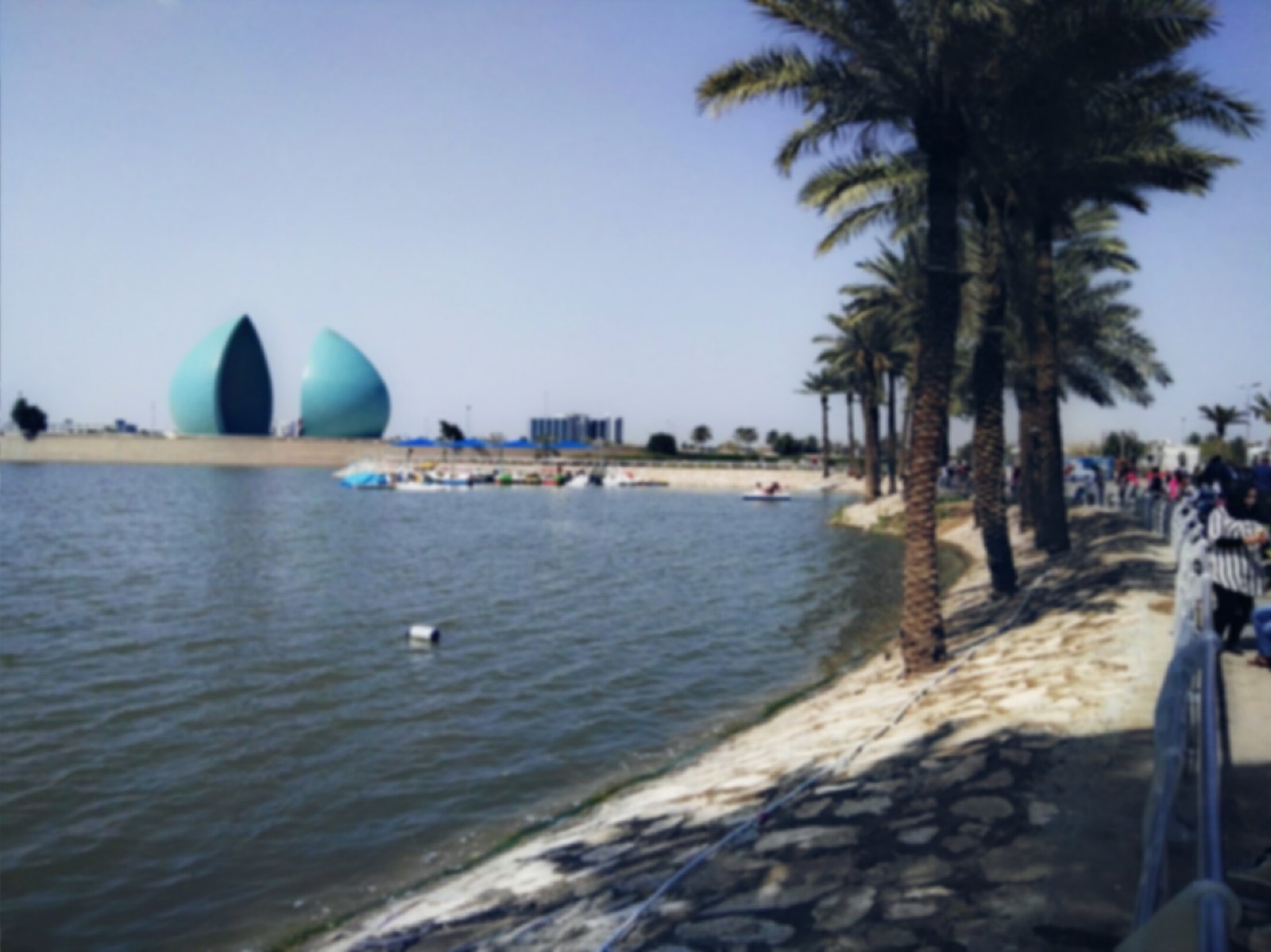
The Al-Shaheed Monument is on the Rusafa side — east Baghdad, east bank of the Tigris — directly west of the Army Canal, the Qanat al-Jaish, which is the channel separating Sadr City from the rest of the city. Approach is via Palestine Street. Archnet’s catalogue entry and the FCDO’s map together give you something useful here: because the Al Shaheed Monument sits west of the canal, it is not in Sadr City, and Sadr City is the one part of Baghdad province the FCDO rates “against all travel” rather than “against all but essential travel”. The line matters, and it is close by.
It is roughly 4.5 kilometres north of Tahrir Square. We are not going to give you a drive time, because Baghdad traffic and checkpoints make free-flow figures meaningless and no source publishes a real one. Assume the checkpoints, not the distance, are the variable — our guide to what actually happens at Iraqi checkpoints covers what officers ask and how long it takes.
On transport generally: self-driving is effectively closed to tourists, partly because the FCDO points to the 1968-version international driving permit, which cannot be obtained outside your home country. Hire a driver. Baghdad’s ride-hailing market is led by Baly, a local company founded in 2021 with roughly 80% share; Careem also operates, around the clock, in four Iraqi cities including Baghdad. Neither is a substitute for a driver who knows a specific gate. The full picture is in our guide to getting around Iraq.
One sobering number for perspective on risk: Iraq recorded 2,351 road deaths in 2025, and Baghdad accounts for around 19.5% of national crashes. Traffic injures far more visitors to Iraq than anything political does.
This is not the Swords of Qadisiyah
The Al-Shaheed Monument and the Victory Arch get conflated in conversation more than in print, and the difference is genuinely useful to know before you ask a driver for either. They are on opposite sides of the river, built a decade apart, by different sculptors, under very different levels of state control. Our wider Baghdad travel guide puts them in the context of the whole city; here is the quick separation.
| Al-Shaheed Monument | Victory Arch (Swords of Qadisiyah) | |
|---|---|---|
| Side of Baghdad | Rusafa — east bank, off Palestine Street | Karkh — west bank, inside the Green Zone |
| Opened | July 1983 | 8 August 1989 |
| Sculptor | Ismail Fatah al-Turk | Khaled al-Rahal, completed by Mohammed Ghani Hikmat |
| Form | Split turquoise dome, 40 m, on a 190 m platform | Two pairs of forearms holding crossed swords, 43 m each |
| Commemorates | The Iraqi war dead; now read as all Iraqi martyrs | Claimed victory in the Iran–Iraq war |
| Access in 2026 | Grounds sometimes, interior effectively no | Inside a restricted zone; most visitors photograph it from the car |
The Victory Arch and Grand Festivities Square
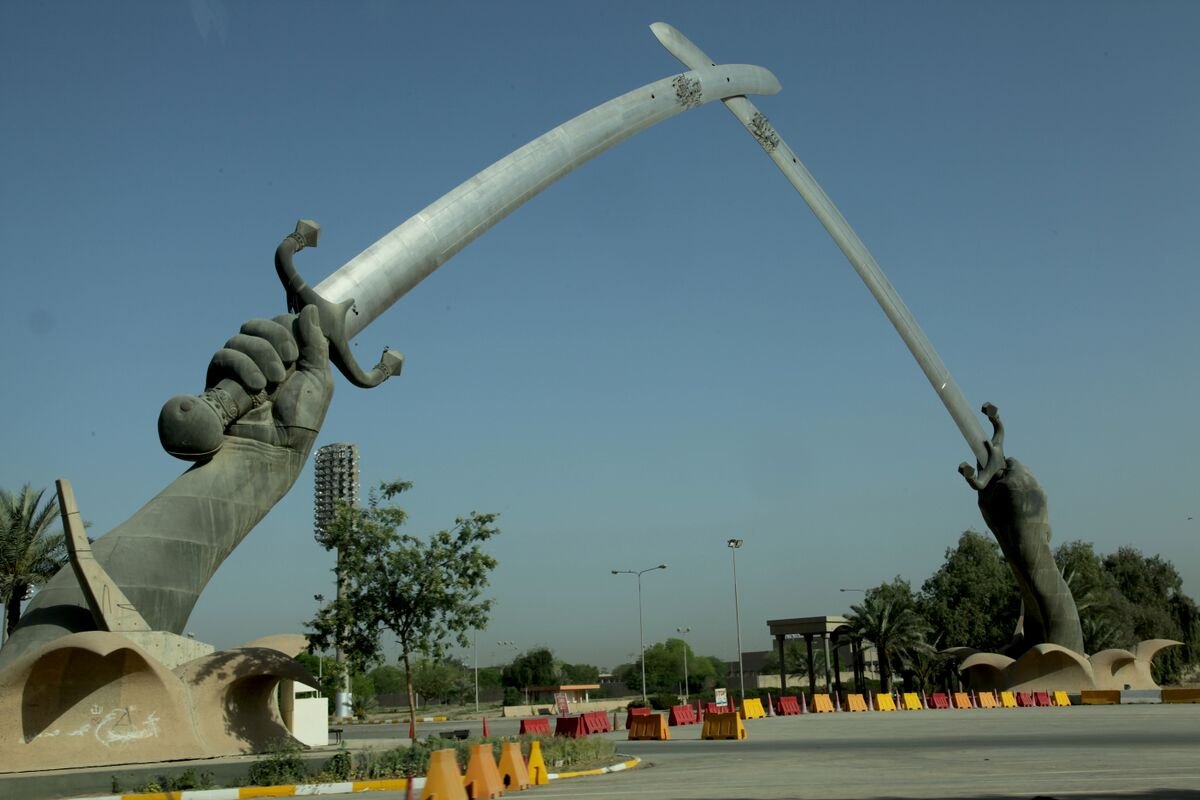
The Victory Arch is two arches, marking the two entrances to Grand Festivities Square and its parade ground at the edge of Zawra Park. The concept was sketched by Saddam Hussein himself. Khaled al-Rahal designed and executed it and died in 1987 before it was finished; Mohammed Ghani Hikmat took over and completed it. It opened to the public on 8 August 1989. Saddam rode beneath it on a white horse at the dedication — an allusion to Husayn ibn Ali at Karbala — although sources differ on whether that was the 1989 opening or a 1990 event.
The specifications are grim and precise. Each sword is 43 metres of stainless steel with a blade weighing 24 tons, modelled on the weapons of Sa’d ibn Abi Waqqas, the Arab commander at al-Qadisiyyah in 636 CE. The swords were cast in Iraq, partly from metal melted down from the guns and tanks of Iraqi soldiers killed in the Iran–Iraq war. Each bronze forearm and grip weighs 20 tons and sits on a 20-ton frame; the arms were cast in the United Kingdom at the Morris Singer Foundry. The swords meet about 40 metres above the ground, with a stainless steel flagpole rising a further seven metres. The whole thing was fabricated by an international consortium led by the German foundry H+H Metallform.
The forearms are Saddam’s. Al-Rahal worked from photographs and plaster casts of Saddam’s own arms, and towards the end of the project — after Ghani had taken over — the sculptor personally took an impression of one of Saddam’s thumbs, and the resulting fingerprint was added to the mould for one of the thumbs on the arch.
Beneath each plinth sit 2,500 helmets, 5,000 in total, held in cast-bronze nets that let them spill onto the ground. Saddam said they belonged to Iranian soldiers killed in the war. In February 2007 the new Iraqi government’s Committee for Removing Symbols of the Saddam Era began dismantling the monument; demolition started on 20 February, three-metre chunks were cut out of the bronze, and bystanders and coalition troops were seen carrying off helmets and fragments as souvenirs. The US ambassador Zalmay Khalilzad blocked the demolition the next day and the government reversed course. Restoration began in February 2011, described at the time as a gesture of reconciliation. How many helmets remain, and in what condition, nobody has reported since.
Can you visit it?
Carefully, and not on your own terms. The Green Zone is a 10 km² district of Karkh, formally Karradat Mariam. Full control passed to Iraqi security forces on 1 January 2009 while the area stayed off-limits to the public; it opened to the public with restrictions on 4 October 2015, and parts opened without restrictions for the first time in over 15 years on 10 December 2018.
The concrete, sourceable reason the arch is reachable at all is not any recent barrier removal but the reopening of Grand Festivities Square in June 2023, after a 20-year closure, with al-Mansour Cinema, al-Mansour Theatre and the Fine Art Hall rehabilitated and opened to the public. That land is the same 350 acres of parkland absorbed into the Green Zone that Zawra Park officials were publicly asking to have returned back in 2009.
What we will not tell you is that the Zone is now freely walkable. A claim circulating that barriers were removed in early March 2026 could not be verified from any source, and the same weeks saw rockets, a missile strike and drones hitting inside the Green Zone between 14 and 16 March 2026, followed by security forces blocking roads with armoured vehicles. Access here is reversible at a few hours’ notice. Ask locally on the day.
If you do get close, the standing joke among photographers is real: stand in the right spot and the picture makes it look as though the swords are in your own hands. The arms are hollow, and soldiers used to climb up inside them.
The two Unknown Soldier monuments
Baghdad has had two, and losing the first to build the second tells you a lot about the 1980s.
The 1959 monument was Rifat Chadirji‘s arch at what is now Firdos Square: a modern adaptation of the Arch of Ctesiphon, with sketches held at the Institute of Fine Arts revealing the image underneath the abstraction — a mother bending to pick up her martyred child. It stood at what most visitors now know only as the square where the Saddam statue came down in April 2003, ringed by the hotels the foreign press used — the Palestine and the Ishtar, the latter closed for years now, which is worth knowing if you are looking at where to stay in Iraq. It was demolished in 1982, and the architectural review that publishes the demolition photograph notes that Chadirji himself is standing in it, beside the contractor removing his own building. He raised the idea of rebuilding it on the original site in 2009. Nothing came of it. He emigrated to England and died of COVID-19 on 10 April 2020.
The 1982 replacement stands in the Grand Festivities Square area, now inside the Green Zone. Khaled al-Rahal again supplied the concept; the architectural design was developed by the Italian architect Marcello D’Olivo. It was commissioned in 1979 and built between 1979 and 1982, although one Iraqi source dates completion to 1983. It sits on an artificial hill shaped as a low truncated cone 250 metres across. The centrepiece is a cantilevered reinforced-concrete dome, 42 metres in diameter, inclined at 12 degrees, representing a dira’a — a traditional Iraqi shield — falling from the dying grasp of a warrior. Beside it stands a spiral tower echoing the Malwiya minaret at Samarra, clad in copper, and a flagpole entirely sheathed in Murano glass in the national colours. Beneath the shield is a cube of seven layers of metal, said to stand for the seven levels of Jannah, with sheets of red acrylic inside representing the blood of the slain; it connects by a long shaft to an underground museum, from which visitors look up into the cube.
Access is worse than at Al-Shaheed and has been for a long time. The sharpest available statement is from 2020, not 2026: after it was completed, families of the unknown soldiers found it difficult to visit, and “they were and still are stopped and questioned if they try to visit it or photograph it while on the nearby main road”. We found nothing newer. Treat it as materially harder to see than anything else in this article.
The Freedom Monument, Tahrir Square
If you only look at one piece of public art in Baghdad, make it this one. Nasb al-Hurriyah was commissioned in 1959 by Abd al-Karim Qasim to mark the 14 July 1958 revolution. Qasim approached Rifat Chadirji, who developed the idea with the painter and sculptor Jawad Saleem.
The often-quoted “14 figures or 25 figures” argument dissolves once you know what each number counts: it is 14 bronze castings representing 25 figures, on a travertine slab, raised six metres off the ground — 14 castings echoing the 14th of July. The whole work is 10 metres high and 50 metres long. It reads right to left, like a line of Arabic poetry, beginning with the events before the revolution and ending in harmony after independence, and the relief style deliberately reaches back to Babylonian, Assyrian and Abbasid wall carving.
Chadirji insisted on raising the sculpture to make it monumental; Saleem wanted it at ground level. Chadirji won, and the criticism has stuck ever since: the finished work faces the traffic rather than the people walking in the adjacent gardens. Saleem also resisted every attempt by Qasim to have his own image worked into it. He died in January 1961, before it was finished. It was completed by his wife, the artist Lorna Selim, together with Mohammed Ghani Hikmat, who had already been casting the bronzes, and opened later that year. After Qasim’s assassination in 1963 there was a move to pull it down; the architects Mohamed Makiya and Qahtan Awni talked the Mayor of Baghdad out of it.
Tahrir Square around it was originally Queen Alia Square, with the roundabout built in 1937. It adjoins al-Umma Garden, which holds a large painting by Faiq Hassan and the Mother Statue — not, incidentally, a Mohammed Ghani Hikmat “Mother’s Fountain”, a work that appears in a number of online listings and does not exist. The square was the epicentre of the Tishreen protests from 1 October 2019, in which more than 600 people were killed. By November 2022 the abandoned promenade alongside the Freedom Monument had been paved and planted, making Tahrir one of the few green spaces in central Baghdad, watched by cameras and police. The Turkish Restaurant building that protesters occupied was still standing and still carrying its graffiti at that date; we could not confirm its condition since.
Mohammed Ghani Hikmat’s Baghdad
You will see his work all over the city without necessarily knowing it. Ghani Hikmat (1929–2011) was born in Kadhimiya, trained in Baghdad and then at the Academy of Fine Arts in Rome, learned bronze casting over seven years in Italy, and carved the wooden gates for the Church of Testa di Lepre — becoming, as far as anyone records, the first Muslim sculptor to produce work for the Catholic Church. Iraqis called him the sheikh of sculptors, and the way his work sits in traffic islands and on riverbanks says a lot about how public art functions here, something we go into in our guide to Iraqi culture and etiquette. His shrine city of birth has its own guide to Kadhimiya and its district.
The pieces worth seeking out:
- Kahramana — bronze, 3.3 m, built in the late 1960s and officially opened in 1971, at Kahramana Square on al-Sa’doun Street. Marjana pouring boiling oil into the forty jars, from Ali Baba. The water was switched off during the Iran–Iraq war and the jars were painted green against the sculptor’s wishes. After 2003 it became a standard starting point for protest marches, with Iraqis reading the forty thieves as the forty-member Governing Council. Google gave it a Doodle on 20 April 2016, on what would have been Ghani’s 87th birthday.
- Scheherazade and Shahryar — a pair of bronzes, 4.25 m, 1971, on the Tigris bank near Abu Nuwas Street. The Shahryar figure was badly vandalised after 2003.
- Al-Mutanabbi — bronze, 1977, on the street named after the poet. It anchors the end of the book market; see our guide to Mutanabbi Street.
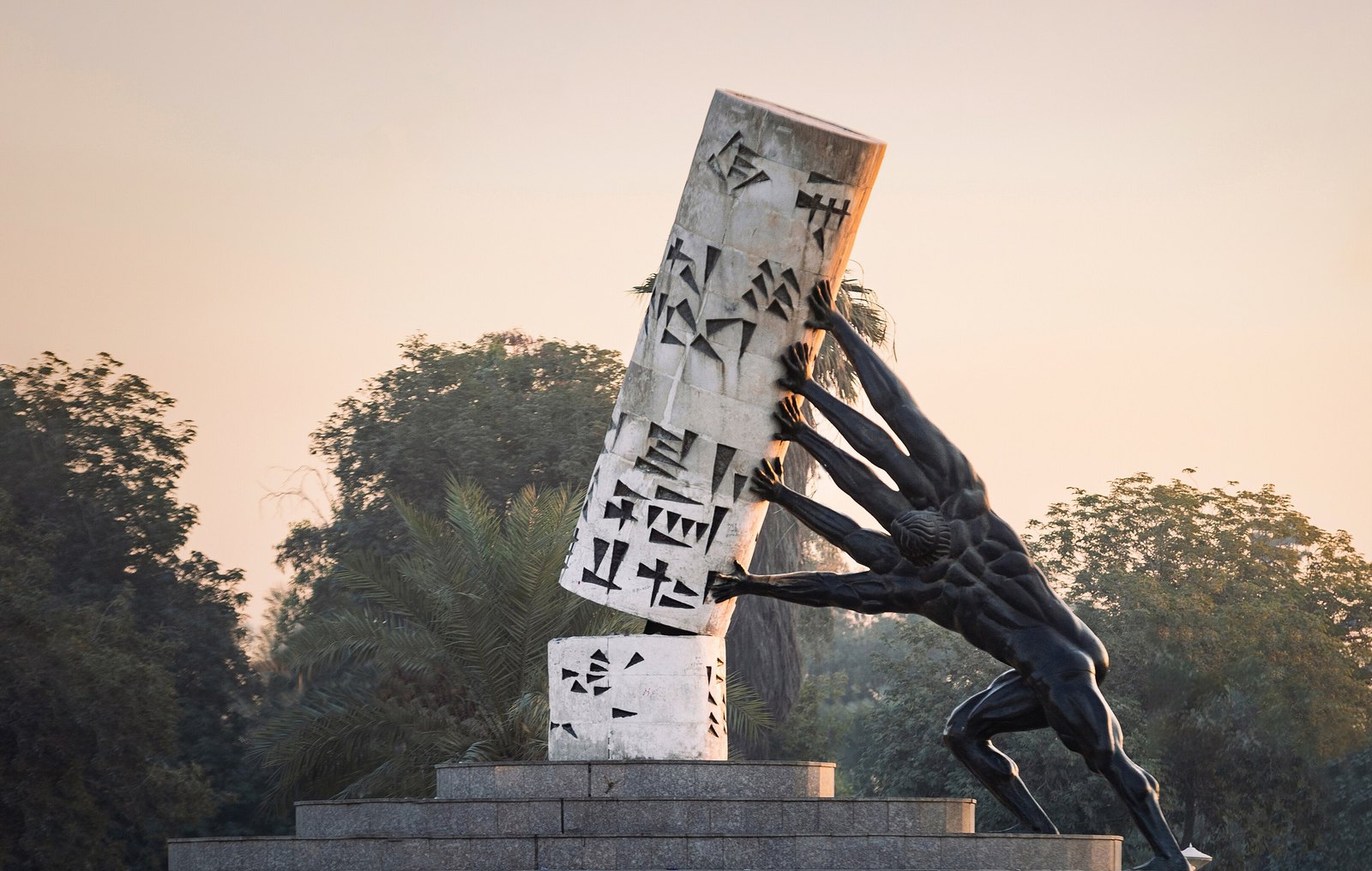
- Save Iraqi Culture — commissioned in 2010, finished by his son after his death and unveiled in 2013 at Arabian Knight Square in al-Mansour, not outside the Iraq Museum as several listings claim. Ten metres tall: a broken Sumerian cylinder seal held up by many hands, its cuneiform reading “writing began here”.
- Timthal Baghdad — 2013, Al Andalus Square, a 13.5 m column carrying Arabic calligraphy, with Baghdad personified as a girl in Abbasid dress.
He also spent his last years trying to get stolen art back. Around 8,500 paintings and sculptures were looted from the National Museum of Modern Art in 2003. Ghani founded and personally funded a recovery committee in about 2007; by 2010 some 1,500 works had been returned by all routes, of which his committee was directly credited with 150 of the most important. Note the two numbers — plenty of accounts collapse them into one and credit him with the lot. He had 150 pieces stolen from his own studio, including Jawad Saleem’s Motherhood, which was recovered.
Baghdad Tower — and why you should not plan around it
The 204-metre tower in western Baghdad, in the al-Ma’mun and Yarmouk area of Karkh, is the city’s most persistent piece of misinformation. Construction began in 1991 alongside the al-Ma’mun telecom exchange and it opened in 1994, with a revolving restaurant and an observation deck on the top floor. On 27 March 2003, a week into the invasion, 4,700-pound bombs destroyed the exchange and damaged the tower, which was abandoned.
Then it gets contradictory, and we are not going to resolve it for you because the sources do not. Arabic press reported an inauguration on 26 December 2018 by President Barham Salih, listing completed works: lift maintenance, the entrance, the revolving restaurant, the viewing gallery, the gardens, the car park and the lighting. But English Wikipedia, citing a Los Angeles Times report of 18 April 2020 headlined on the tower being derelict, states that as of 2020 it remained closed despite public outcry. The best reading is that December 2018 was a ceremonial reopening that never turned into a sustained public one.
Nothing newer than April 2020 could be obtained. There is no published ticket price, no published opening hours, and no confirmation that the revolving restaurant has operated at any point since 2003. On the height, use 204 m — the commonly quoted 205 m and “620 feet” both circulate, and 620 feet is 189 m, which matches nothing.
Zawra Park, the zoo and the rest
Al-Zawraa Park in Mansour, west Baghdad, was laid out in the early 1970s on a former army camp and is run by the Baghdad municipality. Its area is given as 3 square kilometres in one academic source and 400 acres by Reuters — a straight conflict, so take it as “large”. It holds an amusement park, a tower, a lake and Baghdad Zoo, and hosts the Baghdad International Flower Festival. There is a big Ferris wheel; before the Green Zone opened, tour groups used to go up it specifically to see the Victory Arch over the wall. There is no wheel called the “Baghdad Eye” — that name appears in AI-written listings and in no source we could find.
Entry to the park is ticketed, confirmed as recently as November 2022, but no price is published anywhere we could reach. The only figure ever recorded is Reuters in 2009 — about 40 US cents — which is sixteen years old and useless as a budget line. Security is real and worth knowing about in advance: the park is guarded by the special police units that protect government facilities, visitors are frisked, bags and picnic baskets are checked for explosives, and during holidays the roads to the park are closed.
Baghdad Zoo opened in 1971 across roughly 200 acres. Of the 650 to 700 animals there before the 2003 invasion, only 35 had survived to the eighth day. It reopened on 20 July 2003 with 86 animals, including all 19 surviving lions, mostly rescued from palace menageries and private collections. Almost nothing has been published about its condition, animal numbers or welfare since around 2010, so we cannot tell you what you would find there today.
Two more come up often enough to be worth handling honestly, and both belong on any list of Baghdad’s genuinely less-visited places rather than on an itinerary. The Umm al-Qura mosque in western Baghdad, completed on Saddam’s birthday in 2001, has eight minarets — four inner at 37 metres shaped like Kalashnikov barrels for his birth year, four outer at 43 metres shaped like Scud missiles for the “43 days of aggression” in 1991 — and a reflecting pool with 28 fountains, at whose centre sits a 7.5-metre mosaic of Saddam’s thumbprint. It housed the so-called Blood Qur’an, written in blood donated by Saddam over roughly two years and handed over in September 2000, whose volume is reported variously as three pints, nearly 50 pints and 24–27 litres. A medical expert pointed out that 27 litres would take about nine years to donate safely, not two. It has been in storage and off public display since 2003, and no published reporting records it ever being forensically tested. The newest account of its whereabouts is from December 2010. The mosque’s own most recent reported event is a fire inside on 28 April 2023; its 2026 condition and visitability are unknown to us.
The al-Rahman mosque in Mansour, begun in 1998 and abandoned in 2003, is still a concrete skeleton on 4.5 hectares. Militias used the surrounding land as a car park, an Iranian-backed party took the site over, and by December 2021 around 150 homeless families were reported living in it. A 2020 court ruling ordering $200 million in compensation was never implemented. There is no documented visitor access of any kind, and nothing has been reported since 2022.
Photography, security and how to behave here
The Al-Shaheed Monument is a war memorial. More than 150,000 names are carved into it, most of them men who died in a war that began in 1980 and that a great many Baghdadis you pass in the street can attribute a specific relative to. Behave as you would at any national war memorial: quietly, and without photographing people who have not agreed to it. Iraqis at the site are not scenery.
On cameras generally, Iraq has what one Iraqi architectural writer calls a persistent culture of “no photography” around state and military sites. Photographing towards a checkpoint, a ministry or a security barrier is a bad idea anywhere in Baghdad, and the rules at the Al Shaheed Monument itself are not published — we could not establish what the guards allow. Ask before you lift the camera, every time, and put it down when told.
Drones are a hard no. In the two days before this guide was updated, Baghdad security forces publicly announced seizing 20 locally-made drones with four arrests on 13 August 2026 and 15 camera drones from a delivery motorcycle on 15 August 2026. Flying anything over a state monument in Baghdad in 2026 is not a fine, it is an arrest. Our notes on photographing Iraq and our summary of the laws tourists actually run into both go further into this.
The wider practicalities
The FCDO’s advice, updated 22 July 2026 and still current when we checked on 15 August, is regionalised rather than blanket. Baghdad province except Sadr City is “against all but essential travel”; Sadr City itself is “against all travel”. Plenty of competitor pages still describe the whole country as off-limits, which has not been true for over a year. What has not changed is the consequence: travelling against FCDO advice invalidates most travel insurance, which is the single most practical thing in the whole advisory and the thing most pages bury. Read how insurance actually works for Iraq before you book anything, and our summary of the current advisories for the full picture. The US State Department has Iraq at Level 4, Do Not Travel, reissued 2 March 2026 with an ordered departure of non-emergency government employees on the same date.
The regional situation is live and moving. Since 8 July 2026 there have been strikes and retaliatory attacks by Iran across the region including Iraq, against US military and civilian infrastructure, and Baghdad itself had a bad March: rockets on the US embassy on 7 March, a missile strike on 14 March, drones inside the embassy compound and a drone on the roof of a hotel in the Green Zone on 16 March. EASA’s Iraq bulletin advising operators out of the Baghdad flight information region ran to 31 August 2026. Every one of those bulletins expires around or before the time you are reading this — re-check them rather than trusting our dates. Whether Baghdad feels manageable to you is a judgement we are not going to make for you; our page on whether Baghdad is safe lays out the inputs.
There is no standing curfew. The midnight-to-05:00 curfew that ran for a decade was lifted on 7 February 2015, and the November 2025 parliamentary election passed with no curfew and no road closures. But movement restrictions can be imposed the same day, as they were after the March 2026 strikes.
Money: Iraq runs on cash and ATMs are rare. The street rate on 15 August 2026 was about 1,535 IQD to the dollar against an official peg of 1,320, so always ask which rate a quoted price uses. Card acceptance is genuinely improving in Baghdad restaurants and malls, but not at gates, monuments or markets. Our breakdown of what Iraq costs has the working numbers.
Heat: Baghdad’s July mean maximum is 44 °C, and four Iraqi governorates recorded 50 °C on 15 August 2026 — the extreme heat does not reliably stop in mid-August. Visiting an unshaded plaza in an artificial lake at two in the afternoon in July is a genuinely bad idea. Early morning or the hour before sunset, both for the temperature and because that is when the tiles do the interesting thing. The seasonal detail is in when to visit Iraq.
Entry: visa on arrival in federal Iraq ended on 1 March 2025 and an e-visa is now mandatory for most nationalities, currently priced at $160 for 60 days. A Kurdistan Region visa is not valid in federal Iraq. See the Iraq e-visa process.
What we could not confirm
This section is the most useful thing on the page, and we would rather publish it than fill the gaps with plausible-sounding numbers.
- Whether the Al-Shaheed Monument or its underground museum is open in 2026. No source from 2025 or 2026 says so either way. The evidence we have is negative and ends in June 2025.
- Any ticket price, in dinars or dollars. Any opening hours. Any closed days. The circulating “closed Friday and Saturday, mornings only” and “daily 09:00–18:00, free” claims are unsourced, contradict each other, and appear on pages that get the dome height wrong. We are not printing a number we cannot stand behind.
- Who mans the gate day to day — Martyrs Foundation staff, army, federal police or Hashd — and whether a permit, a letter or a local guide is formally required, or whether foreigners face extra requirements.
- Whether the park, plaza, lake and trench are freely walkable by individuals when the interior is shut. The only evidence of grounds access we have is an organised commemorative event in December 2025.
- Photography rules at the site. Nothing published. Assume restrictive and ask.
- Whether the 2023 “first phase” rehabilitation was completed, whether the martyrs’ museum of mass-grave belongings was ever built, whether the bronze wreath stolen after 2003 was replaced, whether the fountain runs, and the current condition of the tiles after the May 2025 work.
- Any first-hand traveller account from 2024, 2025 or 2026 beyond the reviews in the table above. If you have one, we would genuinely like to hear it.
- Baghdad Tower’s status at any point after 18 April 2020, and whether the 2018 inauguration led to any public opening at all.
- Zawra Park’s entry price, and the zoo’s condition, animal numbers, hours or fees at any point after about 2010.
- What physically stands on the plinth at Firdos Square today. The 2003 replacement sculpture was gone by 2013; the square was reconstructed in 2020; nothing since.
- 2026 access to the Monument to the Unknown Soldier, and the condition of the Turkish Restaurant building at Tahrir. Both trails end in 2020 and 2022 respectively.
- How many of the 5,000 helmets remain at the Victory Arch, and whether military parades are held at Grand Festivities Square today.
Frequently asked questions
Is the Al-Shaheed Monument open to visitors?
The grounds are used and tour groups are still driven to it, but the interior should be treated as closed. The last visitor who demonstrably reached the underground museum did so in 2019, and every dated report since September 2023 describes a closure, a barrier or being kept at a distance. There is no published statement from the Martyrs Foundation either way.
How much does it cost to get in?
Nobody publishes a price, including the body that controls the site. One 2021 visitor said entry was not free; one AI-written guide says there is no admission fee; neither gives a figure. If someone quotes you a ticket price for the al shaheed monument, ask them where it came from.
What are the opening hours?
There are no published opening hours for the Al Shaheed Monument anywhere. The “closed Friday and Saturday, open mornings only” line that appears on several sites traces back to a single traveller review written in August 2021 and has no other source.
Who do I ask for permission?
In practice, your driver or tour operator asks the guards on the gate. The controlling body is the Martyrs Foundation, under the Council of Ministers, but it publishes no visitor process, no contact for visits and no application form. There is no permit office we could identify.
Is the Al-Shaheed Monument the same as the crossed swords?
No. The crossed swords are the Victory Arch, or Swords of Qadisiyah, on the west bank inside the Green Zone, opened in 1989 and designed by Khaled al-Rahal. Al-Shaheed is on the east bank off Palestine Street, opened in 1983, designed by Ismail Fatah al-Turk. Different monuments entirely.
How tall is the dome?
Forty metres, split into two half-shells. The 190-metre figure that circulates is the diameter of the circular platform underneath it, not the dome. Several travel pages have swapped the two.
Which part of Baghdad is it in, and is that area rated safely?
Rusafa, on the east bank, immediately west of the Army Canal. That canal is the boundary of Sadr City, which the FCDO rates “against all travel”; the monument sits on the other side of it, in the part of Baghdad province rated “against all but essential travel”. The distinction is narrow enough that you want a driver who knows exactly where the line runs.
Can I fly a drone over it for photographs?
No. Baghdad security forces have been seizing drones through August 2026, including camera drones, and a state war memorial is the worst possible place to test the rules.
What else can I combine it with in a morning?
It sits on the Rusafa side with the older city, so the natural pairings are the book market and the river frontage rather than anything in Karkh. Our guide to old Baghdad covers that walk, and the Iraq Museum page explains why the obvious museum stop is not currently an option — it has been closed since July 2025.
Final thoughts
The frustrating thing about the Al Shaheed Monument is that it deserves better than it gets. It is a genuinely great building — a piece of abstract sculpture at architectural scale, engineered by Arup, built by Mitsubishi, tiled in six shades of blue chosen off six Baghdad mosques, with the names of 150,000 dead cut into three kilometres of stone by hand. It has been a state ceremonial venue, a US Army barracks, a looting target, a protest backdrop and a building site, and it is still standing there doing the thing al-Turk designed it to do, opening as you approach.
What the Al Shaheed Monument is not, in 2026, is a museum you can buy a ticket for. Anyone telling you otherwise has copied a price or a schedule from a page that invented it. Go with a driver, go early or late for the light, expect the exterior, and treat the interior as a possibility rather than a plan. If the gate opens, you will have seen something almost nobody has seen in seven years.
For the wider city, our round-up of things to do in Iraq puts the Al-Shaheed Monument in a national context, Iraq’s museums covers which collections are actually open right now, and if you are still working out whether the trip is for you at all, start with the main Iraq travel guide.
Photo credits
Al-Shaheed Monument, December 2024 — Mohmmd Abd (CC0). Dome tiles at sunset and the flag sculpture between the half-shells — Manar Al-Obaidi (CC0). The monument across its lake — Taifshakir (CC BY-SA 4.0). Victory Arch / Swords of Qadisiyah — LeoPro89reg (CC BY-SA 4.0). Save Iraqi Culture, al-Mansour — Ameer Ali (CC BY 4.0), cropped. All images via Wikimedia Commons.