Last updated: August 2026. FCDO province ratings, the Samarra checkpoint regime, Babylon’s entry fee and the July 2026 Lake Habbaniyah rehabilitation interview were all re-checked in mid-August 2026. Security bulletins in Iraq expire quickly — re-check yours before you book anything.
Every list of day trips from Baghdad you will find online tells you where to go. Almost none tells you whether you will be let in. That is the gap this guide exists to fill, because on day trips from Baghdad the deciding question is rarely “how far is it” and almost always “who is on the gate”. All of these start from the base we describe in our Baghdad travel guide.
Here is the direct answer. Babylon, Ctesiphon and Aqar Quf are genuinely walk-up destinations — no permit, no escort, one short checkpoint stop on the Babylon road. Karbala and Najaf are open but are full days rather than half days. Samarra is different in kind: the checkpoint into the city is run by Saraya al-Salam rather than the army, there is no published permit process to apply to, and foreigners are not allowed to stay overnight. Al-Ukhaidir needs a private vehicle and a long day. Lake Habbaniyah is operating again, but as a domestic family resort fighting a drought, not a foreigner destination. Balad we do not send anyone to, and we explain why below.
The other thing worth saying at the top: these destinations straddle two different British government risk ratings, and the difference decides whether your travel insurance still works. Samarra and Balad sit in Salah al-Din province, which the FCDO advises against all travel to. Babylon, Karbala, Najaf, Al-Ukhaidir, Lake Habbaniyah, Ctesiphon and Aqar Quf sit in provinces rated one step down, at “all but essential travel”. That is not a technicality. It is the single most consequential fact on this page.
What follows: the advisory map in plain language, nine destinations with what is actually known about access and cost, the case for hiring a driver, how to time a day so the heat does not ruin it, what is emphatically not a day trip, and an honest list of everything we could not confirm. That last list is long, and no competing page will admit to it.
The short answer
| Question | Answer |
|---|---|
| Can I just drive out and go? | To Ctesiphon, Aqar Quf and Babylon, effectively yes. To Samarra, no — there is a gate, and it is discretionary. |
| Do I need a permit anywhere? | No published permit process exists for any of these sites, including Samarra. That is not the same as free access. |
| Which is the easiest? | Aqar Quf. Roughly 30 km west of the city, no reported permit, no reported fee, half a day. |
| Which is the best full day? | Babylon, with Borsippa attached. Around eight to nine hours door to door. |
| What does Babylon cost to enter? | 25,000 IQD for foreign visitors, reported by an Iraqi operator in March 2026. Samarra’s Grand Mosque complex is the same figure. |
| Will my insurance cover me? | Probably not. Every destination here is in an FCDO advise-against zone, and travelling against that advice can void a standard policy. |
| Do I need a driver? | Not legally. In practice a local driver is your checkpoint interface, your translator and your navigator, and that is worth more than the money. |
What the advisories say, and why it decides your day
The Foreign, Commonwealth and Development Office regionalised its Iraq advice on 22 July 2026, and that edition was still live when we checked on 15 August 2026. Most travel pages still describe the advice as a blanket “against all travel to Iraq”. It has not been that for some time, and the province-level detail is exactly what a day-tripper needs.
Sorted for this article’s purposes:
| Destination | Province | FCDO rating, mid-August 2026 |
|---|---|---|
| Ctesiphon (Salman Pak), Aqar Quf | Baghdad | Against all but essential travel — the same tier as Baghdad city itself |
| Babylon, Borsippa | Babil | Against all but essential travel (Jurf al-Sakr town excepted) |
| Karbala, Al-Ukhaidir | Karbala | Against all but essential travel |
| Najaf, Wadi al-Salam, Kufa | Najaf | Against all but essential travel |
| Lake Habbaniyah | Anbar, east of Ramadi | Against all but essential travel |
| Samarra, Balad | Salah al-Din | Against all travel |
| Jurf al-Sakr town | Babil | Against all travel — a single-town carve-out on the road south |
Two points in that table are routinely got wrong, including by us in earlier articles. The first is Anbar. The FCDO’s “against all travel” band in Anbar covers only the province west of, and not including, Ramadi City. Lake Habbaniyah lies between Fallujah and Ramadi — east of Ramadi — so it falls in the remainder of Anbar, at “all but essential”. That is a meaningfully softer rating than most write-ups imply, including our own previous phrasing.
The second is Jurf al-Sakr. It is a single town inside an otherwise “all but essential” province, and it carries its own “against all travel” rating. Jurf al-Sakr, renamed Jurf al-Nasr, sits on the Baghdad–Karbala axis. It has been held by Kataib Hezbollah and closed since October 2014, shut even to its own displaced residents, of whom there are more than 120,000. You will not be going there, and nobody will offer to take you. But it is worth knowing that the road south passes a place the FCDO singles out by name.
The insurance consequence nobody prints
The FCDO states it plainly: your travel insurance could be invalidated if you travel against FCDO advice. Since every destination in this article sits inside an advise-against zone of one grade or another, a standard off-the-shelf policy is very likely void the moment you leave your hotel for any of them. Specialist policies that cover advise-against regions exist and cost more. The FCDO also notes that consular support is severely limited in areas it advises against — so the practical position is that you are on your own for both medical costs and consular help. We go into the mechanics in our guide to arranging travel insurance that actually pays out in Iraq.
The American position, and the live picture
The US State Department reissued its Level 4 “Do Not Travel” advisory for Iraq on 2 March 2026, with an ordered departure of non-emergency US government employees on the same date. That is the ceiling of the US scale and it does not distinguish between provinces. If you hold a US passport, you are not choosing between Babylon and Samarra on a risk scale — your government’s advice treats them identically.
On top of the standing ratings there is a live escalation. The FCDO’s current text says that since 8 July 2026 there have been strikes and retaliatory attacks by Iran across the region, including in Iraq and the Kurdistan Region, against US military and civilian infrastructure. A US–Iran memorandum of understanding was announced on 17 June 2026 and did not stop it. Iraqi airspace has closed at short notice more than once in 2026. Bulletins in this environment are written in weeks, not years: the aviation notices in force in mid-August 2026 expire between late August and early October. Assume everything in this paragraph has moved by the time you read it, and check the current advisory position for Iraq before you commit to anything.
The nine best day trips from Baghdad, compared
Split into two tables, because the two halves behave completely differently. First, the ones you can realistically organise yourself:
| Destination | Direction and distance | Can you go independently? | Time needed |
|---|---|---|---|
| Aqar Quf (Dur-Kurigalzu) | ~30 km west | Yes. No permit reported, no escort reported. | Half day |
| Ctesiphon / Taq Kasra | ~35 km south-east | Yes. No staffed authority on site since the early 1990s. | Half day |
| Babylon (+ Borsippa) | 85 km south | Yes. One checkpoint on the Hillah approach, around two minutes. | 8–9 hours door to door |
| Karbala | South, past Hillah | Yes to the city. Shrine entry is at security’s discretion. | Full day |
| Najaf | Further south than Karbala | Yes to the city. Same caveat on shrine entry. | Full day — not the same day as Karbala |
And the four that are harder, slower or governed by something other than distance:
| Destination | Direction and distance | Can you go independently? | Time needed |
|---|---|---|---|
| Samarra | 120–130 km north | Only through a militia-run checkpoint. Discretionary, sometimes escorted, no overnight for foreigners. | Full day; ~90 min each way plus 0–45+ min at the gate |
| Al-Ukhaidir | 50 km south of Karbala | Only with a private vehicle. Secondary and unpaved roads, no public transport. | A very long day, or a Karbala overnight |
| Lake Habbaniyah | West, between Fallujah and Ramadi | Unknown for foreigners. A military base and airport share the site. | Full day |
| Balad | North, on the Samarra road | No usable published information exists. | Not recommended |
Ctesiphon and Taq Kasra: the closest great ruin
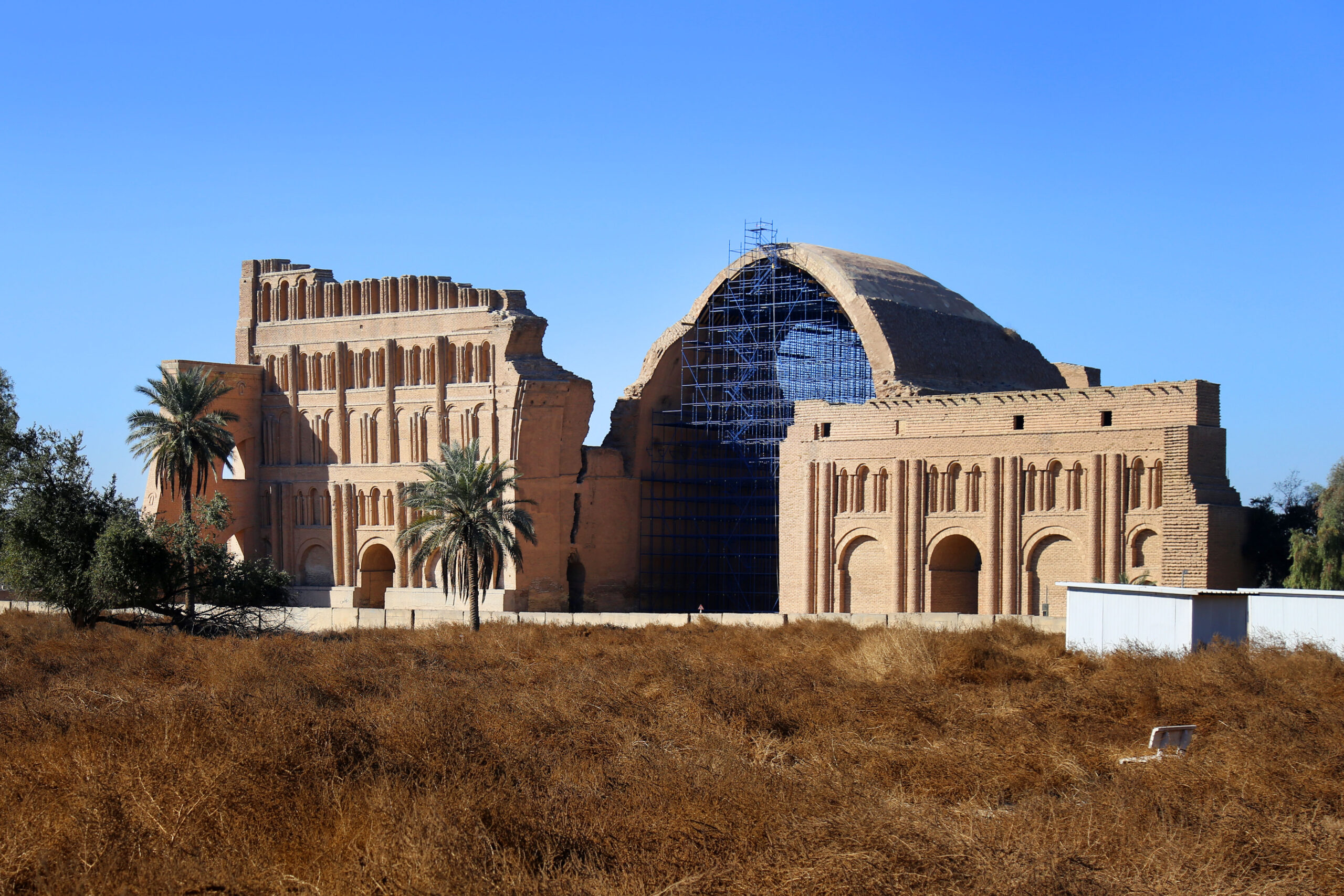
Taq Kasra stands in the village of Salman Pak, described in the reference sources as 22 miles or 35 km south-east of Baghdad. It is the surviving audience hall of the Sasanian capital, and it is generally called the largest single-span unreinforced brick vault anywhere. The numbers usually attached to it — a span of around 25 to 26 metres, a height of 35 to 37 metres, a depth of 48 to 50 metres — circulate widely and disagree with each other depending on the source. We could not settle them against a primary source, so treat any single confident figure you read elsewhere with suspicion.
Even the builder is contested. Some accounts credit Shapur I in the third century, others Khosrow I Anushirvan in the sixth. Both attributions are in serious circulation. Nobody honest picks one without a caveat.
What is not contested is the condition, and it is grim. The north wing collapsed in the Tigris flood of 1888. A Czech firm, Avers, completed a contracted restoration in 2017; two years later, in 2019, that work itself collapsed and damaged the monument further. Heritage reporting notes that no security or authoritative agency has been regularly present on site since the early 1990s, which is why vandalism and visitors climbing the vault for photographs have added their own damage. In May 2025 the head of Iran’s Islamic Culture and Communication Organization reaffirmed an offer to fund and staff preservation work, conditional on an official invitation from the Iraqi government. As of August 2026 that offer is on the table and no active restoration is confirmed.
Practically: Salman Pak is in Baghdad province, outside Sadr City, so visiting Ctesiphon does not move you into a worse risk tier than standing in central Baghdad does. That makes it the only monument of that scale you can see without changing your FCDO rating. No entry fee and no opening hours are published anywhere we could find. The absence of any staffed authority suggests it functions as an open, unticketed site, but we are inferring that rather than reporting it. Do not be surprised either way.
One negative finding worth carrying: Ctesiphon is not on Iraq’s UNESCO Tentative List at all. Iraq lists fifteen tentative sites and this is not among them, which for a monument of that stature is genuinely odd and something you will not read on any competing page. Our overview of Iraq’s inscribed and tentative UNESCO sites sets out where each one stands.
You will see the district signposted as al-Mada’in — the Arabic name for the wider area rather than a separate destination. If you are reading road signs, that is the word to look for.
Aqar Quf: the best half day from Baghdad
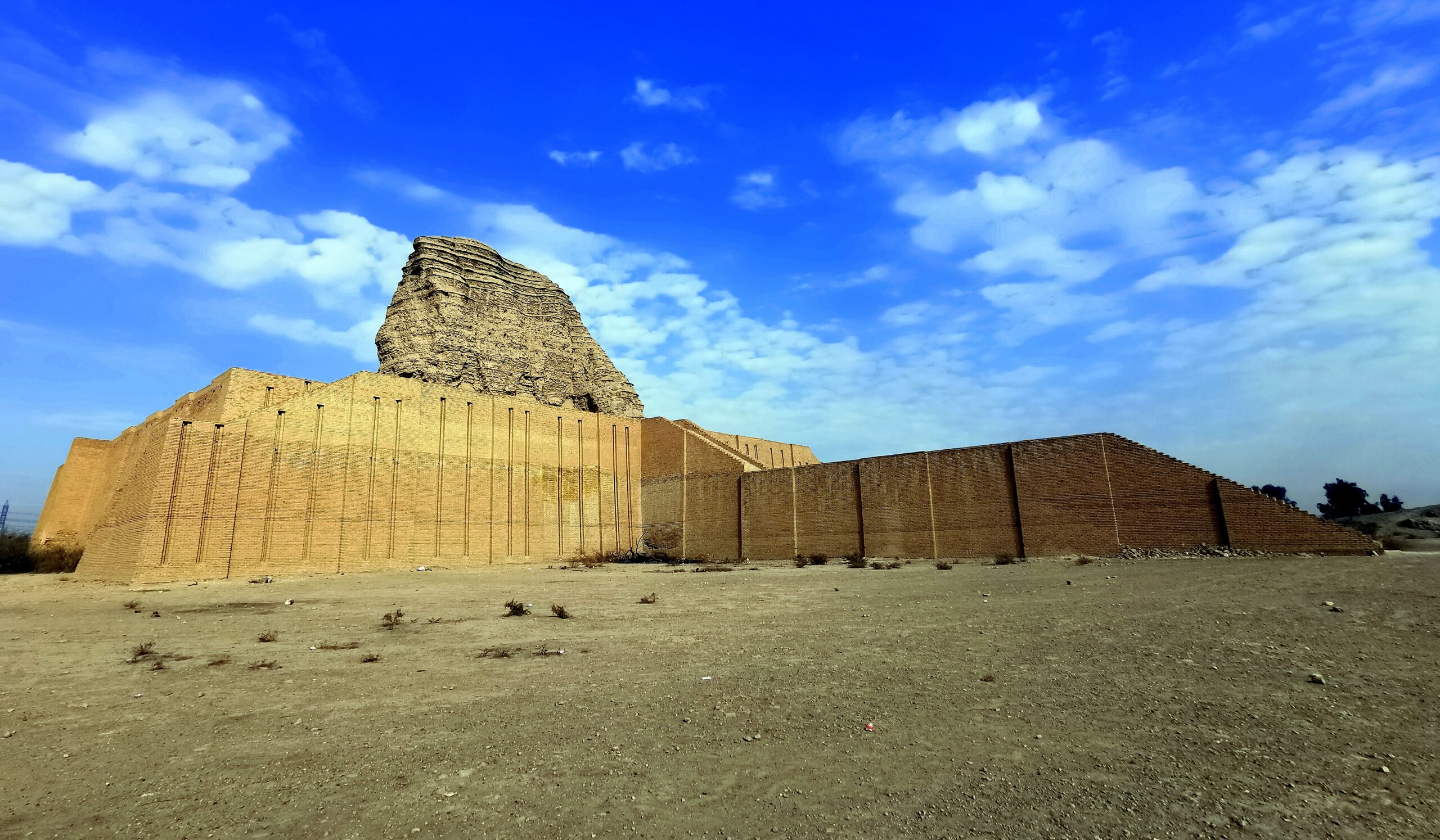
Roughly 30 kilometres west of the city, in the Abu Ghraib district of Baghdad governorate, a ruined ziggurat core rises out of flat farmland. This is Aqar Quf, ancient Dur-Kurigalzu, founded by the Kassite king Kurigalzu I in the fourteenth century BCE as a new capital. What survives is the mud-brick heart of the ziggurat, its outer casing long gone, standing far higher than anything comparable in Iraq.
How high is disputed. Around 52 metres is the figure the encyclopaedic sources return; around 57 metres is also widely quoted, usually phrased as height above the surrounding plain. The two are probably measuring different things — surviving brick core against total elevation above the plain — but nobody has reconciled them, so we give both.
The newest fact about Aqar Quf is the best one. It was added to Iraq’s UNESCO Tentative List in 2025, reference 6797, making it the most recent addition to the country’s list. No competing travel page has this.
Access is the reason we rate it first for a half day. No source reports any permit requirement. It is described as one of Iraq’s most visited and best-known sites precisely because it is so close to the capital. A bus or shared taxi from al-Nasr Square heading west is reported to cost around 1,000 IQD and take 30 to 45 minutes depending on traffic — that is weakly sourced and we flag it as reported rather than confirmed, but it is the only public-transport route to any site in this article that anyone describes as routine. No entry fee and no opening hours could be found for Aqar Quf either.
The name problem is bigger than the access problem. The road west runs through the Abu Ghraib area and continues towards Fallujah, and readers who recognise the name will assume the worst. Abu Ghraib district is inside Baghdad governorate. It carries the same FCDO rating as the rest of Baghdad province, and the site itself sits in farmland, not in a security zone. Expect checkpoints; carry your passport.
Babylon: the flagship day trip
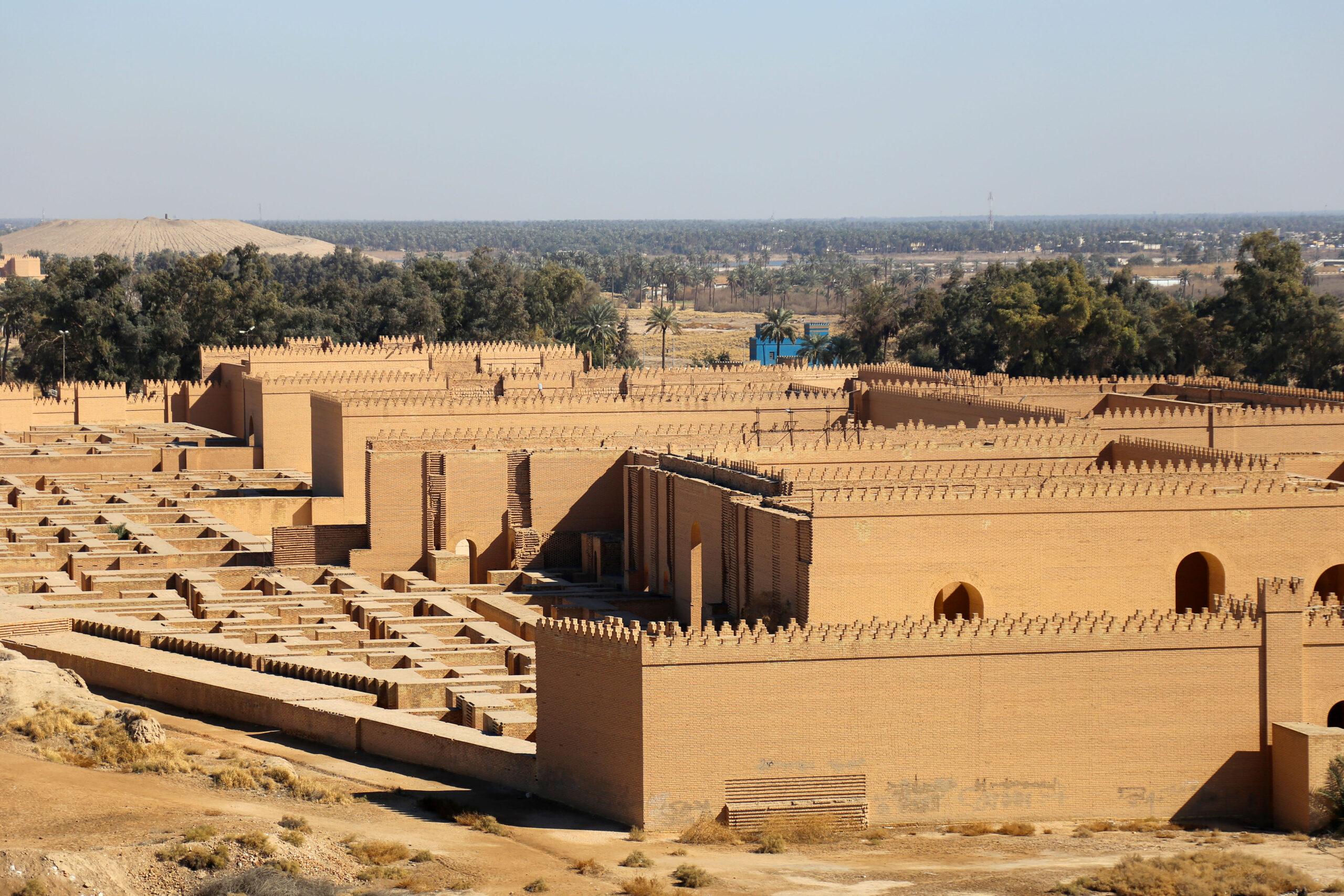
Babylon is 85 kilometres south of Baghdad by UNESCO’s own reckoning, near Hillah in Babil province. It was inscribed on the World Heritage List on 5 July 2019 under criteria (iii) and (vi), covering 1,054.3 hectares with a 154.5-hectare buffer. Unlike Samarra, it is not on the List of World Heritage in Danger. Also unlike Samarra, eighty-five per cent of it remains unexcavated.
Getting there and getting in
An Iraqi operator who runs the site weekly published dated practical detail in March 2026, and it is the most useful set of numbers on the whole subject. The drive is about an hour and a half via Hillah on a good, well-maintained road, described as one of the most heavily patrolled in the country. There is a single checkpoint on the approach to Hillah and it takes about two minutes when a local handles the paperwork. No permit, no escort, no advance application.
Entry for foreign visitors is 25,000 IQD, which at the mid-August 2026 street rate of about 1,535 dinars to the dollar is roughly US$16, or about US$19 if you convert at the official peg of 1,320. That gap is worth understanding across Iraq generally: quoted dollar prices often use the peg, so paying in dinar frequently works out cheaper. The same operator says the fee covers the main archaeological site including the Ishtar Gate replica, the Processional Way, the palace foundations and the Lion, and that Saddam’s palace on the hill is included at no extra charge. Other 2025–26 guides report a separate 1,500 IQD charge for the palace and around 15,000 IQD for a guide. The palace charge is inconsistently reported and we cannot resolve it; carry small notes and assume you may be asked. Foreign cards are not reliably accepted anywhere on site.
A guide is not compulsory. The operator’s own answer is that the site is open to the public and you can walk around independently — he advises against it not for access reasons but because there is very little signage or interpretation on site, which is a fair criticism of Babylon rather than a sales line. There is no public transport to the ruins: shared taxis run to Hillah, and from Hillah you would need a local taxi.
What is actually there
The Ishtar Gate you walk through is a replica. The original was excavated by German archaeologists in the early 1900s, shipped to Berlin piece by piece, and stands in the Pergamon Museum — a sore point locally, and one worth knowing before you photograph it. The Processional Way was originally lined with 120 glazed-brick lions in blue and gold; the reconstruction is partial but the layout is still legible. Nebuchadnezzar’s Southern Palace survives largely as foundation walls.
The Lion of Babylon is the thing most people remember: a basalt statue about 2,600 years old, standing over a human figure, out in the open with no glass case and no rope. It appears on Iraqi currency and government insignia.
Saddam Hussein’s palace sits on an artificial hill directly above the ruins, built in the 1980s on top of the archaeological layers — damage that was one reason UNESCO hesitated over inscription. It is abandoned now, interiors stripped, marble cracked, walls carrying graffiti left by soldiers of several eras. It also has the best view over the whole site and the Euphrates beyond. UNESCO’s own assessment of the Saddam-era “Revival of Babylon Project” is blunt: the reconstructions have negatively affected the property’s integrity, and their heights and designs are based on conjecture rather than archaeological evidence. UNESCO also recorded at inscription that the general physical fabric of the site was in critical condition.
One thing to let go of before you arrive: the Hanging Gardens were probably not here. Most contemporary scholars place them at Nineveh near modern Mosul, treat them as a literary invention, or consider the accounts heavily exaggerated. There is no archaeological evidence of them at Babylon. Most travel pages still sell them. For the wider context of what Babylon was and where it sits among Iraq’s older cities, see our guide to the Mesopotamian sites and what survives of them.
Borsippa, twenty minutes further
Twenty minutes south of Babylon, alone in flat farmland, stands the Birs Nimrud ziggurat at Borsippa. Almost nobody goes. Many scholars believe this is the structure behind the biblical Tower of Babel story. The vitrified bricks at the top — heat-fused, blackened — fed centuries of speculation about divine fire; the likeliest explanations are a lightning strike or a kiln effect. There is no formal entrance fee, it is an open site in the countryside, and 30 to 45 minutes is enough. The catch, in the operator’s words, is that Borsippa is almost impossible to find without someone who knows the unmarked roads. It is not on the UNESCO Tentative List.
Timing Babylon
Operator practice is to leave Baghdad at 07:00 and be on site by 08:30, because the ruins are open and unshaded and by midday between April and October the heat is punishing. Babylon itself takes two to three hours; with Borsippa and lunch in Hillah, the whole thing is eight to nine hours door to door. Avoid Fridays, the Iraqi weekend, when the site fills with local families and school groups. Tuesday to Thursday mornings are the quietest. One operator quotes day trips from US$120 per person including both sites and all entrance fees — that is a single operator’s March 2026 rate, not a market price, and we found no other dated 2026 figure to compare it against.
Samarra: the hardest gate in Iraq
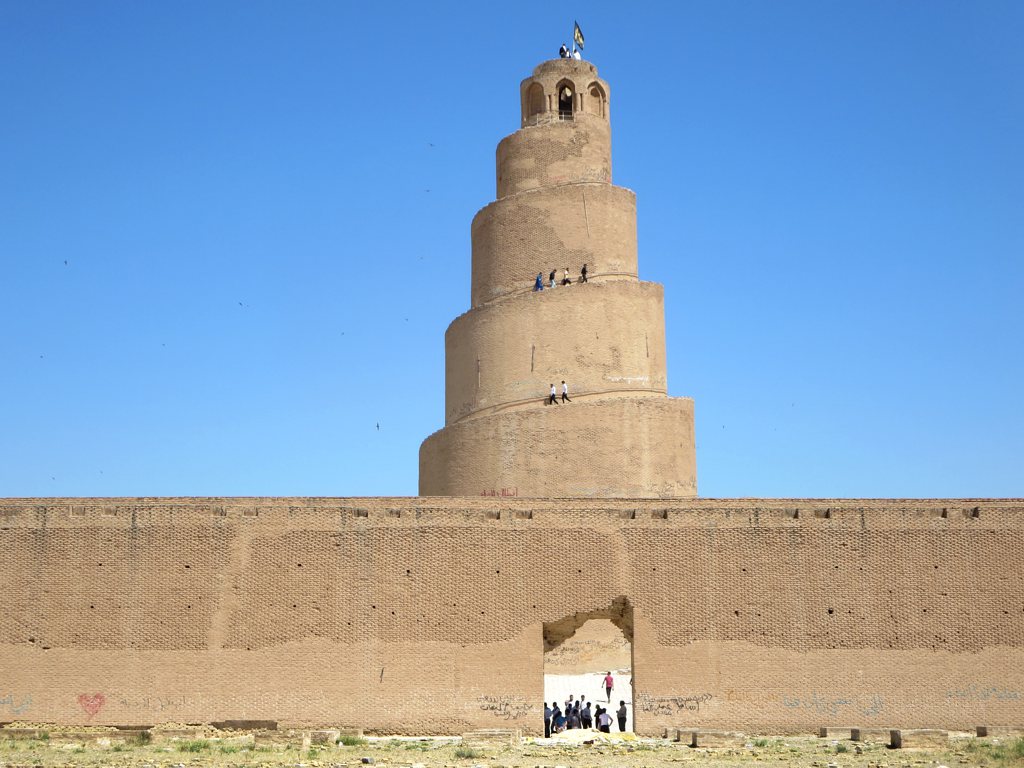
Samarra Archaeological City was inscribed by UNESCO in 2007 and placed on the List of World Heritage in Danger in the same year. It has been in danger for all nineteen years of its listing. The property covers 15,058 hectares with a 31,414-hectare buffer, runs 41.5 kilometres north to south, and is around 80 per cent unexcavated. It was the Abbasid capital from 836 to 892 CE, and UNESCO’s framing is worth quoting: following the loss of the monuments of Baghdad, Samarra represents the only physical trace of the Caliphate at its height, and it is the only surviving Islamic capital that retains its original plan, architecture and arts.
UNESCO is equally blunt about why it is in danger. Since the war began in 2003 the property has been occupied by multi-national forces using it as a theatre for military operations, and protective procedures have been in abeyance since 2003.
Distance depends on which end of a 41.5-kilometre archaeological city you are measuring to. UNESCO says 130 kilometres north of Baghdad; travel sources say 125; the range in general circulation is 120 to 125. All of those can be true at once.
The checkpoint, which is the whole story
This is the part no page-one competitor carries. Getting into Samarra is not a paperwork problem. It is a gate.
The checkpoint into the city is run by Saraya al-Salam — the Peace Brigades, Muqtada al-Sadr’s formation, which has guarded Samarra’s shrine approaches since 2014 — and not by the Iraqi army. There is no published permit process. You cannot apply in advance, because there is nothing to apply to. What exists instead is a decision made on the day by whoever is on duty.
The best-dated first-hand account we have is a tour leader’s report updated in February 2026. Her description: some people get through without any problems, others get held up and questioned about why they are visiting; a local contact is valuable; others have reported needing a contact in Samarra, or an escort to continue with them to the Grand Mosque; you may be given a military or police escort at the checkpoint. Her own group, travelling in December–January, waited about 45 minutes. Her summary is the honest one — sometimes it just depends on who is manning the checkpoint that day.
A separate 2026 account describes a document-exchange system: you hand over your passport or national ID at the checkpoint, receive a visitor card, and swap it back on the way out. We report that as reported, not verified.
We have previously seen it claimed that Samarra access loosened in February 2026. We could not re-confirm that this run and we are not repeating it as fact. What is defensible is that through early 2026 foreigners were routinely getting in, often with a delay and sometimes with an escort, against a regime that older accounts describe as permit-and-escort. Both pictures appear in the record. The reasonable conclusion is that the position varies by checkpoint, by season and by who is standing at the barrier, and that anyone telling you it is settled has not checked.
The other rule is firm and useful: foreigners are not permitted to stay overnight in Samarra. That is why it belongs on a list of day trips at all. The state will not let it be anything else.
Excluding checkpoint time, the drive is about 90 minutes each way. Budget three hours of driving plus an unpredictable nought to forty-five minutes or more at the gate, and treat it as a full day with no other plans attached. Our guide to what happens at Iraqi checkpoints covers the documents, the questions and the etiquette in more detail.
The Malwiya
The spiral minaret is 52 metres high and is the reason most people come. It belonged to the ninth-century Great Mosque of al-Mutawakkil, the largest mosque in the world at the time it was finished. Hulagu Khan’s invasion in the thirteenth century destroyed the mosque; the outer walls and the minaret survived. In 2005 an insurgent attack partially destroyed the upper section, and the minaret has since undergone extensive restoration, with plans in place to restore the mosque itself. The spiral ramp is thought to echo the ziggurats of the Mesopotamian plain.
Whether you can climb it in 2026 is genuinely disputed. The February 2026 first-hand account treats climbing as normal and recommends it, with advice to bring a light jacket for the wind at the top in winter. Another 2026 guide says access to the ramp depends on the security mood on the day, and that in recent years it has mostly been no. Both are recent. Do not build your day around the climb.
The al-Askari shrine
Samarra’s golden-domed shrine holds the tombs of the tenth Imam, Ali al-Hadi, and the eleventh, Hasan al-Askari, along with the cellar associated with the occultation of the Hidden Imam. It is one of the most significant Shia sites anywhere, and its bombing in 2006 is one of the pivotal events of the Iraqi civil war — dates for that attack and the later reopening are well established in the historical record but we did not verify them against a source this run, so we are not printing them as ours. We cover the site’s history and significance separately in our guide to the al-Askari shrine at Samarra.
Access for non-Muslims is a different question and the honest answer is that nobody can promise you anything. The barrier is not doctrinal so much as physical: there is a second checkpoint at the shrine itself, and it may or may not let you through. The February 2026 tour report is framed entirely around the Malwiya, and the escort it describes accompanies visitors to the Grand Mosque rather than to the shrine. Assume the shrine is not part of your day, and treat it as a bonus if it happens.
Doing Samarra independently
It is possible and people do it. Shared taxis leave Baghdad for Samarra from Allawi North Garage at around 15,000 IQD a seat, with a private charter of the whole car reported at about 30,000 IQD each way after some hard bargaining. The return runs from Samarra Garage at the same rates. Add the 25,000 IQD foreigner fee for the Grand Mosque and Malwiya complex and the whole day comes in under about US$60 at the street rate.
What that saving buys you is the checkpoint, handled alone, in Arabic, while being asked why you are there. That is the trade. Compare the two-minute checkpoint on the Babylon road when a local handles the paperwork with a 45-minute hold at Samarra and you have the argument for a driver in one line.
Balad: the one we will not send you to
Balad is in Salah al-Din province, so it carries the same “against all travel” rating as Samarra, and it sits on the same corridor. Its Sayyid Muhammad shrine — for the son of the tenth Imam and brother of the eleventh — is a major Shia pilgrimage destination in its own right.
Beyond that we have nothing usable. We could not source the road distance or drive time from Baghdad, the permit or escort position, whether non-Muslims are admitted, or any current visitor information at all. Rather than fill those gaps with plausible-sounding guesses, we are saying plainly that there is not enough verified access information to send anyone there. Treat Balad as a place you pass on the Samarra road, and note that if you have accepted Samarra’s rating, you have already accepted Balad’s.
Karbala and Najaf: the shrine cities
Both are reachable from Baghdad in a day, and neither should be attempted on the same day as the other.
We could not independently source the road distance to either city this run. The commonly quoted figures — around 100 to 105 kilometres to Karbala, around 160 to 165 to Najaf — appear everywhere and we could not verify them, so we are not asserting them. The one sourced adjacency we do have is an operator’s March 2026 statement that the shrine cities are about an hour beyond Hillah, which by his own reckoning puts Karbala at roughly two and a half hours from Baghdad.
Neither shrine charges admission. There is no permit and no escort requirement to enter either city. What there is, on the Karbala road, is the Jurf al-Sakr carve-out described earlier.
Can non-Muslims go inside?
Every tour operator and recent traveller account we found says yes: non-Muslims are admitted to the Imam Hussein and al-Abbas shrines in Karbala and the Imam Ali shrine in Najaf, interiors included, with modest dress and respectful behaviour. Several explicitly contrast this with Mecca.
We could not find a single official statement from any shrine custodianship confirming it. Not from al-Ataba al-Husayniyya, not from al-Ataba al-Abbasiyya, not from the Imam Ali shrine. Every source is an operator or a blogger. Access has historically been at the discretion of shrine security, which means it can differ between two visitors on the same afternoon. Our position: assume yes, prepare for no, and do not build your day around getting inside. If you are planning a trip that centres on shrine visits rather than sightseeing, our ziyarat route planner and the wider guide to pilgrimage travel in Iraq are built around that intent.
Dress is stricter in the shrine towns than in Baghdad. Women wear an abaya with hair covered, and abayas are usually available to borrow at shrine entrances. Men need long trousers and sleeves. Expect shoe and phone checks at the gates.
What is in each city
Karbala is the two haramayn, a few hundred metres apart, and the space between them — which is where the atmosphere actually lives. Our city guide to Karbala covers the layout, and if you decide to stay rather than day-trip, there is a separate rundown of where to stay in Karbala.
Najaf has the Imam Ali shrine, the hawza seminary, and Wadi al-Salam — which sits on Iraq’s UNESCO Tentative List as the Wadi Al-Salam Cemetery in Najaf, reference 5578, submitted in 2011. It is universally described as the largest cemetery in the world. We are not printing an area or a burial count, because the published figures vary wildly and none of them checks out; our guide to Wadi al-Salam goes through why. Nearby Kufa and its Great Mosque fold naturally into a Najaf day rather than standing alone, and Najaf has its own international airport — so a traveller heading only for the shrine cities can skip Baghdad entirely. Our Najaf city guide covers arriving that way.
The pilgrimage calendar will close your day trip
Arbaeen 2026 fell on 4 August. The al-Abbas Holy Shrine’s own count was 19,999,870 pilgrims; organisers reported 21,103,524 participants; 4,887,660 foreign visitors had entered Iraq for it. Those are different measurements of the same event and we give all three rather than picking one. It is the largest annual gathering of people on earth, and it is concentrated on exactly the Najaf–Karbala corridor you would be driving.
The FCDO notes that curfews and vehicle bans can be imposed at short notice around religious holidays, pilgrimages and politically sensitive periods, and separately that routes in and out of Baghdad and its airport may close with little or no notice. Ashura, the 25 Rajab pilgrimage and Ramadan all compress movement too. Do not plan a Karbala or Najaf day trip inside the Arbaeen window. If your dates are flexible, our note on when to visit Iraq maps the calendar, and there are dedicated guides to Arbaeen itself and to the walk between the two cities if that is what you are coming for.
Al-Ukhaidir: a fortress in the desert
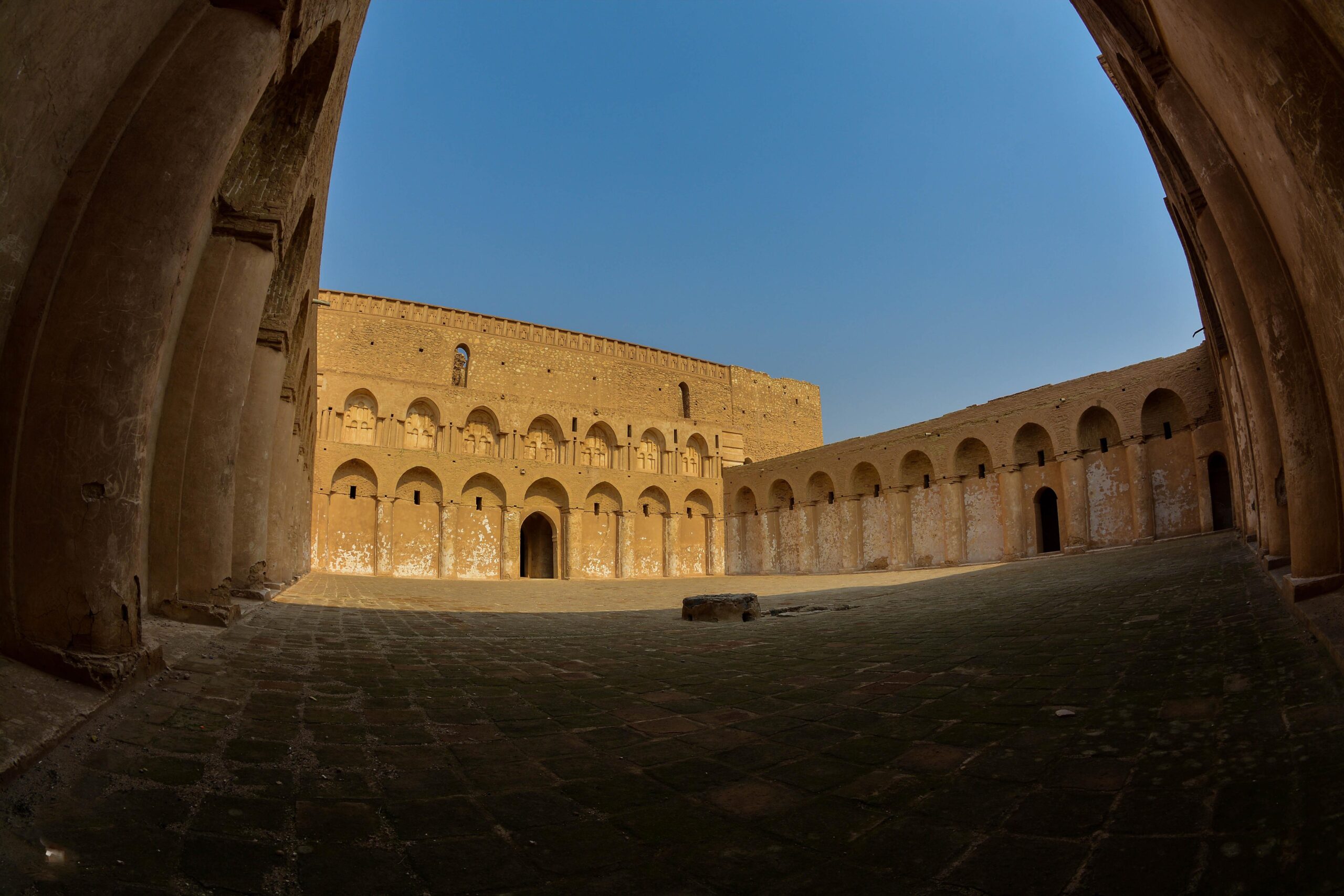
Al-Ukhaidir is an Abbasid fortress-palace of around 775 CE, built by Isa ibn Musa, nephew of the caliph al-Saffah. It is a large rectangular complex of courtyards, residences and a mosque, and it is one of the best-preserved early Islamic palaces anywhere. It sits 50 kilometres south of Karbala, which puts it in Karbala province and therefore in the “all but essential” tier.
It has been on Iraq’s UNESCO Tentative List as the Fortress of Al-Ukhaidar since 2000, reference 1467 — twenty-six years listed and never nominated for inscription.
Access is by unpaved or secondary roads from Karbala, which means a private vehicle, a taxi or an organised tour; there is no public transport. No permit is reported. No entry fee and no opening hours could be sourced. You will find a confident set of daily opening hours circulating online for Ukhaidir — it traces back to an aggregator site we do not trust, and we are not repeating it. The same goes for the taxi fares quoted from Karbala.
Can it be combined with Karbala in one day from Baghdad? Not comfortably. It is Karbala plus a 50-kilometre desert detour each way on secondary roads, on top of a roughly two-and-a-half-hour approach. It works as a very long day with a private car, or as an easy morning if you have stayed overnight in Karbala. One more thing about desert sites generally: the FCDO notes landmines and remnants of war in rural and desert areas, that some areas have warning signs and not all do, and that people are killed by them every year. Stick to tracks and to ground other people are walking on.
Lake Habbaniyah: the drought story
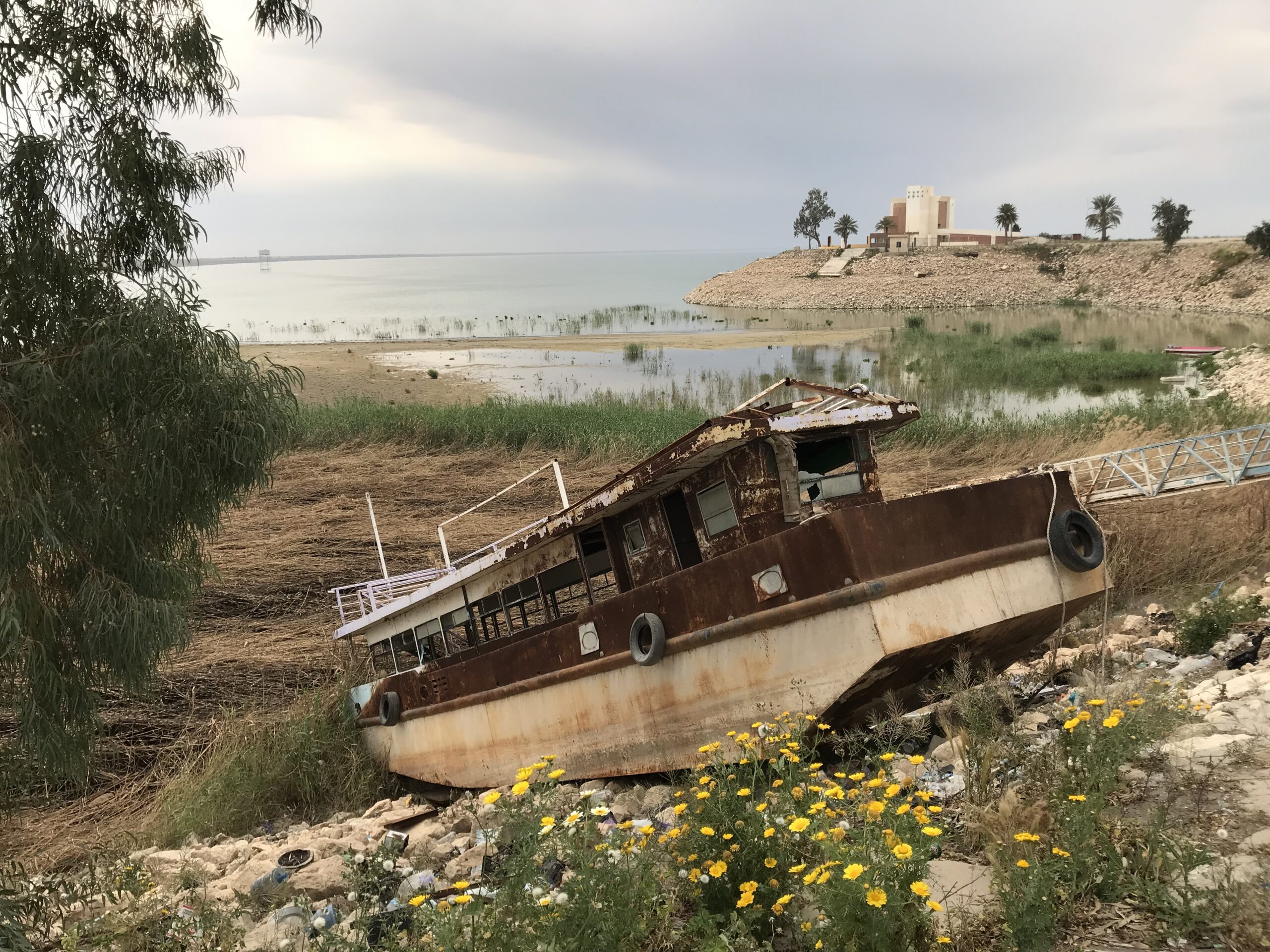
This is the cheerful entry on a list that does not have many. Al-Habbaniyah Tourist City is operating. In an interview with Shafaq News published on 13 July 2026, its director Moayad Al-Mashouh said the current infrastructure can take visitors following the restoration of 100 housing units inside the resort, with work continuing on the private and wooden cabins and completion expected by the end of the year. A large events hall, a water park and swimming pools are under construction. The resort was awarded to an investor in 2011, and the Ministry of Tourism has now formed a committee to follow up on the investment file.
The interesting part is what the director named as the site’s biggest challenge. Not security. Water. Declining water levels over the past four years have cut visitor numbers; recent releases have improved conditions; he puts the requirement at at least one billion cubic metres of continuous releases to restore tourism activity, and about 3.5 billion to return the lake to its previous level. Around 5,000 families visited during the Eid al-Fitr and Eid al-Adha holidays, plus regular weekend traffic.
The site covers about 701 square kilometres in western Anbar between Fallujah and Ramadi, and includes residential complexes, a military base and an airport. After the war against ISIS it sheltered around 60,000 displaced people — roughly 12,000 families — from Fallujah. A separate project, the Euphrates Resort at Al-Baghdadi near the lake, opened in 2025 as Anbar’s first major post-ISIS tourism development.
The honest arc is not “ruined, now reopening”. It reopened in 2018, was degraded by drought from around 2022, and is being rebuilt through 2026 while the water problem remains unsolved.
What we cannot tell you is whether you, as a foreign visitor, can go. No source addresses foreign-visitor access, permits, or what the military base on site means for entry. This is a domestic destination serving Iraqi families. The route from Baghdad passes Fallujah, which will alarm readers who know the name; the accurate statement is that both Fallujah and Ramadi sit in the “all but essential” tier rather than the “all travel” tier. We could not source the road distance either. If Habbaniyah interests you, ask a local operator whether they run it at all before you plan around it.
Do you need a driver?
Not legally. Practically, for most day trips from Baghdad, yes, and the case is easy to make from sourced material rather than sales pitch.
The FCDO’s own wording on Iraqi roads: road travel within Iraq is dangerous, driving standards are low, road traffic accidents are frequent and often fatal, fake vehicle checkpoints have been used to launch terrorist attacks, and there is a risk of carjacking and robbery. The numbers behind that: 2,351 road deaths in Iraq in 2025 according to CSGIS, with Baghdad accounting for around 19.5 per cent of national crashes. Traffic injures far more visitors to Iraq than anything political does.
Checkpoints are the second argument. Carrying photographic ID is a legal requirement in Iraq, and the authorities may stop people for ID checks in cities and on main roads. At Samarra a foreigner is asked why they are visiting, a question that goes considerably better in Arabic. A local driver is your interface at the barrier, and the two-minutes-versus-forty-five-minutes contrast between Babylon and Samarra is what that interface is worth.
Navigation is the third. Signage is Arabic-first and some sites — Borsippa above all — are described as almost impossible to find without someone who knows the unmarked roads.
Self-drive is a fourth barrier, and a paperwork one. The FCDO requires both your home licence and the 1968-version international driving permit, and an IDP cannot be bought outside your home country. If you did not sort that before flying, you cannot legally self-drive, whatever a rental desk tells you. Aggregators do list Europcar and SIXT for Iraq, and a domestic company, Wed Rent Car, describes itself as the first officially registered Iraqi firm offering fully insured rental without a driver, with a branch at Baghdad International Airport. An aggregator listing is not proof that a foreign tourist can walk up and drive away, and deposit terms, insurance validity in advise-against areas and permission for inter-governorate travel are all unverified. We would not describe self-drive as straightforward.
We could not source a single dated 2025–26 bare car-and-driver day rate for Baghdad. The only dated 2026 price of any kind we found is the bundled US$120-per-person Babylon tour mentioned earlier. Anyone quoting you a confident daily rate for a car and driver in Baghdad is quoting from memory or from thin air. Ask two or three operators and compare. Our overview of how tours and drivers are arranged in Iraq and the wider guide to moving between Iraqi cities both go further into the options.
Shared taxis are real, cheap, and foreigners do use them: the Samarra route from Allawi North Garage at around 15,000 IQD a seat is the best-documented example. Iraq is still a cash economy and ATMs are scarce, so carry dinar. Budget planning is covered in our breakdown of what a trip to Iraq actually costs.
Timing your day
Heat is the constraint that decides everything about day trips from Baghdad between April and October. Baghdad’s July mean maximum is 44 °C, and on 15 August 2026 four Iraqi governorates recorded 50 °C — so the extreme window does not reliably end in mid-August, whatever you have read. Babylon, Aqar Quf, Borsippa and Ukhaidir are all open and unshaded. A midday summer visit to any of them is genuinely dangerous rather than merely unpleasant. Leave at seven, be on site by half past eight, be finished by noon.
Friday is the Iraqi weekend and the archaeological sites fill with local families and school groups. Tuesday to Thursday mornings are quietest. Sand and dust storms are common in spring and summer and can wipe out a day entirely, including flights. Flash floods are common between November and March. During Ramadan the FCDO advises against eating, drinking, smoking or chewing gum in public during daylight hours, including inside your car.
One legal warning that belongs on any day trip to an archaeological site: Iraqi law allows the death penalty for intentional export of antiquities. Jim Fitton, a 66-year-old British visitor, was sentenced to 15 years for pottery and stone fragments he picked up on an organised archaeology tour and was caught with at Baghdad airport. Do not pick anything up. Do not accept anything offered to you at a site. The rules that catch visitors out are set out in our guide to Iraqi laws travellers get wrong.
What is not a day trip from Baghdad
Several places turn up on other lists of day trips from Baghdad that should not be on any of them.
Hatra is a UNESCO World Heritage site inscribed in 1985 and added to the Danger list in 2015 after ISIS damage. It is in Ninawa province, which the FCDO rates against all travel, and it is around 290 kilometres from Baghdad. Two disqualifiers at once.
Tikrit and Dujail are both in Salah al-Din, both rated against all travel, and neither has any sourced visitor infrastructure. Dujail is historically significant — the 1982 assassination attempt and the case that ultimately convicted Saddam Hussein — but there is nothing there to visit.
Ashur (Qal’at Sherqat) is another World Heritage site, inscribed in 2003, also in Salah al-Din and also under the hardest rating. UNESCO published a piece on protecting the Ziggurat of Ashur on 16 November 2025, so conservation work is live, but it is not somewhere you go from Baghdad in a day.
Kish, Ain al-Tamr, and the Sawa and Razzaza lakes all come up in conversation. We found no dated access, condition or fee information for any of them and we are not going to invent it. They may be possible with a local operator; there is no reliable published information either way.
The Abbasid caravanserais along the Baghdad–Karbala corridor belong to the Darb Zubaydah pilgrim route, which is on Iraq’s Tentative List under reference 6576, submitted in 2022. That is the correct umbrella name if you want to ask about them, but we could not source the condition or accessibility of any individual khan.
Mosul, Erbil, Ur, Basra and the Ahwar marshes are all overnight or fly-in destinations, not day trips. Mosul in particular is in a province rated against all travel and needs at least a night. The southern sites are covered in our guide to travelling in southern Iraq, and the wider shortlist of what is worth the journey is in the best places to visit in Iraq.
What we could not confirm
On a subject where every competing page states confident opening hours and prices, here is what is genuinely not published. This list is longer than the confirmed one, and pretending otherwise would be the dishonest choice.
- Opening hours for every single destination in this article. Not one of these sites publishes hours anywhere we could find — not Babylon, not Samarra, not Ctesiphon, not Aqar Quf, not Ukhaidir, not the shrines. The confident hours you will see quoted elsewhere are, as far as we can establish, invented or copied from aggregators.
- Entry fees for Ctesiphon, Aqar Quf, Al-Ukhaidir and Lake Habbaniyah. No figure exists for any of them. Only Babylon and Samarra have a sourced 25,000 IQD foreigner rate, and we could not confirm whether that is a published national tariff or a coincidence of two sites.
- Drive times to Karbala, Najaf, Balad, Lake Habbaniyah and Al-Ukhaidir. None is independently sourced. The road distances commonly quoted for Karbala, Najaf, Balad, Habbaniyah and Ukhaidir are equally unverified.
- Non-Muslim access to the shrines at Karbala, Najaf and Samarra. No official statement from any custodianship exists. Every source is an operator or a traveller.
- Ctesiphon’s arch dimensions. Span, height, depth and wall thickness are all in circulation and none of them verified against a primary source.
- Aqar Quf’s height. Given as both 52 m and 57 m, and the two have never been reconciled.
- Any bare car-and-driver day rate in Baghdad, and whether self-drive hire is genuinely available to a foreign tourist.
- Whether Babylon charges separately for Saddam’s palace (1,500 IQD per some guides, included per the operator who runs the site weekly), and whether the roughly 15,000 IQD guide fee is official or informal.
- Whether foreigners may visit Lake Habbaniyah at all, and what the military base on site means for access.
- Everything about Balad except its FCDO rating and the existence of the Sayyid Muhammad shrine.
- Whether the Malwiya can currently be climbed. Two 2026 sources say opposite things.
- Wadi al-Salam’s area and burial count. Published figures vary so widely that none of them is usable.
- Whether photographing checkpoints is actually illegal. It is universally advised against and we advise against it too, but we could not find it stated as law in the FCDO text.
Frequently asked questions
Which day trip from Baghdad is easiest for a first visit?
Aqar Quf, if you only have half a day, or Babylon if you have a full one. Both are in provinces rated the same as Baghdad city or one step down, neither needs a permit, and Babylon’s single checkpoint takes about two minutes. Neither involves the discretionary gate that makes Samarra unpredictable.
Do I need a permit to visit Samarra?
There is no permit to get. No published application process exists — what exists is a checkpoint run by Saraya al-Salam where a decision is made on the day. Some visitors pass straight through, others are held and questioned, and some are assigned an escort to the Grand Mosque. Having a local contact in Samarra materially improves your odds.
Can I stay overnight in Samarra?
No. Foreigners are not permitted to stay overnight in Samarra, which is precisely why it appears on a list of day trips. Plan it as an out-and-back from Baghdad and leave enough margin for the checkpoint at both ends.
How much does it cost to get into Babylon?
25,000 IQD for foreign visitors, per an Iraqi operator writing in March 2026 — roughly US$16 at the mid-August 2026 street rate or about US$19 at the official peg. Reports differ on whether Saddam’s palace is included; the operator says yes, some guides report a separate 1,500 IQD. Bring cash in dinar.
Is my travel insurance valid for these trips?
Almost certainly not on a standard policy. Every destination here sits in a zone the FCDO advises against travelling to, and travelling against that advice can invalidate cover. Specialist insurers who write advise-against regions exist. Read the wording before you assume.
Can non-Muslims enter the shrines at Karbala and Najaf?
Every operator and recent traveller report says yes, with modest dress. No shrine custodianship publishes a policy either way, and admission has historically been at security’s discretion, so two visitors on the same day can have different experiences. Go expecting the city rather than the interior, and treat entry as a bonus.
Can I do Karbala and Najaf in the same day from Baghdad?
You can drive it, but you will not see much. Both are shrine cities where the value is unhurried time in the courtyards, both involve dress changes and security checks, and both sit past the same southbound checkpoint chain. Operators sell the pair as a long day or an overnight rather than a comfortable single day trip.
What is the best time of year for day trips from Baghdad?
October to April. Between April and October the sites are open, unshaded and dangerously hot by midday, and Baghdad’s July mean maximum is 44 °C. Avoid the Arbaeen window entirely for anything south of the city, and expect dust storms in spring and summer.
Are these sites safe from unexploded ordnance?
The main sites are on well-walked ground. The FCDO does warn that rural and desert areas, particularly near borders, contain landmines and remnants of war, that not all contaminated areas are signed, and that people are killed by them each year. That applies most to the desert approach to Al-Ukhaidir. Stay on tracks.
Final thoughts
The pattern that emerges once you lay the nine best day trips from Baghdad side by side is that distance barely matters. Aqar Quf is half an hour away and effectively open. Samarra is ninety minutes away and governed by a decision somebody makes while looking at you. Habbaniyah is closer than Najaf and harder to establish anything about. What determines your day is jurisdiction, not kilometres — which province you are in, who holds the checkpoint, and whether anyone has ever bothered to publish a rule.
That is also why so much of this page is hedged. We would rather tell you that no opening hours exist for Babylon than print a plausible-looking range that gets you standing at a locked gate at eight in the morning. The sites in this article have survived floods, invasions, a collapsed restoration and two decades of military occupation, and the one thing none of them has is an information desk.
If you are building a longer trip around these, start with the sample Iraq itineraries and work backwards from your fixed dates. If Baghdad itself is where you are based, our Baghdad city guide covers the neighbourhoods and the practicalities you will need before you go anywhere else, and the shrine district at Kadhimiya is a genuine half-day inside the city limits if a day trip falls through. And if the reason you are here is the security question rather than the sightseeing one, read our assessment of how safe Baghdad currently is first — the answer to that shapes everything on this page. Back in the city, our guides to Mutanabbi Street and the Iraq Museum cover the two stops most visitors pair with a day out.
Photo credits
Taq Kasra at Ctesiphon and the Southern Palace at Babylon: Safa Daneshvar (CC BY-SA 4.0). Malwiya minaret, Samarra: David Stanley (CC BY 2.0). Aqar Quf ziggurat: Osama Shukir Muhammed Amin FRCP(Glasg) (CC BY-SA 4.0). Al-Ukhaidir fortress courtyard: Hekmat Al-Ayashi (CC BY-SA 4.0). Lake Habbaniyah: Synaps (CC BY-SA 4.0). All images via Wikimedia Commons.