Last updated: August 2026. Advisory wording, airspace bulletins and casualty figures all re-checked on 7 August 2026.
Two governments looked at the same city this summer and answered the question “is Baghdad safe” in almost opposite ways. Britain’s Foreign Office now advises against all but essential travel to Baghdad province, having carved the capital out of its blanket warning on 22 July 2026. The United States still says Do Not Travel — Level 4, no regional exceptions, leave now if you are there. Neither is lying. They are answering different questions. How the capital fits the national picture is set out in our honest guide to whether Iraq is safe.
The honest answer is that Baghdad carries a real and unusual risk profile, and one that looks nothing like the city most people picture. The things that actually happen to foreign visitors here, in rough order of frequency, are traffic accidents, stomach trouble, a bureaucratic hassle at a checkpoint and a phone confiscated for photographing the wrong building. The things the advisories are built around — kidnapping, indirect fire, militia activity — are far less likely to touch you, but they are not hypothetical, they have specific recent examples with names attached, and the consequences if they do reach you are severe in a way petty crime never is.
What almost nobody on page one will tell you is why the two advisories diverge. That gap is the most useful thing in this article. This guide covers what each government says now and what drives the difference, the five real risk categories ranked by how likely they are rather than how frightening they sound, Baghdad district by district including the one neighbourhood every advisory singles out, what the current escalation means for someone with a flight booked, checkpoints and photography rules, the insurance consequence most “is it safe” pages never mention, and an honest list of the people who should not go.

The short answer
If you only read one thing on this page, read the table. Everything below it is the reasoning.
| Question | Answer |
|---|---|
| What does the UK say? | All but essential travel to Baghdad province; against all travel to Sadr City only |
| What does the US say? | Level 4 Do Not Travel, whole country, no regional carve-out |
| Is anyone actually visiting? | Yes — tourist numbers rose through 2025 and early 2026, almost all with a guide |
| Biggest real risk to a visitor? | Road traffic, by a wide margin |
| Biggest catastrophic risk? | Kidnapping, historically profile-targeted rather than random |
| Can you walk around? | In parts of Rusafa and Karrada, yes, usually with someone local |
| Will insurance cover you? | Standard policies generally will not. See the insurance section |
| Can this change overnight? | Yes. Airspace has closed at short notice more than once in 2026 |
Is Baghdad safe? What the travel advisories actually say
Most articles asking whether Baghdad is safe quote a version of the FCDO advice that has not been current since July. The regionalisation matters, so here it is precisely.
The United Kingdom
The FCDO updated its Iraq advice on 22 July 2026 and it remained in that form when we checked on 7 August. It is no longer a blanket warning against all travel to Iraq. It is a map with two tiers.
Against all travel covers Kirkuk province, Ninawa province (which includes Mosul), Salah al-Din province, Anbar west of Ramadi City, Diyala except Baqubah City, the town of Jurf al-Sakr in Babil, the strips within 5km of the Iranian, Saudi and Kuwaiti borders — and, inside the capital, Sadr City.
Against all but essential travel covers, among other places, Baghdad province except Sadr City, Karbala, Najaf, Babil, Basra including Highways 1 and 8, Dhi Qar, and the entire Kurdistan Region.
The distinction is not cosmetic. “All but essential” is the same tier the FCDO has historically applied to places people do in fact visit, and it changes what some insurers will underwrite. It also means that if you read a page telling you the British government warns against all travel to Baghdad, that page is out of date and you should treat everything else on it with the same suspicion.
The United States
The State Department reissued its Iraq advisory on 2 March 2026 at Level 4 — Do Not Travel — with unchanged risk indicators and no regional exceptions of any kind. The wording is unambiguous: do not travel to Iraq for any reason, and leave now if you are there. On the same date, State ordered non-emergency US government employees to depart Iraq, and the mission has remained on ordered departure since. US government personnel in Baghdad are prohibited from using Baghdad International Airport.
The advisory also asks US citizens who travel anyway to draft a will, designate a family member to handle their affairs, and discuss leaving DNA samples with their medical provider. That line gets quoted for shock value and sneered at in roughly equal measure. It is neither absurd nor theatrical: it is boilerplate the State Department applies to countries where a kidnapping or a body recovery is a live administrative possibility, and its purpose is to make the practical consequences legible before you go, not to frighten you out of going.
Everyone else
Other governments answer “is Baghdad safe” with their own wording and their own maps. Australia’s Smartraveller and Canada’s travel.gc.ca both advise against travel to Iraq, with Canada making a partial exception for the Kurdistan Region. The general pattern is that European advisories have been the first to regionalise and the Anglosphere security partners the slowest. Whichever passport you hold, read your own government’s page rather than a summary of it — including this one.
Why the UK and the US disagree so sharply about Baghdad
This is the part that is missing from every competitor page, and it is the actual answer to the question.
The US assessment of Iraq is not primarily a general public-safety judgement. It is heavily weighted towards the specific, sustained threat to American citizens and American-linked targets from Iran-aligned armed groups operating inside Iraq. That threat is real, documented and directed. It is why the US embassy sits behind the heaviest fortification in the country, why US government personnel are barred from the civilian airport, and why the advisory has no regional carve-out: the threat follows the passport, not the postcode.
A Japanese, Spanish, Malaysian or Brazilian visitor carries a materially different risk profile through the same streets. They are not a target of the same actors for the same reasons. They are exposed to the same background risks — a road accident, being near a protest, being in a district when something happens — but not to the specific one that drives the American assessment.
Three qualifications, because this is exactly the kind of reasoning that gets over-extended.
First, “not a primary target” is not “safe”. Kidnapping for ransom does not always check nationality first, and being visibly Western is a category in itself. Second, the calculus for a British, Australian or Canadian passport sits somewhere between the two poles, closer to the American end than most holders assume. Third, dual nationals of any Western country plus Iraq occupy a genuinely awkward position: Iraq does not recognise the protective effect of your second passport, and consular help may be limited or refused entirely. If that describes you, get specific advice rather than general reassurance.
The honest summary is that “is Baghdad safe” has a different answer depending on what is printed on the front of your passport, and no single advisory can tell you which answer applies to you. The same logic runs through the rest of the country, where the regional variation is sharper still and where the places worth the journey are not evenly distributed — our guide to the best places to visit in Iraq maps them against the advisory tiers.
The five real risks, ranked by likelihood
Advisories rank risks by severity. Travellers experience them by frequency. Anyone asking whether Baghdad is safe is really asking about five separate things at once, so here they are separated out and ordered the second way, which is more useful when you are deciding what to actually do.
| Risk | How likely for a visitor | What reduces it |
|---|---|---|
| Road traffic | High — the most common cause of injury | Seatbelts, no night driving, an experienced driver |
| Petty crime | Low by big-city standards | Ordinary precautions, low profile |
| Protests and closures | Moderate — mostly disruption, not danger | Flexible plans, local news, leaving early |
| Indirect fire, drones | Low but non-zero | Distance from US-linked and government sites |
| Kidnapping | Low, and profile-dependent | Local guide, no fixed routine, discretion online |
1. Road traffic — the thing that actually hurts people
Iraq’s Commission of Statistics and Geographic Information Systems recorded 2,351 road deaths in 2025, down 15.7% on 2024, from 11,948 recorded accidents outside the Kurdistan Region. Baghdad province accounted for the single largest share — 2,333 crashes, 19.5% of the national total, ahead of Basra on 16.6% and Wasit on 9.8%. Injuries ran to 11,564.
Those are reported figures from a country where a great deal goes unreported, so treat them as a floor. What they establish is the shape of the problem: Baghdad traffic is dense, fast, weakly policed on lane discipline, and prone to sudden stops at checkpoints that drivers approach at speed. Seatbelts in the back are often unavailable and almost never used. Motorcycles weave. Night driving compounds all of it.
This is the risk you can most cheaply reduce and the one visitors think about least. Insist on a seatbelt, decline to travel intercity after dark, and if a driver is on his phone say something. Our guide to getting around Iraq goes into the practicalities of drivers, shared taxis and the intercity roads.
2. Petty crime — genuinely low, and worth saying plainly
Pickpocketing and bag theft happen in crowded markets, as they do everywhere, and there are the usual overcharging and fake-official scams aimed at obvious foreigners. Violent street crime against visitors is not a common report. Iraq is a heavily cash economy, so you will be carrying more cash than you are used to; that is the main thing to be careful about, along with the ordinary discipline of not flashing a phone in a crowd.
We are not going to compare Baghdad’s crime statistics to an American city, which is a rhetorical trick that tells you nothing. Iraqi crime data is not collected or published on a basis that supports the comparison, and anyone doing it is guessing with confidence. What can be said is that the ordinary background hum of urban predation that shapes travel in many capitals is not the thing that shapes travel in Baghdad.
3. Protests, closures and civil unrest
Baghdad protests, frequently, and the security response is to seal the centre. In June 2026, security forces closed Tahrir Square and shut al-Jumhuriyah Bridge in both directions ahead of a farmers’ demonstration — the second in five weeks — by growers from Najaf, Karbala, Diwaniyah and Babil over unpaid crop revenues and flood and drought losses. In March 2026 there were sustained anti-US demonstrations around Tahrir Square and the south bank of the 14th July Bridge, with attempts by demonstrators to reach the US embassy.
For a visitor this is mostly a logistics problem rather than a physical one: bridges close with little notice, a fifteen-minute drive becomes ninety, and the route to the airport can be affected. It becomes a physical problem if you are in the wrong place when tear gas and live rounds enter the picture, which has happened. The rule is simple and absolute — if you see a crowd forming, leave in the opposite direction, immediately, and do not stop to film it.
4. Indirect fire, drones and regional escalation
This is the risk category that has changed most in 2026, and it is concentrated rather than diffuse. Rockets and drones in Iraq are aimed at US military and diplomatic facilities, at Iraqi government installations and at energy infrastructure. They are not aimed at bookshops. The exposure for a visitor is proximity and imprecision: these weapons miss, and where they land is a function of where they were aimed from and at.
The practical implication is geographic. Distance from the International Zone perimeter, from Baghdad International Airport’s military side and from major government compounds reduces your exposure, at the cost of being further from the places that are easiest to secure. Most itineraries resolve this by staying in Karrada or Jadriya rather than immediately adjacent to the IZ, which is what most operators already do.
5. Kidnapping — the risk the advisories are really built around
Kidnapping is why the US advisory carries a K indicator and why the DNA line exists. It deserves a straight account rather than either dismissal or melodrama.
The recent cases in Baghdad have been targeted, not opportunistic. Shelly Kittleson, an American freelance journalist, was seized on Saadoun Street in central Baghdad on 31 March 2026, close to several hotels, and released on 7 April after an armed group linked to Kataib Hezbollah said it would let her go on condition she leave the country immediately. Elizabeth Tsurkov, an Israeli-Russian academic, disappeared in Baghdad in 2023 and was not freed until September 2025 — two and a half years — having been held by the same group.
Read those two cases carefully and the pattern is consistent: journalists and researchers with a specific professional profile, in the capital, taken by an organised armed actor rather than by criminals. That is a meaningfully different risk from a tourist on a guided itinerary, and it is dishonest to present it as the same thing. It is also dishonest to pretend the boundary is firm. The Kittleson abduction happened on an ordinary commercial street near ordinary hotels, in daylight, and the mitigations that matter — a reputable local fixer, not advertising your movements online in advance, not repeating the same route at the same time — are the same mitigations regardless of why someone might want to take you.

Baghdad district by district
“Is Baghdad safe” is a question about geography more than anything else, and the geography is not complicated. The city splits along the Tigris. Karkh is the west bank — government, the International Zone, the airport road, Mansour, Zawra Park. Rusafa is the east bank — the old commercial city, al-Rasheed Street, Mutanabbi Street, Karrada to the south, Sadr City to the north-east. Baghdadis use these two names constantly and you will hear them from drivers before you hear any neighbourhood name.
The International Zone (the Green Zone)
The IZ is a walled district on the west bank holding the government complex, several embassies including the US mission, and the Saddam-era monuments including the Victory Arch. It has never been a tourist attraction, and its status keeps changing.
Access has expanded and contracted repeatedly since 2018 depending on the political weather. During the escalation of early 2026 the entrances were blocked with concrete again; Shafaq News reported on 4 March 2026 that authorities had begun removing the barriers, with a subsequent reopening covering all gates to both pedestrians and vehicles. What that means for a visitor in practice is that the IZ may be drivable through and is not somewhere you should plan around. Even when the gates are open, stopping, walking and photographing inside are separate permissions, and the monuments most visitors want to see are the ones most likely to require a clearance your guide does not have on the day.
The persistent myth — repeated in some otherwise well-informed traveller writing — is that Westerners in Baghdad are confined to the Green Zone. They are not. Foreigners live and work in ordinary Baghdad neighbourhoods. That claim was true of a particular period and a particular category of person, and it has been quietly recycled ever since.
Karrada
The east-bank district where most independent visitors end up: hotels, restaurants, money changers, a middle-class commercial street life that runs late. It is where you will get the best rate on crisp hundred-dollar bills and where a walk in the evening is an unremarkable thing to do. Karrada has a hard history — it was the site of the deadliest single bombing of the post-2003 period — and Baghdadis will tell you so. It is also, now, one of the more ordinary parts of the city. Both things are true.
Sadr City — the explicit no
Sadr City, in the north-east, is the one part of the capital the FCDO singles out for its strongest warning: against all travel. It is a dense, poor, overwhelmingly Shia district of roughly two million people, and it is the operational base of armed political movements. There is no version of a tourist itinerary that includes it. Do not go, do not let a driver take a shortcut through it, and do not treat a friendly invitation as an exception. This is one of the places where the advice and the reality point in exactly the same direction, and there is nothing more to add.
Mutanabbi Street and al-Rasheed Street
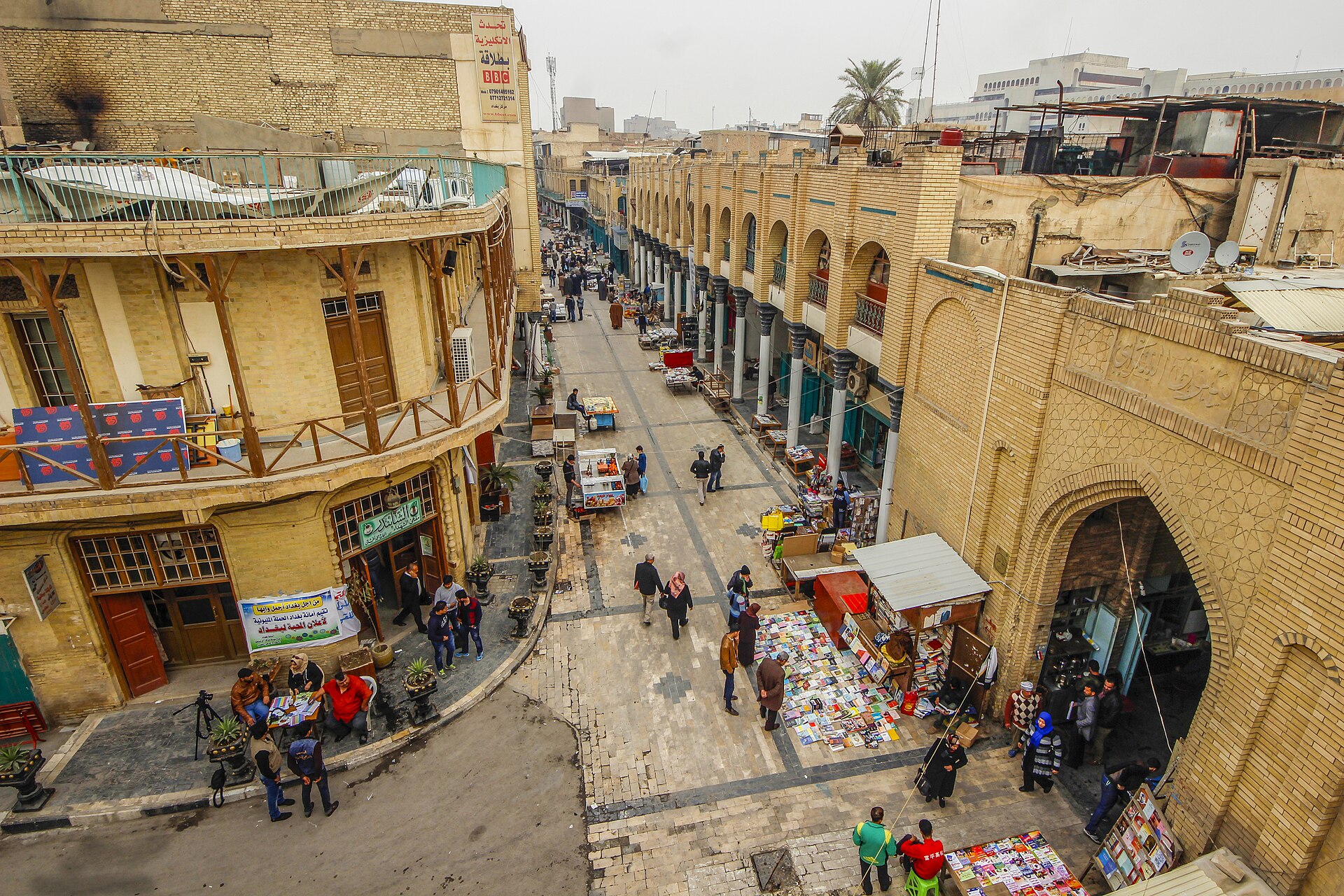
The book street is the emotional centre of literary Baghdad and the easiest place in the city to feel like a normal visitor. Friday morning is when it comes fully alive — booksellers spreading stock straight onto the pavement, the Shabandar café packed, poetry recitations, families. It is also crowded, which is the standard caveat about crowds anywhere in Iraq. It was bombed in 2007, rebuilt, and now stays open around the clock. Adjacent al-Rasheed Street, with its colonnades and shanasheel balconies, is under slow and patchy restoration and is worth a walk in daylight.
Abu Nuwas
The riverside street on the east bank, named for the Abbasid poet, lined with masgouf restaurants where carp is split and grilled upright against a fire. Going before sunset and eating as the light drops over the Tigris is one of the genuinely good evenings in Iraq. It is a normal, busy public place. It is also a riverside strip with limited exits, which is worth knowing rather than worrying about. Our guide to Iraqi food covers masgouf properly, and the Baghdad city guide covers what else is open and when.
Mansour, Jadriya and the airport road
Mansour on the west bank is affluent and quiet; Jadriya on the east holds the university and several of the better hotels. The airport road — once the most notorious stretch of tarmac in the world — is now an ordinary multi-lane run with checkpoints. It is not the story it was. Give yourself far more time than the distance suggests, because a closure or a queue can double it without warning.

What a normal visitor’s day in Baghdad actually looks like
Worth spelling out, because the gap between the advisory language and the lived experience is what confuses people most about whether Baghdad is safe on any given Tuesday.
You wake in a hotel in Karrada or Jadriya. A driver you arranged the night before takes you to the Iraq Museum, where you spend two hours with Sumerian and Assyrian material that would be the centrepiece of any collection in Europe. You cross to Rusafa, walk Mutanabbi Street, buy a book you cannot read, drink tea at Shabandar under photographs of the owner’s sons. Lunch is in a place with no menu. In the afternoon you visit the Abbasid Palace or the Al-Shaheed Monument, both by car. You are stopped at three or four checkpoints; at two of them nobody looks up, at one a young soldier asks where you are from and grins when you say it. Around sunset you eat masgouf on Abu Nuwas. You are back at the hotel by ten.
What that day does not include: walking anywhere after dark on your own, going anywhere north-east of the city centre, photographing anything with a uniform or a wall in front of it, or being anywhere near a demonstration. It is a constrained day, not a frightening one, and the constraints are the price of admission. The Iraq itinerary guide shows how a Baghdad day fits into a longer trip, and the Mesopotamian sites guide covers the museum and the day trips south.

The current moment, with dates
An article cannot stay current on this. What it can do is give you the anchor points and tell you where to look for what has happened since.
The US and Iran announced a memorandum of understanding on 17 June 2026. It did not hold as a general de-escalation. Since 8 July 2026 there have been strikes and retaliatory attacks by Iran across the region including inside Iraq and the Kurdistan Region, against both US military and civilian infrastructure. Eight explosive-laden drones were downed over Erbil during July 2026 — worth noting because Erbil is the part of Iraq usually described as the calm one, and the situation there feeds directly into how the Kurdistan Region is currently assessed.
Iraqi airspace has closed at short notice more than once in 2026, including a full closure following strikes on 28 February 2026, since reopened to limited commercial traffic. EASA’s Iraq-specific bulletin CZIB-2026-05, issued 8 July 2026 and running to 31 August 2026 unless reviewed earlier, advises operators not to use the Baghdad flight information region. The FAA has a NOTAM and an SFAR in force. On 1 August 2026 the US Mission in Iraq issued a security alert telling Americans in the region to expect flight cancellations, periodic airspace closures and travel disruption, and noting that some regional airlines had postponed resuming earlier schedules while others had cancelled routes.
What “prepared for short-notice disruption” means in practice
It is a phrase advisories use and rarely unpack. Concretely, for someone with a Baghdad flight booked:
- Never book a same-day onward connection. Build in a night, in a third country if you can. A missed connection out of Baghdad is not a rebooking, it is a stranding.
- Carry enough cash to buy your own way out. Cards fail, ATMs run dry, and an unscheduled ticket on a departing carrier is bought at the counter.
- Know the land options before you need them. The routes out to Jordan, Kuwait and Turkey exist and are long, and knowing which one you would take is worth an hour of planning you will probably never use.
- Have a plan that does not depend on your embassy. An embassy in a country its own government tells citizens to leave is a limited resource. Assume you are your own evacuation plan.
- Keep the phone working. Get a local SIM on arrival — our Iraq SIM card guide explains why an eSIM alone is a poor primary here — and download offline maps.
Checkpoints, photography and being visibly foreign
These three things account for almost every unpleasant interaction a well-behaved visitor has in Baghdad, and all three are avoidable.
Checkpoints
You will pass through several a day. Most are routine: slow down, window down, a glance, a wave through. Sometimes your passport is taken and carried to a hut for ten minutes, which feels much worse than it is. The rules that matter are to keep your passport and visa physically on you rather than in a bag in the boot, to let your driver or guide do the talking, to stay in the vehicle unless told otherwise, and never to argue or joke about politics or religion. If you are told to turn back, turn back. There is no appeal and no upside to trying.
Photography — the rule that gets phones taken
It is illegal in Iraq to photograph or film checkpoints, security personnel, military vehicles, military bases, government buildings and embassies. The consequences run from being made to delete the images while an officer watches, through confiscation of the camera or phone, to detention and questioning. Journalists without accreditation have been arrested for it. Drones are worse: flying one anywhere near a security zone can get it seized and get you held.
The practical problem is that “government building” is broader than it sounds and is not signposted. The workable habit is to ask your guide before raising the camera in any street with a concrete blast wall, a checkpoint or an armed guard in the frame, which in central Baghdad is a lot of streets. Photographing people, incidentally, is the opposite — ask, and you will usually be met with enthusiasm and then asked to be in the photo yourself.
Being visibly foreign
Foreign visitors in Baghdad attract attention, and it is overwhelmingly friendly attention: invitations to tea, questions, requests for selfies. The security argument for a low profile is not that Iraqis are hostile; it is that a conspicuous foreigner with a predictable routine is the raw material of a targeting decision by a very small number of people. Dress conservatively — long trousers, sleeves, a headscarf for women in shrines and a good idea in the older districts anyway; our Iraq packing list covers what that means in 48°C. Do not post your location in real time. Do not discuss your itinerary loudly in a hotel lobby. Our Iraq travel tips covers the etiquette side in more depth, and the culture guide explains why the hospitality is as intense as it is.
Curfews and night movement
Baghdad has no standing curfew in August 2026, but curfews have been imposed at a few hours’ notice during past unrest and can be again — during protests, around elections and at moments of escalation. Separately, Iraq shuts off national internet access for one to three hours on school exam mornings in May and June, most recently in June 2026, which is a nuisance rather than a danger unless you are relying on a live map at dawn. The general practice among visitors is to be off the streets and in the hotel by mid-evening, not because of a rule but because moving after dark reduces your options if something happens.

The insurance consequence nobody mentions
This is the concrete cost of the advisory position, and it belongs in any honest answer to the question “is Baghdad safe to visit” — because it converts an abstract risk rating into a number on a bill.
Travelling against FCDO advice invalidates most standard travel insurance policies. Baghdad province sits inside the advised-against zone — “all but essential travel” is still advice against travel for underwriting purposes at the great majority of insurers. A policy bought in the usual way from the usual comparison site will very likely pay nothing for anything that happens to you in Baghdad, including the boring things: a broken ankle, appendicitis, a stolen laptop.
That matters more than it sounds, because the alternative to insurance in Iraq is cash. Private clinics in Baghdad are functional and inexpensive by Western standards for routine care. Medical evacuation is not: an air ambulance out of Iraq is a five- or six-figure bill, payable in advance, and it is the single scenario that turns a manageable problem into a ruinous one.
Specialist high-risk policies exist and are the only realistic route. They cost several times a normal policy, usually exclude acts of war and sometimes exclude terrorism, and they require you to read the definitions rather than the marketing. Our guide to travel insurance for Iraq sets out what to check clause by clause. Check separately whether your employer’s duty-of-care policy forbids the trip outright, because many do, and finding out afterwards is a resigning matter for some people.
Why almost every visitor to Baghdad is with a guide
It is close to universal, and the reasons are more mundane than “for protection”.
A local guide or fixer handles the checkpoints in Arabic, knows which permissions a site needs this month, knows which streets are closed today, has a driver who will not take you through Sadr City to save four minutes, and can read a situation on a street corner in a way you cannot. The security benefit is real but indirect: you are less likely to end up somewhere you should not be. There is also a bureaucratic dimension, because some sites in federal Iraq require a permit or an escort and the rules change.
Independent travel in Baghdad is possible and a small number of people do it. It requires Arabic or a lot of patience, a very high tolerance for uncertainty, and prior regional experience. If you are considering it, read our guide to solo travel in Iraq first, honestly. For most people a small-group or private arrangement is the right call — how Iraq tours actually work covers what you get and what you pay for.
Who should not go to Baghdad
Every article about a difficult destination should have this section and almost none do. If any of the following describes you, the answer to “is Baghdad safe enough for me” is no, and the rest of the reasoning on this page does not apply.
- First-time solo travellers with no regional experience. Baghdad is not a place to learn how to travel in the Middle East. Jordan, Oman and the Gulf are, and Iraqi Kurdistan is a reasonable intermediate step.
- Anyone who needs reliable medical care. If you have a condition that could require an intensive care unit, a specialist drug or a rapid diagnosis, the honest position is that Baghdad cannot guarantee it and evacuation is slow and expensive.
- Anyone whose employer or insurer forbids it. Going anyway can void your cover, breach your contract and, if something happens, leave your family with no recourse.
- Anyone unwilling to make plans that do not rely on their embassy. Consular capacity in Iraq is limited by design. If your contingency plan is “I’ll call the embassy”, you do not have a contingency plan.
- Anyone who cannot absorb a cancelled trip. Airspace closes. Advisories change. If you cannot afford to lose the cost of the trip at 48 hours’ notice, this is not the year.
- Anyone travelling primarily to see the wreckage. The war-tourism impulse is unwelcome, sometimes dangerous, and misreads the city entirely. People live here.
And a category that is not a prohibition but deserves flagging: women travelling alone. Iraqi hospitality towards foreign women is genuinely warm and harassment reports are lower than in several better-regarded regional destinations, but a solo woman in Baghdad is conspicuous in a way that runs against every other piece of advice on this page. Most solo women who travel here do so with a guide, and that is a reasonable rather than a timid choice.
How to check the picture yourself
The most useful thing this article can do is make itself unnecessary. Anyone who tells you “is Baghdad safe” has a fixed answer is selling either a tour or an opinion. These are the primary sources, they are all free, and they are all more current than any guide.
| Source | What it tells you |
|---|---|
| gov.uk/foreign-travel-advice/iraq | The regionalised FCDO map and the date it last changed |
| travel.state.gov | The US advisory level and its risk indicators |
| iq.usembassy.gov | Security alerts, often the fastest signal that something has happened |
| smartraveller.gov.au / travel.gc.ca | Useful cross-checks with different underlying assessments |
| EASA Conflict Zone Information Bulletins | Whether airlines are being told to avoid Iraqi airspace |
| Shafaq News, Rudaw, Kurdistan24 | Same-day Iraqi reporting in English on closures and incidents |
Two habits are worth more than any single source. Check the date at the top of every advisory page, because the wording changes without the URL changing. And check at least two governments, because the divergence between them is information in itself — when the European advisories and the American one move in opposite directions, that usually tells you something about who is being targeted rather than about the general level of danger.
Is Baghdad safe? Your questions, answered
Is Baghdad safe to visit as a tourist right now?
Baghdad is under an “all but essential travel” advisory from the UK and a Do Not Travel advisory from the US, and both positions are defensible. Tourists do visit, almost always with a local guide, and the great majority have an uneventful trip. Whether that is safe enough is a judgement about your own risk tolerance, your passport, your insurance and your obligations to other people.
Which part of Baghdad is the most dangerous?
Sadr City, unambiguously — it is the only part of the capital the FCDO puts in its against-all-travel tier. Beyond that, exposure is less about neighbourhoods than about proximity to US-linked and government facilities, and about being near any crowd that forms without warning.
Can you walk around Baghdad?
In parts of it, yes, and people do — Mutanabbi Street, al-Rasheed Street, Karrada, the Abu Nuwas corniche. Walking is normal in daylight in those districts and is generally done with someone local. Walking alone at night, or anywhere unfamiliar, is not what visitors do.
Is Baghdad safe for solo female travellers?
Reports of harassment are lower than many expect and Iraqi hospitality towards foreign women is real. The complication is visibility: a solo foreign woman stands out sharply, which cuts against the low-profile approach that underpins everything else. Most solo women here travel with a guide, and that is the arrangement we would suggest.
Do I need a visa to visit Baghdad?
Yes. Visa on arrival in federal Iraq was suspended on 1 March 2025 and an e-visa is now mandatory for 37 nationalities including the US, UK, Canada, Australia, the EU, Japan and South Korea, at roughly US$114. A Kurdistan Region visa is a separate regime and is not valid in federal Iraq. Our Iraq visa guide and entry requirements guide cover the process and the traps.
Is there still terrorism in Baghdad?
The mass-casualty bombing campaigns of the 2000s and mid-2010s are over, and the security improvement since 2017 is the single biggest change in the city. The threat has not gone: attacks remain possible, crowded places and religious gatherings are the classic targets, and the current escalation has added a category of risk that did not exist in 2019. Treating it as finished would be wrong; treating the city as it was in 2006 would be equally wrong.
Is it safe to fly into Baghdad International Airport?
Commercial flights operate and the airport functions. EASA advises operators not to use the Baghdad flight information region under bulletin CZIB-2026-05, in force to 31 August 2026, and several carriers have suspended or reduced routes. US government personnel are prohibited from using BIAP. Airspace has closed at short notice in 2026 and can again. Fly on a carrier with a good rebooking record and never book a same-day onward connection.
Do I need a bodyguard or armoured car in Baghdad?
Corporate and diplomatic visitors move with close protection because their organisations require it. Tourists on ordinary itineraries do not, and arriving with a private security detail would make you far more conspicuous, not less. What almost everyone does use is a vetted local guide and driver, which is a different thing.
Is the food and water safe in Baghdad?
Tap water is not reliably potable — drink bottled. Cooked food from busy restaurants is generally fine and Baghdad eats well. One item of current context: Iraq has an ongoing Crimean-Congo haemorrhagic fever outbreak, with 313 confirmed cases and 24 deaths nationally in 2026 to date. It spreads by tick bite and by contact with the blood or tissue of infected livestock, so it is a risk for people visiting livestock markets and abattoirs, not for someone eating a grilled fish on Abu Nuwas.
When is the worst time to be in Baghdad?
Arbaeen, which fell on 5 August in 2026, transforms movement across central and southern Iraq for weeks, with roads, hotels and transport all behaving differently — see our guides to the pilgrimage season and the best time to visit Iraq. July and August also bring 45–50°C heat and grid failures. Election periods raise the odds of protest and curfew.
Is Baghdad safe compared with the rest of Iraq?
It sits in the middle. The Kurdistan Region is calmer on the ground but is now itself absorbing drone and missile activity. Najaf and Karbala carry the same “all but essential” tier as Baghdad. Ninawa, Kirkuk, Salah al-Din and Anbar west of Ramadi are in the against-all-travel tier — which is why Mosul is a harder proposition than the capital, and why the southern cities and marshes are often the easier half of a trip.
Is Iraq actually open to tourists at all?
Yes. It issues e-visas, its airports run, and the Interior Ministry reported a sharp rise in Arab and foreign arrivals through 2025 and early 2026 with Baghdad topping the list. Baghdad held the Arab Tourism Organization’s Arab Capital of Tourism designation for 2025. Our guide to whether Iraq is open to tourists reconciles that with the advisories, which is a genuinely strange thing to have to reconcile.
Final thoughts
The reason “is Baghdad safe” is such a bad question is that it collapses five different risks with five different probabilities into a single word. The version worth asking is narrower: safe for whom, doing what, with what fallback if it goes wrong. A guided visitor on a Dutch passport spending three days between Karrada, the museum and Mutanabbi Street is running a risk somewhere in the region of a difficult but manageable trip. An American freelancer working alone on a story about armed groups is running a risk that has a documented recent precedent with a name attached. Those are not the same trip and no advisory colour can hold both.
What we would not do is tell you whether to go. That decision involves your obligations, your insurance, your employer, your tolerance for a cancelled flight and your reasons for wanting to be there in the first place, and none of those are visible from here. What we would say is that the people who regret this trip are almost always the ones who went with an idea of Baghdad rather than information about it — either the ruin they expected or the reassurance they were sold. It is a working capital of eight million people where an enormous amount is ordinary and a small number of things are genuinely serious, and knowing which is which is most of the job.
If you are still weighing it up, the wider country picture is in our Iraq safety guide, the practical planning in the complete Iraq travel guide, and what a trip actually costs in the Iraq travel cost breakdown. If you decide to go, sort your accommodation early — where to stay in Iraq explains which Baghdad hotels are used to foreign guests and why that matters more here than elsewhere. Related reading: Is Iraqi Kurdistan Safe? and Is Mosul Safe to Visit Now?.
Photo credits
All images via Wikimedia Commons: Al-Taghyeer Channel (CC BY 3.0); Ayham4002 (CC BY-SA 4.0 and CC0); Manar Al-Obaidi (CC0); Omar9x (CC BY-SA 4.0).