Last updated: September 2026. Travel advice re-checked on 25 and 26 September 2026 against the FCDO’s Iraq pages and the US State Department’s 29 August 2026 reissue; access and restoration details checked against our research files (August 2026), SBAH’s 2022 restoration announcement and published excavation summaries.
Plenty of people have seen Hatra without knowing it. The opening of The Exorcist, the sun-bleached dig in northern Iraq where the priest turns up the demon’s amulet, was filmed among its temples in the early 1970s. Almost none of those viewers could go and see it for themselves now: Hatra is one of the most striking ancient cities in our guide to Iraq’s Mesopotamian sites, and one of the hardest to reach legally.
Hatra, called al-Hadr in Arabic, is a round, walled city of the Parthian era in the desert of Nineveh province, 110 km south-west of Mosul. Its temples to the sun god Shamash and a crowd of other gods survived two Roman sieges and a Sasanian conquest, and most of its buildings survived ISIS. It has been a UNESCO World Heritage Site since 1985 and on the danger list since 2015.
This page explains what Hatra was, what makes its temples unusual, what ISIS damaged and what has been restored, where its statues ended up, why visiting in 2026 needs special permission, the FCDO’s against-all-travel advice for Nineveh as of September 2026, and what we could not confirm.
The short answer
| Question | Answer |
|---|---|
| Where is it? | Nineveh province, northern Iraq: 110 km south-west of Mosul, about 290 km north-west of Baghdad |
| What was it? | A Parthian-era trading and religious city, capital of a small Arab kingdom in the 2nd and 3rd centuries AD |
| What survives? | A circular city nearly 2 km across, with walls, towers and a central sacred precinct of temples and vaulted halls |
| UNESCO | World Heritage since 1985; on the List of World Heritage in Danger since 2015 |
| Can you visit? | Only with special permission, which is not granted to everyone; in practice, on an organised tour |
| UK advice | FCDO: against ALL travel to Nineveh province (unchanged as of 25 September 2026) |
| US advice | Level 4, Do Not Travel, for all of Iraq (reissued 29 August 2026) |
What was Hatra?
The city grew up where caravan routes crossed the open steppe between the Tigris and the Euphrates. There is no firm evidence of a town here before the Seleucid era, and it flourished in the first and second centuries AD, when the Parthians, the Iranian dynasty whose capital was Ctesiphon, held the region. It was a religious centre as much as a market: pilgrims came to its temples, and its rulers styled themselves first as “lords” and later as “kings”.
By the late second century it was the capital of a small kingdom its inscriptions call Araba, sometimes described as the first Arab-ruled kingdom, one of a chain of desert cities that included Palmyra and Petra. It lived by balancing between two empires, Parthian Iran to the east and Rome to the west, and it chose sides with care: one king backed a losing Roman claimant, a later one became Rome’s ally.
Rulers and turning points
| Date (AD) | Ruler or event |
|---|---|
| 116/117 | The emperor Trajan besieges the city and fails |
| 128/29–176/77 | Nasru, one of the city’s “lords” |
| from 176/77 | Sanatruq I, whose statues are the best-known portraits of a Hatran king |
| 192/93–201/02 | Abdsamiya, who backed the Roman claimant Pescennius Niger |
| 198/199 | Septimius Severus attacks twice and fails |
| 207/08–229/30 | Sanatruq II, later an ally of Rome |
| 238 | The city defeats the Sasanian Persians |
| 241 | The city falls to the Sasanian king Shapur I and is abandoned |
The Roman historian Cassius Dio, describing Trajan’s failed siege, noted that the country around it was desert with little water, no timber and no fodder, and that the city was sacred to the Sun. The heat, the flies and the thirst did as much as the walls to beat the Romans. Septimius Severus fared no better eighty years later.
The Sasanians finished what Rome could not. The city beat them in 238, but in 241 the city fell to Shapur I, the king who is also one of the candidates for building the great arch at Ctesiphon. Arabic tradition tells the story through al-Nadirah, the king’s daughter, who fell in love with Shapur and betrayed the city to him, only to be executed by the man she had helped. It is a legend, not history, but it has lasted longer than the kingdom did.
Why is Hatra called the city of the sun god?
Because Shamash, the sun god, stood at the head of its pantheon, and the great sanctuary in the middle of the city was the reason many people came at all. But its religion was famously crowded. Its temples honoured Shamash alongside Nergal, Hermes, Atargatis, Allat and Baalshamin: a mixture of Greek, Assyrian, Canaanite, Aramean and Arabian gods that tells you who passed through, traded and settled here.
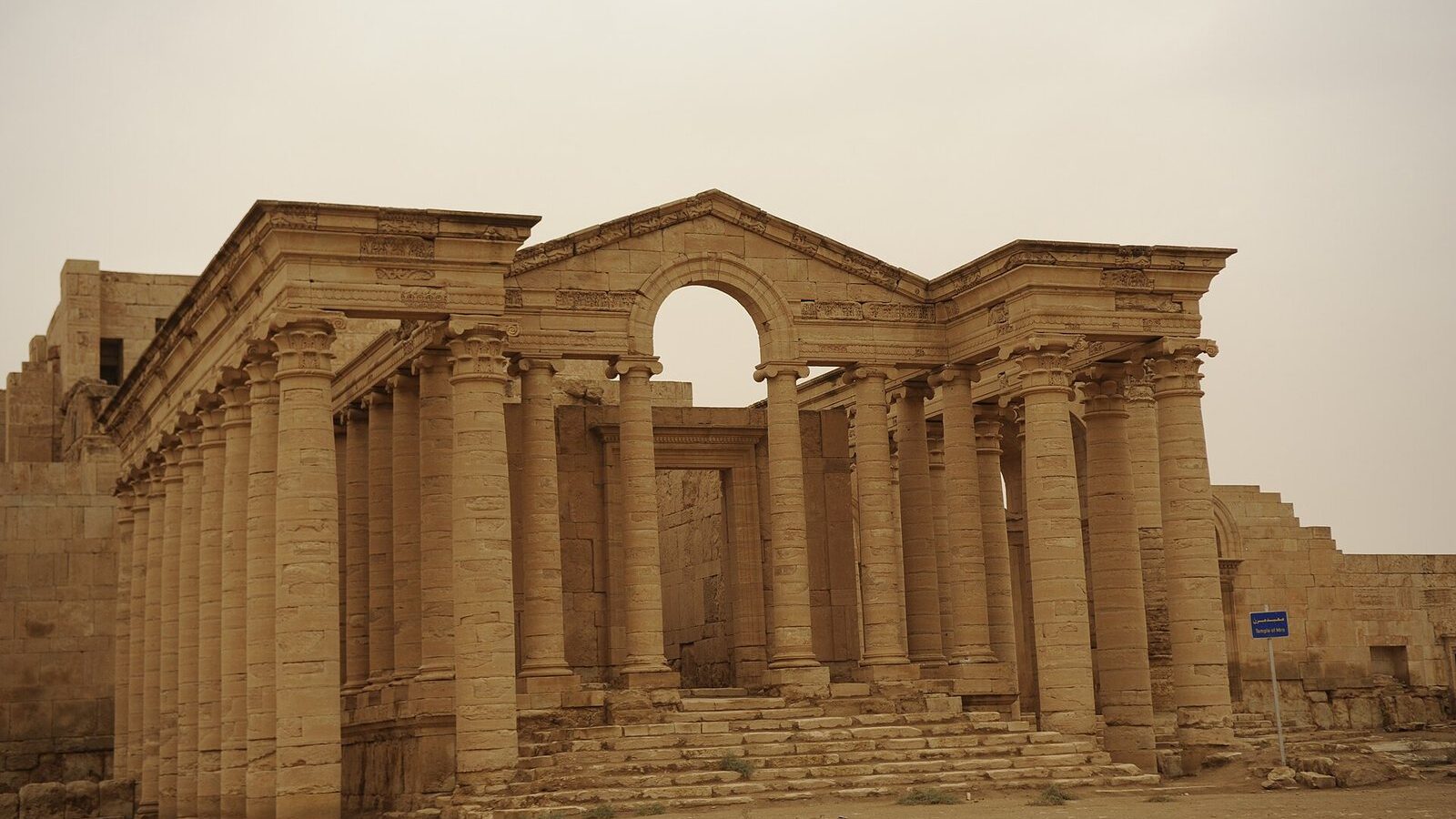
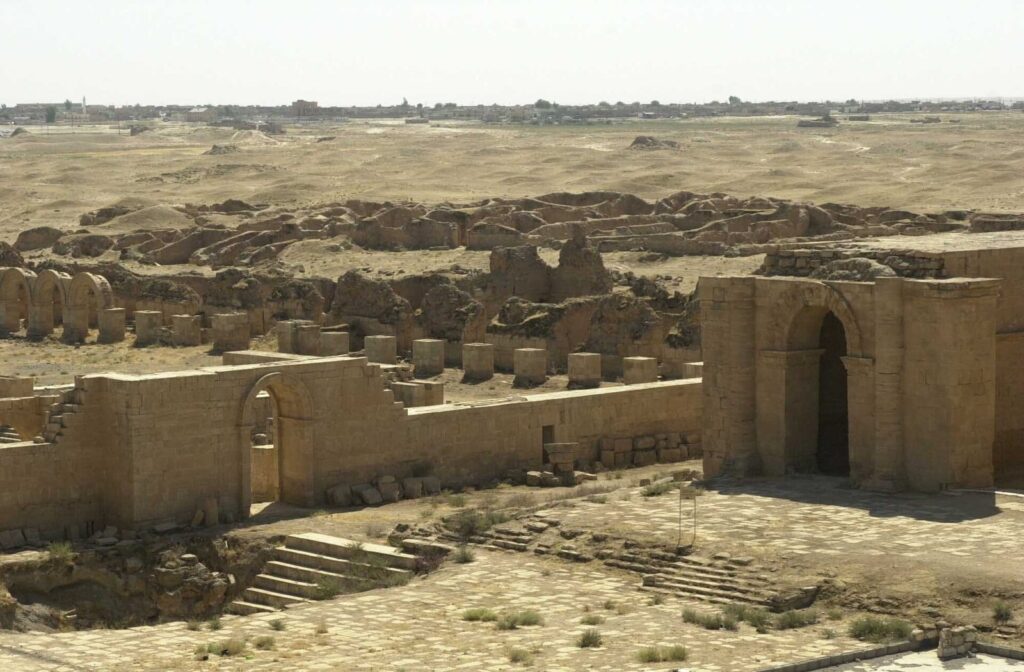
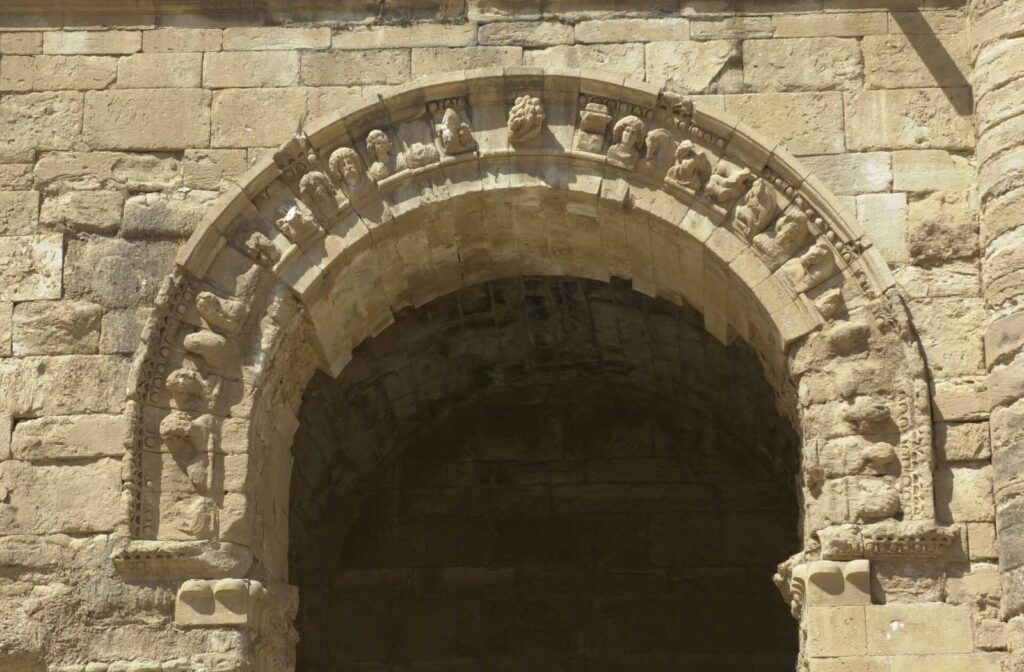
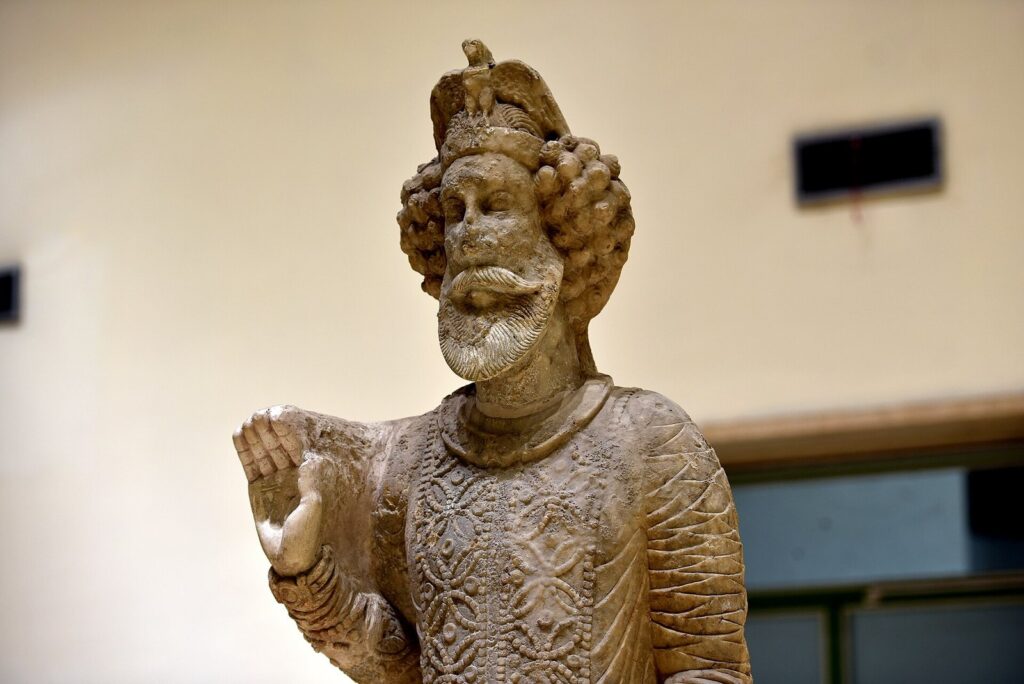
The buildings mix just as freely. Classical columns, capitals and mouldings sit alongside the iwan, the tall vaulted hall open at one end that the Parthians made their signature. The Great Temple rose to about 30 metres, and the temple buildings in the central precinct covered about 1.2 hectares. The sculpture is the other signature: rulers and nobles in stiff, frontal poses, with elaborately curled hair and beards, embroidered tunics and a raised right hand, and carved heads projecting from the arches of the temples.
The round city
The plan is its most unusual feature. The city is roughly circular, with inner and outer walls nearly two kilometres across, reinforced by more than 160 towers. In the centre stood a walled temenos, the sacred precinct, holding the temples and iwans. It is this design, adapted to the site’s terrain, that UNESCO singles out, and it is why the site is often called the best-preserved Parthian city anywhere.
| Feature | Figure |
|---|---|
| City plan | Circular, inner and outer walls nearly 2 km in diameter |
| Towers | More than 160 |
| Temple buildings in the central precinct | About 1.2 hectares |
| Great Temple | Rising to about 30 m |
| Main gods | Shamash, Nergal, Hermes, Atargatis, Allat, Baalshamin |
What you see at Hatra today
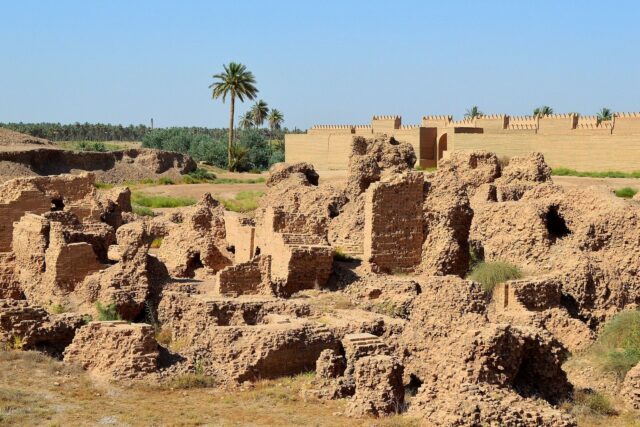
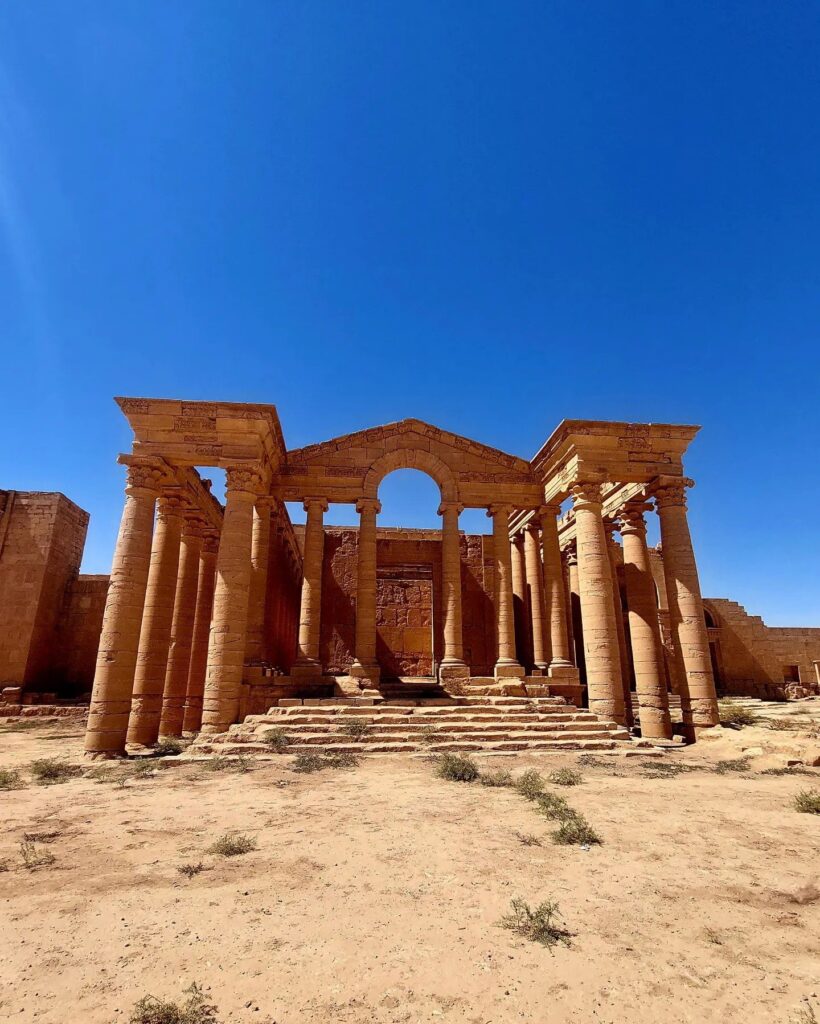
Unlike the mud-brick mounds of southern Iraq, Hatra was built in dressed limestone, and it still reads as a city rather than a set of humps in the ground. The walls trace their ring through the steppe; inside, the ground is strewn with the foundations of houses and smaller shrines; and at the centre the walls of the sacred precinct enclose the buildings everyone photographs.
- The great iwans. A row of tall vaulted halls, open at the front, forms the heart of the sanctuary. Their arches carry the carved heads and masks that were the site’s signature, and that ISIS went after.
- The columned buildings. Nearby stand halls and temples with classical columns and pediments, the most photographed part of the site.
- The smaller shrines. Scattered through the residential city and numbered by the excavators; the statue of Sanatruq I in the Iraq Museum came from the one they called the Tenth Temple.
- The inscriptions. Hundreds of texts in the local form of Aramaic name kings, gods and donors, many of them on statues and buildings.
- The walls. Nearly two kilometres across, with the stumps of more than 160 towers. From the top of the central temple you can see how the circle sits in the empty land around it.
How much of this you can walk through depends on your escort and the permission granted on the day. If you are free to explore, allow at least two hours.
What ISIS did to Hatra, and what survived
ISIS took the area in mid-2014. In March and April 2015 it released videos of its fighters attacking the sculptures with hammers and rifles, and reports described explosives and a bulldozer being used on the site. UNESCO added the site to the List of World Heritage in Danger the same year. The Popular Mobilization Forces retook it on 26 April 2017.
The damage was real but narrower than the videos implied. Assessments after 2017 found most of the buildings standing; the losses were concentrated in the sculpture and carved decoration. That distinction matters: the architecture is largely intact, while many of the faces that made it famous are not.
How badly was Hatra damaged? What the sources say
| Source | Claim | What it actually tells you |
|---|---|---|
| ISIS propaganda videos, 2015 | Statues and reliefs smashed on camera | Real destruction of sculpture, staged for effect |
| Post-liberation assessments, 2017 | Most buildings intact; sculptures and engravings damaged | The architecture survived; the decoration took the damage |
| Xinhua, February 2022 | Hatra, like Nimrud and the Mosul Museum, was “destroyed” | A sweeping summary line, not a site assessment |
| Arabic reporting, undated | Restoration resumed in 2022, stopped in 2024; urgent need to finish | The work is incomplete; we could not date or confirm the stoppage |
The restoration
On 25 February 2022 Iraq’s State Board of Antiquities and Heritage (SBAH) announced that the first phase of restoration was complete. Funded by ALIPH, the Geneva-based heritage foundation, and carried out by Italy’s ISMEO with Iraqi experts over three months, it rehabilitated the site’s administrative headquarters, repaired sections of the city walls, and restored statues and carved pieces on the temple arches. Summaries of ALIPH’s programme describe a project running since 2020, with the Universities of Padua and Siena, that has also re-attached sculptures at the Great Temple and tested protection for the alabaster floors of the Allat temple. Arabic reporting says the work stopped again in 2024.
The site has a long excavation history behind it. The German archaeologist Walter Andrae surveyed the site between 1906 and 1911; Iraqi excavations began in 1951; an Italian expedition from the University of Turin worked there from the 1980s; and a Polish team documented the walls in 1990.
Where to see Hatra’s statues
Much of the best sculpture left the site decades ago, which is partly why it survived. The problem in 2026 is that the museums holding it are not all open.
| Museum | What it holds | Status (latest we have) |
|---|---|---|
| Iraq Museum, Baghdad | The statue of King Sanatruq I, a military commander and other Hatran sculpture | Closed for refurbishment in August 2026 |
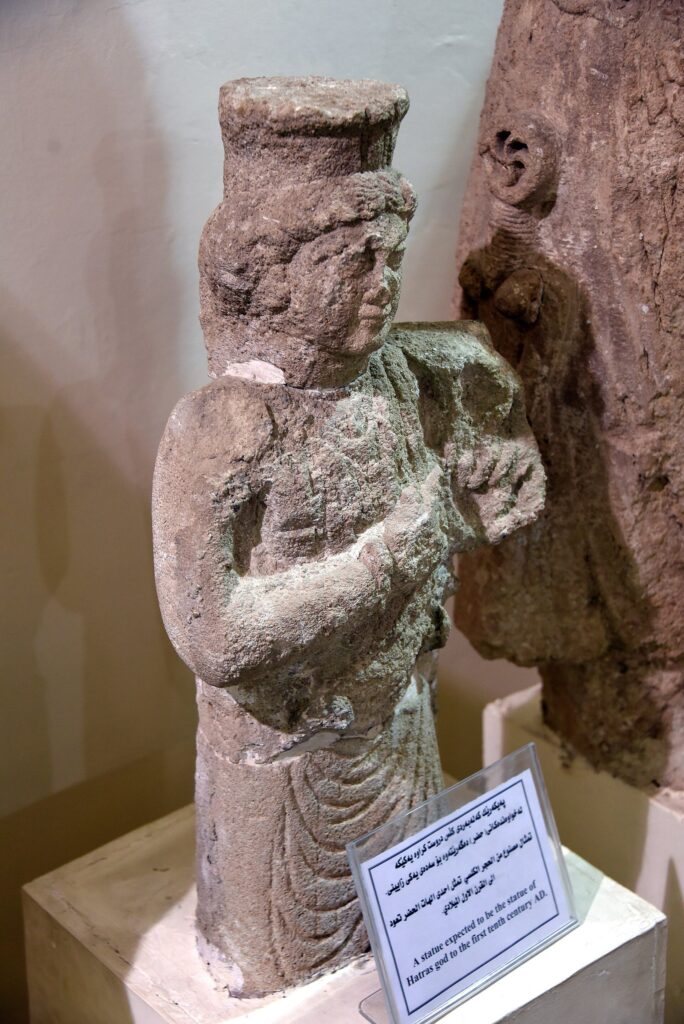
| Erbil Civilization Museum | A statue of Sanatruq I and a goddess from the Great Temple’s iwan | Open, with erratic hours and no confirmed price (August 2026) |
| Mosul Museum | Hatran sculpture, much of it wrecked by ISIS | Not reopened; a full reopening was targeted for autumn 2026 |
If you are in the Kurdistan Region, the Erbil Civilization Museum is the realistic option: our guide to things to do in Erbil covers it. In Baghdad, check our Iraq Museum guide for the reopening, and our overview of museums in Iraq for what else is open.
Can you visit Hatra?
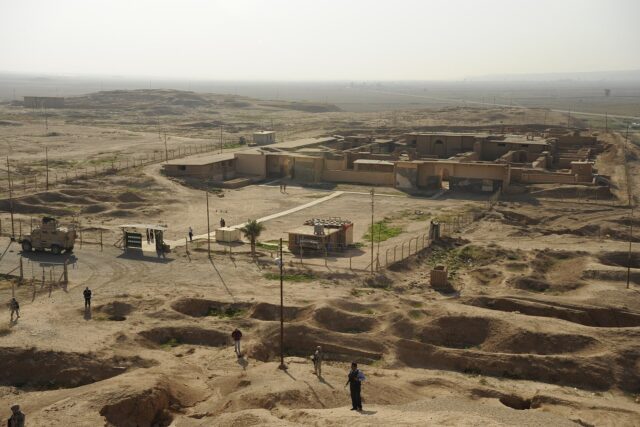
Yes, but not on your own terms. As of August 2026, the latest information in our files, Hatra was reachable only with special permission, which is not granted to everyone, and in practice only on an organised tour. The site is secured by a brigade of the Popular Mobilization Forces, the state-sanctioned umbrella of mostly Shia armed groups formed in 2014, and ISIS cells remain active in the surrounding desert. At least one international operator selling 2026 Iraq tours tells customers plainly that permission to visit Hatra is hard to obtain.
So treat it as a possibility, not a promise. If Hatra matters to you, choose an operator that has taken groups there recently, ask how and when they apply for permission, and ask what happens if it is refused on the day. Our guide to choosing a tour operator in Iraq lists the questions to put to them.
The practical chain
- Visa. The site is in federal Iraq, so you need the federal e-visa, applied for at least 24 hours before travel; as of 25 September 2026 the FCDO put it at $160 for 60 days. A Kurdistan Region visa is valid in the Kurdistan Region only, so arriving in Erbil on one does not cover a trip to Mosul or Hatra. Our Iraq e-visa guide explains the process.
- Base. Mosul, 110 km to the north-east, is the natural base, and tours usually reach Mosul from Erbil. Baghdad, about 290 km away, is too far for a day trip.
- Checkpoints. Expect several between Mosul and the site, and carry your passport and printed permissions. Our guide to Iraqi checkpoints explains the routine.
- On site. There is no shade to speak of and nothing to buy. Bring water and sun protection, stay with your guide, and don’t wander into the open desert beyond the walls.
- Photography. Photograph the ruins, but never the guards, their vehicles or positions, and ask your guide if in doubt. Drones are, in practice, banned for foreigners.
When is the best time to visit Hatra?
Spring or autumn, if at all. The steppe around the site has almost no shade, and northern Iraq’s summers are ferocious: in August 2026 Erbil reached 49°C while several governorates hit 50°C. Winters are cooler but can be wet and windy, and dust storms are common in spring and summer. March, April, October and November give the most bearable days, and early mornings are best in any season. Our guide to the best time to visit Iraq has the month-by-month picture.
Is Hatra safe to visit?
Here is the frame as of late September 2026. Read it as it is written.
- UK. The FCDO advises against all travel to Nineveh (Ninawa) province, which includes Hatra, Mosul and Nimrud. It is the FCDO’s highest level of warning. Its Iraq travel advice, last updated 22 July 2026, was unchanged when we checked on 25 September 2026, and it notes that terrorism is more frequent in former Daesh areas, Nineveh among them.
- US. The State Department’s advisory is Level 4, Do Not Travel, for the whole country, reissued on 29 August 2026.
- Insurance. Travelling against FCDO advice can invalidate your insurance, and against-all-travel areas are the most likely to be excluded. See our guide to travel insurance for Iraq.
- The local picture. ISIS remnants still carry out sporadic roadside bombings and assassinations in Nineveh; more than 100 such incidents were reported in the governorate in 2024. The site sits in open desert, which is exactly where those cells operate.
- The wider picture. Iraq’s 2026 has been shaped by the confrontation between Iran and the United States, with airspace closed for 38 days in the spring and repeated drone and missile strikes on the Kurdistan Region. The US-led coalition’s mission was due to end on 30 September 2026.
People do visit Hatra, under escort and with permission, and nothing in our files records an incident involving a tour group there. But you would be going against your government’s clearest advice to a place where the risk is not theoretical. Our assessments of whether Mosul is safe and of how the UK and US advisories for Iraq work give the full context.
Hatra, Mosul and the Assyrian cities
Hatra is the odd one out among the great sites of northern Iraq. Nineveh, Nimrud and Ashur are Assyrian, older by a thousand years and more; Hatra belongs to the Parthian and Roman world, closer in spirit to Palmyra in Syria than to anything Assyrian. Ashur, another danger-listed World Heritage Site, lies about 70 km to the east on the Tigris. Iraq has six World Heritage properties, and half of them, Hatra, Ashur and Samarra, are on the danger list; see our guide to Iraq’s UNESCO World Heritage Sites, and our page on the Malwiya Minaret at Samarra for the third.
In Mosul itself, the rebuilt al-Nuri mosque and al-Hadba minaret reopened on 1 September 2025, and the al-Nuri Grand Mosque Museum opened on 9 February 2026. The Mosul Museum, which ISIS wrecked in 2015, had not reopened as of August 2026.
Hatra and Palmyra: two desert cities, one fate
The closest relative of this city is not in Iraq at all. Palmyra, in the Syrian desert, was another caravan city on the frontier between Rome and Iran, with its own mixed pantheon, its own portrait sculpture and its own brief moment of independence. The two stories rhyme uncomfortably.
| Hatra | Palmyra | |
|---|---|---|
| Where | Northern Iraq, between the Tigris and the Euphrates | Central Syria, on the road from the Euphrates to the Mediterranean |
| Sphere | Parthian, balancing Rome | Roman, trading with Parthia |
| Chief god | Shamash, among many others | Bel, among many others |
| End of independence | Taken by Shapur I in 241 | Taken by the emperor Aurelian in 272–273 |
| UNESCO | 1985; in danger since 2015 | 1980; in danger since 2013 |
| ISIS | Sculpture smashed on camera, 2015 | Temple of Bel and other monuments blown up, 2015 |
What we could not confirm
- How to apply for permission. No official page explains who issues it, how far in advance, or on what grounds it is refused. Operators handle it privately.
- Whether Hatra is formally open to the public. SBAH announced restoration in 2022, and some outlets reported a reopening, but we found no official statement of opening hours or public access.
- An entry fee. None is published.
- The state of the restoration. Arabic reporting says work stopped in 2024; we could not date that report or find an official update.
- The details of ALIPH’s project after 2022. We have summaries of its programme but could not read ALIPH’s own project page in this update.
- The exact security arrangement. Our August 2026 files name a specific Popular Mobilization Forces brigade guarding the site; we could not confirm whether that has changed.
- The Mosul Museum’s reopening date. Autumn 2026 was the stated target; we had no confirmation by late September.
Frequently asked questions
Where is Hatra?
In Nineveh province in northern Iraq, in open semi-desert between the Tigris and the Euphrates. It is about 110 km south-west of Mosul and about 290 km north-west of Baghdad; the older Assyrian capital of Ashur lies roughly 70 km to the east. In Arabic the site is called al-Hadr.
Why is Hatra famous?
It is the best-preserved city of the Parthian era, with a unique circular plan, temples that blend Greek and Roman architecture with eastern forms, and fine sculpture. It resisted sieges by the Roman emperors Trajan and Septimius Severus, and it became a symbol of cultural destruction when ISIS filmed its fighters smashing its statues in 2015.
Is Hatra a UNESCO World Heritage Site?
Yes, since 1985, which makes it Iraq’s first World Heritage Site. It was placed on the List of World Heritage in Danger in 2015 after the ISIS occupation, and it is still there, alongside Ashur and Samarra. Half of Iraq’s six World Heritage properties are danger-listed.
Did ISIS destroy Hatra?
Not entirely. ISIS filmed the destruction of sculptures and carvings in 2015, and reports described explosives and a bulldozer, but assessments after the site was retaken on 26 April 2017 found most of the buildings intact. The damage fell mainly on the statues and carved decoration, and a first phase of restoration was completed in early 2022.
Can tourists visit Hatra?
Only with special permission, which is not granted to everyone, so in practice on an organised tour from Mosul or Erbil. The site is guarded by the Popular Mobilization Forces, and ISIS cells remain active in the area. The FCDO advises against all travel to Nineveh province, which can invalidate travel insurance.
Was The Exorcist filmed at Hatra?
Yes. The opening scene of The Exorcist (1973), set at an archaeological dig in northern Iraq, was filmed at Hatra, which is why the ruins look familiar to many visitors. The statue of the demon Pazuzu in that scene is a film prop; the real Pazuzu belongs to much older Assyrian and Babylonian tradition.
Who was the god of Hatra?
Shamash, the sun god, headed Hatra’s pantheon, and the Roman historian Cassius Dio called the city sacred to the Sun. But its temples honoured many others too, including Nergal, Hermes, Atargatis, Allat and Baalshamin, reflecting the mix of Greek, Mesopotamian, Syrian and Arabian peoples who traded and worshipped there.
How did Hatra fall?
To the Sasanian king Shapur I in 241, three years after it had defeated a Sasanian army. Arabic tradition says the king’s daughter, al-Nadirah, betrayed the city to Shapur for love and was executed by him afterwards. Historians treat that story as legend; the city was abandoned after the conquest and never recovered.
Final thoughts
Hatra has outlasted everyone who tried to end it. Trajan’s army went home thirsty, Severus failed twice, Shapur took it and left it empty, and ISIS, with all its hammers and cameras, managed to deface its statues but not to bring down its walls. What survives is a place unlike anywhere else in Iraq: a round desert city where Greek columns frame Parthian vaults and a dozen gods shared one sacred precinct.
For most readers in 2026, it will stay out of reach, and that is a reasonable outcome given the advice and the conditions around it. If you do go, go with an operator who has done it recently, go with realistic expectations about permission, and give the rest of the trip, in Mosul and the Kurdistan Region, the same care.
To see how it fits into the bigger picture, start with our overview of Iraq’s ancient sites, compare it with the Babylonian world at Babylon, and read our honest take on whether Iraq is safe to visit before planning anything in the north.
Photo credits
Columned hall at Hatra, 2008 (featured image): Staff Sgt. JoAnn Makinano, Wikimedia Commons (public domain). Central precinct, Hatra, 2004: 101st Sustainment Brigade, 101st Airborne Division (AA) Public Affairs, Wikimedia Commons (public domain). Carved arch, Hatra, 2004: 101st Sustainment Brigade, 101st Airborne Division (AA) Public Affairs, Wikimedia Commons (public domain). Temple at Hatra, 2022: TomicMarija, Wikimedia Commons (CC BY-SA 4.0). Statue of Sanatruq I, Iraq Museum: Osama Shukir Muhammed Amin FRCP(Glasg), Wikimedia Commons (CC BY-SA 4.0). Goddess statue from Hatra, Erbil Civilization Museum: Osama Shukir Muhammed Amin FRCP(Glasg), Wikimedia Commons (CC BY-SA 4.0). All images via Wikimedia Commons under the licences shown.