Last updated: August 7, 2026. Carrier plans, prices and network status re-checked this week. Prices are what travellers and operators report on the ground; tariffs change often and none of this is a quote.
Every guide to getting online in Iraq tells you the same three things: buy a local SIM, the airport has a counter, bring your passport. All true, all incomplete, and none of it prepares you for the morning your phone simply stops working because somewhere a ministry decided that school exams were starting. Staying connected is one piece of a much larger planning picture, which we set out in our guide to planning a trip to Iraq.
The practical answer: an Iraq SIM card from Zain, Asiacell or Korek costs roughly 20,000–25,000 dinars for a fortnight’s worth of data, takes ten minutes and your passport to set up, and works better than almost anyone expects. Travel eSIMs work too, but in Iraq they’re roaming products rather than local ones, which makes them a useful backup and a poor primary. And a few mornings a year the national internet goes off entirely.
This guide covers the three networks and what they actually cost, where each one works, the registration trap that catches people arriving on a fresh e-visa, the honest case for and against eSIMs, and the two kinds of deliberate outage — exam season and wartime — that no other connectivity guide seems to mention.

The short answer
| Question | Answer |
|---|---|
| Which network? | Zain or Asiacell nationally; Korek is strongest in Kurdistan |
| What does it cost? | SIM itself a few thousand dinars; ~20,000–25,000 IQD for around 10GB |
| Where do I buy? | Airport arrivals, or any phone shop in any city |
| What do I need? | Your passport, and ideally your visa sticker rather than just a printout |
| Is 4G good? | Yes in cities, patchy in the desert and mountains. 5G is only starting |
| Do eSIMs work? | Yes, but as roaming — decent backup, weaker primary |
| Will it ever just stop? | Occasionally, yes. Nationwide exam shutdowns and wartime disruption both happen |
| Do I need a VPN? | Install one before you arrive. It’s easier than wanting one later |
The three networks
Iraq has three national mobile operators, and the differences between them are mostly geographic.
Zain Iraq is the one most travellers end up on, largely because its counter is the most visible at Baghdad airport arrivals — on the left as you come out. Solid coverage across Federal Iraq, decent in Kurdistan, and the most straightforward tourist packages.
Asiacell, part of Ooredoo, has the strongest reputation in the south — Basra, Nasiriyah, Dhi Qar and the marshes. If your trip is weighted toward southern Iraq, this is the one locals will tell you to buy.
Korek Telecom is the Kurdish operator and the strongest in Iraqi Kurdistan — Erbil, Sulaymaniyah, Duhok and the mountain roads. It’s correspondingly weaker in the deep south, and experienced travellers specifically warn against relying on Korek below Baghdad.
If you’re doing both halves of the country, Zain or Asiacell is the safer single choice. If you’re doing a lot of driving in the north, Korek genuinely holds signal where the others thin out. Nobody needs two SIMs for a two-week trip, but people doing three weeks across both regions sometimes carry one of each — they’re cheap enough that it’s a reasonable insurance policy.
What it actually costs
Reported prices from recent travellers and Iraq-based guides. Treat these as the shape of the market rather than a tariff sheet — Iraqi operators change bundles constantly.
| Item | Reported price | Notes |
|---|---|---|
| SIM card itself | 1,500–15,000 IQD | Often bundled into the first package |
| Zain, ~10GB / 15 days | 20,000–23,000 IQD (~$14–16) | The standard traveller purchase |
| Asiacell, weekly “unlimited” | ~12,000 IQD | Throttles after a threshold — see below |
| Asiacell, monthly 10GB + social | ~15,000 IQD | Good value if you’re staying a month |
| Asiacell, monthly “unlimited” | ~40,000 IQD | Also throttled |
| Zain Super Card bundle | ~42,000 IQD | Reported as 20GB plus 720 minutes and 720 SMS |
| Small top-up, ~1GB | Around $3 | Widely available |
One word of warning about “unlimited.” Iraqi unlimited packages are throttled, not uncapped: reported thresholds put the weekly bundle at around 20GB and the monthly at around 100GB before speeds drop to roughly 3 Mbps. That’s still usable for messaging and maps, and useless for video calls. If your work depends on a stable connection, buy a metered bundle and top it up rather than trusting the word “unlimited.”
For context on how these numbers fit a trip budget, our Iraq travel cost guide puts independent travel at roughly $45–65 a day — a fortnight of data is a rounding error against that, so don’t over-optimise.
Buying one, and the trap that catches new arrivals
The process is simple. Find a counter or a phone shop, hand over your passport, wait while they register the SIM against it, pay in cash, and you’re connected before you’ve left the building. SIM registration against a passport is mandatory — this is not the paperwork-free purchase some guides describe.
The trap is subtler. Travellers have reported being refused a SIM while holding only a printed e-visa approval, because the shop wanted to see the physical visa sticker in the passport. If you’re buying at Baghdad airport this is rarely an issue, since the sticker goes in at immigration before you reach the counter. If you’ve entered somewhere the sticker process differs, or you’re buying on day three in a small town, have the passport page with the sticker ready rather than a PDF on your phone. Our entry requirements guide explains how the sticker works.
Two smaller notes. Your phone must be unlocked — a handset locked to a home network will reject the SIM, and there’s no fixing that in Iraq. And buy at the airport if convenience matters, or in a city shop if price does; the airport premium is small but real, and city shops will spend longer setting the thing up properly for you.

Coverage: what works where
Better than the country’s reputation suggests, and worse than a European traveller’s instincts assume.
Cities are fine. 4G in Baghdad, Erbil, Sulaymaniyah, Basra and Najaf is perfectly serviceable — good enough for video calls, maps and uploading photos. Reports from Kurdistan specifically describe 4G strong enough for video calls without drama.
5G exists but barely. Deployment has begun in Baghdad and Erbil and is not broadly available across the country. Don’t choose a network on the strength of a 5G claim in 2026.
Highways are mostly covered, with gaps. The long southern runs and the desert stretches west of the Euphrates drop out. This matters most on the intercity shared-taxi journeys described in our getting around Iraq guide — download your offline maps before you leave the city, every time.
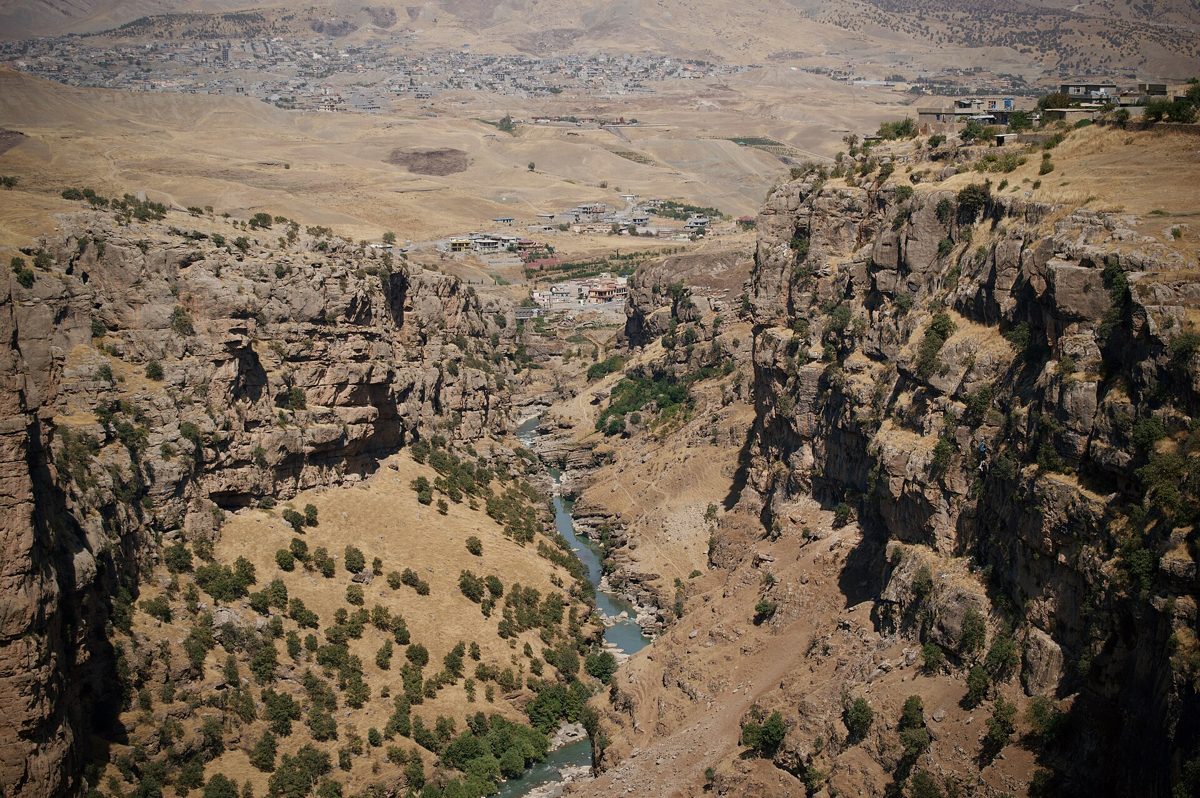
Mountains and the marshes are the real gaps. The Kurdish highlands around Rawanduz, Barzan and the Turkish border have genuine dead zones, and out on the water in the Mesopotamian marshes you should expect nothing at all. Neither is a problem if you’ve planned for it; both are if you haven’t told anyone where you’re going.
Archaeological sites are usually fine, being near towns — but Hatra, Uruk and the remoter tells are not places to rely on a signal. Our Mesopotamia guide covers which sites are genuinely remote.
eSIMs: the honest verdict
Search “eSIM Iraq” and you’ll find dozens of comparison sites ranking dozens of providers, most of them earning a commission on the click. Here’s what those pages tend not to say.
Iraq eSIM coverage is largely roaming, not local. Iraqi operators have not made local eSIM provisioning broadly available to visitors, so what a travel eSIM app sells you for Iraq is generally a roaming arrangement riding on a partner network. That has three consequences: you may get a subset of the coverage a local SIM would give you, you’ll usually pay more per gigabyte, and you won’t have a local phone number.
That last one matters more here than in most countries. A local number is how you talk to drivers, guesthouses and guides, all of whom operate on WhatsApp, and how a hotel calls you back when your taxi arrives. It’s the same reason our itinerary guide assumes you can reach a driver at short notice. An eSIM with no Iraqi number leaves you contactable only by people who already have your foreign number.
Where an eSIM genuinely earns its place: as a same-minute connection when you land at 2am and every counter is shut; as a backup when your local SIM has no signal or you’ve burned through a bundle; and for short trips where ten minutes at a counter isn’t worth it. Running both is a perfectly sensible setup, and cheap.
Where it doesn’t: as your only connection on a two-week independent trip. Buy the local SIM.
Check before you rely on any of it that your phone supports eSIM, that it’s carrier-unlocked, and that the specific plan lists Iraq rather than a vague “Middle East” region — regional bundles sometimes exclude Iraq entirely, and you’ll only discover that on arrival.
The thing no other guide mentions: Iraq turns the internet off
This is the section that matters most and that connectivity guides almost universally omit.
Exam season
Iraq is one of a small number of countries that deliberately shuts down national internet access to stop cheating in school exams. This is not a rumour or a historical curiosity — the Ministry of Communications has run these outages every May and June for several years, and they continued through 2026. On 9 June 2026 the government suspended internet service between 6:00 and 7:30 in the morning, the fourth in a series of shutdowns across that exam period.
The pattern is usually an early-morning cut lasting one to three hours, repeated on exam days across several weeks. Sometimes it’s a full blackout; sometimes it’s a targeted block on WhatsApp, Facebook, Instagram, X and Telegram while the rest of the internet limps on. Access Now, the Internet Society and Iraqi digital-rights groups have campaigned against the practice for years, and the shutdowns have been reduced in scope rather than abandoned.
What it means for you: if you’re travelling in May or June, expect the possibility of a dead phone for a couple of hours in the early morning. Don’t schedule an airport transfer that depends on calling a driver at 6am, don’t rely on a live map for a dawn departure, and screenshot anything you’ll need. If you’re travelling in exam season anyway, our best time to visit guide explains what else May and June bring. It’s an inconvenience rather than a crisis — unless it’s the morning you needed to check in for a flight.
Wartime disruption and blocked services
The second category is the regional conflict. Through 2026 Iraq has seen periodic connectivity disruption tied to the escalation, alongside airspace closures and flight cancellations — the picture our is Iraq safe guide sets out in full. Separately, researchers documented in mid-2026 that censorship methods are applied inconsistently across Iraqi ISPs, with no standardisation — meaning a site or service that works on one network can be unreachable on another, and the blocking sometimes catches ordinary educational, business and research platforms as collateral.
The practical implication is not to panic but to build in redundancy: an eSIM on a different network, offline maps, offline translation, downloaded documents, and a phone number for your accommodation written on paper. Our is Iraq open to tourists guide tracks the wider disruption picture.
VPNs
Install one before you fly. That’s the whole recommendation, and the reason is procedural rather than dramatic: if a service you need is blocked on the network you’re on, downloading a VPN at that moment is exactly the thing you may not be able to do.
Travellers routinely use VPNs in Iraq for ordinary reasons — accessing banking that geo-blocks, streaming subscriptions, and occasionally a messaging service that’s unreachable on one ISP but not another. Choose a provider before departure, install it, test it, and know how to switch servers.
WhatsApp is the country’s operating system
Worth stating plainly because it shapes everything else. In Iraq, WhatsApp is not one app among several — it is how the country conducts business. Hotels take bookings on it. Drivers confirm pickups on it. Guides send you the day’s plan on it. Guesthouses in the marshes and small-town hotels that appear on no booking platform are reachable exclusively through it, as our accommodation guide explains.
Two things follow. First, get a local number, because the friction of being un-WhatsApp-able locally is higher than any data saving. Second, join the traveller communities before you go — the Iraqi Travellers Cafe group on Facebook remains the fastest source of ground truth on what’s open, which checkpoint is awkward this week, and which hotel is currently overcharging.

Wi-Fi, power cuts and staying charged
Hotel Wi-Fi in Iraq is generally serviceable and occasionally excellent, particularly in Erbil and the better Baghdad hotels. Cafés and restaurants in the cities usually have it. What varies is not the connection but the electricity behind it.
Iraq’s grid fails daily. Every hotel runs a generator, but budget places often switch it off overnight, and there was a nationwide blackout during a 50°C heatwave in August 2025. When the generator is off, the router is off. This is why a power bank is the single most useful piece of kit you can carry, and why our Iraq packing list treats it as non-optional rather than nice-to-have.
Plug type matters too: Iraq runs types C, D and G at 230V, so a universal adapter rather than a single-shape one. Ask about 24-hour power when you book, and charge everything when you have the chance rather than when you need it.
Calling home
International calls over the mobile network are expensive and unnecessary. Everyone — locals included — uses WhatsApp, and voice calls over it work fine on 4G in any Iraqi city. If you need a real phone line, most bundles include local minutes that are plenty for calling a driver.
Roaming on your home SIM is technically possible for many networks and rarely worth it: Iraq sits outside almost every inclusive roaming zone, and daily rates are punitive. Turn data roaming off before you land, then decide deliberately.
One practical note for anyone who might need to be reached in an emergency: give someone at home both your local Iraqi number and your normal number, tell them which one you’re actually using, and warn them that a few hours of silence in exam season or during a disruption is not evidence of anything.
How much data you’ll actually use
People either wildly over-buy or run dry on day four, so here’s a realistic picture of what internet in Iraq costs you in gigabytes.
A normal travel day — maps, messaging, a few searches, uploading a handful of photos — runs somewhere around 300–600MB. Add video calls home and you’re at 1–1.5GB a day. Add streaming and all bets are off. On that arithmetic, a 10GB bundle comfortably covers a fortnight of ordinary use and gets tight if you’re calling home nightly on video.
Two Iraq-specific things push usage up. Offline maps don’t help as much as you’d hope in a country where you’ll frequently be navigating by describing landmarks to a driver, so live maps get more use than usual. And photo backup is the silent drain — Iraq is intensely photogenic, you’ll shoot more than normal, and automatic cloud upload over mobile data will eat a bundle in days. Turn it to Wi-Fi-only before you land.
The counter-pressure is that data is cheap and top-ups are everywhere. Buying a modest bundle and topping up twice costs less than the anxiety of rationing, and any phone shop in any town will do it in two minutes.
Working remotely from Iraq
A small but real number of visitors work while they travel here, and the honest answer is that it’s very doable in the Kurdish cities and harder elsewhere.
Erbil and Sulaymaniyah are the practical bases. 4G is strong enough for video calls, hotel Wi-Fi in the mid-range and upmarket places is genuinely fine, café culture is well established and laptops in cafés attract no attention. Both cities have the mix of reliable power, decent connectivity and long opening hours that remote work needs.
Baghdad works in the better hotels and is patchier outside them. The south — Najaf, Karbala, Nasiriyah, Basra — is fine for messaging and email and unreliable for anything that needs a stable uplink at a scheduled time.
Three practical constraints worth planning around. The power supply is the real limit, not the bandwidth: confirm 24-hour generator cover before booking anywhere you intend to work. Iraq is UTC+3 year-round with no daylight saving, which puts it two hours ahead of central Europe in summer and three in winter, and seven to ten ahead of North America — awkward for US calls, comfortable for European ones. And the exam-season and conflict outages above are exactly the kind of thing that ruins a scheduled call, so build slack into anything that can’t move.
One legal note that isn’t connectivity but bears on it: a tourist visa is not a work visa. Answering your own emails is one thing; taking paid local work is another, and our visa guide covers what the e-visa actually permits.
Why Iraq’s internet behaves the way it does
A short answer to a question travellers ask once they’ve been there a week.
Iraq’s mobile networks are genuinely modern — three competing operators, widespread 4G, cheap data, and the sort of coverage that decades of conflict would not lead you to expect. The country leapfrogged fixed-line infrastructure the way much of the region did, which is why mobile data is good and home broadband is comparatively poor, and why almost everything social and commercial happens on a phone.
What sits above that is a governance layer with more discretion than most travellers are used to. The Ministry of Communications can and does order national shutdowns. Blocking is implemented by individual ISPs without much standardisation, which is why two people standing in the same café on different networks can have different experiences of the same website. The Kurdistan Region operates with a degree of autonomy here as in much else, which occasionally means the north stays up when the south doesn’t.
None of this makes Iraq difficult to be online in. It makes it a country where connectivity is a policy variable as well as a technical one — and where the sensible traveller keeps a screenshot.
A setup that works for a two-week trip
- Before you fly: unlock your phone, install a VPN and test it, download offline maps for every city and route you’ll use, download Arabic and Kurdish in Google Translate, and install WhatsApp if somehow you haven’t.
- Optionally load a travel eSIM with a small data allowance as a landing-day safety net. Confirm the plan explicitly lists Iraq.
- On arrival: buy a local SIM with your passport at the airport counter, or in town the next morning if you’d rather save a few thousand dinars. Zain or Asiacell for a whole-country trip; Korek if you’re staying north.
- Buy a metered bundle rather than an “unlimited” one if you need reliable speed. Around 10GB covers a fortnight of normal use comfortably.
- Send your local number to your hotel, your driver or guide, and someone at home.
- Carry a power bank and charge opportunistically.
- Screenshot the essentials: hotel address in Arabic, your visa page, driver’s number, the day’s route. Assume you’ll need them offline at some point, because you will.
Iraq SIM cards and internet: your questions, answered
Can tourists buy a SIM card in Iraq?
Yes, easily. Zain, Asiacell and Korek all sell to foreigners. You need your passport for mandatory registration, and it takes about ten minutes at an airport counter or any phone shop.
How much does an Iraq SIM card cost?
The SIM itself runs from a couple of thousand dinars up to around 15,000, often bundled into your first package. A typical traveller bundle of around 10GB for a fortnight is reported at roughly 20,000–25,000 IQD, about $14–16. Small top-ups of a gigabyte or so cost around $3.
Which Iraqi network is best for travellers?
Zain and Asiacell both give solid national coverage, with Asiacell strongest in the south. Korek is the best choice inside the Kurdistan Region and noticeably weaker further south. For a trip covering both halves of the country, Zain or Asiacell is the safer single SIM.
Do eSIMs work in Iraq?
They do, but as roaming rather than local service, so expect higher prices, potentially narrower coverage and — the real drawback — no Iraqi phone number. Excellent as a landing-day backup, weak as your only connection. Check the plan names Iraq specifically rather than a regional bundle.
Is there 5G in Iraq?
Only just. Deployment has started in Baghdad and Erbil and isn’t broadly available nationally. 4G in the cities is good and is what you’ll actually be using.
Is the internet good in Iraq?
Better than most people expect. Internet in Iraq runs mainly on mobile data, and city 4G handles video calls and maps without complaint; hotel Wi-Fi is generally fine. The weak points are remote terrain, the power supply behind the router, and deliberate government shutdowns.
Does Iraq block the internet during exams?
Yes. The Ministry of Communications has run nationwide shutdowns during school exam periods for several years running, typically an early-morning outage of one to three hours on exam days in May and June. The most recent series continued into June 2026. Sometimes it’s a full blackout, sometimes a block on WhatsApp, Facebook, Instagram, X and Telegram.
Do I need a VPN in Iraq?
Not usually, but install one before you arrive anyway. Blocking is applied inconsistently across Iraqi ISPs, so a service may work on one network and not another, and you can’t easily download a VPN at the moment you discover you want one.
Do I need my passport to buy a SIM in Iraq?
Yes — registration against a passport is mandatory. Travellers have also reported shops wanting to see the physical visa sticker rather than a printed e-visa approval, so have the actual passport page ready.
Will my phone work in Iraq?
If it’s unlocked and supports the standard GSM bands, yes. A handset locked to your home carrier will not accept an Iraqi SIM, and that can’t be resolved locally. Check before you fly.
Is WhatsApp used in Iraq?
Universally. It’s how hotels, drivers, guides and guesthouses communicate, and it’s the main reason to want a local number rather than only a data-only eSIM.
Is Starlink available in Iraq?
We couldn’t confirm the current regulatory position for visitors, and it changes — so treat satellite internet as something to check locally rather than plan around. For an ordinary trip it’s unnecessary: local 4G does the job.
Can I use my home SIM on roaming?
Technically, usually. Financially, rarely sensible — Iraq sits outside almost every inclusive roaming zone and daily rates are steep. Turn data roaming off before landing and buy locally.
Final thoughts
Connectivity is one of the genuinely pleasant surprises of travelling in Iraq. You arrive braced for a communications problem and instead find good 4G in every city, cheap data, functional hotel Wi-Fi and a country that runs its entire informal economy through WhatsApp. Ten minutes and about fifteen dollars solves it.
What’s worth carrying is the awareness that the network here is subject to decisions rather than just to physics. Exam season takes it away on schedule, conflict takes it away unpredictably, and the grid takes the router with it most nights. None of that is a reason to worry — it’s a reason to have offline maps, a power bank, a written phone number and a little slack in any plan that depends on a signal at a particular moment.
With the phone sorted, the rest of the trip is in our complete Iraq travel guide — and the practical ground rules worth knowing before you land are collected in 25 Iraq travel tips.
Photo credits
All images via Wikimedia Commons: Sarbast T. Hameed (CC BY-SA 4.0); Usamasaad (CC BY-SA 3.0); Mustafa Nader (CC BY-SA 4.0).