Last updated: August 2026. Restaurant and café trading status re-checked against Iraqi reporting from April 2026 and December 2025; fish prices re-checked against a dated December 2024 market report; the alcohol law, the electronic-payment mandate and the Ramadan 2026 dates re-verified on 15 August 2026.
Almost everything written in English about Baghdad food has the same problem: it names dishes but never names a place that is demonstrably still open. Restaurants in this city turn over quickly, and a listicle written in 2021 and re-stamped 2026 will send you to a shuttered frontage. So here is the honest answer first. Baghdad’s food is river fish, charcoal meat, slow-cooked lamb and sweet tea, it is cheap by any Western measure, it is almost entirely dry, and the small number of venues you can actually prove are trading right now can be counted on two hands.. Where to eat sits inside the practical detail of our Baghdad travel guide.
The dish is masgouf — a large river fish split open, staked upright beside a wood fire and cooked for an hour or more. Around it sits a repertoire that has barely changed in a century: kebab on flat skewers, quzi, dolma, tashreeb, kubba, all of it eaten with samoon bread and followed by tea in a small waisted glass. There is no alcohol in normal restaurants, and that is a legal fact rather than a cultural preference. There are almost no published prices for anything, which is why most guides invent them.
What follows is a working Baghdad food guide, written for people who are actually going to Baghdad: what the dishes actually are, how masgouf is cooked and what it should cost, which restaurants and cafés have a dated source behind them, how you pay, what happens in the summer heat and during Ramadan, and a frank list of the things we could not confirm. Read the security framing in our Iraq travel advisory explainer before you plan anything — the FCDO advises against all but essential travel to Baghdad province, and travelling against that advice invalidates most insurance policies.
The short answer
| Question | Answer |
|---|---|
| What should I eat first? | Masgouf, if you have the time. Kebab and samoon if you do not. |
| How long does masgouf take? | Count on an hour minimum, up to three. Order it the moment you sit down. |
| Can I drink alcohol with dinner? | No. Sale is a criminal offence federally; assume every Baghdad restaurant and hotel is dry. |
| Cash or card? | Cash. Electronic payment is being mandated but street-level adoption is not verified. |
| Is it expensive? | No. Street food runs 1,000–3,000 IQD; masgouf is the one genuinely costly item. |
| Is the tap water safe? | No. Bottled water only, and it is on every table anyway. |
| Good for vegetarians? | You will eat well but narrowly. Every headline dish is meat or fish. |
Currency note: conversions below use the street rate of roughly 1,535 IQD to the US dollar, reported for Baghdad on 15 August 2026. The official central bank peg is 1,320, and you will not get it. Our Iraq travel cost breakdown goes into the two-rate problem in more detail.
Masgouf: the Baghdad food everything else is judged against
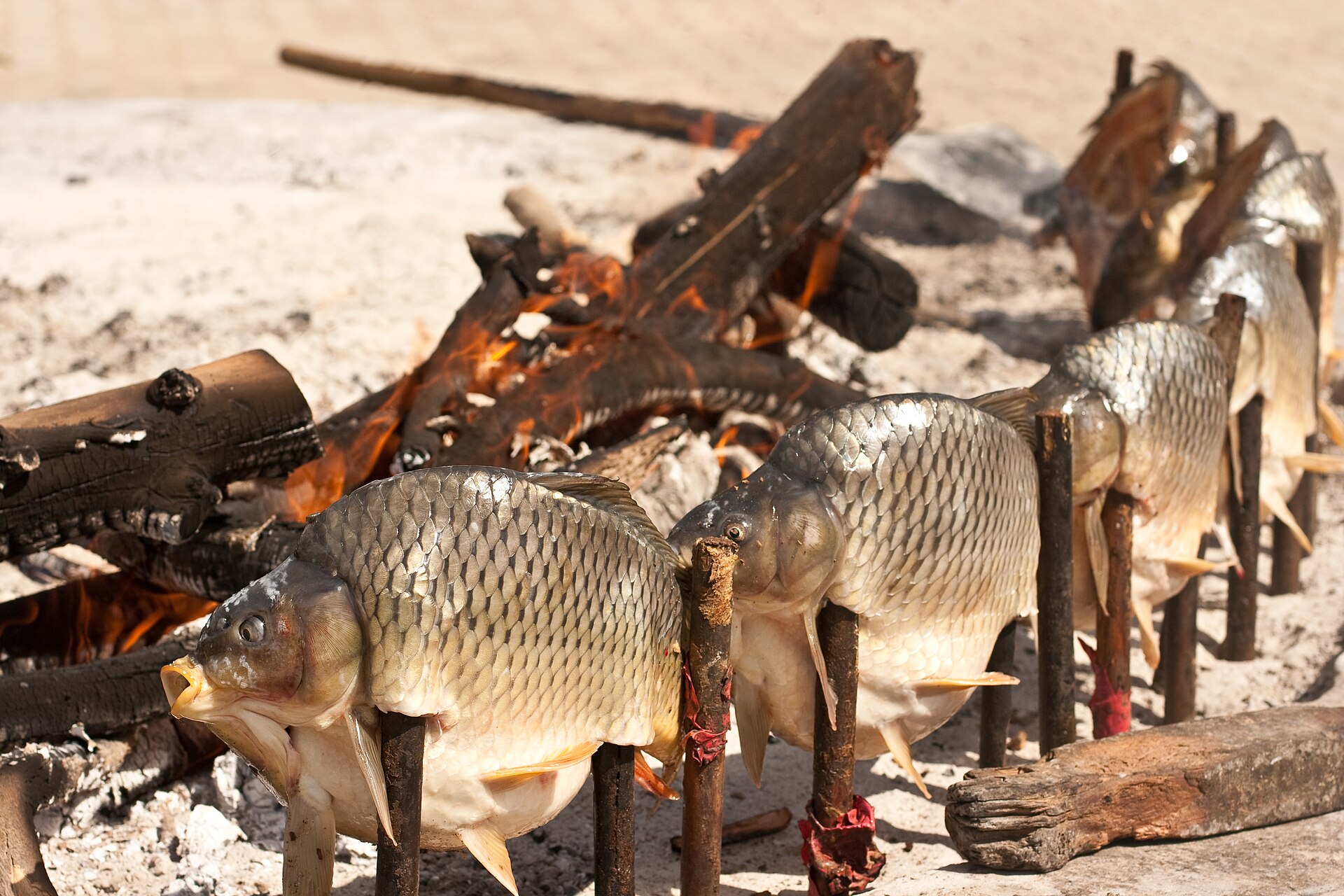
Masgouf (مسكوف) is the reason Baghdad has a food reputation at all. It is a large freshwater fish, split down one side and fanned open into a single flat sheet, marinated, then cooked upright next to an open fire until the flesh sets and the skin blisters.
How it is actually cooked, and why that matters
The fish is butterflied and pinned open on a pair of wooden stakes driven into the ground. The stakes stand in a ring around a fire of split wood — apricot and other fruit woods are the traditional choice — with the flesh side facing the flames. It is not grilling. The fish is being cooked by radiant heat from the side, slowly, and only at the end is it laid flat over the embers to finish.
That method is the whole explanation for two things travellers complain about. First, the time: a tour operator writing in January 2025 puts it at anywhere from 45 minutes to three hours and recommends ordering ahead, and we could not find a dated source that pins it to a single number. Treat an hour as the floor. Second, the price: this occupies a fire, a patch of ground and someone’s attention for most of an evening, on top of the cost of the fish itself.
The wood is not incidental either. When masgouf arrived in Sinjar in 2025 on the advice of Basrawi cooks, Iraqi reporting noted that the local mountain oak changed the flavour — evidence that Iraqis treat the wood species as part of the recipe rather than a detail. There is also a genuine environmental argument now attached to the dish: after roughly 200 olive trees were cut for firewood in Bashiqa in August 2025, there were public calls in Iraq to boycott masgouf altogether.
What fish you are eating, and what it costs
This is the single most useful thing to know before you order, and no English-language guide has it. There are two entirely different categories of fish going onto Baghdad’s fires, and the price gap between them is roughly threefold.
The prized fish are native river species: binni (بني), shabbout (شبوط) and gattan (كطان). The cheap alternative is farmed carp, raised in ponds and lakes. When 964media visited the Shawaka fish market on the Karkh bank of the Tigris in December 2024, the sellers themselves described the farmed carp as “low quality and almost tasteless.”
| Fish, at market | IQD per kg | ≈ USD |
|---|---|---|
| River gattan / binni / shabbout, sold for grilling | 20,000–25,000 | $13–16 |
| Large river fish | up to 28,000 | $18 |
| Zouri | 10,000 | $6.50 |
| Farmed carp | 7,000–8,000 | $4.50–5.20 |
| Imported frozen sea fish | 6,000 | $3.90 |
Source: 964media reporting from Shawaka fish market, Baghdad, 3 December 2024. These are raw-fish market prices per kilo in a market, not restaurant prices, and they are more than eighteen months old.
We are labelling those figures carefully on purpose. They tell you the floor a restaurant is working from, not what you will be charged. A restaurant plate has to sit meaningfully above the market rate for the fish, plus wood, labour and sides. Anyone quoting you a precise 2026 restaurant price for masgouf in Baghdad is guessing, and precise-sounding Baghdad food prices are exactly where guides go wrong.
Where the fish comes from is worth knowing too. Baghdad’s supply arrives from Amara in Maysan, from Haditha and from Lake Tharthar as much as from the Tigris outside the door. Scarcity is the stated reason prices are high: 2025 was Iraq’s driest year since 1933, with national water reserves falling below 4 billion cubic metres by December. A wet winter lifted live storage back to around 20 bcm and a five-year water agreement with Turkey was signed in November 2025, so 2026 is materially better than 2025 — but the structural problem is not solved, and it shows up on the menu.
Ordering masgouf without getting stung
- Ask what the price is based on before they light the fire. Masgouf is normally priced per kilo of the raw fish you choose. Some places quote per fish or per person instead. These produce very different bills.
- Ask which fish it is. “Samak” tells you nothing. Binni, shabbout and gattan are the river fish; carb (carp) is the farmed one. Both are legitimate — you just should not pay river-fish money for pond fish.
- A two-kilo fish feeds two to three people. It is not a solo order.
- Order it first, then everything else. Mezze, soup and tea are what you do while it cooks.
- Go in the evening. In June to August, sitting outdoors by a wood fire at midday is not a realistic plan. See the section on heat below.
Abu Nuwas Street: what we can and cannot say
Abu Nuwas Street, running along the Tigris on the Rusafa bank, is the address everyone associates with masgouf, and there is a row of grill houses along the corniche. What we could not do — and we tried — is verify a single specific masgouf restaurant on Abu Nuwas as currently trading using a dated editorial source. Several well-known names have active Facebook and Instagram pages and nothing else. That is not proof, and we are not going to send you to a specific door on the strength of a social-media post.
What is confirmed is that the street is in normal public use: it hosted a Baghdad schools marathon run with the French embassy in November 2024. So the practical advice is: go to Abu Nuwas, look at what is lit and busy, and check a specific place’s own page the same week you go. Abu Nuwas also turns up on almost every list of Iraq’s best photography spots, which is a fair guide to where the evening crowds are.
Where to eat in Baghdad: venues with a date attached
In April 2026, Baghdad restaurants staged a three-day strike against delivery-app commissions of up to 27% of order value. The dispute was organised by Anas al-Sarraf, head of the Iraq Restaurants Association, and Iraqi reporting on 30 April 2026 named the businesses taking part. That gives us something no page-one competitor has: a list of Baghdad restaurants with a specific date on which they were demonstrably open and trading.
| Venue | Side of the city | What for |
|---|---|---|
| Kebab al-Badawi (كباب البدوي) | Rusafa | Kebab house; led the strike |
| Falafel Lebanon (سلسلة فلافل لبنان) | Chain, both Karkh and Rusafa | Falafel |
| Mandi w Shawaya (مندي وشواية) | Rusafa | Mandi and grills |
| Dhulou’ al-Jadriya (ضلوع الجادرية) | Jadriya, Rusafa | Ribs and grills |
| West Burger (ويست برغر) | Karkh | Burgers |
| Heroes Burger (هيروز برغر) | Rusafa | Burgers |
| Fire Fly (فاير فلاي) | Rusafa | General restaurant |
Source: 964media, 30 April 2026. This is a snapshot of one day, not a recommendation list — nobody has reviewed the food. Restaurants close. Check before you travel across the city for one.
Two things are worth reading out of that table. The first is that the Karkh/Rusafa split — west bank and east bank of the Tigris — is how Baghdadis themselves locate a restaurant, and it is the geography you should use when asking for directions. The second is that burgers are currently a major Baghdad category. Two of the named businesses are burger brands, and the head of the national restaurants association owns one of them. If you arrive expecting an unbroken wall of clay ovens, the actual city will surprise you.
A note on what is not in that table. We deliberately have not characterised Karrada, Arasat al-Hindiya, Mansour or Zayouna as dining strips with particular personalities, because we could not find a dated source that does so. Karrada is unquestionably a major commercial district, and there is food everywhere in it — but the venue-by-venue descriptions circulating online trace back to undated aggregators, and several to sites we do not cite at all.
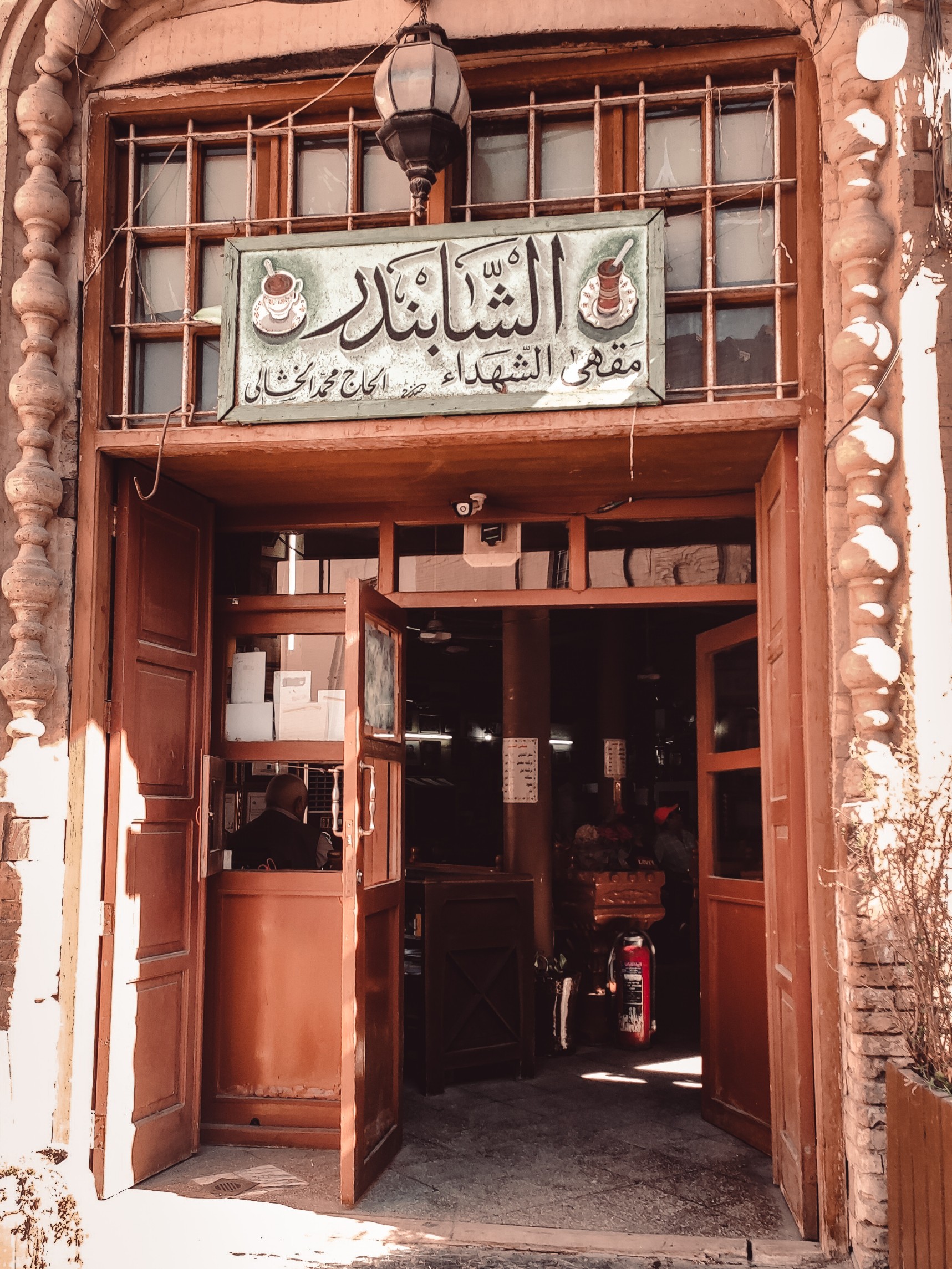
Al-Shabandar: the café everyone means, and what changed in 2025
At the far end of Mutanabbi Street, near the Qishla, is Al-Shabandar — the café that appears in every book, documentary and photo essay about the city. The building dates to 1907 and started life as the Shabandar family’s printing press. The Khashali family took it over in 1963.
It is open. That matters, because a great many things in old Baghdad are not, and the café’s own story took a turn recently that most English-language pages have missed.
Haj Mohammed al-Khashali, who ran it for more than sixty years and was there daily, died on a Saturday in January 2025 at the age of 93 — 11 January, by the day of the week Iraqi reporting gives. His surviving son Omar now runs the café. Omar had returned from Turkey three years earlier to care for his father; a foreign correspondent reporting from inside the café in December 2025 found it operating as it always had.
The reason the sign above the door reads Al-Shabandar: the Martyrs’ Coffee Shop is the car bombing of Mutanabbi Street on 5 March 2007, which killed at least thirty people. Al-Khashali lost four sons and a grandson in a single day. He rebuilt, reopened, and hung enlarged photographs of them on the walls, where they remain. We flag this precisely because the widely-copied version — “five of the owner’s children” — is wrong, and the error has propagated through most of the internet. His own formulation was that he forgave but did not forget. If you go, that is a wall of family photographs in a working café, not an exhibit.
Practically: the menu is deliberately three items — Arabic coffee, black tea, and a sour tea made by simmering dried black limes for hours. Hookah is allowed. Backgammon is banned because it is too noisy; the owner wanted people talking. The high ceilings and internal ventilation shafts, built with steel the Shabandar family imported from Belgium, keep it bearable in summer and stop it filling with smoke. And in a detail that says everything about how change lands in this part of the city, al-Khashali refused to install digital payment and successfully petitioned the government to exempt the café from the electronic-payment mandate.
The Baghdad food to work through, dish by dish
Iraqi cooking is regional, and Baghdad’s version is the one that travelled. Our broader guide to Iraqi food covers the national picture; what follows is what you will actually be handed in the capital.
Kebab and tikka
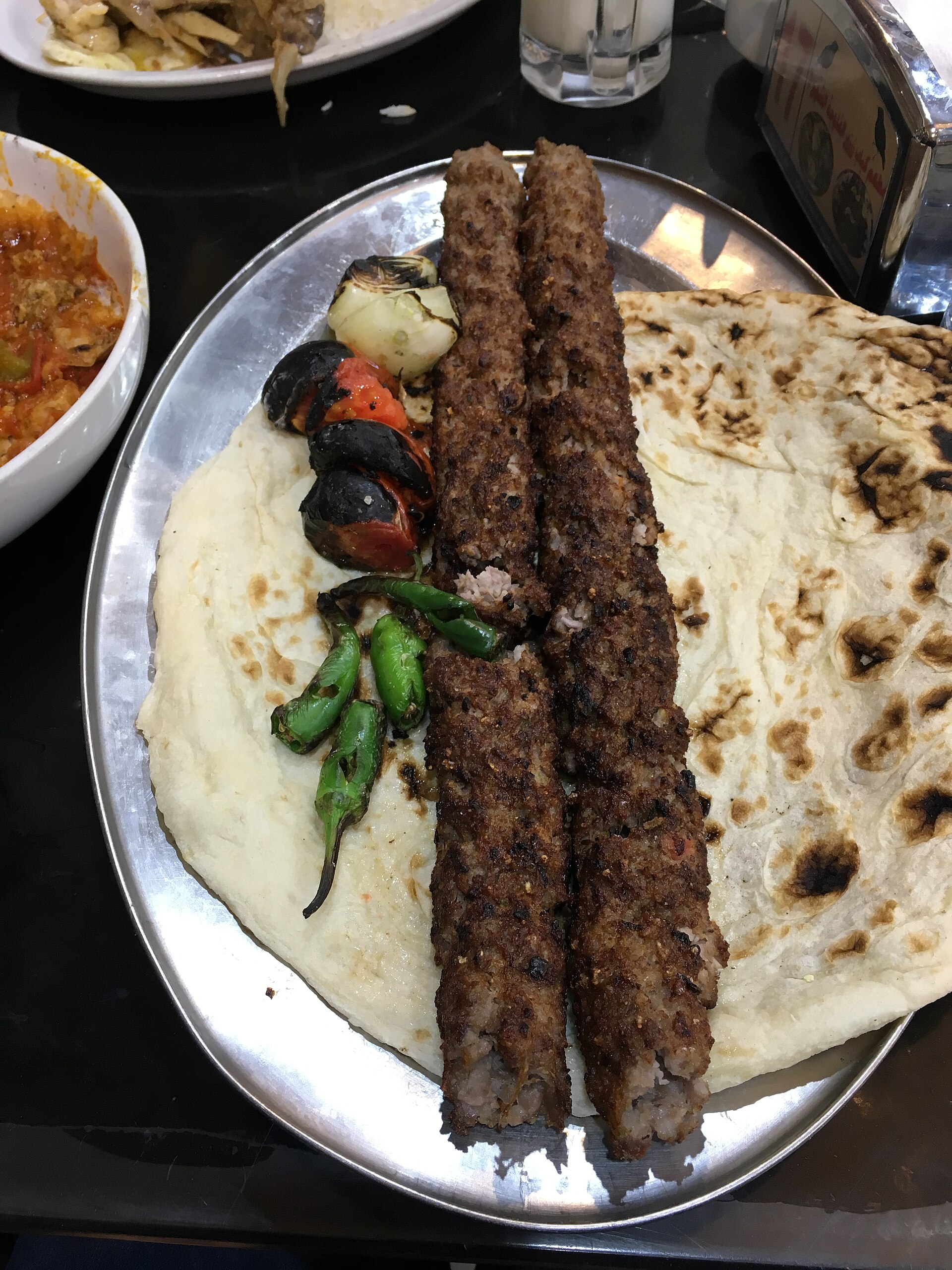
Iraqi kebab is minced lamb or beef, worked with grated onion and parsley and pressed onto wide flat skewers over charcoal. Tikka is the cubed-meat version. It arrives with grilled tomato and onion, sumac and a stack of samoon, and it is the default meal at every price point in the city — from a five-star hotel dining room to a two-table place with a fan and a plastic chair. If you eat one thing in Baghdad besides masgouf, this is it.
Quzi
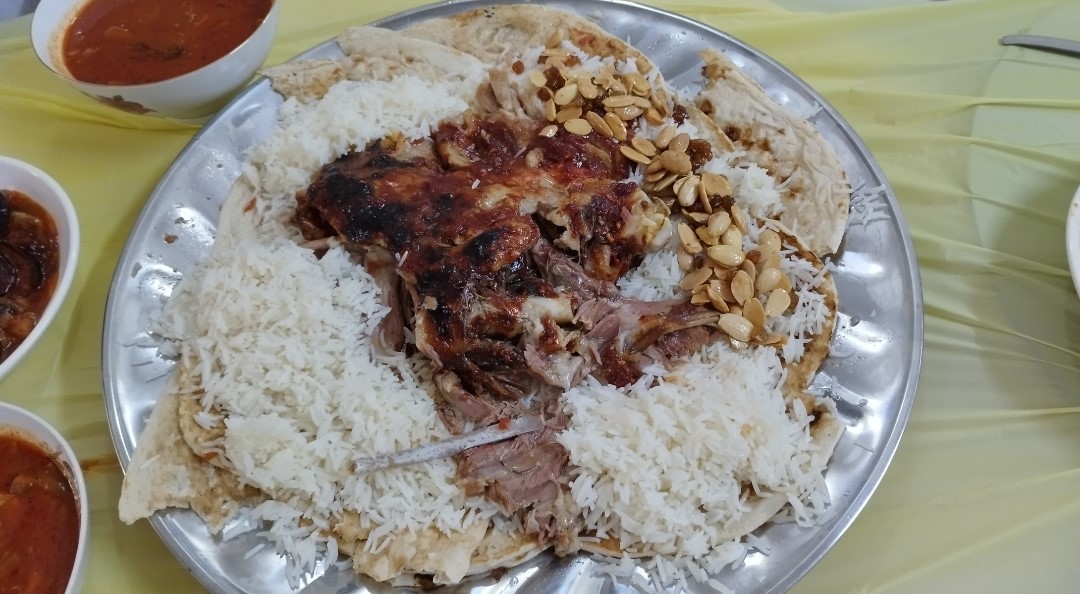
Whole lamb, slow-cooked until it falls apart, served over spiced rice with almonds and raisins on a communal platter. Quzi is wedding and feast food, and it is scaled accordingly — this is not a plate for one. It is still a live restaurant dish rather than a museum piece: Baghdad’s street-food scene is in a mash-up phase at the moment, to the point where one Basra-born vendor in the capital was reported in April 2026 selling a “spicy Mexican quzi” alongside thirty-five invented variants of another dish.
Dolma
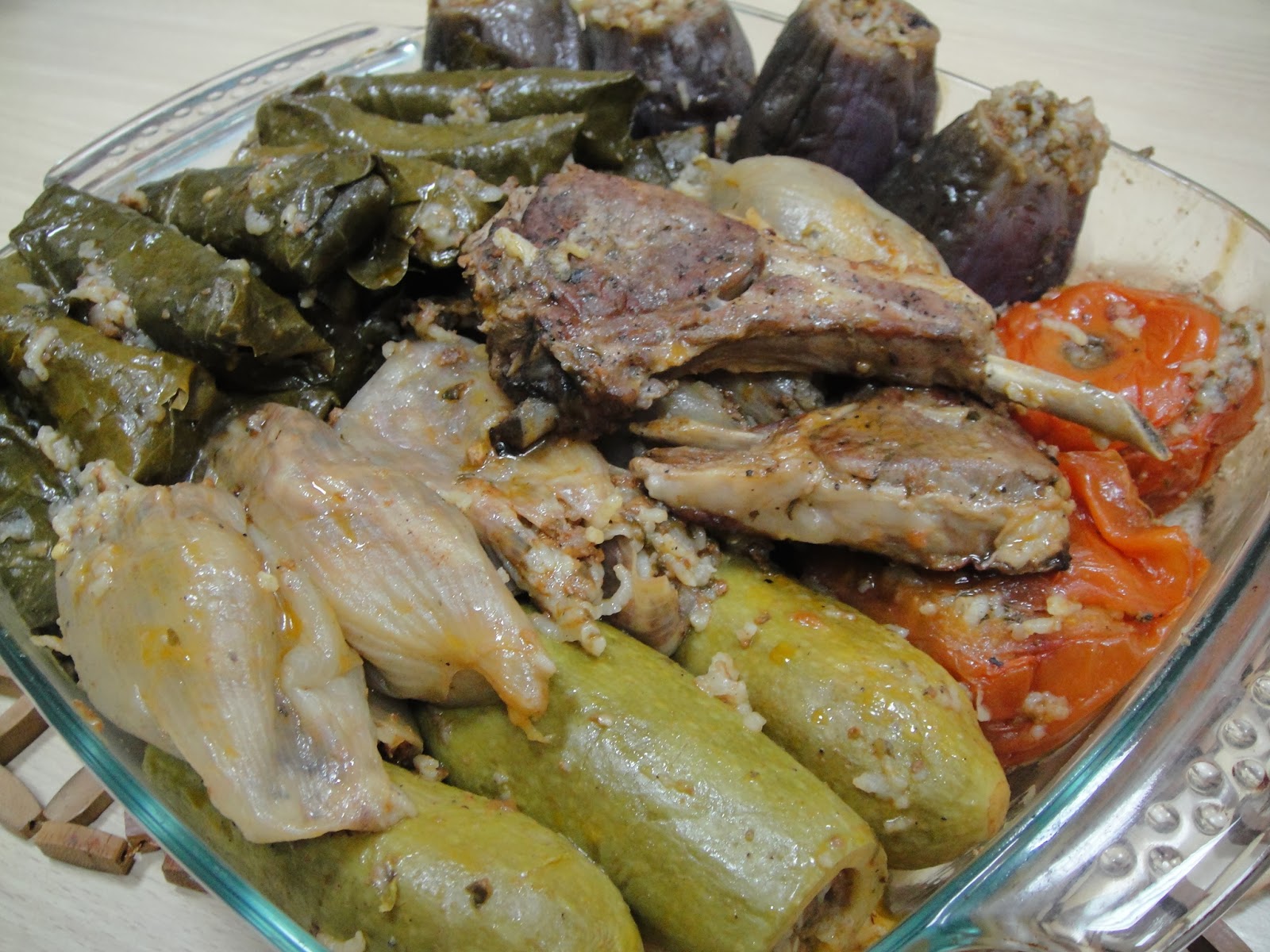
Iraqi dolma is not one stuffed vegetable, it is a mixed pot: vine leaves alongside stuffed onion, aubergine, courgette, pepper and tomato, packed in layers, weighted down, and soured with tamarind or pomegranate. The pot is cooked and then inverted onto the serving platter, which is the moment the whole thing is judged on. It is commonly described as the Friday family lunch, though we could not attach a dated source to that claim. The stuffing usually contains meat, so vegetarians should ask rather than assume.
Tashreeb
The word means “to soak”, and that is the dish: bread torn into a bowl and left to absorb meat broth until it turns to something between a stew and a pudding. Usually lamb, sometimes chicken or beef, often with vegetables cooked in. It is filling in a way that catches people out, and it is genuinely old — it is popularly described as having been the Prophet’s favourite dish.
Kubba
Shells of bulgur or rice around spiced meat, fried or simmered. The variants are regional and Iraqis will tell you which is which: Mosul kubba are large flat discs; kubba Halab has a rice shell and is fried; kubba hamuth comes in a sour broth. The Baghdad one usually named is kubba Saray, cooked in a tomato soup with chickpeas and dried limes — though that description comes from aggregated food writing rather than a dated report, so take it as how the dish is commonly described.
Pacha
Sheep’s head, trotters and stuffed stomach, simmered for hours and eaten very early in the morning, in winter. It is not a tourist dish and nobody will be offended if you pass. It is also treated with real seriousness — in Sinjar it is eaten as a New Year good-luck ritual. If you want to understand how Iraqis eat rather than how visitors eat, this is the one to try.
Samoon and the bread question
Samoon is the diamond-shaped Iraqi bread baked on the floor of a stone or gas oven, sold hot from neighbourhood bakeries, and it is the vehicle for everything above. Khubz tannour, the flat round bread, does the same job. Both are cheap, and we are not going to tell you how cheap because no dated published price for a samoon exists and we will not invent one.
Samoon is also defended. In February 2026 a bakery in Bartella was reported making a third attempt at selling a French-style baguette shaped as a “samoona” — the fact that this keeps being tried and keeps needing another go tells you how firmly the original holds its ground.
Breakfast: kahi w geymar
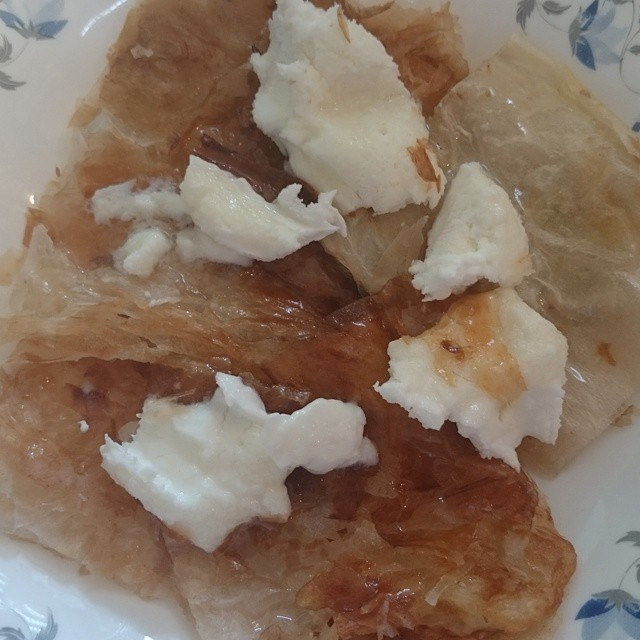
Baghdad breakfast is kahi w geymar: a flaky, laminated, butter-drenched pastry baked in wide sheets and served under geymar, the thick clotted cream skimmed from buffalo milk, finished with date syrup or honey. It is eaten early, often standing at a counter, with sweet tea. It is very rich and it is completely worth it.
You will see two kahi houses near Tahrir Square named repeatedly in travel writing. We are not printing the names as current recommendations because the sources naming them date to 2023 and we could not confirm either as trading in 2026. Ask locally in the morning; kahi is a dawn-to-mid-morning trade and the good places are obvious from the queue.
The rest of the breakfast table: eggs fried with basturma, halawa and tahini with date syrup, geymar spread straight onto hot samoon, and — in winter — tashreeb bagilla, bread soaked with broad beans. Hotel breakfasts will usually put out a lentil soup as well.
Tea, and why it is not really about the tea
Chai in Baghdad is served black, heavily sweetened, usually with cardamom, in a small waisted glass called an istikan carried on a circular tray. It is claimed that Iraqis drink roughly twice as much tea as the global average. Whether or not that survives scrutiny, the behaviour behind the claim is real: tea is the unit of social time here, bundled with cigarettes, shisha and — outside Al-Shabandar — backgammon.
Two practical points. A glass of chai or Arabic coffee after a meal is frequently brought without charge and without being ordered; accept it. And we cannot tell you what a glass of tea costs, because no dated published figure exists. It is small money. Ask, or watch what the person in front of you hands over.
The other drink worth trying is nomi basra — dried black limes simmered for hours into a sour, smoky tea. It is one of the three items on Al-Shabandar’s menu and it tastes like nothing else in the region.
Baghdad food prices: street eating and the only published figures
These are the figures we can source and date. Everything else you read about Baghdad food prices is estimated, however confidently it is written.
| Item | IQD | ≈ USD |
|---|---|---|
| Grilled corn on the cob from a street stall | 1,000–1,500 | $0.65–0.98 |
| Sabich sandwich | under 1,000 | under $0.65 |
| Fasolia (white beans) with rice, roadside restaurant | under 3,000 | under $1.95 |
| Shorba (lentil soup) | often free, as a first course | — |
Source: Young Pioneer Tours, published 4 January 2025, converted at 1,535 IQD/USD. Nineteen months old at the time of writing.
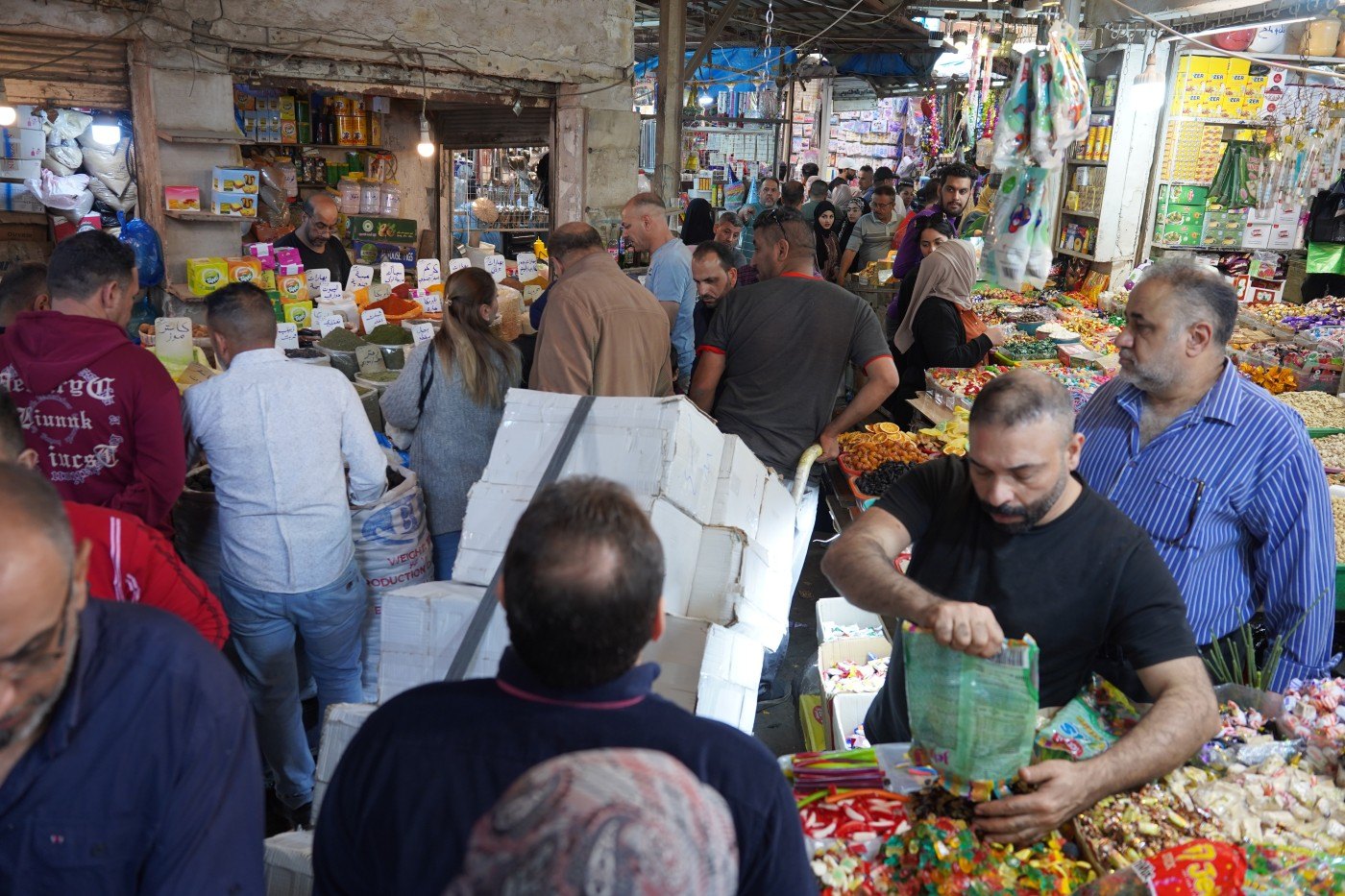
Falafel is everywhere and cheap — Falafel Lebanon is a chain with branches on both banks. The sabich sandwich, pita stuffed with fried aubergine, salad and chips, has a Baghdad origin story: it is traced to an Iraqi Jew, Sabich Tzvi Halabi, who sold it from a kiosk downtown before emigration carried it abroad, where most people now meet it as an Israeli dish. Grilled corn, roasted nuts, fresh juice and ice cream fill in the gaps, and the corniche and market streets are where you find them. Street eating is one of the cheapest and least intimidating ways into the city, and it works just as well in the other cities in Iraq.
Alcohol: the law, stated precisely
This is the single most misreported thing about eating out in Iraq, so here it is carefully. Article 14 of the Municipal Revenues Law, voted in 2016 and gazetted in March 2023, criminalises the import, manufacture and sale of alcohol. It does not criminalise consumption. Fines run from 10 to 25 million IQD. Lawyers acting for liquor traders have filed constitutional challenges; as of May 2025 those had made no progress.
The practical position tightened after that. Until late 2024, hotels and registered social clubs continued to serve, which is where the “you can still drink at the clubs” line in older guides comes from. That loophole is closed: in late 2024 the Interior Ministry moved to halt sales inside registered clubs, decades-old Baghdad private clubs received official letters, and 20 to 30 outlets closed, most of them in Baghdad. Prices on the grey market doubled.
So: assume every restaurant, café and hotel in Baghdad is dry, because in practice it is. Alcohol remains legal in the Kurdistan Region and at Baghdad airport’s duty-free. A grey market persists — some liquor shops on the Karkh side stay open until an official complains, and cars arriving from Kurdistan are searched for beer — but we are not in the business of directing visitors towards a criminal transaction, and neither should any guide. Our summary of Iraqi laws travellers need to know covers the wider picture, including the July 2024 amendment to the Anti-Prostitution and Homosexuality Law, which carries prison terms and heavy fines and applies to visitors as well as residents.
Paying: cash, cards and a mandate nobody expected
Carry cash. Iraq is still overwhelmingly a cash economy, and as of mid-2025 Mansour Mall was cited as one of the very few places in Baghdad where any establishment takes a card at all.
But this is genuinely moving, and it is worth knowing because it will change what your trip feels like within a few years. The Central Bank of Iraq is implementing a Council of Ministers decision on deploying card terminals, and restaurants are named explicitly among the businesses obliged to take a minimum share of receipts electronically, alongside fuel stations, pharmacies and clinics. From 1 January 2026, QI Card began advertising zero commission on all electronic payments across its network. Zain Cash, FastPay and international cards through TBI are all in use.
Two caveats. We could not trace the terminal rollout into the markets, which remain cash. And the most eloquent piece of evidence about how this is landing is that Baghdad’s most famous café successfully applied to be let out of it. Bring dinars, in small notes, and change money at the street rate rather than the peg. There is more on the mechanics in our Iraq travel tips page.
Delivery apps, and the strike that named the restaurants
How Baghdad actually eats on a weeknight is by phone. Four apps dominate the capital: Talabat, Toters, Talabatey and Bly. Commissions running up to 27% of order value are what triggered the three-day restaurant strike that began on 30 April 2026, called the “first phase” by the Iraq Restaurants Association — though a source told Iraqi media the action covered association members only, and many well-known Baghdad restaurants did not join.
If you are staying somewhere with a kitchen or simply do not want to cross the city in August, this is a real option, and it needs a local number and data — see our Iraq SIM card guide. Note what is not on that list: Careem Food, Uber Eats and Lezzoo are all commonly claimed for Baghdad and none of them is confirmed. Lezzoo in particular is an Erbil company. For getting yourself to a restaurant rather than the other way round, Baly holds roughly 80% of Baghdad ride-hailing and Careem operates in the city too; our getting around Iraq guide has the detail.
When to eat: heat, hours and Ramadan
Timing shapes Baghdad food more than any other single factor. Baghdad’s July mean maximum is 44°C, and on 15 August 2026 four Iraqi governorates were recording 50°C. The 50-degree window does not politely end in mid-August. This is not a weather statistic — it is the reason the city’s social life is nocturnal in summer. Markets thin out in the afternoon, restaurants fill after dark, and outdoor riverside dining is an evening activity or it is nothing.
We are not going to give you Baghdad’s peak dining hours as a clock time, because no dated source publishes them. What we can say is that late dining is a live and expanding trend: when a restaurant in Samarra began staying open until dawn in March 2026 it was reported as news.
Ramadan changes everything for a month. In 2026 it ran from 19 February for the full thirty days, with Eid al-Fitr on Friday 20 March and official working hours suspended from 18 March. During Ramadan, daytime eating in public is not on, restaurant hours shift entirely to the iftar-to-suhoor window, and the atmosphere after sunset is genuinely one of the better things about visiting. Ramadan 2027 will fall around early February, but the start depends on a moon sighting and we will not state a date. Our guide to the best time to visit Iraq sets out the calendar, including Arbaeen, when free food is served on a scale you have to see to believe along the pilgrim routes south.
Vegetarians, coeliacs and other awkward eaters
Honest version: a vegetarian will eat well in Baghdad but narrowly. The mezze and pulse layer is genuinely good — fasolia, falafel, sabich, salads, bread, dairy, grilled corn, pickles, hummus, aubergine. What you cannot do is eat the food Baghdad is known for, because masgouf, kebab, quzi, tashreeb, kubba and pacha are all meat or fish. Two specific traps: dolma is normally stuffed with meat, and shorba is often built on a meat broth even when it looks vegetarian. Ask about the broth every time. Halal is the default and pork is effectively absent, which simplifies things for some travellers and not others.
Coeliacs should plan carefully. Iraq’s coeliac patients’ association went public on 19 July 2026 to say that safe gluten-free food is prohibitively expensive in Iraq and to ask the government for a dedicated body to handle it. In a cuisine built on samoon, bulgur and bread-based dishes, that is a serious constraint. Bring what you need.
Water, hygiene and the CCHF question
Do not drink the tap water. Bottled water is standard, cheap and already on the table in most places. We could not find a dated source on ice specifically, so apply the usual caution in places you are unsure about.
On Crimean-Congo haemorrhagic fever, which several travel pages handle badly: Iraq has an ongoing outbreak, with the IFRC recording 171 confirmed cases and 11 deaths across 15 governorates as of mid-June 2026. It matters, and it is worth understanding. But it spreads by tick bite and by contact with the blood or tissue of infected animals. That is a risk for people handling livestock or visiting animal markets and abattoirs. It is not a meaningful risk from eating cooked food in a restaurant. Our Iraq vaccinations and health guide covers hepatitis A, typhoid and the rest of the standard pre-travel list, which is where your actual attention should go.
Manners at the table
Iraqi hospitality is not a cliché, it is a set of specific behaviours you should be ready for. Soup or salad usually appears before you ordered it, and is usually free. Tea or coffee usually appears after the meal, likewise. Tipping is customary but not obligatory — around 10% is appreciated, and fine dining may already have added a 10–15% service charge, so check the bill first.
In a private house, take your shoes off, and do not wander past the living room uninvited. That is not fussiness: women of the household may be in the back rooms unveiled, and the rule matters most for male guests. Expect to be fed far more than you can eat and to have your refusal ignored twice before it is accepted. Our Iraqi culture guide goes further into this, and it is worth reading before your first invitation rather than after.
What we could not confirm
This list is the point. Most guides to Baghdad food fill these gaps with plausible-sounding invention.
- Any restaurant price for masgouf, per kilo, per fish or per person, from a dated 2024–2026 source. The only figures in circulation are restaurant social-media promotions with no verifiable date.
- Any specific operating masgouf restaurant on Abu Nuwas Street with dated editorial proof. Several have Facebook pages; that is all.
- Café Zahawi, Umm Kulthum Café and Hassan Ajmi Café. We could find no dated 2024–2026 evidence either way. They may well be trading; we cannot say they are.
- The named kahi houses near Tahrir Square. Sourced to 2023 and undated aggregators only.
- The price of a glass of chai, a samoon, or a plate of kahi. No dated published figure exists for any of them.
- Any typical mid-range or high-end Baghdad restaurant meal cost. Nobody publishes one. Anyone quoting you one has estimated it.
- Any Western fast-food or coffee chain operating in Baghdad. Widely claimed, never sourced. Same for specialty-coffee venues, which certainly exist as a culture but which we could not verify by name.
- Karrada, Arasat, Mansour and Zayouna as characterised dining strips. We can confirm the Karkh/Rusafa split and place one restaurant in Jadriya. The venue-by-venue neighbourhood profiles online are undated.
- Whether Tigris fish are currently regarded locally as safe after the 2018 and 2022–23 die-offs. No dated statement found in either direction.
- Typical Baghdad restaurant peak hours as a clock time, and whether any specific café is open 24 hours.
- Any named long-running Baghdad ice-cream parlour. The dessert culture is real; we could verify no individual business.
The pattern is consistent, and it is the same pattern you meet at the Iraq Museum, which has been closed since July 2025 while page after page still lists its opening hours. Iraq publishes very little operational information in any language. Anything specific and confident you read about a Baghdad venue deserves a second look.
Baghdad food FAQ
What is the national dish of Iraq?
Masgouf — river fish split, staked around an open fire and cooked slowly. It is more strongly associated with Baghdad than with anywhere else in the country, because of the Tigris and the Abu Nuwas riverside tradition. Kebab, quzi and dolma are the other dishes most Iraqis would name.
Is Baghdad food spicy?
Not in the chilli-heat sense. Iraqi cooking is aromatic rather than hot: baharat blends, cardamom, cinnamon, turmeric, dried lime and tamarind for sourness. Heat, when it appears, comes from a chilli sauce or pickles served alongside, which you control.
Can I drink alcohol in Baghdad restaurants?
Assume not. Federal law criminalises the import, manufacture and sale of alcohol, though not consumption, and the hotel and social-club exemption effectively ended in late 2024 when the Interior Ministry halted sales inside registered clubs. Alcohol is legal in the Kurdistan Region and at Baghdad airport duty-free.
How much does a meal cost in Baghdad?
Street food is genuinely cheap: 1,000–1,500 IQD for grilled corn, under 3,000 for beans and rice at a roadside place. Masgouf is the expensive item, priced by the kilo of raw fish, and river fish was 20,000–25,000 IQD/kg at market in December 2024. There is no published figure for a typical sit-down restaurant meal, and we are not going to invent one.
Do I need to book a restaurant in Baghdad?
Generally no, but you should order masgouf as soon as you arrive rather than after the mezze, because it takes an hour at minimum and can take three. Phoning ahead to start the fish is a normal thing to do if you have a local contact or a driver who can call.
Is the food in Baghdad safe to eat?
Cooked food from a busy place is fine, and the usual travel rules apply. The tap water is not reliably potable, so stick to bottled. Crimean-Congo haemorrhagic fever is a real ongoing outbreak in Iraq but is transmitted through ticks and contact with livestock blood and tissue, not by eating cooked meat in a restaurant.
What is the difference between Iraqi kebab and other kebabs?
Iraqi kebab is minced meat with grated onion and parsley pressed onto a wide flat skewer, grilled over charcoal, and served with samoon rather than a long flatbread wrap. Cubed meat on a skewer is called tikka in Iraq, and is ordered separately.
What is the best Baghdad food for a first-time visitor?
Kebab with samoon, because it is everywhere, cheap and quick, followed by masgouf on an evening when you have two or three hours to give it. Add kahi with geymar for one breakfast and a glass of tea somewhere old. That covers the Baghdad food a local would want you to have tried.
Where do Baghdadis eat rather than tourists?
Neighbourhood kebab houses, falafel counters, and their own kitchens — and increasingly by delivery app, with Talabat, Toters, Talabatey and Bly the four names in the capital. Locations are described by bank of the river first, Karkh on the west and Rusafa on the east, then by district. Learning that split will get you further than any restaurant list.
Final thoughts
Baghdad food is the easiest part of a trip here, and the part where the gap between the city’s reputation and the city itself is widest. It is cheap, the portions are absurd, and hospitality operates at a level that catches most visitors off guard. What Baghdad food is not is documented. There is no restaurant guide with prices, no reliable opening hours, and a page-one search result that will happily tell you about a café nobody has verified since 2023.
So plan loosely. Fix the dishes you want rather than the addresses — masgouf on a river evening, kebab and samoon at least twice, kahi and geymar for one early morning, tea at Al-Shabandar with the photographs on the wall. Ask your driver, your hotel or the person next to you at the counter where they eat. That question works better in Baghdad than any list, including this one.
If you are building the rest of a trip around this, start with the city overview in our things to do in Iraq guide, work out where you are sleeping with where to stay in Iraq, and read the honest security assessment in is Baghdad safe before you commit. If you are here for the shrines, the food culture around Kadhimiya and the pilgrim cities of Karbala and the wider southern Iraq runs on entirely different rhythms — and if you want a sense of how the modern city presents itself, our piece on the Al-Shaheed Monument is the other half of the picture. The full route planning sits in our Iraq itinerary guide and the country overview in the Iraq travel guide.
Photo credits
Masgouf cooking on an open fire, Baghdad — Al Jazeera English / Omar Chatriwala (CC BY-SA 2.0). Iraqi kebab in a Baghdad restaurant — Aziz1005 (CC BY-SA 4.0). Iraqi quzi — Abdulsalam Al Dabbagh (CC BY-SA 4.0). Iraqi dolma — Hill93 (CC BY-SA 4.0). Kahi with geymar — Muhib mansour (CC BY-SA 4.0). Al-Shabandar Café, Mutanabbi Street — Karrarheydar (CC BY-SA 4.0). All images via Wikimedia Commons.