Last updated: August 2026. We re-checked the FCDO’s regionalised advice for Baghdad province (current 15 August 2026), the February 2025 reopening of Al-Aimmah Bridge, the 2026 date of the 25 Rajab pilgrimage, and — the awkward one — whether anybody publishes opening hours for the shrine. Nobody does.
Kadhimiya is the part of Baghdad that most people have seen a photograph of without knowing its name: two gold domes of exactly equal size, four gold minarets, and a dense grid of market streets pressing right up against the walls. It sits on the Karkh, or west, bank of the Tigris, and it is both a neighbourhood and one of the city’s nine administrative districts. The shrine at its centre holds the seventh and ninth Shia Imams, and on one January day in 2026 something on the order of fourteen million people walked towards it. Kadhimiya is one district among many in our guide to visiting Baghdad.
You can almost certainly get in — foreigners, including non-Muslims, do visit the Kadhimiya shrine — but no shrine authority publishes an admission policy, an opening time or a fee, and the practical details below come from visitor accounts rather than from the custodianship. The two things you can rely on are these: cameras do not get past the security cordon, and phones are taken off you at a point inside. Every page that tells you photography is permitted here is wrong.
This guide covers how to reach Kadhimiya and roughly how long it takes, what happens at the checkpoints, what to wear, what you are actually looking at once you are through, the January pilgrimage that reshapes the whole district, the bridge disaster of 2005 and the 2025 reopening nobody in English has noticed, and the souks and old quarters that exist in Arabic sources and almost nowhere else. It also has a long section on what we could not confirm, because on this subject that list is more useful than a confident guess.
The short answer
| Question | Answer |
|---|---|
| Where is it? | West (Karkh) bank of the Tigris, north-west Baghdad. Shrine at 33.3800°N, 44.3381°E. |
| Can non-Muslims go in? | In practice yes, on the evidence of first-hand visitor accounts. No shrine-issued policy exists either way. |
| Entry fee | None is charged. Iraqi Shia shrines do not ticket. |
| Opening hours | No published hours exist anywhere. Do not trust the “open 24 hours” figure that circulates. |
| Cameras and phones | Cameras banned at the checkpoints. Phones taken from you at a point inside. Reported consistently since 2021. |
| Dress | Women: abaya and headscarf, or chador, in the haram. Men: long trousers, plain shirt. |
| Time needed | One to two hours on an ordinary day. Considerably more during a pilgrimage. |
| FCDO rating | Baghdad province except Sadr City: against all but essential travel (updated 22 July 2026). |
Where Kadhimiya is, and what the name covers
The name attaches to at least four things, which is the first source of confusion. Kadhimiya (الكاظمية, al-Kāẓimiyya) is the district; it is also the town-within-a-city that grew around the tomb; it is loosely used for the shrine itself; and the shrine’s own formal name is the Kadhimayn or al-Jawadayn — the dual form, “the two Kadhims”, or “the two Jawads” — because two imams are buried under those two domes. Persian and Urdu speakers will say Kazimayn. Older English sources write Kazimiyya or Kadhimain. They are all the same place.
Wikipedia describes it as “about 5 kilometres from the city center”. That is a straight-line figure and it is not what you will drive. Routed on actual roads, the shrine is about 17.4 km from Tahrir Square on the Rusafa side and about 28.5 km from Baghdad International Airport (measured on the OpenStreetMap road network, August 2026). Both those numbers assume free-flowing traffic and no checkpoints, which is not a condition Baghdad has ever been observed in. Treat them as geometry, not as travel time.
Directly across the river is Adhamiya, the Sunni district built around the tomb of Abu Hanifa. The two face each other, and the relationship between them is one of the more interesting things about visiting either. We come back to it below.
Getting to Kadhimiya
There is no visitor-facing transport information for Kadhimiya anywhere on the English internet, so here is what can actually be established.
| From | Road distance | Free-flow drive | What to actually budget |
|---|---|---|---|
| Baghdad International Airport | 28.5 km | ~24 min | An hour or more. The airport’s own perimeter and checkpoint chain is the variable, not the road. |
| Tahrir Square / central Rusafa | 17.4 km | ~18 min | Assume double, more at peak. Cross-river traffic is the constraint. |
| Shrine to Al-Aimmah Bridge | 2.8 km | ~3–4 min | Short. The bridge is mapped as a drivable road and reopened in February 2025. |
Distances and free-flow times measured on the OpenStreetMap road network in August 2026. They exclude traffic and checkpoints, which dominate real journey times.
For ride-hailing, the thing worth knowing is that the app everyone abroad assumes is dominant is not. Baly, an Iraqi company founded in Baghdad in late 2021, is reported to hold around 80% of Baghdad ride-hailing. Careem does operate in Iraq — in exactly four cities, Baghdad, Najaf, Basra and Erbil, per its own site as of August 2026 — with Taxi, Awfar, Extra and To Airport tiers. There is no evidence of Uber or Bolt operating in Iraq. We have deliberately not printed a fare: the only figure in circulation traces back to our own earlier pages, which is circular, and we could find no independent source. Ask your driver or your hotel before you set off, and see our notes on moving around Iraq by road, air and shared taxi for the wider picture.
Self-driving is effectively closed to visitors. The FCDO requires the 1968-convention International Driving Permit, which you cannot obtain outside your own country, and Iraq recorded 2,351 road deaths in 2025 with Baghdad accounting for roughly a fifth of national crashes. A car with a driver is the normal arrangement and the sane one.
What actually happens at the gate
This is the section every competitor page is missing, so we will be precise about how solid each piece of it is.
Security is layered and body searches are repeated. A 2021 first-hand account from a Western visitor describes “multiple body searches before you get inside” and security that was “very very strict”. A claim circulates that there are three checkpoints — one on entering the Kadhimiya area and two more before the mosque — but we could not verify that on any page we fetched, so treat the number as indicative and the principle as certain.
Cameras do not go in. The same 2021 account is unambiguous: “no cameras of any kind are allowed into the checkpoints”. The ban is attributed locally to a grenade attack in May 2021 that injured ten people. A tour-operator page currently ranking on page one states that photography is allowed except where indicated. That page carries no first-hand detail of any kind and we would not weigh it against a dated eyewitness account. Do not arrive with a camera you are not prepared to leave behind.
Phones are taken from you. Two independent reviewers, writing in 2022 and 2025, describe the same thing: “no mobiles are allowed after a certain point”, and a complaint that phones are “confiscated as needed for people doing Ziarat from abroad to avoid getting lost”. That second remark is the useful one — if you are relying on your phone to find your group afterwards, agree a physical meeting point before you go through, because you will not have it inside. Whether the mechanism is a numbered deposit counter or a hand-over to a guard, we could not establish.
The practical consequence is that you should carry as little as possible, keep your passport or ID on you for the checkpoints, and expect the whole entry process to take a while. Our separate guide to what to expect at Iraqi checkpoints covers the general etiquette; Kadhimiya is a hard version of the same thing rather than a different thing.
Shoes come off in some areas. Reports mention designated shelves and staff directing people; nobody describes a formal ticketed cloakroom. Watch what everyone else does and follow it.
Can a non-Muslim visit the Kadhimiya shrine?
Honestly: almost certainly yes, and we cannot prove it from an official source.
What exists is a small body of first-hand evidence. A Western traveller published a dated account with photographs in November 2021 describing the interior from inside — “insanely beautiful, with golden minarets and mirrored ceilings and walls” — having passed the searches. A Russian solo traveller wrote up a long, detailed November 2024 visit in October 2025, though his photo captions place him at the main entrance rather than explicitly inside the haram, so we will not overclaim from it. The shrine’s TripAdvisor page carries only twenty-two reviews in total, the most recent from October 2025.
What does not exist is any statement from the custodianship. The official domains associated with the shrine — aljawadain.iq, aljawadain.org, alkadhimain.org and imamalkadhim.org — all returned empty when we fetched them on 15 August 2026. There is no consular note, no posted policy, and no account we could find of a foreigner being turned away either. The cheerful “non-Muslims are welcome” line that appears on aggregator pages traces back to unsourced, machine-written travel content.
So the honest framing is: entry appears to be at the discretion of the people on the gate, it is generally granted, and it is worth going with an Iraqi who can speak for you. Whether a guide or escort is formally required, we could find no source either way. Compare this with Karbala and Najaf, where there is a far larger body of foreign-visitor reporting to draw on — Kadhimiya has almost none in English since 2022, which is precisely why so much of what is written about it is invented.
What to wear
None of the following is shrine-issued. It comes from Iraqi pilgrimage guidance and from visitors, and it matches practice at comparable sites.
- Women: an abaya and headscarf, or a chador, in the haram itself. Modest, loose, dark clothing across the whole shrine perimeter. Whether an abaya is lent free at the women’s entrance or has to be bought, we could not confirm — loan abayas are common at Iraqi shrines generally, but no source states it for Kadhimiya. Bring your own if you can.
- Men: long trousers, no shorts, a plain or dark shirt. Bright colours read as disrespectful during mourning periods.
- Black is the pilgrim norm rather than a rule. If you do not have it, you are not excluded.
- Behaviour: lower your voice, do not block walkways, step aside if you stop, and never photograph mourners — a point that becomes moot once your phone is gone, but matters on the approach streets. If anyone asks you to stop doing something, stop immediately.
During mourning weeks this is a funeral rather than a monument, and the distinction is not academic. Women travelling alone will find our notes on solo female travel in Iraq relevant here, and the general laws and social rules visitors need to know apply.
What you are looking at
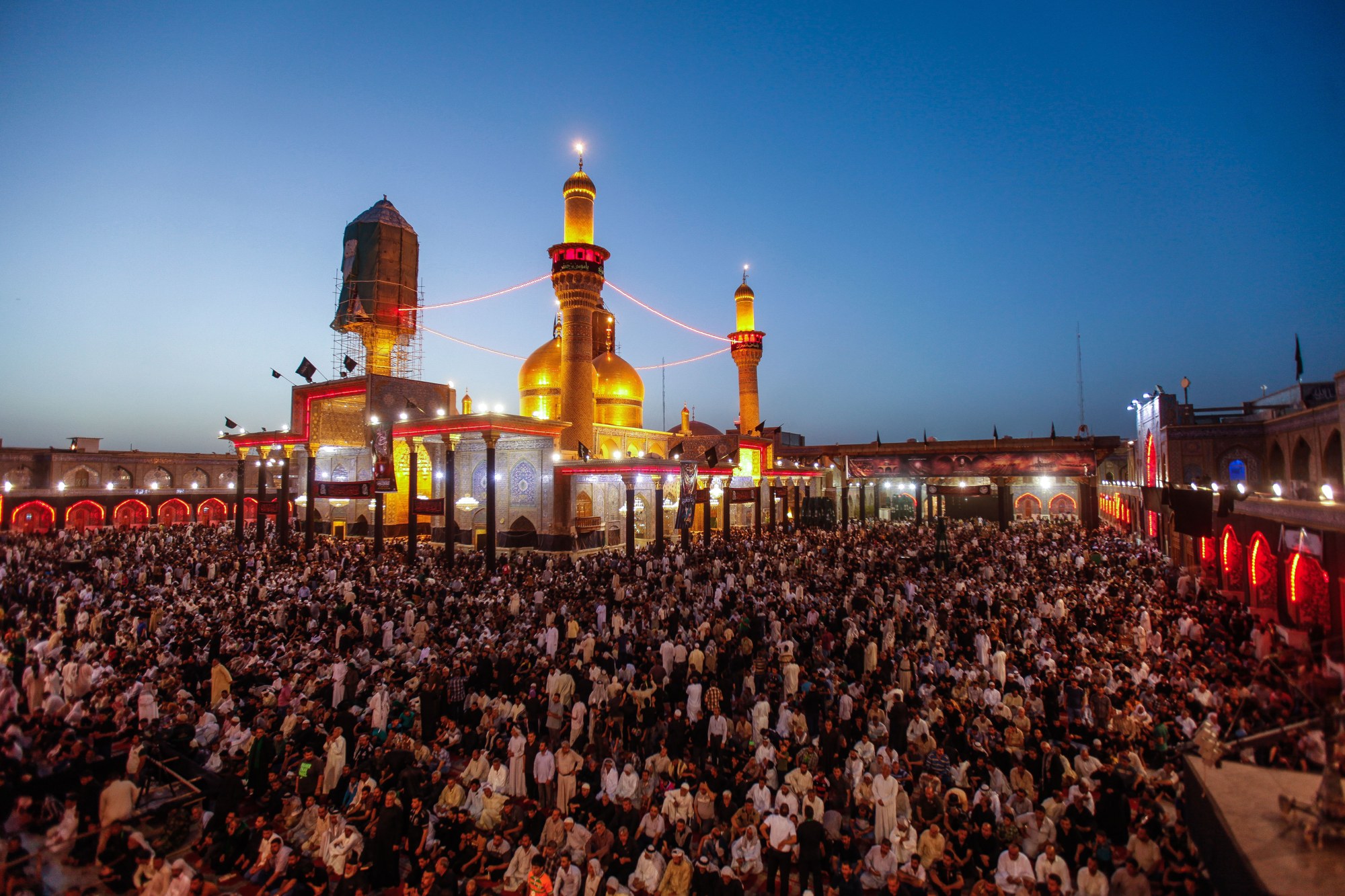
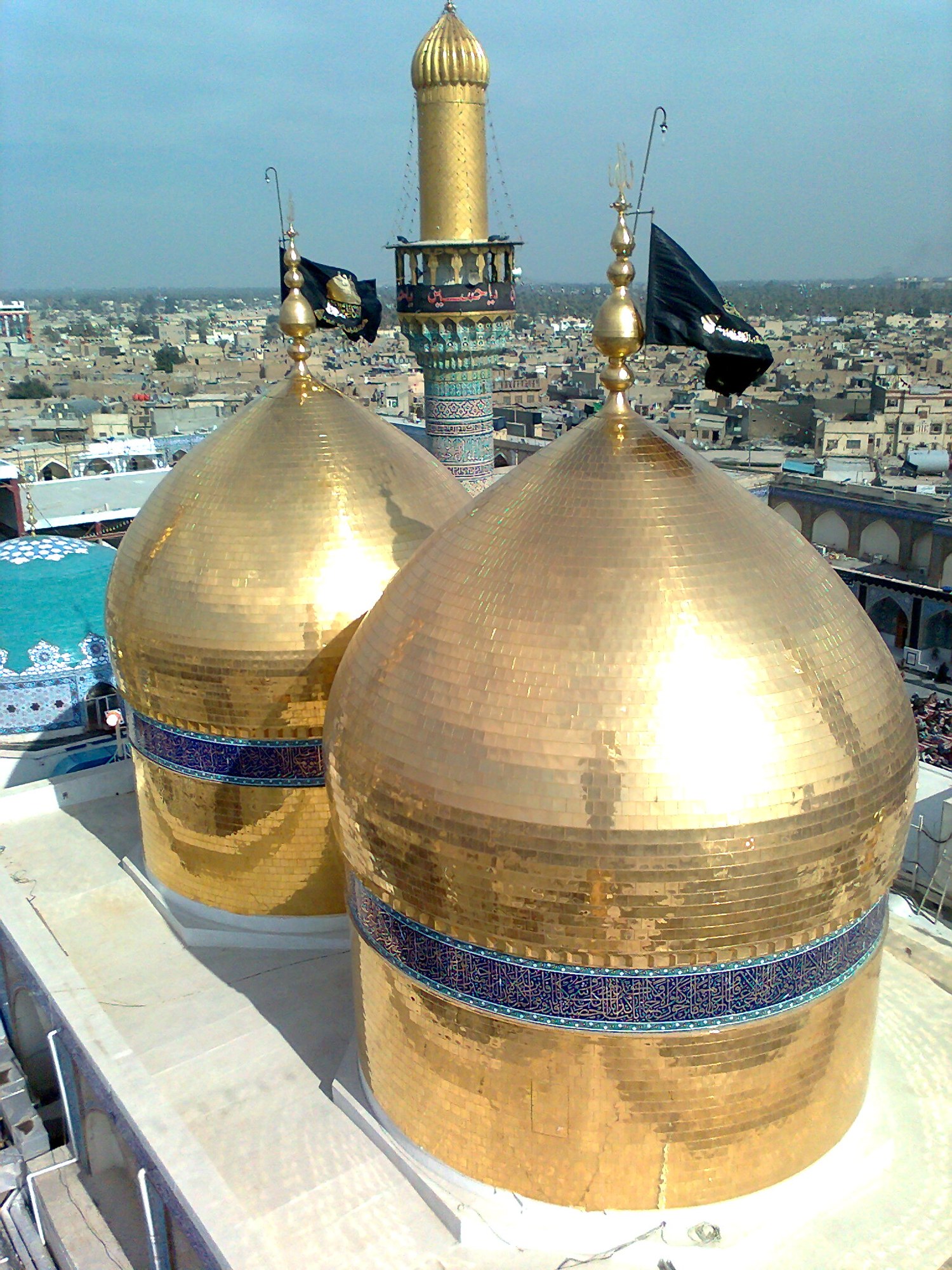
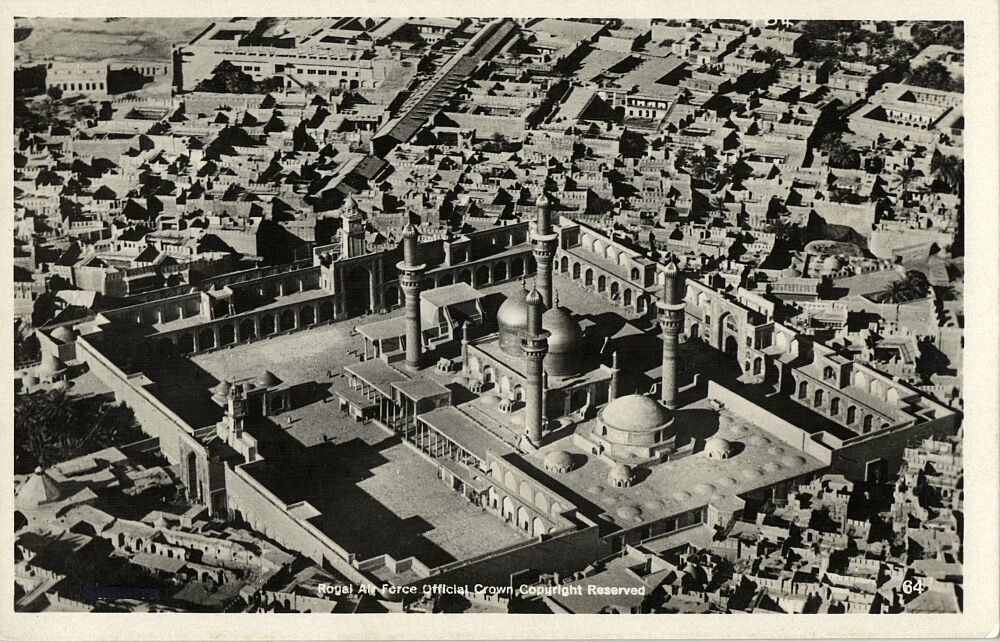
The shrine is unusual among Iraqi shrines in being a genuine double: two tombs, two domes of equal size, arranged as a single symmetrical building rather than as a main shrine with an annexe. Once you know that, the silhouette becomes legible from a long way off.
| Feature | Figure | What it measures |
|---|---|---|
| Shrine area | 14,514 m² | The shrine proper |
| Area with buildings | ~26,000 m² | The complex including its outbuildings — a different number, often quoted as if it were the same one |
| Plan | 140 m × 135 m | South–north by west–east, near-square |
| Domes | 2, equal size | Reportedly clad in 9,000 bricks of gold. Widely repeated; flagged as uncited on Wikipedia. |
| Large minarets | 4, gold | Reported as rising 35 m above the ceiling. Same caveat. |
| Corner towers | 4, ~4.5 m | Small minaret-shaped turrets, not to be counted as minarets |
| Courtyard gates | 10 named | Portico gates were deliberately raised from seven to eight to match the eight gates of paradise |
Note the two area figures. 14,514 m² is the shrine; roughly 26,000 m² is the shrine plus its buildings. Both are sourced to the same authority, and pages that quote one while describing the other are the norm rather than the exception.
The gates
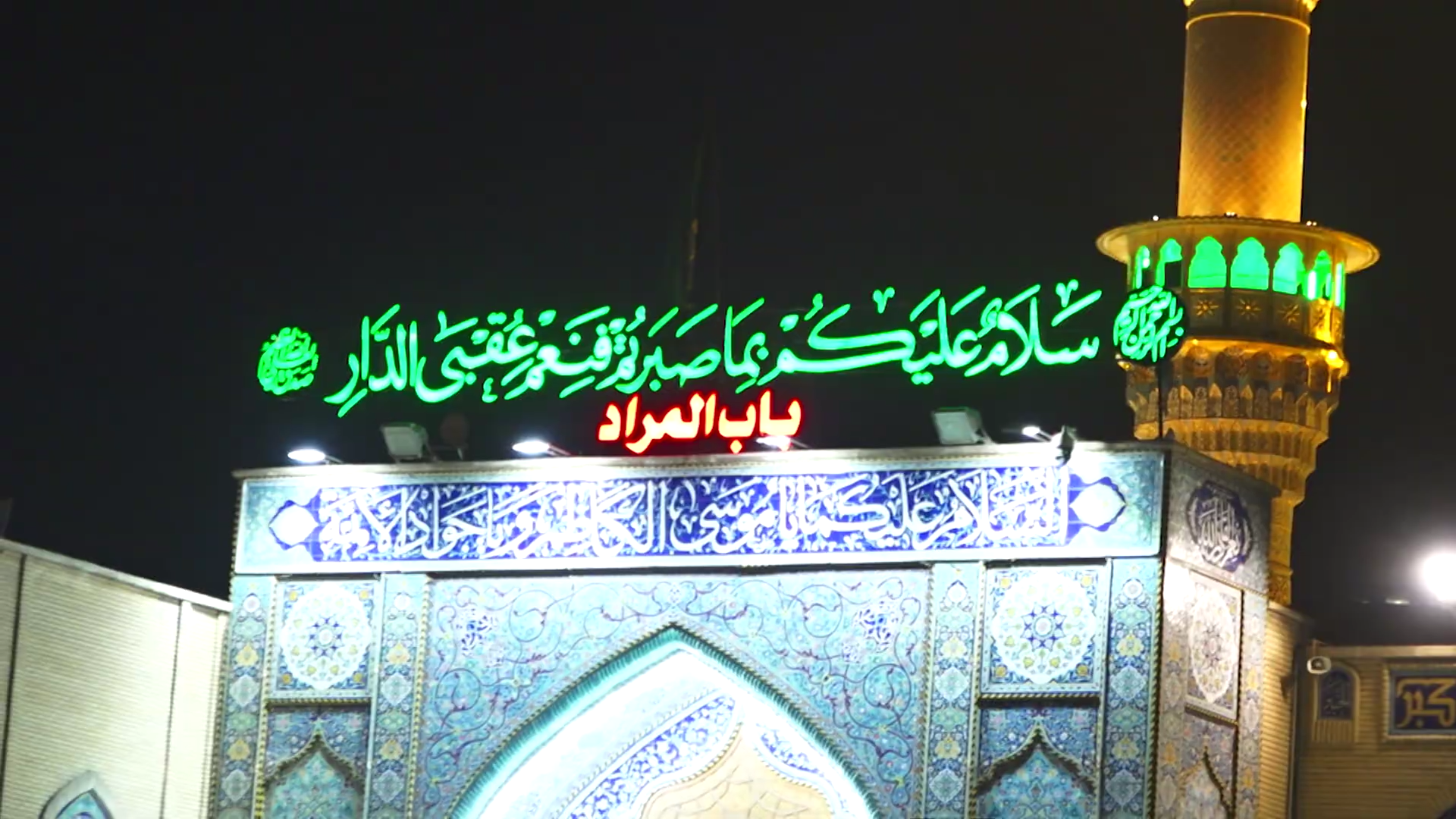
Ten gates open onto the courtyard, and their names are how locals give directions. Bab al-Murad, the Gate of the Wish, is on the east wall and is the one the gold souk grew up against. Bab al-Qibla is on the south and opens onto the oldest market in the district. Bab al-Farhadiyya takes the north-east corner of the east wall; Bab al-Raja, Bab al-Rahma and Bab al-Maghfira were added in the 1940s and 1950s; Bab Safi holds the south-west corner; Bab Sahib al-Zaman the west; Bab al-Jawhariyya and Bab Quraysh the north. A further main gate, Bab al-Dirwaza, gives its name to a whole quarter outside; the word is Persian, darwāza, the open door.
Inside, four porticos — east, west, south and north — wrap the roofed chamber that holds the tomb screens. Three of them open through roofed porches built between 1864 and 1914.
Who is buried here
The two imams are Musa al-Kadhim, the seventh Imam, who died in 799 CE (183 AH) after imprisonment in Baghdad under Harun al-Rashid, and his grandson Muhammad al-Jawad, the ninth Imam, who died in 220 AH — rendered as either 834 or 835 CE depending on how the conversion is done. Musa al-Kadhim’s honorific, Bab al-Hawa’ij, “the Gate of Needs”, is why people come here to ask for things, and why the eastern gate is called the Gate of the Wish.
They are not alone. The eastern portico holds al-Shaykh al-Mufid, one of the most consequential Shia theologians of the Buyid period, and Ibn Qulawayh, author of the Kamil al-Ziyarat. The western portico holds Nasir al-Din al-Tusi, the thirteenth-century polymath, which is why it is also called the Portico of Khwaja Nasir. Also buried in the complex are the Buyid ruler Mu’izz al-Dawla, the Abbasid caliph al-Amin, and Zubaydah bint Ja’far, Harun al-Rashid’s wife and the funder of the pilgrim road across Arabia that still carries her name. Immediately adjacent are the smaller shrines of the brothers al-Sharif al-Radi — who compiled the Nahj al-Balagha — and al-Sharif al-Murtada.
For a site with no admission desk, that is an extraordinary concentration of the intellectual history of Islam in a space the size of two football pitches. If you are building a route around Iraq’s Shia sites, our ziyarat itinerary sets Kadhimiya alongside Najaf, Karbala and Samarra.
How the shrine got here
Kadhimiya starts as a graveyard. When al-Mansur laid out the Round City of Baghdad in 762 CE, he set aside a cemetery for the Quraysh outside it — Maqabir Quraysh, on ground that had earlier been called Shunizi and had already taken the dead of the battle of Nahrawan in 658. Musa al-Kadhim was buried there in 799. Everything else grew around that fact.
| Date | Event |
|---|---|
| 762 CE | Quraysh cemetery established outside al-Mansur’s Round City |
| 799 CE | Musa al-Kadhim dies in Baghdad and is buried in the cemetery |
| 834–835 CE | Muhammad al-Jawad buried beside his grandfather |
| 1502–1524 | Shah Ismail I demolishes the existing structure and builds the present plan: portico, courtyard, two domes, two minarets |
| after 1534 | Ottoman Suleiman the Magnificent ornaments the complex; a Safavid-begun minaret is finished in 1570 |
| 1611 | An Ottoman firman grants custodianship to the family later known as al-Jamali |
| 1720–1865 | The al-Chalabi family administers the town of Kadhimiya |
| 1920 | The mosque hosts anti-British national gatherings during the Iraqi Revolt |
| 2004–2008 | Post-2003 reconstruction: new tomb screen, new gates, two new courtyards, re-gilding of both domes |
The 1920 detail is worth pausing on. During the Iraqi Revolt, the mosque hosted mixed gatherings that combined Mawlid celebrations with Husayni mourning assemblies — Sunni and Shia in the same room against the British — and contemporaries recorded it as a moment of deliberate unification. It is not the story the district’s twentieth-century reputation would lead you to expect.
The expansion, and the cost of it
The reconstruction programme since 2003 has been substantial: a new tomb screen, rebuilt gates, two entirely new courtyards, structural repairs completed before the end of 2007, a cooling system from late 2008, and water filtration units installed in November 2008. The al-Jawad dome was re-gilded and unveiled in March 2004; work on the al-Kadhim dome began in August 2008.
It has a counterweight, and we think it belongs in any honest account. A 2022 Chatham House study of heritage predation in Iraq found that shrine expansion programmes of this kind have been criticised for demolishing more than 130 archaeological sites, Ottoman landmarks and traditional houses, and for rebuilding in modern rather than historically accurate materials. The gold you photograph from the outside was paid for partly in fabric that is gone. That is not a reason not to visit; it is a reason not to describe the complex as untouched.
The 25 Rajab pilgrimage
Once a year Kadhimiya stops being a district and becomes a destination for a substantial fraction of a country.
The commemoration marks the martyrdom of Musa al-Kadhim on 25 Rajab. In 2026 that fell on Thursday 15 January. Note the discrepancy that trips up nearly everyone writing about it: calculated calendars gave 14 January, but the observed and officially marked Iraqi date was the 15th, and it was on the 15th that authorities suspended official working hours in Baghdad and Karbala. If you are planning around a Hijri date in Iraq, the observed date is the one that governs what is open.
The shrine administration put attendance at approximately 14 million for the 2025 commemoration. Where that ranks is contested and we will not pick a side: Shafaq News calls it the third-largest Shia gathering after Ashura and Arbaeen; Shia Waves calls the Kadhimayn procession the second-largest after Arbaeen. The difference is what is being counted — a gathering or a mourning procession. For scale, Ashura and Arbaeen are put at 20–25 million.
People walk. Not a token distance — commonly 5 to 20 km or more, setting off from Karrada, Palestine Street, Mansour and elsewhere across the city, and roads and bridges towards Kadhimiya close to vehicles to free the routes for pedestrians. Along them stand the mawakib, volunteer service stations giving away qeema with rice, hareesa, grilled meat, sandwiches, cardamom tea, coffee, juice and cold water, plus seating, foot massage and sometimes somewhere to sleep. All free, all donated. If you have read about the Arbaeen walk to Karbala, this is the same institution at a different scale.
The Hijri calendar drifts about eleven days earlier each year, so this walk currently happens in January, when Baghdad nights are genuinely cold and a warm jacket is not optional. Within a decade it will have moved out of winter altogether. Our guide to the best time of year to visit Iraq explains how the drifting religious calendar interacts with the fixed brutality of the Iraqi summer.
If you are in Baghdad on the day, expect the district to be effectively closed to vehicles, security to be surged, and the shrine itself to be beyond crowded. It is an extraordinary thing to witness and a terrible day to try to do a quiet architectural visit.
Al-Aimmah Bridge
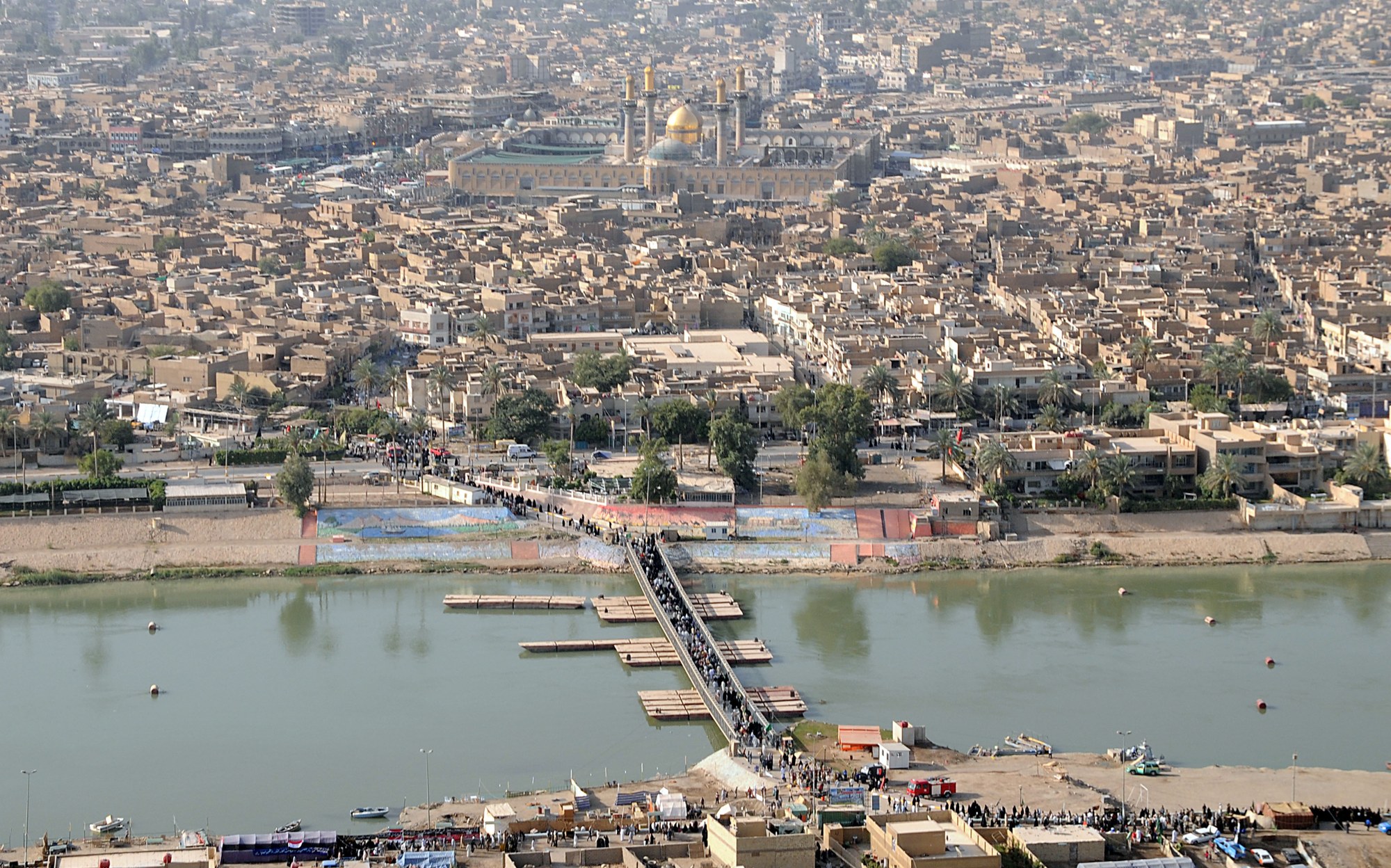
The bridge that links Kadhimiya to Adhamiya is called Al-Aimmah, the Bridge of the Imams, and it carries a history that every English-language page about this district ends in 2008. It did not end in 2008.
On 31 August 2005, a crowd of Shia pilgrims walking to the shrine panicked on the bridge. Railings gave way. Hundreds fell into the Tigris. CNN’s figure, reported on 1 September 2005, is 965 dead; contemporaneous reports ranged from roughly 700 to a thousand, and the BBC’s same-day headline read “Iraq stampede deaths near 1,000”. The bridge had been closed for the three months before that day and had been reopened specifically for the pilgrimage — a detail almost nobody includes, and one that explains a great deal about how the crowd came to be where it was.
The rescue came from the other bank. Residents of Adhamiya — the Sunni district, at a point in the war when the two communities were being pulled apart as hard as anyone could manage it — went into the river and pulled people out, using their own mattresses as stretchers. Othman Ali Abdul-Hafez, a young man from the Adhamiya side, drowned rescuing pilgrims. The BBC reported his story on 5 September 2005. Two decades on, he is the part of this that people in both districts still talk about.
The bridge reopened on Tuesday 11 November 2008, after three years closed, with Shia and Sunni clerics walking across it together. Contemporary reports describe it as reopening to pedestrians. (You will see 12 November in some accounts; that is the reporting date, not the opening date.)
And then, on Monday 17 February 2025, it reopened again. Iraq’s General Traffic Directorate announced the opening of Al-Aimmah Bridge “after completion of resurfacing and rehabilitation works”, under directives from the prime minister, supervised by the interior minister and the traffic director — part of a congestion-clearing programme, and one of five Baghdad bridges rehabilitated under a Central Bank of Iraq initiative alongside Bab al-Mu’adham, al-Ahrar, al-Shuhada and al-Sinak. The government statement said the bridge “will contribute directly to flow to and from the holy city of Kadhimiya”.
The bridge is open in 2026 and is mapped as a drivable road. What we cannot tell you is whether you can currently walk across it: the 2008 reopening was framed in pedestrian terms, the 2025 one entirely in traffic terms, and nothing we found settles it. Ask locally rather than turning up on foot and hoping.
Security: the history, and what it means now
The reason the searches are what they are is not abstract. Between 2004 and 2016 the shrine and its approaches were attacked repeatedly.
| Date | Incident |
|---|---|
| 2 March 2004 | Coordinated attacks during Ashura at Kadhimiya, at least 75 killed |
| 2007 | Car bombs in June (7 killed, then 14 killed) near the shrine |
| 28 December 2008 | Car bomb about 90 m from Bab al-Dirwaza, 24 killed |
| 7 January 2009 | Suicide bombing as crowds gathered for Ashura, 38 killed |
| 24 April 2009 | Two suicide bombers at Friday prayers, 66 killed and 125 wounded |
| 7 May 2016 | Triple car bomb during the al-Kadhim commemoration, at least 18 killed, claimed by ISIS |
| May 2021 | Grenade attack, 10 injured — the reason usually given for the current camera ban |
That list is history, and it should be read as history. The last mass-casualty attack on the shrine that we can source is 2016. Nearly every page that recites this chronology stops without saying so, which leaves the reader holding a risk picture from 2009.
The current picture is different in shape. The FCDO advises against all but essential travel to Baghdad province except Sadr City, which is a separate and harder rating; Kadhimiya sits in Baghdad province and is nowhere near Sadr City, which is on the Rusafa side. That advice was last updated on 22 July 2026 and was still current when we checked on 15 August 2026. Travelling against FCDO advice invalidates most travel insurance, which is the single most practical consequence of the rating and the one most pages bury — see our guide to travel insurance for Iraq for what that actually means when you try to buy a policy. The US State Department has Iraq at Level 4, Do Not Travel, reissued 2 March 2026 with an ordered departure of non-emergency government staff.
Layered on top is a regional escalation that began on 8 July 2026, with strikes and retaliatory attacks by Iran in locations across the region including Iraq, directed at US military and civilian infrastructure. Baghdad itself saw a bad March in 2026, including a drone strike on a hotel roof inside the Green Zone on 16 March. All of this moves fast, and anything we write in August will be weeks stale by the time you read it. Check the current advisory before you commit, and read our standing analysis of whether Baghdad is safe to visit and the wider Iraq travel advisory picture alongside it, not instead of it.
The district beyond the shrine
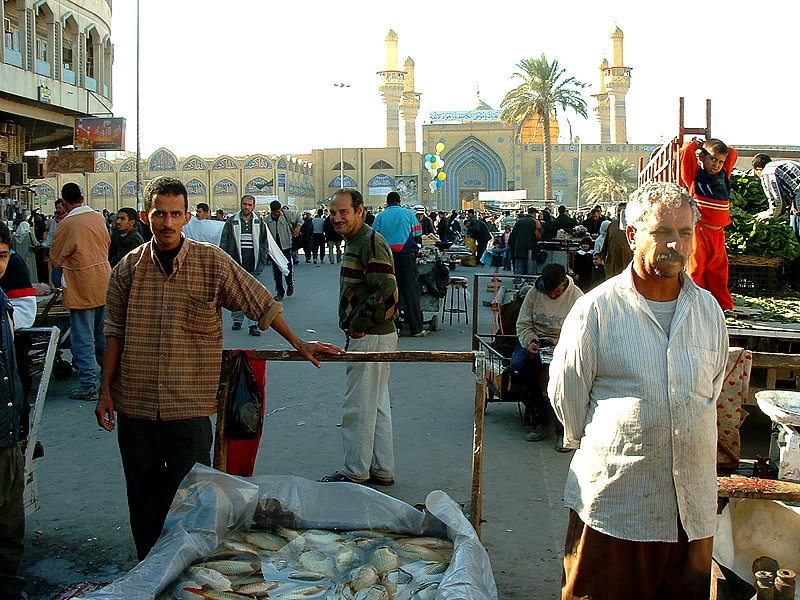
Almost everything in this section exists in Arabic sources and essentially nowhere in English. It is the reason to give Kadhimiya an afternoon rather than an hour.
Souq al-Istarbadi
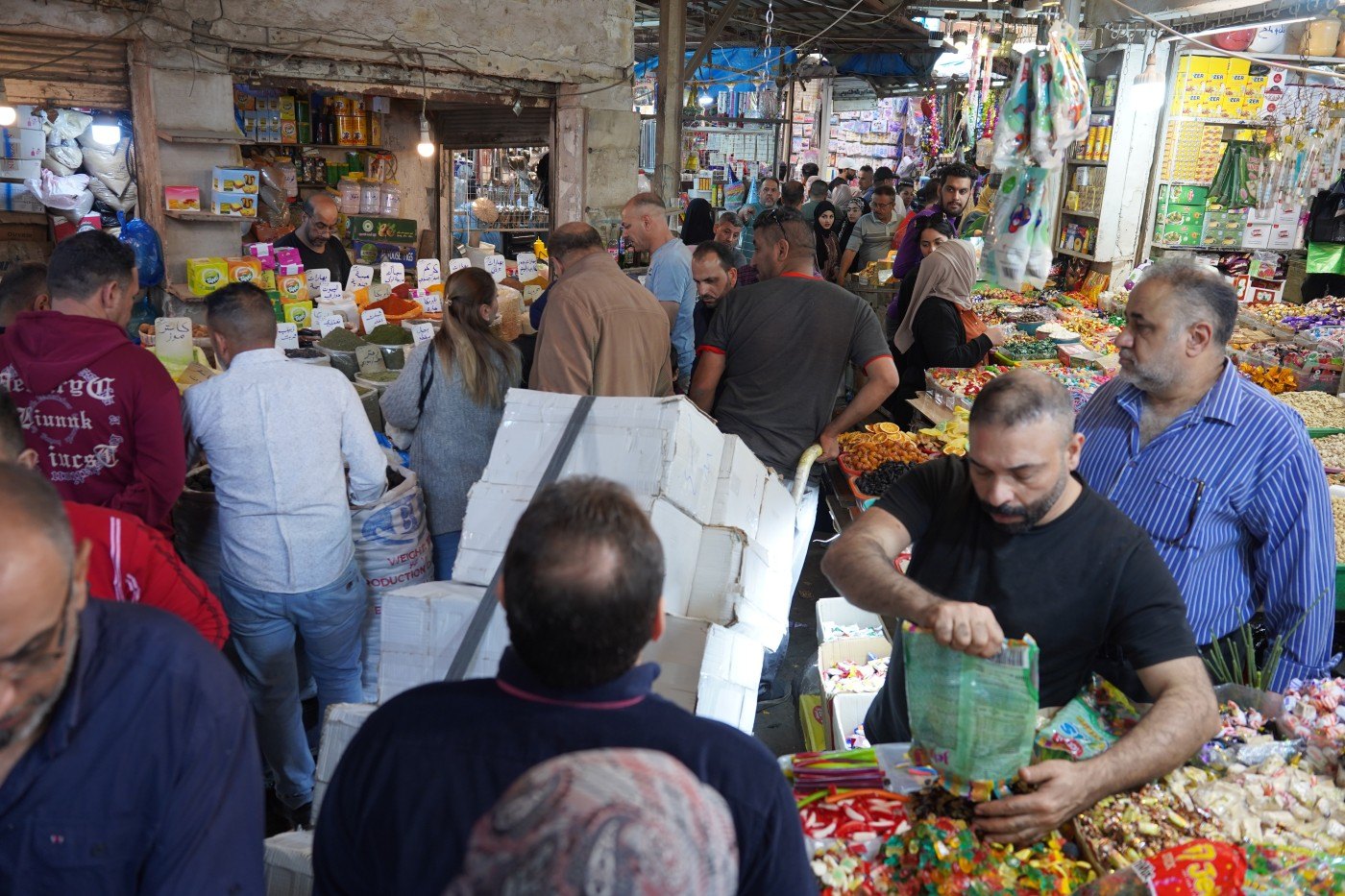
Souq al-Istarbadi is the oldest market in Kadhimiya, built in 1912, roughly 350 metres long, and it opens directly onto Bab al-Qibla — the shrine’s southern gate — running out to the main street. Its trade is specific: around 85% of its shops sell men’s dishdashas, made in the souk itself and wholesaled across Iraq. It also sells men’s abayas, women’s accessories, and rosaries. Its roofs are largely wooden and the structure is deteriorating from damp; Iraqi press coverage describes it as a dilapidated historic witness rather than a restored attraction.
We mention that because you will find English pages claiming Kadhimiya’s souk sells prayer stones and traditional sweets. We could not source either. The documented trade is clothing and rosaries.
The gold souk at Bab al-Murad
The gold market sits on the east side, against Bab al-Murad, and its origin is one of the better stories in Baghdad. The shops were built onto the frontage of the manthar — the mausoleum-endowment — of Iqbal al-Dawla al-Nawab, grandson of the founder of the state of Awadh in India, whom the British exiled to Kadhimiya after he fought them. His line died out. His retainers, unable to touch the endowment itself because it was waqf, monetised its street frontage by building the gold shops that are still there. An Indian princely dynasty’s exile is, in a fairly direct sense, why there is a gold souk on that wall.
If you buy: gold in Iraq is priced per mithqal, and in Iraqi trade a mithqal is 5 grams, not the classical 4.25 g. As a reference point, 21-carat Gulf gold was selling at around 866,000 IQD per mithqal on Baghdad’s al-Nahr Street on 1 August 2026, with Iraqi-made 21-carat trading about 3.5% cheaper. Rates move; the point is the unit, because getting the unit wrong makes a price look wrong by 15%.
The old quarters
Kadhimiya’s mahallat, its named quarters, are still how the place is described locally. Mahallat al-Shuyukh, the largest, sits west and south-west of the courtyard and contains Souq al-Istarbadi, Sharif al-Radi Street and the run down to Bab al-Dirwaza; it is named for the shaykhs of the Tayy tribe. Mahallat al-Tall abuts the courtyard on the west and north-west and is named for a spoil mound that was quarried for brick and then used to plug the Nazim Pasha flood dyke when it burst in the early 1930s; its sub-quarter al-Dabbagh-khana was a tannery on the riverbank.
Others carry their etymologies openly: Umm al-Numi after an orchard of sweet limes, al-Hibna after the bend of the Tigris, al-Souq al-Jadid on the site of the palace of Isa, al-Mansur’s uncle, and al-Dawriyyin, Abbasid-era Qatufta, Aramaic for “the picking” — which contains the conical-minaret tomb of Zumurrud Khatun, wife of the caliph al-Mustadi’. There is also Bayt al-Istarbadi, a surviving heritage house divided into family quarters and a diwakhana guest house, where King Mohammed Zahir Shah of Afghanistan stayed in 1950 when he came to visit the shrine.
Two other mosques in the district are worth knowing about: the Buratha Mosque, where tradition holds that Imam Ali prayed on his way back from Nahrawan, and the Safavid congregational mosque built by Shah Ismail on the shrine’s north side.
None of these have opening hours, signage in English or visitor facilities. They are a neighbourhood, not a heritage trail. If walking historic Baghdad is what you are after, the old city on the Rusafa bank is the more legible version, and al-Mutanabbi Street is where you will find the book market on a Friday.
Kadhimiya and Adhamiya
Shia Kadhimiya on the west bank faces Sunni Adhamiya on the east, and the shrine of the seventh and ninth Imams faces the tomb of Abu Hanifa, founder of the Sunni legal school that bears his name, across about a kilometre of river. Al-Monitor once framed the pair as “symbols of Iraqi sectarianism”, and during the civil war years that framing was earned.
It is not the whole story, and the Arabic sources are better on this than the English ones. The Tayy shaykhs who gave Mahallat al-Shuyukh its name split between the two banks, and the corresponding Adhamiya quarter carries the same name after their brothers. Young men from Kadhimiya have historically crossed the bridge to celebrate the Mawlid in Adhamiya. And in 2005 it was Adhamiya that went into the water.
You can see both in a morning if the bridge is passable for you, and the contrast between them — two neighbourhoods that look almost identical and are constantly described as opposites — tells you more about how Iraqi society actually works than any museum will.
Money, heat and the rhythm of the day
Kadhimiya is cash. The souks are cash, the mawakib are free, and the electronic-payment push that Iraqi authorities have been running since 2026 could not be traced into any Baghdad market. On 15 August 2026 the street rate in Baghdad was about 1,535 IQD to the dollar, against an official peg of 1,320; which rate a quoted price uses matters, so ask. ATMs are rare. Bring cash and small notes. Our breakdown of what a trip to Iraq costs goes into the exchange-rate mechanics in more detail.
Heat governs the timetable for most of the year. Baghdad’s July mean maximum is 44 °C, and on the day we compiled these notes — 15 August 2026 — four Iraqi governorates were sitting at 50 °C. Iraqi cities go nocturnal in summer for a reason. Markets thin out in the afternoon and refill after dark. The winter pilgrimage, by contrast, happens on cold nights.
Budget one to two hours for the complex on an ordinary day: more if the searches are slow, considerably more during any commemoration. And if you are relying on data, note that Iraq shuts off the national internet for one to three hours on school exam mornings in May and June — see our notes on getting a working SIM card in Iraq.
Getting into the country at all
One point that catches people planning a shrine trip. Visa on arrival in federal Iraq was suspended on 1 March 2025 and an e-visa is now mandatory for the affected nationalities. The FCDO states the cost as US$160, valid for 60 days. The Kurdistan Region runs a separate regime with visa on arrival still available, and a Kurdistan visa is not valid in federal Iraq — travellers have been refused when trying to head south on one. If you are visiting Baghdad, sort the federal visa first. See our guides to Iraqi visas and the e-visa application process, and to entry requirements at the border.
What we could not confirm
This is a long list, and we think publishing it is more useful than filling the gaps with plausible-sounding numbers. Every item below appears somewhere online stated as fact. None of it could be sourced.
| Claim you will see | What we found |
|---|---|
| Opening hours (“open 24 hours”, “8am–10pm”) | No published hours exist anywhere. All four official shrine domains returned empty on 15 August 2026. |
| An entry fee | No fee is charged and no ticketing exists at Iraqi Shia shrines — but no source states this for Kadhimiya specifically. |
| “Non-Muslims are welcome” | No shrine statement, no consular note. Best evidence is a 2021 first-hand account of getting in. |
| A guide or escort is required | No source either way. |
| Abayas are lent free at the women’s entrance | Common practice at Iraqi shrines generally; no source confirms it here. |
| Phones go into a numbered deposit counter | Reviewers confirm phones are taken. Nobody describes the mechanism. |
| “Three checkpoints” | Could not be verified on any page we fetched. Layered security is certain; the count is not. |
| You can walk across Al-Aimmah Bridge | Bridge open since February 2025, framed as vehicular. Pedestrian access unresolved. |
| Any taxi fare figure | The circulating number traces back to our own site. No independent source found. |
Two more. Photography is allowed — we found this on a page-one tour-operator listing and it contradicts two dated first-hand accounts; assume cameras will not get through. And Kadhimiya’s souk sells prayer stones and traditional sweets — we could find no source for either trade here.
We also cannot confirm the current operating status of Bab al-Fatimah, the women’s entrance whose construction began in late 2008, and we found no dated 2024–2026 municipal works programme specific to Kadhimiya. The only hard recent infrastructure item is the bridge.
Kadhimiya FAQ
Is Kadhimiya safe to visit?
It sits inside Baghdad province, which the FCDO rates “against all but essential travel” as of 22 July 2026, and the US State Department rates the whole country Level 4. The last mass-casualty attack on the shrine that we can source was in 2016. Those two statements are both true and you have to hold them together; the rating reflects country and regional conditions, not a specific current threat to the district.
Can I take photos at the Kadhimiya shrine?
Not inside. Cameras are not permitted through the security checkpoints and phones are taken from you at a point within the complex. Exterior and street photography around the district is generally tolerated, but ask before photographing people, and never photograph mourners.
What are the opening hours of the Kadhimiya shrine?
Nobody publishes any. We checked every official domain associated with the shrine and all four returned empty. Any specific hours you see online are invented. In practice access swings around prayer times and commemorations; early morning is reportedly quieter and evening busier.
Is there an entrance fee?
No. Iraqi Shia shrines do not charge admission or operate ticketing. There is no source stating this for Kadhimiya specifically, but no visitor account has ever described paying.
How far is Kadhimiya from central Baghdad?
About 5 km as the crow flies, which is the figure most encyclopedias quote, but roughly 17 km by road from Tahrir Square and about 28 km from the airport. Free-flow driving times are around 18 and 24 minutes respectively; real times with traffic and checkpoints are materially longer.
Which imams are buried at Kadhimiya?
Musa al-Kadhim, the seventh Imam, who died in 799 CE, and his grandson Muhammad al-Jawad, the ninth Imam, who died in 220 AH (834–835 CE). The shrine’s dual name, Kadhimayn or Jawadayn, refers to them. Several major scholars are buried in the porticos, including al-Shaykh al-Mufid and Nasir al-Din al-Tusi.
When is the Kadhimiya pilgrimage?
On 25 Rajab, marking Musa al-Kadhim’s martyrdom. In 2026 it fell on Thursday 15 January — calculated calendars gave the 14th, but the 15th was the observed and officially marked date. It moves about eleven days earlier each Gregorian year.
What should women wear at the Kadhimiya shrine?
An abaya and headscarf, or a chador, in the haram itself, and modest loose clothing across the whole shrine area. Black is the norm rather than a requirement. Whether abayas are lent at the entrance we could not confirm, so bring your own if you can.
Can I combine Kadhimiya with other shrines?
Yes, and most pilgrims do. Karbala and Najaf are the obvious pairings, with Samarra’s al-Askari shrine a harder proposition because it sits in Salah al-Din, which the FCDO rates against all travel. Our Iraq pilgrimage guide sets out the geography.
Final thoughts
The strange thing about Kadhimiya is how much has been written about it and how little of it is any use. Four of the top ten results for its name are encyclopedias, and two more are copies of encyclopedias. They will tell you which Buyid amir paid for which portico. Not one of them will tell you that your camera is not coming in with you.
What we would say, having gone through everything findable in two languages: go with someone local, go with nothing in your pockets, and go on a normal day rather than a commemoration unless the commemoration is the point. Give it an afternoon and walk out into the Istarbadi souk afterwards, because the shrine without the district around it is only half of what makes the place coherent. And be aware, as you look at all that gold, that some of the neighbourhood it stands in was demolished to make room for it.
For the wider city, start with our Baghdad travel guide, which sets Kadhimiya alongside the other districts worth your time. If you are still deciding whether to come at all, whether Iraq is actually open to tourists is the honest starting point, and our suggested itineraries will show you how a Baghdad shrine day fits into a route through the country.
Photo credits
Taisir Mahdi (CC BY-SA 4.0); Gilgamish-ankidu (CC BY-SA 4.0); Iraqi Prime Minister’s Media Office (CC BY 3.0); Staff Sgt. Lorie Jewell, US Army (public domain); Devin Murphy (CC BY-SA 3.0); A & K Naman, Baghdad, for the Royal Air Force (public domain). All images via Wikimedia Commons.