Last updated: August 2026. The curfew position, the alcohol law and its enforcement, the Abu Nuwas corniche phase status, Baghdad’s working cinema list and the current ride-hailing apps were all re-checked in August 2026 against Iraqi press, government statements and live listings.
Search for Baghdad nightlife and the first page will offer you ranked nightclubs. One of them is placed in Kadhimiya, a few hundred metres from one of the holiest Shia shrines in Iraq. Another advertises a “premier night club” on Abu Nuwas Street. None of these venues exists. They are machine-written listings for a city where selling alcohol has been a criminal offence since the law was gazetted in March 2023, and where the last hotel bars were shut in late 2024. Evenings are the least-documented part of the city covered in our Baghdad travel guide.
Here is the real answer. Baghdad has no bars and no nightclubs, and there is no legal alcohol anywhere in the city. What it does have is one of the most committed evening cultures in the region: tea houses that fill after dark, shisha terraces, a lit riverside promenade, ten-plus working multiplex cinemas including an IMAX, an enormous public park, and a city that eats dinner at ten o’clock because the afternoon is 44 °C and nobody goes outside in it. There is also no curfew — the nightly midnight-to-five curfew was lifted on Saturday 7 February 2015 and has not returned as a standing rule.
That is a more interesting city than the fabricated one. This article covers what an evening in Baghdad actually consists of, district by district: the chaikhana and how it works, Abu Nuwas Street and the state of the corniche rebuild, Karrada after eleven, the cinemas nobody writes about, Al-Zawraa Park, live music, Ramadan nights, and the safety and legal picture you need before you walk out of the hotel. Our Baghdad travel guide covers the city as a whole; this is the after-dark half of it.
The short answer
| Question | Answer, August 2026 |
|---|---|
| Are there bars or nightclubs? | No. Federal law criminalises the import, manufacture and sale of alcohol. The hotel and social-club exceptions were closed from late 2024. |
| Is drinking itself illegal? | Article 14 targets import, manufacture and sale. Consumption is not what the statute criminalises. Buying is. |
| Is there a curfew? | No standing curfew since 7 February 2015. Area lockdowns can be imposed the same day after an incident. |
| What is actually open late? | Cafés, shisha terraces, restaurants, ice-cream shops, malls, cinemas, the corniche, Al-Zawraa Park. |
| When does the evening start? | After sunset in summer, and it runs late. Thursday and Friday are the weekend nights. |
| How do I get home? | Ride-hailing, booked in the app. Baly leads Baghdad; Careem runs 24/7 in four Iraqi cities. |
| Biggest real risk after dark? | Traffic, by a wide margin. Then checkpoints you did not plan for. |
Why the evening is the day: 44 °C and the shape of a Baghdad night
This is the fact that explains everything else, and no page on the first page of results mentions it. Baghdad’s mean July maximum is 44 °C. On 15 August 2026, four Iraqi governorates recorded 50 °C. That is not a heatwave; it is the normal summer, and it runs from roughly mid-June to well past the middle of August.
A city at 44 °C does not have an afternoon. Shops shutter, markets empty, and anyone with a choice stays indoors under whatever air conditioning the grid is supporting that hour. Life resumes when the sun goes down. What outsiders label Baghdad nightlife is really just Baghdad’s daytime, displaced by six hours because the actual daytime is unusable.
The practical consequences for a visitor are concrete. Restaurants fill around nine and ten. Families are in parks at eleven with small children, and this is normal rather than remarkable. Cafés and ice-cream shops trade past midnight. If you plan an Iraqi summer trip on European hours — dinner at seven, back at the hotel by ten — you will spend the trip on empty streets and then go to bed just as the city gets going. Our guide to the best time to visit Iraq makes the case for spring and autumn for exactly this reason, but if you are here in summer, invert your clock rather than fight it.
Power cuts push in the same direction. Iraqi households have lived with rolling outages for two decades, and a hot flat with no fan is a strong argument for being out. One Diyala restaurateur told Iraqi outlet 964media in August 2023 that he had built an outdoor terrace specifically “to beat the heat and power outages” — a small story that describes a national habit.
Is there a curfew in Baghdad?
No. Baghdad has had no standing nightly curfew since Saturday 7 February 2015. Prime Minister Haider al-Abadi announced the lifting on Thursday 5 February 2015 and it took effect that weekend, ending a curfew that had run from midnight to 05:00 for roughly a decade. NBC News reported at the time that many closed roads across the city would reopen alongside it. This is a dateable, checkable fact, and it is remarkable how many pages about Baghdad nightlife either imply a curfew still exists or simply avoid the question.
A resident quoted in that 2015 coverage said the lift was “a good chance for men to stay outside in bars. Before we had to leave bars by 11:30 p.m.” Both halves of that sentence are now historical. The curfew went in 2015; the bars went with the alcohol enforcement of late 2024.
The second piece of evidence is more recent and more useful. Iraq held parliamentary elections on 11 November 2025, and the High Security Committee for Elections explicitly ruled out a curfew and road closures in advance. Its head, Qais Al-Muhammadawi, said in late October 2025 that the committee was working to ensure “smooth movement for voters and vehicles on polling day.” That broke with precedent: in 2021 the authorities closed airports and border crossings, suspended inter-governorate travel, banned vehicles and declared the day a holiday. In 2018 there was an inter-governorate travel ban from midnight Friday. In 2025, none of it.
What can still shut your evening down
None of this means movement is guaranteed. Iraq retains the power to impose a curfew at a few hours’ notice — it used a nationwide one for the November 2024 census — and, more relevantly for a visitor, the response to any security incident is an immediate hard closure of the streets around it. On 16 March 2026, after a drone struck the roof of the Al Rasheed hotel inside the Green Zone, Al Jazeera’s Baghdad correspondent reported that security forces “blocked all roads to the Green Zone with armoured vehicles and barricades.” That is an area lockdown, not a city curfew, and the distinction matters: the rest of Baghdad kept moving.
The honest framing is that there is no curfew, but there is no guarantee either. Ask your hotel in the evening rather than assuming what was true yesterday is true tonight, and read our Iraq travel advisory explainer for how the security picture is currently rated.
Alcohol in Baghdad, stated precisely
This is where most competitor pages on Baghdad nightlife go wrong, in both directions. Some still describe hotel bars and “licensed spots in Karrada and Jadriya.” Others flatly assert “Iraq banned alcohol in 2023,” which compresses a decade of legislative history into one misleading clause.
The actual sequence: Iraq’s parliament passed the Municipal Revenues Law in October 2016. Article 14 of that law bans the import, manufacture and sale of all alcoholic beverages, with fines of 10 to 25 million Iraqi dinars — roughly US$6,500 to US$16,300 at the August 2026 street rate of about 1,535 IQD to the dollar. The law then lay dormant for over six years and was not published in the official gazette until March 2023, which is where the “2023 ban” shorthand comes from. Reasons given for the delay include the war against ISIS and a reluctance to be seen mirroring ISIS practices.
| Element | Position as of August 2026 |
|---|---|
| Legal instrument | Article 14, Municipal Revenues Law, passed October 2016, gazetted March 2023. |
| What is criminalised | Import, manufacture and sale. Not personal consumption. |
| Penalty | Fines of 10–25 million IQD. |
| Hotel bars and social clubs | Closed. The Interior Ministry moved to halt sales inside registered clubs in late 2024. |
| Outlets closed | An estimated 20–30 since enforcement began, concentrated in Baghdad. |
| Where it is still legal | The Kurdistan Region, and Baghdad International Airport’s duty-free zone. |
| Legal challenges | Filed by Christian and Yazidi lawmakers under Article 22 of the constitution. No favourable outcome reported as of January 2026. |
The 2024 change is the one that matters and the one page one has missed. Shafaq News, reviewing enforcement in January 2026, reported that large social clubs and several tourist facilities including hotels initially kept serving despite the ban, and that “this changed in late 2024, when the Interior Ministry moved to halt sales inside registered clubs and launched campaigns targeting shop owners.” So the standard advice you will still read — that you can drink at a hotel or at one of Baghdad’s long-running private social clubs — is out of date. That door closed.
Two further points a traveller should hold. First, the people hit hardest are minorities: alcohol production and retail in Iraq has long been a Christian and Yazidi trade, and reporting through 2024 and 2025 counted dozens of closed businesses and estimated 150,000 to 200,000 workers affected across alcohol-linked sectors. Second, a black market and cross-border smuggling from the Kurdistan Region followed, and prices inside Iraq roughly doubled. We state the legal position; we are not going to tell you where to find illegal drink, and getting caught buying it is a straightforwardly bad idea in a country whose laws for visitors are covered in our guide to Iraqi laws tourists should know.
The planning implication is simple: if alcohol matters to your trip, that is a reason to spend time in Iraqi Kurdistan, where it remains legal, and to stop expecting it in Baghdad.
The chaikhana: the heart of Baghdad nightlife
Baghdad cafés are the load-bearing institution of the city’s nightlife, and it is nothing like a European café. A chaikhana is a room with long benches, a tiled or concrete floor, photographs on the walls, a lot of noise, and a very short menu. You do not go for the drink. You go to sit for two hours.
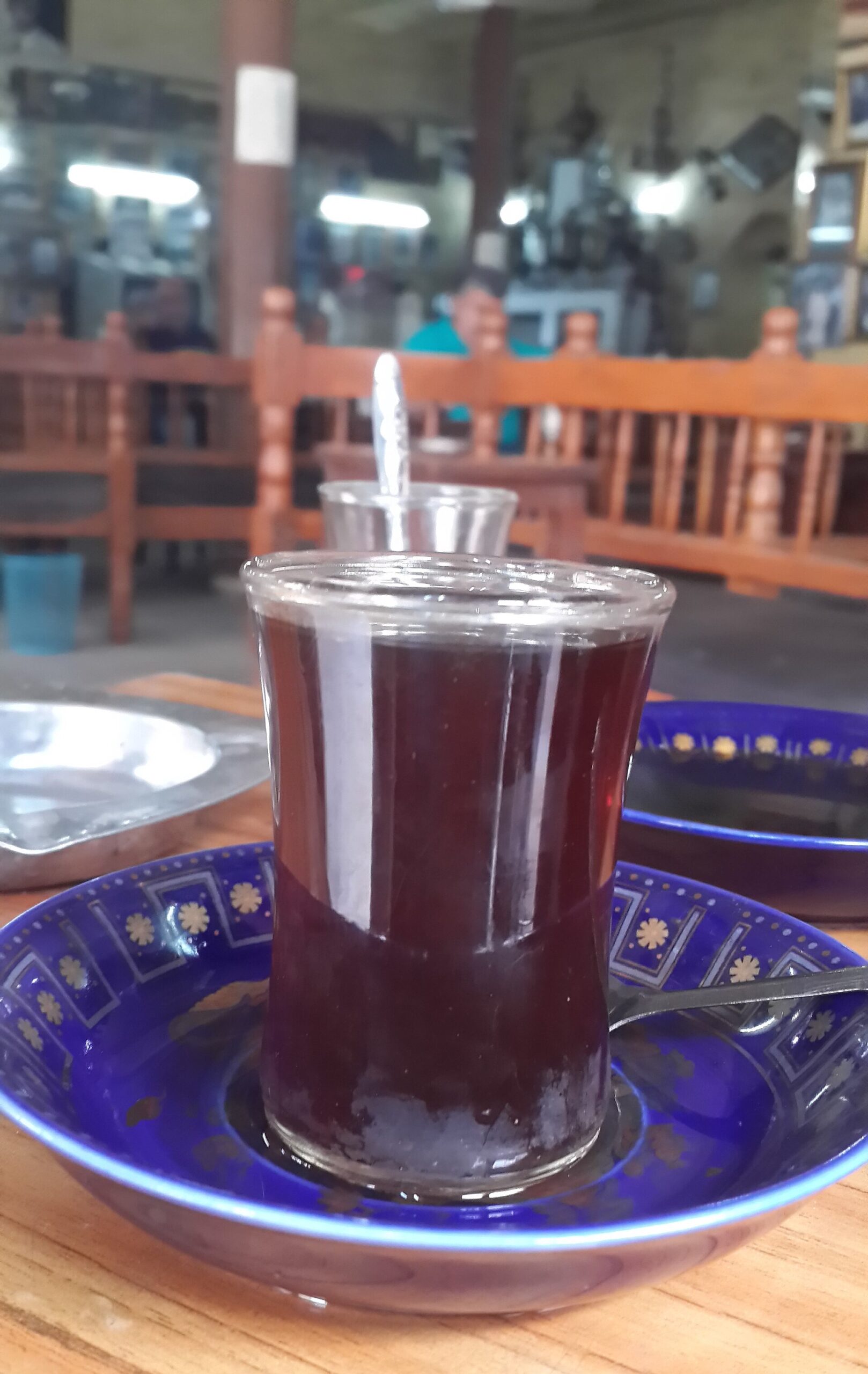
The Shabandar, and why it is the one café worth the trip
At the end of Mutanabbi Street, near the Qushla, stands the Shabandar Café — known also as the Martyrs’ Café. It is the only Baghdad café we can point to with a dated, on-the-ground journalistic account: a reporter for The World visited and filed in December 2025.
The building dates to 1907 and was originally the al-Shabandar printing press. The Shabandar family imported the steel from Belgium and commissioned masons to build the high ceilings that keep the room cool in summer; ventilation shafts are set into the inner walls, which is why it does not fill with smoke when people are using the hookahs. The al-Khashali family took the café over in 1963.
In 2007, al-Qaeda drove a car bomb to the café. It killed at least 30 people and wounded more than 100. Among the dead were four sons and a nephew of the owner, Mohammed al-Khashali. He and his one surviving son, Omar, repaired the room and reopened it. Mohammed had large photographs of the dead printed and hung on the wall, and renamed the place the Martyrs’ Café. His line, quoted repeatedly since, was “I forgive, but I do not forget.” A journalist who was first on the scene in 2007 put it another way: “Al-Qaeda is gone, and we remain.”
Mohammed al-Khashali died on Saturday 11 January 2025, aged 93. Thousands attended the funeral and the prime minister called him “a unique Iraqi figure.” The café is open and trading under Omar al-Khashali, who was photographed in it by The World’s reporter in late 2025. That is as current a confirmation as exists for any café in the city.
The details that make it worth an hour: the menu is three things — Arabic coffee, black tea, and a sour tea made by simmering dried black limes, noomi Basra, for hours. Tea comes in the hourglass-shaped istikan on a saucer, carried on circular trays. The benches are covered in a red kilim design. The walls carry black-and-white photographs of royal visits, writers, and men who sang maqam. Hookah is fine. Backgammon is banned, because Omar says it is too noisy and he would rather people talked to each other. That single house rule tells you more about Baghdadi café culture than any list of venues.
Regulars remember that certain writers had a specific bench and would shoo anyone else off it, and that younger men would not sit in the room at all if their father or elder brothers were present. Some regulars still wear the triangular felt hats of Baghdad’s effendiyya, the twentieth-century urban class of teachers and students. The Shabandar sits at the natural end of a daytime walk through old Baghdad, and it is where a visit to Mutanabbi Street should finish.
Dominoes, shisha and the rest of the room
The game in a Baghdadi café is dominoes, not backgammon — a small distinction that matters if you are trying to describe the place accurately. Pool halls are the other young-male evening venue. ArrivalGuides, updating its Baghdad entry in June 2025, described young residents “frequenting outdoor cafés and pool halls, enjoying chai tea and playing dominoes well into the night,” and noted that nights out are typically alcohol-free, with tea and sunflower seeds — bzuurat — the standard accompaniment.
Shisha is unremarkable and legal, and in Baghdad it usually happens on an outdoor terrace. Note that indoor smoking bans are being enforced patchily and by governorate rather than nationally: Karbala began enforcing an indoor ban with fines in March 2025. No Baghdad-specific shisha restriction was found, but this is the kind of rule that changes without announcement.
Two rooms exist side by side. The heritage cafés are, in practice, all-male: every regular quoted and photographed at the Shabandar in December 2025 was a man. The modern café scene is mixed, and women are visibly present in Baghdad’s cultural spaces — a woman musician was among the participants at a maqam workshop on Mutanabbi Street in November 2025, and study cafés and independent coffee shops elsewhere in Iraq have been founded and run by women. A claim you will find in older Western reporting, that cafés are where Iraqi women can go out alone and mix freely, traces to writing from the 2010s and should not be treated as a current description. Solo women travellers will find our notes on solo female travel in Iraq more useful than any generalisation here.
Opening hours, and why we will not print any
No Baghdad café publishes hours — and we mean none of them. We searched for them and found none — not for the Shabandar, not for any of the Rasheed Street coffeehouses, not for anything. Every “open until 1 a.m.” figure circulating online traces back to an unattributed travel listicle.
What we can say from consistent, if soft, reporting: Baghdad cafés, shisha places and ice-cream shops are described as trading past midnight, later at the weekend, and later still in summer. Iraq’s weekend is Friday and Saturday, so Thursday and Friday nights are the busy ones. Beyond that, there is no timetable, and inventing one would be doing exactly what the pages we are correcting have done.
Abu Nuwas Street and the Tigris corniche
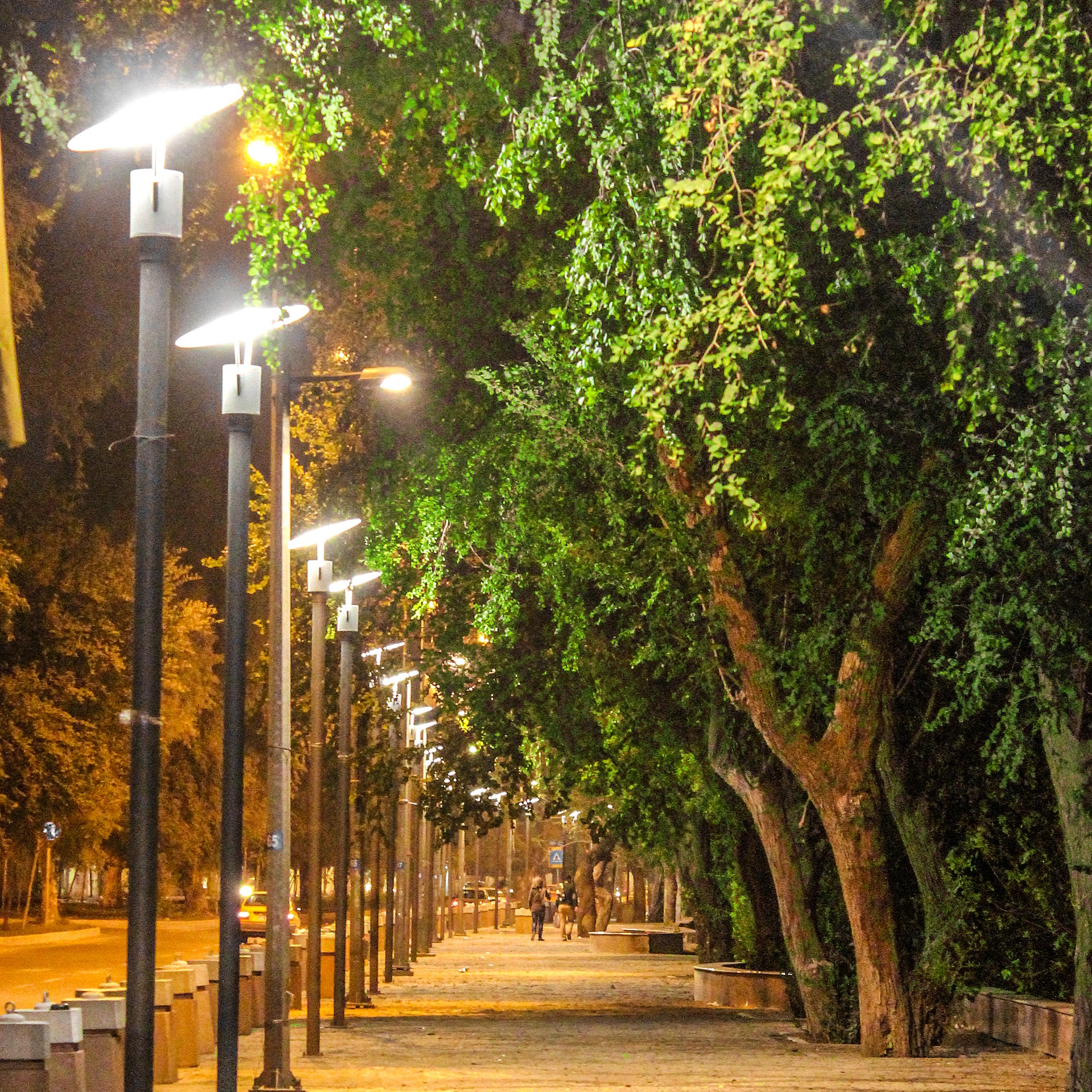
Abu Nuwas Street runs along the Rusafa bank of the Tigris, named for the eighth-and-ninth-century Abbasid poet. It is the closest thing Baghdad has to a designated evening destination: a riverside road with a parallel promenade, gardens, benches, statues and a row of masgouf grills. It is also a construction project that has been running, on and off, since 2011.
The phase status, with the conflict left in
Phases 1 and 2 of the corniche redevelopment are complete. Phase 3 is not open. Baghdad Municipality spokesperson Uday al-Jandil told Iraqi News on 5 May 2026 that “while the first two phases of the Abu Nuwas Corniche are complete, work continues on the third phase,” alongside similar riverfront projects in al-Adhamiya, al-Kadhimiya and al-Qadisiya.
That is the official line. Here is the other one, from the same official.
| Source and date | What it says | What it measures |
|---|---|---|
| Shafaq News, 27 March 2025 | Work stalled for lack of funding; “once financial resources become available, efforts will resume.” Waste accumulating along the road toward Karrada and Jadriya; the park deteriorating. | Conditions on the ground, plus the municipality’s own admission of a funding halt. |
| Iraqi News, 5 May 2026 | Phases 1 and 2 complete; “work continues on the third phase” as part of a wider tourism campaign. | An official statement of programme status, 13 months later. |
| Shafaq News, 27 March 2025 (phase 1) | “After the completion of the first phase in 2023, the street saw a resurgence, with families flocking to its parks and public spaces.” | Phase 1 completion date and its effect. |
| Baghdad Mayor Ammar Musa Kazem, June 2023 (phase 2 spec) | 1 km of corniche, 17 acres of green space, parking for 100 vehicles, designated areas for children, older people and disabled visitors. | The scope of the phase that is finished. |
Both are worth carrying. Official statements and street conditions diverge here, and if you go expecting a finished European-style waterfront you will be disappointed; if you go expecting the 2025 Shafaq description of neglect, you may find rather more than that. What is not in dispute is that the completed stretch is used, at night, by families.
There is a neat piece of urban geography in this. The Rasheed Street restoration’s phase 2 runs from al-Rusafi Square to the start of Abu Nuwas Street — roughly 3.5 km and 183 buildings, still in progress as of May 2026. In other words, the walk from the old city to the river is precisely the thing the government is currently building. Right now it is not a walk; it is a building site with traffic. Our guide to Baghdad’s souks and markets covers what is happening at the other end of that corridor.
Masgouf on the river
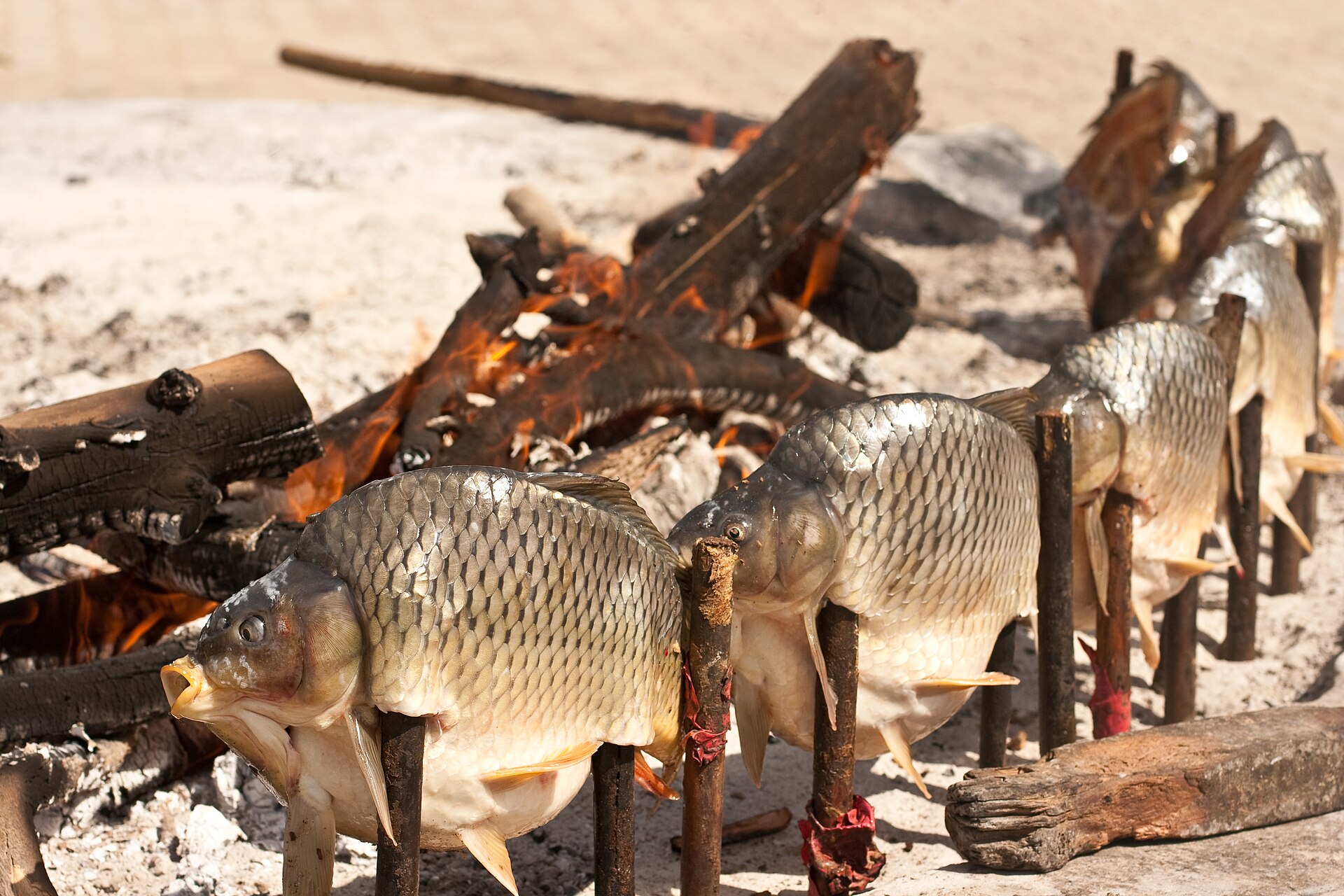
The Abu Nuwas grills are the most famous eating strip in Iraq. Masgouf is river carp — usually shabbout or common carp — butterflied, staked upright beside an open wood fire for around an hour, and finished with tamarind and turmeric. It is slow food in the most literal sense: expect to wait, and expect to eat late.
The pricing convention is worth understanding before you sit down, because it is not how restaurants elsewhere work. The fish is priced by its raw weight, and a slip of paper carrying that weight follows it from the tank to the table. A masgouf fish generally comes in above two kilograms, so it is a meal for at least two people. We are not printing a price. Every corniche masgouf figure we found traces to aggregator content rather than journalism, and the one per-kilo figure we could source was for a restaurant in Erbil. For the dish itself, and what else to eat in the city, see our Baghdad food guide and the wider survey of Iraqi food.
Two statues, and the mistake people make with them
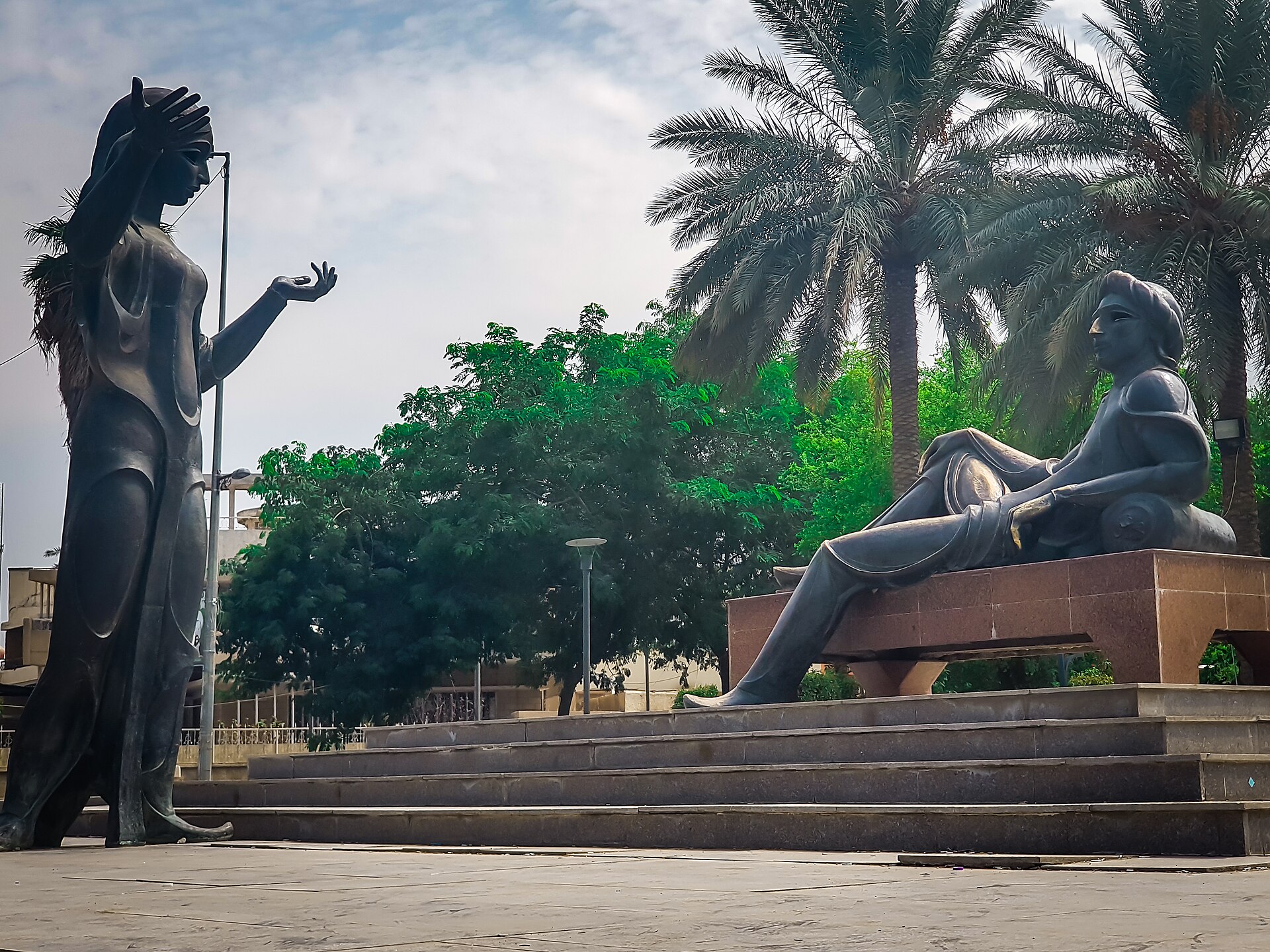
Abu Nuwas Street carries two well-known sculptures and they get conflated constantly, including in reporting. The Scheherazade and Shahryar group — she standing with a raised hand, he reclining on a plinth — is by Mohammed Ghani Hikmat, the sculptor responsible for much of Baghdad’s public art. Separately, there is a statue of the poet Abu Nuwas himself, after whom the street is named. They are different works by different hands.
Shafaq reported in March 2025 that “the statue” on the street had been restored roughly a year earlier. That restoration was of the Abu Nuwas poet statue. We could not confirm the current condition or any restoration of the Scheherazade group, and you will find pages that assume the two stories are one. They are not. If you are photographing either, read our notes on photography in Iraq first — camera rules near government buildings and checkpoints are stricter than you expect.
Abu Nuwas Park and the kite festival
The park along the street is unambiguously alive. It hosts Baghdad’s annual Kite Festival, founded in 2017 and in its seventh edition when 964media covered it in May 2025. The founder, Ali al-Ghalib, told the outlet the festival “was established in 2017 as a response to the claim that ‘Baghdad is the worst capital,’ and it’s continued every year because of the strong public turnout” — a reference to Baghdad ranking last of 231 cities in Mercer’s 2017 quality-of-living index. The festival runs music, theatre and an open-air bazaar of handmade crafts. One participant’s line is the best summary of the mall-versus-park argument in Baghdad: “Iraqi families need open green spaces away from the crowding of malls.”
Abu Nuwas Street is also one of fourteen sites across Baghdad that the municipality lights for New Year.
Karrada after eleven
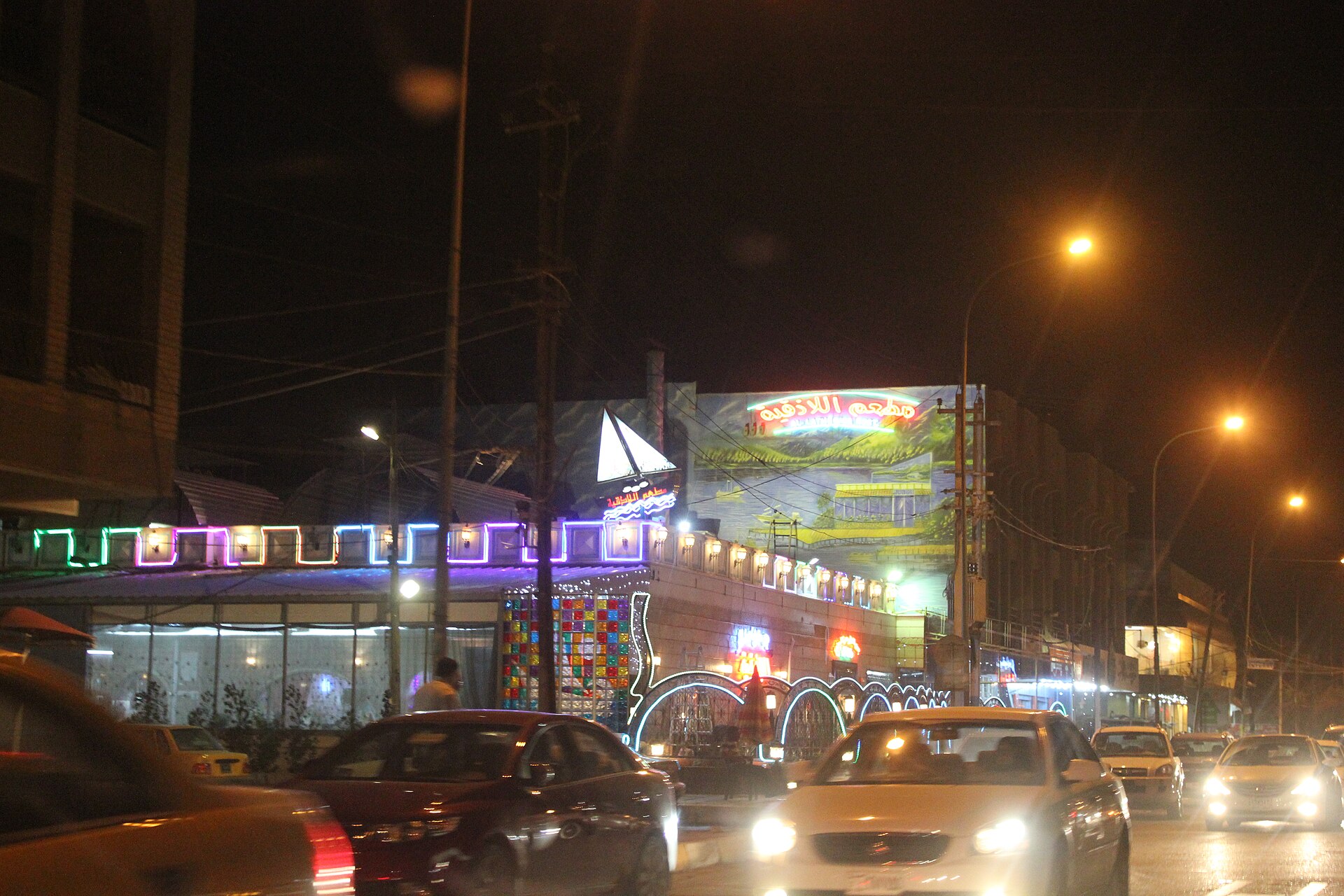
Karrada is the closest thing Baghdad nightlife has to a strip, and the city’s most consistently active evening district: a long commercial strip on the Rusafa side, busy well past midnight, with ice-cream shops doing serious trade at eleven at night and shisha cafés spilling onto the pavement. The pattern is shop first, then eat. Dijlah Village, in al-Masbah at the Karrada end, is a leisure complex with a working cinema.
Karrada also carries the memory of one of the worst attacks of the ISIS period. On 3 July 2016, during Ramadan, a refrigerator truck packed with explosives was driven into the Hadi Center commercial building. The toll is genuinely contested and it is worth seeing why:
| Figure | Source and date | What it counts |
|---|---|---|
| ~250 | Time, 5 July 2016 | Early confirmed toll. |
| 281 | BBC, days later | Revised toll. |
| “more than 320” | Later research summaries | Recovered bodies as rubble was cleared. |
| 340+ | Various | Total across the series of attacks that night, not the single blast. |
| 382 | Figure later given officially | Final official count. |
| 1,000 | Juma Inad, defence minister at the time, in a 2021 interview | A contested outlier. Treat with caution. |
We could not confirm a formal permanent memorial at the site. Candles were lit there on 5 July 2016 and Iraq declared three days of national mourning. If you are in Karrada in the evening, it is worth knowing what happened there; it is not worth treating as a photo stop.
The cinemas nobody writes about
Here is the single clearest piece of evidence that Baghdad has an ordinary evening life, and the entire Baghdad nightlife search results page missed it. Baghdad has at least ten working multiplex cinemas and Iraq’s first IMAX. We verified this by fetching live showtimes on 15 August 2026, and found current international releases listing alongside Egyptian and Arabic titles across the city.
| Cinema | Where |
|---|---|
| IC Iraq Mall Cinema (with IMAX) | Al-Dora, near the Two-Storey Bridge |
| IC Mansour Mall Cinema | Rowad Building, Mansour Mall |
| IC Babylon Mall Cinema | Mansour Street, Babylon Mall, second floor |
| IC Zayoona Mall Cinema | Palestine Street, Zayouna |
| IC Jadriya Mall Cinema | Jamia Street, Jadriya |
| IC Dijlah Village Cinema | Al-Masbah, Karrada |
| IC Dream City Mall Cinema | Al-Rabie Street, near al-Rabie Bridge |
| IC Amriya Mall and IC Iraq Gate Boulevard | Al-Amiriya near the airport; Damascus Street |
The listing paginates, so ten is a floor rather than a total. All carry the “IC” prefix, for Iraqi Cinema, which appears to be the dominant national exhibitor. Iraq’s first IMAX opened at Iraq Mall and was inaugurated by the acting minister of culture, tourism and antiquities; we could not pin down the exact opening date.
The contrast is the story. Baghdad’s historic single-screen cinema palaces on Rasheed Street and Saadoun Street — the Granada among them — stand derelict, faded signs and broken doors, while every working screen in the city sits inside a suburban shopping mall. A new generation of Iraqi filmmakers is pushing for a domestic industry revival, but the venues they will show in are mall multiplexes, not the old picture houses.
For a visitor this is genuinely useful: a cinema is an air-conditioned, unremarkable, low-risk way to spend a Baghdad evening, and nobody will find it strange that you are there.
Al-Zawraa Park, the malls, and a safety note about the rides
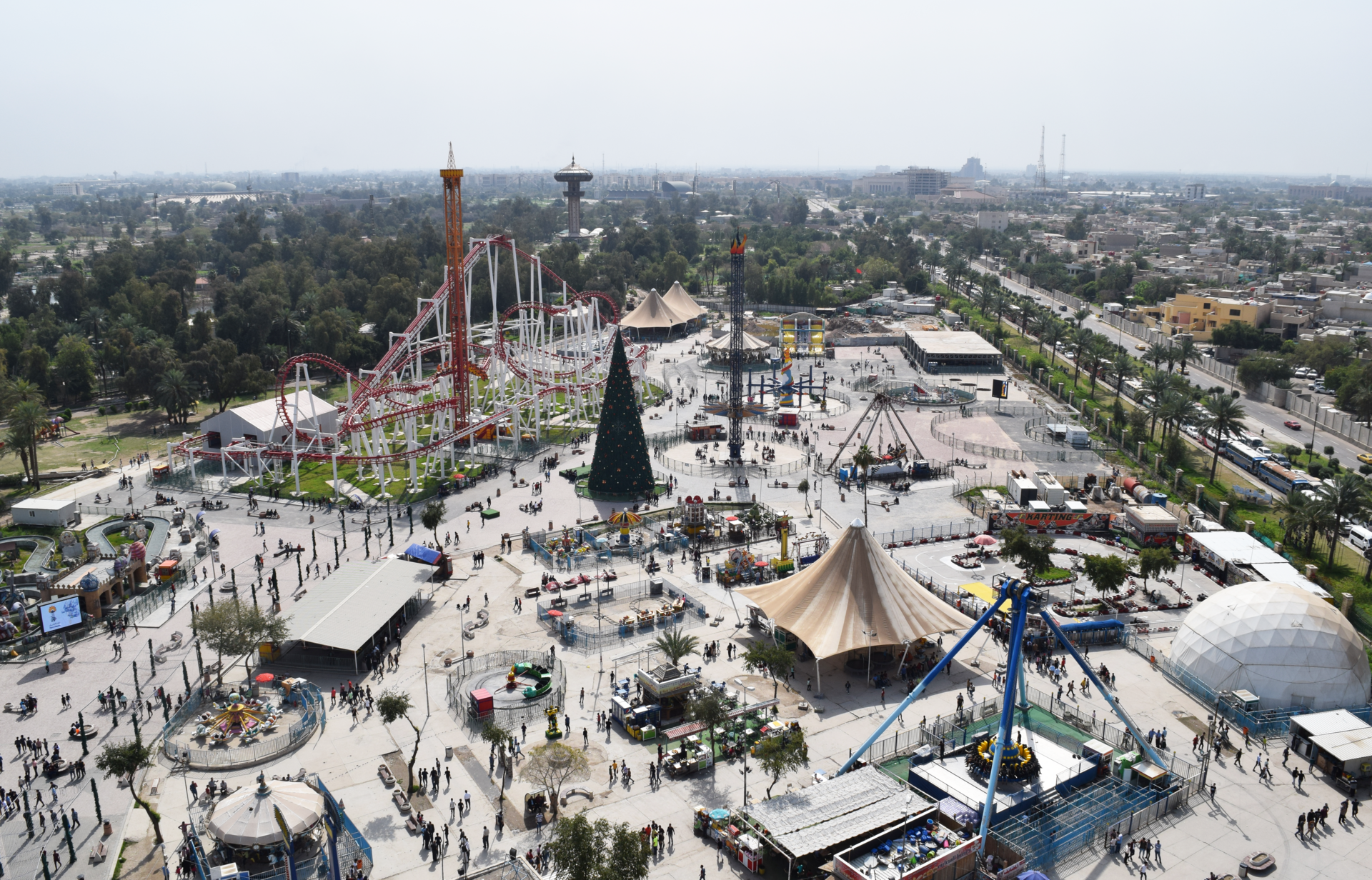
Al-Zawraa Park on the Karkh side was established in the early 1970s and is one of the largest public spaces in Baghdad, containing a zoo, an amusement park, gardens and an artificial lake. It is where Baghdad holds its all-night New Year celebration — the 2024 edition ran under a 30-metre Christmas tree, the tallest in the country that year and one of fourteen installed across the city’s municipalities — and where Baghdad Day is marked.
It is confirmed operating in 2026, though the confirmations are grim ones: 964media reported an amusement-park operator arrested in May 2026 after eleven people were stranded on a malfunctioning ride, and a child killed by a tiger at the zoo during the Eid holiday in March 2026. In August 2026 five members of one family were injured when a ride collapsed at a park in Diyala. Iraqi funfair rides have a documented safety problem and we are not going to recommend them. The park itself, as a place to walk in the evening with everyone else in Baghdad, is a different proposition.
We could not find a published entry price or evening opening hours for the park. A figure of around 1,000 IQD for adult entry circulates, but only on aggregator sites with no primary source, so treat it as unverified. Night operation is confirmed for major occasions rather than as a published nightly schedule.
Malls are a larger component of Baghdad nightlife than any venue list would suggest, and in a 44 °C city that is not a snub — an air-conditioned public space with food, shops and a cinema under one roof is a legitimate destination rather than a fallback. Mansour Mall, Babylon Mall, Iraq Mall in al-Dora, Zayouna, Jadriya, Dream City and Baghdad Mall all exist and trade. Mansour Mall is also, per a 2025 assessment, one of the few places in the city where some establishments accept cards; assume cash everywhere else, and read our Iraq travel costs guide before you arrive with the wrong money.
Live music: what exists, and what does not
The part of Baghdad nightlife you can buy a ticket for barely exists. There is live music in Baghdad; there is not a gig circuit. The distinction is real and worth stating plainly, because a reader who books a trip expecting ticketed evening shows will not find them.
What exists is workshop, institutional and festival music. In November 2025, the Oud House group ran a maqam workshop on Mutanabbi Street, led by musician and composer Anwar Abu Dragh, which drew a large turnout of musicians and students. The session dealt with the difference between the Panjgah maqam, a branch of Rast, and the Lami maqam, an independent scale derived from Kurd. A music professor at the same event said: “Our students have become artists. This shows that music today is doing well.” A participant, Mariam Amin, made the case for the format itself.
A maqam is a system of melodic modes defining both the scale and the rules for improvisation, each carrying a distinct mood. The Iraqi Maqam specifically is narrative sung poetry — memorised stories, sung. It was proclaimed a UNESCO Masterpiece of the Oral and Intangible Heritage of Humanity in 2003 and incorporated into the Representative List in 2008, when the Masterpieces were transferred across. Both years are correct and they measure different things; a page giving you only one of them is giving you half the fact.
The Iraqi National Symphony Orchestra, founded as the Baghdad Symphony in 1944 and renamed in 1959, is government-funded and based in the city; it performed at the opening of Baghdad’s year as Capital of Arab Tourism, which launched on 15 January 2025. That year is now over — a surprising number of pages still write it in the present tense.
Beyond music, Baghdad’s cultural calendar is real and documented: a communist party festival with art and journalism events in October 2025, the annual “I Am Iraqi, I Read” festival which distributed a record 45,000 free books, centenary events for theatre pioneers, memorials for actors and writers, and a bookshop that opened an architecture-and-literature club in July 2026. These are mostly evening events and mostly unadvertised in English. Ask locally; there is no listings magazine. Our overview of Iraqi culture gives more context on what you are walking into.
Ramadan nights, and the ring game
If you visit during Ramadan the whole rhythm inverts again, harder. Ramadan 1447 ran from around 19 February 2026 with Eid al-Fitr on Friday 20 March 2026; the next one begins around early February 2027, and Iraq sets the date by local moon sighting, so announced dates can move by a day.
The specifically Baghdadi Ramadan night activity is Mheibes — a team ring game played after iftar. One team conceals a ring, the mehbis, the signet ring many Iraqi men wear; forty players huddle under a blanket to decide who will hide it in their palm; and the opposing captain has ten minutes to work out which of the forty is holding it, reading faces and hands. There are nearly 400 teams nationally with annual competitions, and ten qualify in Baghdad alone, representing different neighbourhoods. An Iraqi folklore expert traces the game to Ottoman-era Baghdad, as early as the sixteenth century. It survived the sectarian war of 2006 to 2008; only COVID stopped play. One player’s summary, to AFP in March 2025: “It’s in our blood.”
Is Baghdad safe after dark?
The security question shapes every decision about Baghdad nightlife, so here is a straight answer and then the proportions, because both matter.
What the advisories say
The UK Foreign, Commonwealth and Development Office advises against all but essential travel to Baghdad province except Sadr City, and against all travel to Sadr City. That advice was updated on 22 July 2026 and was still current in mid-August 2026. The US State Department has Iraq at Level 4, Do Not Travel, reissued 2 March 2026, with an ordered departure of non-emergency US government employees on the same date.
The single most practical consequence, and the one most pages bury: travelling against your government’s advice invalidates most travel insurance policies. If you are going anyway, that is a decision to make with open eyes and with our guide to Iraq travel insurance read first. The broader question is covered in is Baghdad safe.
The regional picture in mid-August 2026 is also unusually live. The FCDO notes that since 8 July 2026 there have been strikes and retaliatory attacks by Iran across the region including Iraq, against US military and civilian infrastructure. Baghdad itself saw drone strikes on the US embassy compound and on a Green Zone hotel roof in March 2026. Every bulletin in this paragraph has an expiry or review date before or around the time you are reading it. Re-check rather than trusting this snapshot.
The risk that actually gets travellers
None of the above is what is most likely to hurt you on a night out. That is traffic. Iraq recorded 2,351 road deaths in 2025, and Baghdad accounts for roughly 19.5% of national crashes. Roads are poorly lit, driving standards are assertive, and the risk compounds after dark. If you take one practical instruction from this article, make it this one: do not walk in the road, do not cross a Baghdad arterial on foot at night, and do not self-drive. Self-driving is in any case effectively closed to tourists, since the FCDO requires the 1968-convention international driving permit, which you cannot obtain outside your home country.
Checkpoints at night
Baghdad is a city of checkpoints and they do not stop at sunset. They are routine, and orderly paperwork keeps them quick. Carry your passport — the physical one, plus a phone photo — and your hotel booking, every time you leave the building. Checkpoint positions shift, and a checkpoint crew at midnight may not be expecting a foreign passenger, which makes documents matter more rather than less. Our guide to Iraqi checkpoints covers what is asked and how to answer it.
The rest is ordinary sense applied honestly: stay in busy, lit areas; do not wander into unfamiliar districts on foot at night; treat your hotel’s front desk as the best available source on which streets are currently fine, because that information changes weekly and no website has it. One perception index rates Baghdad at 50 out of 100 for night-time safety sentiment against a higher daytime rating — that is a crowd-sourced feeling, not an incident rate, and we cite it only to say that locals and visitors alike are more careful after dark, which is the correct instinct.
Getting home
Getting home is the least glamorous and most important part of Baghdad nightlife. Ride-hailing is the answer, and the app you want may not be the one you expect.
| App | Status in Baghdad, August 2026 |
|---|---|
| Baly | Baghdad-based, founded 2021, roughly 80% of the city’s ride-hailing market. The one to install first. |
| Careem | Operates 24/7 in four Iraqi cities: Baghdad, Najaf, Basra and Erbil. Budget tier is called Awfar. |
| Alo TukTuk | An app for Baghdad’s tuk-tuks, with GPS and ID-verified drivers, launched by 2025. |
| Uber, Bolt | No evidence of operation in Iraq. Do not plan around them. |
| Lezzoo | Erbil-centred, and has no passenger ride-hailing product despite being widely described as a taxi app. |
Two corrections worth making explicitly, because they circulate widely. Careem is not the Baghdad market leader; Baly is. And an app called “Waffar” does not exist — the name is a garbling of Careem’s Awfar budget tier. Booking in an app rather than hailing on the street after dark also gives you a record of the driver and the route, which is the actual argument for it. Baghdad has over a million tuk-tuks, of which only around 100,000 are registered; they are fine for short daytime hops and are not what you want at midnight. Broader transport options are in our guide to getting around Iraq, and you will want a local data plan for any of this to work, which our Iraq SIM card guide covers.
Laws that apply to a night out
Two things every visitor to Baghdad should know before an evening in public, stated as legal facts rather than opinions.
Iraq’s Anti-Prostitution and Homosexuality Law was amended in July 2024. The amendment provides for up to seven years’ imprisonment and a fine of 10 to 15 million Iraqi dinars where authorities judge that a person’s actions, clothing or possessions promote LGBT+ identities, and for 10 to 15 years’ imprisonment for same-sex relationships. This applies to foreign visitors. It is the single most consequential law for LGBT+ travellers considering Iraq, and it belongs in any honest account of going out in Baghdad after dark.
Dress is conservative and the expectation is stricter in the evening in mixed public space than a Western visitor assumes. Women should have shoulders and knees covered in public. Men wear long trousers; shorts and vest tops are not worn by adults. This is not a legal requirement outside religious sites, but it is a strong social one, and dressing wrongly is the fastest way to make yourself the centre of attention on a street where you would rather not be.
Add to those the standing rules for the rest of the country: photography of government buildings, checkpoints and security personnel is a genuine problem rather than a theoretical one, and the antiquities law is severe. See our Iraq travel tips for the practical version.
An honest evening, planned
If you want a template rather than a list, here are two that work with what actually exists.
The river evening. Leave the hotel around seven, after the worst of the heat. Walk the finished stretch of the Abu Nuwas promenade while it is still light enough to see the Tigris, find the Scheherazade group, and let the light go. Eat masgouf on the corniche around nine, understanding that it takes an hour to cook and that you are paying by raw weight. Tea afterwards, on the street or back in Karrada. Home by app, not on foot.
The old city evening. Do this on a Thursday or Friday. Spend the late afternoon walking Rasheed Street and Mutanabbi Street — the book market is a Friday morning phenomenon, so do not save it for the night — and finish at the Shabandar with tea as the room fills. Then Karrada for dinner, late, and ice cream after eleven, when everyone else is doing the same. If it is too hot to be outdoors at all, substitute a mall cinema; nobody will think it a waste of a Baghdad night.
Neither of these needs a guide, though a driver who knows current checkpoint positions removes most of the friction. Where you base yourself matters for both — see where to stay in Iraq. And if you have a spare day, the day trips from Baghdad guide covers what is reachable and what is not.
What we could not confirm
Everything above is sourced and dated. The following is not, and we would rather tell you than fill the gaps with plausible invention — which is exactly what the pages ranking for Baghdad nightlife have done.
- Any price for a glass of tea or a shisha in Baghdad. No dated Iraqi source gives one.
- Any restaurant masgouf price, and whether any specific Abu Nuwas masgouf restaurant is currently trading with dated editorial proof.
- Al-Zawraa Park’s entry fee and any routine evening hours.
- Closing times for any café or restaurant in the city. None publishes hours.
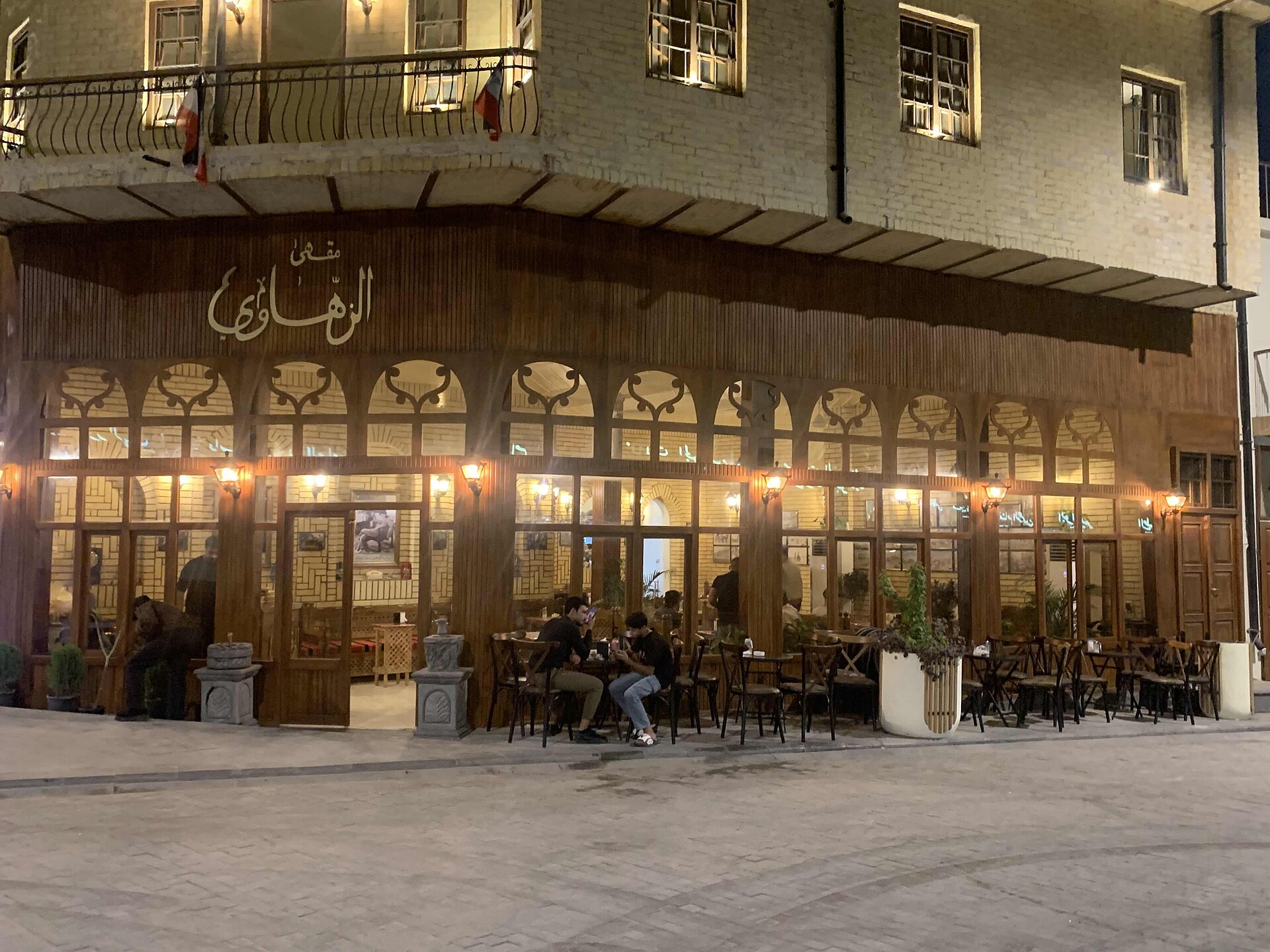
- The current trading status of the al-Zahawi, Umm Kulthum and Hassan Ajmi coffeehouses. All three are real and historic; we found no dated 2024–2026 source confirming any of them is open. The photograph above shows the al-Zahawi frontage lit at night in October 2025, which is evidence and not a guarantee.
- The current status of Al-Jardagh Café in Adhamiya, a riverbank heritage café established in 1933 and named for the canopies locals put up along the bank. The most recent report we found, from December 2023, described it operating at minimal capacity and unable to fund restoration.
- The condition or restoration status of the Scheherazade and Shahryar statue. The restored statue reported in 2025 was the poet Abu Nuwas, a different work.
- Passenger boats, ferries or river cruises on the Tigris in Baghdad. No dated evidence either way.
- Which Tigris bridges are lit at night, and the current status of Umm al-Khanazeer island.
- Reports of crackdowns on concerts or parties by conservative factions in 2025–26. We searched for these directly and found nothing about Baghdad. That does not mean they have not happened.
- The names of the social clubs that were serving alcohol before late 2024. Reporting confirms the category and the November 2024 letters; no source we found names the clubs individually, so neither do we.
- The exact opening date of Iraq’s first IMAX at Iraq Mall, and whether Al-Nakheel Mall and Times Square exist as described elsewhere. Neither appeared in any dated source or in the live cinema directory.
- A formal permanent memorial at the Karrada bombing site.
Frequently asked questions
What is Baghdad nightlife actually like?
Cafés, shisha terraces, late family dinners, a riverside walk on Abu Nuwas Street, shopping malls, cinemas and public parks — all running from sunset until well past midnight, and all completely alcohol-free. If you arrive expecting bars, Baghdad nightlife will look like nothing at all. If you arrive expecting a city that socialises after dark, it is busier than most European capitals on a Tuesday.
Is there any way to drink alcohol legally in Baghdad?
Not in the city. Federal law criminalises import, manufacture and sale, and the hotel-bar and social-club exceptions were closed from late 2024. The two legal exceptions are the Kurdistan Region, where alcohol is sold openly, and the duty-free zone at Baghdad International Airport. Cars arriving from Kurdistan into the rest of Iraq are searched for it.
Is it safe to walk around Baghdad at night?
In busy, lit areas of central districts, visitors do it and report it as unremarkable. The risks that should shape your behaviour are traffic first, then unfamiliar neighbourhoods, then the possibility of a same-day area closure after a security incident. Sadr City carries a UK “against all travel” rating and is not an evening destination. Ask your hotel about current conditions rather than relying on anything written in advance.
What time do cafés close in Baghdad?
Nobody publishes hours and no Iraqi source reports a fixed closing time. Cafés, shisha places and ice-cream shops are consistently described as trading past midnight, later on Thursdays and Fridays, and later still in summer. Any specific time you see quoted online is somebody’s guess.
Are there nightclubs in Baghdad?
No. The clubs and discos named on the first page of search results do not exist and appear to have been invented by automated listing sites — one of them places a “disco” in Kadhimiya, beside a major Shia shrine. If a page names a Baghdad nightclub, that is a reliable signal that the rest of the page is unreliable too.
Can women go out at night in Baghdad?
Yes, and Iraqi women are visible in restaurants, malls, parks and modern cafés in the evening. The traditional heritage chaikhanas are in practice male rooms; a foreign woman entering one will not be thrown out but will be conspicuous. Dress conservatively, and prefer app-booked transport to street hails after dark.
Do I need a guide for an evening out?
Not for a walk on the corniche, a café or a cinema. A driver who knows where the checkpoints are tonight saves time and stress, and if you are already on an organised trip your operator will arrange it. See our overview of Iraq tours for how that usually works.
Is there live music or theatre I can go to?
There is a real cultural calendar — maqam workshops, book festivals, orchestral performances, theatre commemorations — but almost none of it is advertised in English and there is no listings publication. Ask at Mutanabbi Street bookshops or your hotel. There is no ticketed gig circuit in the Western sense.
Does Baghdad have cinemas?
Yes — at least ten working multiplexes plus Iraq’s first IMAX, all inside shopping malls, all showing current international and Arabic releases. This is verifiable from live showtimes and is the most commonly missed fact about evenings in the city. The historic single-screen cinemas on Rasheed Street are derelict; the working screens are all suburban.
What should I not do on a night out in Baghdad?
Do not photograph checkpoints, security personnel or government buildings. Do not attempt to buy alcohol. Do not cross main roads on foot after dark. Do not travel without your passport. And be aware that the July 2024 amendment to the Anti-Prostitution and Homosexuality Law carries severe penalties, including for clothing or possessions judged to promote LGBT+ identities.
Final thoughts
The reason the search results for Baghdad nightlife are so bad is that the question is framed wrongly. Ask “where are the bars” and a machine will write you bars. Ask what an evening in Baghdad is, and you get something else entirely: a city that does its living after dark for six months of the year because the alternative is 50 °C, and that has rebuilt an entire evening culture — cafés, riverside, cinemas, parks, family dinners at ten — without any of the infrastructure a European would recognise as nightlife.
What that means practically is that you should stop looking for venues and start looking for hours. Be out between eight and midnight. Sit somewhere for longer than you meant to. Order the tea, decline the backgammon, and accept that the most interesting thing about a Baghdad evening is that it is completely ordinary — which, given everything the last twenty years did to this city, is the whole point.
For the daytime half of the city, start with our things to do in Iraq overview and the guide to Kadhimiya and its shrine district, and if you want the one landmark that defines Baghdad’s skyline after sunset, read about the Al-Shaheed Monument.
Photo credits
Abu Nuwas Street at night by Mustafa Nader (CC BY-SA 4.0). Al-Zahawi Coffeehouse in 2025 by Ayham4002 (CC0). Tea at the Shabandar Café by Mohammdaon (CC BY-SA 4.0). Scheherazade and Shahryar statue by Abdulrzaq1 (CC BY-SA 4.0). Al-Zawra amusement park by Mohammad Ali Huzam (CC BY-SA 2.0). Arasat al-Hindiya at night by ainudil (CC BY-SA 2.0). All images via Wikimedia Commons.