Last updated: August 2026. Bookseller quotes and trading conditions re-checked against AFP reporting of 11 June 2026; the Shabandar Cafe details, the 2007 death toll and the funding of the 2021 restoration were re-verified against Al Jazeera, Arab News and Shafaq; al-Qishla’s closure was checked as of June 2026.
Every guide to Mutanabbi Street tells you the same story: a thousand-year-old book market, poets in the cafes, volumes left out on the pavement overnight because nobody would steal a book. It is a lovely story. It is also, in 2026, roughly a decade out of date. On a Friday morning in June 2026, a bookseller in his seventies named Hussein Ali told an AFP reporter what the trade actually looks like now: “Thirty-five years ago, I would sell more than 50 copies on a day like this. Today, I can barely sell five.” The street is one afternoon inside the larger city covered in our Baghdad travel guide.
So here is the direct answer. Mutanabbi Street is still Baghdad’s book street, it is still open, it is still free to walk, and Friday morning is still the day to go — but it is a book market in trouble, not a thriving one. Toys and stationery have taken the main-street frontage; the booksellers have retreated into the alleys behind it; a publisher who has worked there for decades says the street is losing a book vendor a month. You can have a genuinely good morning there. You should just know what you are looking at.
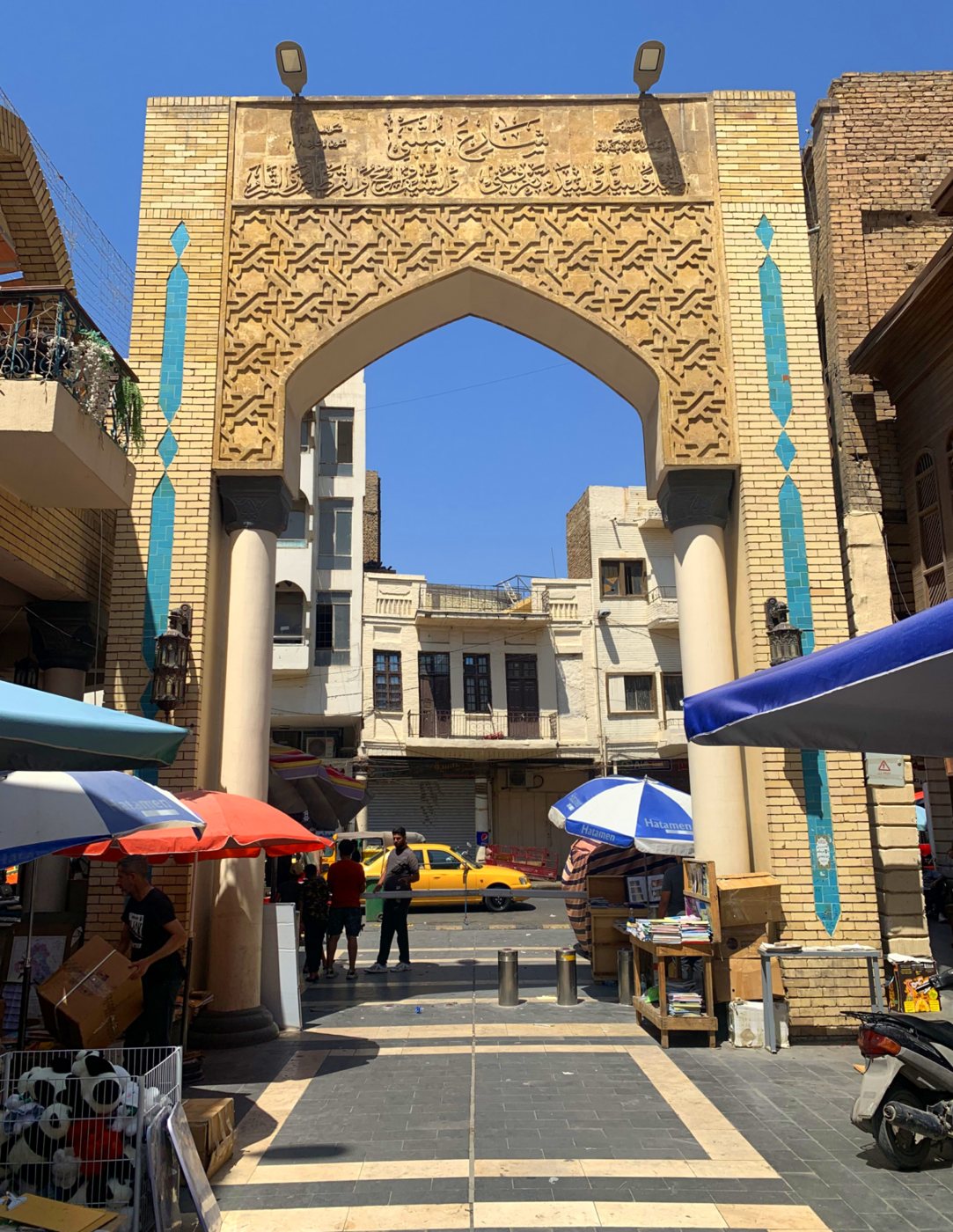
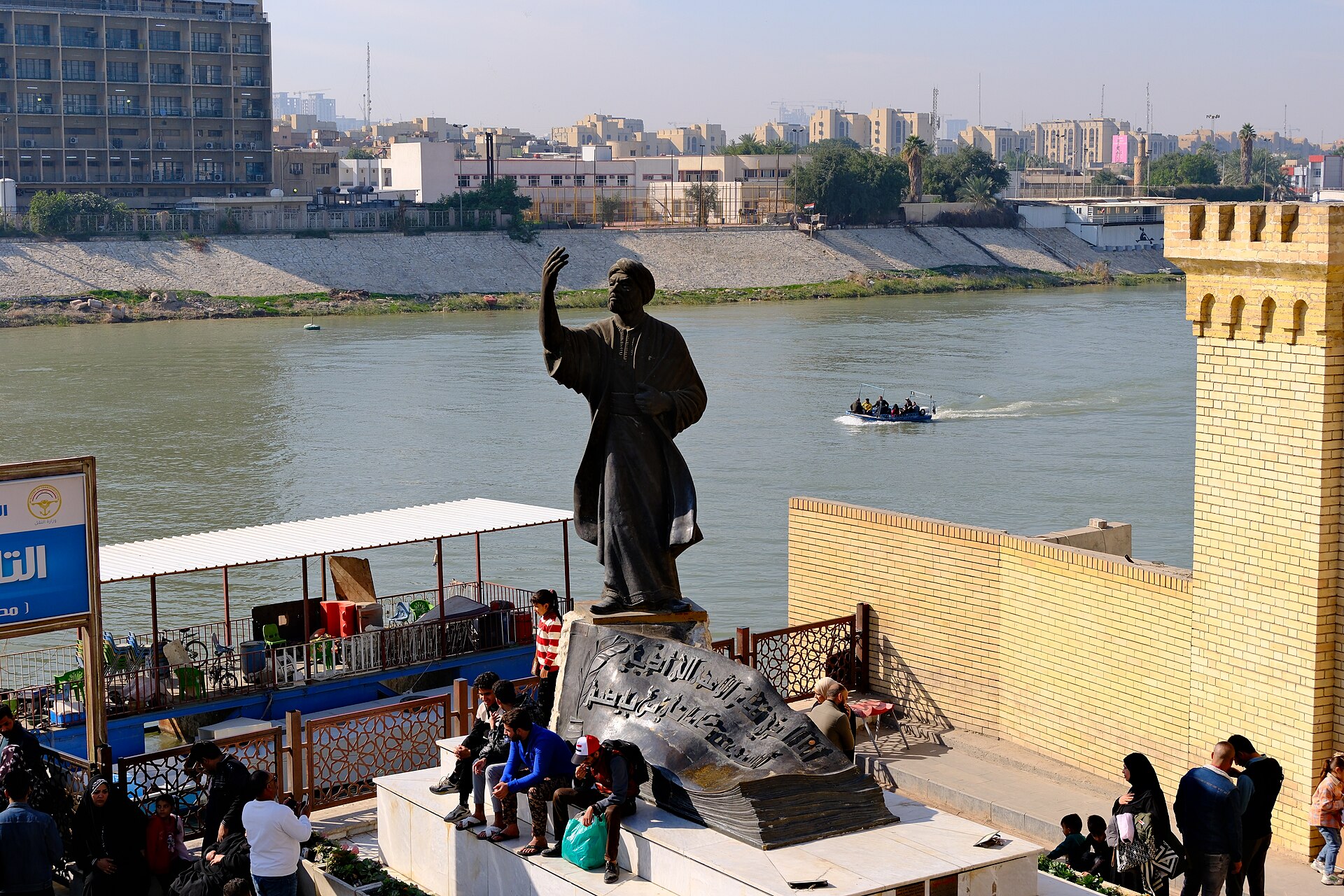
The street runs about a kilometre through Rusafa, off Rasheed Street, ending at the Tigris under a bronze statue of the poet it is named after. It is car-free, there is no ticket and no gate, and it sits inside the district the rest of our Baghdad travel guide covers as its historic core.
This article covers what is actually on the street now, what the 2021 restoration did and who paid for it, the 2007 bombing and why the death toll is reported four different ways, the truth about the Shabandar Cafe and its owner, what is open and what is closed around it, and how to plan a visit that is worth the trip. It also sets out plainly what we could not confirm.
Mutanabbi Street at a glance
| Question | Answer |
|---|---|
| Where is it? | Rusafa, central Baghdad, running off Rasheed Street to the Tigris. Roughly 33.341°N, 44.389°E. |
| How long is it? | Just under 1 km, pedestrian only. |
| Opening hours / fee | No gate, no ticket, no hours. Shops set their own; many stay open into the evening. |
| Best day | Friday morning. It is the start of the Iraqi weekend and the day the cultural sessions run. |
| What sells there | Arabic and English books new and second-hand, plus a large and growing amount of stationery, school supplies, toys and street food. |
| Typical second-hand price | Many pavement volumes are marked at under the equivalent of a dollar — roughly 1,500 IQD at the mid-2026 street rate. |
| Closed next door | Al-Qishla, the Ottoman parade ground at the Tigris end, has been shut to the public since roughly late 2024. |
| Do I need a guide? | No. Foreign visitors walk it unaccompanied. Carry your passport for checkpoints on the way in. |
What the booksellers are actually saying in 2026
AFP published a piece on 11 June 2026 under the headline “Famed Baghdad booksellers lament fading legacy as sales dwindle.” It is the most recent serious reporting from the street and it is worth reading before you go, because every one of the people quoted in it works there.
Hussein Ali, in his seventies, sells from a spread on the pavement. His fifty-copies-to-five line was said on a Friday, the busiest day of the week. He described “sorrow that I work hard without any return”, and said he keeps going out of habit and to see the old friends who still come. He blamed, in part, “the spread of social media”.
Abdullah Abdulazim is 26 and runs his shop the way his generation does — promoting it on social platforms. He still reports a “great decline” in readers and visitors, and says that “sometimes profits are meagre, others they are nonexistent”. Ismail al-Bayati, also in his seventies and by his own count a reader of more than 500 books, put it bluntly: “there is currently no demand for books in Mutanabbi.” He went on to compare the modern relationship with the internet to addiction — “if we don’t have Internet, it’s as if we’ll die.”
The author Hakim al-Shammari has started giving his latest book away free to ministries and institutions, because he cannot sell it. That is the temperature of the market.
None of this makes the street not worth visiting. It makes it a different kind of visit. You are not walking into a golden age; you are walking into a working trade under pressure, and the people running the stalls know it. Treating them as picturesque local colour is the one thing not to do. Buy something.
The squeeze, with numbers
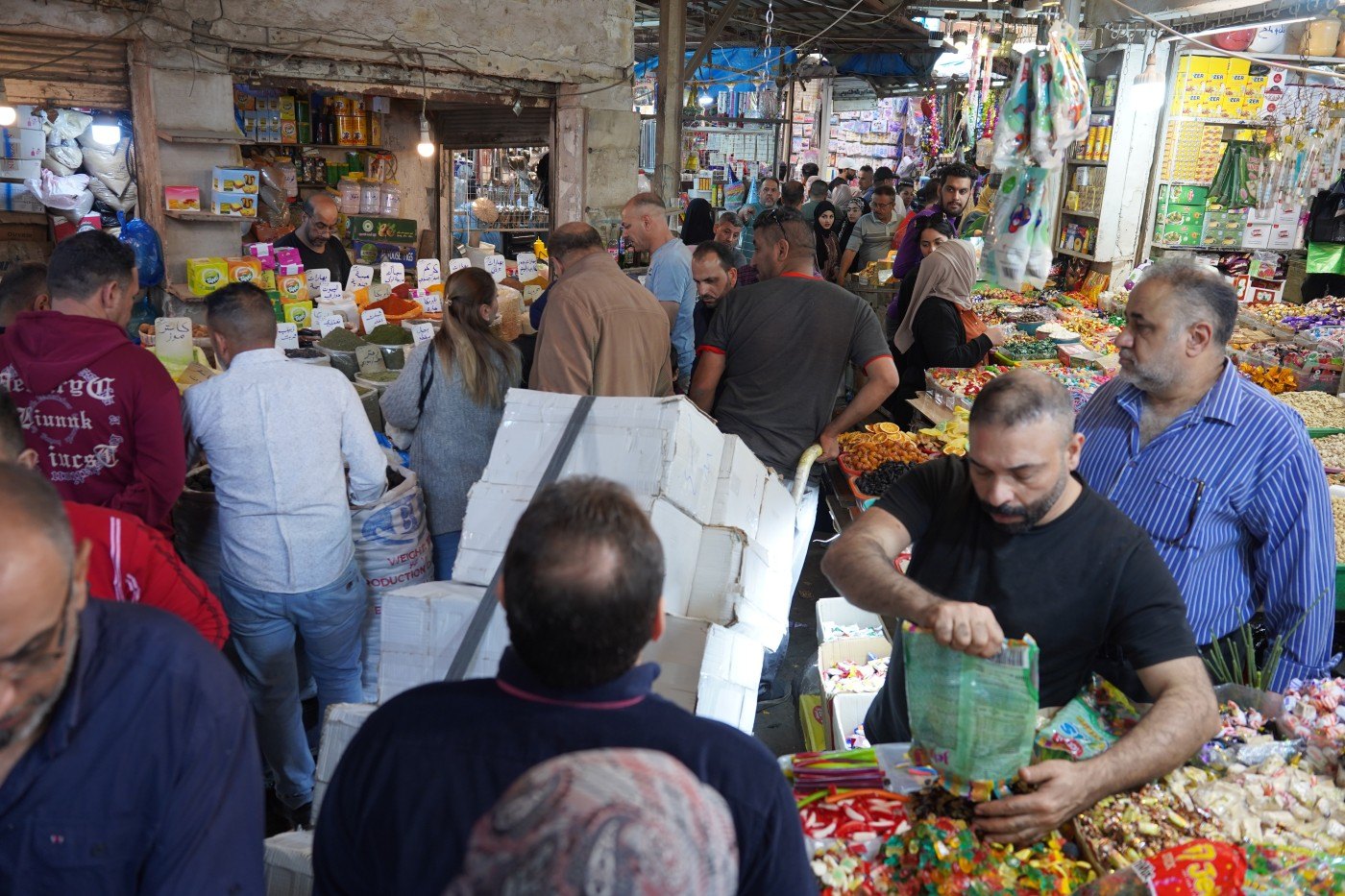
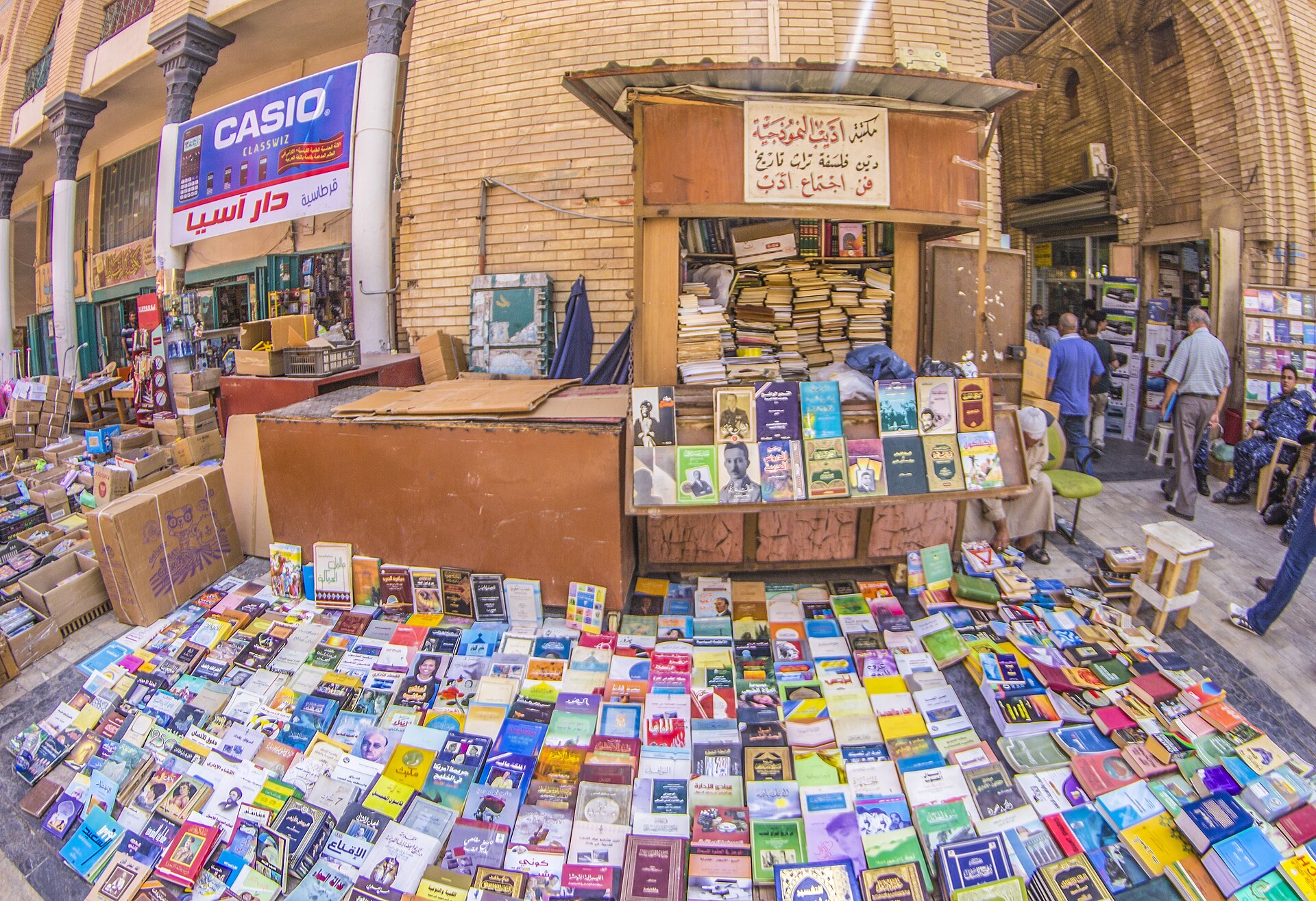
Shafaq News ran a detailed piece in May 2025 titled, accurately, “From poetry to plastic”. Approaching from al-Rusafi Square, it noted, you now pass toy stalls and stationery booths before you see a single bookshelf. Of the dozens of literary shops that once lined the main road, only a handful are still visible from it.
The mechanism is rent. Main-street shopfronts were going for 2 to 3 million Iraqi dinars a month — about $1,540 to $2,310 — while a shop in one of the narrow side alleys, the qasariyyas, averaged around 350,000 dinars, roughly $270. A stationery business can carry the frontage. A bookshop mostly cannot. So the books moved into corridors barely wide enough for two people to pass.
Sattar Mohsen Ali, a publisher who has worked on the street for decades, told Shafaq: “The street’s original identity was rooted in bookstores. Pens and printers were always secondary. But today, stationery sells better.” And then the line that should be in every guide to this street and is in none of them: “We’re losing a book vendor every month.”
Three other pressures compound it:
- Piracy. Unauthorised photocopies flood the market. Safaa Dhiab, who founded Shahriyar Publishing in 2017 and once had a shop on the street, described publishers investing thousands of dollars in a title only to see pirated copies sold for under two dollars.
- The Souk al-Saray rebuild. The redevelopment of the adjoining souk moved several of the major literary outlets into a single building away from the foot traffic. Visitor numbers to those shops dropped. So did sales.
- No institutional buyer. “In the Gulf, governments purchase books for public libraries,” Sattar told Shafaq. “Here, we’re left alone.” Without institutional purchasing, everything depends on individual walk-in customers.
It is worth holding one counter-view alongside all of that, because the street is not unanimous. Ayam Rasheed, who opened the Dar-Ayam bookshop about five years ago, told The Middle East Uncovered in July 2025 that the renovation had brought new visitors and that her sales — of books and of other things — had gone up, particularly through the summer months when book-buying normally collapses. Two booksellers on the same street, opposite conclusions about the same crowd. Both are telling the truth about their own shop.
Where the name comes from — and one origin story to be careful with
The poet is Abu al-Tayyib al-Mutanabbi, born in Kufa around 915 CE and killed in 965. He is one of the towering figures of Arabic literature, quoted casually in ordinary conversation across the Arab world the way Shakespeare is in English. The bronze of him at the Tigris end of the street was made by the Iraqi sculptor Mohammed Ghani Hikmat in 1977.
The street took his name in 1932, under King Faisal I. Before that it was known as Ekmek Khana — Turkish for public bakery, after the Ottoman military bakeries that stood here. Al Jazeera interviewed the Shabandar’s owner in 2023 about running along this street as a child, and noted that in his boyhood it “was not yet known as the Booksellers’ Street”. Printing houses and bookshops arrived because the courts and government offices were next door, and the bookselling identity built up from there.
You will read almost everywhere — including on Wikipedia and on most of the AI-written pages now ranking for this keyword — that the street descends directly from the Abbasid Suq al-Warraqin, the market of the paper-sellers and copyists, and has therefore been a book market for a thousand years. That is a tradition rather than a documented lineage. We could not find a primary source establishing continuity between the Abbasid paper market and this specific street. The Abbasid book trade in Baghdad is real and enormously well attested; the claim that this pavement is its unbroken continuation is not. It is a small thing, but it is the difference between a guide that checked and one that copied.
The 5 March 2007 bombing, and why you will see four different death tolls
On 5 March 2007 a bomb went off on Mutanabbi Street. It killed around thirty people, wounded roughly sixty more, and destroyed a large part of the street’s shops and stalls. Among the dead were four sons and a grandson of the man who runs the Shabandar Cafe.
If you compare sources you will find the toll reported as 20, 26, 30 and 38. This is not a small discrepancy and it is worth setting out, because most pages simply pick one and state it flatly.
| Source | Figure | Date |
|---|---|---|
| The New York Times, same-day report | 20 killed | 5 March 2007 |
| English Wikipedia, main street article | 26 killed | current as of August 2026 |
| Al Jazeera, Arab News, AFP — the settled wire figure | 30 killed, about 60 wounded | 2023 and 2026 reporting |
| English Wikipedia, a second article on the attack | 38 killed, 105 wounded (tagged failed verification) | current as of August 2026 |
The pattern is the usual one for a same-day attack: the first wire count is low because it reflects the bodies recovered in the first hours, and it then rises as people die of their injuries and the rubble is cleared. Thirty killed and around sixty wounded is the figure that has settled across the reputable coverage, and it is the one we use. Sources also differ on whether it was a car bomb or a suicide bomb; both descriptions appear in serious reporting and we have not found a resolution.
The street reopened officially on 18 December 2008, when Prime Minister Nouri al-Maliki cut the ribbon after a long clean-up. In 2012 there was a second, much less remembered blow: Iraqi troops arrived at night and bulldozed the wooden street stalls in a crackdown on pavement bookselling, just as sales were recovering. The response from young Iraqis was to found the annual “I Am Iraqi, I Read” festival, which still runs and still gives away thousands of free books a year.
The Shabandar Cafe, and the detail almost everyone gets wrong
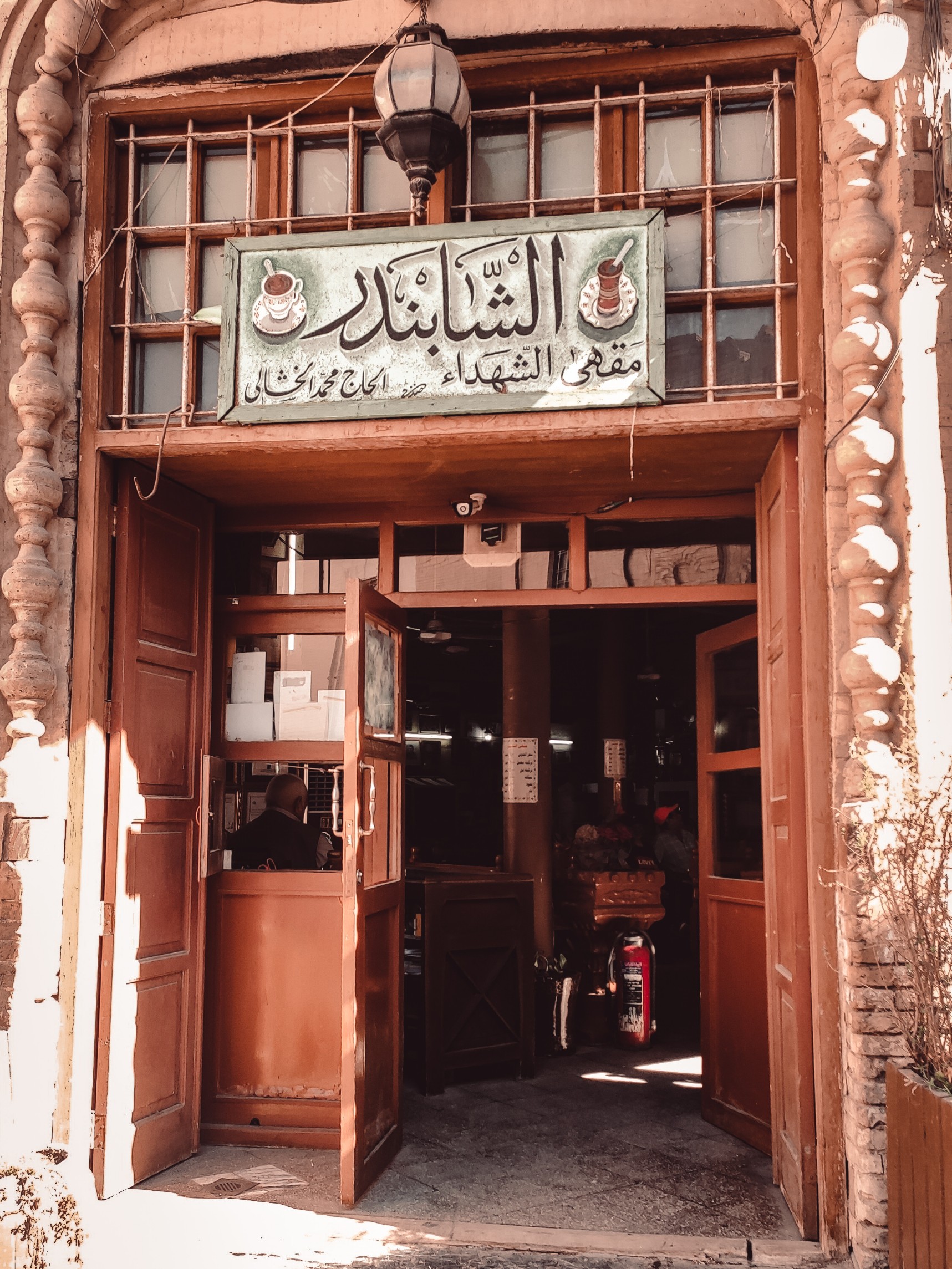
The Shabandar is the tea house on the corner, and it is the single most photographed interior in Baghdad. The building dates from 1904; it has operated as a coffee house since 1917; and Haj Mohammed al-Khashali has been renting it since 1963. Its walls are covered floor to ceiling with photographs of old Baghdad — a collection al-Khashali built himself, reprinted from his own negatives after the 2007 blast damaged the building.
Here is the correction. English Wikipedia says the bombing “took five of the owner’s children”, and that sentence has been copied into dozens of travel pages. It is wrong. Al-Khashali lost four sons and one grandson — five relatives, killed together, but not five children. Al Jazeera, which interviewed him at length in March 2023 when he was 89, reports it correctly and notes that he has three surviving children, a son and two daughters. The green sign above his counter reads “Al-Shabandar: The Martyrs’ Coffee Shop”, and their photographs hang beneath it. If you go in, that is what you are looking at. Ask before photographing it.
Practical notes, with their limits stated:
- Hours. The cafe’s own Instagram account gives 7am to 11pm daily. That is a single source and we could not corroborate it elsewhere; treat it as indicative rather than guaranteed.
- Price of tea. We could not confirm one. Figures circulating online range widely and none traces to a source we would stand behind, so we are not printing a number. It is cheap; bring small dinar notes.
- Women. There is no confirmed women’s section and no confirmed policy either way. What is documented: Al Jazeera photographed Zahraa Kadhim, 74, drinking tea inside with her 27-year-old granddaughter in March 2023. Women do sit in the Shabandar. See our notes on solo female travel in Iraq for the wider picture.
- Atmosphere. It is loud, crowded and male-dominated on a Friday, and it is a place people go to argue about politics and poetry rather than to be quiet. Games are discouraged in favour of conversation.
The 2021 restoration: who paid, and what it changed
The street you walk today was rebuilt in 2021, and the credit is routinely given to the wrong people. It was not a government project and it was not a UNESCO project. It was privately funded, by donations from the Central Bank of Iraq and the Iraqi Private Banks League, at a cost of about $3 million. Work began in August 2021 and ran three months, carried out by the Baghdad construction firm Diamond Loft, whose representative director Omar al-Handal described the site beforehand as “a deserted, dark area full of stray dogs”.
The reopening date is reported two ways and we give both: Arab News says the street reopened in December 2021; The National, writing in late January 2022, describes the renovation as having just rejuvenated Baghdad’s nights and dates the reopening to early January 2022. Either way, the work was done by the turn of that year.
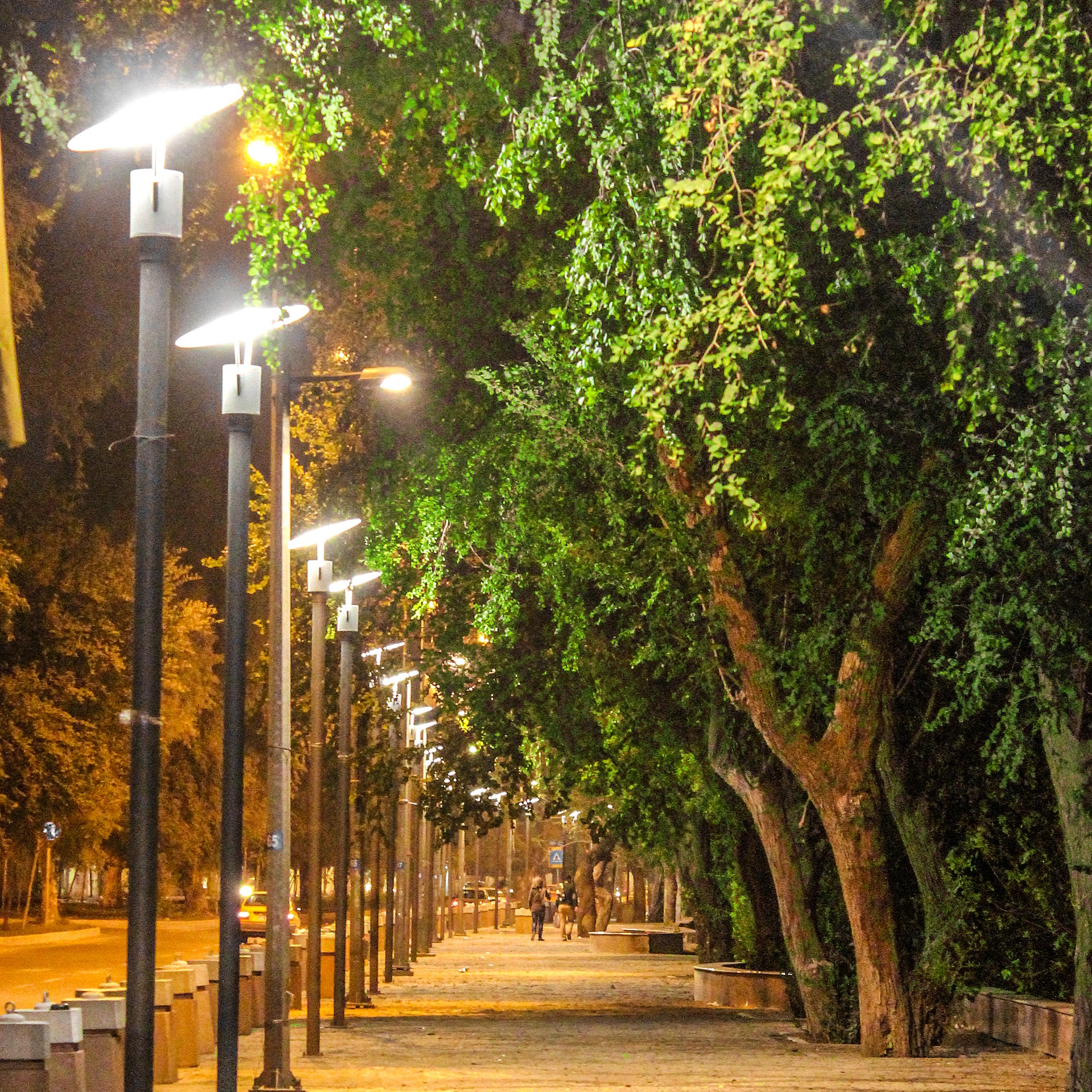
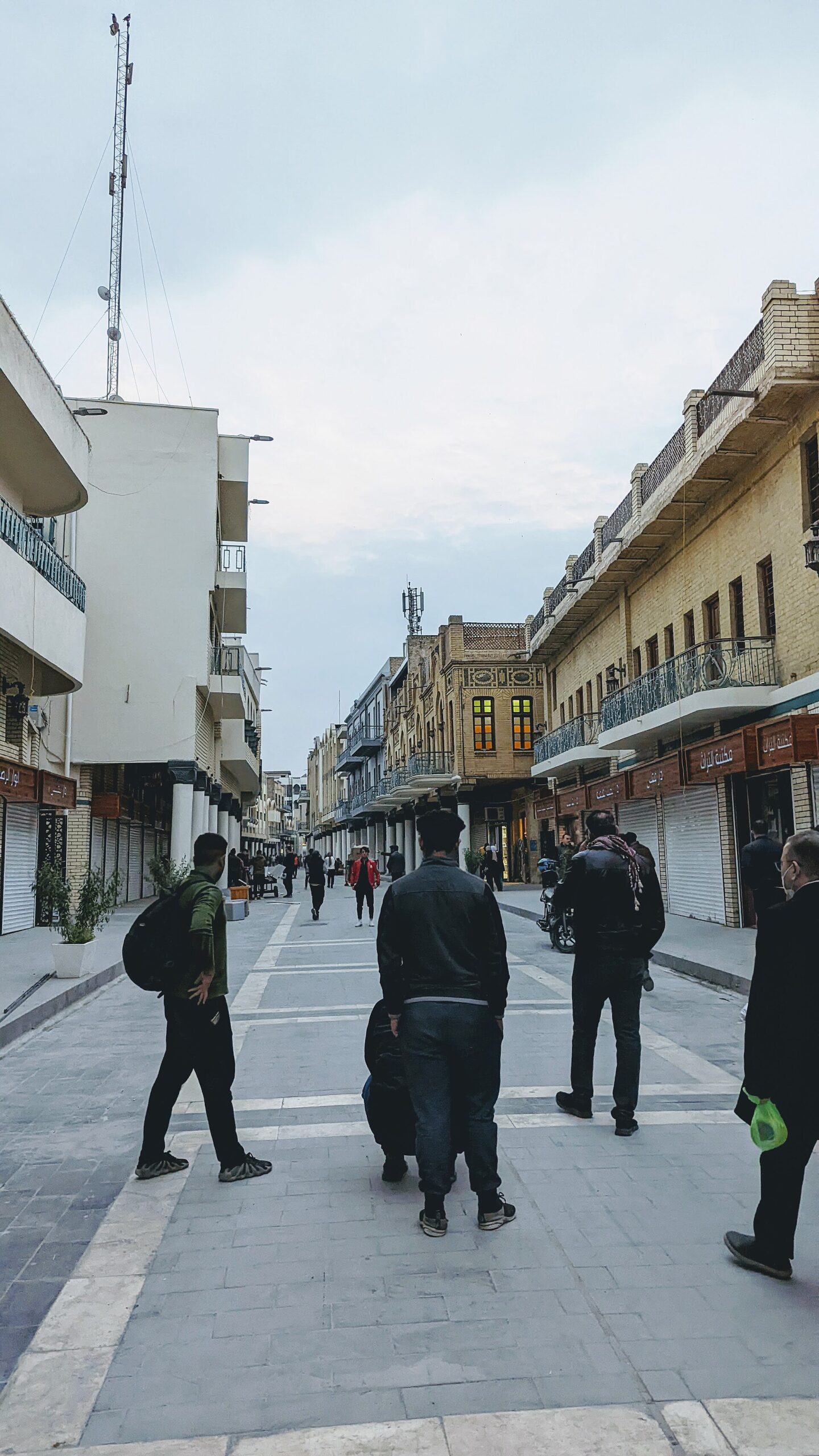
What changed physically: the roadway and pavements were relaid in stone as a single pedestrian surface, a new lighting system went in, and the facades along the main street were painted. The qasariyya alleys either side — about eight feet wide — were left untouched.
What changed commercially is the part the tourist pages skip. The renovation made the street a destination for people who were not there for books. Juice and food vendors moved in. Landlords raised rents: one bookshop owner told Al Jazeera his rent had been doubled because the street “has become a magnet to visitors until late hours”. And not everyone likes the look. “It’s paint, it’s not the authentic colour of the bricks,” a bookshop manager complained, gesturing at the restored Baghdadi Cultural Center by the river. Zahraa Kadhim, who had come down from Erbil specifically to see the new street after decades away, said: “I didn’t feel the historical identity of the place any more.”
“The reader does not steal, and the thief does not read”
This is the most-repeated sentence about Mutanabbi Street in the English-language internet, and it is almost always presented as an observed fact: booksellers leave their stock out on the pavement overnight, unguarded, because in Baghdad nobody steals a book.
Here is what the sourcing actually supports. Arab News, in March 2023, wrote: “The Iraqis who frequent Al-Mutanabbi Street say that books can safely remain out on display there at night because ‘the reader does not steal, and the thief does not read.'” That is reported speech — a saying Baghdadis quote about their own street, recorded by a journalist. It is not a description of what the reporter watched happen.
We could find no 2025 or 2026 report confirming that books are routinely left out overnight as a current practice, and no bookseller quoted in the recent coverage says they do it. So: it is a real and much-loved Baghdadi saying, and you will hear it. Treat it as a saying, not as a security arrangement. Do not go expecting to photograph unattended stacks of books at two in the morning, and do not repeat it as fact to the person who owns the stall.
What is open, what is closed, and what is new around the street
The area immediately around Mutanabbi Street has changed considerably in the last eighteen months, mostly in ways no travel page has caught up with. The single most important thing to know is that al-Qishla is closed.
| Place | Status, August 2026 | What to know |
|---|---|---|
| Mutanabbi Street itself | Open, free, pedestrian | Friday morning is the peak. Cultural and film sessions run on Friday mornings. |
| Shabandar Cafe | Open | 7am–11pm daily per the cafe’s own Instagram — single source. Cash only, small notes. |
| Al-Qishla | Closed to the public | Shut for more than 18 months as of June 2026. Competitors still list it as a stop. |
| Souk al-Saray | Open | Under 300 m long, path under 3 m wide; now mostly stationery, notebooks and school books. Entrance faces the al-Sarai Mosque (1660). |
| Iqraa Downtown | Open since 21 February 2026 | New cultural and retail complex on al-Sarai Street with a gallery, public library, cafes and a small hotel. |
| Al-Mutanabbi statue & Tigris frontage | Open | Free, at the river end. The Baghdadi Cultural Center sits beside it. |
| The Iraq Museum | Closed | Shut since July 2025 with no announced reopening. Do not build a day around it. |
Al-Qishla: closed, and contested
Al-Qishla is the Ottoman military complex at the Tigris end of the street, built under Midhat Pasha and finished in 1868, with a clock tower given by King George V. Sources give the tower as 22 or 23 metres; we have not been able to settle which. It reopened to the public in 2012 and its gardens became the Friday gathering place for poets, musicians, artists and chess players — the natural second half of a Mutanabbi Street morning.
It has been shut to the public for more than eighteen months. On 9 June 2026 the Iraqi Publishers and Booksellers Association demanded its reopening and protested outside the building. The dispute is not only about the delay: reports circulated that the site might be opened to private investment, with parts turned into cafes or commercial venues. The State Board of Antiquities and Heritage denied that al-Qishla was being “invested”, describing the arrangement instead as a revenue-collection contract intended to fund maintenance. The protesters’ slogan was “Al-Qishla is not for sale.”
If you see a page telling you to combine Mutanabbi Street with the Qishla gardens, that page has not been checked since 2024. Plan around it.
Iqraa Downtown: the thing nobody has written up
On 21 February 2026 a new complex called Iqraa Downtown opened on al-Sarai Street, between Mutanabbi Street and al-Qishla. It was developed by Al Handal International Group — the same corporate family as Diamond Loft, which carried out the 2021 street restoration — and the opening was attended by Baghdad’s mayor, the governor of the Central Bank of Iraq and the prime minister’s adviser for cultural affairs.
Inside there is an indoor gallery showing work by Iraqi artists, a large public library you can sit and read in, a pedestrian walkway of restaurants and cafes, retail with a mix of Iraqi and international brands, and a small five-star boutique hotel. The gallery is genuinely active — it hosted an exhibition in partnership with the Netherlands embassy in July 2026.
Whether you find this encouraging or ominous rather depends on which bookseller you ask. It is a serious, well-funded cultural investment two minutes’ walk from a book trade that is losing a vendor a month, arriving at exactly the moment when campaigners are protesting the possible commercialisation of the heritage building next door. Both of those facts are true at once, and a guide that only reports the shiny one is not being straight with you. Go and look, and make up your own mind. For the wider context of how Baghdad is redeveloping its historic core, see our guide to Iraqi culture.
What you can actually buy there
Stock is in Arabic and English, new and second-hand, and the range is wider than the “old books” cliche suggests. AFP’s reporter walked past shelves of astrology, psychology and yoga before finding the interesting material behind them.
The genuinely rare things do exist. Hussein Ali showed AFP a copy of the Ginza Rabba — “The Great Treasure”, the central religious text of the Sabian Mandaeans, an ancient minority community found mainly in Iraq and Iran. Books of that kind are not on the pavement tables; you find them by asking, in the alley shops, from sellers who know their stock.
A few practical points on buying:
- Prices. Pavement second-hand volumes are frequently marked at the equivalent of under a dollar — call it 1,500 dinars or so. Rare and academic material is priced properly and is negotiable within reason.
- Pirated copies are everywhere. Photocopied editions of in-copyright books circulate openly and cheaply. If the paper feels wrong and the binding is glued, it is a copy. Some buyers do not mind; publishers very much do.
- Cash only, in dinars. Iraq runs on cash. Bring small notes and expect nobody to take a card. See our breakdown of what a trip to Iraq costs for the wider picture on money.
- Exporting books. Ordinary modern books are unproblematic. Genuinely antique material and manuscripts are a different matter entirely and can fall under antiquities rules — our notes on Iraqi laws tourists should know cover the principle.
One more point worth knowing: Iraq’s book market as a whole was projected at around $37 million in 2025, growing at well under one per cent a year. That is a small market with an enormous cultural reputation, which is precisely the tension the street is living through.
“Al-Mutanabbi Street Starts Here”
The 2007 attack produced one of the more remarkable responses in modern publishing. Beau Beausoleil, a poet and bookseller in San Francisco, read about the attack and started a project called Al-Mutanabbi Street Starts Here in 2007 — on the argument that an attack on a street of booksellers is an attack on every street of booksellers.
It grew into a genuine international body of work: letterpress broadsides by printers around the world, an archive of roughly 278 artists’ books produced between 2007 and 2015 and held at Columbia University’s Rare Book and Manuscript Library, and an anthology edited by Beausoleil and the poet Deema Shehabi, published by PM Press in 2012, whose hundred contributors included Anthony Shadid and Yassin Alsalman. The Smithsonian Libraries mounted a show of the artists’ books for the project’s Washington DC festival in 2016.
It is a rare case of an act of solidarity that outlasted the news cycle by nearly two decades, and you will see the project’s name on a sign on the street itself.
How to visit Mutanabbi Street
When to go
Friday morning. Friday is the start of the Iraqi weekend, it is the day the cultural and film sessions run, and it is when the street is at its fullest. It is also, as AFP noted, the day a bookseller expects his best sales — which makes it the honest day to see the trade. Late afternoon and evening are livelier now than they used to be, but the evening crowd is more food-and-photographs than books.
Season matters more than you might think. Baghdad in July averages a mean maximum around 44°C and the street has limited shade. November to March is far more comfortable for a walking morning. Our guide to the best time to visit Iraq goes into the detail.
Getting there
The street is in Rusafa, on the east bank, a short taxi ride from most central Baghdad hotels. Careem operates in the city and the local app Lezzoo is widely used; agreeing a fare with a street taxi before you get in is normal practice. Traffic in central Baghdad is heavy and unpredictable, so allow more time than the distance suggests. More on getting around Iraq.
You will pass checkpoints. They are routine, they are usually quick, and the officers are generally uninterested in tourists — but carry your passport, not a photocopy. Our page on Iraqi checkpoints explains what is actually asked. American passport holders should expect slightly longer stops.
Safety, plainly
The street is not a dangerous place to walk. Independent travellers report walking it freely with a camera and without being stopped or questioned. The realistic risks on a Baghdad day out are traffic, heat and pickpocketing in a crowd, in that order.
That said, you should make your decision with the official advice in front of you rather than around it. The FCDO advises against all but essential travel to Baghdad province, and against all travel to Sadr City specifically; the US State Department has Iraq at Level 4, Do Not Travel. Travelling against your government’s advice invalidates most travel insurance, which is the practical consequence that matters most and the one most pages bury. We set the whole picture out in our assessment of whether Baghdad is safe and the current Iraq travel advisories.
Photography and etiquette
The street is one of the easiest places in Baghdad to photograph and people are generally relaxed about it — it is on most lists of Iraq’s best photography spots for good reason. The exceptions are worth respecting: ask before photographing individuals, ask before photographing inside the Shabandar, and do not photograph the memorial wall of the owner’s dead sons without permission. Do not photograph checkpoints or security personnel anywhere in Iraq.
Alcohol is banned federally in Iraq and there is none on sale here. Dress is normal city dress; nothing special is required for the street, though the nearby mosques have their own expectations.
Fitting it into a trip
The street is a half-day at most, and it pairs naturally with a walk along Rasheed Street and down to the Tigris. If you are building a Baghdad day, do the street in the morning, eat lunch nearby — Iraqi food is genuinely good in this part of town — and keep the afternoon flexible, because the Iraq Museum and al-Qishla are both closed and several of the alternatives keep uncertain hours.
On a longer route it slots into the first or last day of most Iraq itineraries, since almost everyone flies in and out of Baghdad. If you are travelling on to the south, the south of the country and the shrine cities are the usual next step; the sites of ancient Mesopotamia are the other obvious thread.
What we could not confirm
Several things repeated confidently elsewhere did not survive checking. We would rather tell you that than fill the gaps.
- The date pedestrianisation began. The street is car-free and the 2021 works relaid it as a pedestrian surface, but we could not source the year vehicles were first excluded. Pages that give a specific year are guessing.
- The price of tea at the Shabandar. No reliable figure. We are not printing one.
- Shabandar opening hours beyond a single source. 7am to 11pm comes from the cafe’s own Instagram and nowhere else we could verify.
- A women’s section at the Shabandar. Unconfirmed either way. What is documented is that women do drink tea there.
- Whether books are left out overnight today. The saying is real and well sourced as a saying. The practice is not documented in any recent reporting.
- The Abbasid Suq al-Warraqin descent. Traditional, widely repeated, not established by any source we could find.
- The al-Qishla clock tower height — 22 or 23 metres depending on the source.
- Whether the bomb was a car bomb or a suicide bomb. Both appear in credible reporting.
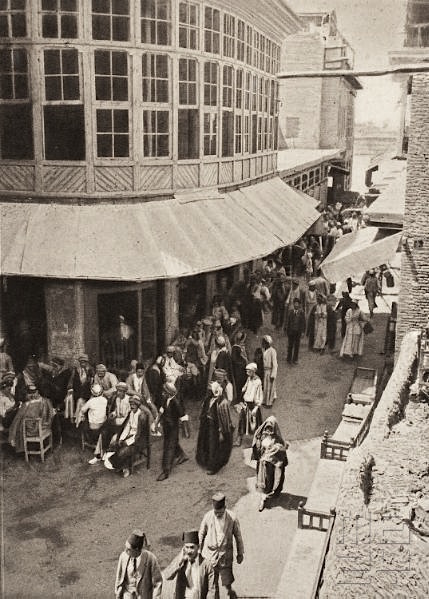
- The famous 1920s “Mutanabbi Street” photograph. The much-reproduced c.1923 coffee-house image filed on Wikimedia Commons as “Shahbandar Cafe” carries an explicit note from the uploader that it shows a different cafe and predates the Shabandar’s establishment on this street. We have captioned it accordingly rather than repeating the error.
- When al-Qishla will reopen. No date has been announced.
Frequently asked questions
Is Mutanabbi Street worth visiting in 2026?
Yes, with adjusted expectations. It is free, central, easy to walk and unlike anywhere else in the city, and the Shabandar alone justifies the morning. But it is a book market under real commercial pressure, and the romantic version you will read elsewhere no longer matches what is on the pavement.
What day is the book market on Mutanabbi Street?
The shops trade most days, but Friday is the market day in the sense that matters — the start of the Iraqi weekend, the fullest crowds, and the day the cultural sessions run. Go in the morning.
Who was al-Mutanabbi?
Abu al-Tayyib al-Mutanabbi, born in Kufa around 915 CE and killed in 965, one of the greatest poets in the Arabic language. The street was named after him in 1932 under King Faisal I. His statue, cast by Mohammed Ghani Hikmat in 1977, stands at the Tigris end.
What happened on Mutanabbi Street in 2007?
A bomb detonated on the street on 5 March 2007, killing around thirty people and wounding about sixty. It destroyed much of the street’s commerce and killed four sons and a grandson of the Shabandar Cafe’s owner. Prime Minister Nouri al-Maliki reopened the street on 18 December 2008.
Who paid for the restoration of Mutanabbi Street?
Private money, not the government and not UNESCO. Donations from the Central Bank of Iraq and the Iraqi Private Banks League funded roughly $3 million of work, carried out by the contractor Diamond Loft from August 2021 over about three months. Reports date the reopening to December 2021 or early January 2022.
Is the Shabandar Cafe still open?
Yes. It has operated as a coffee house since 1917 in a building dating from 1904, and Haj Mohammed al-Khashali has held the lease since 1963. Its own Instagram gives hours of 7am to 11pm daily, which we could not confirm elsewhere.
What is “Al-Mutanabbi Street Starts Here”?
An international arts project founded in 2007 by the San Francisco poet and bookseller Beau Beausoleil in response to the bombing. It produced letterpress broadsides, an archive of around 278 artists’ books now at Columbia University, and a 2012 PM Press anthology edited by Beausoleil and Deema Shehabi.
Can I visit al-Qishla from Mutanabbi Street?
Not at the moment. The Ottoman complex at the end of the street has been closed to the public for more than eighteen months, and in June 2026 the Iraqi Publishers and Booksellers Association protested outside it demanding its reopening. No reopening date has been announced.
Do foreigners need a permit or a guide for Mutanabbi Street?
No. There is no permit and no guide requirement; visitors walk the street independently. You do need a valid Iraqi visa to be in the country at all — for most nationalities that now means an e-visa applied for in advance, since visa on arrival in federal Iraq was suspended in March 2025. See our guide to Iraq entry requirements.
Are there English-language books on Mutanabbi Street?
Yes. The stalls carry Arabic and English stock side by side, though Arabic dominates by a wide margin. Rare and specialist material — including religious texts of Iraq’s minority communities — tends to sit in the alley shops rather than on the pavement tables.
Final thoughts
The thing that makes Mutanabbi Street worth an hour of your morning is not that it is ancient, and not that it is thriving, because one of those is unproven and the other is untrue. It is that a functioning intellectual public square survives in the middle of a city that has had every reason to lose one, and that the people keeping it going will tell you honestly how hard that is if you stop and buy something and ask.
Go on a Friday. Get there before the heat. Buy a book you cannot read, because the point is the transaction, not the object. Sit in the Shabandar for half an hour and look at the photographs on the walls, including the five that are there for a reason. Then walk down to the river and stand under the statue, and note that the Qishla gates behind it are shut, and that a five-star hotel opened two streets away in February, and that both of those facts are the same story about what Baghdad is deciding to be.
If you are planning the rest of the trip, start with our round-up of the best places to visit in Iraq and the wider Iraq travel guide, and if you want somewhere to stay within reach of Rusafa, we have looked at where to stay in Iraq in detail.
Elsewhere on the site: things to do in Iraq, Iraq’s museums and what is currently open, and the lesser-known corners of the country if you would rather build the trip around places most visitors skip.
And if you are weighing up whether to come at all, our pages on whether Iraq is safe, whether Iraq is open to tourists and travelling solo in Iraq are the honest starting points, along with an overview of Iraq’s cities and the practicalities of getting an Iraqi SIM card. Related reading: The Iraq Museum: How to Visit & What You’ll See and Old Baghdad Walking Tour: Rasheed Street to the Tigris.
Photo credits
Mutanabbi Street gate, 2023 — Ayham4002, CC BY-SA 4.0, via Wikimedia Commons. Baghdad street-corner coffee house, c.1923 — Abdul Karim, public domain, via Wikimedia Commons. Books on the pavement, 2015 — Mondalawy, CC BY-SA 4.0, via Wikimedia Commons. Shabandar Cafe, 2020 — Karrarheydar, CC BY-SA 4.0, via Wikimedia Commons. Mutanabbi Street, December 2021 — Kushared (Mohammed Sardar), CC BY-SA 4.0, via Wikimedia Commons. Al-Mutanabbi statue, 2024 — Ayat Jaryan, CC BY-SA 4.0, via Wikimedia Commons.