Last updated: September 2026. Openings and closures re-checked on 26 September 2026 against our research files (August 2026), Shafaq News, 964media and INA; FCDO and US advisories checked 25 and 26 September 2026. Baghdad’s museums and streets have changed fast since 2021: check each stop the week you travel.
Most Baghdad itinerary plans still open with the Iraq Museum and the Ottoman Qishla by the river. In 2026 both were shut: the museum since July 2025, after three missed reopening dates, and the Qishla for more than 18 months. What changed instead is the street life of the old city. Mutanabbi Street reopened in December 2021, the Souk al-Saray in June 2024, and the first 650 metres of a rebuilt Rasheed Street in September 2025, where a retro battery tram first ran in March 2026. A long weekend in Baghdad now makes more sense on foot in Rusafa than in its museums. Our Iraq itinerary planner covers longer trips.
In short, a realistic Baghdad itinerary for three days spends day one in the old city on the east bank, day two at the shrines of Kadhimiya and Adhamiya and the city’s modern monuments, and day three on a half-day trip to the ziggurat of Aqar Quf or the arch of Ctesiphon, ending on the Tigris. Mornings are for sights; evenings are when the city comes out.
Below: the plan at a glance, each day in turn, a two-day version, getting around, when to go, what we could not confirm and the safety frame as it stood in late September 2026. For the full list of sights, see our guide to things to do in Baghdad.
The short answer
| Question | Answer |
|---|---|
| How many days? | Three is right for a first visit; two covers the essentials. |
| Day 1 | Mutanabbi Street, Souk al-Saray, Rasheed Street, the Abbasid Palace and the Mustansiriya |
| Day 2 | Kadhimiya and Adhamiya; the Monument to Freedom, the Al-Shaheed Monument; Karrada at night |
| Day 3 | Aqar Quf or Ctesiphon in the morning; the Tigris at sunset |
| Closed or uncertain | Iraq Museum, Al-Qishla, the Baghdadi Museum (under rehabilitation), Baghdad Tower |
| Getting around | Ride-hailing (Baly, Careem) and taxis; a driver for the day trips |
| Advisories (26 September 2026) | FCDO: against all but essential travel to Baghdad, against all travel to Sadr City. US: Level 4, Do Not Travel. |
The Baghdad itinerary at a glance
| Day | Morning | Afternoon | Evening |
|---|---|---|---|
| 1 | Mutanabbi Street and the Shabandar café | Souk al-Saray, Rasheed Street, the Mustansiriya and the Abbasid Palace | The river at dusk |
| 2 | The Kadhimiya shrine; across the bridge to Adhamiya | Tahrir Square, the Monument to Freedom, the Al-Shaheed Monument | Karrada or Al-Zawraa Park |
| 3 | Aqar Quf or Ctesiphon | Rest through the heat | Masgouf by the Tigris |
Day 1: the old city on the Rusafa bank
Start where Baghdad’s cultural life has always gathered: Mutanabbi Street, the booksellers’ street, just under a kilometre long and car-free, running from an arch carrying the poet’s verses to his statue above the Tigris. It is best on a Friday morning, when books spill across the pavement. The street reopened in December 2021 after works funded by donations rather than the state budget, from the Central Bank of Iraq and the Iraqi Private Banks League. Take tea at the Shabandar café, whose building, dated 1904 or 1907 depending on the source, began life as the Shabandar family’s printing press.
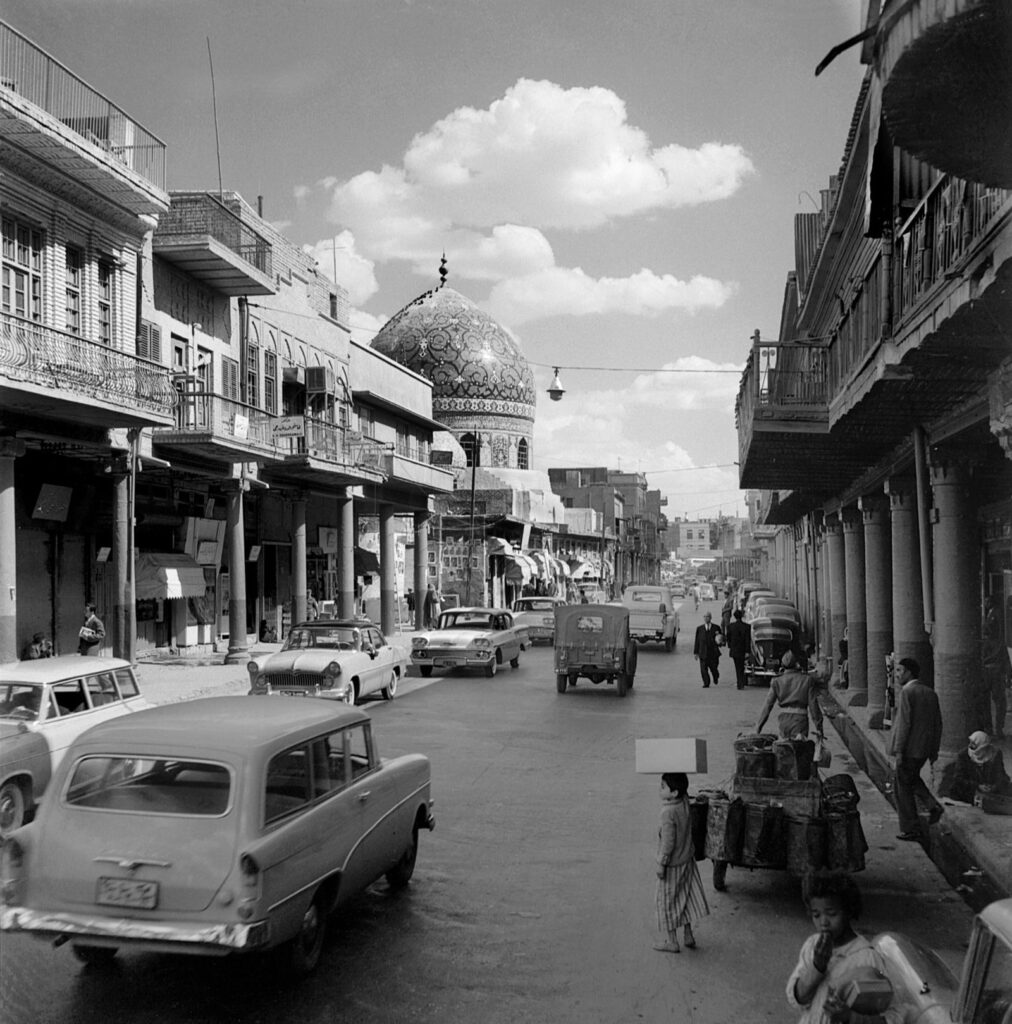
From there, walk into the Souk al-Saray, whose restored axis opened in mid-June 2024, and on to Rasheed Street, Baghdad’s first modern boulevard. Its first rebuilt section, about 650 metres from al-Midan to al-Rusafi with some 70 restored buildings, was inaugurated by the Prime Minister on 11 September 2025; a retro battery tram first ran on it in March 2026, and a second section of about 3.5 km towards Abu Nuwas was still under way in May 2026. The small Abd al-Karim Qasim Museum, opened on Rasheed Street in January 2021, is one of the few museums in this quarter that has been open.
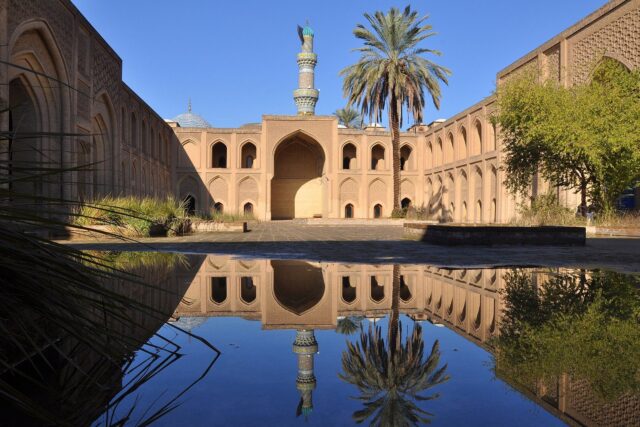
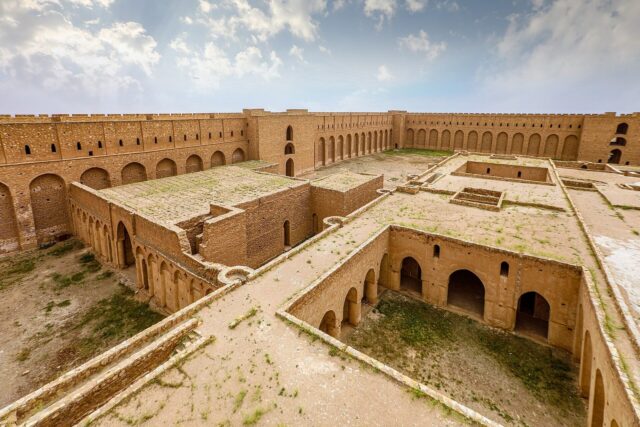
The afternoon belongs to the two great Abbasid buildings on the river. The Mustansiriya Madrasa, built for the caliph al-Mustansir in the 1230s, and the so-called Abbasid Palace are both part of a stretch of the Tigris bank that Iraq put on UNESCO’s Tentative List in 2014. The Abbasid Palace appears on current itineraries and is believed open; neither building publishes hours or fees, so check the Mustansiriya before you go. Close by, the Souk al-Safafeer, the coppersmiths’ market, is a shadow of what it was: the last published count, in 2018, found about ten workshops left from 68 before 2003. What you won’t get into: the Qishla, closed since at least late 2024, and the Baghdadi Museum, whose rehabilitation began in June 2026. Our guides to old Baghdad and Baghdad’s bazaars go deeper.
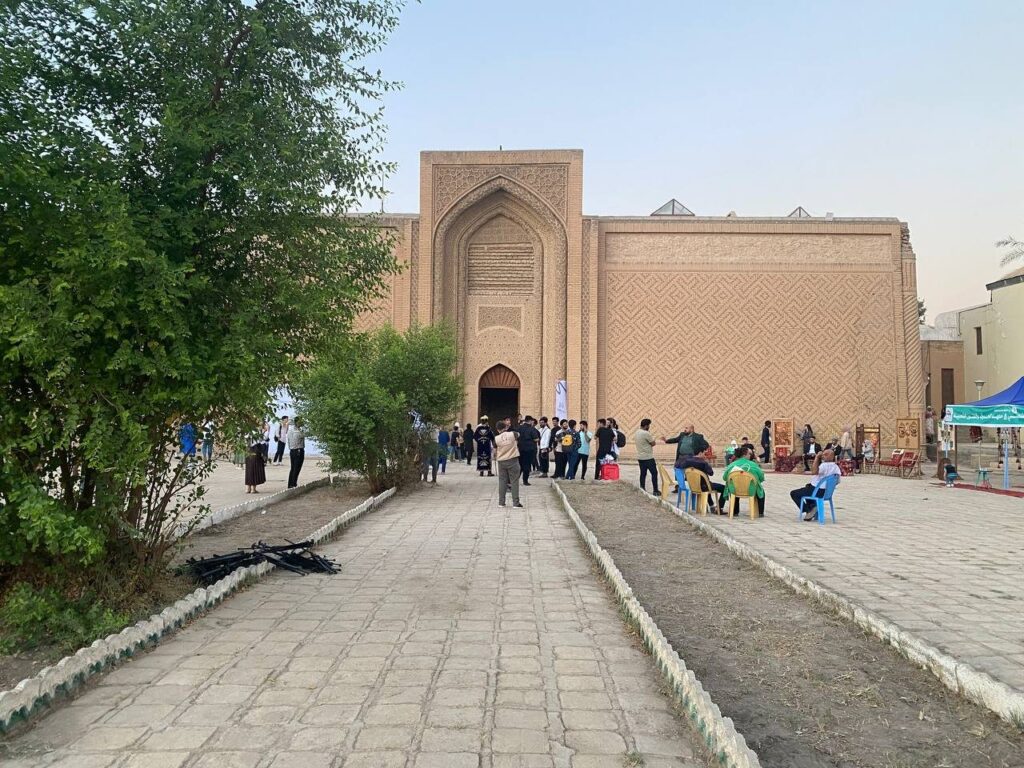
Day 2: Kadhimiya, Adhamiya and modern Baghdad
Go early to Kadhimiya, the shrine of the seventh and ninth Shia Imams, Musa al-Kadhim and his grandson Muhammad al-Jawad, with its twin gold domes and four minarets. Women need to cover fully, and headscarves are sold near the shrine; expect searches at the entrance. Then cross the Al-Aimmah Bridge, the Bridge of the Imams, to Adhamiya on the east bank and its Abu Hanifa Mosque, the great Sunni shrine. The two districts face each other across the river, Shia and Sunni, and the bridge carries a hard memory: in 2005 a stampede on it killed hundreds of pilgrims, and a young man from Adhamiya, Othman Ali Abdul-Hafez, drowned pulling people from the water while his neighbours used their own mattresses as stretchers.
The two banks are more tied together than the sectarian shorthand suggests. Al-Mada reported in January 2026 that the shaykhs of the Tayy tribe were split between them, which is why part of Adhamiya is still called al-Shuyukh after their kin in Kadhimiya, and young men from Kadhimiya have long crossed the bridge to celebrate the Prophet’s birthday in Adhamiya. Walking from one shrine to the other takes you across the river and through that history in a single morning.
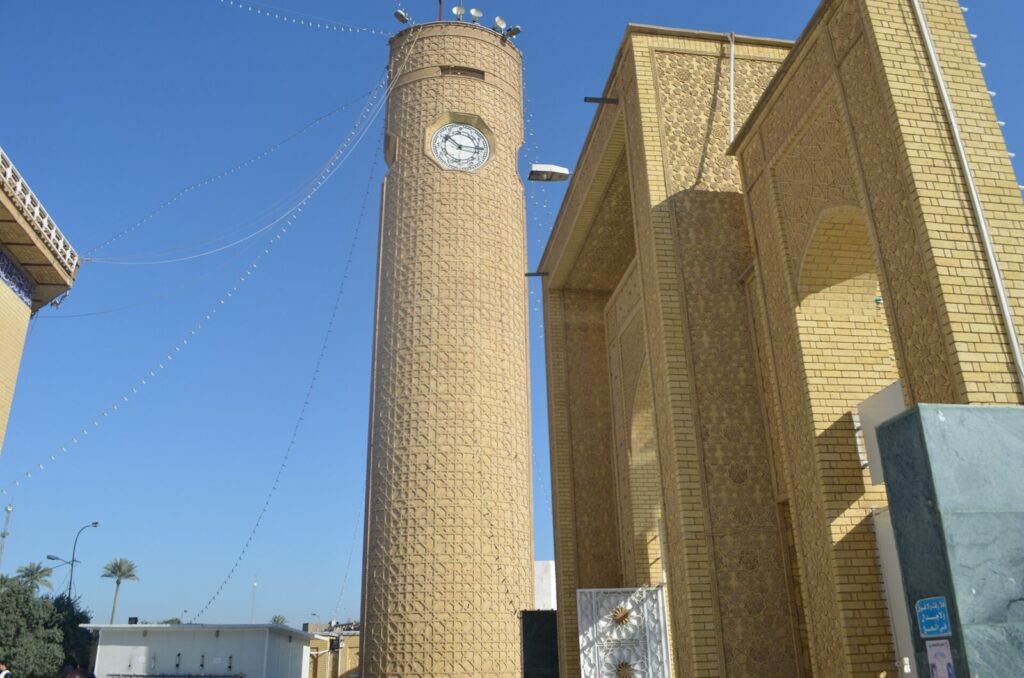
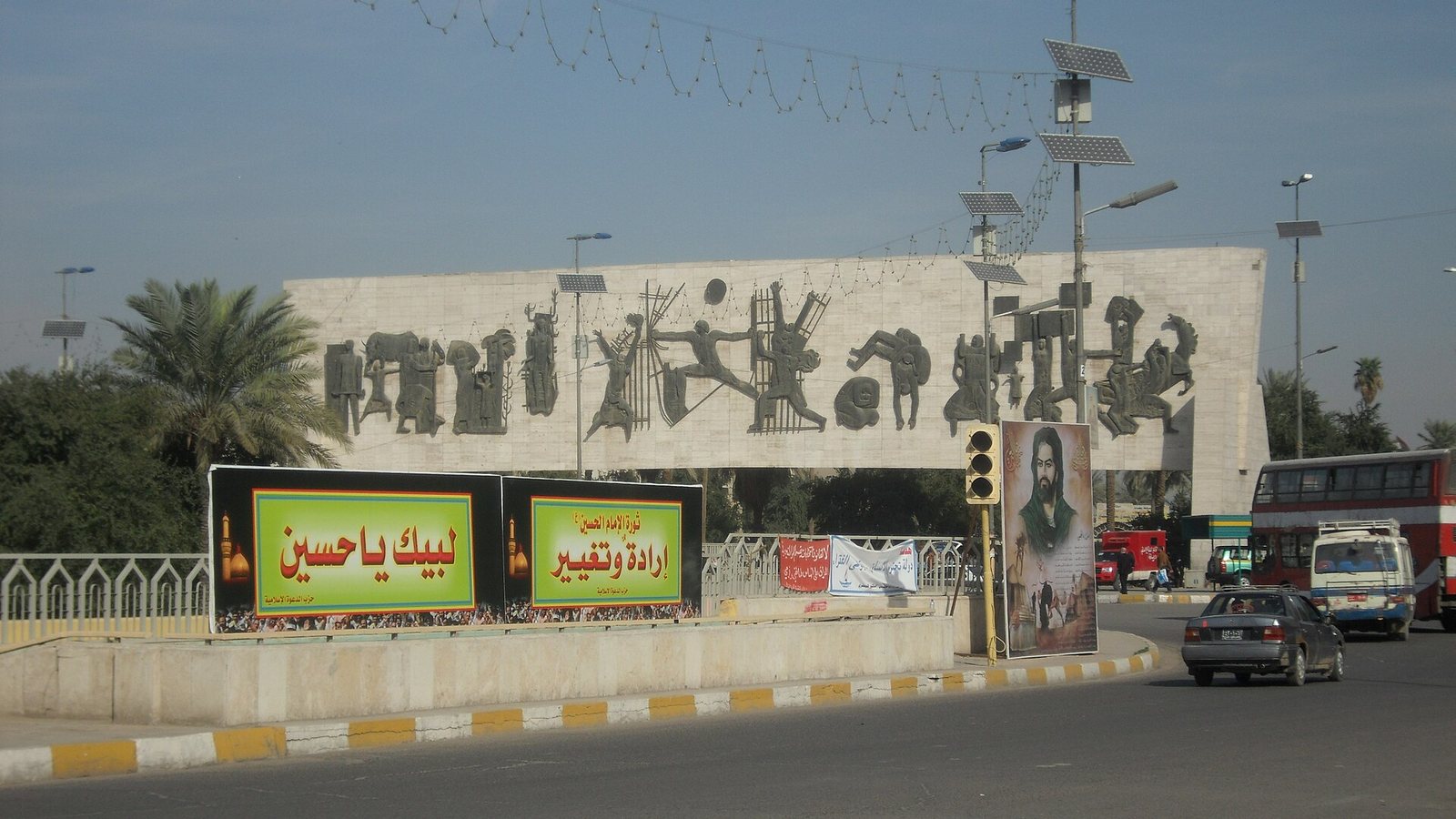
In the afternoon, move to Baghdad’s twentieth-century monuments. The Monument to Freedom on Tahrir Square, commissioned in 1959 to mark the 1958 revolution, was sculpted by Jawad Saleem on a travertine wall designed by the architect Rifat Chadirji, and is read from right to left like a line of Arabic verse; it has appeared on the 10,000-dinar note. Tahrir Square was the centre of the protests that began on 1 October 2019, and the square around the monument was restored by late 2022. Nearby are Firdos Square and Mohammed Ghani Hikmat’s Kahramana fountain, the heroine of Ali Baba and the forty thieves pouring oil into forty jars.
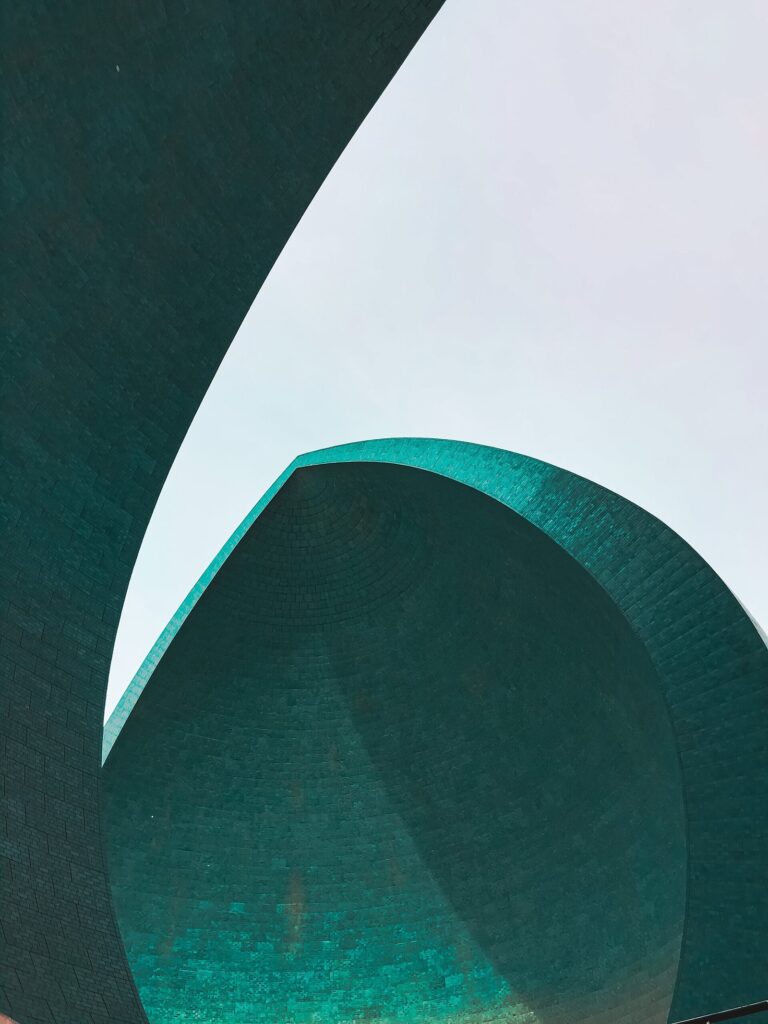
The Al-Shaheed Monument, the split turquoise dome built in 1983 for the dead of the Iran-Iraq war, is best seen from outside in late-afternoon light; the museum beneath it has no demonstrable visit since 2019. Baghdad Tower, the 204-metre telecoms tower, has no confirmed 2026 opening, price or hours.
Spend the evening in Karrada, the shopping district, where the habit is to shop first and then eat from the kebab and tikka stands, or at Al-Zawraa Park, which has hosted all-night New Year and Baghdad Day celebrations. Our guide to Baghdad at night covers the cafés and where they are.
Day 3: a ziggurat or an arch, then the river
Leave the city for a half day. Aqar Quf, about 30 km west, was the Kassite capital Dur-Kurigalzu in the 14th century BC; its eroded ziggurat core, with reed-matting still visible between the brick courses, rises higher than anything comparable in Iraq, and it joined Iraq’s UNESCO Tentative List in 2025. Ctesiphon, south-east at Salman Pak, holds the Taq Kasra, the vast brick arch of the Sasanian palace, whose north wing collapsed in the Tigris flood of 1888. Both are covered in our day trips from Baghdad and our Ctesiphon guide.
If you would rather give the day to Babylon, plan on eight to nine hours door to door, with a driver, leaving at 07:00; foreigners paid 25,000 dinars to enter in March 2026. Either way, come back for the evening on the Tigris. The masgouf restaurants along Abu Nuwas, where carp is split and slow-grilled beside a wood fire, are the classic Baghdad dinner, though no named restaurant, price or opening hour could be confirmed for 2026; our guide to eating in Baghdad explains how to order it.
What to eat along the way
Baghdad’s food fits the itinerary’s rhythm. Start day one with kahi, flaky layered pastry baked in sheets and eaten with geymar, thick clotted buffalo cream, and dibis, date syrup, or honey: an early breakfast, often eaten standing, with sweet tea. At the Shabandar, the menu is deliberately three drinks: Arabic coffee, black tea in hourglass istikan glasses, and noomi basra, a sour tea made by simmering dried black limes. Hookah is allowed; backgammon is not, because the owner wants conversation. The café’s own Instagram gives its hours as 07:00 to 23:00. Its long-time owner, Mohammed al-Khashali, died in January 2025 at 93, and his son now runs it.
For lunch, look for dolma, which in Iraq is a mixed pot of vine leaves, onions, aubergines, courgettes, peppers and tomatoes stuffed and cooked upside down, then turned out onto the platter; and kubba, meat in a bulgur or rice shell, of which the Baghdad version is commonly described as cooked in a tomato soup with chickpeas and dried limes. Sabich, pitta with fried aubergine and salad, is said to trace back to an Iraqi Jewish vendor in downtown Baghdad. Dinner is masgouf by the river. Vegetarians eat well from the mezze and beans, but ask about dolma, which is usually stuffed with meat. 964media’s April 2026 round-up of places trading in the capital included Kebab al-Badawi and Falafel Lebanon. Our guide to Iraqi food covers the national dishes.
Baghdad in 2 days
With two days, merge the plan: day one as above, finishing at the Abbasid Palace, and a second day that starts at Kadhimiya and Adhamiya, takes in Tahrir Square and the Al-Shaheed Monument in the afternoon, and ends with masgouf by the river. Drop the day trip, or swap Adhamiya for Aqar Quf if ancient Mesopotamia matters more to you than the shrines. Our one-week Iraq itinerary shows how two Baghdad days fit into a longer route.
Why sources disagree about Baghdad’s sights
| Source | What it says | What it actually measures |
|---|---|---|
| Shafaq News, 27 March 2025 | Abu Nuwas rehabilitation stalled after phase 2 for lack of funding; the park deteriorating | The state of the corniche in early 2025 |
| Municipal statements (undated in our sources) | Abu Nuwas phase 3 continuing, alongside new riverfronts at Adhamiya and Kadhimiya | Plans and works in progress, not a finished park |
| Official targets for the Iraq Museum | Early 2026, then June or July 2026 | Promises; on 28 July 2026 the museum was still in “preparations” |
| Baghdad Tower figures | 204 m, 205 m or 620 ft | 204 m to the antenna spire per Wikipedia; 205 m and 620 ft (189 m) also circulate and don’t agree with each other |
| Travel listings for the Al-Shaheed Monument | “Includes a museum under the monument” | A 2019 visit; no later visit inside is documented |
What is Friday like in Baghdad?
Friday is the Iraqi weekend, and it reshapes the plan. It is the best morning for Mutanabbi Street, when the booksellers spread out and families come to browse, and a good afternoon for Al-Zawraa Park. It used to be the day for Souk al-Ghazl, the old animal and bird market near the Abbasid-era Ghazl minaret, where Friday trading is documented; but in February 2026 964media reported the market moving to night-time as traders dodged municipal crackdowns that followed the demolition of the Mureidi market. If you want to see it, ask locally where and when it is running. Friday midday prayers slow the city for an hour or so, so plan the morning and the late afternoon rather than the middle of the day.
Is a guide worth it in Baghdad?
For the old city, you can manage alone: Mutanabbi Street, the Souk al-Saray and Rasheed Street are compact and walkable, and ride-hailing gets you between districts. A local guide earns their fee in three places. At Kadhimiya, they explain the etiquette and steer you through the searches. At the checkpoints, they do the talking. And outside the city, a driver who knows the roads turns Aqar Quf, Ctesiphon or Babylon into an easy half day; one Babylon operator’s day trip from Baghdad started at $120 a person in March 2026, including the vehicle, guide, entrance fees and Borsippa. Whoever you go with, don’t photograph checkpoints, soldiers or government buildings, and ask before photographing people. Our page on Iraq tours explains what operators offer.
How do you get around Baghdad?
By ride-hailing and taxi. Baly, a Baghdad start-up founded in 2021, holds about 80 per cent of the city’s ride-hailing market, and Careem also operates around the clock. There is no metro, and walking works within the old city but not between districts. Carry your passport and visa: the FCDO says carrying photographic ID is a legal requirement, and checkpoints within the city may stop you. For the day trips, a local driver is the practical choice; self-driving needs the 1968 International Driving Permit plus your licence, and the FCDO calls road travel in Iraq dangerous. Our guides to getting around Iraq and Iraqi checkpoints have the detail.
| Trip | How | What we know |
|---|---|---|
| Within Rusafa’s old city | On foot | Mutanabbi Street is just under 1 km and car-free |
| Rusafa to Kadhimiya | Ride-hailing or taxi | Roads close to cars around the shrine at pilgrimage times |
| Aqar Quf | Driver or taxi | About 30 km west |
| Ctesiphon | Driver or taxi | About 30 to 40 km south-east, depending on the source |
| Babylon | Driver | About 85 km south; about 1h30 each way (operator, March 2026) |
A summer version
Between June and September, Baghdad’s afternoons average 43 to 44 °C and 50 °C days come most years, so the plan flips. Do the sights between first light and late morning, sleep through the afternoon, and go out after dark, when cafés and ice-cream shops trade well past midnight and the riverbank fills. Leave for Babylon at 07:00 at the latest. In 2026 power cuts also shaped the day: in May, parts of Baghdad were on two hours of mains electricity and two hours off, so choose a hotel that runs its own generator through the night. Our page on Iraq in summer covers the heat in detail.
When to go
October to April is the comfortable window: Baghdad’s afternoons average about 33 °C in October and 16 °C in January, against 43 to 44 °C in July, when the city lives at night. Friday is the Iraqi weekend and the best day for Mutanabbi Street. Check the religious calendar: the Rajab walk to Kadhimiya, expected around 4 January 2027, closes the roads into the district and drew about 14 million people in 2025, and Ramadan, expected from about 8 February 2027, changes daytime rhythms. Our guide to the best time to visit Iraq has the month-by-month detail.
The safety frame for Baghdad
The UK Foreign, Commonwealth & Development Office’s Iraq travel advice, last updated 22 July 2026 and unchanged when we checked on 25 September, advises against all but essential travel to Baghdad and against all travel to Sadr City, in the north-east of the capital. It warns of a high threat of kidnapping throughout Iraq, with British nationals seen as legitimate targets, including tourists. The US State Department’s advisory is Level 4, Do Not Travel, reissued on 29 August 2026.
2026 has been tense. On 16 March, Al Jazeera reported at least four people killed in an air raid on a building in Jadriyah used by an Iran-backed group, drones striking inside the US Embassy compound, and a drone hitting the roof of the Al Rasheed Hotel in the Green Zone; in August, 964media’s own headlines ran from militia threats to drone seizures in the city. It is the backdrop to any trip. The FCDO warns that your travel insurance could be invalidated if you travel against its advice; our guide to safety in Baghdad and Iraq travel insurance page set out the details. We give you the inputs; the decision stays with you.
What we could not confirm
- The Iraq Museum’s reopening date. Still in “preparations” on 28 July 2026, with no announced date since.
- Whether the Qishla has reopened. Closed for more than 18 months as of June 2026.
- Hours and fees at the Mustansiriya and the Abbasid Palace. Neither publishes them.
- Baghdad Tower’s status. No 2021 to 2026 source for opening, price or hours.
- Named masgouf restaurants on Abu Nuwas. The strip exists; no named restaurant, price or hours could be confirmed.
- Al-Zawraa Park’s entry price. The only figure in circulation comes from an aggregator we don’t trust.
- The Rasheed Street second section. Still under way in May 2026; no completion date found.
- Souk al-Ghazl’s trading times. After its reported move to night-time in February 2026, no schedule has been published.
- Street-food and tea prices. No dated figure exists for a glass of tea, a samoon loaf or a plate of kahi with geymar, so we don’t print one.
Frequently asked questions
How many days do you need in Baghdad?
Three days suits a first visit: one for the old city on the Rusafa bank, one for Kadhimiya, Adhamiya and the modern monuments, and one for a half-day trip to Aqar Quf or Ctesiphon. Two days covers the essentials; add a fourth if you want a full day at Babylon.
What is the best Baghdad itinerary for a first visit?
Start with Mutanabbi Street, the Shabandar café, Souk al-Saray and Rasheed Street, then the Mustansiriya and the Abbasid Palace. On day two, see the Kadhimiya shrine and Adhamiya’s Abu Hanifa Mosque, then Tahrir Square and the Al-Shaheed Monument. Finish with a ziggurat or Ctesiphon, and masgouf by the Tigris.
Is the Iraq Museum open?
Not as of our latest check. It closed in July 2025 for rehabilitation, missed targets of early 2026 and June or July 2026, and was still in “preparations” on 28 July 2026 with no announced reopening date. Check local news before you plan around it.
Is it safe to walk around Baghdad?
The old city around Mutanabbi Street and Rasheed Street is walkable by day and busy with Iraqis. The FCDO still advises against all but essential travel to Baghdad and against all travel to Sadr City, and warns of a high kidnap threat. Keep ID on you and move between districts by car.
What is Baghdad like at night?
Lively, especially in summer, when the heat pushes life into the evening. Karrada’s shopping streets, Al-Zawraa Park and the cafés are busiest after dark, and masgouf by the Tigris is an evening meal. The city is at its most sociable in Ramadan, after the fast is broken.
What should I wear in Baghdad?
Modest, loose clothing: long trousers for men and women, and covered shoulders. At Kadhimiya women must cover fully, hair included, and headscarves are sold near the shrine. The rest of the city is more relaxed, but shorts draw attention. The FCDO notes that clothing ignoring local norms causes more offence during Ramadan.
Do I need cash in Baghdad?
Yes. Iraq runs largely on cash, and shops, restaurants and hotels rarely take foreign cards. Bring clean US dollars and change them as you go: in mid-August 2026 the street rate was about 1,530 dinars to the dollar against an official 1,320. Declare Iraqi currency over 200,000 dinars on arrival or departure.
Can you visit Babylon from Baghdad in a day?
Yes, with a driver. Babylon is about 85 km south, roughly an hour and a half each way, and a full day with Borsippa runs eight to nine hours door to door. Leave by 07:00, especially from April to October, when the open site is punishing by midday.
Final thoughts
Baghdad rewards visitors who come for the city rather than a checklist. The museums that should anchor a trip have been shut, but the streets that were derelict a few years ago are open again, and the Tigris, the shrines and the evening life were never closed. Three days lets you see the old city at a walking pace, cross between the two faiths that share the river, and still leave room for a ziggurat.
If Baghdad is the start of a longer trip, our two-week route through Iraq begins here, and our Iraq routes planner covers every length. For the city in more depth, start with our guide to the Iraq Museum, ready for the day it reopens.
Photo credits
Monument to Freedom, Baghdad (featured image): ainudil, Wikimedia Commons (CC BY-SA 2.0). Rasheed Street, 1961: لطيف العاني (Latif al-Ani), Wikimedia Commons (public domain). Abbasid Palace, Baghdad: Mohammed Qays Kazem, Wikimedia Commons (CC BY-SA 4.0). Abu Hanifa Mosque, Adhamiya: Moshtakmoshtak, Wikimedia Commons (CC BY-SA 3.0). Al-Shaheed Monument: Manar Al-Obaidi, Wikimedia Commons (CC0). All images via Wikimedia Commons under the licences shown.